Chindia Alert: You’ll be Living in their World Very Soon
aims to alert you to the threats and opportunities that China and India present. China and India require serious attention; case of ‘hidden dragon and crouching tiger’.
Without this attention, governments, businesses and, indeed, individuals may find themselves at a great disadvantage sooner rather than later.
The POSTs (front webpages) are mainly 'cuttings' from reliable sources, updated continuously.
The PAGEs (see Tabs, above) attempt to make the information more meaningful by putting some structure to the information we have researched and assembled since 2006.
Chinese groups calling for more ‘fighting spirit’ are getting the upper hand on those who favour calm and cooperation, government adviser says
From Hong Kong to Covid-19, trade to the South China Sea, Beijing and Washington are clashing on a growing number of fronts and in an increasingly aggressive way
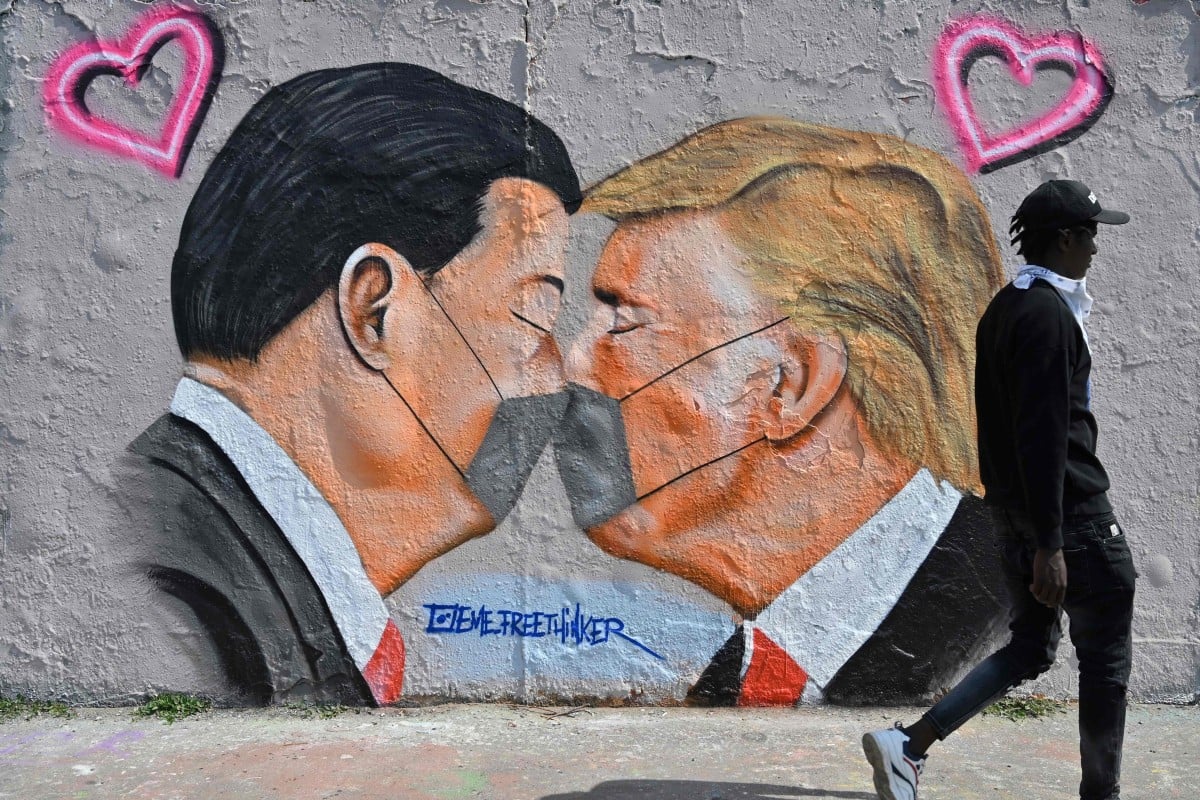
Efforts to promote dialogue and cooperation between the US and China are failing, observers say. Photo: AFP
Moderates who favour dialogue and cooperation as a way to resolve China’s disputes with the United States are losing ground to hardline groups bent on taking the fight to Washington, according to political insiders and observers.
“There are two camps in China,” said a former state official who now serves as a government adviser and asked not to be named.
“One is stressing the combat spirit, the other is trying to relieve tensions. And the former has the upper hand.”
Relations between China and the US are under intense pressure. After Beijing moved to introduce a national security law for Hong Kong, US President Donald Trump said on Friday that Washington would begin eliminating the special policy exemptions it grants the city, as it no longer considers it autonomous from mainland China.
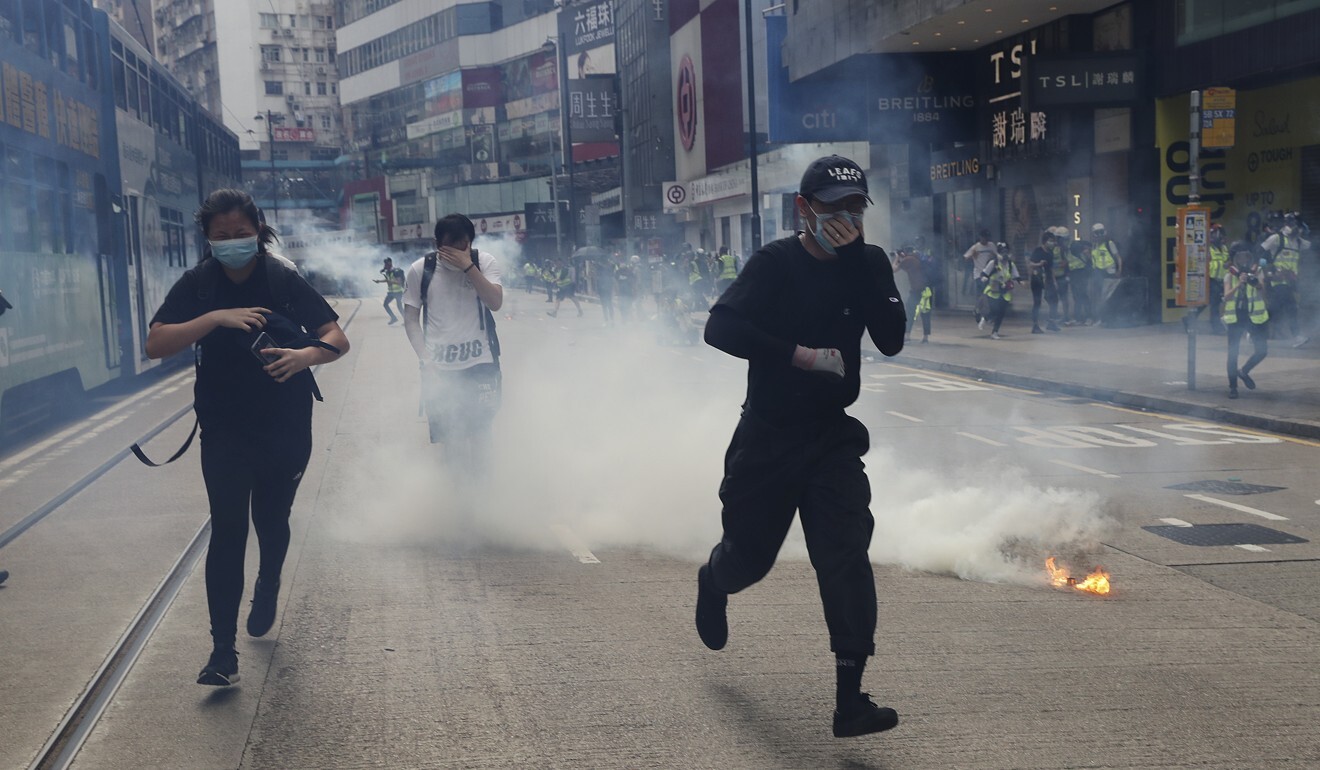
Beijing’s decision to enact a national security law for Hong Kong was met with anger from the US and other Western countries. Photo: Sam Tsang
The two nations have also clashed over trade, Xinjiang, Taiwan and the South China Sea, with the US passing several acts denouncing Beijing and sanctioning Chinese officials.
China has also experienced turbulence in its relations with other countries, including Australia and members of the European Union, mostly related to the Covid-19 pandemic
and Beijing’s efforts to position itself as a leader in the fight against the disease with its policy of “mask diplomacy”.
After Canberra appealed for an independent investigation to be carried out to determine the origins of the coronavirus, Beijing responded by imposing tariffs on imports of Australian barley, showing it is prepared to do more than just trade insults and accusations with its adversaries.
Pang Zhongying, a professor of international relations at Ocean University of China in Qingdao, said there was a worrying trend in China’s relations with other nations.
“We need political and diplomatic means to resolve the challenges we are facing, but … diplomatic methods have become undiplomatic,” he said.
“There are some who believe that problems can be solved through tough gestures, but this will never work. Without diplomacy, problems become confrontations.”
said during his annual press conference on the sidelines of the National People’s Congress last weekend that China and the United States must work together to prevent a new Cold War.
His words were echoed by Chinese Premier Li Keqiang, who said during a press conference after the closure of the legislative session on Thursday that the many challenges facing the China-US relations could only be resolved through cooperation.
However, the government adviser said there was often quite a chasm between what China’s leaders said and what happened in reality.
“Even though we say we do not want a Cold War, what is happening at the working level seems to be different.” he said. “The implementation of policies is not properly coordinated and often chaotic.”
Tensions between China and the US have been in a poor state since the start of a trade war almost two years ago. After multiple rounds of negotiations, the sides in January signed a phase one deal, but the positivity that created was short-lived.
In February, Beijing expelled three reporters from The Wall Street Journal over an article it deemed racist, while Washington has ramped up its military activity in the South China Sea and Taiwan Strait, and threatened to revoke the visas of Chinese students studying science and technology in the US over concerns they might be engaged in espionage.
Beijing has also used its state media and army of “Wolf Warrior” diplomats to promote its narrative, though many Chinese scholars and foreign policy advisers have said the latter’s nationalistic fervour has done more harm than good and appealed to Beijing to adopt a more conciliatory tone.
However, Hu Xijin, editor-in-chief of Chinese tabloid Global Times, said China had no option but to stare down the US, which regarded the world’s most populous nation as its main rival.
“Being contained by the US is too high a price for China to pay,” he said. “I think the best thing people can do is forget the old days of China-US ties”.
Jin Canrong, a professor of international relations at Renmin University in Beijing, wrote in a recent newspaper article that Beijing’s actions – notably enacting a national security law for Hong Kong – showed it was uncompromising and ready to stand its ground against the US.
Wu Xinbo, dean of international studies at Fudan University in Shanghai, agreed, saying relations between the two countries were likely to worsen in the run-up to the US presidential election in November and that Beijing should be prepared for a fight.
But Adam Ni, director of China Policy Centre, a think tank in Canberra, said the issue was not that the moderate camp had been sidelined, but rather Beijing’s perception of the US had changed.
“Beijing has woken up to the idea that America’s tough policy on China will continue and it is expecting an escalation of the tensions,” he said.
“The centre of gravity in terms of Beijing’s perception of the US has shifted, in the same way the US perception of China has shifted towards a more negative image”.
Beijing was simply responding in kind to the hardline, assertive manner of the US, he said.
Nations may need help from China during virus outbreaks but remain wary of Beijing as adversary in disputed waters
Analysts say code of conduct negotiations are too sensitive and important for virtual meetings and may be delayed until coronavirus crisis is resolved
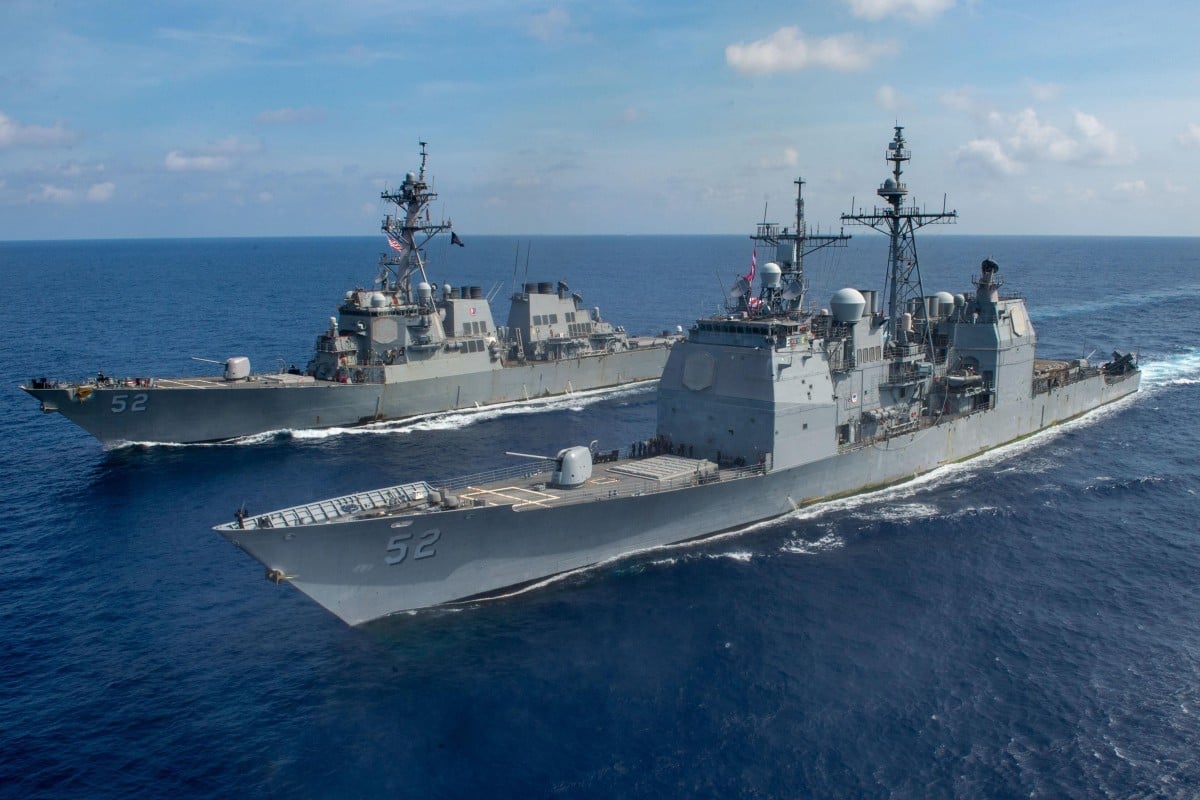
On April 18, the US Navy Ticonderoga-class guided missile cruiser USS Bunker Hill (front) and Arleigh-Burke class guided-missile destroyer USS Barry transit the South China Sea. The presence of both Chinese and American navy ships in the area in recent weeks worries Southeast Asian nations. Photo: US Navy
Negotiations between China and its Southeast Asian neighbours for a South China Sea
code of conduct have been postponed as the nations involved put their efforts into containing the Covid-19 pandemic, creating uncertainty about whether the two sides can work together amid rising tensions in the contested territory.
Southeast Asian nations are increasingly caught in a dilemma whether to maintain relations with Beijing during the pandemic while also fearing that tensions over the disputed waters are spiralling out of control. Both Chinese and United States navies are sending vessels to the area more frequently.
Indonesian Foreign Minister Retno Marsudi expressed concern over recent activities in the South China Sea, noting that they might potentially escalate tensions at a time when global collective effort to fight Covid-19 was essential.
Speaking on Wednesday, she called on all parties to respect international law, particularly the United Nations Convention on the Law of the Sea.
“While negotiation of the code of conduct is being postponed due to Covid-19, Indonesia calls on all relevant parties to exercise self-restraint and to refrain from undertaking action that may erode mutual trust and potentially escalate tension in the region,” she said.
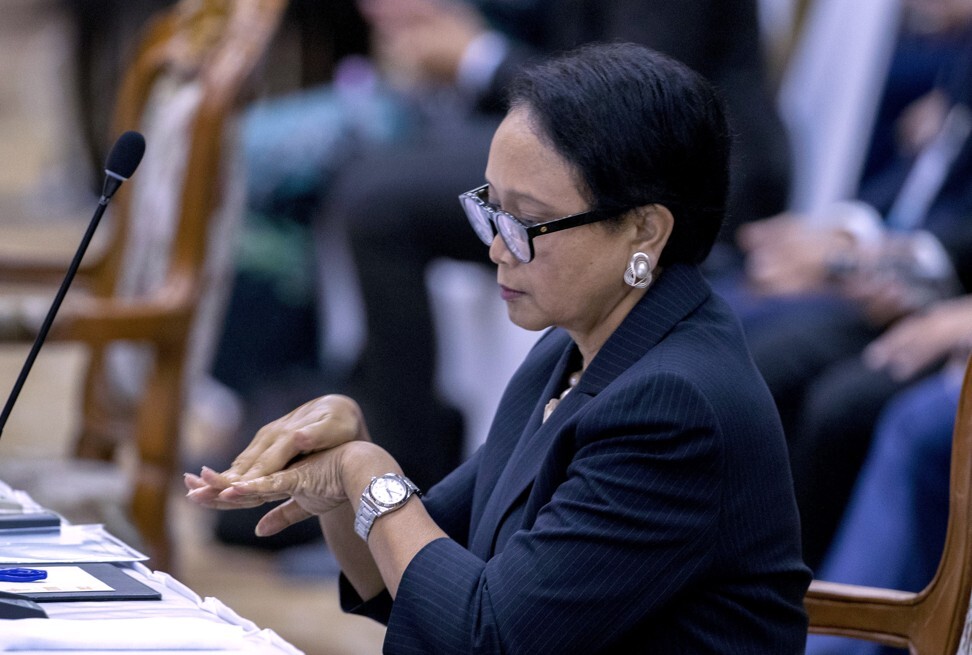
Indonesia’s Foreign Minister Retno Marsudi. Photo: AP
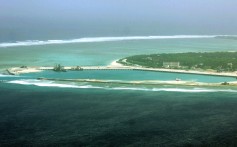
Calls for a binding code of conduct surfaced in 1995 when China occupied Mischief Reef
, a maritime feature claimed by the Philippines. China did not agree to start talks until 1999, and subsequent negotiations led to a non-binding Declaration on Conduct in 2002.
The Association of Southeast Asian Nations (Asean) and China agreed in 2018 on a draft code laying the foundations for conduct in the disputed waters. At that time, Chinese Premier Li Keqiang said China hoped to complete the negotiation by the end of 2021, a move he said could show China and Asean could jointly maintain regional peace.
Named and claimed: is Beijing spoiling for a new fight in the South China Sea?
27 Apr 2020
But tensions over the South China Sea have not calmed and, in fact, have surged in recent months with both Beijing and Washington seen to be using the Covid-19 pandemic to create a stronger presence there.
This year, the US has conducted four freedom of navigation operations in the South China Sea and China has scrambled air and sea patrols to expel US vessels.
The confrontation between Beijing and Southeast Asian nations has also intensified. Last month, a Vietnamese fishing boat sank after a collision with a Chinese coastguard vessel near the Paracel Islands, known in China as the Xisha Islands, and in Vietnam as the Hoang Sa Islands.
On Saturday, the 35th escort fleet of the Chinese navy also conducted drills in the Spratly Islands chain – known as Nansha Islands in China – after completing an operation in the Gulf of Aden, off Somalia. Analysts said the drill aimed to boost far-sea training for combat ships and boost protection against piracy for Chinese merchant ships.
Collin Koh, a research fellow at the S. Rajaratnam School of International Studies, based at Nanyang Technological University in Singapore, said the code of conduct talks had been delayed because of the pandemic, but Beijing was consolidating its position in the South China Sea amid the outbreak.
“So it’s doing what it can now to consolidate and further enhance its position before talks restart, and by then these moves will raise Beijing’s leverage in the negotiations with its Asean counterparts,” he said.
“The current situation gives it a window of opportunity amid this interlude on the talks, to further advance its physical hold in the South China Sea, especially while Asean parties have their hands full on the pandemic”.
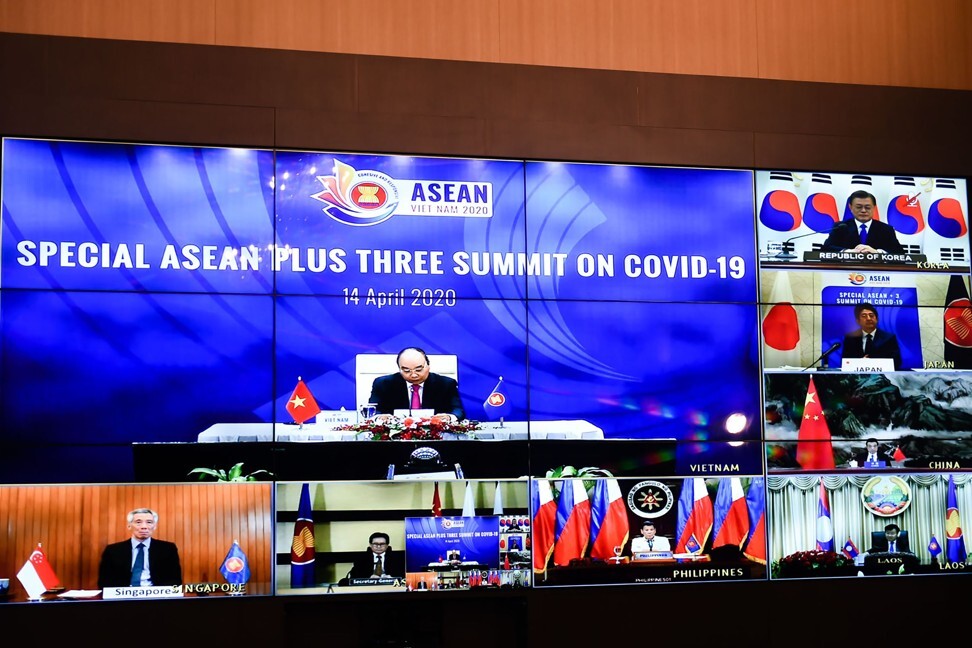
Asean nations have turned their attention to coping with coronavirus outbreaks in their own countries. On April 14, a live video conference for the special Asean Plus Three Summit on the coronavirus pandemic was held in Hanoi. Photo: AFP
Kang Lin, a researcher with Hainan University, said progress for the code of conduct would still go ahead, but it might be affected as face-to-face meetings between officials were disrupted.
“The negotiations involves multiple departments, such as diplomacy, maritime affairs, fisheries and even oil and gas-related departments,” he said, adding that those discussions might go online and might not be as effective.
“It is not easy to predict to what extent it will affect next year's goals. If the pandemic cannot be eliminated in the first half of next year, it may be longer than the three-year period we had previously scheduled,” he said.
Richard Heydarian, an academic and former Philippine government adviser, said video-conference meetings would be inadequate for negotiations about the future of the South China Sea.
“The problem with the negotiation of the code is that these are very sensitive, difficult negotiations. I don't think you can really do it just online, these are things that are done in the corridors of power,” he said. “It’s close to impossible to have that right now with the suspension of all international meetings in the Asean.”
Heydarian said Southeast Asian nations hoped to get help from China to contain the pandemic, but were showing unease about Beijing.
“I think there is a lot of resentment building against China,” he said. “There is also a lot of desperation to get assistance from China and, at the same time, complete helplessness with the fact that it is very hard to conduct any important extended international meeting on the level of Asean and beyond under current circumstances.”
Chinese Foreign Ministry spokesman Hua Chunying said on Thursday that China would push forward negotiations on the code of conduct, and hoped the code would be useful for peace and stability over the South China Sea.
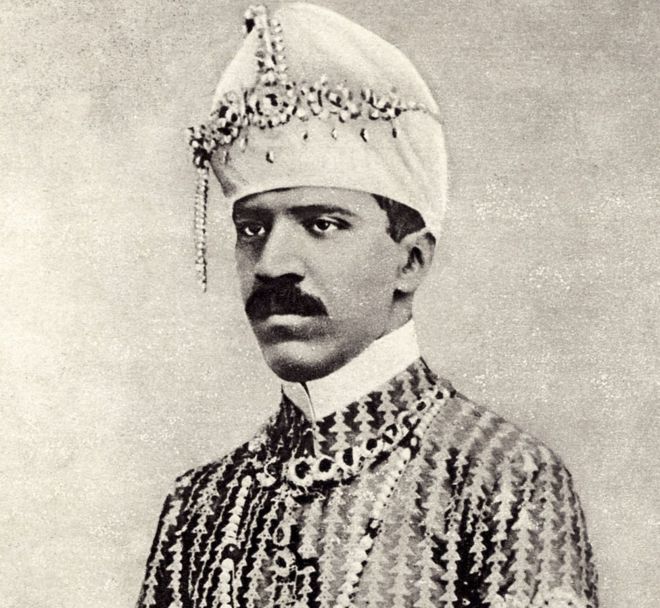
Image copyright GETTY IMAGESImage caption Mir Osman Ali Khan was once the world’s richest man
A London court has ruled that £35m ($42m) held in a UK bank account must go to the descendants of an Indian royal, and not to Pakistan.
The dispute began in 1948 when the last Nizam (king) of Hyderabad deposited £1m in the UK account, held by the then Pakistan high commissioner. With interest, the sum has grown to £35m.
The judge ruled there was no evidence to back Pakistan’s claims to the money.
The origins of the dispute go back to the 1947 partitioning of British India.
Hyderabad, which was a princely state, was annexed by India in 1948 in a military operation – the cash transfer had been made shortly before that.
The Nizam, Mir Osman Ali Khan, had not been able to decide whether his state should be in Pakistan or India.
His descendants alleged that he had asked for the money to be returned weeks after the annexation by India took place, but then Pakistan refused to give it back.
The court case had been fought by his family together with the Indian state.
National Westminster Bank, in which the money had been deposited, refused to release the funds to either party until the case was resolved by the courts.
The interest on the original deposit saw the money grow to £35m by 2019.
Pakistan argued it had been given the money in order to procure arms but the court determined it had the right to rule in the case, given that the money had been deposited in a British bank account.
“The court today made it clear that it did not think the money was handed to Pakistan outright. There is overwhelming evidence that Pakistan only held the money as a trustee and it actually belonged to the Nizam,” Paul Hewitt, the lawyer for one of the grandsons, told the BBC’s Gaggan Sabherwal.
Mr Hewitt said the case, which had begun when his client was a child, was finally being resolved when he was in his 80s.
“We welcome the judgment of Justice Marcus Smith,” Najaf Ali Khan, one of the Nizam’s grandsons, told BBC Telugu.
“The High Court has rightly rejected Pakistan’s claim. The family has long awaited this judgement.”
India’s foreign ministry also welcomed the verdict in a press statement.
Pakistan could seek to appeal, but otherwise the money will be given to the Nizam’s grandsons and the state of India.




 CHINDIA ALERT: You'll be living in their world, very soon