Archive for ‘reunified’

03/05/2020

China’s military budget will still rise despite coronavirus, experts predict

  • Defence spending could show the effect of economic headwinds but is still expected to increase
  • PLA’s modernisation and strategic priorities demand spending is maintained even after GDP’s first contraction since records began, observers say
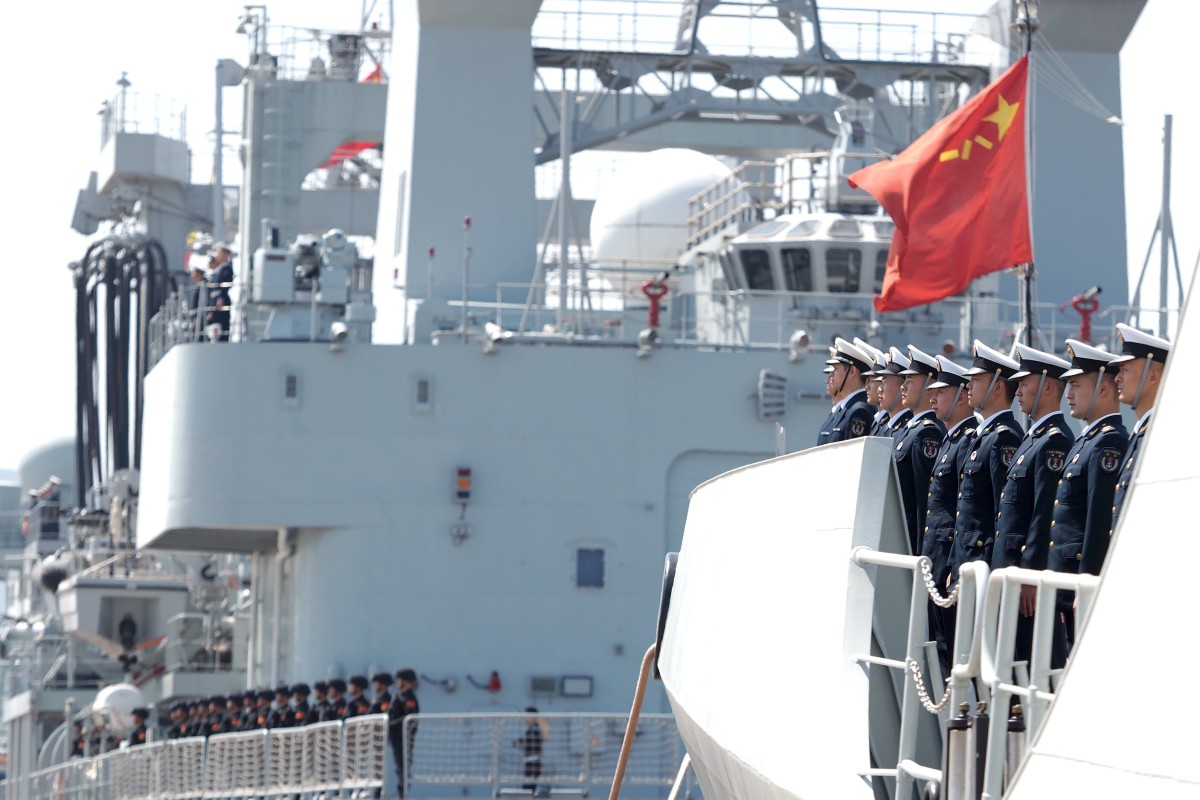
China has made modernising its military and expanding its weaponry a priority. Photo: Xinhua
China’s upcoming defence budget will be only slightly hit by the economic downturn that followed the coronavirus outbreak, and a modest increase is still expected as it continues to develop its military capability, analysts said.
The government’s military budget is expected to be revealed, as is the norm, at this year’s session of the National People’s Congress (NPC), China’s legislative body. Delayed by over two months because of the pandemic, it will finally be convened on May 22.
Last year the defence expenditure announced at the NPC session was 

China has said its military expenditure has always been kept below 2 per cent of its GDP over the past 30 years, although its official figures have long been described by Western observers as opaque, with significant omissions of important items.

The South China Sea dispute explained
In a report earlier this week, the Stockholm International Peace Research Institute estimated that China’s actual military spending in 2019 was US$261 billion, the world’s second highest, after the United States’ US$732 billion.

John Lee, adjunct professor at the University of Sydney and senior fellow at the Hudson Institute in Washington, estimated that this year the Chinese defence budget would remain roughly the same or increase modestly, in line with growth levels of recent years.

“In the current environment, Beijing is keen to emphasise that China has recovered substantially from Covid-19 and that its power trajectory is unaffected by recent events,” Lee said. “At the same time, it would be aware of the anger towards the Communist Party for allowing the virus to become a pandemic.

“Regardless of what the reality might be, I would be surprised if there were a dramatic increase or a significant cut.”

First made-in-China aircraft carrier, the Shandong, enters service
China’s GDP suffered a 6.8 per cent decline in the first quarter, the first contraction since quarterly records began in 1992, after an extensive shutdown while it contained its coronavirus outbreak. However, the official increases in the military budget have since 2011 always exceeded overall GDP growth.

The Chinese government may focus more on job creation, social welfare and poverty alleviation, but not at the expense of military investment, according to Collin Koh, research fellow from the S Rajaratnam School of International Studies at Singapore’s Nanyang Technological University in Singapore.

“I tend to think it will be more or less the same,” Koh said. “To reduce [the budget] may send the wrong signal to would-be adversaries, both domestic and external: that Beijing has lost the will to keep up its military modernisation to assert core national interests.”

PLA flexes military muscle near Taiwan ‘in show of Covid-19 control’

15 Apr 2020

The People’s Liberation Army (PLA) began a massive – and costly – reform in 2015, with a personnel reshuffle, change in structure, upgraded equipment and enhanced training to better resemble battle scenarios. That was supposed to be complete this year.

Given the deteriorating relationship with the United States and rising tensions in the Taiwan Strait and South China Sea, the PLA faces challenges requiring a steady increase in investment, according to Hong Kong-based military commentator Song Zhongping.

Taiwan shows off its military power after presidential election
Macau-based military expert Antony Wong Dong predicted there would still be about 6-7 per cent growth in the budget “no matter what”.
“The PLA played an important role in the fight against the contagion, so a decrease in spending would not be accepted,” Wong said.
That role included the deployment of more than 4,000 military medics to help treat Covid-19 patients, and helping to transport medical supplies.
Wong said it would be a crucial year for the PLA in completing its preparation for potential military action against Taiwan, which would be so strategically important that “[President] Xi Jinping himself would never allow it to be affected by a shortage of funding”.
China’s military draws on 6G dream to modernise its fighting forces
18 Apr 2020

But a slight increase in budget would be sufficient to meet defence needs and maintain a deterrence against potential threats, including preventing self-ruled Taiwan taking the opportunity to declare independence, naval expert Li Jie said.

Beijing views Taiwan as a breakaway province to be reunified with the mainland, by force if necessary. Its relationship with Taipei has been strained, and dialogue halted, since Tsai Ing-wen, of the pro-independence Democratic Progressive Party, was elected the island’s president in 2016. Tsai was re-elected for a second term in January.

Li estimated that the budget would probably be kept at the same level or show a “slight” increase from last year.

“It would feed the ‘China threat’ theory and raise international concerns if the Chinese government expands military spending too much,” he said.

Source: SCMP

03/01/2019

Xinhua Headlines: Xi says “China must be, will be reunified” as key anniversary marked

CHINA-BEIJING-XI JINPING-MESSAGE TO COMPATRIOTS IN TAIWAN-COMMEMORATION (CN)

Chinese President Xi Jinping, also general secretary of the Communist Party of China (CPC) Central Committee and chairman of the Central Military Commission, delivers a speech at a gathering to commemorate the 40th anniversary of issuing Message to Compatriots in Taiwan, at the Great Hall of the People in Beijing, capital of China, Jan. 2, 2019. (Xinhua/Li Tao)

BEIJING, Jan. 2 (Xinhua) — President Xi Jinping on Wednesday said China must be and will be reunified, as he addressed a gathering in Beijing to commemorate the 40th anniversary of the Chinese mainland’s Message to Compatriots in Taiwan.

“It is a historical conclusion drawn over the 70 years of the development of cross-Strait relations, and a must for the great rejuvenation of the Chinese nation in the new era,” said Xi, also general secretary of the Communist Party of China (CPC) Central Committee and chairman of the Central Military Commission.

Speaking at the Great Hall of the People, Xi called for joint efforts across the Taiwan Strait to advance peaceful national reunification.

The long-standing political differences can not be dragged on generation after generation, Xi said.

The Taiwan question originated from national weakness and disorder and has lasted for 70 years.

Xi said since 1949 the CPC, the Chinese government and the Chinese people have always unwaveringly taken resolving the Taiwan question to realize China’s complete reunification as a historic task.

He expressed confidence that the Taiwan question will definitely end with national rejuvenation.

BEST APPROACH

On Jan. 1, 1979, the National People’s Congress Standing Committee issued the Message to Compatriots in Taiwan. It was considered a declaration of the mainland’s policy for peaceful reunification.

Halt to military confrontations was proposed. Visits, cross-Strait transportation, postal services and economic and cultural exchanges were promoted. A page on cross-Strait relations has been turned.

On Wednesday, Xi raised a five-point proposal for peaceful reunification.

He said the principles of “peaceful reunification” and “one country, two systems” are the best approach to realizing national reunification.

He proposed that the mainland and Taiwan conduct democratic consultation on cross-Strait relations and the future of the nation, and establish institutional arrangement for peaceful development of cross-Strait relations.

He said on the basis of ensuring China’s sovereignty, security and interests of development, the social system and way of life in Taiwan will be fully respected, and the private property, religious beliefs and legitimate rights and interests of Taiwan compatriots will be fully protected after peaceful reunification is realized.

The president pledged “utmost sincerity and greatest efforts” for the prospect of peaceful reunification and said Taiwan will be guaranteed lasting peace after reunification.

“We are all of the same family,” Xi said.

While stressing that the “Chinese don’t fight Chinese,” Xi said, “We make no promise to renounce the use of force and reserve the option of taking all necessary means.”

This targets only the interference of external forces and the very small number of “Taiwan independence” separatists and their activities, he added.

IRRESISTIBLE TREND

“‘Taiwan independence’ goes against the trend of history and will lead to a dead end,” Xi said.

The president said achieving the country’s greatness, national rejuvenation and cross-Strait reunification is the trend of history, which can never be blocked by anyone or any force.

The peaceful and stable development of cross-Strait situations and the progress of cross-Strait relations are the tide of the time that can never be stopped by anyone or any force, he said.

Liu Jieyi, head of the State Council Taiwan Affairs Office, noted the strengthened political, economic, cultural, personnel exchanges over the decades.

Between 1988 and 2018, 134 million cross-Strait visits were logged; two-way trade reached 2.6 trillion U.S. dollars; and the mainland has been Taiwan’s largest market and top investment destination outside the island, Liu said.

In his speech, Xi said the future of Taiwan lies in national reunification.

“We sincerely hope all the compatriots in Taiwan treasure peace as much as they treasure their own eyes, and pursue national reunification as much as they pursue happiness.”

NO INTERFERENCE FROM OUTSIDE

Xi said the Taiwan question is China’s internal affair and allows no external interference.

The Chinese people’s affairs should be decided by the Chinese people, Xi said, stressing that the Taiwan question concerns China’s core interests and the national bond of the Chinese people.

China’s reunification does not harm any country’s legitimate interests, including their economic interests in Taiwan, Xi said, adding that it will only bring more development opportunities to other countries.

Over the 70 years, more and more countries and peoples have understood and supported China’s cause of reunification, the president noted.

Wednesday’s gathering was attended by Li Zhanshu, a member of the Standing Committee of the Political Bureau of the CPC Central Committee and chairman of the National People’s Congress Standing Committee.

Wang Yang, a member of the Standing Committee of the Political Bureau of the CPC Central Committee and chairman of the National Committee of the Chinese People’s Political Consultative Conference, presided over the event.

Wang said Xi’s speech demonstrated the historical trend of cross-Strait relations and called for joint efforts to forge ahead for the peaceful national reunification.

Chen Ching-lung, a 54-year-old hotel operator in Xiamen, Fujian Province, followed Xi’s speech, which was broadcast live by China Media Group and on Xinhua News Agency’s website (xinhuanet.com).

A veteran who was once stationed in Kinmen, Chen joined the influx of Taiwan compatriots who found bristle business chances on the mainland.

“The direction of peaceful development is totally correct,” he said. “What the two sides should do is to mitigate differences and enhance their communications.”

Hsueh Ching-te, another Taiwan compatriot who runs a business in Fujian, said he looks forward to complete reunification so that “all Chinese people will live in peace, prosperity and with dignity.”

Law of Unintended Consequences

continuously updated blog about China & India

ChiaHou's Book Reviews

continuously updated blog about China & India

What's wrong with the world; and its economy

continuously updated blog about China & India