Chindia Alert: You’ll be Living in their World Very Soon
aims to alert you to the threats and opportunities that China and India present. China and India require serious attention; case of ‘hidden dragon and crouching tiger’.
Without this attention, governments, businesses and, indeed, individuals may find themselves at a great disadvantage sooner rather than later.
The POSTs (front webpages) are mainly 'cuttings' from reliable sources, updated continuously.
The PAGEs (see Tabs, above) attempt to make the information more meaningful by putting some structure to the information we have researched and assembled since 2006.
BEIJING, May 28 (Xinhua) — Chinese lawmakers Thursday voted to adopt the country’s long-expected Civil Code at the third session of the 13th National People’s Congress, the top legislature.
The Civil Code will take effect on Jan. 1, 2021.
In addition to general provisions and supplementary provisions, the Civil Code, the world’s latest modern-day civil law, has six parts on real rights, contracts, personality rights, marriage and family, succession, and tort liabilities.
The personal rights, property rights and other lawful rights and interests of the parties to civil legal relations shall be protected by law and shall not be infringed upon by any organization or individual, reads the Civil Code in its opening chapter.
Lawmakers say the codification is not about formulating a new civil law but rather systematically incorporating existing civil laws and regulations, modifying and improving them to adapt to new situations while maintaining their consistency.
A major innovation of China’s Civil Code, jurists say, is embodied in the personality rights part. While some countries have related law provisions, few have a specific law book in civil code dedicated to protecting personality rights.
The personality rights part covers stipulations on a civil subject’s rights to his or her life, body, health, name, portrait, reputation and privacy, among others.
The personality rights part shows that China has reached a new height in protecting the dignity of people, said Chen Jingying, a national lawmaker and vice president of East China University of Political Science and Law.
The Civil Code is a milestone in developing the socialist legal system with Chinese characteristics, and will greatly boost the modernization of China’s system and capacity for governance, said Wang Yi, dean of the law school at Renmin University of China.
LONDON (Reuters) – China has betrayed the people of Hong Kong so the West should stop kowtowing to Beijing for an illusory great pot of gold, said Chris Patten, the last governor of the former British colony.
Beijing is set to impose new national security legislation on Hong Kong after a sustained campaign of pro-democracy protests last year in the city, which enjoys many freedoms not allowed on mainland China.
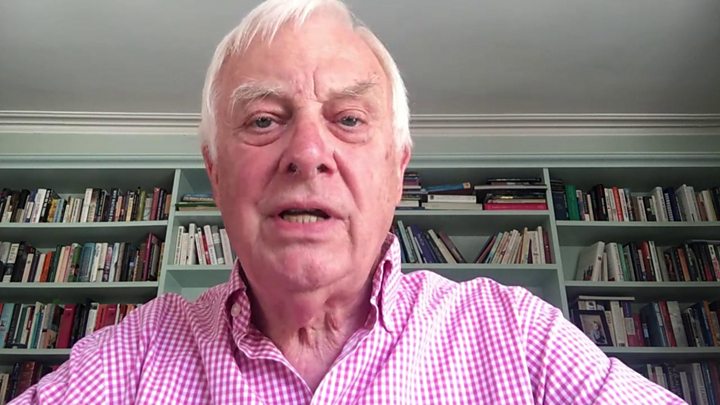
“The Hong Kong people have been betrayed by China,” Patten was quoted as saying by The Times newspaper. Britain has a “moral, economic and legal” duty to stand up for Hong Kong, he said.
Patten watched as the British flag was lowered over Hong Kong when the colony was handed back to China in 1997 after more than 150 years of British rule.
Hong Kong’s autonomy was guaranteed under the “one country, two systems” agreement principle enshrined in the 1984 Sino-British Joint Declaration signed by then Chinese Premier Zhao Ziyang and British Prime Minister Margaret Thatcher.
But China’s plans to impose national security laws on Hong Kong risk destroying the Declaration, Patten said. The United States has branded the laws a “death knell” for the city’s autonomy.
“What we are seeing is a new Chinese dictatorship,” Patten said. “The British government should make it clear that what we are seeing is a complete destruction of the Joint Declaration.”
Hong Kong leader Carrie Lam said her government will “fully cooperate” with the Chinese parliament to safeguard national security, which she said would not affect rights, freedoms or judicial independence.
Patten said the West should stop chasing the illusory promise of Chinese gold.
“We should stop being fooled that somehow at the end of the all the kowtowing there’s this great pot of gold waiting for us. It’s always been an illusion,” Patten said.
“We keep on kidding ourselves that unless we do everything that China wants we will somehow miss out on great trading opportunities. It’s drivel.”
The British government did not immediately comment on Saturday.
Prime Minister Boris Johnson’s spokesman said on Friday the government was monitoring the situation and as a party to the Joint Declaration the UK was committed to the upholding Hong Kong’s autonomy and respecting the one country, two systems model.
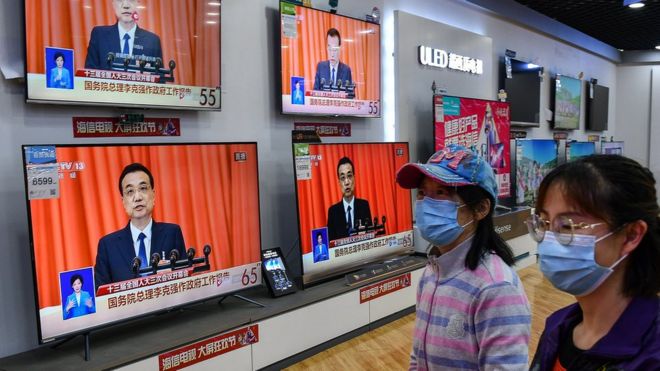
Image copyright AFP / GETTYImage caption Shoppers walking past a broadcast of Chinese Premier Li Keqiang delivering his speech at the opening of the NPC on Thursday
China’s ruling Communist Party has set in motion a controversial national security law for Hong Kong, a move seen as a major blow to the city’s freedoms.
The law to ban “treason, secession, sedition and subversion” could bypass Hong Kong’s lawmakers.
Critics say China is breaking its promise to allow Hong Kong freedoms not seen elsewhere in China.
It is likely to fuel public anger and may even trigger fresh protests and demands for democratic reform.
The plan was submitted at the annual National People’s Congress (NPC), which largely rubber-stamps decisions already taken by the Communist leadership, but is still the most important political event of the year.
Hong Kong, a semi-autonomous region and an economic powerhouse, was always meant to have introduced such laws after the handover from British control to Chinese rule in 1997.
After last year’s wave of sustained and violent protest, Beijing is now attempting to push them through, arguing “law-based and forceful measures” must be taken to “prevent, stop and punish” such protests in the future.
On Friday, Hong Kong’s government said it would co-operate with Beijing to enact the law, adding it would not affect the city’s freedoms.
That article says Hong Kong “must improve” national security, before adding: “When needed, relevant national security organs of the Central People’s Government will set up agencies in Hong Kong to fulfil relevant duties to safeguard national security in accordance with the law.”
China could essentially place this law into Annex III of the Basic Law, which covers national laws that must be implemented in Hong Kong – either by legislation, or decree.
Addressing the congress, Premier Li Keqiang spoke of the economic impact of the coronavirus and on Hong Kong and Macau said: “We’ll establish sound legal systems and enforcement mechanisms for safeguarding national security in the two Special Administrative Regions.”
What do opponents say the dangers are?
Hong Kong is what is known as a “special administrative region” of China.
It has observed a “one country, two systems” policy since Britain returned sovereignty in 1997, which has allowed it certain freedoms the rest of China does not have.
Pro-democracy activists fear that China pushing through the law could mean “the end of Hong Kong” – that is, the effective end of its autonomy and these freedoms.
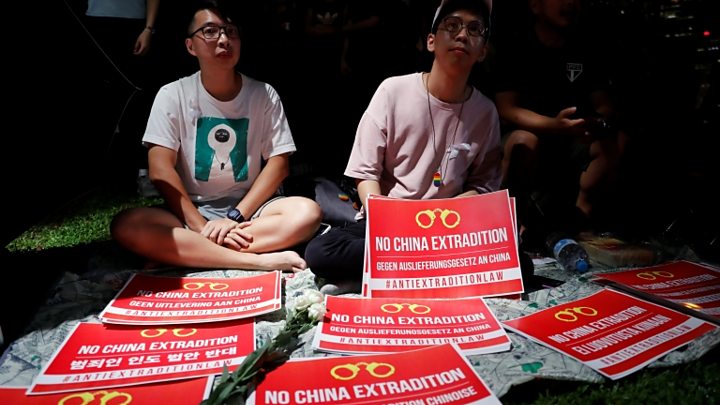
Last year’s mass protests in Hong Kong were sparked by a bill that would have allowed extraditions to mainland China.
Media caption Former Hong Kong governor Chris Patten: “UK should tell China this is outrageous”
The bill was paused, then withdrawn – but the protests continued until the virus outbreak at the end of the year.
The US has also weighed in, with President Trump saying the US would react strongly if it went through – without giving details.
It is currently considering whether to extend Hong Kong’s preferential trading and investment privileges.
Why is China doing this?
Mr Wang said the security risks had become “increasingly notable” – a reference to last year’s protests.
“Considering Hong Kong’s situation at present, efforts must be made at the state-level to establish and improve the legal system and enforcement mechanisms,” he is quoted as saying in state media.
Media caption The BBC’s Helier Cheung on Hong Kong’s 2019 protests
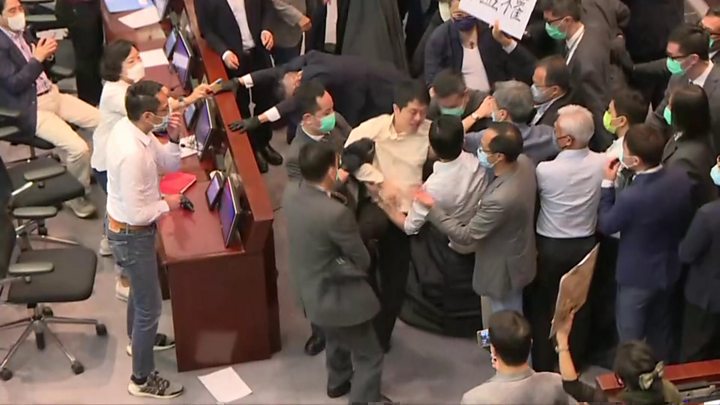
Beijing may also fear September’s elections to Hong Kong’s legislature.
If last year’s success for pro-democracy parties in district elections is repeated, government bills could potentially be blocked.
What is Hong Kong’s legal situation?
Hong Kong was under British control for more than 150 years up to 1997.
The British and Chinese governments signed a treaty – the Sino-British Joint Declaration – that agreed Hong Kong would have “a high degree of autonomy, except in foreign and defence affairs”, for 50 years.
This was enshrined in the Basic Law, which runs out in 2047.
Hong Kong’s rule of law has been pushed to the “brink of total collapse” after more than five months of protests, police have warned.
The warning came as protesters clashed with police across the city on Tuesday.
At the Chinese University of Hong Kong, police fired tear gas and rubber bullets at protesters who built barricades on the campus.
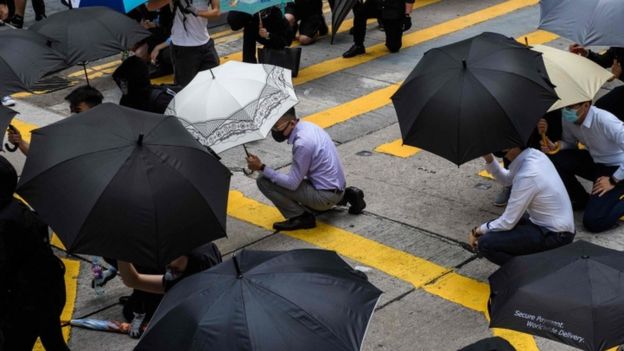
Earlier in the day, around 1,000 protesters rallied in central Hong Kong during the lunch hour blocking roads
Protesters, wearing office clothes, were seen chanting: “Fight for freedom, stand with Hong Kong!”
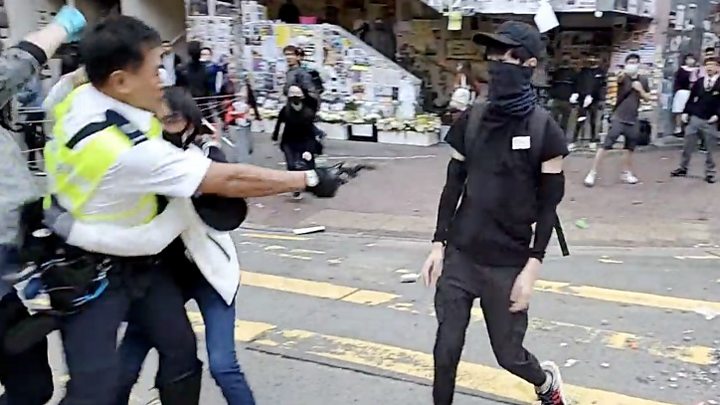
The demonstrations come just a day after the territory saw a marked escalation in violence, with police shooting one activist in the torso. A pro-Beijing supporter was set on fire by anti-government protesters.
The protests started in June against a now-withdrawn plan to allow extradition to mainland China, but have since morphed into wider demonstrations, with activists demanding greater democracy and police accountability in Hong Kong.
On Tuesday afternoon, police spokesman Kong Wing-cheung hit out at the protesters, saying they had “countless examples of rioters using random and indiscriminate violence against innocent” people.
“Hong Kong’s rule of law has been pushed to the brink of total collapse as masked rioters recklessly escalate their violence under the hope that they can get away with it,” he told reporters, adding that Monday’s attack on the pro-Beijing supporter was being investigated as attempted murder.
Image copyright AFPImage caption Protesters and office workers were seen blocking roads in Hong Kong’s financial district
Speaking at the same conference, Supt Li Kwai-wah defended the officer’s decision to shoot the protester on Monday.
“We found out that our colleague did not only face threat from one person, instead it was a group of people with an organised plan attempting to steal the gun,” he said.
“In a situation like this, we believe our police are reacting according to the guideline, to protect themselves as well as the people around them.”
Both the protester and the pro-Beijing supporter remain in hospital, with the latter in a critical condition.
What happened on Tuesday?
Clashes erupted at the Chinese University of Hong Kong, with police firing tear gas to disperse students, while at City University there was a standoff between students and riot police which continued into the evening.
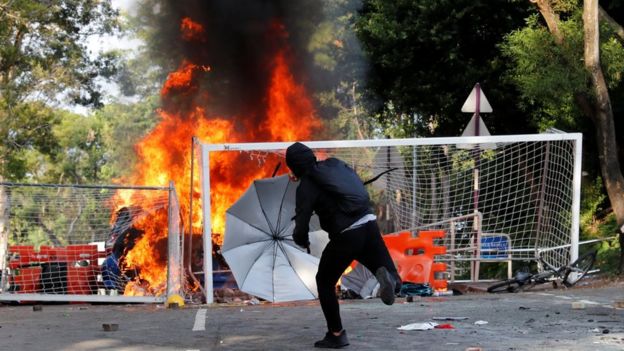
Police continued to use tear gas to try to disperse the protesters who responded with bricks and petrol bombs. Hundreds of protesters remain at the Chinese University of Hong Kong.
Image copyright REUTERSImage caption Students at Hong Kong’s Chinese University fought with police throughout the day
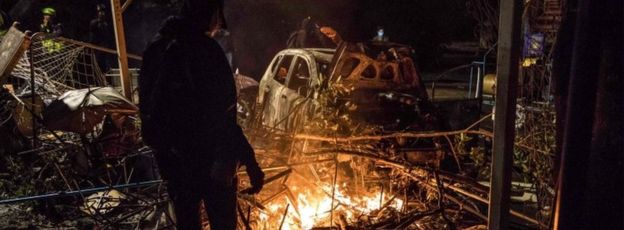
Students built roadblocks on streets in and around City University campus to stop police from entering. At one stage, a van used as part of a street barricade was set on fire.
Students at Hong Kong Polytechnic also tried to disrupt traffic near their campus.
In the morning, suspended railway services and road closures had already led to long traffic jams in the early rush hour. At noon, protesters moved into the city’s central business district for a flash mob protest.
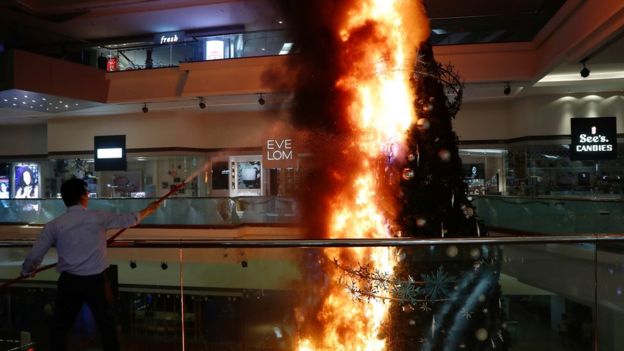
Image copyright REUTERSImage caption At Festival Walk shopping mall, a Christmas tree was set on fire
Protests continued to intensify throughout the day. A Christmas tree inside Festival Walk shopping mall was set on fire by protesters while others were seen smashing a glass railing with hammers.
Train stations were closed across the city.
Media caption This Hong Kong protester’s shooting was livestreamed on Facebook
Eight universities have announced they will suspend classes on Wednesday.
Monday’s protests saw 260 people arrested bringing the number to more than 3,000 since the protests began in June.
Students swear they will not surrender
Grace Tsoi, BBC World Service, at the Chinese University of Hong Kong
Image copyright AFPImage caption Hundreds of protesters remain at the university
The ground was strewn with bricks. The air was filled with the smell of tear gas. Fire was raging on campus. Hundreds of protesters, most of them clad in black, formed human chains to pass bricks and petrol bombs to the front line.
One of the best universities in Hong Kong has turned into a battlefield after another day of intense clashes between students, who have been at the forefront of anti-government protests, and police.
The Chinese University students have been putting up resistance since the morning. On Monday, police seemed to change strategy by deploying forces to campuses. Students told me they should not be allowed there.
The university’s management has tried to deescalate the situation. Vice-chancellor Rocky Tuan was also tear gassed as he was negotiating with police.
Dozens of students have been injured, including at least one hit in the eye by a projectile. The night is young and students swear they will not surrender.



 CHINDIA ALERT: You'll be living in their world, very soon