Chindia Alert: You’ll be Living in their World Very Soon
aims to alert you to the threats and opportunities that China and India present. China and India require serious attention; case of ‘hidden dragon and crouching tiger’.
Without this attention, governments, businesses and, indeed, individuals may find themselves at a great disadvantage sooner rather than later.
The POSTs (front webpages) are mainly 'cuttings' from reliable sources, updated continuously.
The PAGEs (see Tabs, above) attempt to make the information more meaningful by putting some structure to the information we have researched and assembled since 2006.
SHANGHAI (Reuters) – Apple Inc’s (AAPL.O) discounts on the iPhone 11 in China and the release of a new low-price SE model have put the company in a better position than rivals to weather a coronavirus-related plunge in global smartphone demand.
While China, which accounts for roughly 15% of Apple’s revenue, appears to be a rare bright spot, investors will be keen to get a picture of global demand when the Cupertino, California-headquartered company reports second-quarter results on Thursday.
The iPhone maker has shut retail stores in the United States and Europe following the COVID-19 outbreak, and China is the only major market where it has been able to reopen all shops.
Consumer spending is expected to be muted as the pandemic has crippled economies and Apple, the world’s second-most valuable tech company, is better armed with the launch of its new price-conscious iPhone model, analysts said.
“Apple is better positioned than most to experience a rapid recovery in a post COVID world,” Evercore analyst Amit Daryanani said in a research note. “We see demand as pushed out, not canceled.”
He added that the launch of the $399 iPhone SE suggested that Apple’s supply chain was getting back on its feet after weeks of shutdown earlier this year.
Analysts expect Apple to report a 6% drop in revenue and an 11% fall in net income in its fiscal second quarter, according to Refinitiv data.
On the other hand, Chinese brands such as Oppo and Vivo who have steadily moved to offer high-end models to challenge iPhones, stand to lose marketshare as bargain hunters choose Apple.
Earlier this month, several online retailers in China slashed prices of the iPhone 11 by as much as 18% – a tactic Apple has used in the past to boost demand. And while initial social media reaction to the new iPhone SE was muted, analysts said they were seeing a pick up in demand.
The cheaper iPhone SE could tempt iPhone owners to opt for a newer device, something they might have otherwise delayed in a weak economy, said Nicole Peng, who tracks the smartphone sector at research firm Canalys.
“People want to avoid uncertainty in a downturn,” she said. “Having a brand like Apple that can showcase quality and make people less worried about breakdowns or after-sales service can bring in buyers.”
CHEAP IS GOOD
Early data suggests that the Chinese smartphone market is recovering rapidly in the aftermath of the virus, and Apple has emerged relatively unscathed.
Sales of iPhones in China jumped 21% last month from a year earlier and more than three fold from February, government data showed, meaning March-quarter sales in the country were likely to have slipped just 1%.
To be sure, a recovery in Chinese demand won’t offset sales lost in the United States and Europe. And the company is yet to launch a smartphone enabled with 5G wireless technology like those offered by Asian rivals, a disadvantage for Apple so far.
But those same expensive 5G models may not sell well in the current climate of frugality, analysts said.
“If there are no massive subsidies (in China), I doubt there will be many smartphone users who will be eager to upgrade to 5G,” said Linda Sui, who tracks the smartphone sector at research firm Strategy Analytics.
Sui expects iPhone shipments in 2020 to be down 2 percentage points at the most, versus double digit declines at Chinese firms.
Apple also has revenue from its services business to fall back on. It has leveraged its large iPhone customer base to boost services revenue from music, apps, gaming and video.
“Apple’s Services segment should remain resilient in today’s work-from-home environment, thereby demonstrating the durability of Apple’s model,” Cowen analyst Krish Sankar said.
State-owned carrier’s chief says it wouldn’t be ‘morally acceptable’ to stop flying to the country, and it will stand with its ‘Chinese brothers and sisters’
Dozens of airlines have cancelled or reduced services to the nation amid the virus outbreak, including two East African rivals
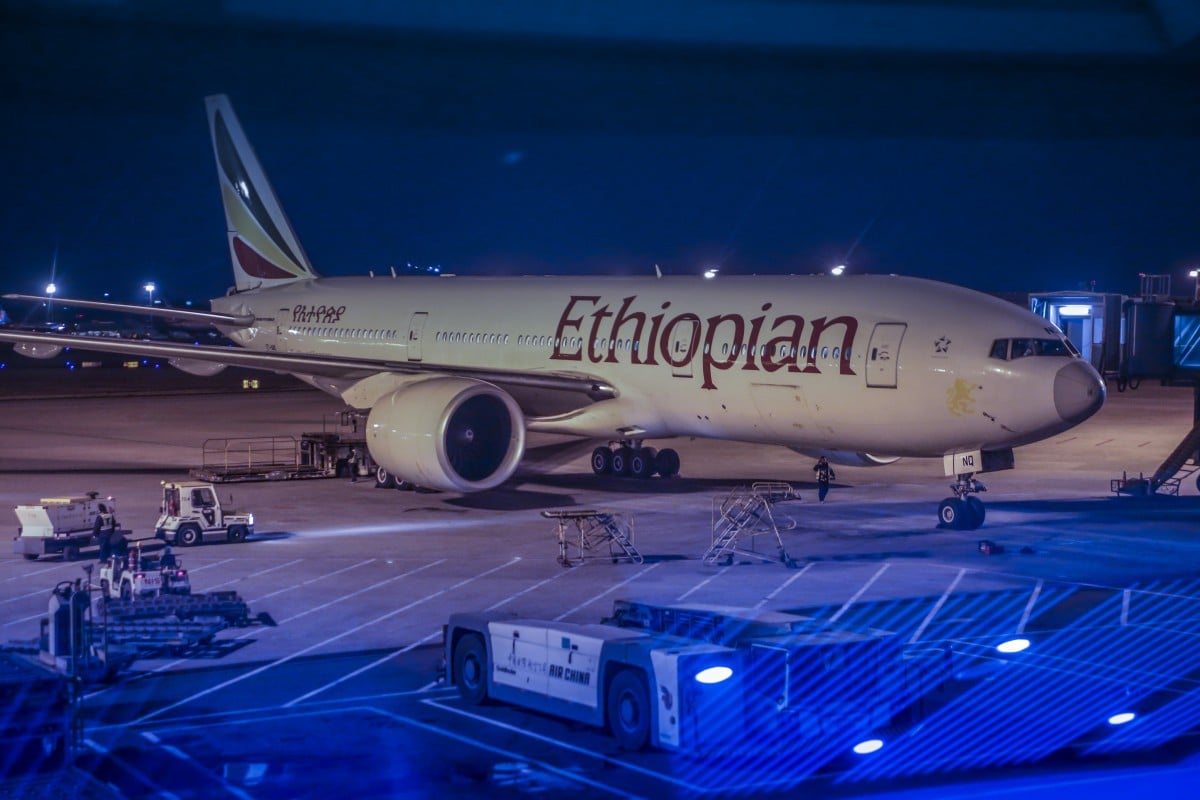
Ethiopian Airlines says it will continue flying to China. The routes are among its most profitable. Photo: Shutterstock
Ethiopian Airlines, Africa’s largest and most profitable carrier, will continue flying to China despite growing pressure for it to suspend services to the country as
Dozens of airlines around the globe have cancelled or reduced their services to cities in the world’s second-largest economy amid fears over the outbreak. Its East African rivals Kenya Airways and RwandAir have both suspended flights to China until the outbreak is contained.
But Ethiopian Airlines chief executive Tewolde GebreMariam said the carrier would not abandon the routes, which are among its most profitable.
Tewolde told media over the weekend that the airline had been flying to China since 1973 and it would not be ethical to suspend flights to the country.
“It will not be morally acceptable to stop flying to China today because they have a temporary problem,” he said, adding that the airline would stand with its “Chinese brothers and sisters”.
His remarks came days after Kenyan President Uhuru Kenyatta put pressure on the Ethiopian government – which wholly owns Ethiopian Airlines – to halt flights to China, citing the need to curb the spread of the virus into the East African region.
Global coronavirus deaths equal Sars, while new infections drop
The airline has bucked a trend that has seen major airlines – from the United States to Europe and Asia – staying away from Chinese airspace as governments around the world move to keep the deadly virus from their borders. The pneumonia-like illness has so far
in mainland China since the outbreak began in Wuhan in December, with cases reported in more than 20 other countries worldwide.
Speaking during a visit to Washington last week, Kenyatta – who is keen to court both China and the US – insisted that Kenya’s decision to suspend flights from Guangzhou to Nairobi was not political.
He said most African countries had weak health systems that would make it harder to handle the outbreak, so preventing its spread – even if through extreme measures such as grounding flights – was the only option.
“Our worry as a country is not that China cannot manage the disease. Our biggest worry is diseases coming into areas with weaker health systems like ours,” Kenyatta said while addressing members of US think tank the Atlantic Council.
Vaccine for new coronavirus unlikely to be ready before outbreak is over, says Sars expert
But Ethiopian Airlines said it would continue flying to Beijing, Shanghai, Guangzhou, Chengdu and Hong Kong and was taking measures to protect staff and passengers. Ethiopia receives about 1,500 visitors from mainland China every day.
According to Tewolde, if the airline halted its Chinese services, China and Africa would be completely disconnected.
“No one in Ethiopian Airlines would like to see this,” he said. “We have to take maximum precautions, but stopping flights is not one of them.”
He added: “Even if we stop flying, people will continue to come to Ethiopia through Singapore, Malaysia, Europe. The transmission of the disease will be dangerously hidden … British Airways stopped flying to China for its economic reasons. But Chinese carriers are flying to the UK.”
Chinese cities keen to get back to work but coronavirus concerns grow as workers return
14 Feb 2020
In a separate statement, the carrier said China was “one of the strongest and one of the oldest markets for Ethiopian Airlines”.
“We have been connecting the great Chinese nation with the entire continent of African for almost half a century and it is our growth strategy,” the airline said, adding that it would continue operating in the five cities in compliance with international aviation and health guidelines.
Aside from seeking to shore up revenues, analysts noted that the airline was under tight state control, and Ethiopia would be reluctant to do anything that might harm its strong bilateral ties with China.
Ethiopia is among the nations on the continent with the highest number of Chinese immigrants. Most of them are workers involved in the construction of infrastructure projects including ports, railways, dams, bridges and malls. Those projects have been financed with billions of dollars in loans from China – Ethiopia is reportedly among the biggest recipients of Chinese lending in Africa.
Last year, China was forced to restructure Ethiopia’s debt after the latter edged closer to defaulting on a loan from Beijing for its standard gauge railway.
Chinese hotel workers arrested in Kenya after caning video prompts demands for action
14 Feb 2020
Ethiopia, Algeria, Angola, Nigeria and Zambia together accounted for nearly 60 per cent of all Chinese workers on the continent at the end of 2017, according to a study by Johns Hopkins University.
Ethiopia is also a major recipient of direct foreign investment from China.
Power-sharing agreement between rebel leader Riek Machar and President Salva Kiir gives hope to ending the conflict
Beijing has invested tens of millions of dollars in the country’s oilfields and sent more than 1,000 peacekeeping troops there
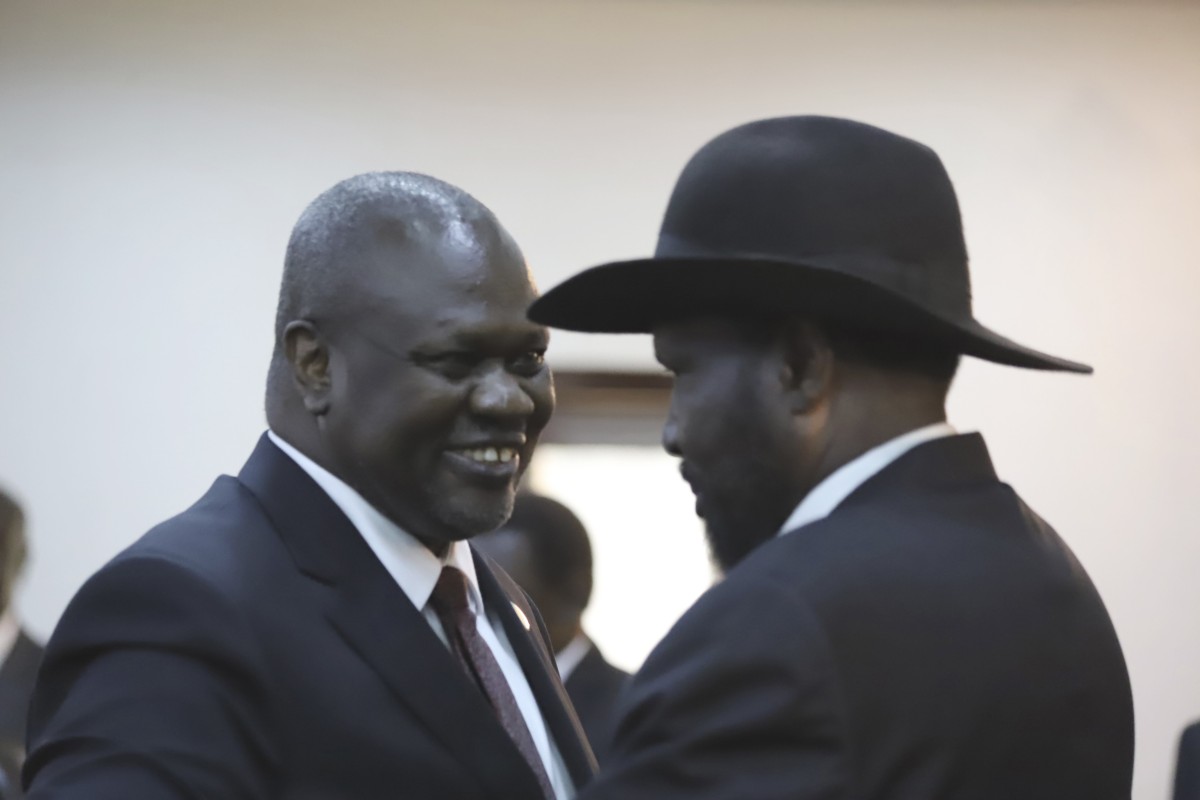
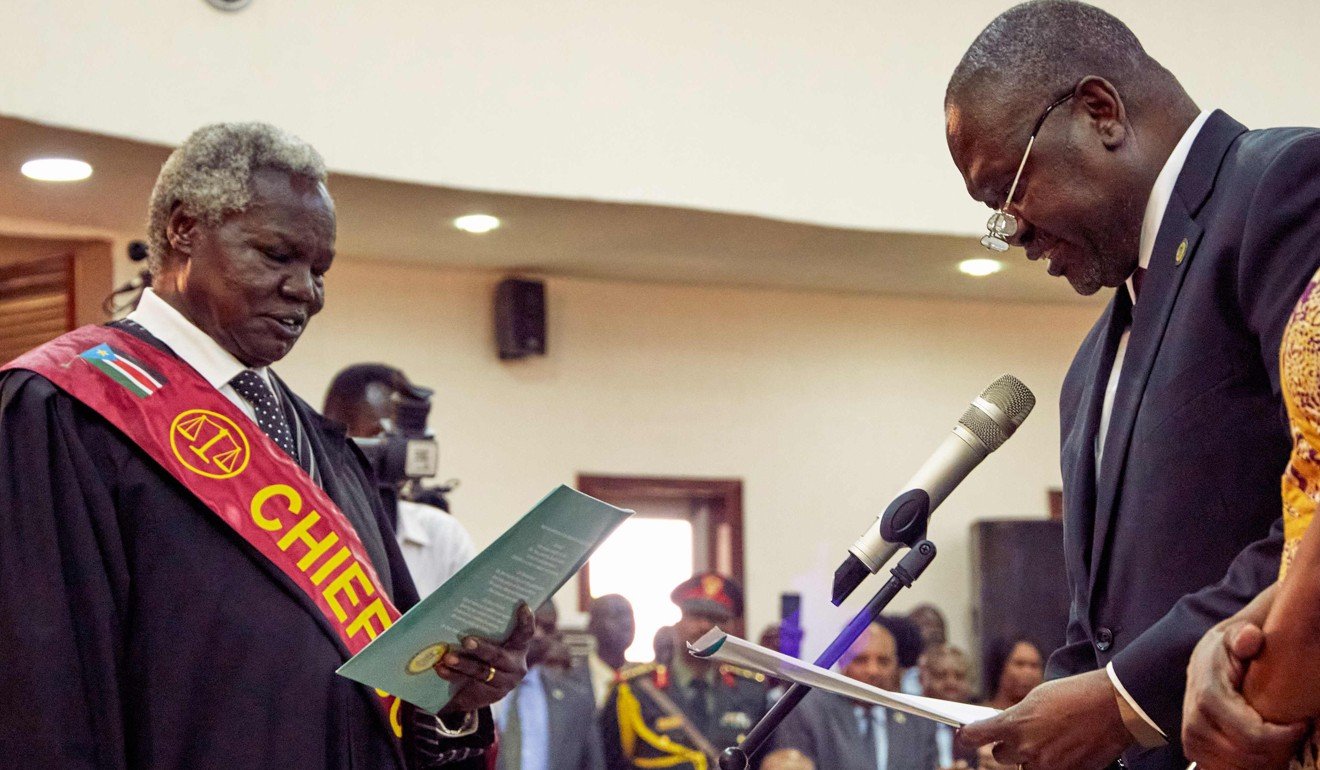
Rebel leader Riek Machar (left) and President Salva Kiir greet each other after the swearing-in ceremony at the State House in Juba on Saturday. Photo: AP
Beijing has welcomed “encouraging developments” in the South Sudan peace process after rebel leader Riek Machar and President Salva Kiir agreed to form a transitional coalition government.
Machar, the Sudan People’s Liberation Movement-In Opposition (SPLM-IO) leader, was among four vice-presidents sworn in on Saturday in the capital, Juba, in a power-sharing deal that gives hope to ending the more than six years of conflict which has killed some 400,000 people and displaced millions more.
“The Chinese side commends and welcomes these encouraging developments, especially the crucial consensus reached between President Kiir and Machar,” the Chinese embassy in Juba said in a statement.
Stability in South Sudan is important for China, which has invested tens of millions of dollars in the country’s oilfields as it seeks to meet energy needs at home. China National Petroleum Corporation (CNPC) owns a 41 per cent stake in South Sudan’s largest oil consortium, Dar Petroleum Operating Company, while Sinopec, another Chinese state-owned firm, holds a 6 per cent stake.
Stability in South Sudan is important for China, which has major investments in the country’s oilfields. Photo: Reuters
China has also sent more than 1,000 troops to the United Nations’ peacekeeping mission in South Sudan, and has not followed the United States and other Western nations in imposing sanctions on leading political and military figures.
“We trust that the relevant parties of South Sudan will resolve the remaining issues in the spirit of mutual trust and understanding, and start a new chapter in the history of South Sudan,” the embassy statement added.
China has offered to help rebuild the country, promising to supply a unified security force that is supposed to be formed from the rival factions as part of the peace process. It has also helped to set up military camps to accommodate both government troops and members of the armed opposition.
Since the peace deal was signed between Kiir and rebel factions in September 2018, China said it had provided diplomatic and other support to military camps and training centres including 1,500 tonnes of rice, 2,500 tents, 50,000 blankets and 1,440 boxes of medicine.
Riek Machar (right) is sworn in as the first vice-president of South Sudan. Photo: AFP
Machar was sworn in as the first vice-president alongside three others – James Wani Igga, Taban Deng Gai and Rebecca Nyandeng. Gai, a former ally of Machar who switched to the government side, was recently sanctioned by the US over serious human rights abuses. Nyandeng is the widow of John Garang, who led a long struggle for independence from Sudan before he died in a helicopter crash in 2005.
“I have forgiven my brother Riek Machar. I also ask for his forgiveness and I also forgive all those who still are holding out on this peace agreement,” Kiir said at a ceremony at the State House attended by regional leaders and diplomats.
After the swearing-in, Machar vowed to work together to end the suffering of South Sudanese.
“I reiterate my commitment to work closely with President Kiir to implement the agreement in letter and spirit,” Machar said.
From Angola to Zambia, China’s African partners brace for coronavirus blow to trade
14 Feb 2020
The South Sudanese have seen more war than peace since the East African nation – whose oilfields contribute about 98 per cent of the government’s revenue – seceded from the Republic of Sudan in 2011. Kiir and Machar formed the independent government but disagreements followed, leading to Machar’s sacking, sparking a bloody war along ethnic lines.
They again agreed to work together in 2015, but the deal fell apart a year later following renewed fighting. After international pressure and peace talks, a new deal was signed in September 2018, but Kiir and Machar have had to push back two deadlines to form the coalition government as they could not agree on issues such as having a unified army and the number of states – highly contentious since it affects the control of oil-rich regions. Machar also wanted his security assured.
On Thursday, Kiir said he had agreed to abolish the 32 states he created in 2015 and revert to the original 10 states.
According to a report released last week on China’s approach to UN peacekeeping in the region, Beijing had used its “economic leverage” in South Sudan.
“China has used its leverage to encourage the government and the opposition parties to negotiate, to come to an agreement, and to implement the ceasefire agreements,” said the report by the Norwegian Institute of International Affairs. “It has reportedly used its economic leverage by signalling that it would be unable to renew and expand its support to the South Sudanese government and the economy as long as the fighting was ongoing.”
Africa is a test lab for how China approaches international security and peacekeeping
8 Aug 2019
South Sudan had also provided an opportunity for Chinese soldiers to put their skills to the test on overseas missions and during armed conflict.
“South Sudan became a real-world laboratory [for China] to test the boundaries of its non-interference principle,” the report said.
Obert Hodzi, an international relations lecturer at the University of Liverpool in England, also said earlier that it was a way for China’s military to get the combat experience it needed.
“South Sudan provides ample opportunities for different segments of the Chinese army to practise, test their equipment and ability to conduct successful missions abroad,” Hodzi said.
BRUSSELS, Dec. 16 (Xinhua) — China and Europe are partners, not rivals, Chinese State Councilor and Foreign Minister Wang Yi said in a speech here on Monday evening.
“In recent years, we have heard an argument suggesting that China has become a rival of Europe in the economic field and should be subjected to all sorts of restrictions,” Wang said while speaking at an event hosted by the European Policy Center, a think tank.
“Although it is not the mainstream view, we must raise our vigilance and not allow it to go unchecked. In fact, any cool-headed person with an objective view will see that, for China and the EU, cooperation far outweighs competition, and our areas of consensus far exceed differences. We are partners, not rivals,” he said.
Over the years, Europe has benefited tremendously from cooperation with China, Wang said.
Between 2001 and 2018, EU’s exports to China grew by 14.7 percent on average each year, more than twice the EU’s average export growth, supporting about four million local jobs. Investment of Chinese companies in the EU has also been growing. As of the end of 2017, Chinese companies have set up over 2,900 ventures in EU countries through direct investment, creating 176,000 jobs for the local people, according to Wang.
Acquisition of Volvo by China’s automaker Geely injected new energy to the Volvo factory in Ghent, Belgium, retaining and creating over 6,000 jobs, said the senior Chinese official, noting that China is now the most profitable market for European companies — as many as 7 million cars, or nearly a quarter of all automobiles sold in China, are produced by European automakers.
Wang said that despite trade friction and the world economy in downward pressure, economic and trade cooperation between China and the EU has bucked the trend and kept growing.
He pointed out that in the first 11 months of this year, trade between China and the EU, according to statistics, was estimated to grow by 7.7 percent from last year. From January to July, EU investment in China was up by 18.3 percent year on year, and sixty percent of EU companies regard China as a leading destination of investment.
China, as a major developing country with some 1.4 billion people, a 900-million-strong labor force and 120 million market entities, has solid internal growth momentum, great resilience, and enormous economic potential, said Wang, adding that China is bound to offer a new round of cooperation opportunities and share the development dividend with countries in Europe.
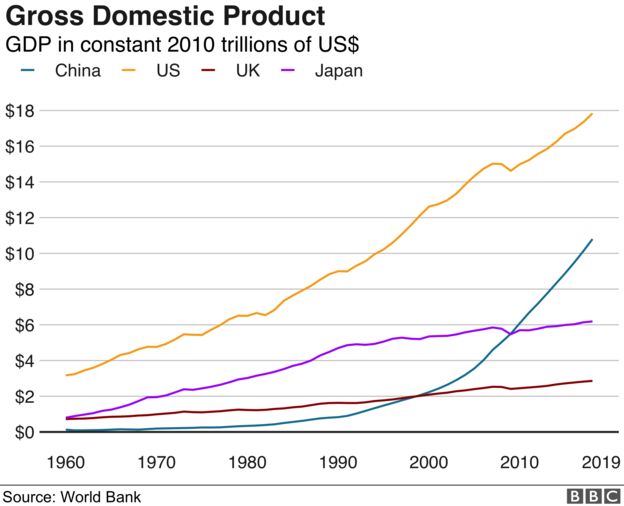
It took China less than 70 years to emerge from isolation and become one of the world’s greatest economic powers.
As the country celebrates the anniversary of the founding of the People’s Republic of China, we look back on how its transformation spread unprecedented wealth – and deepened inequality – across the Asian giant.
“When the Communist Party came into control of China it was very, very poor,” says DBS chief China economist Chris Leung.
“There were no trading partners, no diplomatic relationships, they were relying on self-sufficiency.”
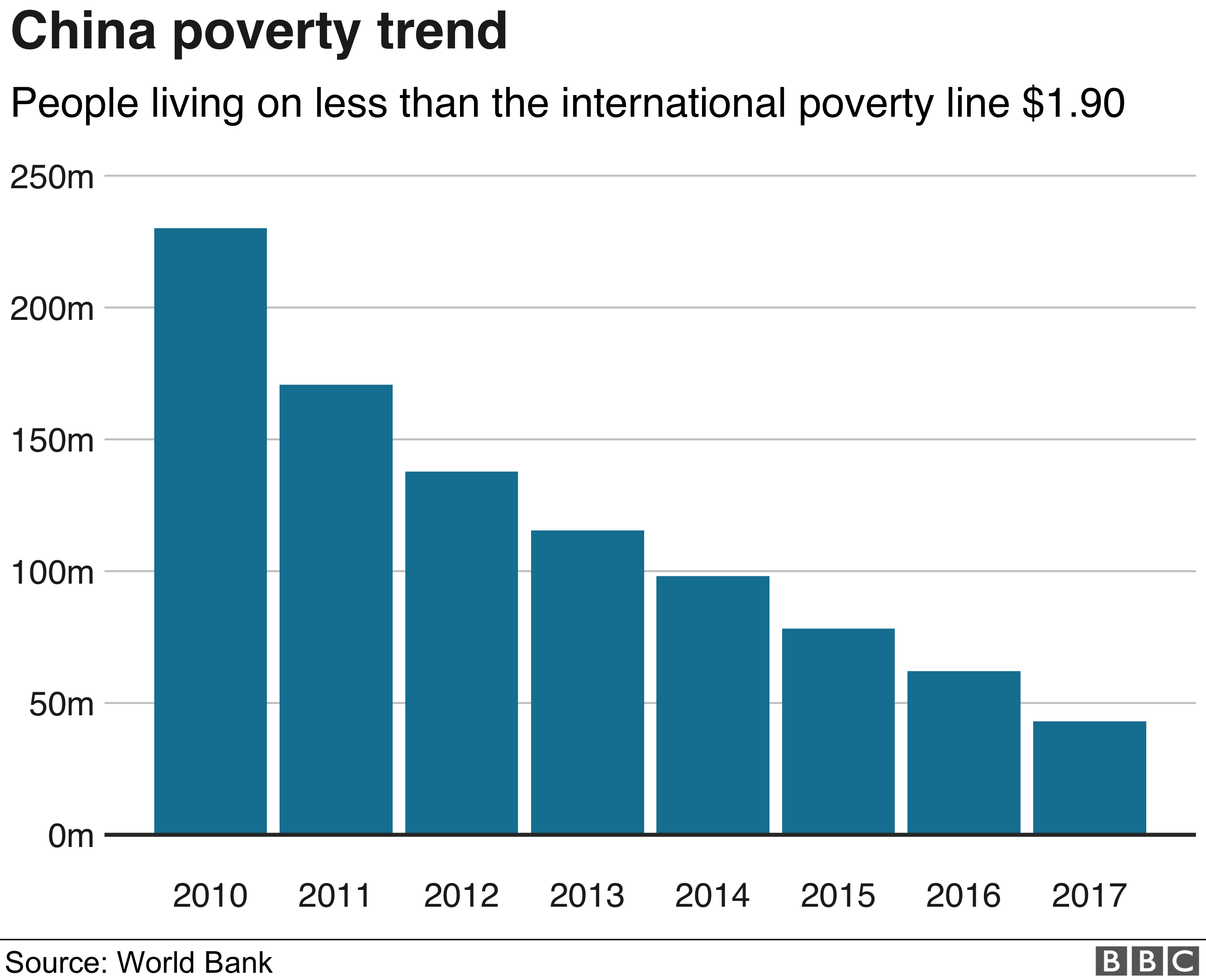
Over the past 40 years, China has introduced a series of landmark market reforms to open up trade routes and investment flows, ultimately pulling hundreds of millions of people out of poverty.
The 1950s had seen one of the biggest human disasters of the 20th Century. The Great Leap Forward was Mao Zedong’s attempt to rapidly industrialise China’s peasant economy, but it failed and 10-40 million people died between 1959-1961 – the most costly famine in human history.
This was followed by the economic disruption of the Cultural Revolution in the 1960s, a campaign which Mao launched to rid the Communist party of his rivals, but which ended up destroying much of the country’s social fabric.
‘Workshop of the world’
Yet after Mao’s death in 1976, reforms spearheaded by Deng Xiaoping began to reshape the economy. Peasants were granted rights to farm their own plots, improving living standards and easing food shortages.
The door was opened to foreign investment as the US and China re-established diplomatic ties in 1979. Eager to take advantage of cheap labour and low rent costs, money poured in.
“From the end of the 1970s onwards we’ve seen what is easily the most impressive economic miracle of any economy in history,” says David Mann, global chief economist at Standard Chartered Bank.
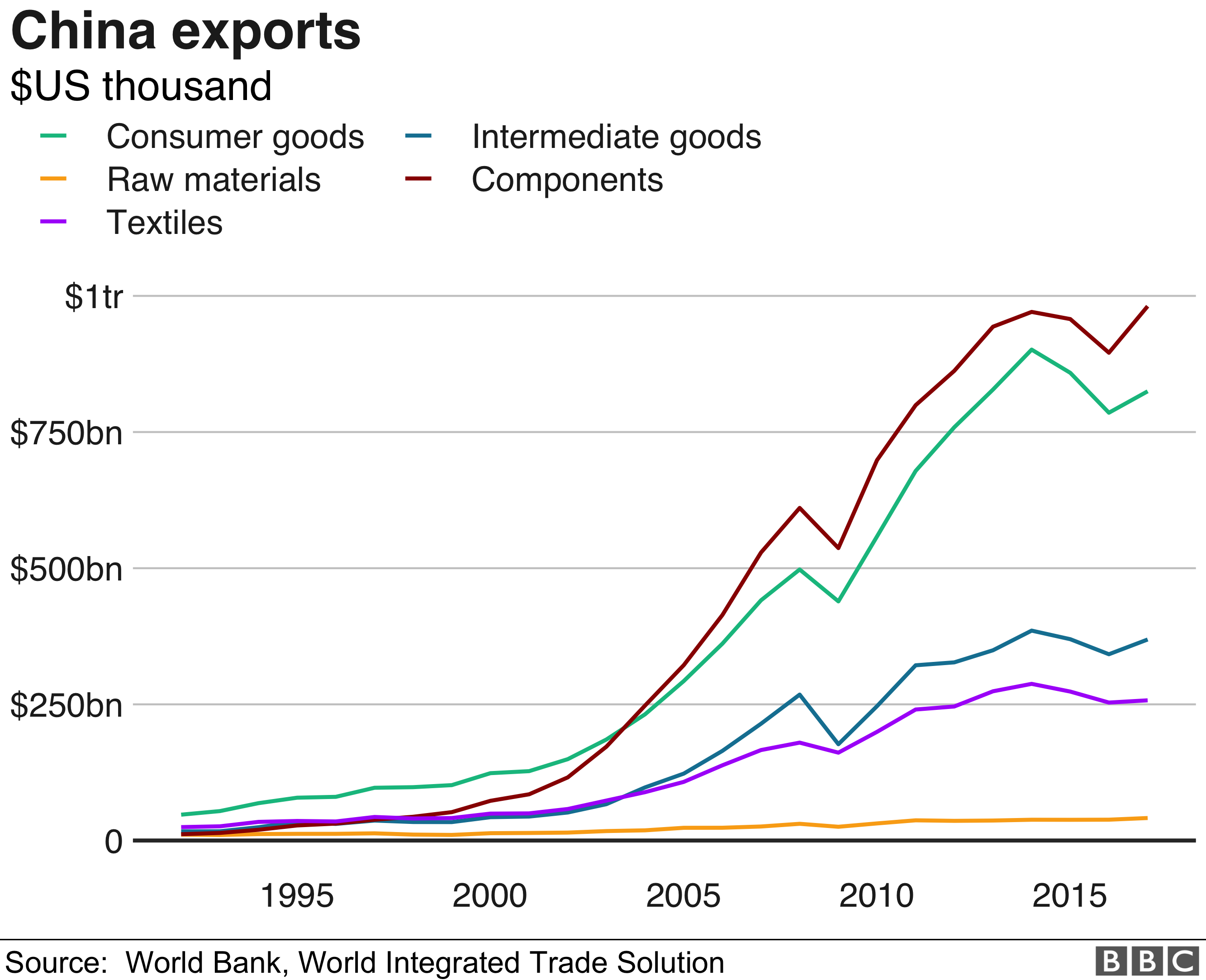
Through the 1990s, China began to clock rapid growth rates and joining the World Trade Organization in 2001 gave it another jolt. Trade barriers and tariffs with other countries were lowered and soon Chinese goods were everywhere.
“It became the workshop of the world,” Mr Mann says.
Take these figures from the London School of Economics: in 1978, exports were $10bn (£8.1bn), less than 1% of world trade.
By 1985, they hit $25bn and a little under two decades later exports valued $4.3trn, making China the world’s largest trading nation in goods.
Poverty rates tumble
The economic reforms improved the fortunes of hundreds of millions of Chinese people.
The World Bank says more than 850 million people been lifted out of poverty, and the country is on track to eliminate absolute poverty by 2020.
At the same time, education rates have surged. Standard Chartered projects that by 2030, around 27% of China’s workforce will have a university education – that’s about the same as Germany today.
Rising inequality
Still, the fruits of economic success haven’t spread evenly across China’s population of 1.3 billion people.
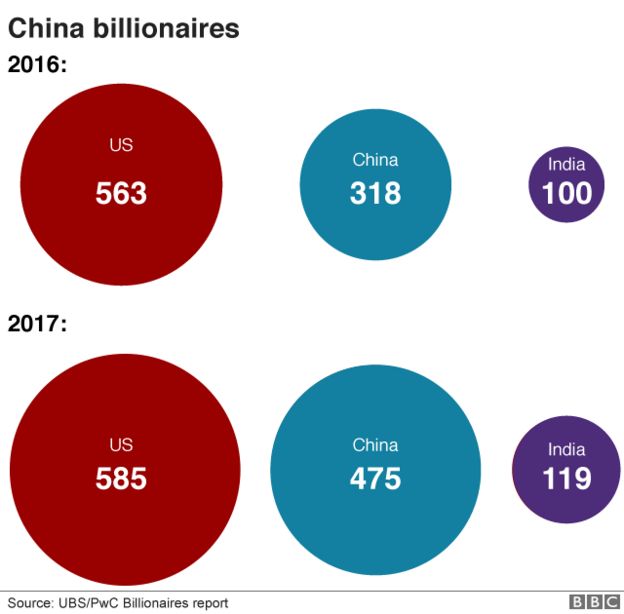
Examples of extreme wealth and a rising middle class exist alongside poor rural communities, and a low skilled, ageing workforce. Inequality has deepened, largely along rural and urban divides.
“The entire economy is not advanced, there’s huge divergences between the different parts,” Mr Mann says.
The World Bank says China’s income per person is still that of a developing country, and less than one quarter of the average of advanced economies.
China’s average annual income is nearly $10,000, according to DBS, compared to around $62,000 in the US.
Slower growth
Now, China is shifting to an era of slower growth.
For years it has pushed to wean its dependence off exports and toward consumption-led growth. New challenges have emerged including softer global demand for its goods and a long-running trade war with the US. The pressures of demographic shifts and an ageing population also cloud the country’s economic outlook.
Still, even if the rate of growth in China eases to between 5% and 6%, the country will still be the most powerful engine of world economic growth.
“At that pace China will still be 35% of global growth, which is the biggest single contributor of any country, three times more important to global growth than the US,” Mr Mann says.
The next economic frontier
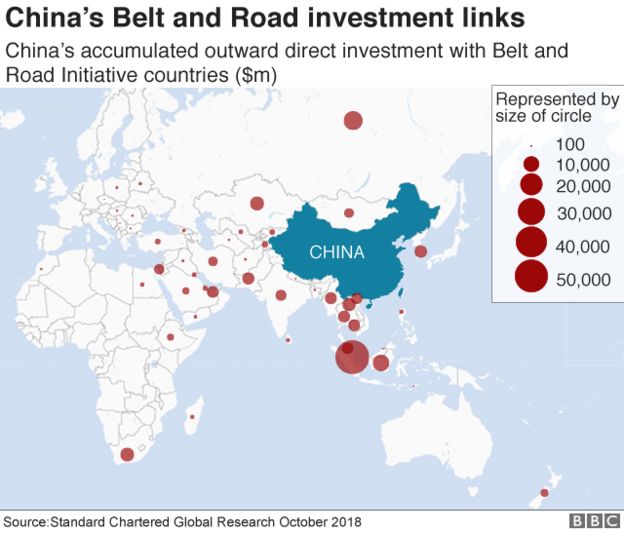
China is also carving out a new front in global economic development. The country’s next chapter in nation-building is unfolding through a wave of funding in the massive global infrastructure project, the Belt and Road Initiative.
The so-called new Silk Road aims to connect almost half the world’s populations and one-fifth of global GDP, setting up trade and investment links that stretch across the world.






 CHINDIA ALERT: You'll be living in their world, very soon