Archive for ‘rubber bullets’

12/11/2019

Hong Kong protests: Rule of law on ‘brink of collapse’, police say

Hong Kong’s rule of law has been pushed to the “brink of total collapse” after more than five months of protests, police have warned.

The warning came as protesters clashed with police across the city on Tuesday.

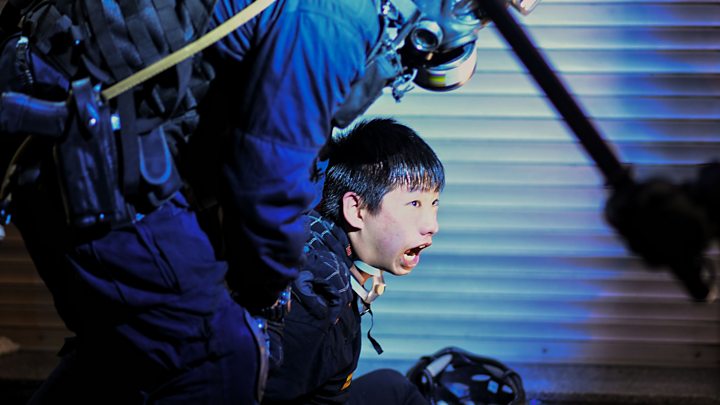
At the Chinese University of Hong Kong, police fired tear gas and rubber bullets at protesters who built barricades on the campus.

Earlier in the day, around 1,000 protesters rallied in central Hong Kong during the lunch hour blocking roads

Protesters, wearing office clothes, were seen chanting: “Fight for freedom, stand with Hong Kong!”

The demonstrations come just a day after the territory saw a marked escalation in violence, with police shooting one activist in the torso. A pro-Beijing supporter was set on fire by anti-government protesters.

The protests started in June against a now-withdrawn plan to allow extradition to mainland China, but have since morphed into wider demonstrations, with activists demanding greater democracy and police accountability in Hong Kong.

On Tuesday afternoon, police spokesman Kong Wing-cheung hit out at the protesters, saying they had “countless examples of rioters using random and indiscriminate violence against innocent” people.

“Hong Kong’s rule of law has been pushed to the brink of total collapse as masked rioters recklessly escalate their violence under the hope that they can get away with it,” he told reporters, adding that Monday’s attack on the pro-Beijing supporter was being investigated as attempted murder.
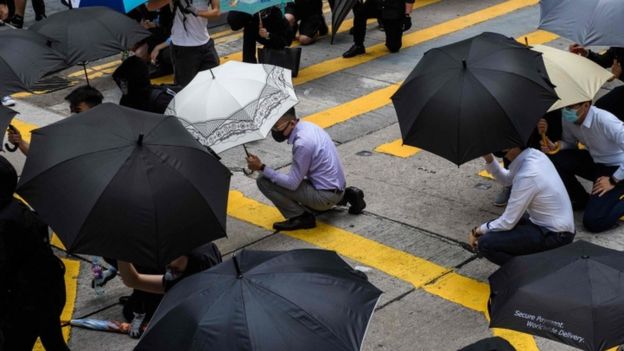
Office workers and protesters gather in CentralImage copyright AFP
Image caption Protesters and office workers were seen blocking roads in Hong Kong’s financial district

Speaking at the same conference, Supt Li Kwai-wah defended the officer’s decision to shoot the protester on Monday.

“We found out that our colleague did not only face threat from one person, instead it was a group of people with an organised plan attempting to steal the gun,” he said.

“In a situation like this, we believe our police are reacting according to the guideline, to protect themselves as well as the people around them.”

Both the protester and the pro-Beijing supporter remain in hospital, with the latter in a critical condition.

What happened on Tuesday?

Clashes erupted at the Chinese University of Hong Kong, with police firing tear gas to disperse students, while at City University there was a standoff between students and riot police which continued into the evening.

Police continued to use tear gas to try to disperse the protesters who responded with bricks and petrol bombs. Hundreds of protesters remain at the Chinese University of Hong Kong.
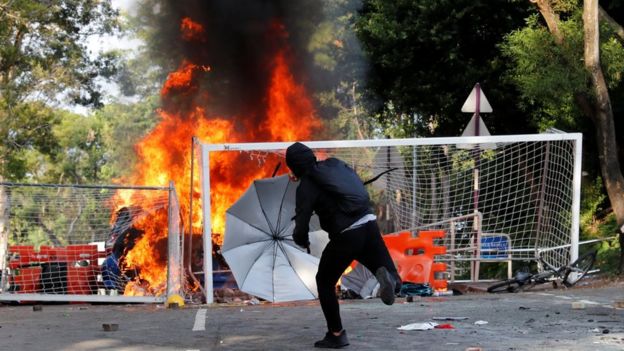
A university students throws an object at riot policeImage copyright REUTERS
Image caption Students at Hong Kong’s Chinese University fought with police throughout the day

Students built roadblocks on streets in and around City University campus to stop police from entering. At one stage, a van used as part of a street barricade was set on fire.

Students at Hong Kong Polytechnic also tried to disrupt traffic near their campus.

In the morning, suspended railway services and road closures had already led to long traffic jams in the early rush hour. At noon, protesters moved into the city’s central business district for a flash mob protest.
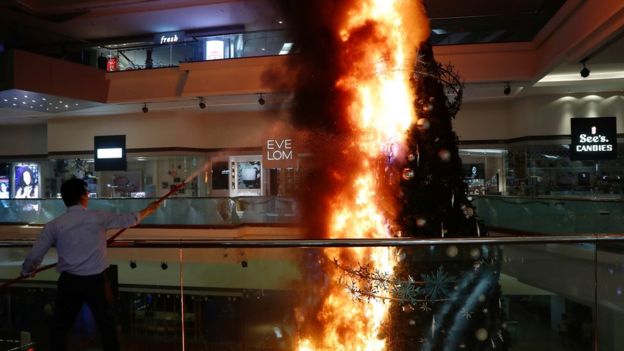
A Christmas tree inside a shopping mall on fireImage copyright REUTERS
Image caption At Festival Walk shopping mall, a Christmas tree was set on fire

Protests continued to intensify throughout the day. A Christmas tree inside Festival Walk shopping mall was set on fire by protesters while others were seen smashing a glass railing with hammers.

Train stations were closed across the city.
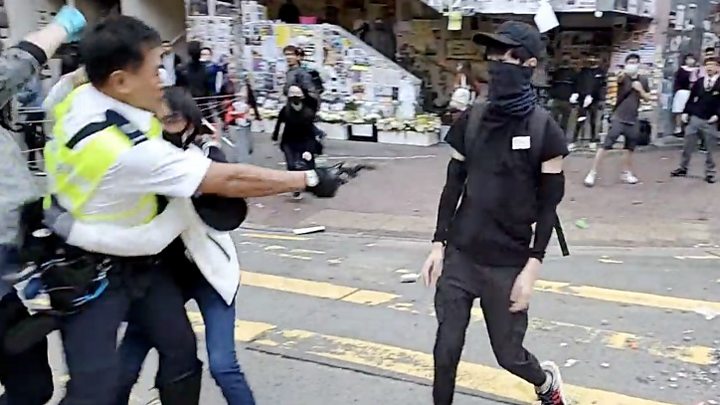
Media caption This Hong Kong protester’s shooting was livestreamed on Facebook

Eight universities have announced they will suspend classes on Wednesday.

Monday’s protests saw 260 people arrested bringing the number to more than 3,000 since the protests began in June.


Students swear they will not surrender

Grace Tsoi, BBC World Service, at the Chinese University of Hong Kong
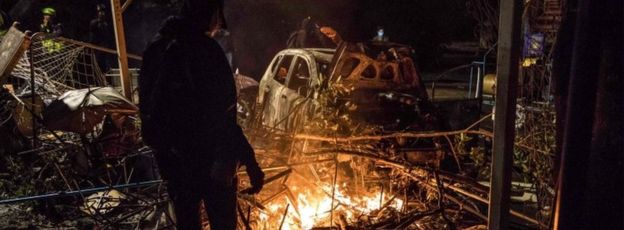
A protester looks at destruction at the Chinese University of Hong KongImage copyright AFP
Image caption Hundreds of protesters remain at the university

The ground was strewn with bricks. The air was filled with the smell of tear gas. Fire was raging on campus. Hundreds of protesters, most of them clad in black, formed human chains to pass bricks and petrol bombs to the front line.

One of the best universities in Hong Kong has turned into a battlefield after another day of intense clashes between students, who have been at the forefront of anti-government protests, and police.

The Chinese University students have been putting up resistance since the morning. On Monday, police seemed to change strategy by deploying forces to campuses. Students told me they should not be allowed there.

The university’s management has tried to deescalate the situation. Vice-chancellor Rocky Tuan was also tear gassed as he was negotiating with police.

Dozens of students have been injured, including at least one hit in the eye by a projectile. The night is young and students swear they will not surrender.


Why are there protests in Hong Kong?

Hong Kong is part of China but as a former British colony it has some autonomy and people have more rights.

The protests started in June against plans to allow extradition to the mainland – which many feared would undermine the city’s freedoms.

The bill was withdrawn in September but demonstrations continued and now call for full democracy and an inquiry into police behaviour.

Clashes between police and activists have become increasingly violent and in October the city banned all face masks.

Source: The BBC
07/09/2019

Hong Kong protests: China’s premier backs government to end ‘chaos’

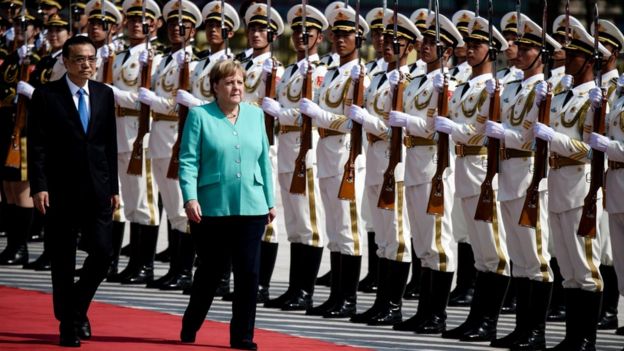
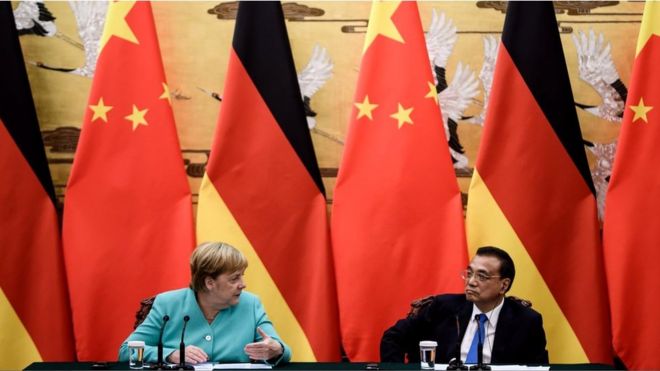
Angela Merkel and Li KeqiangImage copyright EPA
Image caption Ms Merkel calls for dialogue while Mr Li says China can handle its own matters

China’s Premier Li Keqiang has said Beijing supports the Hong Kong government “to end the violence and chaos”.

He is the most senior Chinese official to comment on the unrest which has rocked Hong Kong for months.

His comments came during a joint press conference with German Chancellor Angela Merkel in Beijing.

Hong Kong has seen months of often-violent protests calling for democracy and less influence from China.

The protests were sparked by changes to a law that would allow extradition to mainland China, but have since widened to include calls for an independent inquiry into police brutality and demands for greater democracy.

Li Keqiang and Angela MerkelImage copyright EPA
Image caption Hong Kong activists hope for Western support

On Wednesday, embattled Chief Executive Carrie Lam withdrew the controversial extradition bill but that has failed to appease the activists.

Instead, protests continued on Friday evening, when clashes erupted between police and the demonstrators outside a subway station on the Kowloon peninsula.

Riot police fired both tear gas and rubber bullets at protesters before clearing the nearby streets as the crowd of protesters was forced to retreat.

What did the Chinese premier say?

In August, China had likened to protests to terrorism, warning activists not to “underestimate the firm resolve” of the Beijing government.

Li Keqiang, China’s second highest-ranking leader, told reporters on Friday: “The Chinese government unswervingly safeguards ‘one country, two systems’ and ‘Hong Kong people govern Hong Kong people’.”

He said China backed Hong Kong “to end the violence and chaos in accordance with the law, to return to order, which is to safeguard Hong Kong’s long-term prosperity and stability”.

He said the world “needs to believe that the Chinese people have the ability and wisdom to handle their own matters well”.

Merkel calls for dialogue

German Chancellor Angela Merkel said a peaceful solution was needed for Hong Kong, urging that “in the current situation, violence must be prevented”.

Media caption How Hong Kong got trapped in a cycle of violence

She said there were signs Ms Lam would invite the necessary dialogue.

“I hope that materialises and that demonstrators have the chance to participate within the frame of citizens’ rights.”

She also stressed that the “rights and freedoms” for the people of Hong Kong “have to be granted”.

Soyrce: The BBC

13/08/2019

Hong Kong protests: Airport cancels flights as thousands occupy

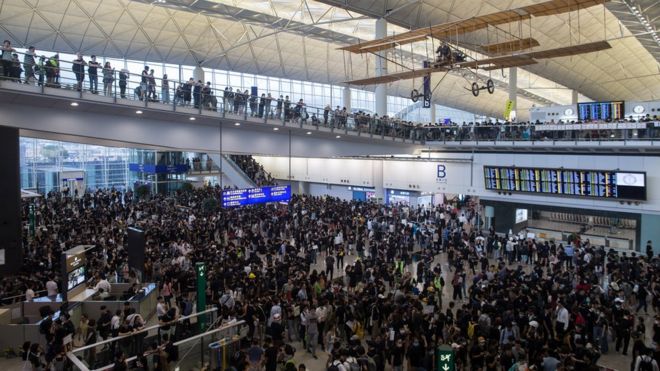
Protesters occupy Hong Kong Chek Lap Kok International Airport in Hong Kong, China,Image copyright EPA
Image caption Officials say about 5,000 gathered for the fourth day of protests at the airport

Hong Kong International Airport cancelled all departures on Monday, as thousands of anti-government protesters occupied and caused disruption.

Passengers have been told not to travel to the airport, which is one of the world’s busiest transport hubs.

In a statement, officials blamed “seriously disrupted” operations.

Many of those protesting are critical of the actions of police, who on Sunday were filmed firing tear gas and rubber bullets at close range.

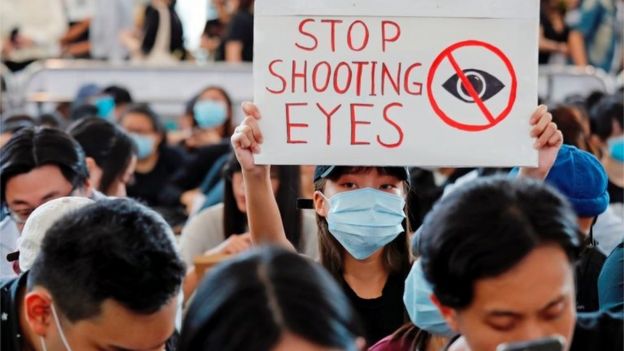
Some protesters wore bandages over their eyes in response to images of a woman bleeding heavily from her eye on Sunday, having reportedly been shot by a police projectile.

In a statement on Monday afternoon, Hong Kong’s Airport Authority said they were cancelling all flights that were not yet checked in.

More than 160 flights scheduled to leave after 18:00 local time (10:00 GMT) will now not depart.

Arrivals already heading into Hong Kong will still be allowed to land, but other scheduled flights have been cancelled.

Officials are now working to reopen the airport by 06:00 on Tuesday, a statement said.

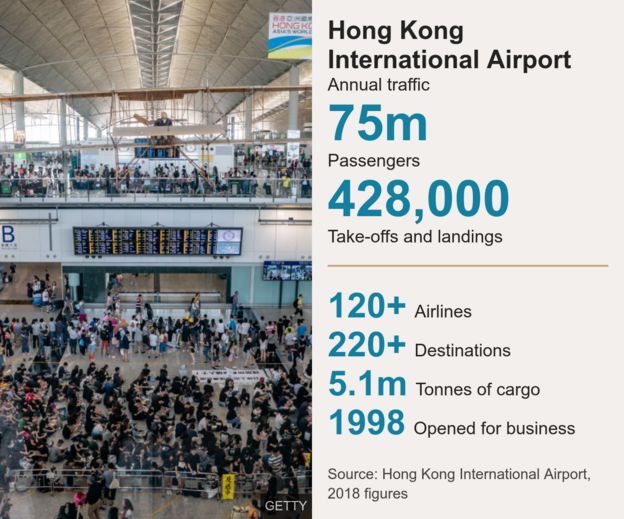
Graphic shows the scale of Hong Kong airport's operations
Some passengers expressed annoyance at the disruption. “It’s very frustrating and scary for some people,” one man from Pakistan told the BBC. “We’ll just have to wait for our next flight.”

Helena Morgan, from the UK, said she was set to return to the UK to get her exam results on Thursday. “I’m hoping we get back for them and we’re not on a flight,” she said.

But others were more understanding of the protests. “I was expecting something, given all the news,” one arrival, Gurinda Singh, told Reuters news agency.

As rumours spread that police plan to move in on protesters on Monday evening, thousands opted to leave on foot. There are large backlogs for transport back into the centre, local reports say.

The BBC’s Stephen McDonell, who is at the scene, says the airport has effectively shut down while authorities work out how to deal with the crisis.

Hong Kong’s mass demonstrations and unrest show no sign of abating, more than two months after they were sparked by a controversial extradition bill.

Beijing officials have strongly condemned Sunday’s violence and linked violent protesters to “terrorism”.

A protester in the airport holds a sign that says "stop shooting eyes"Image copyright REUTERS
Image caption Many of those who gathered carried signs condemning police conduct

What happened on Sunday?

On Sunday afternoon, a peaceful rally in the city’s Victoria Park led to clashes when protesters moved out of the area and marched along a major road despite a police ban.

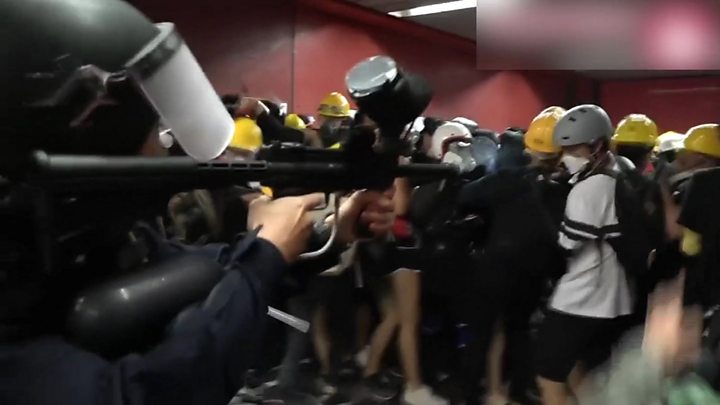
There were confrontations in several central districts and police used rubber bullets in an attempt to disperse the demonstrators.

In the bustling central Wan Chai district, petrol bombs and bricks were thrown at police, who responded by charging at protesters.

A number of people, including a police officer, were injured in the clashes.

Videos on social media also showed officers storming enclosed railway stations and firing tear gas.

Footage inside another station showed officers firing what appeared to be rubber bullets at close range and several police officers beating people with batons.

Media caption Violence erupts in HK train stations

Local media outlets reported that suspected undercover police officers had dressed-up as protesters to make surprise arrests.

While protests in the city have turned increasingly violent, there were no reports of arrests during the three previous days of the airport sit-in.

What has the reaction been?

On Monday the Chinese authorities, who have not yet physically intervened to quell the unrest, used their strongest language yet to condemn violent protesters.

“Hong Kong’s radical demonstrators have repeatedly used extremely dangerous tools to attack police officers, which already constitutes a serious violent crime, and also shows the first signs of terrorism emerging,” Yang Guang, a spokesman for the Hong Kong and Macau Affairs Office (HKMAO), said at a press briefing.

“This wantonly tramples on Hong Kong’s rule of law and social order.”

Elsewhere, Cathay Pacific has warned staff they could be fired if they “support or participate in illegal protests” in Hong Kong. The development comes days after Beijing mounted pressure on the airline and a #BoycottCathayPacific campaign began to spread.

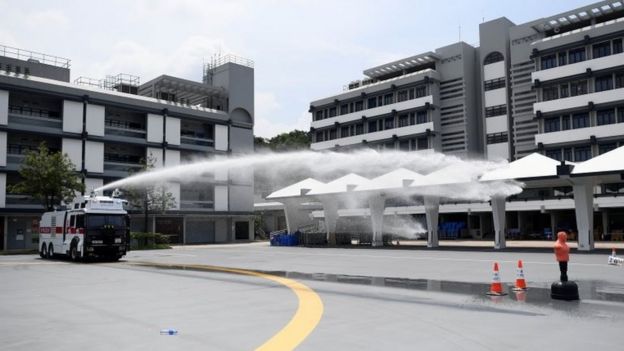
Hong Kong police have also unveiled a water cannon vehicle as a new tool to combat the protests.

Hong Kong Police demonstrate their new water cannon equipped vehicle at the Police Tactical Unit compound in Hong KongImage copyright AFP

Amnesty International has previously warned that the tool could cause serious injuries and inflame tensions.

Why are there protests in Hong Kong?

Demonstrations started in June in opposition to a proposed extradition bill, which would have allowed suspected criminals to be sent to mainland China for trial.

Critics said it would undermine Hong Kong’s legal freedoms, and could be used to silence political dissidents.

Although the government has now suspended the bill, demonstrators want it to be fully withdrawn.

Their demands have broadened to include calls for an independent inquiry into alleged police brutality, and an amnesty for all arrested protesters.

Hong Kong is part of China but its citizens have more autonomy than those on the mainland.

It has a free press and judicial independence under the so-called “one country, two systems” approach – freedoms which activists fear are being increasingly eroded.

Source: The BBC

Law of Unintended Consequences

continuously updated blog about China & India

ChiaHou's Book Reviews

continuously updated blog about China & India

What's wrong with the world; and its economy

continuously updated blog about China & India