Chindia Alert: You’ll be Living in their World Very Soon
aims to alert you to the threats and opportunities that China and India present. China and India require serious attention; case of ‘hidden dragon and crouching tiger’.
Without this attention, governments, businesses and, indeed, individuals may find themselves at a great disadvantage sooner rather than later.
The POSTs (front webpages) are mainly 'cuttings' from reliable sources, updated continuously.
The PAGEs (see Tabs, above) attempt to make the information more meaningful by putting some structure to the information we have researched and assembled since 2006.
China’s economy shrank for the first time in decades in the first quarter of the year, as the virus forced factories and businesses to close.
The world’s second biggest economy contracted 6.8% according to official data released on Friday.
The financial toll the coronavirus is having on the Chinese economy will be a huge concern to other countries.
China is an economic powerhouse as a major consumer and producer of goods and services.
This is the first time China has seen its economy shrink in the first three months of the year since it started recording quarterly figures in 1992.
“The GDP contraction in January-March will translate into permanent income losses, reflected in bankruptcies across small companies and job losses,” said Yue Su at the Economist Intelligence Unit.
Last year, China saw healthy economic growth of 6.4% in the first quarter, a period when it was locked in a trade war with the US.
In the last two decades, China has seen average economic growth of around 9% a year, although experts have regularly questioned the accuracy of its economic data.
Its economy had ground to a halt during the first three months of the year as it introduced large-scale shutdowns and quarantines to prevent the virus spread in late January.
As a result, economists had expected bleak figures, but the official data comes in slightly worse than expected.
Among other key figures released in Friday’s report:
Factory output was down 1.1% for March as China slowly starts manufacturing again.
Retail sales plummeted 15.8% last month as many of shoppers stayed at home.
Unemployment hit 5.9% in March, slightly better than February’s all-time high of 6.2%.
Analysis: A 6% expansion wiped out
Robin Brant, BBC News, Shanghai
The huge decline shows the profound impact that the virus outbreak, and the government’s draconian reaction to it, had on the world’s second largest economy. It wipes out the 6% expansion in China’s economy recorded in the last set of figures at the end of last year.
Beijing has signalled a significant economic stimulus is on the way as it tries to stabilise its economy and recover. Earlier this week the official mouthpiece of the ruling Communist Party, the People’s Daily, reported it would “expand domestic demand”.
But the slowdown in the rest of the global economy presents a significant problem as exports still play a major role in China’s economy. If it comes this will not be a quick recovery.
On Thursday the International Monetary Fund forecast China’s economy would avoid a recession but grow by just 1.2% this year. Job figures released recently showed the official government unemployment figure had risen sharply, with the number working in companies linked to export trade falling the most.
China has unveiled a range of financial support measures to cushion the impact of the slowdown, but not on the same scale as other major economies.
“We don’t expect large stimulus, given that that remains unpopular in Beijing. Instead, we think policymakers will accept low growth this year, given the prospects for a better 2021,” said Louis Kuijs, an analyst with Oxford Economics.
Since March, China has slowly started letting factories resume production and letting businesses reopen, but this is a gradual process to return to pre-lockdown levels.
Media caption Why does China’s economy matter to you?
China relies heavily on its factories and manufacturing plants for economic growth, and has been dubbed “the world’s factory”.
Stock markets in the region showed mixed reaction to the Chinese economic data, with China’s benchmark Shanghai Composite index up 0.9%.
WASHINGTON (Reuters) – U.S. President Donald Trump on Friday said he thinks a trade deal between the United States and China will be signed by the time the Asia-Pacific Economic Cooperation meetings take place in Chile on Nov. 16 and 17.
RELATED COVERAGE
China says will work with the U.S. to address each other’s core concerns
Chinese Vice Premier Liu He will provide Beijing’s perspective on the progress of the talks in a speech on Saturday, according to a tweet from editor-in-chief of the Global Times, a tabloid published by the People’s Daily of China’s ruling Communist Party.
“I think it will get signed quite easily, hopefully by the summit in Chile, where President Xi and I will both be,” Trump told reporters at the White House, without providing details.
“We’re working with China very well,” Trump also said.
The White House has announced that China agreed to buy up to $50 billion of U.S. farm products annually, as part of the first phase of a trade deal, although China seems slow to follow through.
The so-called phase 1 deal was unveiled at the White House last week during a visit by vice premier He as part of a bid to end a tit-for-tat trade war between Beijing and Washington that has roiled markets and hammered global growth. U.S. officials said a second phase of negotiations could address thornier issues like forced technology transfer and non-financial services issues.
BEIJING (Reuters) – Limiting marriage to a relationship between a man and a woman will remain China’s legal position, a parliament spokesman said on Wednesday, ruling out following neighbouring Taiwan in allowing same-sex marriage, despite pressure from activists.
Taiwan’s parliament passed a bill in May that endorsed same-sex marriage, after years of heated debate over marriage equality that has divided the self-ruled and democratic island.
China, which claims Taiwan as its territory, has a thriving gay scene in major cities, but there has been little sign the ruling Communist Party will legalise same-sex marriage.
Asked at a news briefing whether China would legalise same-sex marriage, Zang Tiewei, spokesman for parliament’s legal affairs commission, said Chinese law only allowed for marriage between one man and one woman.
“This rule suits our country’s national condition and historical and cultural traditions,” he said. “As far as I know, the vast majority of countries in the world do not recognise the legalisation of same-sex marriage.”
Individual Chinese legislators have occasionally in the past few years proposed measures during the annual meeting of the largely rubber-stamp parliament every March to legalise same-sex marriage, without success.
There are no laws against same-sex relations in China and despite growing awareness of LGBT issues, the community has been the target of censors in recent months, fuelling fears of a growing intolerance.
Activists have asked people in China to propose amendments to a draft civil code en masse, though they have admitted they see little chance of success. The parts of the code relating to marriage are expected to pass into law next year.
The code makes changes on issues such as sexual harassment, divorce and family planning, but does not further the rights of the LGBT community, drafts published by parliament show.
Zang said the marriage section of the draft civil code maintains the bond as being between a man and a woman.
Prominent gay rights activist Sun Wenlin told Reuters he was disappointed in the comments, but not surprised.
“I feel that my partner and I are sacrificing our happiness for the country’s legal system,” said Sun, who three years ago had his application to legally marry his partner rejected by a Chinese court.
“They are undermining our life plan of choosing to marry the person we love
He added, “I feel I am being excluded, and am absolutely not a consideration for policymakers.”
Another activist, who asked not to be named, told Reuters there were cases in China of same-sex partners who had lost their homes after one of them died, as they lacked the legal protection of marriage.
“We hope these tragedies don’t keen happening,” the activist said.
BEIJING (Reuters) – China’s ruling Communist Party is ramping up calls for political loyalty in a year of sensitive anniversaries, warning against “erroneous thoughts” as officials fall over themselves to pledge allegiance to President Xi Jinping and his philosophy.
This year is marked by some delicate milestones: 30 years since the bloody crackdown on pro-democracy demonstrators in and around Tiananmen Square; 60 years since the Dalai Lama fled from Tibet into exile; and finally, on Oct. 1, 70 years since the founding of Communist China.
Born of turmoil and revolution, the Communist Party came to power in 1949 on the back of decades of civil war in which millions died, and has always been on high alert for “luan”, or “chaos”, and valued stability above all else.
“This year is the 70th anniversary of the founding of new China,” Xi told legislators from Inner Mongolia on Tuesday, the opening day of the annual meeting of parliament. “Maintaining sustained, healthy economic development and social stability is a mission that is extremely arduous.”
Xi has tightened the party’s grip on almost every facet of government and life since assuming power in late 2012.
Last year parliament amended the country’s constitution to remove term limits and allow him to stay in office for the rest of his life, should he so wish, though it is unclear if that will happen and Xi has not mentioned it in public.
Later in the year the party will likely hold a plenum of its top leadership focused on what China calls “party building”, diplomats and sources with ties to China’s leadership say, a concept that refers to furthering party control and ensuring its instructions are followed to the letter.
In late January the party again stressed loyalty in new rules on “strengthening party political building”, telling members they should not fake loyalty or be “low-level red”, in a lengthy document carried by state media.
“Be on high alert to all kinds of erroneous thoughts, vague understandings, and bad phenomena in ideological areas,” it warned. “Keep your eyes open, see things early and move on them fast.”
LOYALTY FIRST
On March 1, Xi spoke at the Central Party School, which trains rising officials, mentioning the word “loyalty” at least seven times, according to official accounts in state media.
Xi noted that whether an official is loyal to the party is a key gauge of whether they have ideals and convictions. “Loyalty always comes first,” he said.
Duncan Innes-Ker, regional director for Asia at the Economist Intelligence Unit, said China was concerned about resistance at lower levels to following party orders, the slowing economy and also about demands for political reforms as people get steadily richer.
“The desire for control is not something particular to any time period,” he said. “It is a fundamental tenet of autocratic governments that they are constantly paranoid about being overthrown.”
Xi looms large over this year’s session of China’s largely rubber stamp parliament, known as the National People’s Congress, which has always been stacked with people chosen for their absolute fealty to the party.
Government ministers who spoke to reporters on the sidelines of parliament’s opening session on Tuesday peppered their comments with references to Xi – 16 times in all.
Customs minister Ni Yuefeng said that Xi himself “pays great attention to not allowing foreign garbage into the country”, a reference to China’s ban on solid waste imports, part of the country’s war on pollution.
“Ideology comes first this year,” said one Western diplomat who is attending the parliamentary sessions as an observer. “It’s all about the 70th anniversary.”
ROOTING OUT DISLOYALTY
The party has increasingly been making rooting out disloyalty and wavering from the party line a disciplinary offence to be enforced by its anti-corruption watchdog, whose role had ostensibly been to go after criminal acts such as bribery and lesser bureaucratic transgressions.
The graft buster said last month it would “uncover political deviation” in its political inspections this year of provincial governments and ministries.
Top graft buster Zhao Leji, in a January speech to the corruption watchdog, a full transcript of which the party released late February, used the word “loyalty” eight times.
“Set an example with your loyalty to the party,” Zhao said.
China has persistently denied its war on corruption is about political manoeuvring or Xi taking down his enemies. Xi told an audience in Seattle in 2015 that the anti-graft fight was no “House of Cards”-style power play, in a reference to the Netflix U.S. political drama.
The deeper fear for the party is some sort of unrest or a domestic or even international event fomenting a crisis that could end its rule.
Xi told officials in January they need to be on high alert for “black swan” events..
That same month the top law-enforcement official said China’s police must focus on withstanding “colour revolutions”, or popular uprisings, and treat the defence of China’s political system as central to their work.
The party has meanwhile shown no interest in political reform, and has been doubling down on the merits of the Communist Party, including this month rolling out English-language propaganda videos on state media-run Twitter accounts to laud “Chinese democracy”. Twitter remains blocked in China.
The official state news agency Xinhua said in an English-language commentary on Sunday that China was determined to stick to its political model and rejected Western-style democracy.
“The country began to learn about democracy a century ago, but soon found Western politics did not work here. Decades of turmoil and civil war followed,” it said.


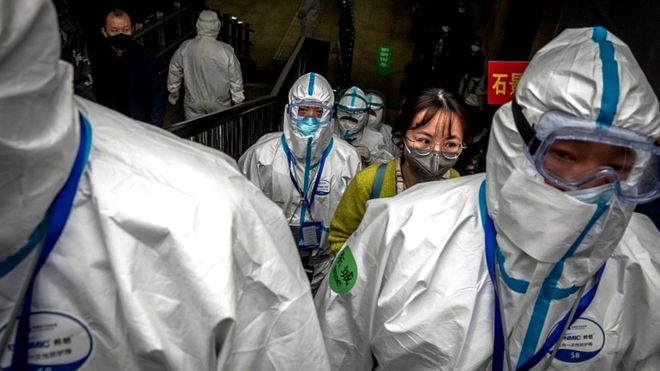 Image copyright EPA

 CHINDIA ALERT: You'll be living in their world, very soon