

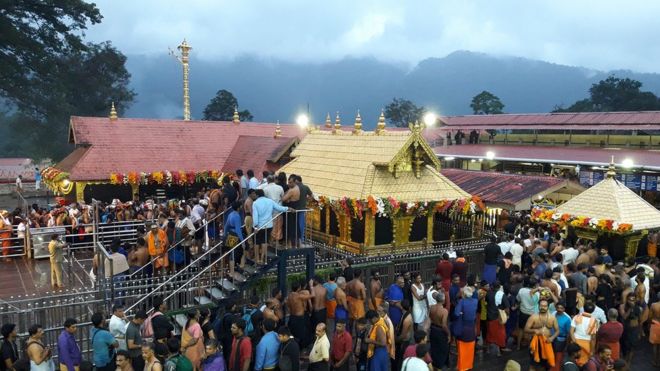
 Image copyright KAVIYOOR SANTHOSH
India’s Supreme Court has agreed to review its landmark judgement allowing women of menstruating age to enter a controversial Hindu shrine.
A five-judge bench last year ruled that keeping women out of the Sabarimala shrine in the southern state of Kerala was discriminatory.
The verdict led to massive protests in the state.
Women who tried to enter the shrine were either sent back or, in some cases, even assaulted.
The move is likely to anger women who fought hard to win the right to enter the temple.
Hinduism regards menstruating women as unclean and bars them from participating in religious rituals.
Many temples bar women during their periods and many devout women voluntarily stay away, but Sabarimala had a blanket ban on all women between the ages of 10 and 50.
What did the court say?
On Thursday the five-judge bench, responding to dozens of review petitions challenging the court’s landmark judgement last year, said that the matter would now be heard by a larger bench.
In doing so, however, it did not stay its earlier order. This means women can still legally enter the temple.
But it’s not going to be easy for them.
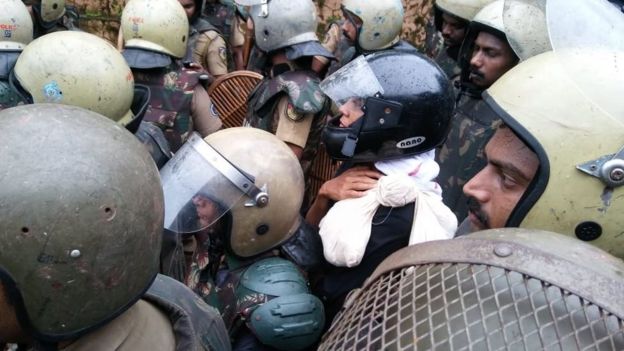
A temple official welcomed the ruling and appealed to women to stay away.
Women trying to enter the temple after the verdict last year were attacked by mobs blocking the way.
Many checked vehicles heading towards the temple to see if any women of a “menstruating age” – deemed to be those aged between 10 and 50 years – were trying to enter.
Following Thursday’s verdict, police in Kerala have appealed for calm, saying that action will be taken “against those who take the law into their own hands”. They added that social media accounts would be under surveillance and those stoking religious tensions online would be arrested.
‘One step forward, two steps back’
Geeta Pandey, BBC News, Delhi
Today’s verdict will come as a massive disappointment to women’s rights campaigners. It’s a case of one step forward, two steps back.
In 2018, while lifting the ban on women’s entry into the shrine, the Supreme Court had said that everyone had the right to practice religion and that the ban was a form of “untouchability”.
It was seen as a hugely progressive ruling and had given hope to women that they were equal before the law and could now claim equality before the gods too. What happened in court today has taken that sense away.
The Supreme Court has not put its earlier order on hold, but with the ambiguity over women’s entry continuing, it’s very likely they could be kept out in the name of keeping peace.
With the case now to be reopened by a larger seven-judge bench, the fight will have to be fought all over again.
Why is the temple so controversial?
Part of the violent opposition to the Supreme Court order to reverse the temple’s historical ban on women was because protesters felt the ruling goes against the wishes of the deity, Lord Ayappa, himself.
While most Hindu temples allow women to enter as long as they are not menstruating, the Sabarimala temple is unusual in that it was one of the few that did not allow women in a broad age group to enter at all.
Hindu devotees say that the ban on women entering Sabarimala is not about menstruation alone – it is also in keeping with the wish of the deity who is believed to have laid down clear rules about the pilgrimage to seek his blessings.
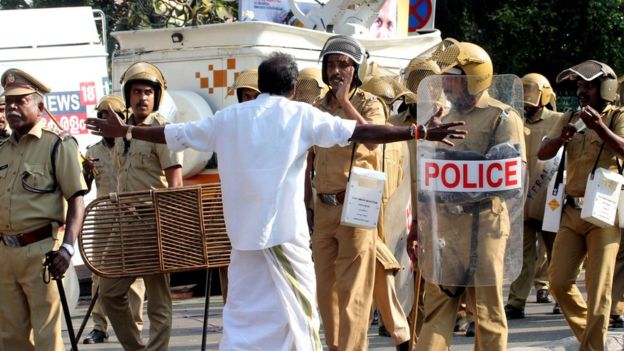 Image copyright GETTY IMAGES
Every year, millions of male devotees trek up a steep hill, often barefoot, to visit the shrine. They also undertake a rigorous 41-day fast, abstaining from smoking, alcohol, meat, sex and contact with menstruating women before they begin the journey.
Women’s rights campaigners who appealed to the Supreme Court to lift the ban said that this custom violated equality guaranteed under India’s constitution. They added that it was prejudiced against women and their right to worship.
Supporters of the ban argued that the practice had been in effect for centuries, and there was no need to change it now.
So, were any women able to enter last year?
In January, two women defied protesters and entered the shrine.
Kanakadurga, 39, and Bindu Ammini, 40, made history when they entered the Sabarimala shrine – but they had to do so under heavy police protection and were also met with massive protests after.
Right-wing groups, supported by India’s ruling Hindu nationalist Bharatiya Janata Party (BJP), demanded a state-wide shutdown after, and businesses and transportation became paralysed.
Across the state hundreds were arrested, and at least one person was killed in clashes.
In an interview with the BBC, the women said they felt it necessary to uphold women’s rights and they weren’t afraid of mobs “enraged” by their actions.
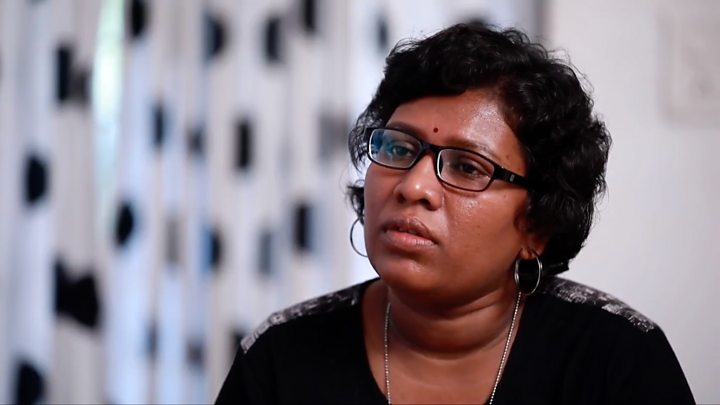
“I am not afraid. But every time women make any progress, society has always made a lot of noise,” Ms Kanakadurga told the BBC in January.
But their decision to enter the temple also came at heavy personal cost.
She alleged that she had been beaten by her mother-in-law and abandoned. She has since filed for divorce.
Source: The BBC

 CHINDIA ALERT: You'll be living in their world, very soon