11/05/2020
- Sales in April hit 2.07 million units in the world’s biggest car market, up 4.4 per cent from a year earlier, according to the country’s largest industry association
- The number of new energy vehicles (NEVs) sold fell for a tenth straight month to
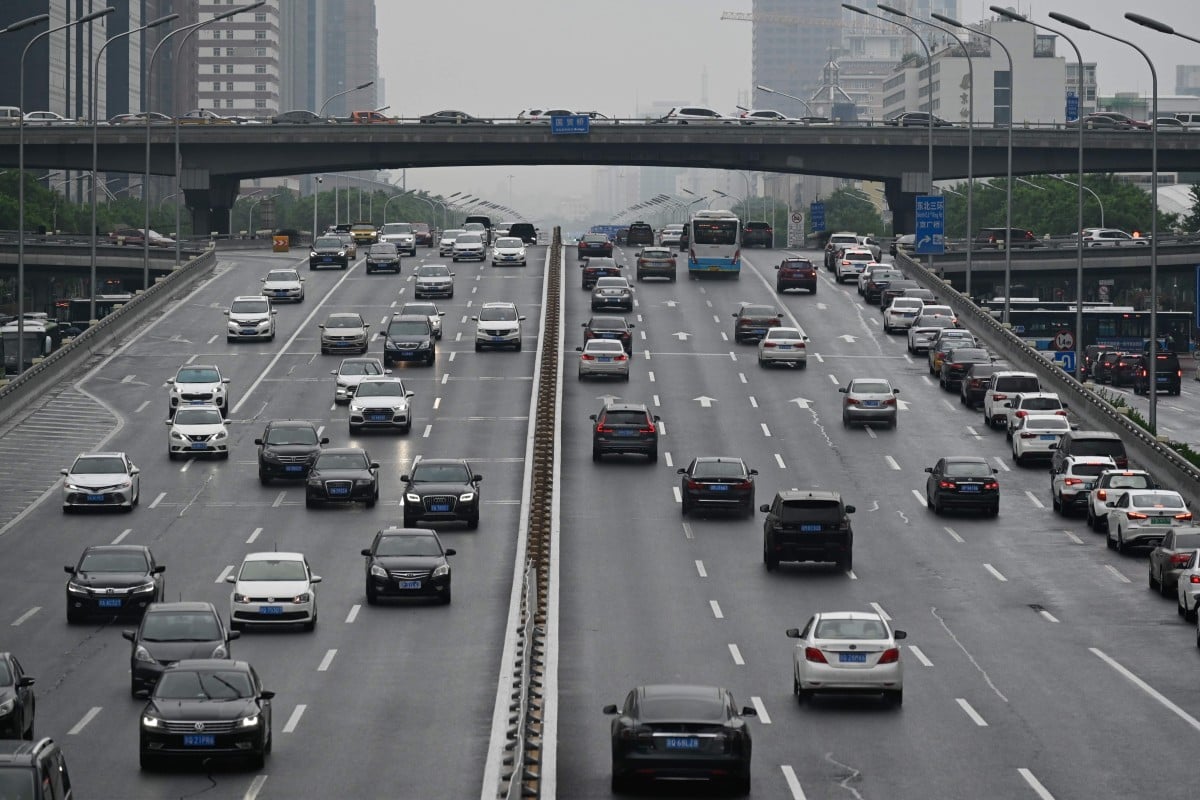
The global industry has been hit hard by the health crisis, but there is growing optimism of improvement in business in China as the country has largely contained the outbreak and started easing lockdown measures. Photo: AFP
China’s monthly car sales rose for the first time in almost two years in April, industry data showed, as more customers visited showrooms after the economy began to open up and authorities loosened coronavirus-related travel restrictions.
Sales in April hit 2.07 million units in the world’s biggest car market, up 4.4 per cent from a year earlier, according to data from the China Association of Automobile Manufacturers, the country’s largest industry association.
This follows a 43 per cent drop in March and a sharper 79 per cent plunge in February
as the pandemic pummelled demand. Monthly sales in China last rose in June 2018.
The number of new energy vehicles (NEVs) sold fell for a tenth straight month to 72,000 units, the data showed. NEVs include battery-powered electric, plug-in hybrid and hydrogen fuel-cell vehicles.
The global industry has been hit hard by the health crisis, but there is growing optimism of
improvement in business in China as the country has largely contained the outbreak and started easing lockdown measures.
Volkswagen reported positive China sales in April, while General Motors’ China ventures saw double-digit year-on-year growth last month.
Source: SCMP
Posted in 2018, almost, April, authorities, car, China, China Association of Automobile Manufacturers, coronavirus, coronavirus-related, customers, demand, eased, economy, February, first, gain, General Motors, global industry, health crisis, hydrogen fuel-cell vehicles, June, largest industry association, lockdown, Mark, new energy vehicles (NEVs), outbreak, pandemic, Plug-in hybrid, pummelled, restrictions, Sales, showrooms, travel restrictions, two years, Uncategorized, Volkswagen, world’s biggest car market |
Leave a Comment »
03/05/2020
BEIJING (Reuters) – General Motors’ sales in China saw double-digit year-on-year growth in April, its two local ventures said on Sunday, as the world’s biggest auto market recovers from the coronavirus.
GM’s (GM.N) joint venture with SAIC Motor Corp (600104.SS), which manufactures Buick, Chevrolet and Cadillac vehicles, said its sales in China grew 13.6% compared to a year earlier. It said it had sold 111,155 units in April, including exported cars.
Meanwhile, SGMW, a separate GM venture with SAIC and Guangxi Automobile Group which produces no-frills minivans and has started to make higher-end cars, said its sales jumped 13.5% to over 127,000 units last month.
U.S. automaker GM, which is China’s second biggest foreign car company after Volkswagen (VOWG_p.DE), said its sales in China fell 43.3% in the first three months of 2020 compared with the same period last year.
To attract customers, GM and SAIC have hired social media celebrities to promote its new models and are offering free medical masks to customers.
China’s biggest automaker SAIC, which sold more than 6 million cars last year, said its sales rose 0.5% compared to the same period last year. As well as the GM venture, it also builds its own brand cars and operates a venture with Volkswagen.
Source: Reuters
Posted in April, Buick, Cadillac, cars, Chevrolet, China sales, coronavirus, double-digit, General Motors, GM, GM’s (GM.N), growth, Guangxi Automobile Group, higher-end, joint venture, jumped, last month, manufactures, market, minivans, no-frills, rebound, recovers, SAIC Motor Corp, SAIC's, Sales, SGMW, Sunday, Uncategorized, vehicles, world’s biggest auto market, year-on-year |
Leave a Comment »
28/04/2020
SHANGHAI (Reuters) – Apple Inc’s (AAPL.O) discounts on the iPhone 11 in China and the release of a new low-price SE model have put the company in a better position than rivals to weather a coronavirus-related plunge in global smartphone demand.
While China, which accounts for roughly 15% of Apple’s revenue, appears to be a rare bright spot, investors will be keen to get a picture of global demand when the Cupertino, California-headquartered company reports second-quarter results on Thursday.
The iPhone maker has shut retail stores in the United States and Europe following the COVID-19 outbreak, and China is the only major market where it has been able to reopen all shops.
Consumer spending is expected to be muted as the pandemic has crippled economies and Apple, the world’s second-most valuable tech company, is better armed with the launch of its new price-conscious iPhone model, analysts said.
“Apple is better positioned than most to experience a rapid recovery in a post COVID world,” Evercore analyst Amit Daryanani said in a research note. “We see demand as pushed out, not canceled.”
He added that the launch of the $399 iPhone SE suggested that Apple’s supply chain was getting back on its feet after weeks of shutdown earlier this year.
Analysts expect Apple to report a 6% drop in revenue and an 11% fall in net income in its fiscal second quarter, according to Refinitiv data.
On the other hand, Chinese brands such as Oppo and Vivo who have steadily moved to offer high-end models to challenge iPhones, stand to lose marketshare as bargain hunters choose Apple.
Earlier this month, several online retailers in China slashed prices of the iPhone 11 by as much as 18% – a tactic Apple has used in the past to boost demand. And while initial social media reaction to the new iPhone SE was muted, analysts said they were seeing a pick up in demand.
The cheaper iPhone SE could tempt iPhone owners to opt for a newer device, something they might have otherwise delayed in a weak economy, said Nicole Peng, who tracks the smartphone sector at research firm Canalys.
“People want to avoid uncertainty in a downturn,” she said. “Having a brand like Apple that can showcase quality and make people less worried about breakdowns or after-sales service can bring in buyers.”
CHEAP IS GOOD
Early data suggests that the Chinese smartphone market is recovering rapidly in the aftermath of the virus, and Apple has emerged relatively unscathed.
Sales of iPhones in China jumped 21% last month from a year earlier and more than three fold from February, government data showed, meaning March-quarter sales in the country were likely to have slipped just 1%.
To be sure, a recovery in Chinese demand won’t offset sales lost in the United States and Europe. And the company is yet to launch a smartphone enabled with 5G wireless technology like those offered by Asian rivals, a disadvantage for Apple so far.
But those same expensive 5G models may not sell well in the current climate of frugality, analysts said.
“If there are no massive subsidies (in China), I doubt there will be many smartphone users who will be eager to upgrade to 5G,” said Linda Sui, who tracks the smartphone sector at research firm Strategy Analytics.
Sui expects iPhone shipments in 2020 to be down 2 percentage points at the most, versus double digit declines at Chinese firms.
Apple also has revenue from its services business to fall back on. It has leveraged its large iPhone customer base to boost services revenue from music, apps, gaming and video.
“Apple’s Services segment should remain resilient in today’s work-from-home environment, thereby demonstrating the durability of Apple’s model,” Cowen analyst Krish Sankar said.
Source: Reuters
Posted in 5G models, 5G wireless technology, accounts, after, analyst, analysts, appears, Apple, Apple Inc’s (AAPL.O), apples, are bright spot, armed, Asian, avoid, back on its feet, better, blow, brand, breakdowns, Buyers, California-headquartered, canceled, cheaper, China, Chinese brands, climate, Company, Consumer spending, coronavirus-related, COVID, COVID-19 outbreak, crippled, Cupertino, current, demand, discounts, downturn, drop, earlier, economies, Europe, Evercore, expected, experience, fall, February, fiscal, fold, following, from, frugality, fter-sales service, global, Government, income, investors, IPhone, iPhone 11, iPhone SE, just, last month, launch, low-price, Major, maker, March, market, marketshare, model, muted, net, new, online retailers, only, Oppo, pandemic, plunge, position, Post, price-conscious, prices, put, quality, quarter, rapid, reaction, recovery, Refinitiv data, release, reopen, reports, research note, results, retail stores, Revenue, rivals, roughly, Sales, SE model, second-quarter, Shanghai, shops, showcase, shut, shutdown, slashed, slipped, smartphone, social media, Strategy Analytics, suggested, Supply chain, tactic, this year, Three, Thursday, to cushion, Uncategorized, uncertainty, United States, Virus, Vivo, weak economy, weather, weeks, World, world’s second-most valuable tech company, worried, year |
Leave a Comment »
23/04/2020
(Reuters) – Consumer goods giant Unilever Plc (ULVR.L) (UNA.AS) withdrew its full-year forecast on Thursday, saying the hit from lockdowns in China and India, as well as lower ice cream sales, offset strong U.S. and European sales of cleaning items, sending its shares down 5%.
Underlying sales across Asia, the Middle East and Russia, fell 3.7%, as lockdowns in the quarter restricted restaurant visits and shopping in China and led to factory shutdowns that halted production in India.
In Europe, Turkey and Latin America, Unilever’s 3 billion euro ice cream business was hit by national efforts to prevent the spread of the coronavirus, deterring distributors in holiday destinations from buying stock.
“Many of our classic out-of-home retailers like leisure sites, travel hubs, beaches and tourist destinations were closed,” Chief Financial Officer Graeme Pitkethly said on a call.
These factors countered increased sales in the United States and Europe, where consumers stocked up on laundry detergents, Domestos bleach, Cif cleaning products and personal hygiene items, as the virus spread to those regions.
Overall, first-quarter turnover rose 0.2% to 12.40 billion euros ($13.42 billion), slightly missing the estimate of 12.77 billion euros based on analysts polled by Factset.
The company withdrew its sales performance targets for the year, which forecast growth at the lower end of a 3%-5% range, saying it could not “reliably assess the impact” of the virus, , although it said it would still pay its interim dividend.
Jefferies analysts said investors would be asking why Unilever “has apparently been hit so badly, and early, by the negative impacts of COVID-19 without seeing much of the positives. We expect a difficult day for the shares.”
Shares in Unilever, which joins spirits maker Diageo (DGE.L) and other consumer goods companies in withdrawing guidance, was down 5.5% at 4,008 pence in early trading.
The Anglo-Dutch company’s report follows results from larger U.S. rival Procter & Gamble (PG.N), which last week said its U.S. sales had seen their biggest rise in decades.
Unilever also said underlying sales grew strongly in North America, rising 4.8% as shoppers stocked up on personal hygiene products, Knorr soups and Hellmann’s dressings.
In Europe, sales growth was led by Germany and Britain, although prices across the region fell.
“We are adapting to new demand patterns and are preparing for lasting changes in consumer behaviour, in each country, as we move out of the crisis and into recovery,” Unilever Chief Executive Alan Jope said in a statement.
The company said it was directing a chunk of its 500 million euro package to support suppliers towards its ice cream distribution partners, which Pitkethly called the “jewel” in its supplier relationships.
Source: Reuters
Posted in 5%, Anglo-Dutch, Asia, Britain, China, Cif cleaning products, cleaning items, Consumer goods, Diageo, Domestos bleach, down, Europe, European, forecast, full year, Germany, giant, guidance, ice cream, India, knocks, Latin America, laundry detergents, lockdowns, lower, Middle East, North America, offset, recovery, Russia, Sales, sending, shares, slide, strong, the hit, Thursday, Turkey, U.S., Uncategorized, Unilever, Unilever plc, Virus, withdraws, withdrew |
Leave a Comment »
23/04/2020
BEIJING (Reuters) – China will cut its subsidies on new energy vehicles (NEV) by 10% this year, and will expand government purchases of NEVs, the finance ministry said on Thursday.
China will in principle cut such subsidies by 20% in 2021 and 30% in 2022, the finance ministry said in a statement. However, it will not cut subsidies on qualified new energy commercial vehicles earmarked for public purposes this year.
Under the plan, China would extend subsidies for NEV purchases to 2022, rather than ending them this year, and extend their purchase tax exemption for two years.
China will slightly lift the requirements for the driving range and power efficiency of cars qualified for the subsidies, the statement said, adding authorities will support the sales of cars with swappable batteries, a technology that has been pursued by Chinese electric vehicle makers Nio Inc (NIO.N) and BAIC BluePark (600733.SS).
Only passenger cars cheaper than 300,000 yuan (34,330.23 pounds) will be offered subsidies, it said. The price is higher than starting price of Tesla Inc’s (TSLA.O) China-made Model 3 sedans.
China also said authorities will give priority to purchase new energy vehicles for government use but did not give further details.
The new policy is effective from April 23. NEVs include battery-powered electric, plug-in hybrid and hydrogen fuel-cell vehicles.
China has set an aggressive goal for NEVs to account for a fifth of auto sales by 2025 compared with the current 5%, as it seeks to reduce pollution and cultivate homegrown champions.
Sales of NEVs, however, contracted for a ninth month in a row in March and were down over 50% from a year earlier, according to data from the China Association of Automobile Manufacturers (CAAM).
Source: Reuters
Posted in 10, 20%, 2021, 2022, 2025, 30, 50%, according, account, aggressive, April, auto sales, BAIC BluePark, batteries, battery-powered electric, cars, champions, cheaper, China, China-made Model 3, Chinese, commercial vehicles, compared, contracted, cultivate, current, cut, Data, down, driving, earlier, earmarked, effective, efficiency, electric vehicle makers, ending, exemption, expand, extend, fifth, Finance Ministry, from, goal, Government, higher, homegrown, However, in a row, in principle, lift, March, month, new, new energy vehicles (NEV), ninth, Nio Inc, offered, only, passenger, plug-in hybrid and hydrogen fuel-cell vehicles, policy, pounds, power, price, public purposes, purchase tax, purchases, pursued, qualified, range, reduce pollution, requirements, Sales, sedans, slightly, starting price, statement, subsidies, swappable, Technology, Tesla Inc’s, this year, Thursday, to cut, two, Uncategorized, year, years, yuan |
Leave a Comment »
14/04/2020
PARIS/BEIJING (Reuters) – French automaker Renault SA (RENA.PA) is ditching its main passenger car business in China following poor sales at the loss-making venture with Dongfeng Motor Group (0489.HK).
A slowdown in Chinese automotive sales, which is expected to worsen this year due to the coronavirus crisis, has heaped pressure on carmakers that were already struggling to establish a big presence in China, the world’s biggest vehicle market.
Renault, which entered the Dongfeng joint venture in 2013 and began producing gas-powered cars under the tie-up in Wuhan three years later, is one of the few global carmakers to exit a major project in China in recent years, however.
The carmaker, which will retain a presence in China with other ventures, including in electric vehicles, is trying more broadly to find cost savings and pull out of businesses where it is struggling to make its mark and turn a profit.
This is part of Renault’s efforts to make the most of its alliance with Japanese partner Nissan (7201.T), and the two are due provide a strategy update by mid-May.
Dongfeng had been anticipating Renault’s potential exit from the Chinese joint venture as long as a year ago, a banking source familiar with the matter said. Sales were under pressure long before the coronavirus crisis walloped demand further, another source with knowledge of the situation said.
The venture sold only 18,607 cars in 2019, far below its annual capacity of 110,000 and reported an operating loss of more than 1.5 billion yuan ($212 million).
Dongfeng, which will take on Renault’s 50% stake in their venture, plans to revamp and upgrade the business’s existing car plants, which will no longer make Renault-branded cars, a spokeswoman for the Chinese automaker said on Tuesday.
Dongfeng will arrange positions for staff at the venture within its wider group operations, she added.
Financial terms of the transaction were not disclosed.
‘NEW CHAPTER’
Renault said it would focus on its light commercial vehicle business with Brilliance China Automotive Holdings (1114.HK). That venture plans to roll out five new models before 2023 and is planning export cars to other markets.
Another focus is electric vehicles, which will be built by its venture with Jiangling Motors Corporation Group.
Renault and Dongfeng also said they would continue to cooperate on “connected vehicles” and work with common partner Nissan Motor Co Ltd (7201.T) on new generation engines.
“We are opening a new chapter in China. We will concentrate on electric vehicles and light commercial vehicles, the two main drivers for future clean mobility and more efficiently leverage our relationship with Nissan,” Francois Provost, chairman of the China region for Renault, said in a statement.
That could include relying on Nissan dealers rather than Renault ones in the longer term, a source familiar with the matter said.
Renault and Nissan, which both reported losses for 2019 even before the global pandemic hit, are looking to rebalance a relationship strained by the 2018 arrest and subsequent flight of former alliance supremo Carlos Ghosn.
The ex-boss-turned-fugitive, accused of financial misconduct, denies any wrongdoing.
Other international carmakers have struggled in China too.
In 2018, Japanese automaker Suzuki Motor Corp (7269.T) sold its stake in a venture with Changan Automobile (000625.SZ).
Renault’s French rival PSA (PEUP.PA), meanwhile, is exiting a small joint venture with China’s Chongqing Changan Automobile (000625.SZ) and said in February it had suffered 700 million euros in losses last year in the country.
Source: Reuters
Posted in 2013, automaker, Beijing, Brilliance China Automotive Holdings, car business, cars, Changan Automobile, China, Chongqing Changan Automobile, ditching, Dongfeng, Dongfeng Motor Group, exit, February, French, gas-powered, global, Japanese, Jiangling Motors Corporation Group, joint venture, main, Major, Nissan, nissan motor co ltd, Paris, partner, passenger, producing, project, PSA (PEUP.PA), quits, recent, Renault, Renault SA (RENA.PA), Sales, Uncategorized, venture, weak, Wuhan, years |
Leave a Comment »
10/04/2020
BEIJING (Reuters) – China will promote the sales of export products in domestic markets, as foreign trade faces unprecedented challenges due to the coronavirus pandemic, an assistant commerce minister said on Friday.
As the coronavirus spreads to almost all of China’s trading partners, the world’s second-largest economy is set to reach a grim milestone for full year growth, with the pace of expansion likely to be the slowest since the Cultural Revolution ended in 1976. And, the export sector is facing millions of job losses and factory shutdowns.
“Due to the rapid spread of the epidemic in the world, foreign demand has slumped and the biggest difficulty facing foreign trade companies is the plunge in orders,” said Ren Hongbin, the assistant minister at the Ministry of Commerce.
He said firms across the board have had their orders cancelled or delayed, and new orders are “very hard to sign”.
“The uncertainty about the pandemic has become the biggest uncertainty for foreign trade development.”
Forecasters expect China’s 2020 growth could be nearer the 2.0% mark – the slowest in over 40 years – due to the sweeping impact of the pandemic both at home and overseas. The economy grew 6.1% last year.
China’s overseas shipments fell 17.2% in January-February from the same period a year earlier, marking the steepest fall since February 2019. Imports sank 4% from a year earlier.
Among the government measures to support the sector, China is accelerating efforts to build online trade fairs and guiding exporters to work with e-commerce retailers for sales in domestic markets and coordinating with its trading partners to stabilise supply chains, said Ren.
The Canton Fair, China’s oldest and biggest trade fair due to take place online, will feature live-streaming services for participants, Li Xingqian, another commerce ministry official, told the same briefing. The fair was originally scheduled to begin on April 15, but was postponed due to the coronavirus outbreak.
China is willing to boost trade relations with other countries, including the United States, under the new circumstances, said Ren, adding that Beijing hopes to work together with Washington to promote bilateral trade.
Both countries have been engaged in a near two-year long trade war with tit-for-tat tariffs on each other’s goods, before negotiators called a truce with an interim trade deal in January.
Source: Reuters
Posted in 0, 1, 10, 11, 12, 13, 14, 15, 16, 17, 18, 19, 1976, 2, 20, 21, 22, 23, 24, 25, 26, 27, 28, 29, 3, 30, 31, 4, 5, 6, 7, 8, 9, April, batters, Beijing, bilateral trade, cancelled, Canton Fair, challenges, China, China’s, Commerce minister, companies, coronavirus, coronavirus outbreak, Coronavirus pandemic, Cultural Revolution, delayed, domestic markets, domestically, encourages, epidemic, export goods, export products, export sector, Factory, February, foreign demand, foreign trade, global, imports, interim trade deal, January, job losses, live-streaming services, milestone, millions, Ministry of Commerce, Negotiators, oldest and biggest trade fair, online, orders, overseas shipments, pandemic, plunge, promote, Sales, shutdowns, slumped, spreads, tit-for-tat tariffs, Trade, trade war, trading partners, Uncategorized, uncertainty, United States, unprecedented, Virus, Washington, World, world’s second-largest economy |
Leave a Comment »
10/02/2020
SHANGHAI (Reuters) – China’s smartphone sales may plunge by as much as 50% in the first quarter, as many retail shops have closed for an extended period and production has yet to fully resume due to the fast spread of a new coronavirus, according to research reports.
The virus outbreak, which has killed more than 900 people and roiled China’s manufacturing industry, comes as top smartphone vendors such as Huawei had hoped China’s 5G rollout plans this year would help the world’s biggest smartphone market rebound after years of falling sales.
“Vendors’ planned product launches will be canceled or delayed, given that large public events are not allowed in China,” research firm Canalys said in a note last week.
“It will take time for vendors to change their product launch roadmaps in China, which is likely to dampen 5G shipments.”
Canalys expects China’s smartphone shipments to halve in the first quarter from a year ago, while IDC, another research firm that tracks the tech sector, forecasts a 30% drop.
Apple Inc said last week it is extending its retail store closures in China and has yet to finalise opening dates, as Foxconn, which assembles iPhones, struggles to fully resume factories.
Foxconn received government approval on Monday to resume production at a plant in the city of Zhenghzou, but its major plant in Shenzhen remain unopened.
Huawei, China’s biggest smartphone vendor, said its manufacturing capacity is “running normally” without specifying further. But like many other local peers, Huawei relies heavily on third-party manufacturers for production.
If factories cannot resume production to full capacity on time, this could delay brands’ ability to bring their newest products to market, analysts said.
Xiaomi Corp, Huawei, and Oppo, three of China’s top Android brands, are all expected to announce flagship devices in the first half.
Oppo told Reuters that while the impact of the virus will affect operations at some local factories, “manufacturing capacity can be guaranteed effectively” thanks to its plants overseas.
Xiaomi did not respond to requests for comment.
“The delays in reopening factories and the labour return time will not only affect shipments to stores, it will also affect the product launch times in the mid- and long-term,” Will Wong, an IDC analyst, said.
Globally, smartphone production will decrease by 12% in the March quarter to a five-year low of 275 million units, research firm TrendForce said on Monday. It revised down iPhone production by 10% to 41 million units, while Huawei’s output forecast was cut by 15% to 42.5 million phones.
Samsung Electronics Co, the world’s top smartphone maker, is seen the least affected by the virus outbreak as its main production base is in Vietnam, the report said, lowering its production forecasts by just 3% to 71.5 million units.
Source: Reuters
Posted in 5G rollout, android, Apple Inc., brands, China's, closed, coronavirus, devices, extended period, first-quarter, flagship, Foxconn, halve, Huawei, IDC, iPhones, manufacturing industry, plans, production, resume, retail shops, Reuters, Sales, samsung electronics co, Shanghai, Shenzhen, smartphone, TrendForce, Uncategorized, vendors, virus outbreak, Xiaomi Corp., Zhenghzou |
Leave a Comment »


 CHINDIA ALERT: You'll be living in their world, very soon