Archive for ‘sanctuary’

31/05/2020

Hong Kong: China fury amid global pressure over security law

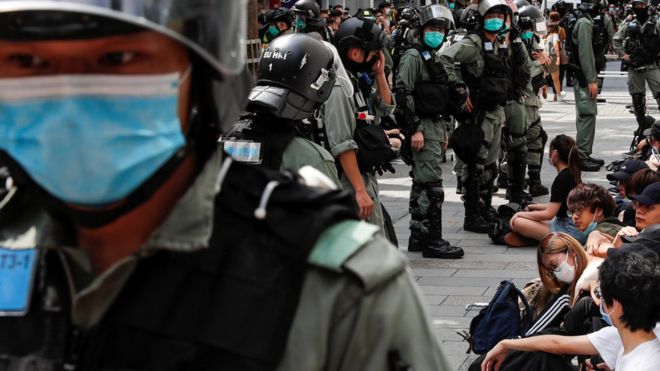
Protest on 27 MayImage copyright REUTERS

China is facing mounting criticism over a planned security law for Hong Kong which would make it a crime to undermine Beijing’s authority in the territory.

The UK and US said at a private session of the UN Security Council that the law would curtail the city’s freedoms.

China, which blocked a formal meeting, warned them to “stop interfering”.

Hong Kong’s autonomy is guaranteed by the 1997 agreement under which it was returned to China from the UK.

It enjoys some freedoms – of the press and association – unseen in mainland China.

But there are fears the proposed law – which has sparked a wave of anti-mainland protests – could end Hong Kong’s unique status.

This week, Britain said that if China went forward with the law, it could offer British National (Overseas) passport holders a path to UK citizenship.

There are 350,000 BNO passport holders in Hong Kong who currently have the right to visit the UK for up to six months without a visa.

On Friday, the UK Home Office confirmed the new rights could be given to up to three million people with BNO status – as long as they applied for and were granted a passport.

China says all BNO passport holders are Chinese nationals, and if the UK changes this practice, it would violate international law.

Australia, Canada and the EU have also criticised the security law and its implications for Hong Kong.

Taiwan’s parliament has backed a plan to offer sanctuary to people who want to flee Hong Kong, but China – which considers Taiwan to be part of its own territory – has warned the island not to get involved.

On Friday, Chinese Foreign Ministry spokesperson Zhao Lijian urged other countries to stop interfering in the matter.

“We will take necessary measures to resolutely counter the wrong acts of external forces interfering in Hong Kong affairs”, he said.

What might the US do?

On Wednesday, US Secretary of State Mike Pompeo told Congress that Hong Kong no longer merited special treatment under US law, potentially paving the way for it to be stripped of trading privileges such as lower tariffs than mainland China.

US media reports that President Trump is considering a range of sanctions. These could include strong measures such as stripping Hong Kong of its trading privileges or milder options such as restricting visas and freezing the assets of Chinese officials.

He is expected to make an announcement later on Friday.

The EU has warned that imposing sanctions would not solve the crisis.

“Our relationship with China is based on mutual respect and trust… but this decision calls this into question and I think that we have to raise the issue in our continued dialogue with China”, EU High Representative for Foreign Affairs Josep Borrell said after talks with foreign ministers on Friday.
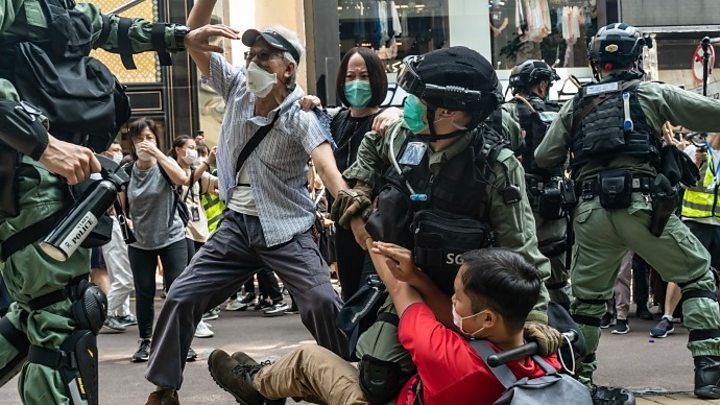
Media caption Police arrested dozens of people in Causeway Bay on Wednesday

Hong Kong’s justice secretary Teresa Cheng told the BBC’s Chinese service that any threat of sanctions was unacceptable.

“Are the sanctions being imposed with a view to coerce another state to change their policy…? Any such sanctions are not going to benefit anyone”.

What is the law about?

China’s parliament has backed the security legislation, which would make it a crime to undermine Beijing’s authority in Hong Kong.

The resolution – which now passes to China’s senior leadership – could also see China installing its own security agencies in the region for the first time.

Full details about exactly what behaviour will be outlawed under the new security law are not yet clear. It is due to be enacted before September.
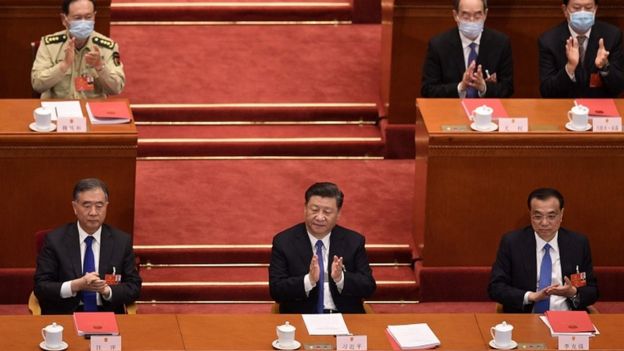
China's President Xi Jinping (c) applauds after the vote during the closing session of the National People's Congress at the Great Hall of the People in Beijing on May 28, 2020Image copyright AFP
Image caption President Xi Jinping and other senior figures applauded when the security law was passed

However, it is expected to criminalise:

  • secession – breaking away from China
  • subversion – undermining the power or authority of the central government
  • terrorism – using violence or intimidation against people
  • activities by foreign forces that interfere in Hong Kong

Experts say they fear the law could see people punished for criticising Beijing – as happens in mainland China. For example, Nobel Laureate Liu Xiaobo was jailed for 11 years for subversion after he co-authored a document calling for political reform.

China’s foreign ministry in Hong Kong described US criticism of the new draft law as “utterly imperious, unreasonable and shameless”.

Source: The BBC
12/12/2019

Citizenship Amendment Bill: India calls in army to Assam and Tripura states

The army has been called into north-eastern India, after thousands of people defied curfews to protest against a new citizenship bill.

The Citizenship Amendment Bill (CAB) offers amnesty to non-Muslim illegal immigrants from three countries.

Critics say the bill discriminates against Muslims – but in the north-east, protesters claim they will be “overrun” by Hindus from Bangladesh.

Indian Prime Minister Narendra Modi has appealed for calm.

Officials said 20-30 people were injured in the demonstrations, and air and railway services have been severely impacted.

The bill – which applies to people from Afghanistan, Bangladesh and Pakistan – was passed in the upper house of parliament on Wednesday night.

It is yet to be ratified by the president, but that is merely a formality.

The ruling Hindu nationalist Bharatiya Janata Party says the CAB will give sanctuary to people fleeing religious persecution.

Illegal migration from Bangladesh has long been a concern in the north-east.

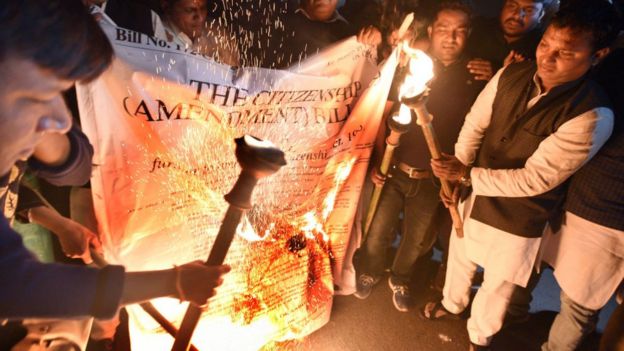
NYC National President Srinivas B.V with party supporters during a torch procession against the Citizenship Amendment Bill at Rajpath near India Gate, on December 11, 2019 in New Delhi, India. Normal life came to a halt on Tuesday in several states amid protests over the Citizenship (Amendment) Bill.Image copyright GETTY IMAGES

How bad are the protests?

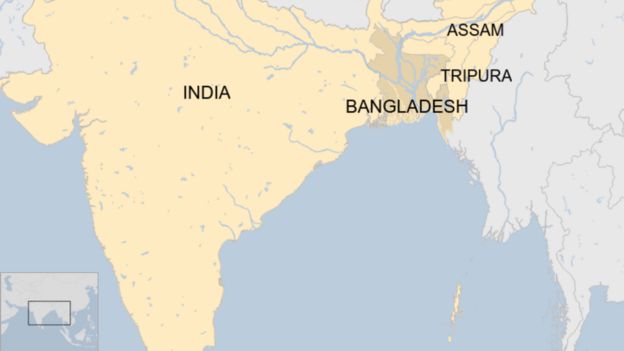
Violent protests intensified on Thursday, and have been particularly bad in the states of Assam and Tripura, which border Bangladesh.

The army has deployed thousands of personnel, as protesters defy curfew orders and spill into the streets.

The protesters blocked roads and set vehicles on fire. There are reports that at least two railway stations have been burned down.

Railway services are suspended and some airlines have started offering rescheduling or cancellation fee waivers.

The AFP news agency reported that police fired blanks into the air in a bid to disperse crowds. They have also used tear gas shells.

Prime Minister Narendra Modi sought to reassure people in Assam, telling them they had “nothing to worry” about.


Read more about the Citizenship Amendment Bill:


“The central government and I are totally committed to constitutionally safeguard the political, linguistic, cultural and land rights of the Assamese people,” he tweeted.

However, with internet and mobile services shut down, it is unlikely residents would have been able to read the message.

The chief minister of Assam was stranded at the airport for several hours on Wednesday because roads were blocked by protests.

What do protesters want?

They want the bill to be repealed, as they say their ethnic and cultural identity is under threat from illegal migration.

Essentially, they do not want any migrants – regardless of religion – to be allowed into the state.

What is further fuelling passions in Assam, is the fact that two million residents – deemed to be illegal immigrants- were left off a citizens’ register last August.

map

The National Register of Citizens (NRC) is a list of people who can prove they came to the state by 24 March 1971, a day before neighbouring Bangladesh became an independent country.

In the run-up to its publication, the BJP had supported the NRC, but changed tack days before the final list was published, saying it was error-ridden.

The reason for that was a lot of Bengali Hindus – a strong voter base for the BJP – were left off the list, and would possibly become illegal immigrants.

The CAB is seen as being linked to the register, although it is not the same thing.

It will help protect non-Muslims who are excluded from the register and face the threat of deportation or internment.

Has the bill been challenged?

The Indian Union Muslim League, a political party, has petitioned the country’s top court to declare the bill illegal.

In their petition to the Supreme Court, the Indian Union Muslim League argued that the bill violated articles of equality, fundamental rights and the right to life.

Source: The BBC

Law of Unintended Consequences

continuously updated blog about China & India

ChiaHou's Book Reviews

continuously updated blog about China & India

What's wrong with the world; and its economy

continuously updated blog about China & India