Chindia Alert: You’ll be Living in their World Very Soon
aims to alert you to the threats and opportunities that China and India present. China and India require serious attention; case of ‘hidden dragon and crouching tiger’.
Without this attention, governments, businesses and, indeed, individuals may find themselves at a great disadvantage sooner rather than later.
The POSTs (front webpages) are mainly 'cuttings' from reliable sources, updated continuously.
The PAGEs (see Tabs, above) attempt to make the information more meaningful by putting some structure to the information we have researched and assembled since 2006.
Malfunction happened during third stage of launch after earlier stages were completed successfully, state media says
Failed mission is second in less than a month after Long March-7A encountered problems after lift-off on March 16
A Long March-3B carrier rocket blasts off from the Xichang Satellite Launch Centre in Sichuan province in November. A similar launch on Thursday ended in failure. Photo: Xinhua
China’s space programme suffered another setback on Thursday night with its second rocket launch failure in less than a month.
Officials are investigating what caused a malfunction during the third stage of the Long March-3B launch after lift-off from the Xichang Satellite Launch Centre in southwest Sichuan province at 7.46pm with an Indonesian Palapa-N1 satellite, Xinhua reported.
“The first and second stages of the rocket performed well, but the third stage malfunctioned,” the report said.
“Debris from the third stage of the rocket and the satellite fell [to the ground]. The launch mission failed.”
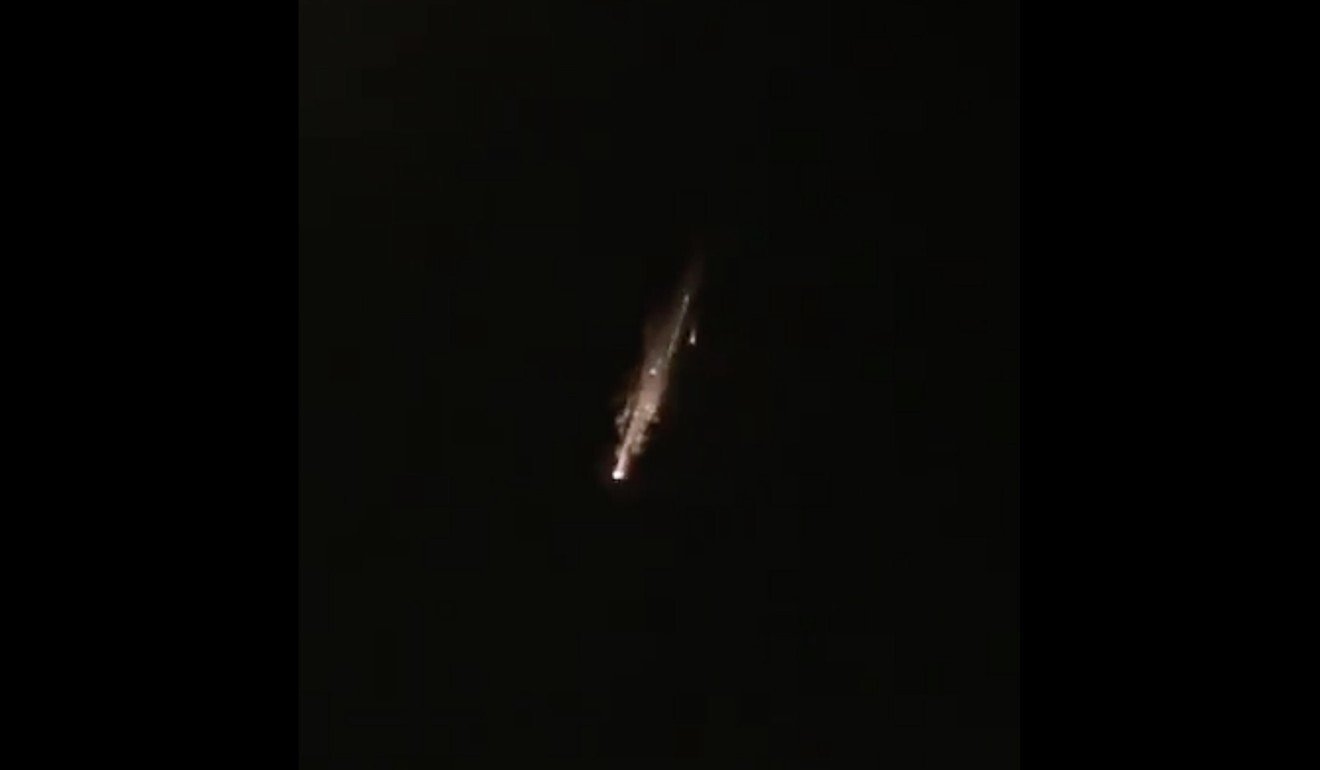
Debris from the failed mission rained down over Guam on Thursday night. Photo: Twitter
China’s state media did not say where the rocket landed, but the office of Guam Homeland Security and Civil Defence said “a fiery object over the Marianas sky” observed on Thursday evening was likely connected to the failed launch.
Video footage of the burning debris falling from the sky was widely circulated on social media.
The setback follows another failed launch on March 16, when China’s new Long March-7A, a three-stage, medium-lift, liquid-fuel rocket, encountered an “abnormality” minutes after lifting off from its launch site in the southern island province of Hainan.
China’s BeiDou system one satellite closer to full operation
11 Mar 2020
The satellite lost on Thursday – the Nusantara 2 – was built in China for Indonesian telecommunication companies Pasifik Satelit Nusantara and Indosat Ooredoo. It was intended to replace an older satellite to provide internet and broadcasting services in Indonesia and across the Asia-Pacific region to Australia, The Jakarta Post reported earlier this month.
It is not known if the failed launch will have an impact on other Long March-3B satellite launches planned for later in the year.
Introduced in 1996, the Long March-3B – also known as the CZ-3B or LM-3B – has been the main orbital carrier rocket of China’s space programme. It was used to carry many of the satellites that make up China’s BeiDou navigation system, with the latest addition being in March.
For that launch, engineers used parachutes to control where the rocket’s boosters would land after being discarded after lift-off so as to minimise the impact on people living below, state media reported.
The latest version of the Long March-3B entered service in 2007 and is dedicated to launching heavy communications satellites of up to 5.5 tonnes into geostationary transfer orbits.
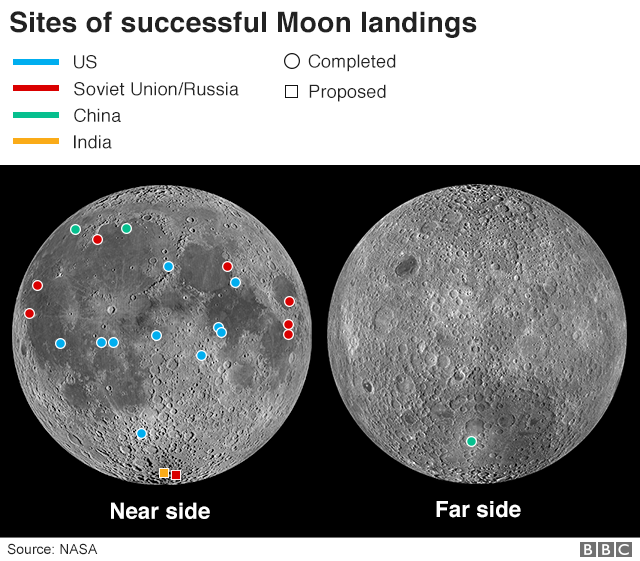
India hopes the $145m (£116m) mission will be the first to land on the Moon’s south pole.
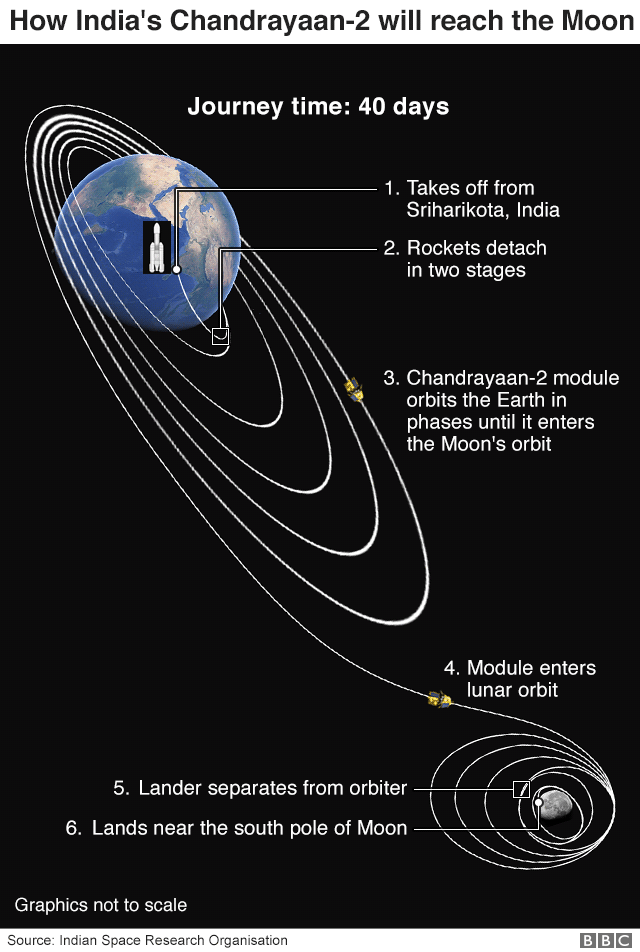
Last month’s launch was the beginning of a 384,000km (239,000-mile) journey. Scientists hope the lander will touch down on the Moon on 6 or 7 September as planned.
India’s first lunar mission, Chandrayaan-1, was launched in 2008 but it did not land on the lunar surface. However it carried out the first and most detailed search for water on the Moon using radars.
Chandrayaan-2 (Moon vehicle 2) will try to land near the little-explored south pole of the Moon.
The mission will focus on the lunar surface, searching for water and minerals and measuring moonquakes, among other things.
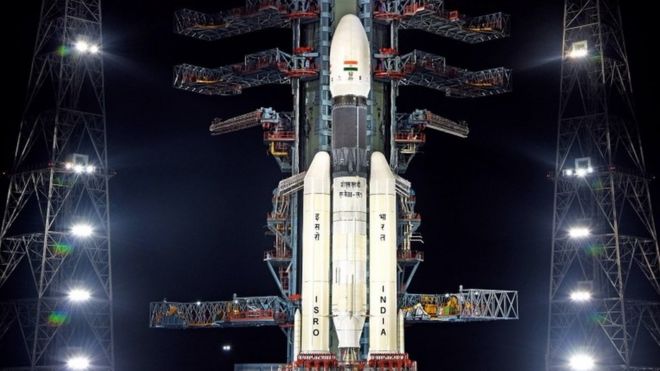
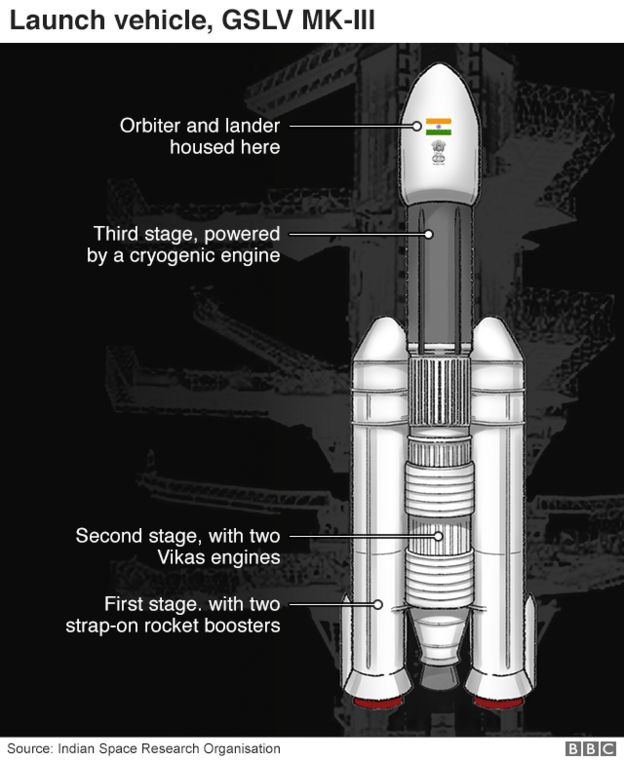
India used its most powerful rocket, the Geosynchronous Satellite Launch Vehicle Mark III (GSLV Mk-III), in this mission. It weighed 640 tonnes (almost 1.5 times the weight of a fully-loaded 747 jumbo jet) and, at 44 metres (144ft), was as high as a 14-storey building.
The spacecraft used in the mission has three distinct parts: an orbiter, a lander and a rover.
The orbiter, which weighs 2,379kg (5,244lb) and has a mission life of a year, will take images of the lunar surface.
The lander (named Vikram, after the founder of Isro) weighs about half as much, and carries within its belly a 27kg Moon rover with instruments to analyse the lunar soil. In its 14-day life, the rover (called Pragyan – wisdom in Sanskrit) can travel up to a half a kilometre from the lander and will send data and images back to Earth for analysis.
Media caption Is India a space superpower?
How long is the journey to the Moon?
The journey of more than six weeks is a lot longer than the four days the Apollo 11 mission 50 years ago took to land humans on the lunar surface for the first time.
In order to save fuel, India’s space agency has chose a circuitous route to take advantage of the Earth’s gravity, which will help slingshot the satellite towards the Moon. India does not have a rocket powerful enough to hurl Chandrayaan-2 on a direct path. In comparison, the Saturn V rocket used by the Apollo programme remains the largest and most powerful rocket ever built.
“There will be 15 terrifying minutes for scientists once the lander is released and is hurled towards the south pole of the Moon,” Isro chief K Sivan said prior to the first launch attempt.
He explained that those who had been controlling the spacecraft until then would have no role to play in those crucial moments. So, the actual landing would happen only if all the systems performed as they should. Otherwise, the lander could crash into the lunar surface.
The chief of the Indian Space Research Organisation (Isro), K Sivan, said this was “the most complex space mission ever to be undertaken by the agency”.
If the launch had gone to plan, the lander and rover would have been expected to touch down in early September.
India’s space agency is yet to give more details on why the launch was delayed and how it will affect the timeline.
The country’s first lunar mission in 2008 – Chandrayaan-1 – did not land on the lunar surface, but it carried out the first and most detailed search for water on the Moon using radars.
How will it get to the Moon?
Chandrayaan-2 (Moon vehicle 2) will attempt a soft landing near the little-explored south pole of the Moon.
India is using its most powerful rocket, the Geosynchronous Satellite Launch Vehicle Mark III (GSLV Mk-III), in this mission. It weighs 640 tonnes (almost 1.5 times the weight of a fully-loaded 747 jumbo jet) and at 44 metres (144ft) is as high as a 14-storey building.
The spacecraft weighs 2,379kg (5,244lb) and has three distinct parts: an orbiter, a lander and a rover.
The orbiter, which has a mission life of a year, will take images of the lunar surface, and “sniff” the tenuous atmosphere.
The lander (named Vikram, after the founder of Isro) weighs about half as much, and carries within its belly a 27kg Moon rover with instruments to analyse the lunar soil. In its 14-day life, the rover (called Pragyan – wisdom in Sanskrit) can travel up to a half a kilometre from the lander and will send data and images back to Earth for analysis.
“India can hope to get the first selfies from the lunar surface once the rover gets on its job,” Dr Sivan said.
A new frontier for India’s space programme
By science writer Pallava Bagla
A soft landing on another planetary body – a feat achieved by just three other countries so far – would be a huge technological achievement for Isro and India’s space ambitions.
It would pave the way for future Indian missions to land on Mars and an asteroid. More importantly, it would open up the possibility of India sending astronauts to the Moon. India hopes to carry out a crewed space flight by 2022.
India also wants to assert itself as a space power to be reckoned with – and national pride is riding high as it aims to hoist its flag on the surface of the Moon.
A successful mission to the Moon would also be a win for India’s ambitious space agency, which has had a string of successes recently.
Media caption Is India a space superpower?
In 2014, it successfully put a satellite into orbit around Mars, becoming only the fourth nation to do so. In 2017, India created history by successfully launching 104 satellites on a single mission, overtaking the previous record of 37 satellites launched by Russia in 2014.
All eyes are on Isro again. Global interest in India’s frugal Moon mission is peaking, according to Simonetta Di Pippo, director of the UN office of Outer Space Affairs.
“The mission’s studies of lunar topography, mineralogy, elemental abundance, the lunar exosphere, and signatures of hydroxyl and water ice will contribute to scientific progress for all of humankind,” she says.
The Indian space community is nervous and Dr Sivan says “there is churning in his stomach”.
“Unknown-unknowns can kill a mission, [although] no stone has been left unturned to understand all the complexities”.
How long is the journey to the Moon?
The launch is only the beginning of a 384,000km (239,000-mile) journey – the robotic craft is expected to land on the Moon some 54 days later.
Isro chose a circuitous route to take advantage of the Earth’s gravity, which will help slingshot the satellite towards the Moon. India does not have a rocket powerful enough to hurl Chandrayaan-2 on a direct path.
“There will be 15 terrifying minutes for scientists once the lander is released and is hurled towards the south pole of the Moon,” Dr Sivan says.
He explains that those who had been controlling the spacecraft until then will have no role to play in those crucial moments. The actual landing, he adds, is an autonomous operation dependent on all systems performing as they should. Otherwise, the lander could crash into the lunar surface.
Earlier this year, Israel’s first Moon mission crash-landed while attempting to touch down.
Who is on the team?
Nearly 1,000 engineers and scientists have worked on this mission. But for the first time, Isro has chosen women to lead an interplanetary expedition.
Two women are steering India’s journey to the Moon. While programme director Muthaya Vanitha has nurtured Chandrayaan-2 over the years, it will be navigated by Ritu Karidhal.
“Women power is powering India’s Moon ambitions,” Dr Sivan said, adding that at Isro, “women and men are all equal. Only talent matters – not the gender.”
The Indian Space Research Organisation (Isro) will launch the country’s newest satellite GSAT-7A, which will give a boost to the defence forces’ communication capabilities, from Andhra Pradesh’s Sriharikota on Wednesday.
In the third mission in just over a month, the space agency will launch the 2,250 kg operational communication satellite from the second launch pad of Satish Dhawan Space Centre. (AP)
The Indian Space Research Organisation (Isro) on Wednesday launched the country’s newest satellite GSAT-7A, which will give a boost to the defence forces’ communication capabilities, from Andhra Pradesh’s Sriharikota on Wednesday.
In the third mission in just over a month, the space agency launched the 2,250 kg operational communication satellite from the second launch pad of Satish Dhawan Space Centre at 4.10pm on Wednesday.
The satellite was carried by the Geosynchronous Satellite Launch Vehicle-F11 (GSLV-F11), Isro’s 35th communication satellite and the 13th flight of the GSLV rocket to orbit.
The GSLV-Mk II rocket launched the satellite into the temporary orbit after a flight of nearly 20 minutes. The rocket will be taken into the geostationary or circular orbit using the onboard propulsion system and it will take few days after the separation from the launcher to reach its orbital slot.
“GSLV F11 is Isro’s fourth generation launch vehicle with three stages. The four liquid strap-ons and a solid rocket motor at the core form the first stage. The second stage is equipped with high thrust engine using liquid fuel. The Cryogenic Upper Stage forms the third and final stage of the vehicle,” the space agency said on its website.
According to reports, GSAT-7A has been built exclusively for the Indian Air Force (IAF) and the Indian Army and will add to the forces’ communication capabilities.
The satellite will allow IAF to interlink its ground radar stations, airbases and airborne early warning and control (AWACS) aircraft, and reduce the reliance on on-ground control stations for drones, they said. It will also boost the air force’s network-dependent warfare capabilities, enhancing its abilities to operate globally.
Wednesday’s mission will be the space agency’s last mission for this year. This year, Isro launched GSAT-11 on December 5 on a European vehicle from French Guinea’s Kourou, GSAT-29 on November 14 on its GSLV-MkIII vehicle and the ill-fated GSAT-6A on March 29 from Sriharikota.
The launch of Chandrayaan-2 and the PSLV-C44 remote-sensing satellite launch are among the seven missions lined up in 2019.
Image copyrightISROImage captionThe satellite was launched from the Kourou spaceport in French Guiana early on Wednesday
India’s heaviest satellite has gone into orbit on a French rocket to help boost broadband internet services.
Weighing about 5,854kg (12,906lb), the GSAT-11 is India’s “most-advanced” multi-band communication satellite.
The Indian Space Research Organisation (Isro) launched the satellite from the Kourou spaceport in French Guiana early on Wednesday morning.
It will be placed in a geostationary orbit by the end of this month and its transponders will be switched on.
Isro chief K Sivan told reporters that the satellite will “play a vital role in providing broadband services across the country”.
Scientists say it will provide internet access to “off-grid” remote areas in India – hills and islands, for example – where traditional fixed-line broadband services are not available and would be helpful during emergencies and disaster relief. And it will also help provide internet connectivity during air travel in India.
India hired a French rocket to carry the satellite, which is expected to have a life span of 15 years, because it does not have a rocket to carry such a heavy payload.









 CHINDIA ALERT: You'll be living in their world, very soon