Chindia Alert: You’ll be Living in their World Very Soon
aims to alert you to the threats and opportunities that China and India present. China and India require serious attention; case of ‘hidden dragon and crouching tiger’.
Without this attention, governments, businesses and, indeed, individuals may find themselves at a great disadvantage sooner rather than later.
The POSTs (front webpages) are mainly 'cuttings' from reliable sources, updated continuously.
The PAGEs (see Tabs, above) attempt to make the information more meaningful by putting some structure to the information we have researched and assembled since 2006.
Indian defence officials have reported a coronavirus outbreak at a key naval base in the western city of Mumbai.
Twenty-one personnel have tested positive for Covid-19 at INS Angre, which is the seat of the force’s western command, the navy said in a statement on Saturday.
It added that there are no infections aboard any ships or submarines.
India has 11,906 active infections and 480 deaths, according to the latest data from the ministry of health.
The Navy said that they had tested a number of personnel who had come into contact with a soldier who had tested positive earlier this month. Many of those who had tested positive for the virus, the statement added, were asymptomatic.
All 21 personnel live in the same residential block, which has been declared a containment zone and has been placed under lockdown.
In a video message to personnel last week, Navy Chief Admiral Karambir Singh stressed the importance of keeping ships and submarines free of the virus.
“The coronavirus pandemic is unprecedented and it has never been seen before. Its impact has been extraordinary across the globe, including India,” he said.
The navy has been playing an active role in India’s response to the Covid-19 outbreak.
It has set up isolation facilities to treat patients at one of its premier hospital units and is also running quarantine camps.
The outbreak aboard the Indian naval base follows reports of outbreaks aboard vessels belonging to other nations.
More than 500 sailors on the USS Roosevelt have tested positive for the virus and one of them died earlier this week. And nearly a third of the sailors serving with France’s aircraft carrier Charles de Gaulle – 668 out of nearly 2,000 – have been infected with coronavirus.
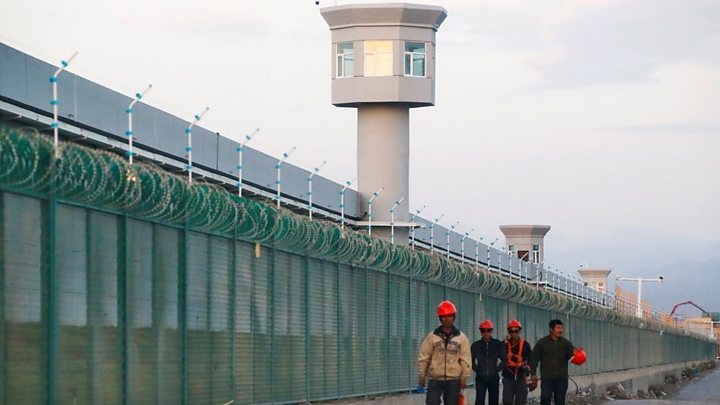
Mr Zakir told reporters in the Chinese capital on Monday that everyone in the centres had completed their courses and – with the “help of the government”- had “realised stable employment [and] improved their quality of life”.
He said that, in future, training would be based on “independent will” and people would have “the freedom to come and go”.
Media caption The BBC’s John Sudworth meets Uighur parents in Turkey who say their children are missing in China
BBC China correspondent John Sudworth points out it is not possible to verify the claims, as access for journalists is tightly controlled and it’s impossible to contact local residents without placing them at risk of detention.
In recent months, independent reports have suggested that some camp inmates are being released, only to face house arrest, other restrictions on their movement or forced labour in factories.
What could be behind the move?
Pressure has been increasing on Beijing in recent months.
A number of high-profile media reports based on leaks to the New York Times and the International Consortium of Investigative Journalists (ICIJ) have shone a spotlight on what is happening at the network of centres, which are believed to hold more than a million people, mainly Uighur Muslims and other minorities.
The bill still needs approval from the Senate and from President Donald Trump.
However, Mr Zakir used the press conference to dismiss the numbers detained as “pure fabrication”, reiterating Beijing’s argument that the centres were needed to combat violent religious extremism.
Media caption“An electric baton to the back of the head” – a former inmate described conditions at a secret camp to the BBC
“When the lives of people of all ethnic groups in Xinjiang were seriously threatened by terrorism, the US turned a deaf ear,” Mr Zakir said at a press briefing.
“Now that Xinjiang society is steadily developing and people of all ethnicities are living and working in peace, the US feels uneasy, and attacks and smears Xinjiang.”
What’s going on in Xinjiang?
Reports of widespread detentions first began to emerge in 2018, when a UN human rights committee was told there were credible allegations that China had “turned the Uighur autonomous region into something that resembles a massive internment camp”.
Rights groups also say there’s growing evidence of oppressive surveillance against people living in the region.
The Chinese authorities said the “vocational training centres” were being used to combat violent religious extremism. However, evidence showed many people were being detained for simply expressing their faith, by praying or wearing a veil, or for having overseas connections to places like Turkey.
Records seen by the BBC show China has deliberately been separating Muslim children from their families.
This is an attempt to “raise a new generation cut off from original roots, religious beliefs and their own language”, Dr Adrian Zenz, a German researcher, told BBC News earlier this year.
“I believe the evidence points to what we must call cultural genocide.”
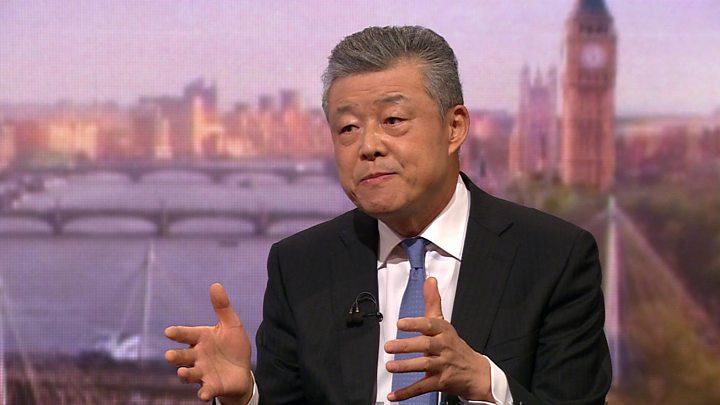
China’s ambassador to the UK said the allegations were “lies”.
Media caption Chinese Ambassador Liu Xiaoming dismisses evidence of a separation campaign in Xinjiang
Researcher says some might find it hard to accept that early humans they assumed to be their ancestors ‘were stupid’
Report suggests that isolation may have made Peking Man less adaptable
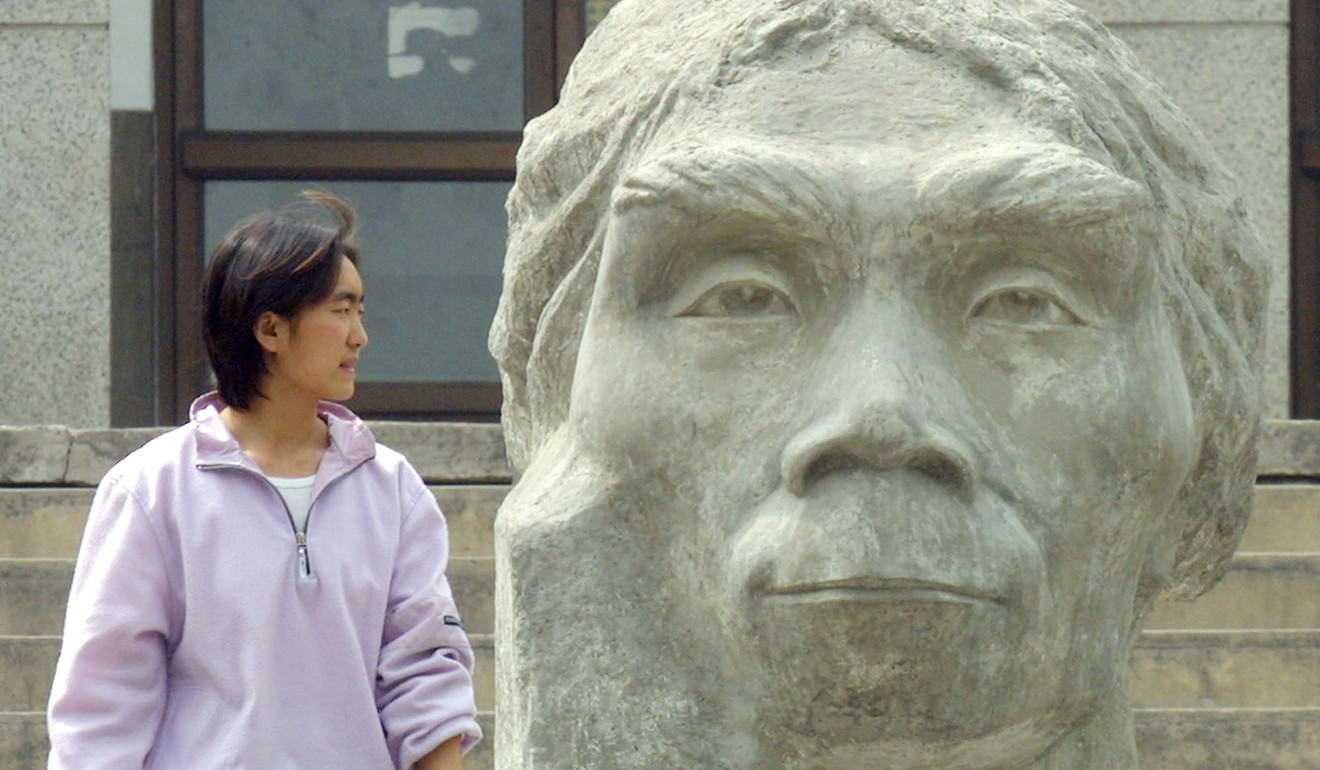
Peking Man is the earliest human sub species discovered in China. Photo: Reuters
“Peking Man”, the Stone Age humans who are believed to be ancestors of the Chinese, left little evidence that they had ever evolved, according to a Chinese scientist.
“It may be hard for some people to accept, but evidence shows they [
] were stupid,” said Professor Wei Qi, a researcher with the Institute of Vertebrate Palaeontology and Palaeoanthropology at the Chinese Academy of Sciences in Beijing.
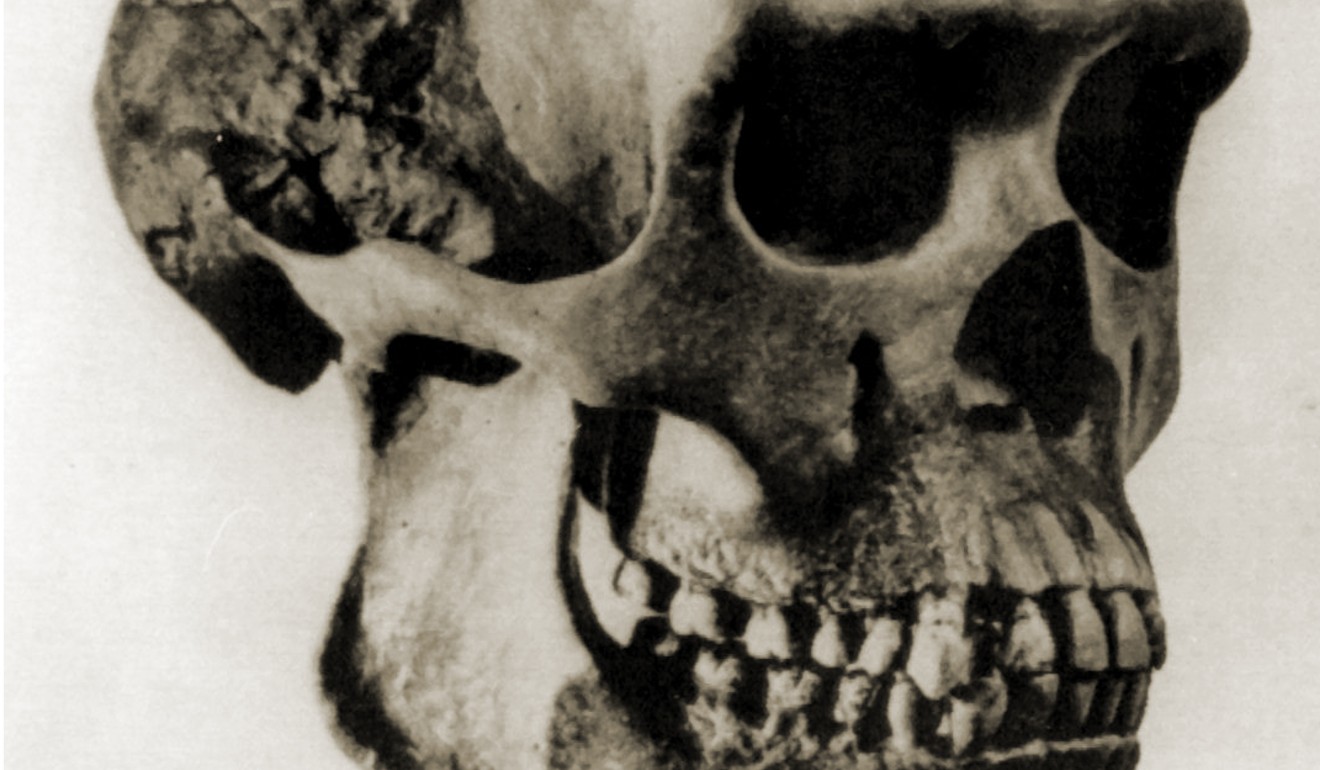
In 1929, a nearly complete skull of Homo erectus pekinensis was discovered in a cave at Zhoukoudian in southwest Peking, as the Chinese capital was then known.
Peking Man became a household name as the earliest human sub species discovered in China, and some scientists maintained that they passed their DNA on to present-day Chinese.
Peking Man is thought to be an ancient ancestor of modern Chinese. Photo: AP
In a paper for the journal Fossils to be published at the end of the month, Wei compared stone tools found at the Peking Man site to those made by the Nihewanians, palaeolithic humans who lived in what is now Yangyuan, northern Hebei province, more than a million years ago.
According to the theory of evolution, the human brain’s complexity should increase over time, expanding creativity and improving the quality of tools.
Wei said his study found very little evidence of evolution in Peking Man. He said they tended to work a piece of stone by repeatedly striking it on one side but rarely turning it.
How Asian fossils could rewrite history of human evolution
Most of the stones worked by the Nihewanians for cutting or other purposes had marks all over them. “It means they would try another side to get a better result,” Wei said. “That is a sign of intelligence.”
He said there was more evidence in Peking Man finds, including many coarse artefacts and few finely processed tools.
ADVERTISING
Other researchers have said the same thing over the years. Pei Wenzhong, a palaeontologist who discovered some of the first Peking Man remains, said the tools appeared primitive compared to other early human artefacts, but there was no investigation at the time.
A Chinese report suggests there is little evidence of evolution to be found in Peking Man remains. Photo: UPI
Wei, who analysed more than 140 finds dated to roughly 700,000 years ago, said the structural changes in Peking Man skulls found in different layers of sediment from various times suggested an unusually slow evolution over half a million years.
Professor Chen Quanjia, a palaeoanthropologist with the college of humanities at Jilin University in northeastern China, said there was an appearance of roughness to Peking Man tools, but that did not mean a lack of intelligence.
“The blame lies in the material,” he said.
Peking Man made tools with quartz, the only material available in the area. Quartz is not easy to handle, often creating a rough surface that makes further processing difficult.
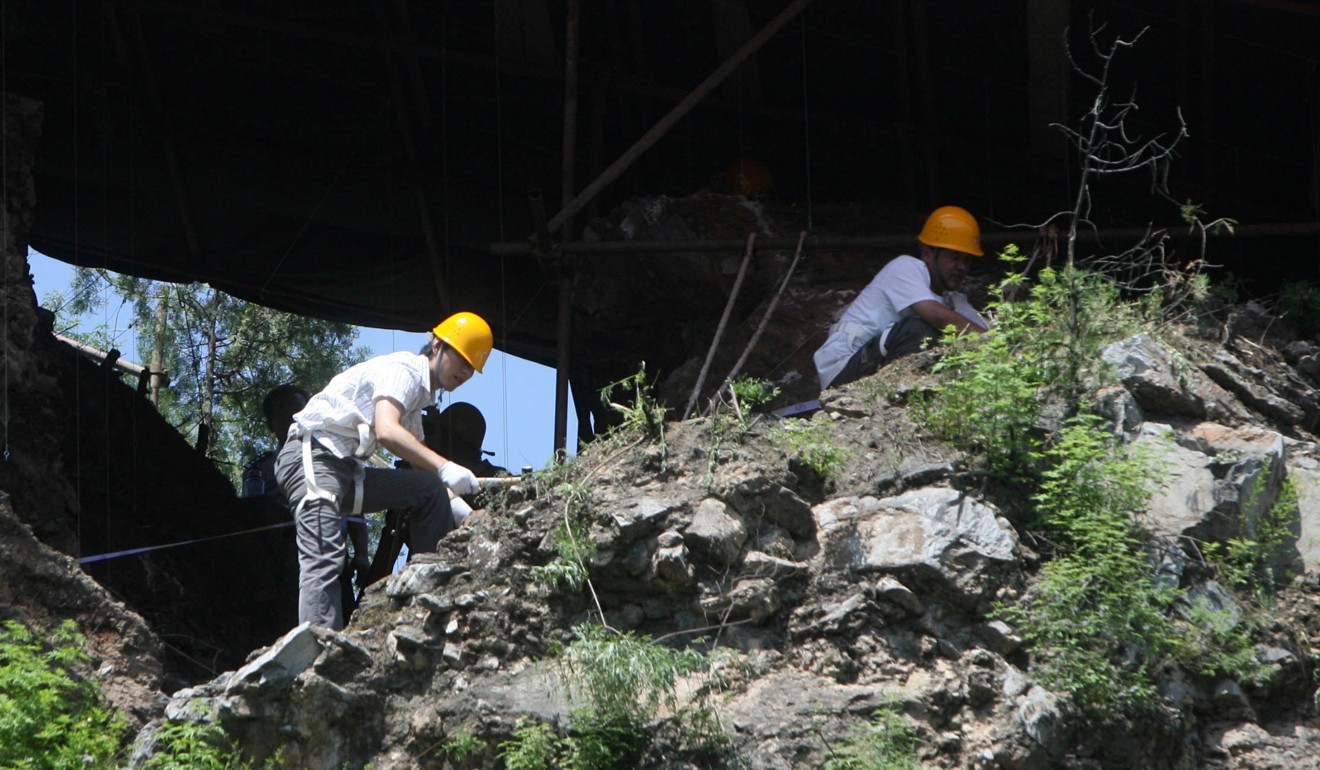
The caves of Zhoukoudian on the outskirts of Beijing are still a treasure trove for archaeologists. Photo: AFP
Wei said material could not explain the difference. A few fine tools made with quartz were found at Zhoukoudian but they were dated to about 300,000 years ago.
“Making high-quality tools with quartz is not a problem, but [that becomes possible] only when the maker becomes smart enough,” he said.
100,000 year old human remains ‘show evidence of cannibalism’
Why Peking Man crafts were so poor remains a big question. Wei said that some patterning on their tools suggested they might be an offshoot of the Nihewanians that was driven out and settled in Zhoukoudian – now a World Heritage Site – about 200km (124 miles) away.
In that isolated environment, Peking Man might have interbred over many generations, Wei said.
This increases the chances of offspring being born with so-called deleterious traits such as inherited conditions and illnesses that affect quality of life and the ability to adapt and survive.


 Image copyright GETTY IMAGES




 CHINDIA ALERT: You'll be living in their world, very soon