Archive for ‘schedule’

01/05/2020

Australia accelerates decision on whether to lift COVID-19 restrictions

SYDNEY (Reuters) – The Australian government said on Friday it would meet a week ahead of schedule to decide whether to ease social distancing restrictions, as the numbers of new coronavirus infections dwindle and pressure mounts for business and schools to reopen.

Australia has reported about 6,700 cases of the new coronavirus and 93 deaths, well below the levels reported in the United States and Europe. Growth in new infections has slowed to less 0.5% a day, compared to 25% a month ago.

Prime Minister Scott Morrison said it was imperative to lift social distancing restrictions as early as possible as 1.5 million people were now on unemployment benefits and the government forecast the unemployment rate to top 10% within months.

“We need to restart our economy, we need to restart our society. We can’t keep Australia under the doona,” Morrison said, using an Australian word for quilt.

Morrison’s government has pledged spending of more than 10% of GDP to boost the economy but the central bank still warns the country is heading for its worst contraction since the 1930s.

With less than 20 new coronavirus cases discovered each day, Morrison said state and territory lawmakers would meet on May 8 – a week earlier than expected – to determine whether to lift restrictions.

“Australians deserve an early mark for the work that they have done,” Morrison told reporters in Canberra.

Australia attributes its success in slowing the spread of COVID-19 to social distancing restrictions imposed in April, including the forced closures of pubs, restaurants and limiting the size of indoor and outdoor gatherings.

Morrison said 3.5 million people had downloaded an app on their smartphones designed to help medics trace people potentially exposed to the virus, though the government is hoping for about 40% of the country’s 25.7 million population to sign up to ensure it is effective.

Cabinet will also decide next week how to restart sport across the country, the prime minister said.

The government says any resumption of sport should not compromise the public health, and recommends a staggered start beginning with small groups that play non-contact contact sport outdoors.

The recommendations suggests Australia’s National Rugby League (NRL) competition may not get permission to restart its competition as soon as many in the sports-mad country would like.

Source: Reuters
16/11/2019

A rubbish story: China’s mega-dump full 25 years ahead of schedule

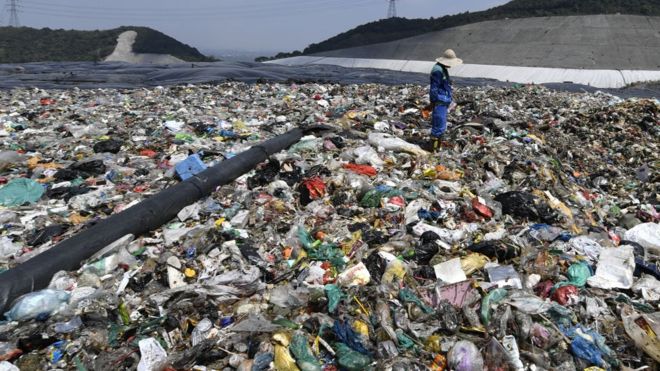
A worker prepares to cover the waste with a capping layer at the Tianziling landfill site on August 7, 2019 in HangzhouImage copyright GETTY IMAGES
Image caption A worker applying a capping layer to a landfill site in Hangzhou

China’s largest dump is already full – 25 years ahead of schedule.

The Jiangcungou landfill in Shaanxi Province, which is the size of around 100 football fields, was designed to take 2,500 tonnes of rubbish per day.

But instead it received 10,000 tonnes of waste per day – the most of any landfill site in China.

China is one of the world’s biggest polluters, and has been struggling for years with the rubbish its 1.4 billion citizens generate.

How big is the landfill site?

The Jiangcungou landfill in Xi’an city was built in 1994 and was designed to last until 2044.

The landfill serves over 8 million citizens. It spans an area of almost 700,000 square metres, with a depth of 150 metres and a storage capacity of more than 34 million cubic metres.

Until recently, Xi’an was one of the few cities in China that solely relied on landfill to dispose of household waste – leading to capacity being reached early.

Earlier this month, a new incineration plant was opened, and at least four more are expected to open by 2020. Together, they are expected to be able to process 12,750 tonnes of rubbish per day.

The move is part of a national plan to reduce the number of landfills, and instead use other waste disposal methods like incineration.

The landfill site in Xi’an will eventually become an “ecological park”.

How much waste does China produce?

In 2017, China collected 215 million tonnes of urban household waste, according to the country’s statistical yearbook. That’s up from 152 million ten years earlier.

The country had 654 landfill sites and 286 incineration plants.

It is not clear what China’s recycling rate is, as no figures have been released. China plans to recycle 35% of waste in major cities by the end of 2020, according to one government report.

This July, sorting and recycling rubbish was made mandatory in Shanghai – leading to “a sense of panic” among some residents.

In 2015, there was a landslide at a rubbish dump in the southern city of Shenzhen, killing 73 people.

The dump was designed to hold four million cubic metres worth of rubbish, with a maximum height of 95 metres.

When it collapsed, it was holding 5.8m cubic metres of material with waste heaps up to 160m high.

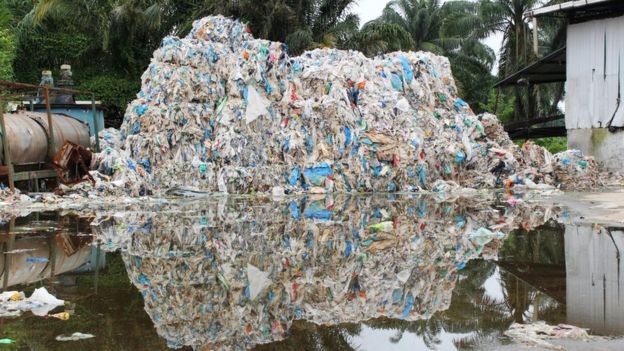
Plastic waste in Kuala Langat
Image caption One town in Malaysia was left swamped with foreign waste

Does China deal with other countries’ waste?

Not anymore. It used to, until the end of 2017 when it decided to ban the import of 24 different grades of rubbish.

In 2017 alone, China took in seven million tonnes of plastic rubbish from Europe, Japan and the US – and 27 million tonnes of waste paper.

Other countries, including Malaysia, Turkey, the Philippines and Indonesia, have picked up some of the slack.

But they struggled to deal with the amount of waste coming in – often times resulting in massive, out-of-control landfills in their own countries.

Some of these countries have now banned the import of certain types of rubbish and are even sending it back.

Source: The BBC

Law of Unintended Consequences

continuously updated blog about China & India

ChiaHou's Book Reviews

continuously updated blog about China & India

What's wrong with the world; and its economy

continuously updated blog about China & India