06/09/2019
- Scientists find some chemicals can kill the cotton leaf curl Multan virus and others can boost cotton plants’ immunity to it
- It is feared the virus could wreak havoc in China’s Xinjiang region, which produces most of the country’s cotton
A cotton picker in Xinjiang, where cases of the virus have been reported. Photo: Xinhua
Chinese scientists have found chemicals in medicinal herbs that could tame a destructive plant virus threatening the cotton industry in its western Xinjiang region.
Some small-molecule chemicals in herbs commonly used in Chinese medicine can effectively suppress cotton leaf curl Multan virus, according to ongoing research led by Professor Ye Jian at the Institute of Microbiology in Beijing.
By targeting WRKY20, a gene in the virus’ DNA, the chemicals could disrupt the viral infection and transmission, Ye’s team found.
Some early findings from their research were published last month in the journal Science Advances.
The leaf curl virus – a species of Begomovirus, the largest genus of plant viruses – poses a significant threat to the world’s cotton plantations, causing leaf curling, stunted growth and lower yields of cotton fibre. It costs the cotton industry in the Indian subcontinent about US$1 billion a year, according to a press release about the study from the Chinese Academy of Sciences.
Were there to be a pandemic in China, the drop in output and measures to contain it could cost the cotton farming industry 50 billion yuan (US$7 billion), according to some researchers’ estimates, the academy added.
The first known cases of the virus in China over the past decade were limited to coastal areas in the country’s east, but several cases have now been reported in Xinjiang Uygur autonomous region.
“We are running out of time,” Ye told the South China Morning Post.
Cotton is a pillar industry in Xinjiang, which provides more than 80 per cent of China’s total cotton production. The industry also contributes up to 50 per cent of the income of farmers involved in it, according to government statistics.
Exact figures for infections in the region are not available, but outbreaks so far remain isolated, according to Ye and other researchers with knowledge of the situation.
Double threat to China’s cotton industry: warmer weather and mirid bug
However, Professor Gao Feng, cotton researcher at the Agricultural College of Shihezi University in Xinjiang, warned that leaf curl virus could reduce cotton production in an infected field to almost zero.
“A large-scale outbreak has not occurred yet, but the threat is very serious and people are very nervous,” Gao told the Post. “We are in desperate need of a solution.”
The challenges facing China’s pork industry highlight the danger viruses can pose to the domestic market. A swine fever outbreak that has wiped out 100 million pigs caused pork prices to rise, forcing China to look to new countries to import from, such as Portugal and Argentina.
Its biggest overseas supplier of cotton is the United States, with which it is locked in a protracted trade war. In July, the government allowed some Chinese companies to buy a total of 50,000 tonnes of cotton from the US without tariffs being charged.
The central and regional governments fear that falling incomes caused by the impact of an outbreak on the cotton industry would increase the risk of ethnic conflict, social instability and anti-government thoughts.
Ye’s team adopted two approaches to fighting the virus.
How trade war with the US is changing China’s cotton industry
Some chemicals they discovered could improve cotton plants’ immunity against the infection by stimulating them to generate an antibody that killed the virus. The other chemicals they found could target the virus, directly reducing its intensity.
“They can be used as sprays,” Ye said, adding that he planned to reveal the chemical composites and related herbs in a paper to be published in a peer-reviewed journal in the coming months.
The discovery could offer an environmental benefit, too. Cotton farmers in Xinjiang use pesticides to deter the whiteflies that transmit the virus, but their overuse has affected Xinjiang’s delicate ecology, which in its desert areas is particularly vulnerable to disturbance.
In the agricultural research community, there is growing concern that some whitefly species will become resistant to pesticides. “If that happens, we will have a major problem,” Ye said.
He said the chemicals identified in the ongoing study would not harm the environment.
“These chemicals come from plants, so the negative impact to the environment would be minimal,” he said.
The study also found that it may be possible to use the cotton leaf curl Multan virus to benefit farmers. It stimulates cotton plants to generate a chemical that is harmful to other insects, such as the bollworm, that compete with whiteflies for food, meaning that it could be genetically modified into a pest control agent.
Most cotton species in commercial plantations are genetically modified to produce an insecticide to kill bollworm. Ye said a man-made virus could reduce the dependence on genetically modified plants.
Source: SCMP
Posted in Agricultural College of Shihezi University, agricultural research community, Argentina, Begomovirus, Beijing, bollworm, Chinese Academy of Sciences, Chinese medicine herbs, cotton, cotton leaf curl Multan virus, cotton virus, defeat, devastating, ethnic conflict, indian subcontinent, Institute of Microbiology, pandemic, pork industry, Portugal, Science Advances, scientists, social instability, south china morning post, swine fever outbreak, Uncategorized, whiteflies, wreak havoc, xinjiang region, Xinjiang Uygur Autonomous Region |
Leave a Comment »
05/09/2019
- New material is almost identical in structure to human enamel, which does not regenerate itself
- Crystal-like mineral can grow on teeth and last permanently, researchers say
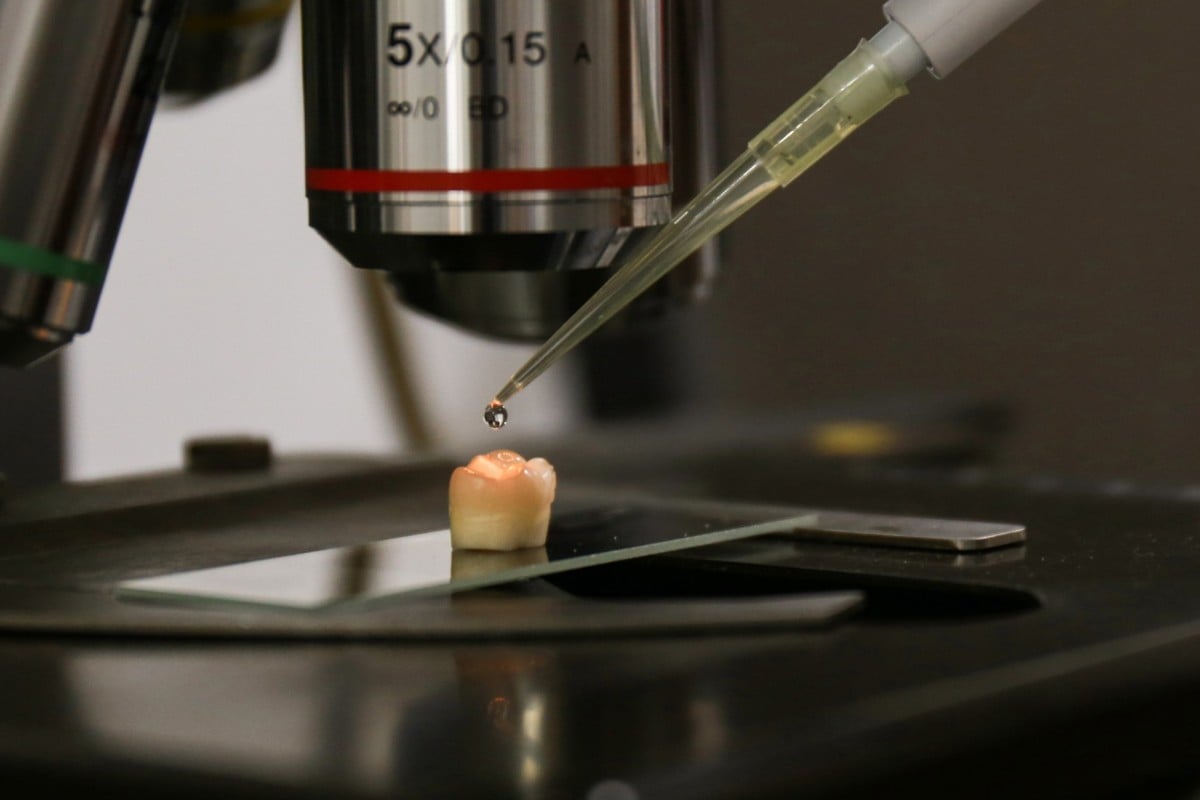
Drops of the liquid solution are applied to a human tooth. Photo: Zhejiang University
Scientists at a Chinese university say they have discovered the world’s first material that can repair damaged tooth enamel once and last for life.
A few drops of the liquid solution can fix all invisible cracks and wear on an ageing molar, according to researchers at Zhejiang University in Hangzhou, eastern China, whose work was published on Friday in the journal Science Advances.
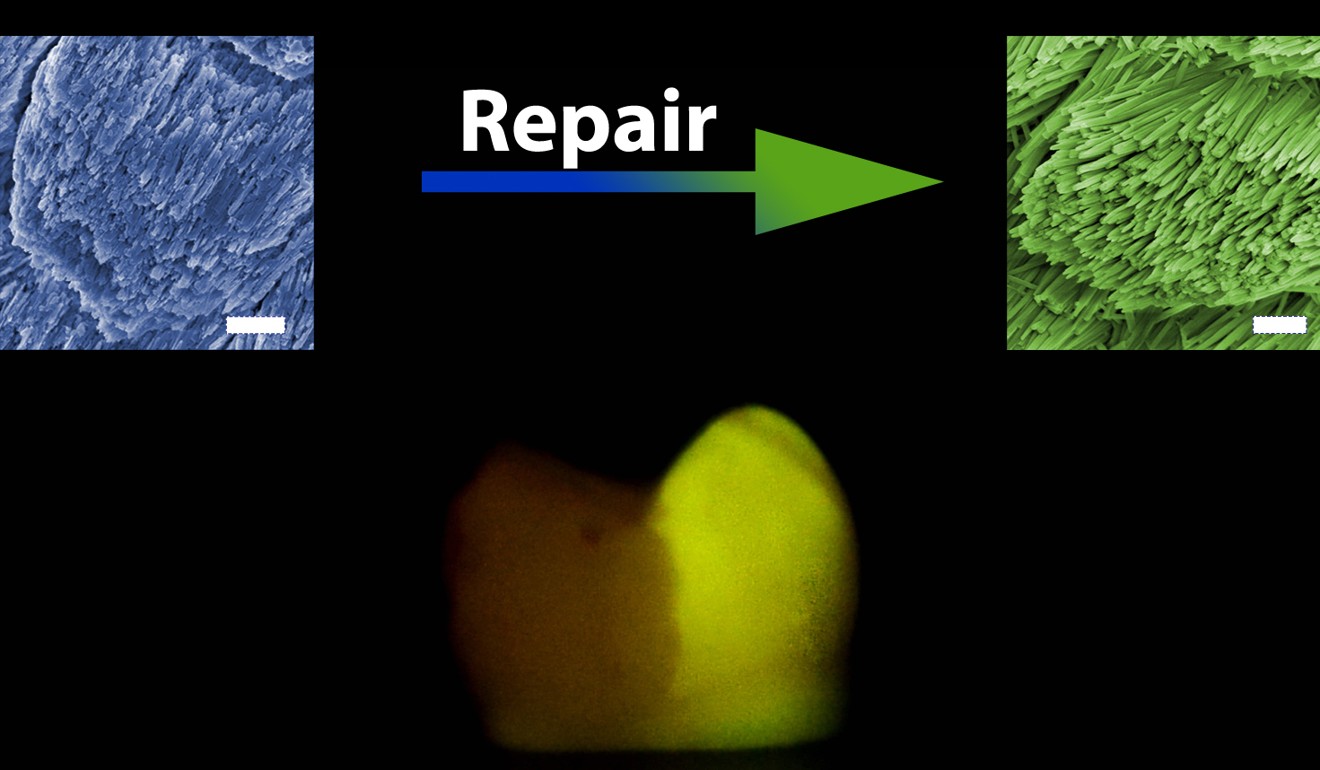
The material, calcium phosphate ion clusters, can grow a thin layer of protective shield on teeth, the research showed. The transparent, crystal-like mineral has a structure resembling fish scales and a high mechanical strength – almost identical to the enamel on a human tooth.
Its repair of the tooth “would be permanent”, wrote the researchers, led by Professor Tang Ruikang at the university’s chemistry department.
A tooth’s non-repaired left side (darker) and repaired right side (lighter) are compared using a fluorescent chemical. Photo: Zhejiang University
The technology could be developed as an effective remedy in clinical practice for enamel erosion, the main cause of tooth decay, Tang’s team said. Tooth decay affects almost half of the world’s population, costing dental patients in the United States and European Union a combined US$200 billion annually, according to the World Dental Federation.
Enamel, the outer covering of teeth, is the hardest tissue in the human body, protecting teeth during biting and chewing food.
Unlike other tissues such as muscle, bone and skin, enamel is generated by cells that die immediately after completing their job. The human body cannot produce more of them, so when enamel breaks or chips, it will not regenerate itself.
For decades, researchers around the world have conducted studies to seek a solution, but the artificial materials tested previously could not recreate precisely the fine structure of natural enamel, leaving gaps or holes that could cause it to break off real enamel.
Wouldn’t it be nice if our teeth fixed themselves, just like pandas’ do?
Tang’s team claim their new material can grow seamlessly on human teeth. They mixed two different types of repairing material together to form tiny clusters of mineral particles only 1.5 nanometres in diameter – smaller than a strand of human DNA.
Unlike in previous experiments, these clusters could remain stable for a long time without clumping together, making precise reconstruction of an enamel-like structure possible.
Chen Haifeng, associate professor at Peking University’s biomedical engineering department, said that the research was a positive step but that the new material might need improvements before clinical use.
For instance, the artificial layer requires two days to grow, which could be difficult for dentists to schedule with patients.
Many children use so much toothpaste it’s unhealthy, experts warn
The liquid solution contains triethylamine, a toxic substance with a very strong smell, which may pose a health risk, according to Chen. “But it doesn’t mean we can’t do anything,” he said.
The researchers said the chemical would quickly vaporise and none would be left in the teeth after the protective shield had formed.
Some products preventing enamel erosion and decay, such as toothpaste with enamel-strengthening ingredients, are already available in shops.
“Prevention is the best approach,” Chen said. “We should never wait until the damage is done. Our teeth are a miracle of nature. Artificial replacement will never do the job as well.”
Source: SCMP
Posted in ageing molar, almost, biomedical engineering department, bone, calcium phosphate ion clusters, chemistry department, Chinese scientists, Crystal-like mineral, dental patients, Enamel, European Union, first, fish scales, fix, grow, Hangzhou, human enamel, identical, invisible cracks, itself, last permanently, make, muscle, New material, pandas, Peking University, perfect replica, regenerate, researchers, Science Advances, skin, structure, teeth, tooth enamel, triethylamine, Uncategorized, United States, wear, World Dental Federation, Zhejiang University |
Leave a Comment »
13/06/2019
- Findings support earliest record of cannabis use, written in 440BC
- Researchers speculate psychoactive THC had role in grim funeral rites
Researchers say their findings at a burial site in Xinjiang about cannabis use 2,500 years ago back up a Greek record written around 440BC. Photo: Handout
Scientists say a burial site in mountainous northwestern China contains evidence that cannabis smoke was used there as far back as 2,500 years ago, corroborating the earliest record of the practice, written by the ancient Greek historian Herodotus.
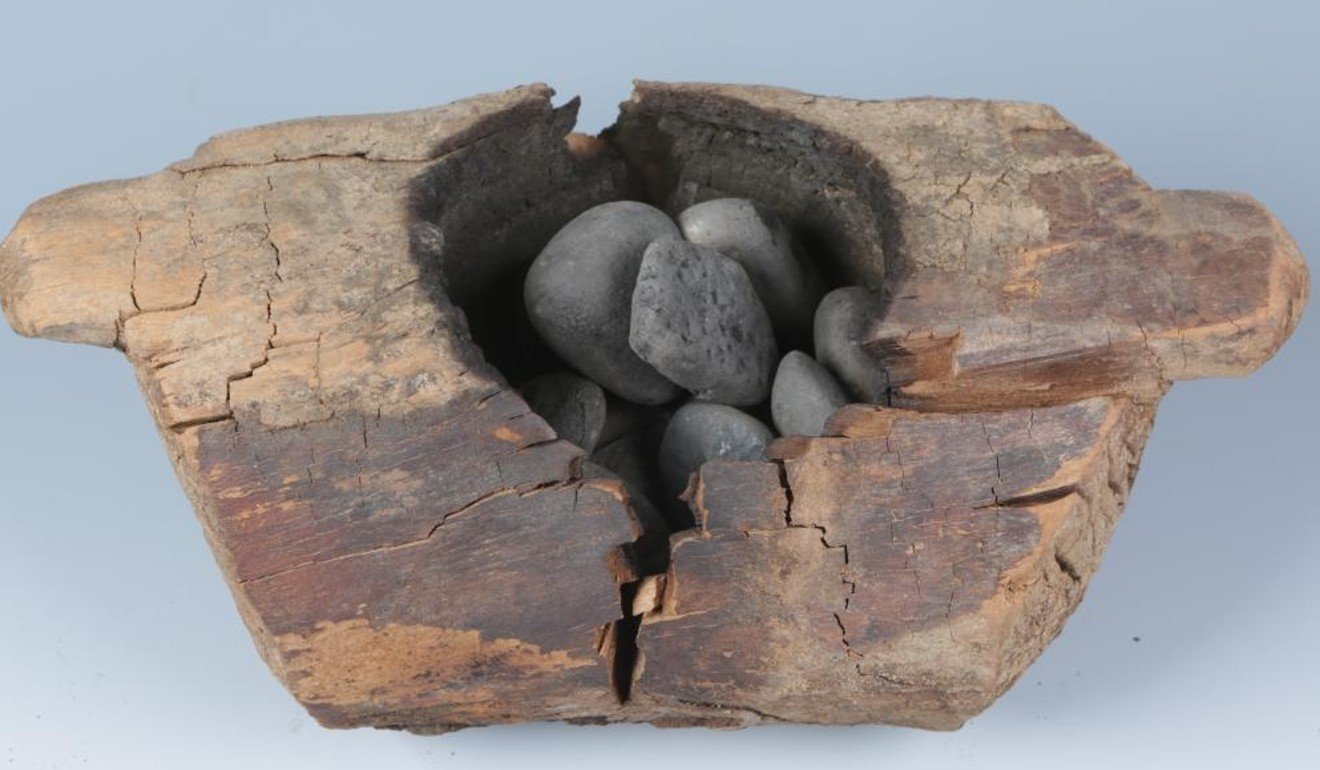
They said the evidence was found in a wooden bowl containing blackened stones unearthed at a Scythian cemetery in the Xinjiang Uygur autonomous region. Chemical analysis showed traces of THC – tetrahydrocannabinol – the potent psychoactive component in cannabis.
Yang Yimin, lead author of a paper published in the journal Science Advances on Thursday, said the discovery at Jirzankal Cemetery, close to the border of Tajikistan, Pakistan and India, was “jaw-dropping”.
Scythians were horseback warriors who roamed from the Black Sea across central Asia and into western China more than 2,000 years ago. Herodotus wrote in The Histories around 440BC that they used marijuana, the earliest written record of the practice.
Scientists in Xinjiang found hemp had been burned on stones inside these wooden bowls 2,500 years ago. Photo: Chinese Academy of Sciences and Max Planck Institute
“The Scythians take the seed of this hemp and … they throw it on the red-hot stones. It smoulders and sends forth so much steam that no Greek vapour-bath could surpass it.
The Scythians howl in their joy at the vapour-bath,” Herodotus wrote.
Yang, who led an international team of researchers from the Chinese Academy of Sciences, the Max Planck Institute for the Science of Human History in Germany and the University of Queensland, said that until now there was no evidence to back up the Greek historian’s account.
“There was never any archaeological proof to the claim. We thought – is this it?” Yang said.
The discovery posed a question for the research team: where would the plants have come from? While hemp was commonly found in many parts of the world and was used for fabric, cooking and medicine, most wild species contained only small amounts of THC.
Ruins of 2,000-year-old coin workshop found in central China’s Henan province
Yang and his colleagues speculated that the altitude, 3,000 metres (9,843 feet) above sea level, and strong ultraviolet radiation might have resulted in a potent plant strain with THC levels similar to those in marijuana today.
“From here it was selected, probably domesticated and then went to other parts of the world along ancient trade routes with the Scythian nomads, forming an enormous ring of culture that shared the ritual of smoking cannabis,” Yang said.
Archaeologists said the site, with its 40 circular mounds and marked by long strips of black and white stones, could have been a burial ground for tribal members, with human sacrifice and cannabis part of the last rites.
Researchers suspect a potent strain of cannabis grew close to the Xinjiang burial site. Photo: Chinese Academy of Sciences and Max Planck Institute
So the early pot party might not have been the kind of celebration Herodotus described, the study’s authors suggested.
While the Scythians might have been inhaling the smoke to try to communicate with the dead in the next world, evidence suggested that a sacrifice – perhaps a war captive or a slave – was struck repeatedly on the head with a sword and the body hacked to pieces nearby, the researchers said.
Source: SCMP
Posted in cannabis, Chinese Academy of Sciences, Chinese scientists, evidence, first stoners, found, Germany, graveyard, Greek record, grim funeral rites, hemp, Henan province, Herodotus, human sacrifice, India alert, Jirzankal Cemetery, marijuana, Max Planck Institute, Max Planck Institute for the Science of Human History, Pakistan, psychoactive THC, Science Advances, Scythians, Tajikistan, tetrahydrocannabinol, ultraviolet radiation, Uncategorized, University of Queensland, vapour-bath, Xinjiang, Xinjiang Uygur Autonomous Region |
Leave a Comment »





 CHINDIA ALERT: You'll be living in their world, very soon