08/04/2019
SINGAPORE (Reuters) – Royal Dutch Shell has entered China’s shale oil sector, signing an agreement with state-owned Sinopec to study an East China block, part of the nation’s early efforts to unlock the potentially massive unconventional resource.
China is already in the initial stages of developing its vast shale gas resources, with production last year making up just 6 percent of total gas output after more than a decade of work. China’s shale oil is at an even more basic phase due to challenging geology and hefty development costs, experts said.
Shale oil makes up less than 1 percent of China’s crude output after several years of development, according to Angus Rodger, research director of Asia-Pacific upstream at Wood Mackenzie.
“China’s shale oil has very low permeability, which means very low per well output that makes the economics hard to work,” said an oil and gas official with China’s Ministry of Natural Resources (MNR). The official declined to be named because he’s not authorized to speak with the press.
Sinopec said on Monday it had agreed with Shell to study the Dongying trough of Shengli in China’s eastern province of Shandong, without giving further details.
Shell confirmed the joint study agreement, but did not offer further comment.
That makes Shell one of the few international oil and gas explorers venturing into China’s shale oil sector, and follows the Anglo-Dutch company’s exit from shale gas drilling in Sichuan province in the southwest after spending at least $1 billion (766.22 million pounds) and getting unsatisfactory results.
Unlike shale gas resources, which are highly concentrated in Sichuan, most of China’s shale oil is trapped in eastern regions such as the Songliao and Bohai Rim basins. North China’s Ordos and Junggar basins are also believed to hold large shale oil resources, the experts said.
The Dongying trough is part of the Bohai Rim basin, where top Chinese oil and gas group China National Petroleum Corp (CNPC) said in February that it is developing another small shale oil field with an annual output of 50,000 tonnes this year.
In 2013, U.S. energy firm Hess Corp signed a production-sharing contract with PetroChina, CNPC’s listed arm, to develop the Malang block of Santanghu basin in the northwest region of Xinjiang, China’s first shale oil deal.
Hess quit the block around late 2014 due to poorer-than-expected drilling prospects and as global oil prices plunged, said the MNR official.
“The understanding of geology, resource and the best recovery techniques (for shale oil) has only just begun,” said Woodmac’s Rodger.
Sinopec is hoping Shell’s expertise in shale oil exploration could help the Chinese state major turn around its fortunes at Shengli oilfield as the reserves at the giant conventional oilfield are depleting rapidly, said Rodger.
Source: Reuters
Posted in Anglo-Dutch company, Angus Rodger, Asia-Pacific upstream, China alert, China National Petroleum Corp. (CNPC), China’s Ministry of Natural Resources (MNR), Chinese oil and gas group, Dongying trough, East China block, Hess Corp, joint study, Malang block, oil and gas official, Ordos and Junggar basins, PetroChina, research director, Royal Dutch Shell, Santanghu basin, shale oil, shandong province, Shell, Shengli, Sinopec, Songliao and Bohai Rim basins, Uncategorized, Wood Mackenzie, Xinjiang |
Leave a Comment »
06/04/2019
A ceremony is held to receive the bone ashes of fireman Zhang Chengpeng, who died while fighting a forest fire in southwest China’s Sichuan Province, at Jinan international airport in Jinan, east China’s Shandong Province, April 5, 2019. The ashes of fireman Zhang Chengpeng returned to his hometown of Zouping in Shandong Province on Friday. (Xinhua/Dong Naide)
Source: Xinhua
Posted in China alert, died, fighting, forest fire, Jinan international airport, martyrs, mourn, shandong province, sichuan province, Uncategorized, Zouping |
Leave a Comment »
13/03/2019
JINAN, March 13 (Xinhua) — Transport authorities in east China’s Shandong Province announced that it plans to invest 162.2 billion yuan (about 24.2 billion U.S. dollars) on roads, railways, ports and airports this year.
The investment is aimed at building an integrated infrastructure network in the province, said Jiang Cheng, head of the provincial transport department.
Last year, fixed asset investment in Shandong’s transportation sector reached 160 billion yuan, among which 115.8 billion yuan was spent on roads, highways and waterways, up 28 percent year on year.
This year, 61 percent of the investment will be on roads, Jiang said.
Shandong has set a target for its expressway mileage to reach 7,400 km by 2020. By the end of this year, the total will hit 6,400 km, he said.
More roads, bridges, and stations will be built in rural areas, he added.
About 10 railway projects are under construction in the province this year, with a total planned investment of 32 billion yuan (4.7 billion dollars). Upon completion, the province will be better connected with big cities such as Beijing, Shanghai and Tianjin.
Shandong had a permanent population of 100.4 million at the end of 2018. It is one of the most populous provinces in China. An improved infrastructure network will better meet economic and social needs.
Source: Xinhua
Posted in airports, Beijing, bridges, China alert, head of the provincial transport department, Highways, infrastructure plan, Jiang Cheng, ports, railways, roads, rural areas, shandong province, Shanghai, stations, Tianjin, Transport authorities, Uncategorized, waterways, yuan |
Leave a Comment »
01/03/2019
- Next month’s nautical spectacle will allow country to show off its most advanced warships to an international audience
- More than a dozen foreign navies are expected to join in, including the United States
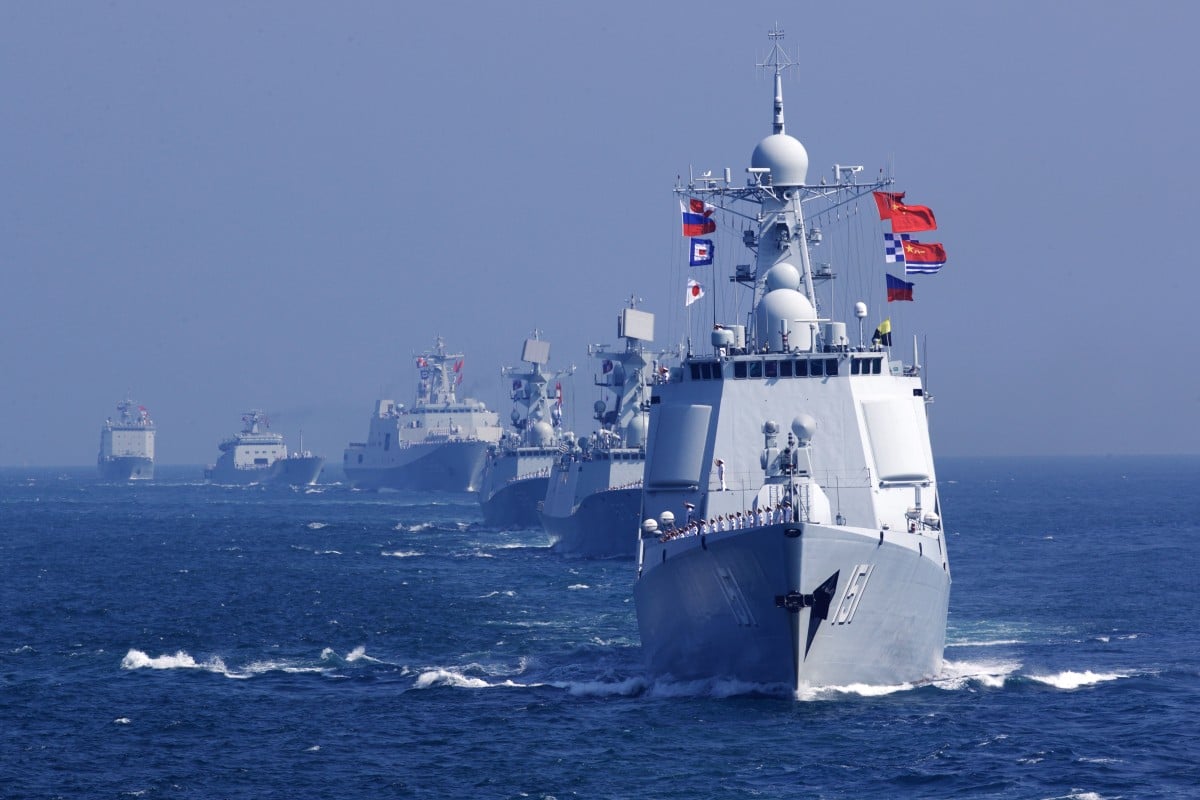
Chinese warships pictured at the end of joint exercise with the Russian navy in 2016. Photo: Xinhua
China will hold a naval parade next month to mark the 70th anniversary of the founding of the People’s Liberation Army Navy and will invite more than a dozen of foreign navies to participate.
The parade will take place on April 23 in the Yellow Sea off the coast of Qingdao in Shandong province, Ren Zhiqiang, a spokesman for the Ministry of National Defence, said on Thursday.
Ren did not provide further details of the parade but military analysts said the exercise would give the navy the opportunity to display its rapidly growing strength and show how that has increased in the past 12 months.
‘No-go zone’ in Yellow Sea for Chinese aircraft carrier sea trials
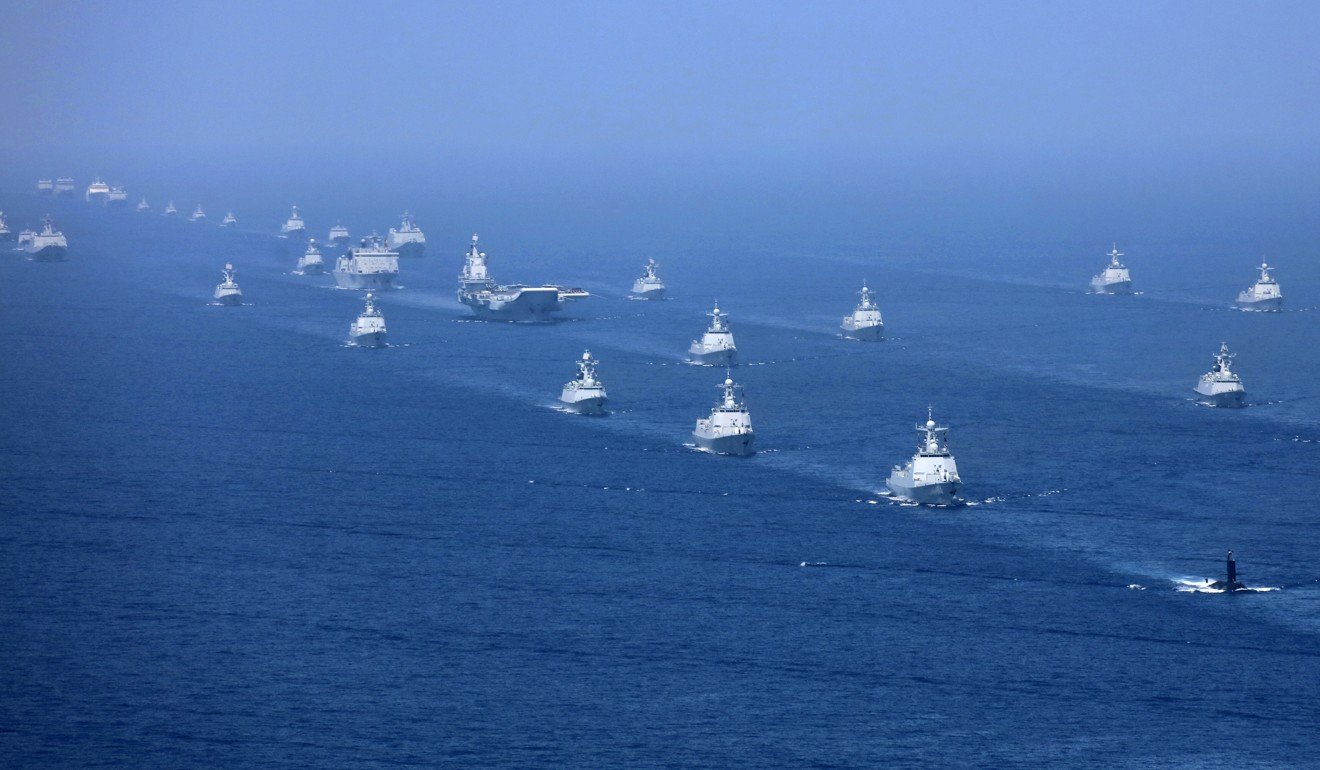
In April last year a naval review in the South China Sea featured a total of 48 vessels and 76 planes, including China’s first aircraft carrier, the Liaoning, its Type 094A and 095 nuclear submarines, 052D guided missile destroyers and J-15 fighter jets.
The experts expect that next month’s event will provide a showcase for several new and more powerful vessels including its home-grown aircraft carrier Type 001A, the Type 055 – Asia’s most powerful destroyer – and several nuclear submarines.
“The fact that China is holding the naval parade just one year after the South China Sea review shows the great importance [the leadership] attaches to the development of China’s maritime interests, the navy and its expansion,” navy expert Li Jie said.
Chinese President Xi Jinping joined the crew on the deck of the cruiser Changsha following last year’s naval review. Photo: Xinhua
Share:
China also held a major naval parade in 2009 to mark the navy’s 60th anniversary.
It was smaller in scale than the upcoming extravaganza with 25 PLA vessels and 31 fighter jets taking part.
Fourteen foreign navies sent ships to the 2009 parade, including the USS Fitzgerald from America and the guided-missile cruiser Varyag from Russia. France, Australia, South Korea, India and Pakistan also joined in the event.
More foreign countries are expected to join the party this year as the PLA has become more active internationally and China has sold more warships to foreign navies.
China’s new veterans’ law to be reviewed at National People’s Congress next week
“The parade is more like a birthday party for the PLA Navy and the participation of foreign navies is a matter of diplomatic courtesy with few military implications,” said Yue Gang, a former PLA colonel.
Yue said the US and its allies would attend despite the rising tensions between the two sides.
Since 2015 the US and Chinese navies have engaged in a series of confrontations in the South China Sea as China strengthens its military presence in the region and the US has sought to challenge Beijing’s claims to the waters by conducting what it describes as “freedom of navigation” operations.
“I don’t expect they will send any of the warships that have taken part in such operations [to the parade],” Yue said.
China has greatly expanded its naval capabilities in recent years. Photo: AP
Share:
It has been reported that the Japanese Maritime Self-Defence Force has expressed an interest in joining the parade and the Philippines – which has a rival claim to the South China Sea – is planning to send a vessel to the event for the first time.
Li said militaries such as the US and Japan would not want to miss the chance to observe the PLA Navy closely.
“In addition, greater transparency [through the parade] will also help reassure smaller regional partners such as the Philippines that China is a friendly power despite its growing military strength,” he said.
China held its first naval parade in 1957 and April’s display will be the sixth such event.
Sailors also took part in the parade through Tiananmen Square to mark the foundation of the People’s Republic on October 1 1949.
Source: SCMP
Posted in Australia, birthday parade, China alert, Chinese President Xi Jinping, France, guided-missile cruiser Varyag, India alert, Japan, Japanese Maritime Self-Defence Force, Liaoning, Ministry of National Defence, nautical spectacle, naval parade, navy, nuclear submarines, October 1 1949, Pakistan, People's Liberation Army Navy, People’s Republic, PLA colonel, Qingdao, Ren Zhiqiang, Russia, sea power, shandong province, South China Sea, South Korea, Tiananmen Square, Uncategorized, United States, US, USS Fitzgerald, warships, Yellow Sea, Yue Gang |
Leave a Comment »
26/02/2019
QINGDAO, Feb. 26 (Xinhua) — China has launched a project for the large-scale cultivation of salmon in the cold water mass of the Yellow Sea to cater to growing seafood demand in Chinese markets.
The project will build a salmon farm about 130 nautical miles off the shore of Rizhao in east China’s Shandong Province, with the aim of producing 45,000 tonnes of salmon annually, said Dong Shuanglin, a professor at the Ocean University of China and the project’s chief scientist.
Initiated by the university and two Chinese firms, the project involves a total investment of over 4.3 billion yuan (642 million U.S. dollars) and has demarcated a cultivation area of 3,000 hectares.
It plans to erect the “Shenlan 2” salmon cage in the second half of this year, following a successful trial of salmon farming at “Shenlan 1,” the world’s largest fully-submersible fish cage.
The “Shenlan 2” cage is 80 meters tall, compared with the 35 meters of “Shenlan 1,” and can accommodate 1 million fish, a large increase from its predecessor’s 300,000, according to Dong.
The project also includes the construction of an onshore industrial park, R&D facilities and a fry cultivation base. The first batch of salmon from the farm is scheduled to hit the market by the end of 2020.
Chinese scientists have in recent years started to test rearing salmon in the Yellow Sea’s cold water mass, a seasonal low-temperature water body, as the country’s offshore fish farming faces a lack of space, disease outbreaks and other environmental problems.
The 13-million-hectare cold water mass in the Yellow Sea is large enough to raise 500 million salmon, and its strong self-purification means lower risks of diseases and parasite outbreaks, according to the university.
Salmon farming in that sea area is also expected to herald a new trend in China’s marine aquaculture following seaweed, shrimp, shellfish, fish and sea cucumber, while offering a platform for cooperation with countries like Norway and Japan in farm management, diseases and parasites control, according to sources familiar with the industry.
Source: Xinhua
Posted in aquaculture, China alert, Chinese scientists, diseases, farm management, fish cage, fully-submersible, Japan, Norway, parasites control, Rizhao, salmon farming, sea cucumber, seaweed, self-purification, shandong province, shellfish, Shenlan 1, Shenlan 2, shrimp, Uncategorized, Yellow Sea |
Leave a Comment »
25/02/2019
BEIJING, Feb. 24 (Xinhua) — China’s national observatory on Sunday forecast that some northern and eastern parts of the country would be shrouded in smog in the coming days while snow will hit western regions.
Thick smog will envelop northern and eastern areas including Hebei and Shandong provinces until Thursday, according to the National Meteorological Center (NMC).
From Sunday night to Monday morning, thick fog will be seen in the provinces of Henan, Anhui, Jiangsu, Shanghai and Hubei, reducing visibility in some areas to less than 200 meters, the NMC said.
From Sunday night to Tuesday, snow will hit west China’s Tibet, Qinghai and Gansu, while rain will soak the south from Tuesday to Wednesday.
Bad weather could disrupt traffic after the Spring Festival holiday when many people are returning to work after the break.
China’s Spring Festival travel rush started from Jan. 21 and will last till March 1.
Source: Xinhua
Posted in Anhui, China alert, Gansu, Hebei, Henan, Hubei, Jiangsu, National Meteorological Center (NMC), national observatory, Qinghai, shandong province, Shanghai, Smog, snow, Spring Festival, Tibet, Uncategorized |
Leave a Comment »
23/02/2019
Photo taken on Feb. 23, 2019 shows a scene of a job fair held in Licang District, Qingdao, east China’s Shandong Province. Several job fairs were held in Qingdao on Saturday. (Xinhua/Li Ziheng)
Posted in China alert, job fairs, Licang District, Qingdao, shandong province, Uncategorized |
Leave a Comment »





 CHINDIA ALERT: You'll be living in their world, very soon