Archive for ‘Shanghai Stock Exchange’

06/02/2020

China drafts banks, brokerages and funds into war on virus

SHANGHAI/HONG KONG (Reuters) – China’s President Xi Jinping is enlisting the state-dominated financial sector in a war against a virus outbreak that has killed more than 500, mobilising lenders, brokerages and fund managers to pump resources into stricken parts of the economy.

Answering Beijing’s call, banks are rushing to offer virus-fighting loans at ultra-low rates, investment banks are helping companies issue anti-virus bonds faster, and managers of mutual funds are refraining from selling stocks, to damp market panic.

Concerted efforts to rein in the virus that emerged late last year in the central city of Wuhan highlight the centralized power the ruling Communist Party wields in a sector dominated by state-owned companies.

But the campaign, which has stirred memories of government rescue efforts during a market crash in 2015, deepens concern over corporate governance in China and risks sowing seeds of future trouble.

Wuhan DDMC Culture & Sports Co (600136.SS), a leisure company in the city, won Shanghai Stock Exchange approval to issue bonds of up to 600 million yuan (66.32 million pounds) via a “green channel” created for virus-hit companies, it said on Thursday.

“It’s like receiving charcoal on a snowy day,” the company, whose operations were wrecked by the epidemic, said on its website.

Three other companies – Zhuhai Huafa Group, Sichuan Kelun Pharmaceutical and China Nanshan Development Group – have raised a combined 2.1 billion yuan ($301 million) this week by issuing bonds via the interbank market, to fund virus-battling efforts.

Proceeds from the debt issuance, which won quicker-than-usual approval from regulators, will fund drug discovery programmes and hospital construction, the companies said.

Regulators have also asked banks to inject cheap funds into virus-stricken areas, and not to withdraw loans from companies suffering the impact. Sectors such as tourism, transport and leisure are the worst-hit.

Bank of Suzhou, in the eastern province of Jiangsu, vowed to cut financing costs for hundreds of small corporate clients and bolster lending.

For companies such as food producers, logistics firms and makers of anti-virus drugs, it will cut the rate on loans by 10 basis points below the lending benchmark, to stand as low as 3.98%.

A loan officer at Bank of China promised special treatment for those defaulting because of virus fallout, saying the central bank would cap interest on loans to firms with operations critical to beating the virus, such as makers of masks and drugs.

He added, “Such companies will enjoy the lowest possible rates.”

But the orchestrated support also triggered concerns of moral hazard among some.

“I’m afraid many companies about to go bankrupt will come and say their businesses are affected by the virus outbreak,” said a bond fund manager, who declined to be named.

A flurry of government support has helped stabilise stocks in China’s equity market after a plunge on Monday.

Regulators have told major mutual fund companies and insurers not to cut net equity positions this week, and urged brokerages to limit short-selling activities by clients, said sources who sought anonymity.

Fund managers were also nudged to do their bit. China’s fund association, which is supervised by the securities regulator, said employees at 26 mutual fund houses had put their own money – or more than 2 billion yuan ($287 million) – into fund products since Monday.

Source: Reuters
19/05/2019

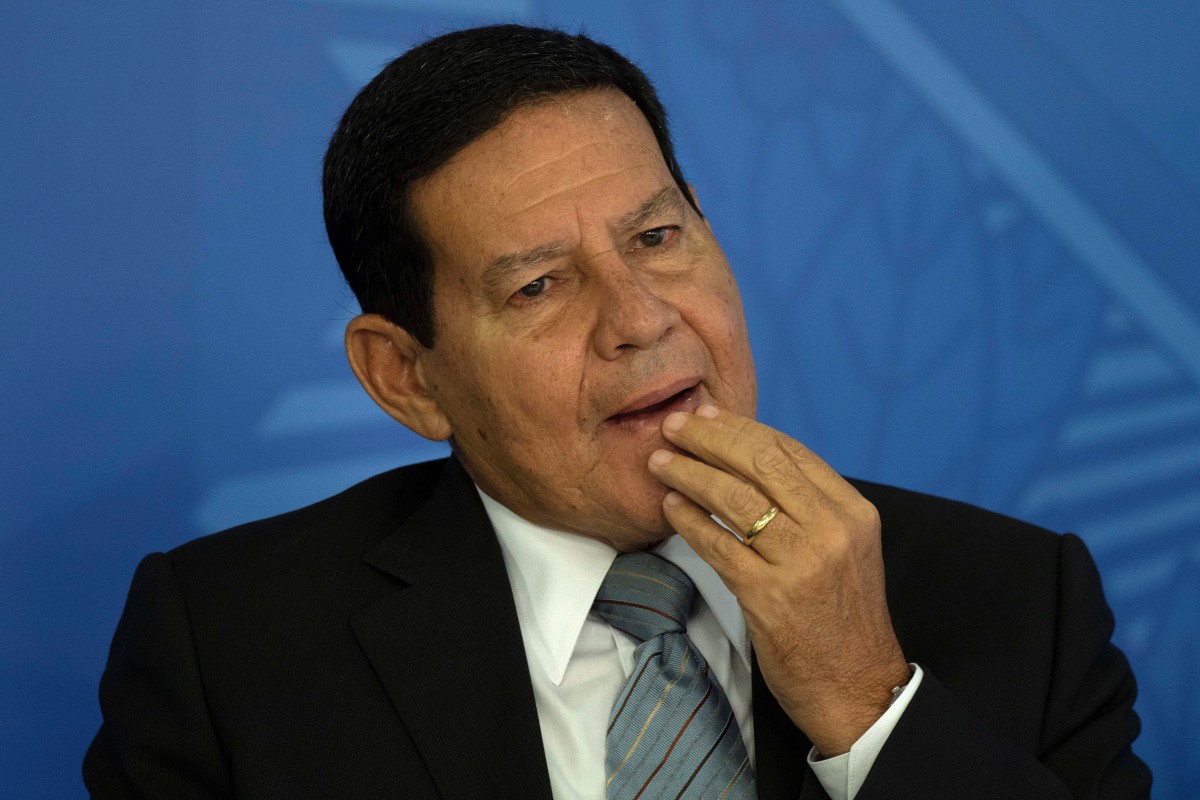
Brazil’s vice-president Hamilton Mourao heads to China to mend relations

  • General will spend five days meeting top Chinese leaders including President Xi Jinping
  • Mission seeks to patch up wounds caused by Brazilian President Jair Bolsonaro’s anti-China rhetoric
Hamilton Mourao favours maximising engagement with China. Photo: EPA-EFE
Brazil’s vice-president is expected to land in Beijing on Sunday on a mission to patch up wounds caused by President Jair Bolsonaro’s lacerating anti-China rhetoric.
General Hamilton Mourao will spend five days in China rubbing shoulders with some of the country’s most powerful leaders, culminating in an audience with President Xi Jinping, in an effort to shore up the relationship between the two emerging market giants. Bolsonaro himself is due to visit later this year, while Xi is due to visit Brasilia in November for the BRICS summit.
China – Brazil’s most important trading partner for the past decade – remains a sensitive subject in the Bolsonaro administration. While Mourao and the other business-oriented members of government favour maximising engagement with the Asian giant, Bolsonaro and his more radical appointees view China with a high degree of suspicion, as a predatory economy that wishes not merely to invest in Brazil, but to own it.

“The Chinese can buy in Brazil, but they can’t buy Brazil,” the president said at a breakfast with journalists last month.

Brazilian President Jair Bolsonaro said last month that the “Chinese can buy in Brazil, but they can’t buy Brazil”. Photo: AFP

Still, in comparison with his pre-election criticism of China as “heartless”, Bolsonaro in office has dialled down his anti-Beijing sentiment. Mourao’s visit is part of an effort to reset that relationship.

“The Chinese understand that Mourao plays a central role in toning down Bolsonaro’s rhetoric,” said Oliver Stuenkel, a specialist on BRICS – an association of five major emerging economies, namely Brazil, Russia, India, China and South Africa – at the FGV business school. “They know that the Mourao-China relationship will be fundamental.”

Should China be worried about Bolsonaro’s bromance with Trump?

Speaking to reporters recently, Mourao recognised the need to balance the Bolsonaro administration’s desire to pivot towards the United States with practical considerations of China’s economic significance.

“The US are the champions of democracy and freedom and our government has left it very clear what this represents,” the vice-president said. “But on the other side we have to be sufficiently pragmatic to understand the importance of China for Brazil’s economic development.”

Chinese investment in Brazil reached almost US$134 billion between 2003 and 2018, Brazilian government figures showed.

Chinese President Xi Jinping is expected to meet the visiting Brazilain vice-president. Photo: AP

While the trade war between the US and China may offer Brazil some short-term gains, particularly for its agricultural sector, the downsides outweigh the benefits, according to Renata Amaral, a foreign trade analyst at Barral MJorge consultancy.

“In truth this war is no good for anyone,” she said.

Mourao said that Brazil was monitoring the situation “critically and cautiously”.

Why US-China trade war could be good for Brazil
From the Chinese perspective, Beijing is looking for Brazil’s formal support for its “Belt and Road Initiative” – Chinese President Xi Jinping’s signature global infrastructure megaproject. Asked whether Brazil might sign up to the programme, Mourao said that any agreement would have to be approved by Bolsonaro in the second half of the year.
After trips to the Great Wall of China and the Shanghai Stock Exchange, Mourao will meet Xi, in a clear sign of Brazil’s importance to China. “The visit of vice-president Mourao will reinforce mutual political confidence, deepen our friendly cooperation and add new dimensions to our strategic partnership,” according to Chinese foreign ministry spokesman Geng Shuang.
With Beijing both uncertain about the direction of Brazilian foreign policy under Bolsonaro and eager to strike deals on infrastructure and food security, it makes sense for the Chinese to roll out the red-carpet for Mourao, according to Hussein Kalout, a specialist in foreign policy and a researcher at Harvard.
China trade vs economic growth: the dilemma for Brazil’s president
While the federal government remains ambivalent about its relationship with China, some of Brazil’s powerful state governors are seeking to develop their own relationship with the Asian country. One of them is Carlos Massa Ratinho Junior, the governor of the southern state of Parana, who travelled to China recently to discuss agriculture and railroad projects.
“We’re open to talk with any country that wants to and understands that the state of Parana is the best to place to invest in Brazil,” the governor said in an interview, adding that his actions did not conflict with the federal government’s stance towards Beijing.

But in a sign of the domestic pressure Bolsonaro is under not to abandon entirely his sceptical attitude to China, Luiz Philippe de Orleans e Braganca, the vice-president of the lower house’s foreign affairs committee and a lawmaker from Bolsonaro’s own party, said the government should set limits to the partnership.

“It’s good to talk to China, but it depends what is being discussed,” he said. “For example, the 5G network set up by China is dangerous because it will give the Chinese more information about Brazilian citizens than the Brazilian government.”

Source: SCMP

04/03/2019

Spotlight: China’s new sci-tech board “good attempt” to boosting innovation, reform: U.S. experts

NEW YORK, March 3 (Xinhua) — The new stock-trading venue in Shanghai Stock Exchange  is a “very good attempt” to optimizing the multi-tiered capital market system and enhancing the capital market’s capability to serve the real economy in China, American experts said.

The science and technology innovation board, which pilots registration-based initial public offering (IPO) system, is “a very good attempt,” and “it may be adopted by A-share markets in the future,” said Henry Huang, professor with Sy Syms School of Business, Yeshiva University.

“If high-tech companies grow and expand in the sci-tech innovation board, maybe they will get listed in the A-share markets later to attract more qualified investors, which makes the sci-tech innovation board an incubator of quality enterprises,” Huang said.

Kevin Chen, chief economist with U.S. wealth management firm Horizon Financial, agreed.

The new board will “largely improve” financing environment for high-tech companies, thereby accelerating the progress of sci-tech innovation in China as a whole, he said.

The adoption of registration-based IPO system will “make shell companies meaningless, while real values of listed companies will be shown in their share prices through more appropriate supervision mechanism,” Chen said.

In addition, the new major reform will facilitate Shanghai’s transformation into an international financial center as well as a science and technology innovation hub, said Allen Tjiong, president and CEO of BOC International (USA) Inc.

“These reforms are essential in making Shanghai a more competitive and attractive capital market for technology companies to raise capital,” said Tjiong.

China’s top securities regulator on Friday released regulations on the science and technology innovation board, which pilots registration-based IPO system. The regulations took effect on March 1 on a trial basis, according to the China Securities Regulatory Commission (CSRC).

The new stock-trading venue focuses on companies in high-tech and strategically emerging sectors such as new generation information technology, advanced equipment, new materials and energy, environmental protection, and biomedicine, according to the CSRC.

Under the pilot registration system, eligible companies can become listed by filing required documents. Currently, new shares of the A-share markets are subject to approval from the securities watchdog.

Source: Xinhua

Law of Unintended Consequences

continuously updated blog about China & India

ChiaHou's Book Reviews

continuously updated blog about China & India

What's wrong with the world; and its economy

continuously updated blog about China & India