Chindia Alert: You’ll be Living in their World Very Soon
aims to alert you to the threats and opportunities that China and India present. China and India require serious attention; case of ‘hidden dragon and crouching tiger’.
Without this attention, governments, businesses and, indeed, individuals may find themselves at a great disadvantage sooner rather than later.
The POSTs (front webpages) are mainly 'cuttings' from reliable sources, updated continuously.
The PAGEs (see Tabs, above) attempt to make the information more meaningful by putting some structure to the information we have researched and assembled since 2006.
SHANGHAI, Aug. 31 (Xinhua) — Construction started Saturday on a memorial hall for the first National Congress of the Communist Party of China (CPC) in Shanghai.
It is located close to the historic building where the first CPC national congress was convened in 1921.
The memorial hall is scheduled to open to the public in 2021 and will exhibit historical materials about the founding of the CPC.
In July 1921, thirteen delegates representing about 50 CPC members nationwide attended the first CPC national congress in the two-story brick-and-wood building in downtown Shanghai.
The building was turned into a memorial site in 1952. In 2018, it received a record number of more than 1.47 million visitors, according to its administration office.
The airline’s data labs unit is using AI to improve customer service and better handle a flood of complaints
China Eastern Airlines planes are seen on the tarmac at Hongqiao International Airport in Shanghai. Photo: Reuters
In a business that receives around one million complaints a year, the ability to handle large amounts of information is critical.
That is why state-owned China Eastern Airlines is now using artificial intelligence (AI) to improve the customer experience, using the technology’s ability to handle huge amounts of data to tailor its services for individual consumers.
The airline’s data labs unit is even trying to solve problems before they happen by, for example, developing a pilot service that will allow customers to give better instructions and feedback on their in-flight meals.
“Using an analogy, if a good chef happens to leave a restaurant, then he or she takes an abundance of knowledge with them,” said Wang Xuewu, the founder and head of China Eastern Airlines’ data lab, in an interview at the AI summit in Hong Kong this month.
“Through AI, we can better ensure that the tastes and preferences of our customers are kept safe, analysed and applied in the future.”
Beijing thunderstorms return China Eastern’s flight MU5331 twice to Shanghai, taking 17 hours to get back to its origin
The idea for a pilot AI food service at China Eastern comes amid the country’s drive to develop AI technology, dubbed the fourth industrial revolution. In an ambitious three-step blueprint, China wants to catch up with the US in AI technology and applications by 2020, see major breakthroughs by 2025, and become a global leader in the field by 2030.
More broadly, the airline’s data lab now automatically classifies thousands of complaints and offers recommended solutions, to help front line customer relations staff. This shortens the customer response time and helps improve the overall quality of service, said Wang.
A Civil Aviation Administration of China (CAAC) report showed that China Eastern Airlines had 41.6 complaints per million passengers in May. This comes as the airline’s frequent flier members reached 39.6 million in 2019, an increase of 18.8 per cent from the year before, according to the company’s March annual report.
Beijing’s new Zaha Hadid-designed airport to showcase latest facial recognition technology
China’s Quora-like website Zhihu has several questions posted by angry fliers about what is the most effective way to get a satisfactory response from an airline to a complaint.
AI-related technologies have already been deployed at China’s airports. Beijing Capital International Airport launched a facial recognition system for security checks in April 2018 and now around 70 mainland China airports use the system, according to Xinhua reports.
Shanghai AI conference has attracted executives from nearly 300 companies including US firms Intel, IBM, Microsoft and Qualcomm
Ma is mainly an AI optimist, whereas Musk has sounded several warnings on the topic
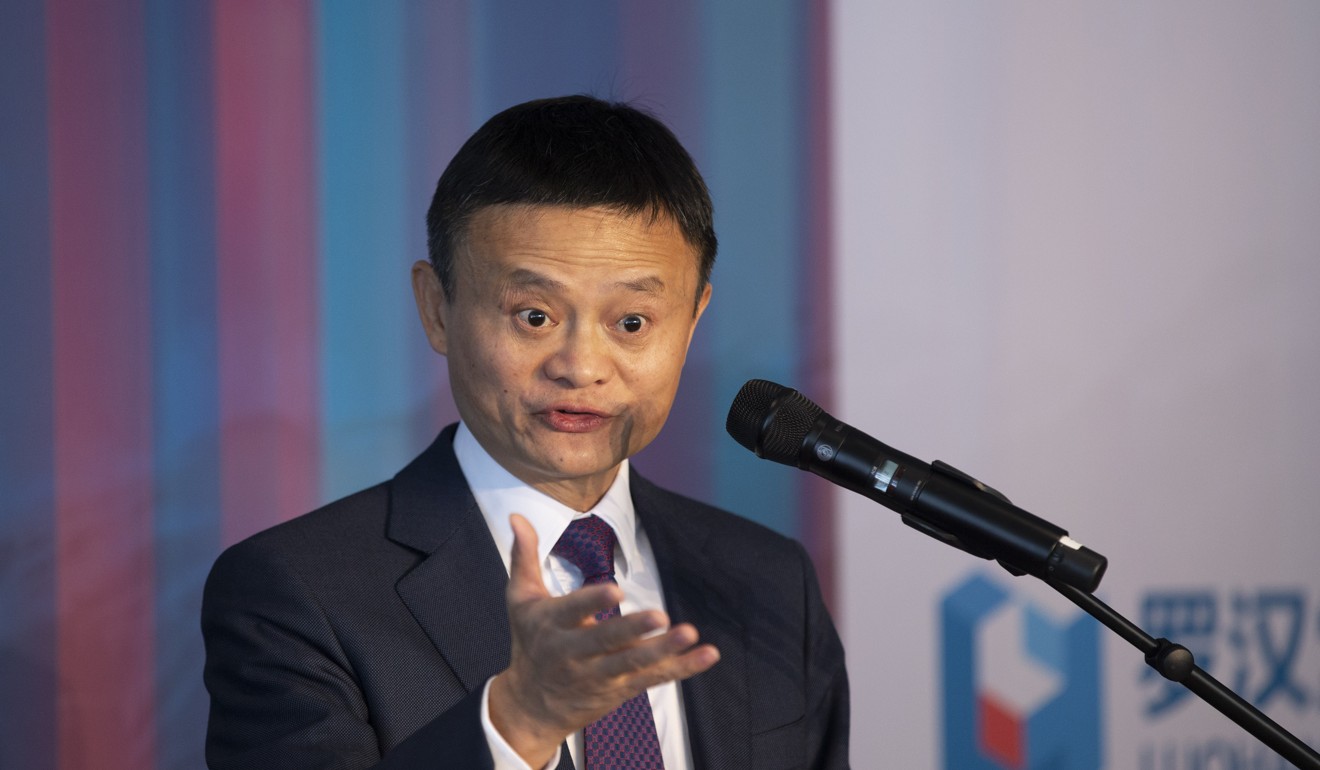
Elon Musk and Jack Ma face off over AI at the 2019 Shanghai WAIC. Photo: SCMP
Billionaire techpreneurs Jack Ma and Elon Musk faced off over AI in a much-anticipated morning session at the Shanghai World Artificial Intelligence Conference on Thursday, and although sparks didn’t actually fly it was clear to the packed audience that they each have a different vision of the future.
“AI will open a new chapter so that humans will know themselves better,” said Jack Ma, Alibaba Group Holding founder. “Most of the projections about AI are wrong … people who are street-smart about AI are not scared by it.”
The conference has attracted executives from nearly 300 companies including US firms Intel, IBM, Microsoft and Qualcomm as well as scientists and scholars from across the world. Both men had to condense their visions of the future into a compact 45-minute session, which also included answering a series of pre-prepared questions from Chinese netizens.
“Due to AI, people will have more time to enjoy themselves as a human being … forget long days, we could end up with 12-hour work weeks,” said Ma. “I don’t worry too much about the impact of AI on jobs … in the future we will not need a lot of jobs.”
Musk, who has founded a string of tech ventures including SpaceX, Boring Company and Neuralink aside from his role as co-founder and CEO of Tesla, said he had heard that “AI sounds like love in Chinese” but in a more cautious tone described AI as “much more than just a smart human”.
“Humans may become too slow. A millisecond is an eternity to a computer today,” said Musk, who has championed everything from electric cars to Mars colonies. “Computers are already smarter than human beings in many aspects,” he said, adding that while humans write AI software today, in the end the machine will do this itself.
Alibaba co-founder and chairman Jack Ma speaks at the 2019 World Economic Forum (WEF) annual meeting in Davos. Photo: Xinhua
The comments from the two executives, who are both engaged in industries [e-commerce and autonomous driving] where AI is essential – were largely in line with what they have said before on the topic. Ma is mainly an optimist, seeing AI as an inevitable agent of change in a digital world, whereas Musk has sounded several warnings.
In 2017, Musk – along with 100 robotics and AI leaders – urged the United Nations to take action against the dangers of autonomous weapons, known as “killer robots”. He has also described AI as humanity’s “biggest existential threat”, comparing it to “summoning the demon”.
AI cannot replace me yet, says Esquire magazine editor
Earlier in the week, Ma said that amid an escalating trade and technology war between the US and China, both countries needed to make a concerted effort to work together on technology for the world to benefit from the digital era.
“In the smart era, it is almost impossible for anyone to strike out on their own,” Ma said in a speech at the Smart China Expo in Chongqing on Monday. “Only if China and the US work together on technology, can we enter the digital era together.”
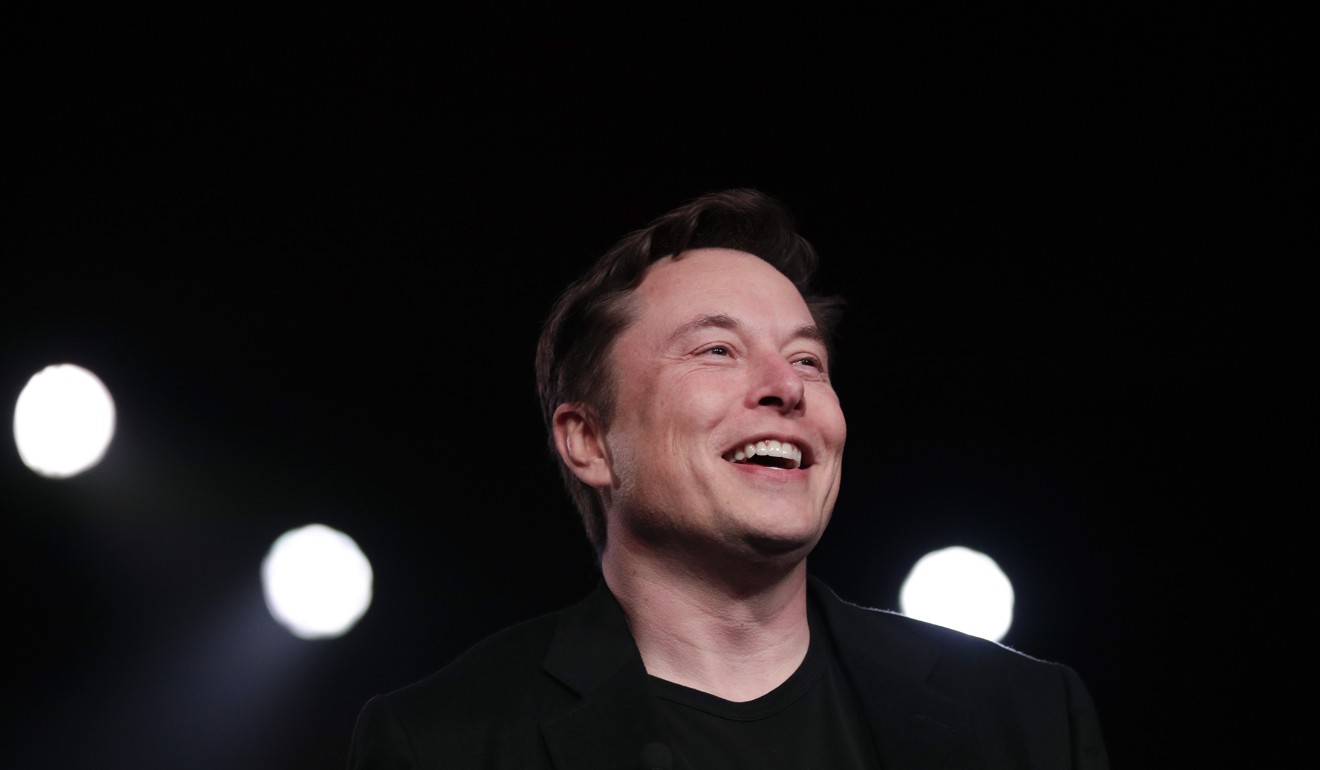
Tesla CEO Elon Musk, 2019. Photo: AP
Chinese Vice-Premier Liu He, Beijing’s top trade negotiator said on Monday at a conference that an escalation of the trade war was not in anyone’s interests. US tariffs on some US$300 billion worth of Chinese imports – mostly consumer goods – are expected to increase from 10 to 15 per cent later this year, in retaliation to China’s decision last week to impose tariffs of between 5 to 10 per cent on US$75 billion worth of American products including soybeans, pork and crude oil.
Automobiles is one of the most high-profile sectors to be affected by the trade war, and US President Donald Trump has highlighted the tariff gap between the US and China on imported cars in earlier comments.
Minority Report-style crime prevention is fast becoming reality
Founded in 2003, Tesla is currently building its first overseas factory in Shanghai, which is nearing completion and expected to start production by the year end with an initial annual output of 250,000 vehicles.
China is Tesla’s second largest market after the US. The California-based electric car-maker reported an over 40 per cent year-on-year surge in sales generated in the country to nearly US$1.5 billion in the first six months of the year.
Musk is expected to visit the US$5 billion production facility in Lingang, part of Shanghai’s free-trade zone, amid his China trip and launch a China unit for his infrastructure start-up Boring, as announced earlier on Twitter.
BEIJING (Reuters) – China will exempt Tesla Inc’s (TSLA.O) electric vehicles (EV) from purchase tax, the Ministry of Industry and Information Technology (MIIT) said on its website.
China currently levies a 10% purchase tax on the sale of each vehicle. The move could reduce the cost of buying a Tesla car by up to 99,000 yuan ($13,957.82), according to a post on Tesla’s social media WeChat account.
Tesla’s pre-market share price jumped more than 5% after the announcement.
Sixteen variants – all the Tesla models sold in the country – are listed on the document issued by MIIT, including Model S, X and 3. No reason was given for the decision to exclude the cars from the tax.
The U.S. EV maker is building a plant in Shanghai, the firm’s first overseas factory.
It is due to start production by the end of the year and Tesla has said it should be able to build 3,000 Model 3 vehicles a week in its initial phases.
The plant is slated to have annual output capacity of 250,000 vehicles after production of the Model Y is added.
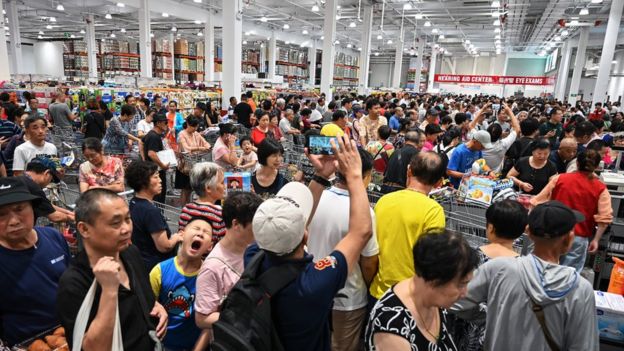
US retailer Costco was forced to close early on its opening day in China, after the store was swamped with shoppers.
Buyers battled long queues and traffic chaos, before the Shanghai store was shut hours early due to “overcrowding”.
Costco’s push into China comes as other foreign retailers have struggled to compete with local rivals.
It also comes at a time of rising tensions between the US and China over trade.
Costco is a discount warehouse store that sells a range of goods, from fresh foods to household electronics.
Some customers spent two hours lining up to pay for their purchases, while some had to wait three hours for parking, state news agency Xinhua reported.
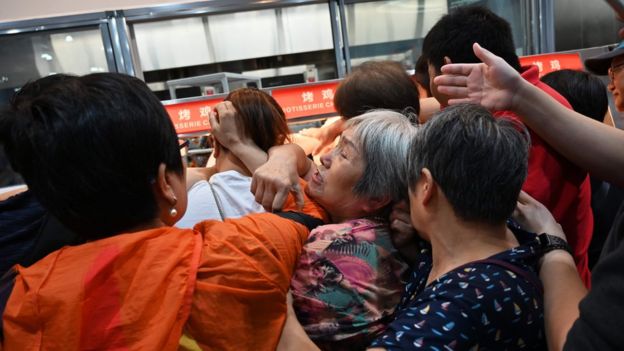
Image copyright AFPImage caption Images from the store show customers caught up in heavy crowds
One video showed people pushing through heavy crowds to get their hands on roast chickens.
“Due to overcrowding in the market, and in order to provide you with a better shopping experience, Costco will temporarily close on the afternoon of August 27. Please avoid coming,” the retailer in a notice on its official app, according to AFP.
Image copyright GETTY IMAGESImage caption Some customers reportedly spent two hours lining up to pay for their goods
Costco has had an online presence in China since 2014, through a partnership with e-commerce giant Alibaba.
The firm’s first store in the country comes as other international retailers battle tough competition in China.
Earlier this year, Amazon said it was downsizing its operations in China and France’s Carrefour agreed to sell 80% of its China business to local retailer Suning.com after a series of losses.
The world’s two largest economies have been fighting a trade war for the past year, and tensions have escalated with the threat of more tariffs from both sides.
NEW DELHI (Reuters) – India is set to impose a nationwide ban on plastic bags, cups and straws on Oct. 2, officials said, in its most sweeping measure yet to stamp out single-use plastics from cities and villages that rank among the world’s most polluted.
Prime Minister Narendra Modi, who is leading efforts to scrap such plastics by 2022, is set to launch the campaign with a ban on as many as six items on Oct. 2, the birth anniversary of independence leader Mahatma Gandhi, two officials said.
These include plastic bags, cups, plates, small bottles, straws and certain types of sachets, said the officials, who asked not to be identified, in line with government policy.
“The ban will be comprehensive and will cover manufacturing, usage and import of such items,” one official said.
India’s environment and housing ministries, the two main ministries leading the drive, did not respond to emails from Reuters to seek comment.
In an Independence Day speech on Aug. 15, Modi had urged people and government agencies to “take the first big step” on Oct. 2 towards freeing India of single-use plastic.
Concerns are growing worldwide about plastic pollution, with a particular focus on the oceans, where nearly 50% of single-use plastic products end up, killing marine life and entering the human food chain, studies show.
The European Union plans to ban single-use plastic items such as straws, forks, knives and cotton buds by 2021.
China’s commercial hub of Shanghai is gradually reining in use of single-use plastics in catering, and its island province of Hainan has already vowed to completely eliminate single-use plastic by 2025.
India lacks an organized system for management of plastic waste, leading to widespread littering across its towns and cities.
The ban on the first six items of single-use plastics will clip 5% to 10% from India’s annual consumption of about 14 million tonnes of plastic, the first official said.
Penalties for violations of the ban will probably take effect after an initial six-month period to allow people time to adopt alternatives, officials said.
Some Indian states have already outlawed polythene bags.
The federal government also plans tougher environmental standards for plastic products and will insist on the use of recyclable plastic only, the first source said.
It will also ask e-commerce companies to cut back on plastic packaging that makes up nearly 40% of India’s annual plastic consumption, officials say.
Cheap smartphones and a surge in the number of internet users have boosted orders for e-commerce companies, such as Amazon.com Inc (AMZN.O) and Walmart Inc’s (WMT.N) Flipkart, which wrap their wares – from books and medicines to cigarettes and cosmetics – in plastic, pushing up consumption.
The traditional view that the man of the house must be the breadwinner may be crumbling, according to a recent survey
Just over half of the men questioned said they were in favour of stay-at-home fathers. Photo:Shutterstock
More Chinese husbands are open to the idea of becoming stay-at-home fathers in a shift away from traditional mores, according to a recent survey.
The idea that the man of the house should be the breadwinner, while child care and domestic duties are the woman’s duties, is deep-rooted in Chinese culture.
But the survey, jointly conducted by the state-run China Youth Daily and questionnaire website wenjuan.com earlier this month, found that 52.4 per cent of male respondents supported the idea of men being a full-time carer.
The number in favour was lower among women, just 45.8 per cent of whom supported the idea.
But however keen men may be about the idea, there may also be practical difficulties.
Yu Xiang, a middle schoolteacher in Shanghai who has a six-month-old daughter, said he was willing to be a stay-at-home father but in reality it was not practical to do that because his wife, who is also a teacher, did not earn enough to support the family.
He also said his wife was not happy leaving him to do the housework, adding that she often scolded him for doing it badly. “She also said he would not feel comfortable letting me take care of our daughter,” he said. “She says I am too careless.”
Chinese father decides to drop in on daughter’s school … via helicopter
Robin Ge, a financial manager from Shanghai, admitted he took a more old-fashioned view of household duties.
The father of a five-year-old boy said he would not accept the idea of becoming a stay-at-home father even if his wife, an office worker, started earning more than him.
“Perhaps I am a traditional Chinese man,” he said. “I believe men should earn more than women. I remember my father told me years ago that a man’s status in his family is determined by his economic status. Compared with stay-at-home mothers, the acceptance rate for stay-at-home fathers among the public is very low.
“I agree that a father caring for the kids has benefits, such as helping the kid to be brave and responsible. However, that doesn’t mean a man needs to be full-time father. What he should do is to spend much of his spare time caring for and playing with his kid.”
The survey questioned 1,987 married people, some 89.2 per cent of whom were parents. Sixty per cent of the respondents agreed that the stereotypical view of the husband being the breadwinner put fathers off staying at home to look after the children.
However, the number of women who said they were opposed to the idea of stay-at-home fathers, 30.9 per cent, was slightly higher than the 28 per cent of men who did not support the notion.
But women whose husbands have given up their jobs to look after the children generally appreciated what they had done.
“I don’t think a man who stays at home is a failure in life. His sacrifice helps me so much and I really am grateful for his support,” a woman wrote on China’s leading parental website ci123.com, adding that this kind of family is more stable and the relationship between husband and wife is more harmonious.
Chinese father takes daughter, 10, to top school’s open day despite her being on an IV drip
Zhang Baoyi, a sociology professor at the Tianjin Academy of Social Sciences, said he believed attitudes would change as society evolved.
“To embrace this practice, we need to recognise the contribution and value of homemakers,” Zhang told China Youth Daily.
“The fact that dads are willing to be more involved in their children’s lives shows that the traditional mentality of ‘career husband and domestic wife’ is changing.”
Zhang also said that more parents in general were willing to stay at home to provide full-time child care because they were attaching increasing importance to their children’s education.
“The number of stay-at-home fathers or mothers is increasing,” he said.
“Couples should adjust the [family] model … according to their economic conditions and abilities to educate the children.”
World’s third largest helicopter assault ship could be launched in a few months, military expert says
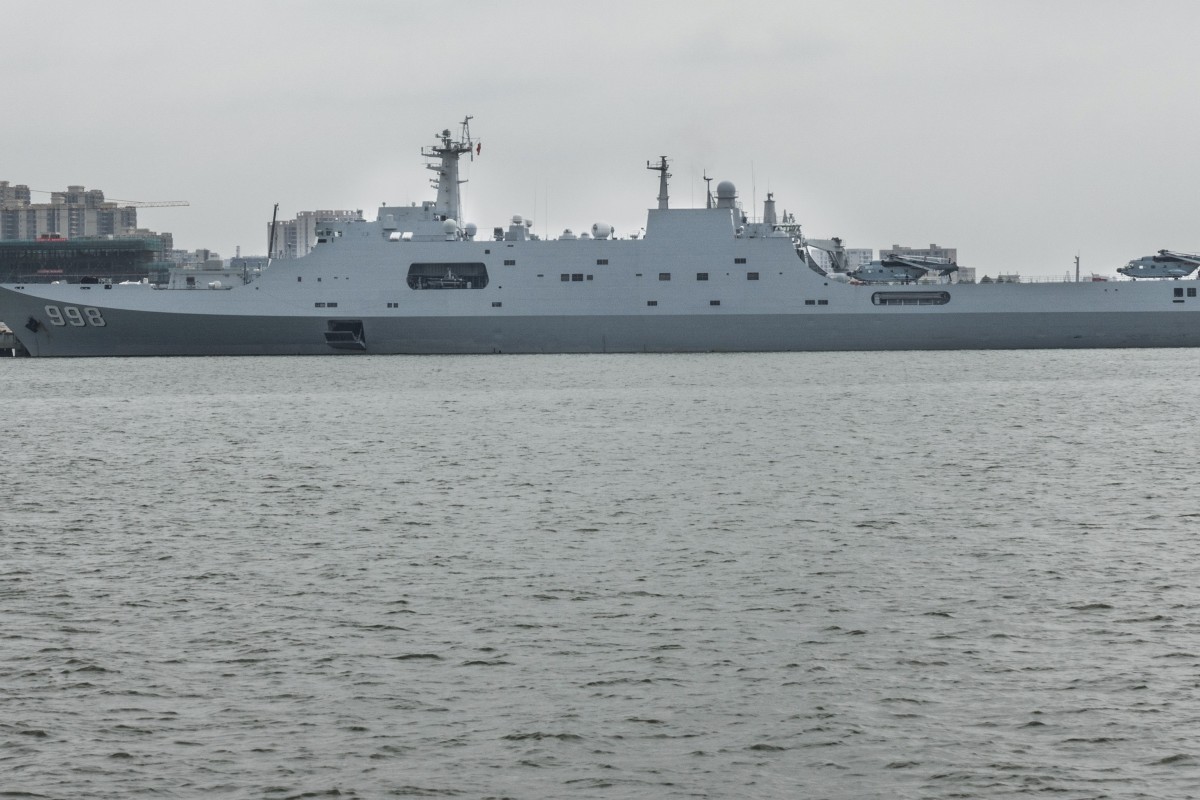
One of China’s previous generation amphibious vessels, the Type 071 Kunlun Shan, launched in 2016. Photo: Chow Chung-yan
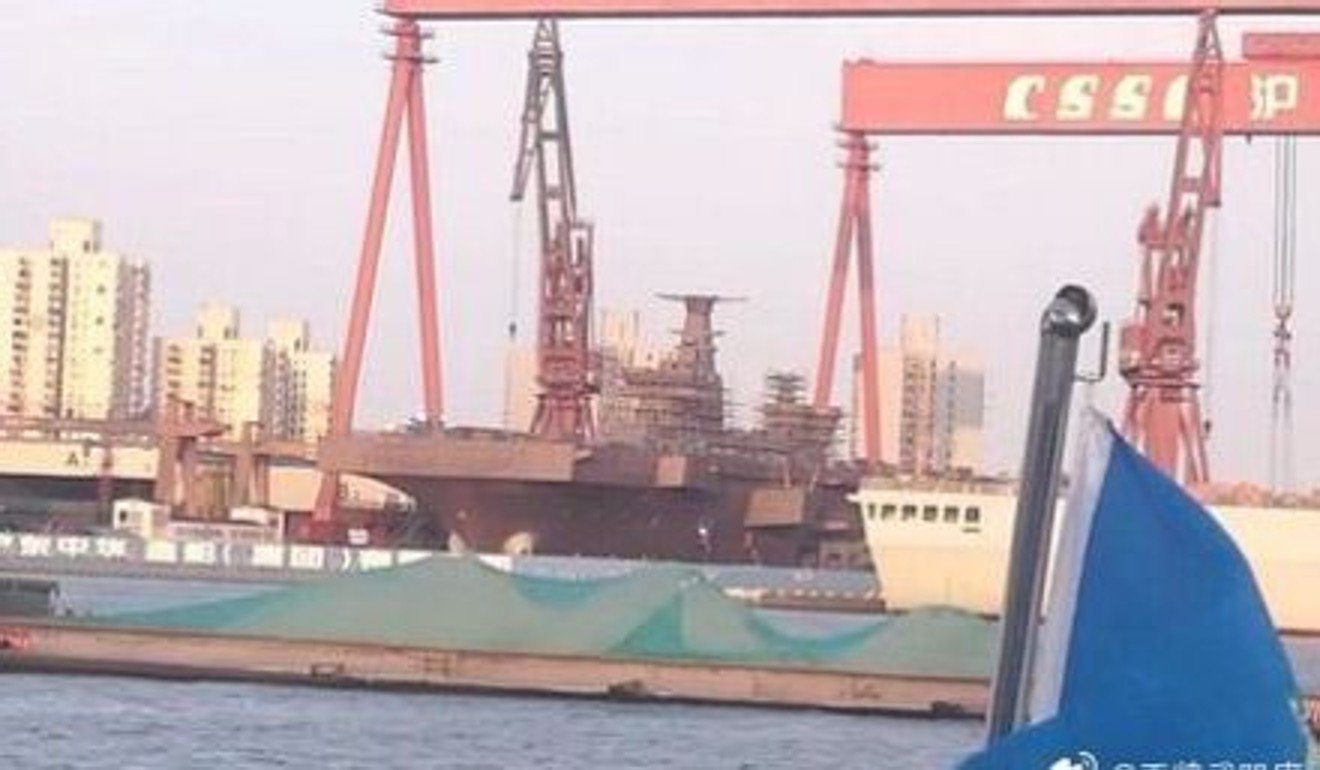
Pictures taken by military enthusiasts earlier this week appear to show that construction of China’s first Type 075 amphibious helicopter assault ship is moving quickly.
The images, taken outside the dry dock at Shanghai’s Hudong-Zhonghua shipyard, were circulated on Chinese social media and showed scaffolding around two separate superstructures above the flight deck, suggesting the estimated 40,000 tonne ship may have two islands.
In June, commercial satellite images showed the vessel had a 32-metre wide beam, with bow and stern sections yet to be added. In the most recent pictures the bow of the vessel is clearly visible.
The status of the construction suggested the ship would probably be launched in the next few months, according to Song Zhongping, a Hong Kong-based military affairs commentator.
An image of China’s first Type 075 amphibious helicopter assault ship suggests the vessel may be completed in the next few months. Photo: Weibo
Share:
Song said large landing helicopter docks (LHDs) like the Type 075 could play an even more important role than aircraft carriers in the future, following last month’s defence white paper released in Beijing which named protecting China’s overseas interests as one of the key missions of its military forces.
“LHDs are a central part of a blue water navy, because an LHD has a full range of weapons with a lot more marine troops for potential ground operations, whereas an aircraft carrier is just a mobile airbase,” he said. “Each time the Americans deploy their forces overseas, LHDs always serve as the vanguard.”
The PLA Navy has ordered several LHDs in recent years, at the same time as Beijing’s claim to the disputed South China Sea has been challenged and the relationship with Taiwan strained
China claims almost all islands and reefs in the South China Sea, many of which are occupied by rival claimants, and reserves the right to use force to reunify Taiwan, which it sees as a breakaway province.
Five Type 071 25,000 tonne amphibious landing dock ships have been launched since 2016, of which three have been commissioned and two are on sea trials.
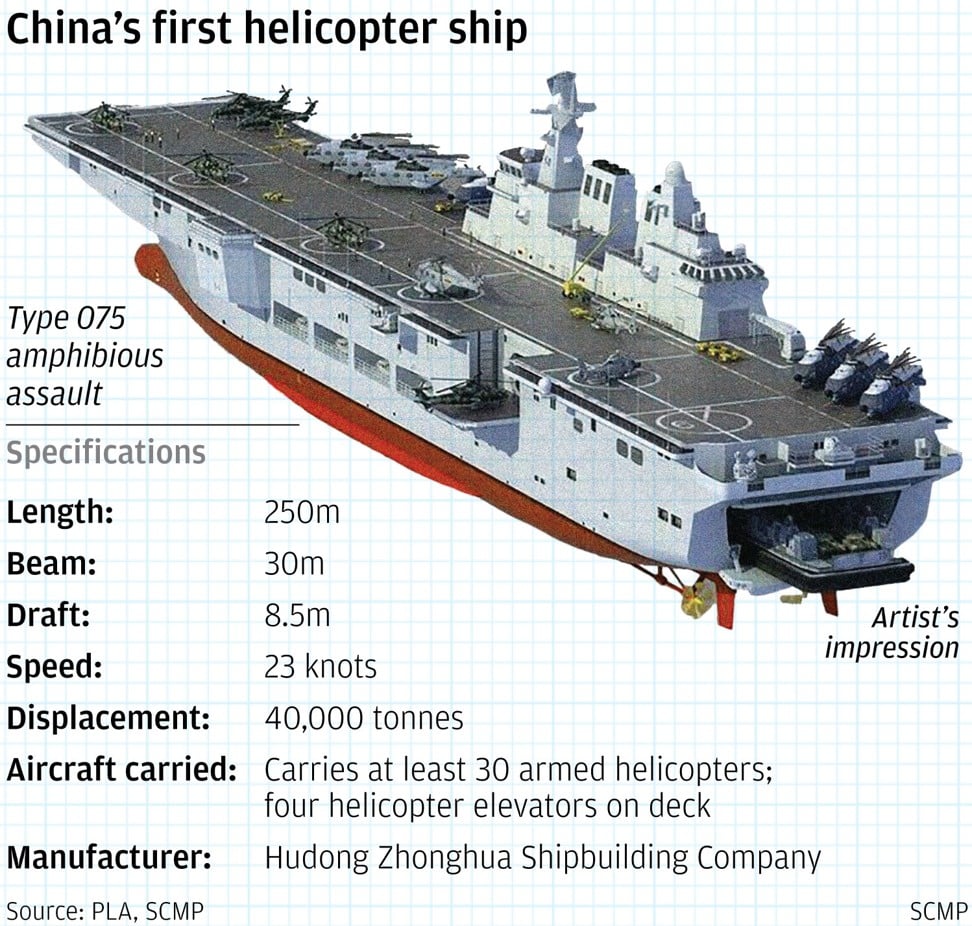
It is believed China’s first batch of Type 075 craft will consist of three ships. The Type 075 will be the world’s third largest amphibious assault ship, behind only the US Wasp-class (41,000 tonnes) and America-class (45,000 tonnes). It is significantly bigger than Japan’s Izumo-class (26,000 tonnes), and France’s Mistral-class (21,000 tonnes).
The Type 075 will be able to carry up to 30 helicopters, as well as a number of amphibious tanks, armoured vehicles, jet boats, and hundreds of marine troops.
Its massive flat deck could also accommodate vertical take-off and landing fighters such as the F-35B. This capability would enable the ship to operate as a light aircraft carrier, in a similar function to the way the US military uses LHDs. However, China currently does not yet have any vertical take-off jets.
Adult consumers are fuelling a boom in China’s toy collectibles market
Men are spending thousands of dollars on figurines to express their identity, boost their street cred, and indulge their inner kid
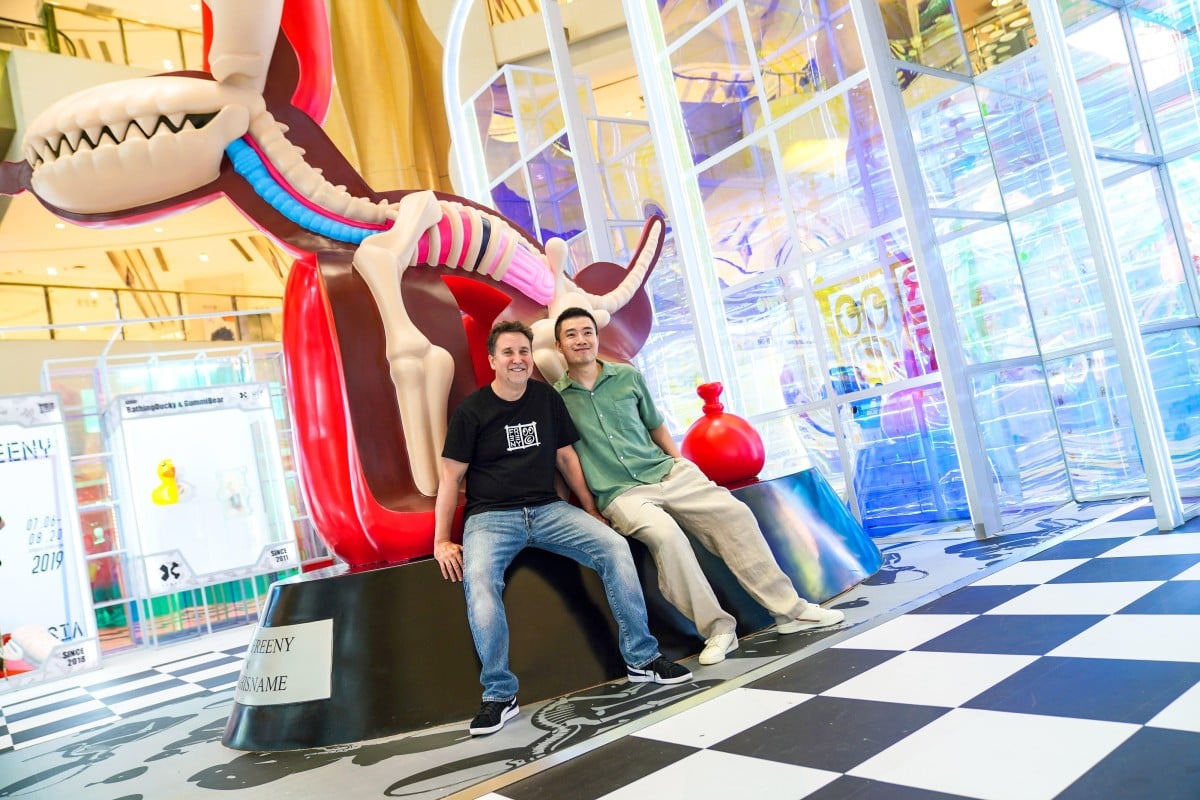
Chinese collector Don Tang with artist Jason Freeny at the Jason Freeny X-Soul Station exhibition in Shanghai. Photo: Don Tang
Don Tang is proud of his toys. So much so that the Shanghai resident, 32, puts them on display both in his home and in the office of the company he runs.
And there are plenty to display. Tang, 32, has some 100 collectibles and the number is growing all the time. Each month he sets aside 2,000 yuan (US$280) to buy the top trending toys, newest releases, or one-of-a-kind items – either from physical stores, online or at toy conventions in China.
But the toys are not connected to his work as the CEO of a firm in the intellectual property sphere. They are simply a hobby, albeit one Tang takes seriously. The crowning jewel of his collection? A 6,000 yuan KAWS action figure bought in Tokyo, Japan.
“When I return home from work each day, I get to see [my toys] and it puts me in a good mood,” says Tang, who realises some people might not get the appeal of his hobby, but says it is an “addictive” pursuit and a way of appreciating designs and craftsmanship. Whether it’s SpongeBob SquarePants, Hello Kitty or Sesame Street, each toy has its own distinct, “lovable, cute, and personalised” identity, he says.
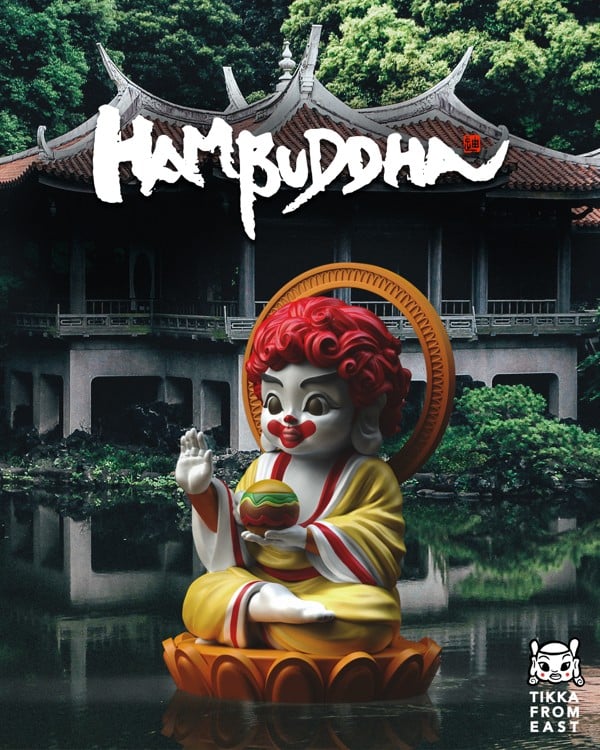
Remind you of someone? Hambuddha is a designer figurine made by Mighty Jaxx of Singapore that is aimed at the adult market. Photo: Mighty Jaxx
“When you look back at the toys that you collected at different times, you realise how your own aesthetic, tastes, and preferences have changed over time,” adds Tang, who would never dream of selling his precious collection.
Tang’s toy story is far from unique. Sales of toys and games in China – which produces 80 per cent of all the world’s toys – soared to 324 billion yuan in 2018, up from 135 billion yuan in 2013, according to market research company Euromonitor. Fuelling these sales is a growing army of toy connoisseurs just like Tang.
CASHING IN
Mighty Jaxx, a Singapore-based urban culture company that designs and manufactures collectibles and lifestyle products, is among the many companies benefiting from this surge in demand.
Its Chinese customer base accounts for 25 per cent of its projected revenue of S$10 million (US$7.21 million) for 2019 – and this proportion is expected to hit 40 per cent over the next few years, according to Mighty Jaxx’s founder and CEO, Jackson Aw, 30.
Smearing cannabis on your face: the latest Asian beauty craze
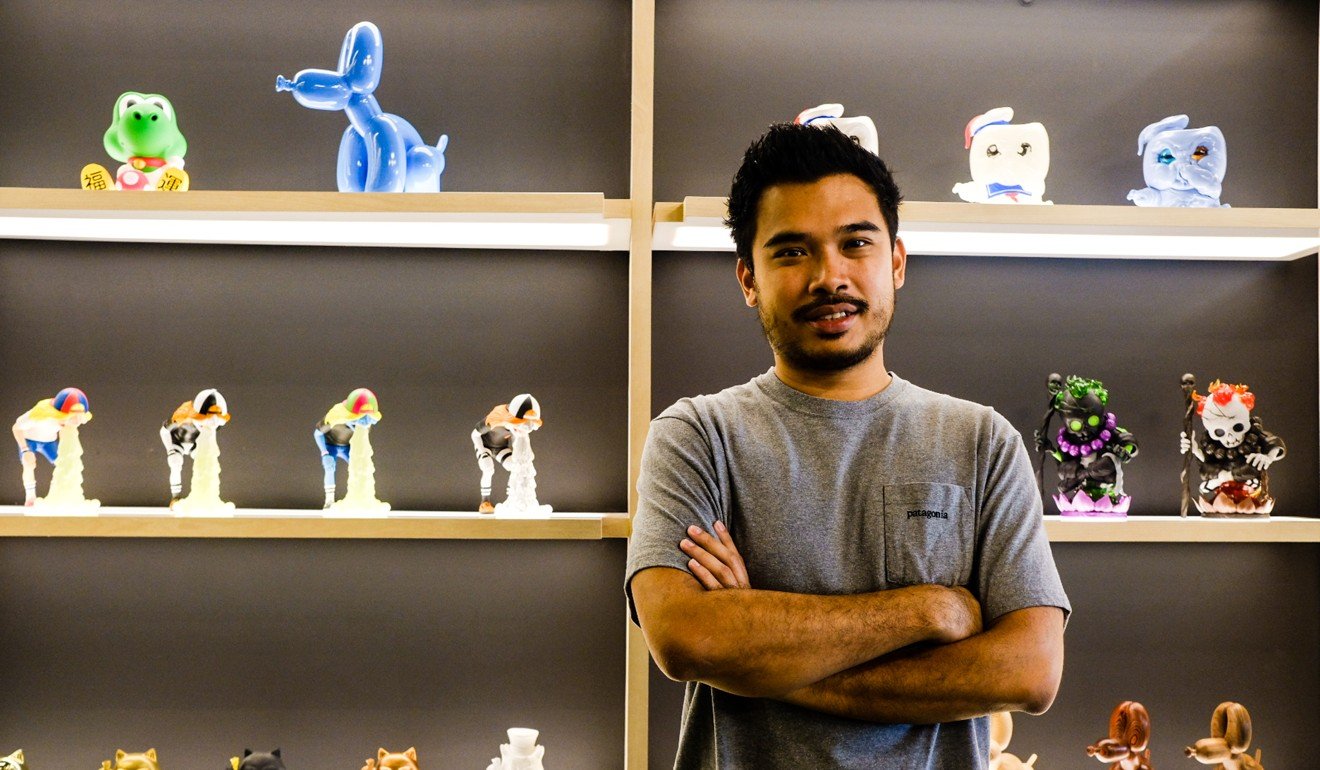
An avid toy collector himself, Aw first mused over the idea of turning his hobby into a viable business back in 2012. He ventured to Shenzhen in China for one month, knocking on factory doors just for a behind-the-scenes glimpse of the toy production process.
Being one of his first times to China, the mammoth scale of the industry came as a major “culture shock” to Aw.
Mighty Jaxx founder and CEO Jackson Aw. Photo: Toh Ee Ming
“I had always thought that it was just one giant machine that spits out parts and that was it. But there were rows and rows of hundreds of people printing, hand painting, assembling and using different skills just to produce one toy,” the Singaporean says.
Describing the visit as his “greatest education”, Aw was inspired to launch Mighty Jaxx from his bedroom with start-up capital of S$20,000 loaned from a bank through his parents.
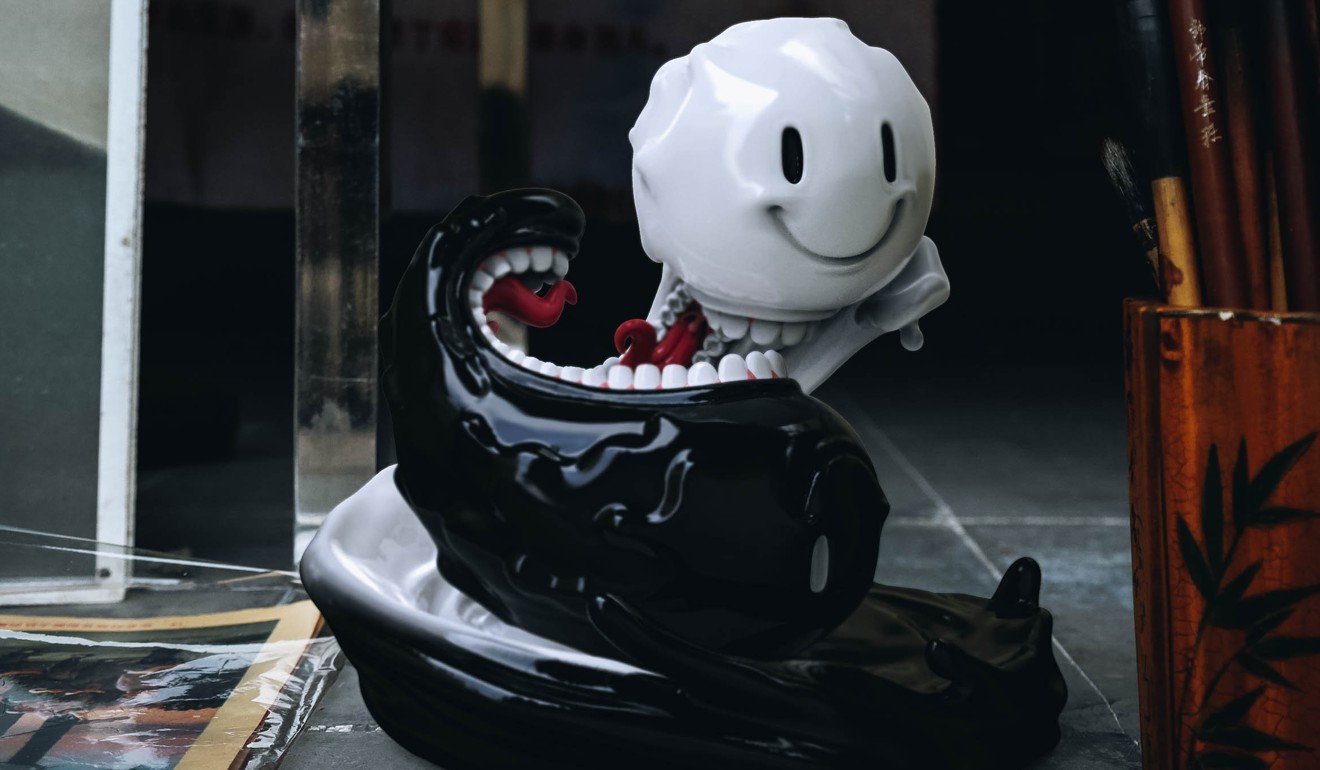
Fast forward to today and his online business has worked with major brands such as Warner Brothers, DC Comics, Cartoon Network, MTV and New Balance, and shipped millions of products to collectors in over 50 countries. It is best known for its XXRAY figures, developed in partnership with artist Jason Freeny, which feature dissected Justice League characters such as Batman, Superman and Wonder Woman.
Hong Kong toy makers hope Asia’s largest toy fair will help boost flagging sales
But in its early days, the China market had intimidated Aw as a “big anomaly” that was still largely closed off. Aw had found it difficult to navigate the cultural norms and familiarise himself with unfamiliar business models.
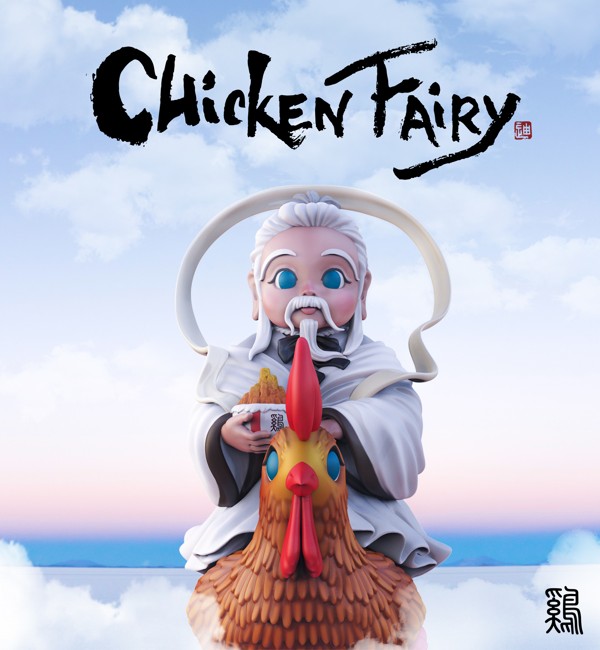
Still, sensing China’s potential, his firm embarked on wide-ranging creative collaborations to tailor its offerings to the Chinese market – from creating yin-and-yang themed toys, celestial chicken fairy deities and the “Hambuddha” (a Buddha holding a pearl-shaped hamburger while on a lotus throne).
It also partnered with Chinese artist Chen Wei (who goes by the alias Cacooca) to develop a new Panda Ink collection, which depicts a panda in the midst of an everyday activity or hobby, such as hiking, playing video games or cuddling with cats.
Mighty Jaxx’s ‘Flow by 18 Uppercut’ has a yin and yang theme with white and black halves. Photo: Mighty Jaxx
It has also collaborated with other big-name artists and celebrities trending among Chinese consumers – such as Los Angeles-based dance crew Kinjaz, who found fame in China appearing on dance shows, and ABS, a leading graffiti crew based in Beijing’s 798 Art District – and has an upcoming collaboration with Taiwanese singer Show Luo.
But it is the comic and toy conventions that provide its biggest fans, typically men in their 20s to 40s who flock in from Beijing, Shanghai and Guangzhou.
Aw says these collectors have a huge appetite to splurge on high-end collectibles, which can range in cost from anywhere between US$10 to US$2,000.
Singapore sex toy sales buzzing thanks to ‘healthy’ branding
To these collectors, price is of little concern as they are looking for “tangible products to buy and show off their personality” and build their street cred among their friends, though they still prefer to stay under-the-radar about their collection to the general public, Aw says.
Today, Mighty Jaxx’s products are manufactured in nearly 20 different factories in Shenzhen and Guangzhou. It set up its first overseas office in Shanghai last year and is planning to open its second one in Suzhou by the end of 2019, according to Aw.
Besides growing Chinese affluence, Aw credits his company’s success to a greater exposure to Western influences and China’s own unique brand of pop culture taking off domestically.
He points to one of China’s biggest blockbusters Monster Hunt, a fantasy martial arts film of how monsters live among humans.
Mighty Jaxx’s celestial chicken fairy deity is aimed at the Hong Kong and mainland China market. Photo: Mighty Jaxx
“Outside China, you wouldn’t know what the hell it’s about. But the Chinese are creating their own unique narrative and developing their own intellectual property … That’s when we know the demand for original creation in different forms is truly there,” Aw says.
Likewise, consumers live in an age of a “mishmash of pop cultures and crossovers” and “subcultures becoming mainstream”, he says.
Citing how the business has teamed up with Team Hero, a China e-sports team comprising professional computer gamers, to roll out new figurines, Aw says: “It doesn’t mean that tattoo artists, skateboarders don’t buytoys … What seems to be separate demographics areconverging to become a multibillion-dollar market.”
Aw says the company is planning to expand from its current business model based on direct selling to collectors, to e-commerce distribution channels like Taobao and Tmall by the end of 2019.
He hopes eventually to set up the firm’s first retail store in Shanghai, as he believes the future lies in experiential retail.
“China has been cultivating that openness in recent decades, and we’re still very curious and excited for new things to happen [in this market],” Aw says. ■
Scientists’ large-scale conversion of agricultural waste into fuel offers savings up to 60 per cent, they say
Discovery could slash military costs and bring civilian applications of hypersonic flight technology closer
Super-fuel for military aircraft costs nearly 10 times as much as ordinary jet fuel for commercial planes. Photo: Shutterstock
Chinese scientists say they have developed a technology to convert bio-waste into fuel for missiles and hypersonic planes, reducing fuel costs by as much as 60 per cent.
The existing JP-10 super-fuel for military aircraft has numerous advantages including high energy density, good thermal stability and low freezing point, but it costs more than US$7,000 per tonne – nearly 10 times as much as ordinary jet fuel for commercial aircraft.
It is used mainly in cruise missiles and ramjet or scramjet engines on new-generation aircraft travelling at hypersonic speed, or five times faster than sound.
Scientists from the Dalian Institute of Chemical Physics, at the Chinese Academy of Sciences in the northeastern province of Liaoning, predicted using the new technology in the near future could reduce the cost to as low as US$2,547 per tonne.
The secret, according to their paper, published in the latest issue of German chemistry journal Angewandte Chemie, lies in cheap bio-waste.
Using agricultural and forestry residues including bran, chaff and mill dust, Professor Zhang Tao, Li Ning and colleagues discovered new chemical processes that can turn the waste to JP-10 fuel on a large scale with unprecedented efficiency.
At present, the super-fuel comes from coal tar or naphtha, and the synthesis is extremely costly and unfriendly to the environment.
The bio-JP-10 fuel can be produced by two different methods, one involving six steps of chemical reactions and the other only four, according to the paper.
China’s plan to make jet fuel from restaurant leftovers
Combining these methods with the latest technology in biomass conversion, the researchers said, the super-fuel can be mass-produced at a price equivalent to that of some of the bio-jet fuels already in commercial use, thanks to government subsidies provided for their environmental benefits.
“We believe that the future commercialisation of bio-JP-10 fuel is very promising, especially taking policy support and exemption from CO2 emission tax into consideration,” the authors wrote in the paper.
Liu Huoxing, professor at the school of energy and power engineering at Beijing University of Aeronautics and Astronautics, said civilian applications of hypersonic flight technology faced many challenges that remained to be solved, with the problem of high fuel prices being one of the headaches.
“No airline will buy a plane if the fuel costs too much, however fast it can fly,” he said.
Liu, who conducts research on engine technology forhypersonic vehicles but was not involved in the Dalian study, said the reduction of production costs for jet fuel was usually incremental and it was quite rare to see a significant drop.
“This can be an important development,” he said of the Dalian findings.
China is developing various models of hypersonic speed aircraft for military and civilian use. Some are aimed at flying distances such as Shanghai to Los Angeles in a couple of hours.




 CHINDIA ALERT: You'll be living in their world, very soon