22/07/2019
- City’s richest person was ‘very pleased’ to have bumped into group of youngsters in Hokkaido, mother says on social media
- Li has a personal fortune of US$31.7 billion and is known for his charitable acts
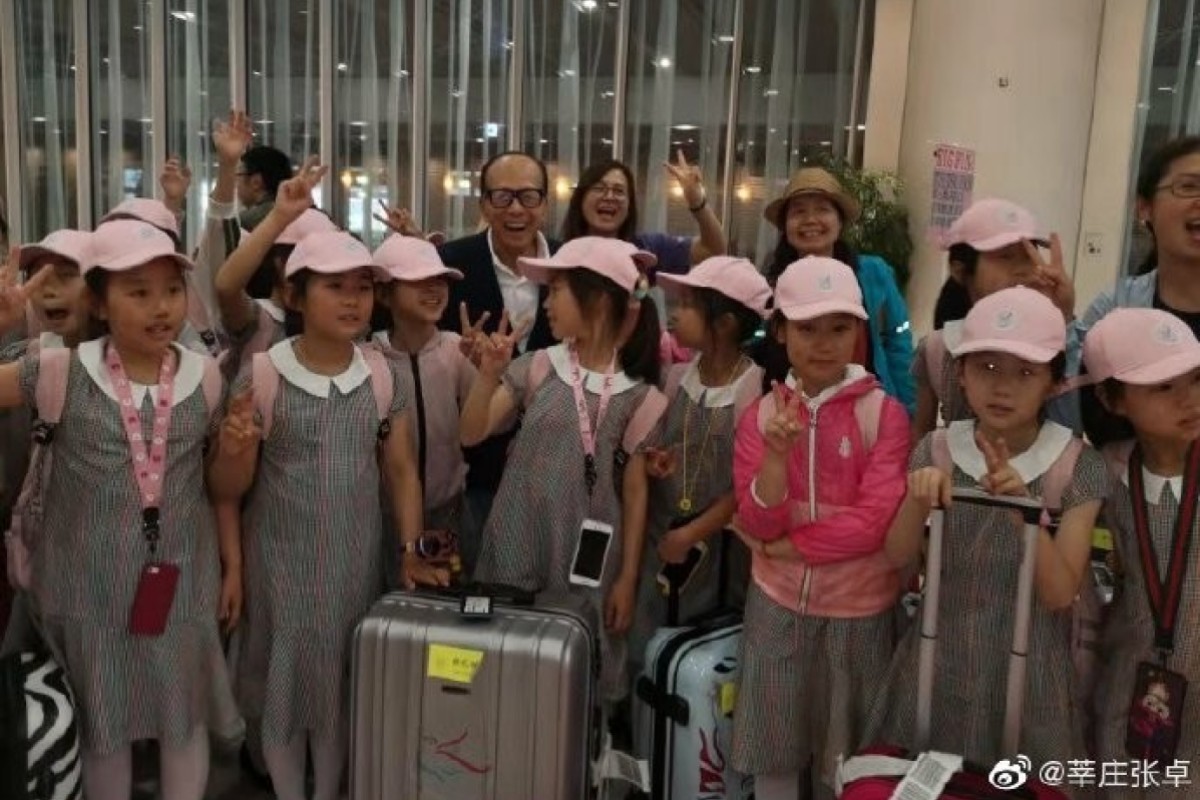
The youngsters from Shanghai got a wonderful surprise when they met billionaire Li Ka-shing at an airport in Japan. Photo: Weibo
Christmas came early for a group of children from Shanghai on Tuesday when they met Hong Kong billionaire Li Ka-shing at an airport in Japan while en route to a dance competition and he offered to pay for their trip … and buy them each a gift.
The 45 youngsters and their teachers from the Little Pigeon Dancing Group in the east China metropolis were passing through New Chitose Airport in Hokkaido, the northernmost of Japan’s main islands, when the serendipitous meeting happened, according to social media posts.
“The children bumped into Mr Li Ka-shing at the airport, who looked very pleased and volunteered to take pictures with the children,” Zhang Zhuo wrote on Weibo – China’s Twitter-like platform – on Thursday, adding that she was the mother of one of the dancers.
“Today a staff member from the Li Ka Shing Foundation contacted the dance group and offered to sponsor the trip to Japan,” she said. “The children shot a video to wish him good health,” she said.
Li met the youngsters from the Little Pigeon Dancing Group in Hokkaido. Photo: Weibo
One of the dance teachers wrote on Weibo that Li was “so pleased after seeing the children at the airport that he decided to sponsor for the trip”.
“So rich and generous, charitable and loving,” she said.
It was not clear exactly how much Li donated, but based on a post by another of the teachers, the cost of the trip was 18,840 yuan (US$2,700) per child, so it would appear to have been in excess of US$120,000.
As part of the offer, the foundation said also that the children should treat themselves to a gift.
Zhang said her daughter treated herself to an eraser, as it was something she wanted to buy before the trip.
“It is not about how expensive the gift is. It’s happiness that counts. We must know to be grateful and moderate,” she wrote.
Li’s influence at Shantou University under threat
Born in 1928 near Shantou in south China’s Guangdong province, Li moved to Hong Kong as a child. According to the latest Forbes list he is richest person in Hong Kong and 28th richest in the world, with a personal fortune of US$31.7 billion.
In 1981 he helped to establish Shantou University and since then the Li Ka Shing Foundation has donated more than 10 billion yuan to support its development.
Last month, the university announced that starting this autumn, for the next four years all new intakes will have the entire cost of their university education paid for by the foundation – a donation of about 100 million yuan a year.
Source: SCMP
Posted in Airport, billionaires, Christmas, dancers, Forbes list, guangdong province, Hokkaido, Hong Kong, Japan, Li Ka Shing Foundatio, Li Ka Shing Foundation, Li Ka-Shing, Little Pigeon Dancing Group, meeting, New Chitose Airport, pays, Shanghai, Shantou University, trips, Twitter, Uncategorized, Weibo |
Leave a Comment »
07/07/2019
TOKYO, July 6 (Xinhua) — “When I wrote the letter, I didn’t expect to receive a reply from President Xi Jinping. I was surprised and honored,” said Daichi Nakashima with excitement.
The 27-year-old Japanese man said he had received the reply from Xi before the Chinese leader attended the Group of 20 summit in Osaka. “When my friend told me on WeChat, I was shocked!” Nakashima said in an exclusive interview with Xinhua.
Nakashima had several times been a winner in the Panda Cup Japan Youth Essay Contest. Founded in 2014, the competition is co-sponsored by People’s China magazine, the Chinese embassy in Japan and the Japan Science Society, aiming to help Japanese youths have a more comprehensive, objective and rational understanding of China.
Nakashima began learning Chinese in college and has participated in several short-term exchange programs in China.
When talking about his original intention of writing a letter to Xi, Nakashima said, “I wanted to convey the warmth and friendship of the Chinese people I felt during my visit to China and the importance of mutual understanding and exchanges between Japanese and Chinese youths.”
Xi, in his reply, said he was glad to see that Nakashima has been studying the Chinese language and literature for a long time and, by participating in essay contests and exchange activities in China, has learned more about China and strengthened his bonds with Chinese friends.
“It’s the best affirmation and recognition of my persistence for so many years. I’m very touched,” Nakashima said.
Born in 1992, Nakashima first learned about China through classics like “Romance of the Three Kingdoms” and “Outlaws of the Marsh,” but it was a two-week trip to Tianjin in 2011 that gave him a glimpse of a vibrant China.
After that, he visited Beijing, Sichuan, Guangdong and other places. Last year, he went to Fudan University in Shanghai and studied for half a year.
Nakashima found that Chinese youth are very familiar with Japanese anime, music and so on, while Japanese youngsters do not know much about China. Their impression of China is restricted to Chinese tourists, “not knowing about Chinese movies and popular music,” he said.
Nakashima said he believes that the friendship between the two peoples needs more bilateral youth exchanges, as President Xi said in the letter.
Noting that China and Japan are close neighbors separated by only a narrow strip of water, Xi said the friendship between the two countries is rooted in the people, and that the future of the friendship between the two peoples is in the hands of the young people.
Xi said he hopes that the youth of China and Japan will strengthen exchanges and mutual learning, enhance mutual understanding, develop long-lasting friendships, and contribute to creating an even brighter future for bilateral relations.
Xi also encouraged Nakashima to continue to promote the China-Japan friendship. Nakashima said this is an encouragement, a mission and also motivation for him to move forward.
Nakashima graduated with a master’s degree in April and has begun to work in a publishing house. He has been determined to introduce excellent works such as Chinese picture books and science fiction to Japan, so that Japanese teenagers can feel the affinity between the two countries.
“I have met many friendly Chinese people and made many friends that are very important to me. In the future, I will continue to make efforts to help Japanese and Chinese youth deepen mutual understanding,” he said.
Source: Xinhua
Posted in Beijing, Chinese embassy in Japan, comprehensive, contributions, Daichi Nakashima, Fudan University, Group of 20 (G20), guangdong province, inspires, Japan Science Society, Japan-China friendship, Japanese youth, letter, master's degree, objective, Osaka, Outlaws of the Marsh, Panda Cup Japan Youth Essay Contest, People's China magazine, President Xi, publishing house, rational understanding, Romance of the Three Kingdoms, Shanghai, shocked, sichuan province, Tianjin, Uncategorized, WeChat |
Leave a Comment »
06/07/2019
SHANGHAI, July 6 (Xinhua) — Shanghai will realize full 5G coverage by 2020, said a guideline for promoting 5G network coverage and application over the next three years released by the municipal government on Friday.
According to the guideline, 10,000 5G base stations will be built to cover the whole of downtown and main suburban areas in Shanghai by the end of 2019.
By 2020, the city will have full 5G coverage throughout the city with 20,000 5G base stations. A total of 20 billion yuan (about 2.9 billion U.S. dollars) will be invested in the area.
By 2021, Shanghai will have 5G related industries worth 100 billion yuan and 100 innovative companies in 5G application industries. The city will add 10,000 more base stations and 10 billion yuan investment based on 2020 numbers.
Shanghai will roll out a three-year action plan to promote 5G in key industries such as manufacturing, transport, medical care, education, leisure and entertainment and the city’s administration.
The city will also push forward innovative application of “5G+4K/8K+AI” in important venues such as China International Import Expo and AI World Conference & Expo, as well as key transport hubs.
Demonstrative regions will be established to promote the in-depth integration of 5G with intellectual manufacturing, industrial internet, big data, artificial intelligence, ultra-high-definition video and industrial control security, according to the guideline.
China is currently testing 5G across all major cities, provinces and regions, including Shanghai. It is forecasted that 28 percent of China’s mobile connections will be running on 5G networks by 2025, accounting for about one-third of all 5G connections globally, according to a report by telecoms lobby group GSMA, which represents the interests of 750 mobile operators.
Posted in AI World Conference & Expo, artificial intelligence (AI), Big data, China International Import Expo (CIIE), full 5G coverage, GSMA, industrial control security, industrial internet, intellectual manufacturing, Shanghai, ultra-high-definition video, Uncategorized |
Leave a Comment »
06/07/2019
TIANJIN/BEIJING, July 6 (Xinhua) — Even at the age of 100, Yang Enze, one of the founders of China’s optical communication, does not stop his research and teaching as a professor at Tianjin University.
Besides his pioneering achievements as the chief engineer of China’s first optical communication project for practical use in the 1970s, Yang is also known as a survivor and a witness of the war of Japanese aggression against China.
“I was admitted to Wuhan University in 1937, the year when Japanese troops attacked the Lugou Bridge, also known as Marco Polo Bridge, on the outskirts of Beijing, on July 7,” said the senior recalling the start of his academic study.
The incident marked the beginning of Japan’s full-scale war against China during World War II and triggered China’s full-scale resistance against the invasion.
Ahead of the 82nd anniversary of the incident that falls on Sunday, Yang said because of the war, his university in central China’s Hubei Province was relocated to southwestern province of Sichuan to avoid the enemy forces. “Even in Sichuan, there were a lot of Japanese bombings, but none of the students missed any of the classes as long as there was no air-raid siren,” he recalled.
It was at that time he and many of his peers cemented the belief that the country needed advanced science and technology for reconstruction and revival.
“I have always kept in mind late chairman Mao Zedong’s words that it was Japanese militarists’ crime that was to blame for the war, not Japanese civilians, ” Yang said, noting that he still gets in touch with many Japanese scholars.
He established the first optical communication laboratory in Tianjin in 1985, when he was invited to teach at Tianjin University. In Yang’s career, he has made friends with several leading experts from Japan at international conferences and even kept friendship with some of them.
Also in Tianjin, Morita Naomi, a Japanese language teacher in Nankai University, works as a consultant to the school’s research institute of Zhou Enlai-Daisaku Ikeda.
“By involving in the research of the friendship between the late Chinese premier and the Japanese philosopher, I want to search for the core factors that help consolidate the friendship between the two peoples,” said Naomi.
She came to Nankai to pursue a master-degree study in Modern Chinese and Chinese Literature in 2010 and has stayed ever since.
When she first arrived, she had troubles even in learning Chinese phonics. Now she can read and speak Chinese fluently, write beautiful Chinese characters, and study ancient Chinese literature independently.
As a teacher, she feels frustrated that most of her Chinese students are more likely to be attracted by Japanese animation and games rather than Japanese literature.
According to the school’s statistics, nearly half of the undergraduates in the 2019 class of Japanese major chose to work in Japanese-funded enterprises or Japanese-related enterprises after graduation.
Naomi said Japanese visitors to China are more likely to choose destinations like Beijing, Shanghai and Guangzhou. Peking University in Beijing impresses young Japanese most.
According to a report released by the China Tourism Academy, China received 2.69 million Japanese visitors in 2018, making Japan China’s fourth largest source of foreign tourists. In the same year, Chinese made 9.06 million outbound visits to Japan as a direct destination.
The academy released the report at the 2019 China-Japan Tourism Forum Dalian held on May 26, which focused on promoting win-win cooperation on cultural exchanges and tourism between the two countries.
China and Japan agreed to push forward bilateral relations along the right track of peace, friendship and cooperation, at the summit of the Group of 20 (G20) major economies held in Osaka, Japan, in June.
This year marks the 70th anniversary of the founding of the People’s Republic of China, and Japan has also entered the Era of Reiwa. It is also the China-Japan Youth Exchange Promotion Year, for promoting friendship and cooperation in a wide range of areas between the two peoples.
“We keep the wartime memory not because we bear the hatred, but because we want the younger generations to cherish what they own today and move towards a better future,” said 70-year-old Zhen Dong, who on Friday visited an exhibition on Beijing’s past, held in Beijing Municipal Archives.
Zhao Hongwei, a professor with Tokyo-based Hosei University, said when it comes to the bilateral relations between China and Japan, it is very important to promote the free trade agreement and expand the markets of both sides.
Source: Xinhua
Posted in air-raid siren, ancient Chinese literature, Beijing, Beijing Municipal Archives, chairman Mao Zedong, China Tourism Academy, China-Japan friendship, China-Japan Tourism Forum, China-Japan Youth Exchange Promotion Year, Dalian, Era of "Reiwa", Group of 20 (G20), Guangzhou, Hosei University, hubei province, Japan, Japanese bombings, Modern Chinese and Chinese Literature, Nankai University, Osaka, Peacebuilders, Peking University, People's Republic of China (PRC), Shanghai, sichuan province, Tianjin University, Uncategorized, war of Japanese aggression, Zhou Enlai-Daisaku Ikeda |
Leave a Comment »
06/07/2019
- President Xi Jinping has made no secret of his desire for China to one day host and maybe even win football’s greatest prize
- But a few passport-switching foreigners are unlikely to be enough to make his dreams come true
China’s soccer team has high hopes, but it still has a long way to go before it can even dream of competing on the world stage. Photo: Reuters
As China targets a place at the 2022 World Cup, England-born
recently became the first foreign player to join the men’s national soccer team as a naturalised citizen.
On his identity card he is listed as ethnic Han.
Several foreign soccer players and other sportspeople have become Chinese citizens in recent years, many of them drawn by the huge financial rewards on offer.
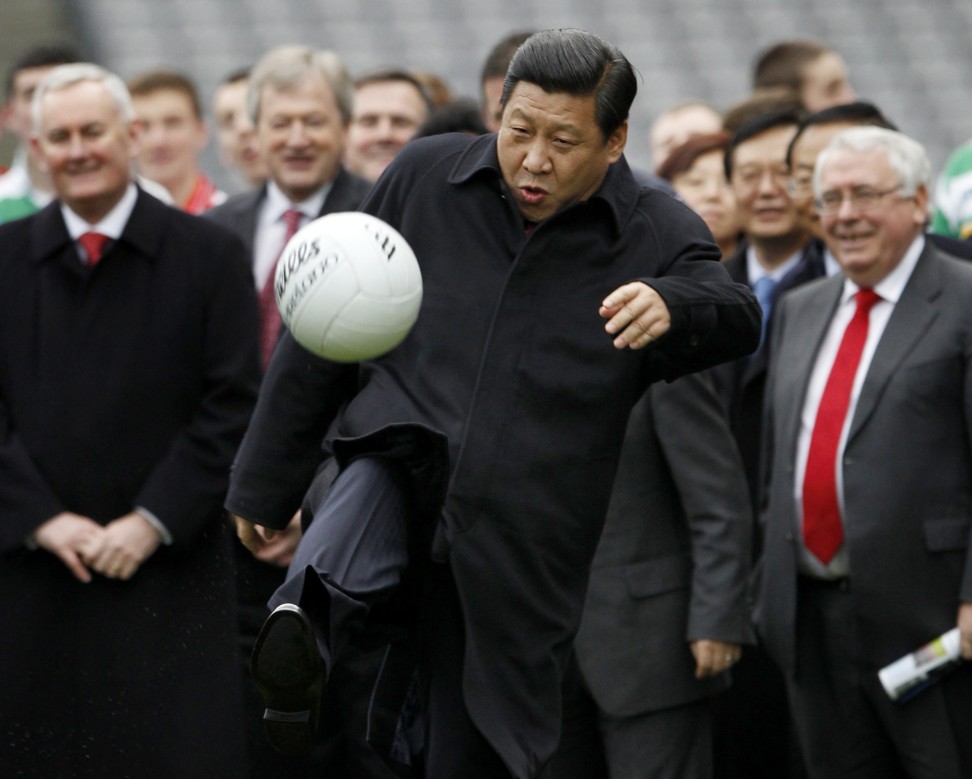
Naturalisation has a long history in many countries, but it is a new concept in China, whose football association only publicly announced it would use it to boost its talent pool late last year. President Xi Jinping’s passion for the game and ambitions for China to host and maybe one day win the World Cup has been public knowledge since before he became leader.
Chinese President Xi Jinping, pictured on a 2012 visit to Croke Park in Dublin while still vice-president, has big dreams for China’s soccer team. Photo: Reuters
John Hou Saeter, who was born to a Norwegian father and Chinese mother, in February became the first professional footballer to switch to Chinese citizenship. The 21-year-old, now known as Hou Yongyong, plays for Beijing Sinobo Guoan, one of the top teams in the Chinese Super League.
Another English player, Tyias Browning, recently joined Guangzhou Evergrande Taobao and is set to complete the process of applying for Chinese citizenship soon, Reuters reported last month.
Yennaris’ naturalisation may help bring China into 21st century
At a work conference in December, Du Zhaocai, the Communist Party secretary of the
(CFA), promised to introduce new policies on naturalisation to help clubs attract players from overseas to join the Super League.
Professor Chen Xiyao from Shanghai University of Sport said such a move would have been unthinkable in the past.
“This is something new in China,” he said. “In the past we only saw our own athletes becoming naturalised citizens of other countries, but not foreign players coming to play for us.”
While the trend was undoubtedly prompted by Xi’s ambitions, Chen said it was also linked to the country’s growing economic prowess and wealth.
“China’s economic growth means it has become better known internationally. Everybody thinks China has money and sports clubs are spending huge sums to attract top players,” he said.
Former Everton player Tyias Browning now plays for Guangzhou Evergrande Taobao. Photo: Reuters
Mark Dreyer, founder of the China Sports Insider website, said naturalised players were motivated not only by money, but also the chance to increase their exposure and possibly play in a major tournament, which they would otherwise not get the chance to do.
“The rewards for the players are fairly clear: more money, more exposure and a shot at playing in the biggest tournaments in the world with China, which they wouldn’t have got if they’d stayed with their original countries,” he said.
“For athletes of Chinese descent, there will also be varying degrees of patriotism built into this as well.”
It is not just soccer players who are making the move top China. It is also happening in other sports, like ice hockey and figure skating.
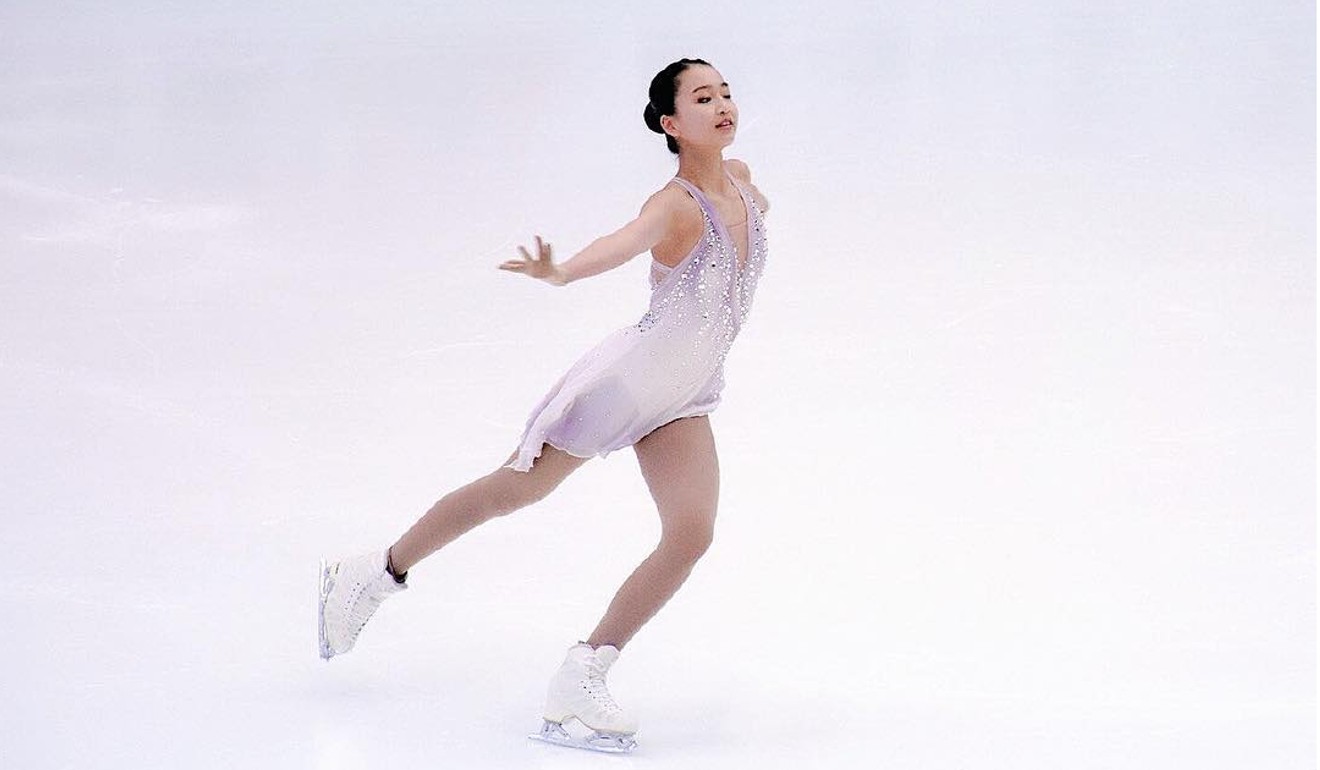
US-born Beverly Zhu, who won the 2018 US Figure Skating Championships, triggered a heated discussion in China after she joined the Chinese team last year, which means she can compete for the host nation at the Beijing 2022 Winter Olympics.
In ice hockey, a number of overseas players have also been naturalised, including Zach Yuen from Canada, who may also represent China in Beijing in 2022.
Beverly Zhu, who won the 2018 US Figure Skating Championships, joined the Chinese team last year. Photo: Instagram
Roy Chu, a lawyer with Links Law Offices in Shanghai who specialises in the sports industry, said that as China does not recognise dual nationality, foreigners have to give up their citizenship if they want to get a Chinese passport and apply for naturalisation.
“Therefore, the players to be naturalised have to be willing to represent China on the one hand, and on the other have a Chinese family background so as to simplify the legal procedures,” Chu said.
Browning’ grandfather and Yennaris’s mother are Chinese.
Dreyer said: “The players who choose to swap clearly think that the rewards outweigh the negatives of trading in their passport for a Chinese one.”
Under Chinese law, only foreigners with Chinese ancestry or those who have lived in China for at least five years can apply for Chinese citizenship. All but one of the sportsmen and women who have so far made the switch have Chinese ancestry.
The exception is Pedro Delgado, who was born and raised in Portugal but now plays for Shandong Luneng. He gained his Chinese citizenship last month and, according to the club, is the first foreign player without Chinese ancestry to become naturalised.
John Hou Saeter, who was born to a Norwegian father and Chinese mother, in February became the first professional footballer to switch to Chinese citizenship. Photo: Instagram
The naturalisation process is the same for sportspeople as it is for anyone else.
“The list of paperwork required by the Ministry of Public Security is quite short, but it doesn’t specify how long it takes to finish each step. So in that sense there is quite a lot of uncertainty,” Chu said.
“Those with Chinese ancestry will become the top targets for naturalisation in the short term so clubs can improve their talent pool, while those without may need more policy support,” he said.
London-born Nico Yennaris recently became the first foreign player to join China’s national soccer team as a naturalised citizen. Photo: AFP
Naturalised players also faced many challenges in China, especially if they did not speak the language or knew little about the culture, he said.
“Aside from settling into a completely different environment, they may also face resentment from their teammates, especially if those players lose their places in the team to the new arrivals,” Dreyer said.
“If the national team has several naturalised players, cliques could develop. We saw this in the US football team, when several German-born Americans were drafted in to play for the national team, causing internal rifts.”
And if the “foreign” players did not perform to the highest standards, the fans might also turn on them, he said.
Xi Jinping has made no secret of his desire to improve China’s and supports events at the school level. Photo: EPA
Under a
issued in March, footballers who become Chinese citizens must be also be educated to be patriotic and learn about the Communist Party. Clubs must also issue monthly reports on how the new players are settling in.
Grass-roots organisations within the Communist Party of China would be “in charge of educating such footballers on the history and basic theory of the party”, it said.
Dreyer said that while the naturalisation process might help China’s ice hockey team to perform slightly better at the 2022 Olympics than it had in the past, it was unlikely to have much of an impact on China’s international soccer ranking. China’s national team has only once qualified for the World Cup, in 2002.
“There is a reason they [naturalised players] didn’t play internationally for their original countries – they weren’t considered good enough,” he said.
“So they are not suddenly going to turn into world-beaters simply by pulling on a Chinese jersey.”
Chen agreed.
“I think it is just a short-term measure that will not truly change China’s overall performance in football or other sports,” he said. “After all, it’s an 11-person team game.”
Source: SCMP
Posted in 2018 US Figure Skating Championships, Beijing Sinobo Guoan, canada, China Sports Insider, Chinese Football Association (CFA), Chinese mother, Chinese Super League, Communist Party of China, Croke Park, Dublin, ethnic Han, figure skating, Guangzhou Evergrande Taobao, ice hockey, Links Law Offices, naturalised players, Norwegian, President Xi Jinping, Shandong Luneng, Shanghai, Shanghai University of Sport, soccer World Cup, Uncategorized |
Leave a Comment »
05/07/2019
- Documentary looks at the fantasy photo shoots of couples, including some who married decades ago when only drab clothing was allowed
- It looks beyond the colourful clothes to consider issues of freedom, status, money and the new ‘China dream’
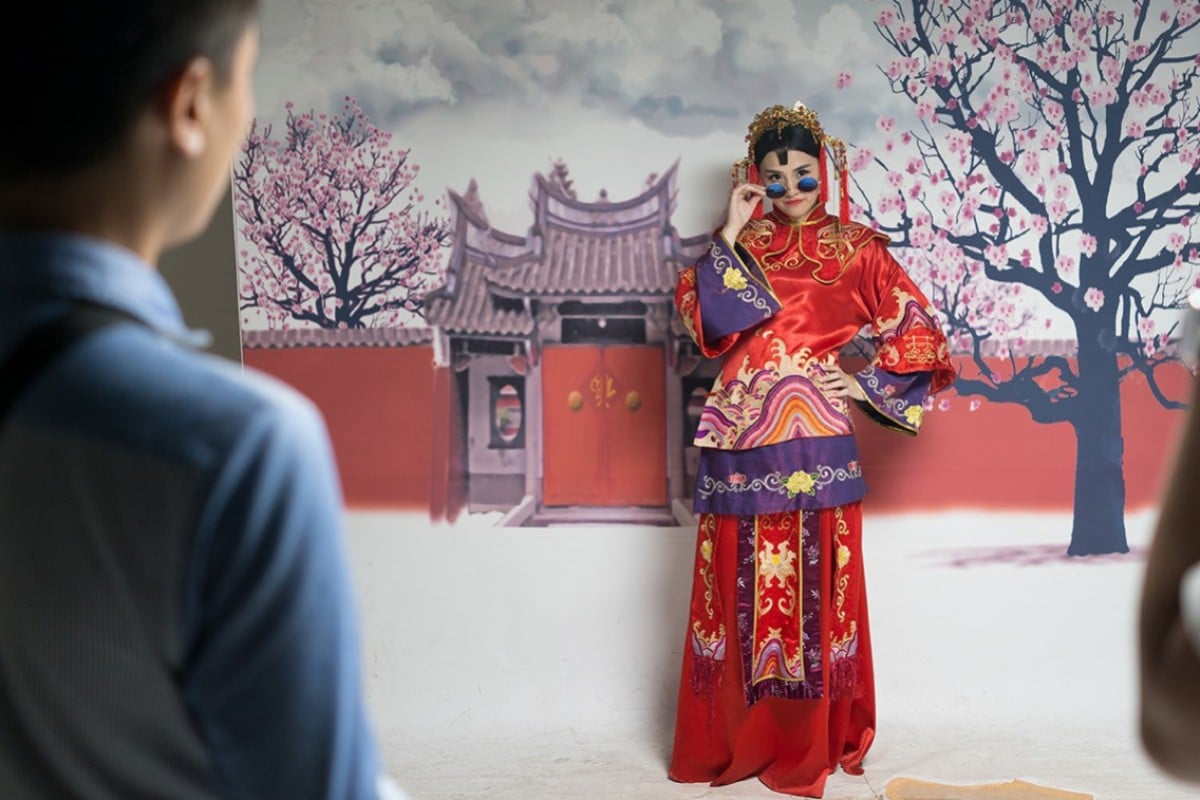
A still from China Love, a documentary by Olivia Martin-McGuire.
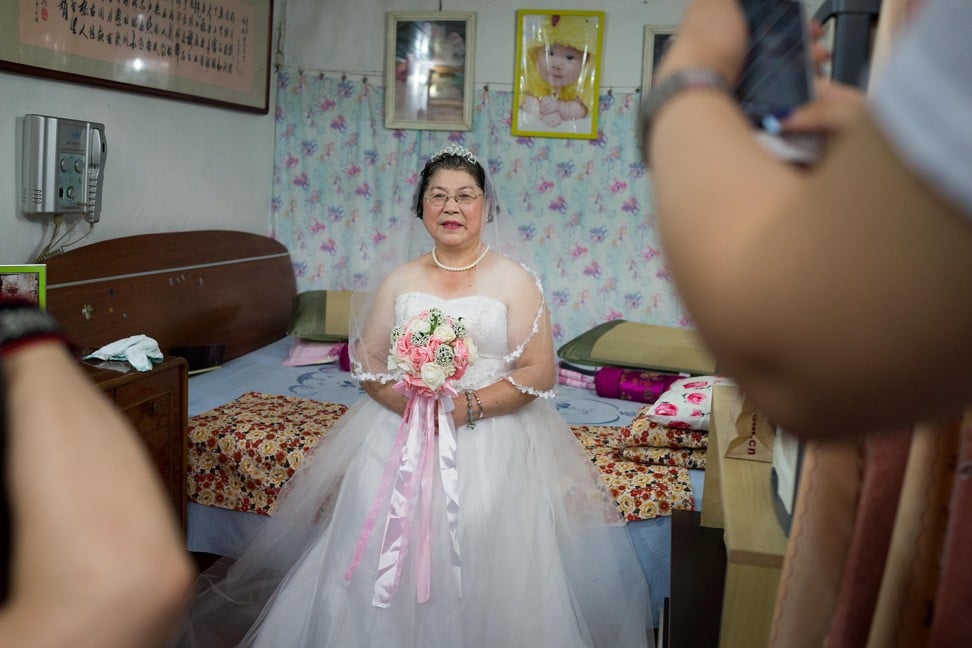
Pei-Pei and Xuezhong live in Shanghai’s French Concession. They married in 1968 and, as was typical for the time, have just one small black-and-white wedding photo.
“Pre-wedding photography could never have happened in 1968 because of the Cultural Revolution,” says Xuezhong, referring to the upheaval that took place under Mao Zedong, from 1966 to 1976. “Colourful clothing was not allowed. We had no choice.”
They did choose, however, to create new memories by having the wedding photos of their dreams taken decades later in a modern setting.
Their story is one of five featured in the documentary
, which explores relationships in contemporary China through the lens of the booming pre-wedding photo industry. It follows couples as they navigate love and family in the lead-up to the most important ritual in Chinese society: marriage.
The documentary debuts in Hong Kong this week, with a special screening on Thursday at the Asia Society, in Admiralty. Attending the screening will be the film’s Australian director, Olivia Martin-McGuire, who spent four years in Shanghai, where a series of photographs taken on the city’s streets developed into a fascination with matters of the heart.
“It started when I saw all these couples in amazingly colourful costumes – some hitching up their dresses to reveal trainers – having [pre-wedding] photos taken near The Bund,” she says.
But Martin-McGuire says the film is more than a commentary on the pre-wedding photography business. It delves into issues of freedom, status, money and the new “China dream”.
“Just over 40 years ago, marriage in China was arranged by the state. Romantic love was seen as a capitalist concept,” she says.
China Love director Olivia Martin-McGuire. Photo: Gráinne Quinlan
Fast forward a generation and the picture couldn’t be more different, with China’s wedding industry today worth a staggering US$80 billion, according to Martin-McGuire.
A big part of that goes on the pre-wedding photos, with some couples spending up to US$500,000 for shoots in exotic locations.
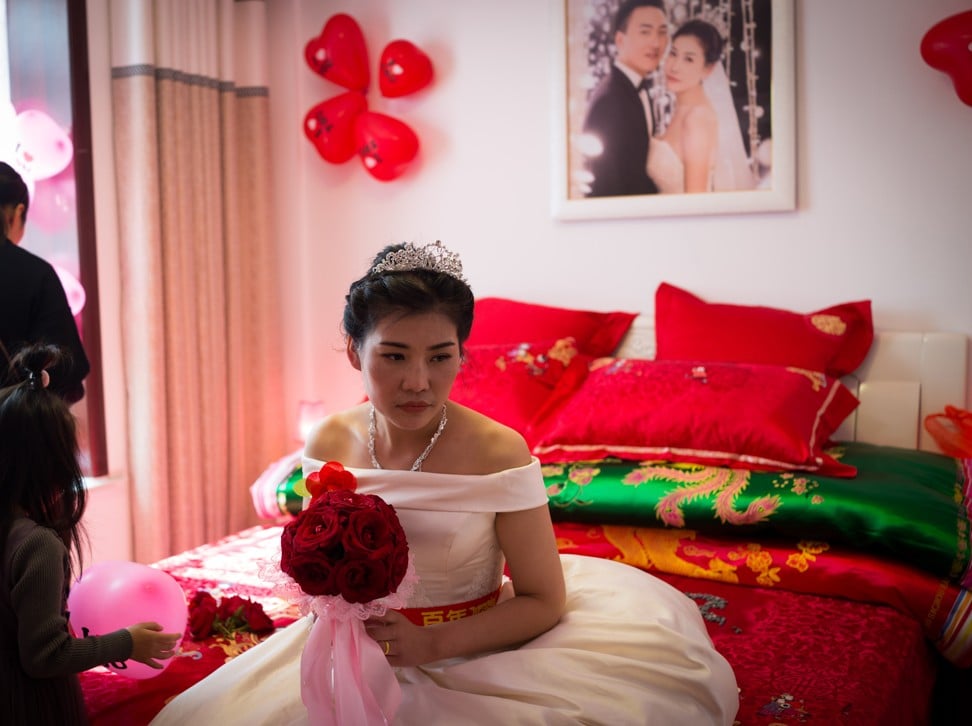
Shoots usually involve several costume and backdrop changes, and can see couples transform into characters from a fantasy. Take Jenny Cheng, born in Urumqi, capital of the Xinjiang Uygur autonomous region, and Australian-born David Shaw. The couple, who are featured in the film and will attend the screening in Hong Kong, had their wedding photos taken under water.
“I wanted the film to feel youthful, fun, and represent the sense of possibility that is infectious in China,” says Martin-McGuire.
China Love will be screened on Thursday, at 6.30pm, at the Asia Society, 9 Justice Drive, Admiralty, followed by a panel discussion. Visit
for details. Photos from the documentary will be featured in the “
” exhibition at the Shanghai Centre of Photography, 2551-1, 1 Longteng Avenue, Shanghai, until August 9.
Stills from China Love
Pei-Pei all set for her shoot.
A couple at the Only Photo Studio, outside Shanghai.
A couple in Shanghai’s Thames Town, which is modelled on London.
Pre-wedding shoots can be exhausting.
A couple at the Only Photo Studio outside Shanghai.
Source: SCMP
Posted in Admiralty, Asia Society, Ürümqi, China Love film, country’s billion-dollar, French Concession, Hong Kong, London, Only Photo Studio, outside Shanghai., pre-wedding photo industry, Shanghai, Shanghai Centre of Photography, Thames Town, The Bund, Uncategorized, Xinjiang Uygur Autonomous Region |
Leave a Comment »
05/07/2019
- The city’s ambitious waste and recycling rules took effect on Monday, aiming to emulate successes of comparable policies in Japan, Taiwan and California
- President Xi Jinping has urged China – the world’s second-biggest waste producer after the United States – to sort rubbish better
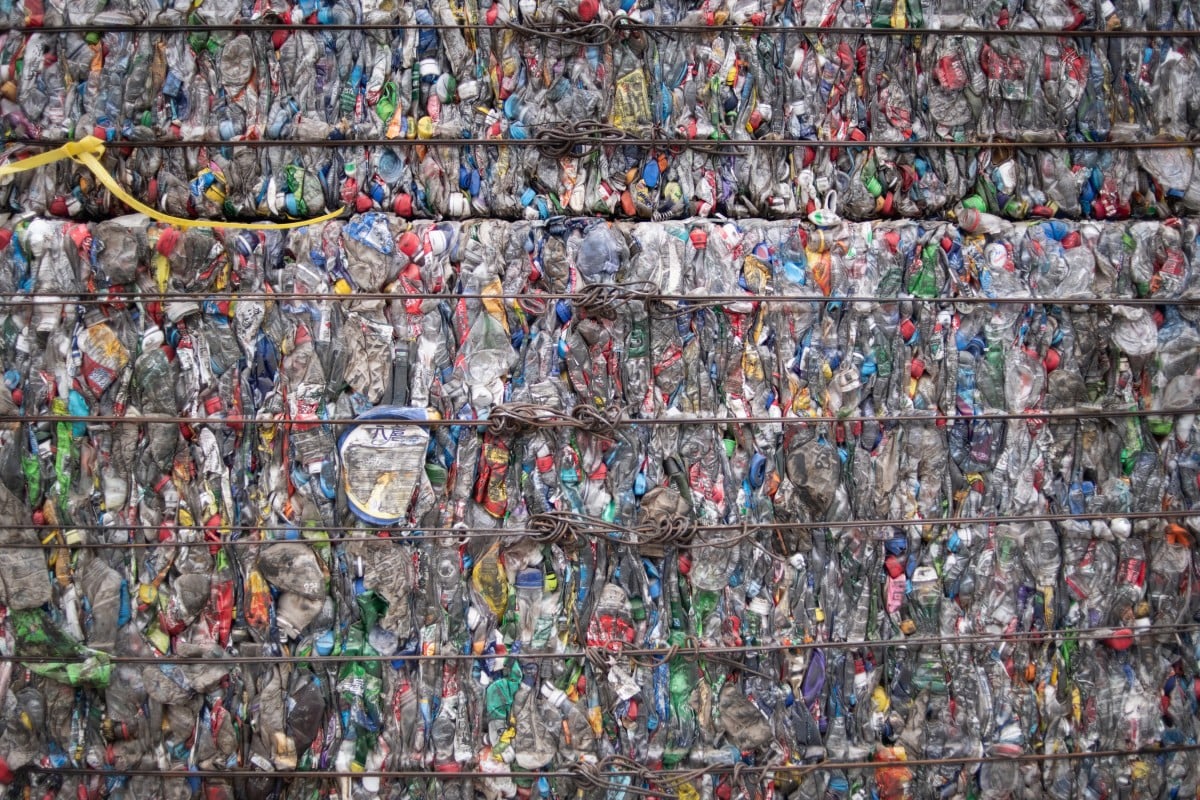
Recyclables such as plastic must be separated from wet garbage, dry garbage and hazardous waste under the new rules in Shanghai. Photo: AFP
At 9pm, Li Zhigang was sitting in front of his fruit shop on a bustling street in central Shanghai’s Xujiahui area, peeling the thin layers of plastic from rotten pears and mangoes.
“This is so much trouble!” he mumbled to himself while throwing the plastic into one trash can and the fruit into another.
In the past, Li simply threw away what could not be sold with the packaging on, but from July 1 he could be fined up to 200 yuan (about US$30) for doing so.
Like Li, many of the tens of millions of residents in the eastern Chinese city have been complaining in recent weeks that the introduction of compulsory
is making life difficult, but at the same time have been having to learn to do it.
Calls for garbage sorting have brought little progress in China in the past decade, but Shanghai is leading a fresh start for the world’s second-largest waste producer with its new municipal solid waste (MSW) regime, observers have said.
China generated 210 million tonnes of MSW in 2017, 48 million tonnes less than the United States, according to the World Bank’s What a Waste database.
“If we say China is now classifying its waste, then it’s Shanghai that is really doing it,” said Chen Liwen, a veteran environmentalist who has worked for non-governmental organisations devoted to waste classification for the past decade.
“It’s starting late, comparing with the US, Japan or Taiwan, but if it’s successful in such a megacity with such a huge population, it will mean a lot for the world,” she said.
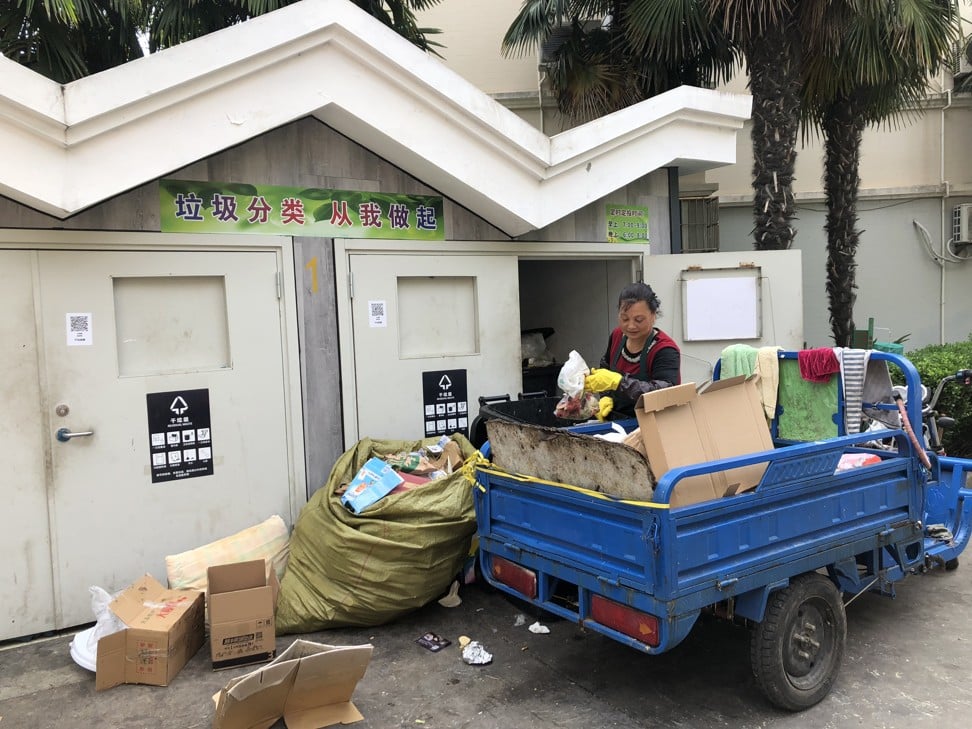
A cleaner re-sorts household waste left at a residential facility in Shanghai. Photo: Alice Yan
Household waste in the city is now required to be sorted into four categories: wet garbage (household food), dry garbage (residual waste), recyclable waste and hazardous waste.
General rubbish bins that had previously taken all types of household waste were removed from buildings. Instead, residents were told to visit designated trash collection stations to dispose of different types of waste during designated periods of the day.
Companies and organisations flouting the new rules could be fined 50,000-500,000 yuan (US$7,000-70,000), while individual offenders risked a fine of 50-200 yuan.
The city’s urban management officers will be mainly responsible for identifying those who breach the rules.
Huang Rong, the municipal government’s deputy secretary general, said on Friday that nearly 14,000 inspections had been carried out around the city and more than 13,000 people had been warned on the issue since the regulations were announced at the start of the year.
As July 1’s enforcement of the rules approached, it became a much-discussed topic among Shanghainese people. A hashtag meaning “Shanghai residents almost driven crazy by garbage classification” was one of the most popular on China’s Twitter-like Weibo platform.
“My daughter took a box of expired medicine from her workplace to the trash collection station near our home yesterday because she couldn’t find the local bin for hazardous waste,” Li said.
While the measures force a change of habits for most people, they bring opportunities for some.
Du Huanzheng, director of the Recycling Economy Institute at Tongji University, said waste sorting was crucial for China’s recycling industry.
“Without proper classification, a lot of garbage that can be recycled is burned, and that’s a pity,” he said. “After being classified, items suitable to be stored and transported can now be recycled.”
G20 set to agree on ways to reduce plastics in oceans
Shanghai’s refuse treatment plants deal with 19,300 tonnes of residual waste and 5,050 tonnes of kitchen waste every day, according to the municipal government. By contrast, only 3,300 tonnes of recyclables per day are collected at present.
Nationwide, the parcel delivery industry used more than 13 billion polypropylene woven bags, plastic bags and paper boxes as well as 330 million rolls of tape in 2016, but less than 20 per cent of this was recycled, according to a report by the State Post Bureau.
Prices of small sortable rubbish bins for home use have surged on e-commerce platforms, while bin makers are also developing smart models in response to new needs.
Some communities are deploying bins that people are required to sign in with their house number to use, and are equipped with a “big data analysis system”. The system records households have “actively participated” and which have not, so that neighbourhood management can publicise their addresses and make house visits, according to a report by Thepaper.cn.
In a residential community in Songjiang district, grocery store owner Nie Chuanguo has found something new to sell: a rubbish throwing service.
He has offered to visit homes, collect waste and throw it into the right bin at a designated time. He charges 30 yuan a month for those living on the ground and first floors, 40 yuan for those on the second and third, and 50 yuan for the fourth and fifth.
“This service will start from July 1. Many people have come to inquire about it,” he said.
According to Du, waste classification is not only about environmental impact or business opportunities. “Garbage sorting is an important part of a country’s soft power,” he said.
For China, it was an opportunity to improve its international reputation, he said. “In the past, Chinese people were rich and travelled abroad, but they threw rubbish wilfully, making foreigners not admit we are a respected powerhouse.”
He added: “It’s also related to 1.3 billion people’s health, since the current waste treatment methods – burying and burning – are not friendly to the environment.”
Shanghai’s part in tackling waste comes amid President Xi Jinping’s repeated calls for the country to sort waste better.
“For local officials, it is a political task,” said Chen, who heads a waste management programme in rural China called Zero Waste Villages.
Huang said the president had asked Shanghai in particular to set a good example in waste classification.
In March 2017, the central government set out plans for a standardised system and regulations for
, with a target for 46 major cities, including Shanghai, to recycle 35 per cent of their waste by then.
In early June, Xi issued a long statement calling for more action from local governments.
However, it was a long process that required input from individuals, government and enterprises, Du said.
“Japan took one generation to move to doing its waste sorting effectively, so we shouldn’t have the expectation that our initiative will succeed in several years,” Du said.
How China’s ban on plastic waste imports caused turmoil
“The lessons we can learn from Japan include carrying out campaigns again and again, and paying close attention to educating young pupils about rubbish classification.”
Chen echoed that Shanghai’s waste sorting frenzy now was only a beginning.
“What we can see now is that people are being pushed to sort waste by regulators, but what’s next? How shall we keep up the enthusiasm?” she asked.
She suggested that how well officials worked on garbage sorting should be included in their job appraisal, and that ultimately people should pay for waste disposal.
“The key to waste classification, going by international experience, is making polluters pay,” Chen said.
Most of Hong Kong and Taiwan’s dumped plastic bottles come from mainland
There is plenty of experience for Shanghai to learn from in California, where unrecyclable waste is charged for at twice the price of recyclables, and Taiwan, where people are charged only for disposal of residual waste, according to Chen.
Taiwan has one of the world’s most impressive recycling rates, with nearly 60 per cent of its waste between January and October last year having been recycled, according to the Taipei government.
The daily amount of garbage produced per person during that period was about 0.41kg – down substantially from 1.14kg in 1997 – the government said.
Hong Kong has tried to copy the Taipei model over the years but failed, with a recycling rate of MSW slightly above 30 per cent in recent years, according to official data.
The city has recently postponed a mandatory
until late 2020 at the earliest. Under its plan, 80 per cent of household waste will have to go into designated bags and will be priced at an average of 11 HK cents (1 US cent) per litre.
On Friday, Shanghai officials admitted that there were plenty of challenges involved in
sorting and transport.
Zhang Lixin, deputy chief of the municipal housing administration, said: “Many property management companies fear the difficulties brought by garbage sorting or are reluctant to implement the new rules.”
The administration trained the heads of more than 200 companies across the city in April, he said.
“We do find that some cleaners and rubbish trucks mix the waste, despite residents being asked to throw different types in different bins,” said Deng Jianping, head of the city’s landscaping and city appearance administration – the government department spearheading the initiative.
In the interests of curbing such practices, they could face fines of up to 50,000 yuan or even have their licences revoked, he said.
Source: SCMP
Posted in ambitious waste and recycling rules, begins, California, China eyes, cleaner image, dry garbage, environmentalist, hazardous waste, Hong Kong, household food, Japan, mainland, municipal solid waste (MSW), new waste sorting era, plastic waste imports, Plastics, President Xi Jinping, recyclables, Recycling Economy Institute at Tongji University, recycling industry, residual waste, second-biggest waste producer, Shanghai, Songjiang, sort rubbish better, Taiwan, Thepaper.cn, Uncategorized, United States, unrecyclable waste, US, wet garbage, Zero-Waste Villages |
Leave a Comment »
04/07/2019
- China’s talent is turning away from multinationals and towards domestic tech champions in the search for a more fulfilling career
- Change in sentiment comes amid raging US-China tech war and perceptions of ‘bamboo ceiling’ in the West
An increasing number of Chinese jobseekers are looking towards domestic tech firms. Image: SCMP
Molly Liu left her hometown Beijing to pursue a master’s degree in the United States in the 1990s.
After graduation, she fought hard to win an entry-level position at a US-based consultancy and after a period was later sent back to China to help the company’s expansion.
In the land of opportunity, the ambitious US firm showered her with avenues to pursue her career and she ended up working in Hong Kong as well as being one of the first people on the ground for the consultancy in Shanghai, Beijing, Taipei and Singapore.
Times have changed, though. Recently, her only son, Ben Zhang, turned down a hard-to-get job offer from a Boeing subsidiary in the US after gaining a master’s degree in computer science from Carnegie Mellon University in Pittsburgh, Pennsylvania.
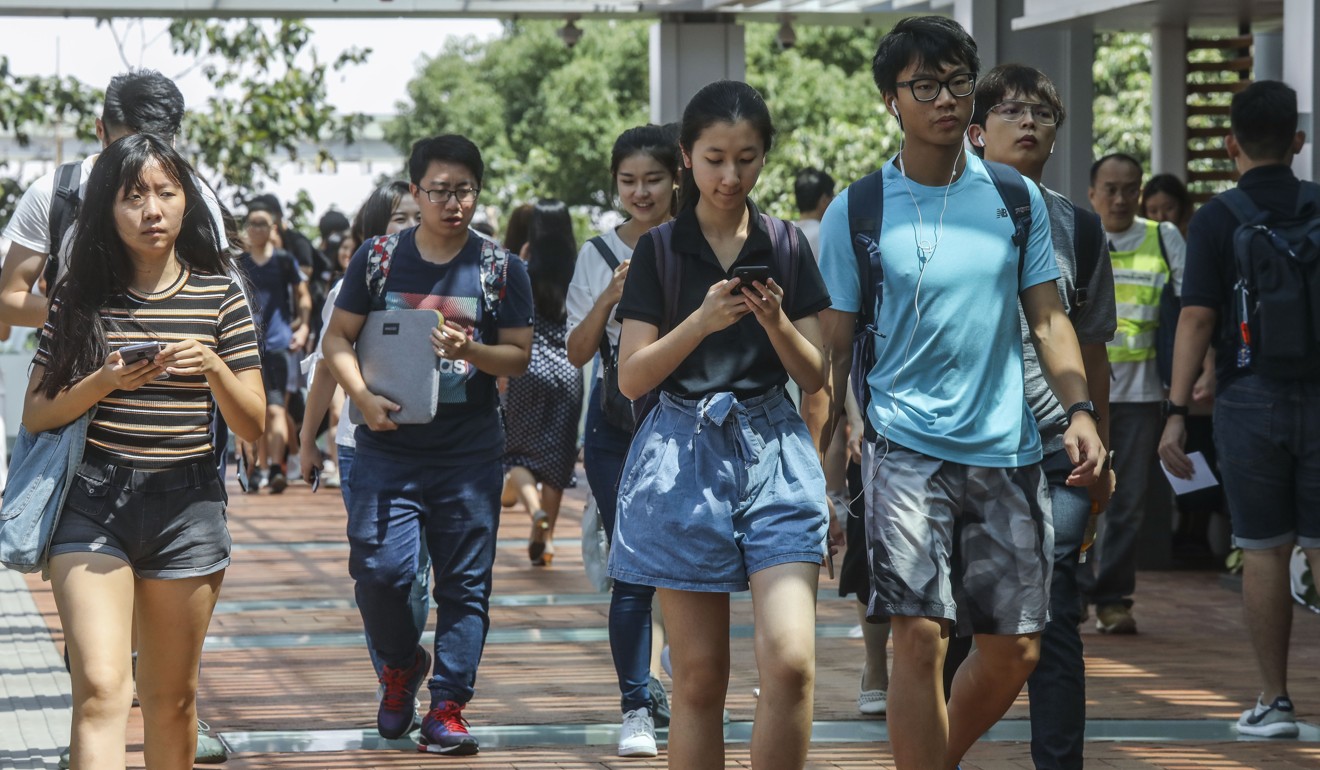
Chinese students educated in the US are now looking more at jobs in China. Photo: SCMP
He decided to return to Beijing in 2018 and now works as a product manager at Chinese smartphone maker Xiaomi. He is convinced that the start-up turned tech major can offer him the same sort of opportunities today that the US tech consultancy offered his mother in the 1990s.
This family story about the career choices of two different generations of US-educated Chinese students reflects a wider trend. Once upon a time, US corporations could cherry-pick top Chinese talent from American universities with the promise of large salaries, generous benefits and the chance to work at market-leading organisations.
Today, China’s cutting-edge technology companies – often referred to as China Tech Corporation (CTC) – are the most sought-after employers among many Chinese students, who want more than just a cushy life.
This marks another blow for multinational corporations (MNCs) already struggling to do business in China amid a myriad of restrictions and growing hostility towards them as the US-China trade and tech war gathers pace.
“What I look for in a job is not money. My parents are not counting on me to support them,” says 28-year-old Zhang, whose team in Xiaomi is working on a wide array of connected devices, from televisions to lamps to smart locks. “What I care about most is personal improvement and access to the best resources a company can offer.”
“In Boeing, I could probably work on a new product once every two to three years. But at Xiaomi, every three months, we can roll out a new product,” he added. “You can bring so many things into people’s everyday lives in China, like using your voice to control a TV or an air conditioner – things you can only imagine in the US.”
Zhang is not alone and many Chinese today perceive a “bamboo ceiling” in the US, where they are more often seen as engineers rather than executives.
One Chinese executive who now oversees the technology unit of a listed finance and insurance firm in China said that he used to lead a team of 20 engineers at one of the world’s most valuable tech companies in Silicon Valley.
“My job was to keep optimising the performance of a product [in Silicon Valley],” he said.
“But within three years in China, I was promoted to the chief scientist of our entire company, leading a team of 1,000,” said the man, who asked to remain anonymous as some of his family still reside in the US.
How Trump’s assault on Huawei is forcing the world to contemplate a digital iron curtain
According to an April survey by professional networking site LinkedIn, an increasing number of Chinese jobseekers share Zhang’s outlook. LinkedIn compiled a list of the top 25 most desired employers in China, and about 60 per cent were local Chinese companies, with 13 of them internet firms.
CTC bagged four of the top five spots, with e-commerce giant Alibaba, search giant operator Baidu and Bytedance – which operates short video hit TikTok – taking the lead.
Tesla ranked sixth behind its Chinese challenger Nio. Amazon, the only other foreign company in the top ten, ranked eighth.
Alibaba is the owner of the South China Morning Post.
Li Qiang, executive vice-president of Zhaopin, one of China’s largest online recruiters, described the rising status of CTC among jobseekers as “the dawning of a new era”.
“Nowadays, there is nothing a multinational can offer that a domestic firm cannot, be it a compensation package or the chance to be part of international expansion,” said Beijing-based Li.
“Jobseekers are not particularly looking for domestic firms or multinational firms. They are after good firms and most of the good firms in China these days happen to be domestic tech firms,” said Li.
Li’s comments reflect the wider opportunities within the domestic economy for Chinese jobseekers today, after the rise of many successful private-sector companies and a thriving start-up scene over the past 10 years, meaning it’s not just a one-way street to a state-owned enterprise (SOE) any longer.
A survey by Zhaopin in late 2018 found that 28 per cent of Chinese university students said MNCs were their employer of choice, down from 33.6 per cent in 2017.
Even on pay and benefits, CTC is catching up with multinationals. Zhang said Xiaomi matched the offer from the Boeing unit in the US and many leading tech firms offer benefits such as gym memberships and childcare facilities.
And the rags-to-riches stories of many leading China tech entrepreneurs, some of whom have become billionaires, continue to grab media attention and inspire the younger generation.
To be sure, Chinese students would still rather work for an MNC than an SOE – but the rise of CTC can be seen in company rankings and in the total number of CTC companies in the top employer list, according to Zhaopin.
For a growing number of Chinese students, the doors to America are closing
William Wu, China country manager of global employer brand consultancy Universum, said that the one element Chinese jobseekers pay most attention to these days is whether or not a job can be “a good reference point for a future career”. And a growing number of private Chinese companies now have global brand recognition.
A recent survey by Universum shows that Apple and Siemens were the only two Western names in the top 10 ideal employers for Chinese students in the engineering sector this year, while there were four foreign firms in the top 10 list in 2017.
Huawei Technologies, the Chinese telecoms giant that has been put on a US trade blacklist after the Trump administration said it was a national security risk, ranked top in the Universum list. Xiaomi, the smartphone maker Ben Zhang works for, ranked second while Apple, one of the most valuable tech firms in the US, ranked seventh.
It seems that China’s rising clout in the world is now an attractive factor for jobseekers.
“Every engineer would like to see the technology they’ve worked on have the potential to change the world one day,” said Li Yan, head of multimedia understanding at Chinese short video major Kuaishou. “In the old times Chinese companies were at the bottom of the global value chain, now they are climbing up, providing more opportunities for talent to create world-changing products.”
At Beijing-based Kuaishou, Li’s 100-strong artificial intelligence algorithm team – many of whom joined from Microsoft Asia Research – is working to make machines understand content better than humans by studying the millions of user-generated videos on the company’s platform every day.
CTC companies do have a strong home advantage, with big Western firms having to navigate a myriad of restrictions.
For example, the “Great Firewall” lets Chinese authorities control the content and information reaching the country’s 800 million-plus internet population. Western firms also face other forms of red tape, such as having to form joint ventures with local partners.
Amazon earlier this year announced the close of its China marketplace, giving up the brutal fight with Chinese online shopping giants such as Alibaba to capture domestic e-commerce market share. Oracle China reportedly laid off 900 people in March as it winds down its research and development center in the country.
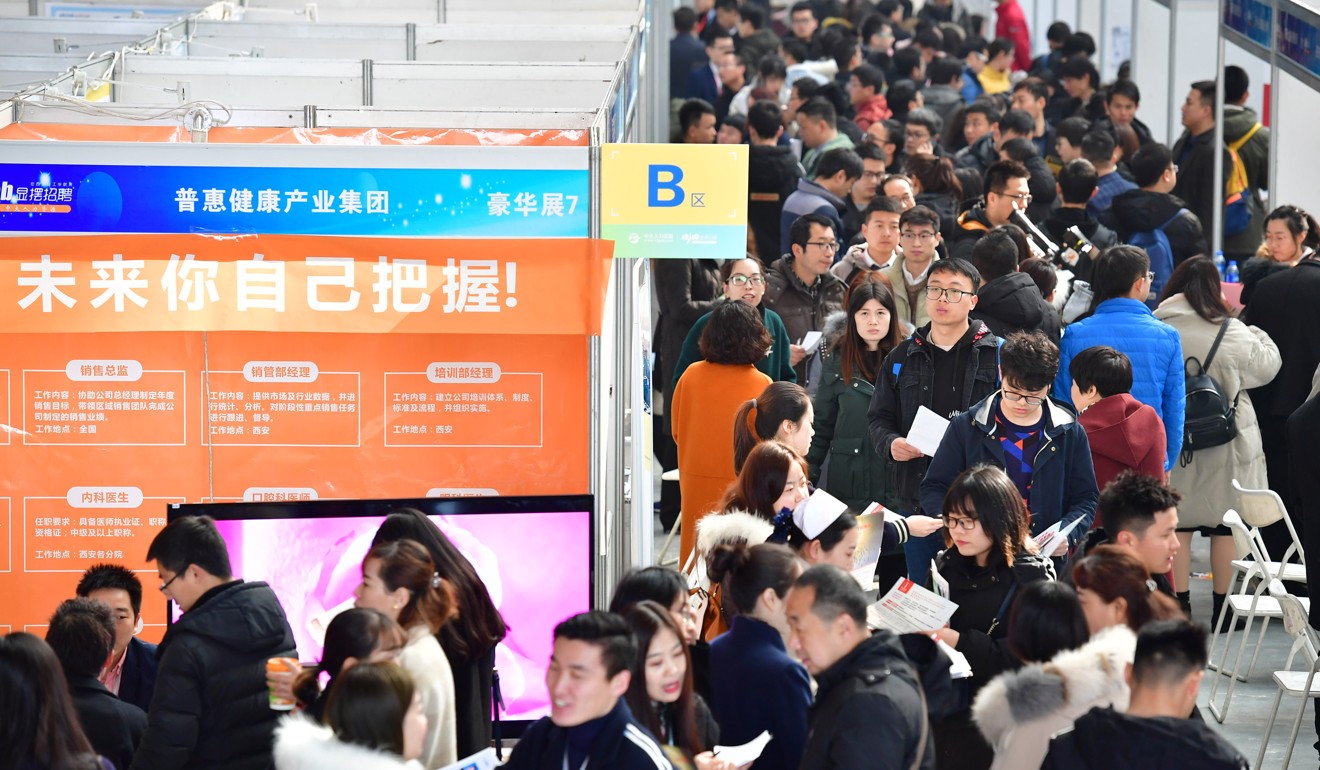
Job applicants visit a provincial job fair at Qujiang International Conference and Exhibition Center in Xian, northwest China’s Shaanxi Province in February. Photo: Xinhua
Oracle has never confirmed the number of lay-offs but said the job cuts formed part of an overall global strategy transformation.
However, there has been little sympathy for those losing their jobs in China, judging by social media posts.
Some people posted that those working for big US tech firms are not “wolf” enough compared with counterparts who work for local tech firms, referring to the long work-hours culture of the domestic tech scene.
A viral story titled “Why there should be no pity for the sacked Oracle China employees” said the company was Beijing’s biggest nursery because of the flexible “work from home” culture and generous compensation package offered to employees.
Oracle said to begin mass lay-offs in China as part of global move to cloud services
“They had every chance to join rising domestic internet firms. But they settled for high salary and low work pressure, which eventually made them frogs in boiling water. Why pity them?” said the article, adding that the earlier people give up on the “glory” of working for MNCs, the quicker they will benefit.
Not all Chinese workers would agree, and there has been a recent backlash against the “996” culture within China’s tech sector, where people routinely work from 9am to 9pm, six days a week.
With geopolitical uncertainty growing day by day, though, many Chinese are asking why leave the family behind for an uncertain fate overseas?
A survey done by consultancy BCG and The Network in 2018 showed that only one in three China residents was willing to move abroad for work, down from 61 per cent in 2014. The country is also the 20th most popular destination worldwide to relocate for a job, compared with 29th in the 2014.
“One of my graduate classmates in the US just gave up a six-digit package at Oracle and joined drone maker DJI in Shenzhen,” said Ben Zhang. “I asked what prompted his return to China. He sent me the viral article and asked, ‘who wants a life that one can see the end of from the very beginning?’”
Source: SCMP
Posted in Alibaba, Apple, ‘bamboo ceiling’, “Great Firewall”, Baidu, Beijing, big brand multinationals, Boeing, Bytedance, Carnegie Mellon University, China Tech Corporation (CTC), China’s top talent, Hong Kong, huawei technologies, Kuaishou, LinkedIn, multinational corporations (MNCs), Nio. Amazon, Oracle China\, Pennsylvania, Pittsburgh, Qujiang International Conference and Exhibition Center, rising domestic tech stars, shaanxi province, Shanghai, Siemens, Silicon Valley, Singapore, south china morning post, state-owned enterprise (SOE), Taipei, Tesla, TikTok, Uncategorized, Universum, wants to work, Xi'an, Xiaomi |
Leave a Comment »
03/07/2019
SHANGHAI, July 2 (Xinhua) — Many Shanghai residents may be experiencing headaches as they face daily tests as to which piece of garbage goes in dry refuse and which goes in recyclable.
A man surnamed Liu, however, may not be that grumpy after all because he managed to retrieve 18 pieces of gold ornaments from his trash.
The Shanghai police told Xinhua that a resident surnamed Liu, who lives in the Putuo District of the city, threw a cardboard carton away a few days ago. He sorted it correctly by putting it into a waste bin labeled recyclable, but he received a call about his trash from the local residents’ committee.
Xun Siwei, a garbage collector in the neighborhood, found that the carton contained a plastic bag full of golden accessories.
“I looked at the gold, and my heartbeat went up. They are gold, but I know they belong to someone else. I can not keep them,” said Xun.
Xun reported his finding to the police on June 28. Police checked the accessories and found a name and birth date inscribed onto a golden badge. Based on the details, police contacted the residential neighborhood Liu lives in and got in touch with him.
Liu said had been searching for the gold for three years, but failed to locate it.
“Getting these valuables back is the boon of garbage sorting,” he said. “My family will spare no effort in carrying out the garbage sorting campaign.”
Shanghai is widely promoting a mandatory garbage sorting system, which requires residents to throw away garbage at a fixed time and place. A disposal site is designated for every 300 to 500 households, where volunteers carefully check whether the household waste is accurately classified.
The city enacted a set of regulations on household garbage sorting and recycling starting Monday, which requires residents to sort household garbage into four categories: dry refuse, wet trash, recyclable waste and hazardous waste. Individuals who fail to sort garbage may be fined up to 200 yuan (about 29 U.S. dollars).
Mr Liu’s gold being retrieved has gathered interested commentators online. “There is really hidden gold in your garbage,” one netizen exclaimed.
“Have faith in garbage sorting, it will bring you good luck,” anther netizen commented.
Source: Xinhua
Posted in found, garbage, garbage collector, Gold, gold ornaments, golden accessories, mandates, Shanghai, sorting, Uncategorized |
Leave a Comment »
02/07/2019
SHANGHAI, July 1 (Xinhua) — As Shanghai starts mandatory garbage sorting on Monday, games and toys that explore fun ways to spread garbage sorting knowhow are gaining popularity among young people.
A 15-second video of a VR game went viral on Chinese social media in the past few days. In the video, players wearing VR equipment could see four different types of trash cans in front of them, and they threw different types of garbage appearing in front of them into the corresponding buckets to score.
This garbage sorting VR game debuted at the Mobile World Congress Shanghai last week. Although this is not the only VR game in the venue, visitors lined up around the booth to explore the game because of its garbage sorting theme.
“As a Shanghai resident, I am in great need of this game. Maybe I won’t need to check how to categorize each garbage on my phone while going through all my garbage every day if I play this game more often,” said Zhou Zhou, a young Shanghai resident. Although the game has not launched officially, Zhou said she was very much looking forward to it.
Some social media users have recently complained about the difficulties in sorting different types of garbage in Shanghai.
Wu Xia, founder and CEO of VitrellaCore, the company that created the game, said the purpose of this VR game is to provide an interesting method for learning garbage sorting.
“It’s simple and easy to understand. Residents can practice garbage sorting knowledge without actually going through the rubbish, and it is also a more effective method than paper materials when training garbage sorting volunteers,” Wu Said.
GARBAGE SORTING NO CHILD’S PLAY
Shanghai is widely promoting a mandatory garbage sorting system, which requires residents to throw away garbage at a fixed time and place. There is a designated garbage disposal site for every 300-500 households, where volunteers carefully check whether household waste is accurately classified.
The city enacted a set of regulations on household garbage sorting and recycling from Monday, which requires residents to sort household garbage into four kinds: dry refuse, wet trash, recyclable waste and hazardous waste. Individuals who fail to sort garbage may be fined up to 200 yuan (about 29 U.S. dollars).
Wu said many streets and neighborhoods in Shanghai have expressed their willingness to cooperate, and the company hopes to launch VR games in more places for residents to experience for free.
“GARBAGE SORTING IS FUN”
On Taobao, an e-commerce platform under Alibaba, the sales volume of a garbage sorting toy increased by nearly 300 pieces on Sunday. This set of toys consists of four miniature sorting bins, with cards representing various types of garbage.
Most of the buyers of this toy are from Shanghai, and the toy is almost out of stock due to strong sales, according to the shop’s customer service representative.
One residential community called Jiayou in Shanghai’s Jiading District ordered several toys for its residents. “We hope to raise children’s interest in garbage sorting,” said Xing Minxia, secretary of the Jiayou Community branch of the Communist Party of China.
“Most garbage sorting volunteers are retired people, while young people are less involved. These innovative ways can win young people’s hearts and make them feel that garbage sorting is fun instead of a burden,” said Mao Qing, director of a community cultural activity center in Changning District.
Residents of this community have recently been keen on a mobile game called “Race Against Time.” In 45 seconds, players are required to move a trash bin of a specific category to accurately catch the garbage belonging to this category. Players who pass the game can participate in a lucky draw.
Fan Weicheng, deputy director of Shanghai Oriental Publicity and Education Service Center that developed the game, said about 21,000 people have played it since they launched the game in early June.
“We often see the elderly gathering around the garbage sorting knowledge boards in residential communities, but young people are hardly ever there,” Fan said. “We hope to involve more young people through mobile games.”
The garbage sorting VR game will be launched on the Steam platform and China’s Tencent WeGame platform in August this year, according to Wu.
“There will be more types of garbage and more gameplay at that time, but the core of the game will always be to teach people about garbage sorting in a fun way,” Wu said.
Source: Xinhua
Posted in Garbage sorting games, hearts, mandatory garbage sorting, Shanghai, Uncategorized, win, young people |
Leave a Comment »














 CHINDIA ALERT: You'll be living in their world, very soon