05/05/2020
- Modified version of country’s most powerful rocket carries next-generation capsule designed to take astronauts to its planned space station
- It will be able to launch and land with three crew members and up to 500kg of cargo, according to state media
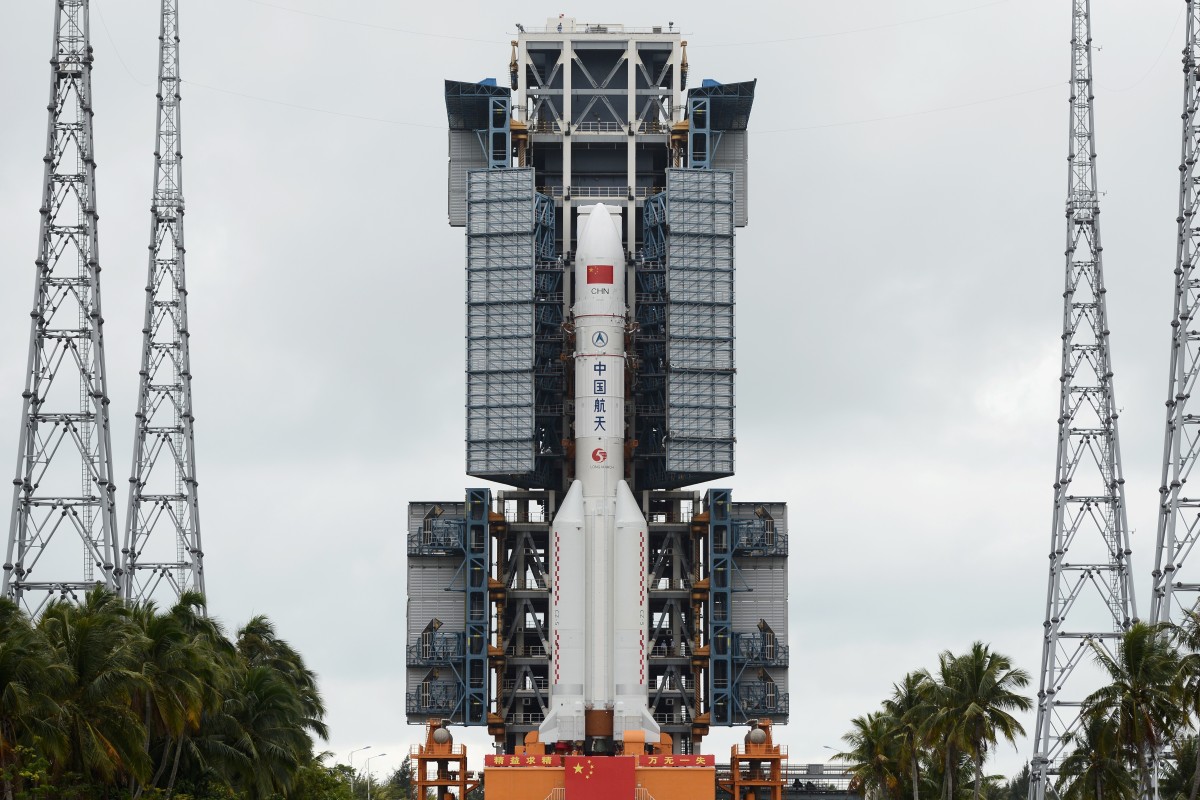
China launched a new version of its heavy-lift Long March 5 rocket on Tuesday. Photo: Reuters
China successfully launched a prototype of its next-generation manned spacecraft – without astronauts – along with a new version of its heavy-lift Long March 5 rocket on Tuesday, its space agency said.
The Long March 5B rocket was launched into low-Earth orbit from the Wenchang Satellite Launch Centre on Hainan Island in the country’s south.
The launch marks a significant step forward for China’s two big space exploration ambitions – building a space station and a mission to Mars.
A modified version of China’s most powerful rocket, the Long March 5B is 53.7 metres (176 feet) tall. It will carry the next-generation crew capsule prototype designed to replace the Shenzhou spacecraft, to transport astronauts to its planned space station in low-Earth orbit.
China aims to launch the core module of that space station designed for three crew members, the Tianhe, in 2021. Beijing has been planning to build its own space station for decades as an alternative to the International Space Station, from which China has been excluded by the United States over security concerns.
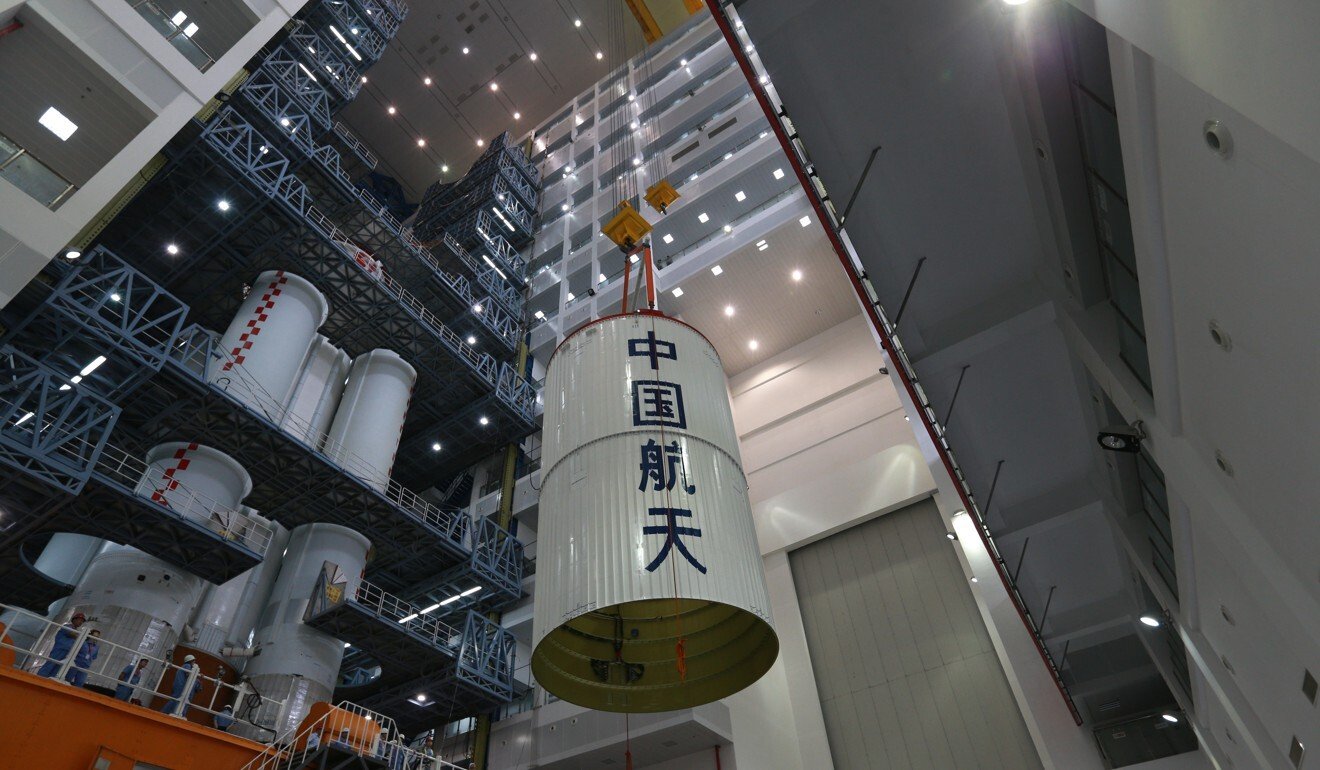
China’s space station project has been delayed by problems with its heavy-lift rockets. Photo: Xinhua
The prototype capsule has a different configuration to Shenzhou’s and it will be able to launch and land with three astronauts on board as well as up to 500kg of cargo, according to state news agency Xinhua. That will mean it can be used to transport research specimens and hardware from the space station back to Earth.
While the Shenzhou can ferry three astronauts, the new capsule design will be able to accommodate up to six crew members and, unlike the Shenzhou, it will be capable of carrying them to the moon, according to Chinese media reports.
Its systems, performance in orbit and parachute deployment are among the areas that will be put to the test during the launch.
Why China’s next Long March 5 rocket mission will be about restoring national pride
14 Dec 2019
The long-anticipated space station project has been delayed by problems in the development of heavy-lift rockets to carry the modules. In 2017, an oxygen supply problem caused the failure of the second Long March 5 launch, and it
plunged into the Pacific Ocean shortly after take-off. But in December it successfully
carried a Shijian-20 satellite into orbit, while the liquid oxygen-liquid hydrogen engines used in both the Long March 5 and 5B rockets passed testing in January.
China’s other space ambitions include a Mars probe, and landing astronauts on the moon within the next decade. For the Mars mission, the unmanned orbiter and rover Tianwen-1 will be launched by the Long March 5 and it is expected to take up to seven months for the probe to reach the red planet. China would be the third country to do so – after the United States and the Soviet Union.
Zhang Kejian, head of the China National Space Administration, said China was on track to launch the mission this year, with July the likely launch date.
Source: SCMP
Posted in 2021, ambitions, astronauts, Beijing, cargo, China, China National Space Administration, country’s south, crew members, December, delayed, designed, Earth, Excluded, Hainan, hardware, heavy-lift rockets, International Space Station, island, July, launches, liquid oxygen-liquid hydrogen engines, Long March 5B rocket, Low Earth orbit, manned, Mars probe, mission to Mars, Moon, national pride, next-generation capsule, orbit, oxygen supply, Pacific Ocean, parachute, planned, problems, prototype, research specimens, restoring, rover, security concerns, Shenzhou spacecraft, Shijian-20 satellite, Soviet Union, Space exploration, space station, space station project, spacecraft, third country, Three, Tianhe, Tianwen-1, Transport, Tuesday, Uncategorized, United States, Wenchang Satellite Launch Centre |
Leave a Comment »
30/09/2019
NANJING, Sept. 30 (Xinhua) — China’s spacecraft tracking ship Yuanwang-3 is sailing to the Pacific Ocean to carry out maritime monitoring missions for the BeiDou-3 and other satellites.
The ship departed Sunday from a port in east China’s Jiangsu Province. It is the third voyage of the ship this year.
Before the voyage, crew members completed preparation of supplies, carried out examinations and tests of the facilities and received tailored training to ensure the success of the missions.
This year, the ship has spent 83 days at sea and completed three missions, including maritime monitoring of a relay satellite Tianlian II and a BeiDou-3 satellite.
Yuanwang-3, China’s second-generation space tracking ship, mainly undertakes maritime tracking and monitoring tasks of high-, medium-, low-orbit satellites, spacecraft and space station.
Since it was launched more than 20 years ago, the ship has made 52 voyages and completed 83 missions on the sea, including maritime tracking of the Shenzhou spacecraft, the Chang’e lunar probe and BeiDou satellites, maintaining a 100 percent success rate.
Source: Xinhua
Posted in BeiDou satellites, BeiDou-3, Chang'e lunar probe, jiangsu province, Pacific Ocean, Relay satellite, sailing, satellite monitoring missions, Shenzhou spacecraft, space station, spacecraft, success rate, Tianlian II-01, Uncategorized |
Leave a Comment »
13/03/2019
NANJING, March 13 (Xinhua) — The space-tracking ship Yuanwang-3 is sailing to the Pacific Ocean from a port in east China’s Jiangsu Province Wednesday for upcoming monitoring missions.
This year, the ship will carry out two maritime space monitoring missions, which will last about two months.
The mission members have conducted a series of training programs and tests before the voyage, to increase emergency response.
Yuanwang-3, which entered service in the mid-1990s, is China’s second-generation space tracking ship. Sailing more than 650,000 nautical miles, it has completed 80 missions, including maritime tracking of the Shenzhou spacecraft, Chang’e lunar probe and BeiDou satellites.
Source: Xinhua
Posted in BeiDou satellites, Chang'e lunar probe, China alert, jiangsu province, monitoring missions, Pacific Ocean, Shenzhou spacecraft, Uncategorized, Yuanwang-3 |
Leave a Comment »




 CHINDIA ALERT: You'll be living in their world, very soon