Archive for ‘shoppers’

22/05/2020

NPC: China begins move to impose controversial Hong Kong security law

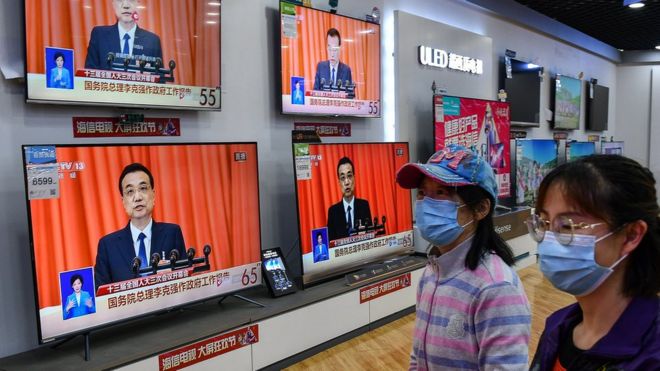
Shoppers walking past a broadcast of Chinese Premier Li Keqiang delivering his speech at the opening of the NPCImage copyright AFP / GETTY
Image caption Shoppers walking past a broadcast of Chinese Premier Li Keqiang delivering his speech at the opening of the NPC on Thursday

China’s ruling Communist Party has set in motion a controversial national security law for Hong Kong, a move seen as a major blow to the city’s freedoms.

The law to ban “treason, secession, sedition and subversion” could bypass Hong Kong’s lawmakers.

Critics say China is breaking its promise to allow Hong Kong freedoms not seen elsewhere in China.

It is likely to fuel public anger and may even trigger fresh protests and demands for democratic reform.

The plan was submitted at the annual National People’s Congress (NPC), which largely rubber-stamps decisions already taken by the Communist leadership, but is still the most important political event of the year.

Hong Kong, a semi-autonomous region and an economic powerhouse, was always meant to have introduced such laws after the handover from British control to Chinese rule in 1997.

After last year’s wave of sustained and violent protest, Beijing is now attempting to push them through, arguing “law-based and forceful measures” must be taken to “prevent, stop and punish” such protests in the future.

On Friday, Hong Kong’s government said it would co-operate with Beijing to enact the law, adding it would not affect the city’s freedoms.

What is in Beijing’s proposed law?

The “draft decision” – as it is known before approval by the NPC – was explained by Wang Chen, vice chairman of the Standing Committee of the NPC.

It consists of an introduction and seven articles. Article 4 may prove the most controversial.

That article says Hong Kong “must improve” national security, before adding: “When needed, relevant national security organs of the Central People’s Government will set up agencies in Hong Kong to fulfil relevant duties to safeguard national security in accordance with the law.”

China could essentially place this law into Annex III of the Basic Law, which covers national laws that must be implemented in Hong Kong – either by legislation, or decree.

Addressing the congress, Premier Li Keqiang spoke of the economic impact of the coronavirus and on Hong Kong and Macau said: “We’ll establish sound legal systems and enforcement mechanisms for safeguarding national security in the two Special Administrative Regions.”

What do opponents say the dangers are?

Hong Kong is what is known as a “special administrative region” of China.

It has observed a “one country, two systems” policy since Britain returned sovereignty in 1997, which has allowed it certain freedoms the rest of China does not have.

Pro-democracy activists fear that China pushing through the law could mean “the end of Hong Kong” – that is, the effective end of its autonomy and these freedoms.

Last year’s mass protests in Hong Kong were sparked by a bill that would have allowed extraditions to mainland China.
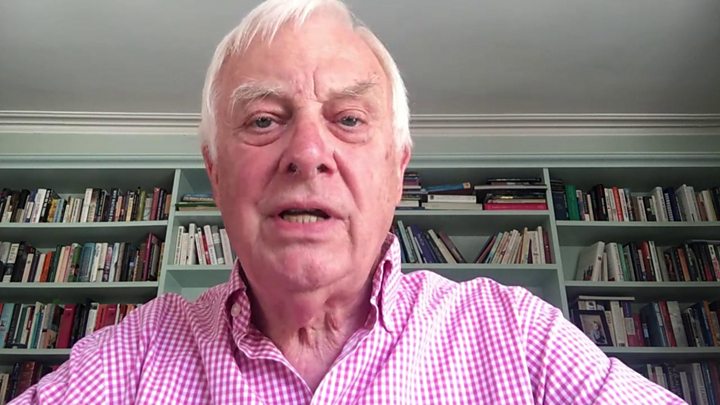
Media caption Former Hong Kong governor Chris Patten: “UK should tell China this is outrageous”

The bill was paused, then withdrawn – but the protests continued until the virus outbreak at the end of the year.

The US has also weighed in, with President Trump saying the US would react strongly if it went through – without giving details.

It is currently considering whether to extend Hong Kong’s preferential trading and investment privileges.

Why is China doing this?

Mr Wang said the security risks had become “increasingly notable” – a reference to last year’s protests.

“Considering Hong Kong’s situation at present, efforts must be made at the state-level to establish and improve the legal system and enforcement mechanisms,” he is quoted as saying in state media.
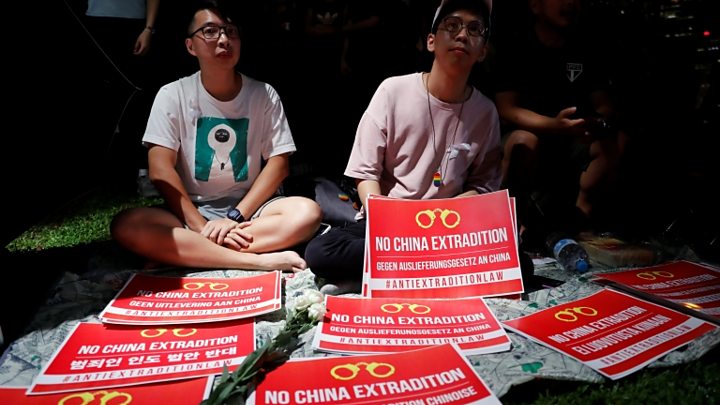
Media caption The BBC’s Helier Cheung on Hong Kong’s 2019 protests

Beijing may also fear September’s elections to Hong Kong’s legislature.

If last year’s success for pro-democracy parties in district elections is repeated, government bills could potentially be blocked.

What is Hong Kong’s legal situation?

Hong Kong was under British control for more than 150 years up to 1997.

The British and Chinese governments signed a treaty – the Sino-British Joint Declaration – that agreed Hong Kong would have “a high degree of autonomy, except in foreign and defence affairs”, for 50 years.

This was enshrined in the Basic Law, which runs out in 2047.

As a result, Hong Kong’s own legal system, borders, and rights – including freedom of assembly and free speech – are protected.

But Beijing has the ability to veto any changes to the political system and has, for example, ruled out direct election of the chief executive.
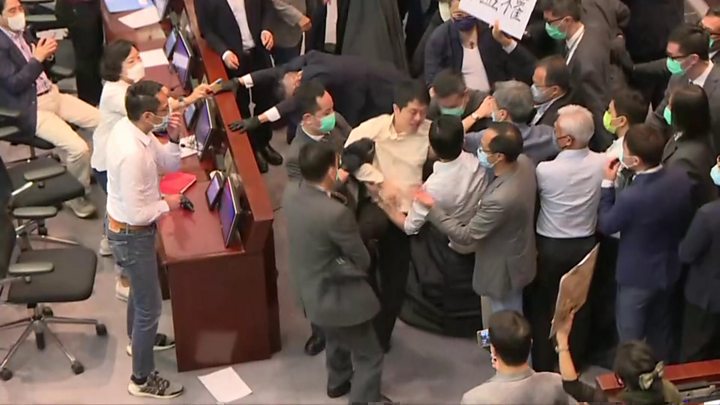
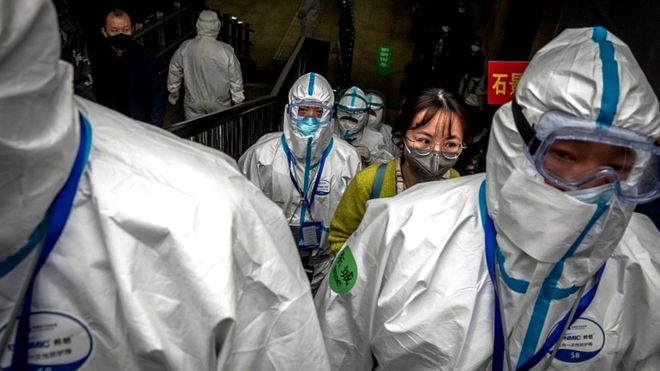
Media caption Uproar on Monday in Hong Kong’s legislature

Source: The BBC

17/04/2020

China’s virus-hit economy shrinks for first time in decades

Train passengers arrive from WuhanImage copyright EPA

China’s economy shrank for the first time in decades in the first quarter of the year, as the virus forced factories and businesses to close.

The world’s second biggest economy contracted 6.8% according to official data released on Friday.

The financial toll the coronavirus is having on the Chinese economy will be a huge concern to other countries.

China is an economic powerhouse as a major consumer and producer of goods and services.

This is the first time China has seen its economy shrink in the first three months of the year since it started recording quarterly figures in 1992.

“The GDP contraction in January-March will translate into permanent income losses, reflected in bankruptcies across small companies and job losses,” said Yue Su at the Economist Intelligence Unit.

Last year, China saw healthy economic growth of 6.4% in the first quarter, a period when it was locked in a trade war with the US.

In the last two decades, China has seen average economic growth of around 9% a year, although experts have regularly questioned the accuracy of its economic data.

Its economy had ground to a halt during the first three months of the year as it introduced large-scale shutdowns and quarantines to prevent the virus spread in late January.

As a result, economists had expected bleak figures, but the official data comes in slightly worse than expected.

Among other key figures released in Friday’s report:

  • Factory output was down 1.1% for March as China slowly starts manufacturing again.
  • Retail sales plummeted 15.8% last month as many of shoppers stayed at home.
  • Unemployment hit 5.9% in March, slightly better than February’s all-time high of 6.2%.
Presentational grey line

Analysis: A 6% expansion wiped out

Robin Brant, BBC News, Shanghai

The huge decline shows the profound impact that the virus outbreak, and the government’s draconian reaction to it, had on the world’s second largest economy. It wipes out the 6% expansion in China’s economy recorded in the last set of figures at the end of last year.

Beijing has signalled a significant economic stimulus is on the way as it tries to stabilise its economy and recover. Earlier this week the official mouthpiece of the ruling Communist Party, the People’s Daily, reported it would “expand domestic demand”.

But the slowdown in the rest of the global economy presents a significant problem as exports still play a major role in China’s economy. If it comes this will not be a quick recovery.

On Thursday the International Monetary Fund forecast China’s economy would avoid a recession but grow by just 1.2% this year. Job figures released recently showed the official government unemployment figure had risen sharply, with the number working in companies linked to export trade falling the most.

Presentational grey line

China has unveiled a range of financial support measures to cushion the impact of the slowdown, but not on the same scale as other major economies.

“We don’t expect large stimulus, given that that remains unpopular in Beijing. Instead, we think policymakers will accept low growth this year, given the prospects for a better 2021,” said Louis Kuijs, an analyst with Oxford Economics.

Since March, China has slowly started letting factories resume production and letting businesses reopen, but this is a gradual process to return to pre-lockdown levels.

Media caption Why does China’s economy matter to you?

China relies heavily on its factories and manufacturing plants for economic growth, and has been dubbed “the world’s factory”.

Stock markets in the region showed mixed reaction to the Chinese economic data, with China’s benchmark Shanghai Composite index up 0.9%.

Japan’s Nikkei 225 jumped 2.5% on Friday, although this was largely due to gains on Wall Street after US President Donald Trump unveiled plans to ease lockdowns.

Source: The BBC

07/04/2020

Coronavirus: How China’s army of food delivery drivers helped keep country going during outbreak

  • Buying and paying for meals and supplies online was already second nature for many Chinese before the Covid-19 lockdown
  • The supply and delivery networks that were already in place were able to work with the authorities in cities like Wuhan
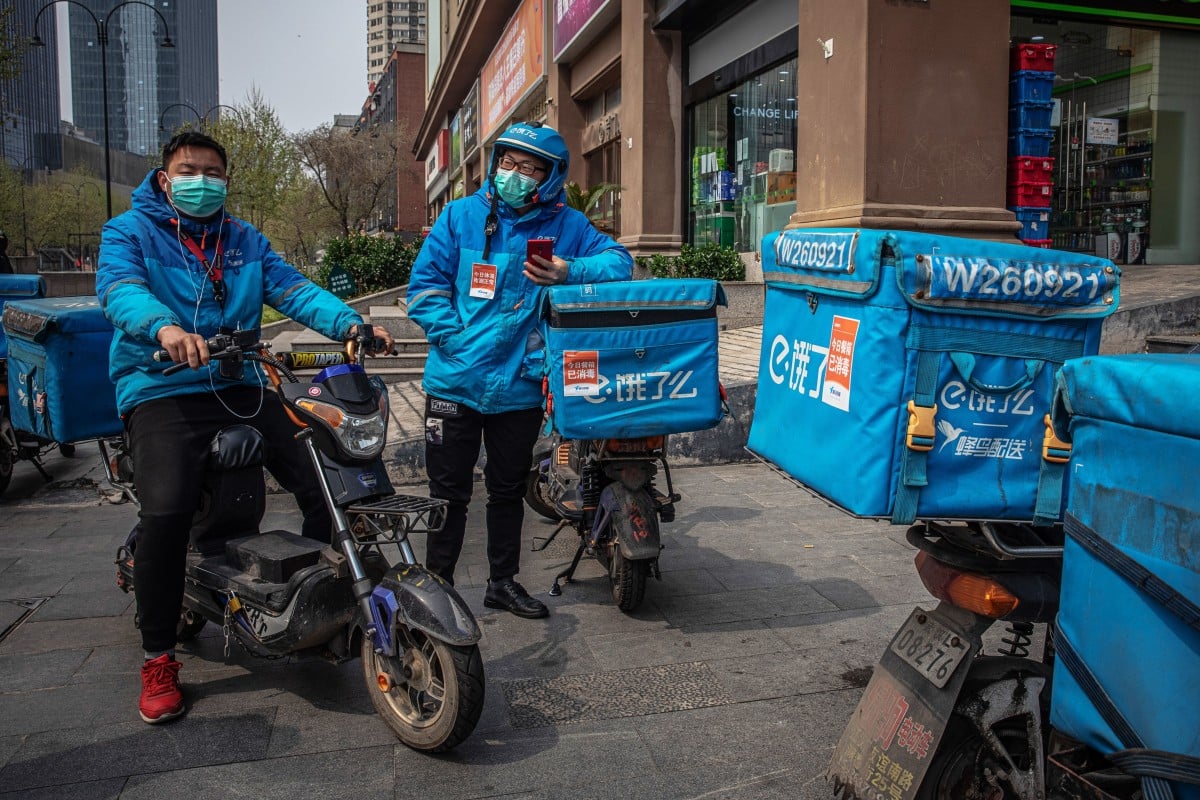
China’s established home delivery system played an important role in getting food and other necessities to residents during the Wuhan lockdown. Photo: EPA-EFE
When Liu Yilin, a retired middle schoolteacher in Wuhan, first heard rumours of a

highly contagious disease

spreading in the central Chinese city he started to stock up on supplies such as rice, oil, noodles and dried pork and fish.

These preparations spared the 66-year-old from some of the early panic when 
the city went into lockdown in late January

and shoppers flooded to the markets and malls to snap up supplies.

But as time went on and with residents banned from leaving their homes, he became increasingly concerned about getting hold of fresh supplies of vegetables, fruit and meat until the nation’s vast network of delivery drivers came to the rescue.
“It was such a relief that several necessity purchasing groups organised by community workers and volunteers suddenly emerged on WeChat [a leading social media app] days after the lockdown,” Liu said. “China’s powerful home delivery service makes life much easier at a time of crisis.”

Hu Xingdou, a Beijing-based independent political economist said: “Home delivery played a very important role amid the coronavirus outbreak. To some extent, it prevented people from starving especially in cases when local governments took extreme measures to isolate people.”

According to Liu, people in Wuhan during the lockdown had to stay within their residential communities, with community workers guarding the exits.

Human contact was limited to the internet. Residents placed orders online with farmers, small merchants or supermarkets to buy daily necessities, and community workers helped distribute the goods from deliverymen.

Every morning, Liu passed a piece of paper with his name, phone number and order number to a community worker who would collect the items from a courier at the gate of the residential area.

Thanks to a high population density in urban areas, affluent labour force and people’s openness to digital life, China has built a well-developed home delivery network.

Extensive funding from technology companies has been invested in hardware infrastructure, software to improve logistics and big data and cloud computing to help predict consumers’ behaviour.

Mark Greeven, professor of innovation and strategy at IMD Business School in Lausanne, Switzerland, said: “Whether it is delivery of products, air parcels or fresh food or even medicine or materials for medical use, China has a very well developed system. Much better developed than I think almost any other places in the world.

“Well before the crisis, China had started to embrace digital technology in daily life whether it is in consumption, business, government and smart cities and use of third party payments. All of these things have been in place for a long time and the crisis tested its agility and capability to deal with peak demand.”

China’s e-commerce giants help revive sales of farm goods from Hubei

3 Apr 2020
According to e-commerce giant JD.com, demands for e-commerce and delivery services spiked during the outbreak of Covid-19, the illness caused by the new coronavirus.
It sold around 220 million items between January 20 and February 28, mainly grains and dairy products with the value of beef orders trebling and chicken deliveries quadrupling compared with a year ago.
Tang Yishen, head of JD Fresh, its fresh foods subsidiary, said: “The surge of online demand for fresh merchandise shows the pandemic helped e-commerce providers further penetrate into the life of customers. It also helped upstream farm producers to know and trust us.”
Meituan Dianping, a leading e-commerce platform, said its grocery retail service Meituan Instashopping reported a 400 per cent growth in sales from a year ago in February from local supermarkets.
The most popular items ordered between January 26 and February 8 were face masks, disinfectant, tangerines, packed fresh-cut fruits and potatoes.
The food delivery service Ele.me said that, between January 21 and February 8, deliveries of frozen food surged more than 600 per cent year on year, followed by a nearly 500 per cent growth in delivery of pet-care products. Fresh food deliveries rose by 181 per cent while drink and snack deliveries climbed by 101 per cent and 82 per cent, respectively. Ele.me is owned by Alibaba, the parent company of the South China Morning Post.
Chinese hotpot restaurant chain adapts as coronavirus fears push communal meals off the menu
E-commerce providers used the opportunity to show goodwill and improve their relationship with customers and partners, analysts say.
Sofya Bakhta, marketing strategy analyst at the Shanghai-based Daxue Consulting, said the food delivery sector had made significant headway in reducing physical contact during the outbreak.
Delivery staff left orders in front of buildings, in lifts or temporary shelters as instructed by the clients as most properties no longer allowed them inside.
Some companies also adopted more hi-tech strategies.
In Beijing, Meituan used self-driving vehicles to deliver meals to contactless pickup stations. It also offered cardboard boxes to be used as shields aimed at preventing the spread of droplets among its clients while they ate in their workplaces. In Shanghai, Ele.me employed delivery drones to serve people under quarantine in the most affected regions.
Some companies even “shared” employees to meet the growing labour demand in the food delivery industry that could not be satisfied with their ordinary workforce, Bakhta said.
More employees from restaurants, general retail and other service businesses were “loaned” to food delivery companies, which faced manpower shortages during the outbreak, according to Sandy Shen, senior research director at global consultancy Gartner.
“These arrangements not only ensured the continuity of the delivery service but also helped businesses to retain employees during the shutdown,” she said.
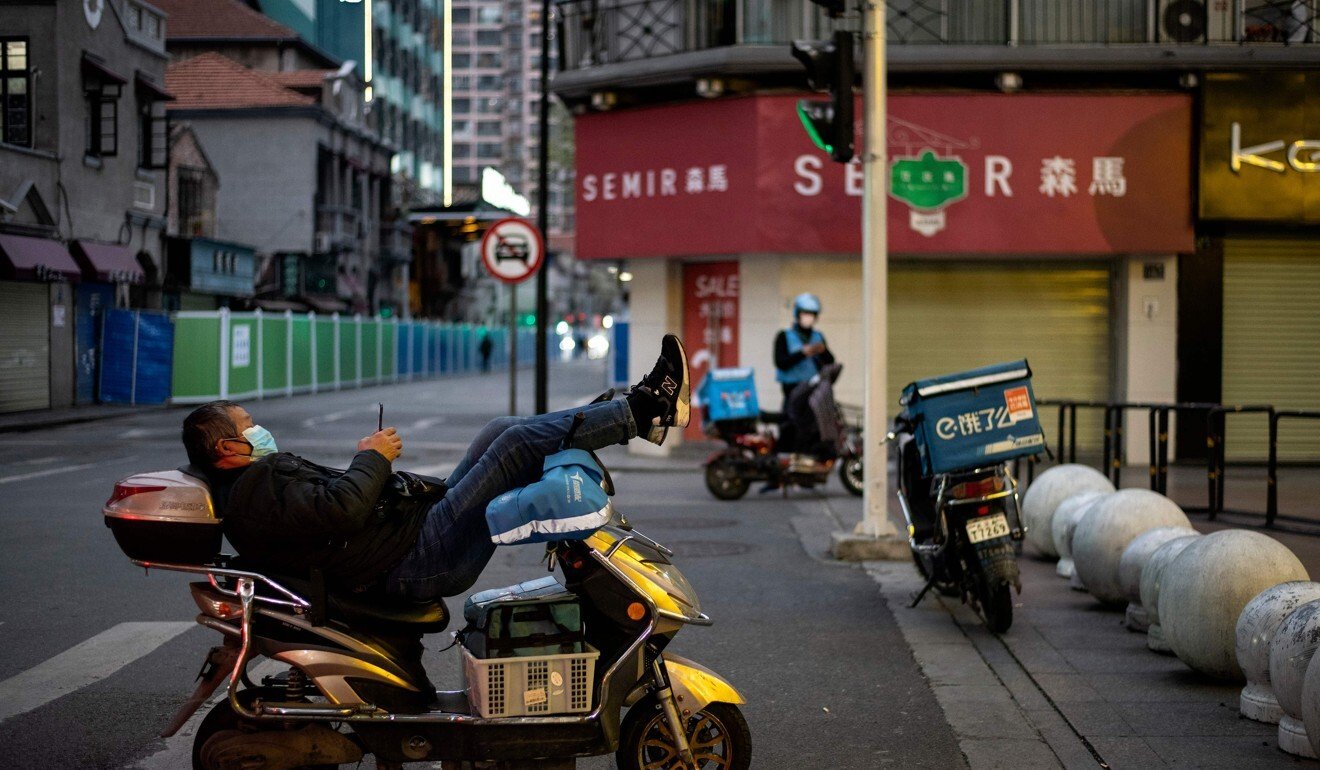
A delivery man takes a break between orders in Wuhan, central China, during the lockdown. Photo: AFP
Mo Xinsheng became one such “on-loan” worker after customers stopped coming to the Beijing restaurant where he worked as a kitchen assistant.
“I wanted to earn some money and meanwhile help people who are trapped at home,” said Mo, who was hired as a delivery man.
But before he could start work he had to go through lengthy health checks before he was allowed into residential compounds.
He also had to work long hours battling the wind and cold of a Beijing winter and carrying heavy loads.
“I work about 10 hours every day just to earn several thousand yuan [several hundred US dollars] a month,” he said.
“Sometimes I almost couldn’t breathe while my hands were fully loaded with packages of rice, oil and other things.
“But I know I’m doing an important job, especially at a time of crisis,” Mo said, “It was not until then that I realised people have become so reliant on the home delivery system.”
Woman uses remote control car to buy steamed buns amid coronavirus outbreak in China
The delivery system has been improved by an effective combination of private sector innovation and public sector coordination, said Li Chen, assistant professor at the Centre for China Studies at Chinese University of Hong Kong.
“[In China,] government units and the Communist Party grass roots organisations have maintained fairly strong mobilisation capabilities to cope with emergencies, which has worked well in the crisis,” he said.
However, Liu, the Wuhan resident, said prices had gone up and vegetables were three times more expensive than they had been over Lunar New Year in 2019.
“There were few varieties that we could choose from, apart from potatoes, cabbage and carrots,” he said.
“But I’m not complaining. It’s good we can still get fresh vegetables at a difficult time. Isn’t it? After all, we are just ordinary people,” he said.
Source: SCMP
30/08/2019

Costco forced to shut first China store early due to crowds

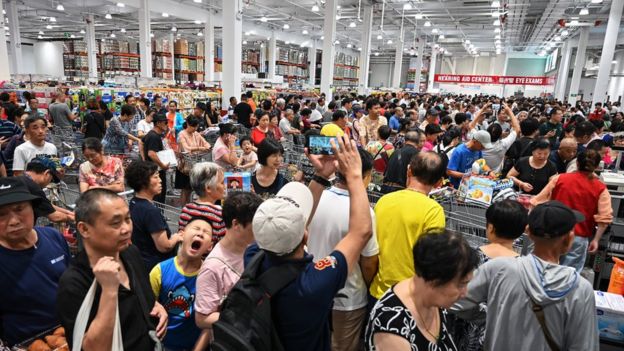
US retailer Costco was forced to close early on its opening day in China, after the store was swamped with shoppers.

Buyers battled long queues and traffic chaos, before the Shanghai store was shut hours early due to “overcrowding”.

Costco’s push into China comes as other foreign retailers have struggled to compete with local rivals.

It also comes at a time of rising tensions between the US and China over trade.

Costco is a discount warehouse store that sells a range of goods, from fresh foods to household electronics.

Some customers spent two hours lining up to pay for their purchases, while some had to wait three hours for parking, state news agency Xinhua reported.

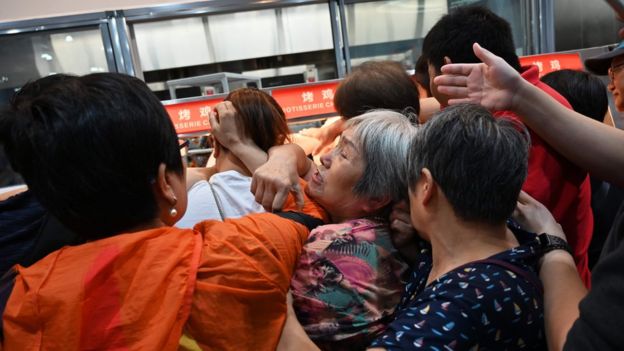
People jostle for cooked chickensImage copyright AFP
Image caption Images from the store show customers caught up in heavy crowds

One video showed people pushing through heavy crowds to get their hands on roast chickens.

“Due to overcrowding in the market, and in order to provide you with a better shopping experience, Costco will temporarily close on the afternoon of August 27. Please avoid coming,” the retailer in a notice on its official app, according to AFP.

People visit the first Costco outlet in China, on the stores opening day in Shanghai on August 27, 2019Image copyright GETTY IMAGES
Image caption Some customers reportedly spent two hours lining up to pay for their goods

Costco has had an online presence in China since 2014, through a partnership with e-commerce giant Alibaba.

The firm’s first store in the country comes as other international retailers battle tough competition in China.

Earlier this year, Amazon said it was downsizing its operations in China and France’s Carrefour agreed to sell 80% of its China business to local retailer Suning.com after a series of losses.

Tesco has struggled to crack the Chinese market.

Costco’s China move also comes at a difficult time for US-China relations.

The world’s two largest economies have been fighting a trade war for the past year, and tensions have escalated with the threat of more tariffs from both sides.

Source: The BBC

Law of Unintended Consequences

continuously updated blog about China & India

ChiaHou's Book Reviews

continuously updated blog about China & India

What's wrong with the world; and its economy

continuously updated blog about China & India