Archive for ‘silk’

07/05/2020

Xinhua Headlines: Archaeological findings provide key proof of Chinese civilization origin

— Chinese archaeologists announced significant achievements at the Shuanghuaishu site in central China’s Henan Province, providing key proof of the origin of the over 5,000-year-long Chinese civilization.

— With an area of 1.17 million square meters, the Shuanghuaishu site, dating back to around 5,300 years, is located on the south bank of the Yellow River in the township of Heluo, Gongyi City, and was proposed to be named “Heluo kingdom.”

— A large number of relics of the Yangshao Culture dating back 5,000 to 7,000 years have been discovered at the site.

by Xinhua writers Xu Ruiqing, Wang Ding, Gui Juan, Shuang Rui

ZHENGZHOU, May 7 (Xinhua) — Chinese archaeologists announced Thursday significant achievements at the Shuanghuaishu site in central China’s Henan Province, providing key proof of the origin of the over 5,000-year-long Chinese civilization.

With an area of 1.17 million square meters, the Shuanghuaishu site is located on the south bank of the Yellow River in the township of Heluo, Gongyi City.

The ancient city relic dating back to around 5,300 years ago was proposed by Chinese archaeologists to be named “Heluo kingdom” after its location in the center of the Heluo area, where the Yellow River (known as He in ancient China) and the Luohe River meet.

“The Shuanghuaishu site is the highest-standard cluster with the nature of a capital city discovered so far in the Yellow River basin in the middle and late stage of Yangshao Culture, the early stage of the formation of Chinese civilization,” said Li Boqian, a professor at Peking University, at a press conference on major archaeological discoveries at Shuanghuaishu site held Thursday in Zhengzhou, the provincial capital.
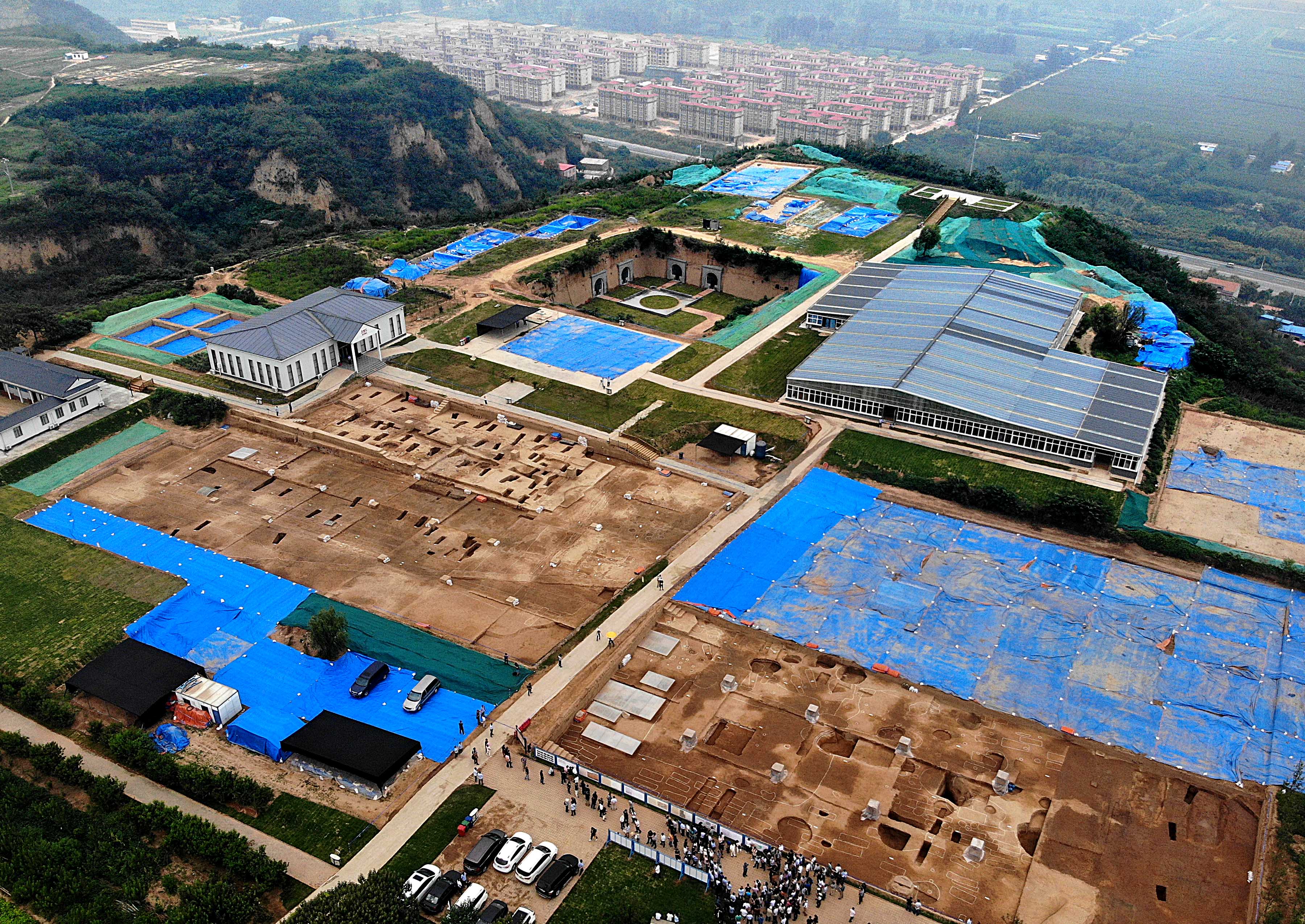
Aerial photo taken on Aug. 27, 2019 shows the Shuanghuaishu site in central China’s Henan Province. (Xinhua/Li An)

A large number of relics of the Yangshao Culture dating back 5,000 to 7,000 years have been discovered at the site, said Gu Wanfa, director of the Zhengzhou Municipal Research Institute of Cultural Relics and Archaeology, at the press conference.

“The important archaeological findings provide key proof of the origin of Chinese civilization, and also prove the representativeness and influence of the Heluo area in the golden stage of the origin of Chinese civilization around 5,300 years ago,” said Wang Wei, a member of the Chinese Academy of Social Sciences.

Since 2013, the Zhengzhou Municipal Research Institute of Cultural Relics and Archaeology and the Institute of Archaeology of the Chinese Academy of Social Sciences have conducted continuous archaeological excavations on the site.

According to archaeologists, the Shuanghuaishu site was about 1,500 meters long from east to west and 780 meters wide from north to south. It was surrounded by three ring trenches with each found to have external access, forming a strict defense system.

Aerial photo taken on Aug. 27, 2019 shows the Shuanghuaishu site in central China’s Henan Province. (Xinhua/Li An)

The central residential area with four rows of houses was found in the northern part of the inner ring moat. Meanwhile, three public cemeteries with more than 1,700 tombs, three sacrificial remains, an astronomical relic, a pottery workshop area, a water storage area, a road system, and other facilities were also discovered at the city ruins.

“The Shuanghuaishu site was a well-selected and scientifically planned settlement site,” said Wang.

“Based on the geographical location and scale, it’s also the only large-scale city settlement discovered so far in the Yellow River basin from the middle and late stage of Yangshao Culture,” Wang added.

Archaeologists believe that the Heluo kingdom was the source of many typical characteristics of Chinese civilization.

Silk originated in China and later became one of the country’s major trade items. “The mulberry-growing and silkworm-raising culture was an important component of Chinese civilization,” said Li.

Among the unearthed relics at Shuanghuaishu, a boar tusk carving of a silkworm, 6.4 cm long, nearly 1 cm wide and 0.1 cm thick, was believed to be China’s earliest carving depicting silkworms.

Undated photo shows a boar tusk carving of a silkworm unearthed at the Shuanghuaishu site in central China’s Henan Province. (Xinhua)

Experts say that the carving depicts a spinning silkworm which is quite similar to modern silkworms in appearance. “The spinning shape of the carving suggests that ancient Chinese people were familiar with the habits of silkworms,” said Gu.

Along with silk fabrics unearthed at the surrounding Wanggou site and Qingtai site, archaeologists said they are solid evidence to prove that the ancient Chinese in the Yellow River basin began raising silkworms and silk production around 5,300 years ago.

“Except Shuanghuaishu and its surrounding settlement sites, there were no definite discoveries from around 5,300 years ago related to the silk textile industry in other parts of the country,” said Li. “In that sense, they are the earliest representatives in the development history of Chinese mulberry cultivation and silkworm-rearing culture.”

Meanwhile, at the astronomical relic at Shuanghuaishu, nine pottery pots were arranged in the pattern of the nine stars of the Big Dipper, which shows that the ancestors of Heluo had relatively mature astronomical knowledge.

Photo taken on April 28, 2020 shows one of nine pottery pots arranged in the pattern of the nine stars of the Big Dipper, at an astronomical relic at the Shuanghuaishu site in central China’s Henan Province. (Xinhua/Li An)

“The relic also indicates the worship of the celestial body may have formed a grand sacrificial ceremony for observing the solar terms and praying for a good harvest,” said Gu.

Experts also believe the astronomical relic and the surrounding sacrificial remains constitute a whole, which is consistent with the records of winter solstice sacrifices in ancient Chinese documents. “It is of great significance to the study of early Chinese astronomy and the origin of Chinese civilization,” added Gu.

Source: Xinhua

12/11/2019

Feature: Xi spearheads closer China-LatAm cooperation for common prosperity

MEXICO CITY, Nov. 12 (Xinhua) — China and Latin America sit on the opposite sides of the globe, but the formidably vast Pacific Ocean that separates them did not stop them from sharing a long history of exchanges.

Today, the major developing country in the East is forging an increasingly close partnership with the dynamic region in the Western Hemisphere, especially since Chinese President Xi Jinping took office in 2013, and set into motion what is now known as Xiplomacy.

In the past six years, Xi has visited 11 Latin American and the Caribbean (LAC) countries. On Tuesday, he is setting foot on the region for the fifth time as president, as he arrives in Brazil for the upcoming 11th BRICS summit.

Thanks in no small part to Xi’s push, the time-honored, distance-defying China-Latin America relationship is flourishing with new vitality. China has become the second largest trading partner of Latin America, while the latter is one of the fastest growing sources of exports to China. Two-way trade rose 18.9 percent year on year to 307.4 billion U.S. dollars in 2018.

GRAND VISION

Every time Xi visited Latin America, he reaffirmed China’s commitment to cementing bilateral friendship and expanding win-win cooperation.

His first trip to the region as head of state, in 2013, took him to Trinidad and Tobago, Costa Rica and Mexico. The following year saw him travel to Brazil, Argentina, Venezuela and Cuba.

It was in Brazil that Xi met with leaders from 11 LAC countries, and for the first time laid out his grand vision for building a China-Latin American community with a shared future.

“Let us seize the opportunities presented to us and work together to blaze new trails in building a community of shared destiny for common progress and usher in a bright future for the relations between China and Latin America and the Caribbean,” Xi said in a keynote speech at the first ever China-Latin American and Carribean Countries Leaders’ Meeting in 2014.

He then proposed a “1+3+6” cooperation framework to “promote faster, broader and deeper cooperation between the two sides for real results.”

The “1” refers to “one plan,” the Chinese-Latin American and Caribbean Cooperation Plan (2015-2019), formulated to promote inclusive growth and sustainable development.

The “3” alludes to “three engines” for driving practical cooperation for comprehensive development, namely trade, investment and financial cooperation.

The “6” means the six priority cooperation fields of energy and resources, infrastructure building, agriculture, manufacturing, scientific and technological innovation, and information technologies.

In 2016, Xi visited Ecuador, Peru and Chile. Two years later, he traveled to Argentina for the Group of 20 summit as well as Panama, a Central American country which established diplomatic ties with China in June 2017.

In a landmark speech at the Peruvian Congress in Lima in 2016, Xi expounded the significance of strengthening China-Latin America cooperation.

“With one fifth of the world’s total area and nearly one third of the world’s population, China and Latin America and the Caribbean are crucial forces for world peace and stability,” he said.

China, he added, “will increase sharing of governance experience and improve planning and coordination of macro policies with Latin American and Caribbean states to better synergize our development plans and strategies.”

Besides top-level engagement, Xi also reaches out to local people from all walks of life, in order to keep cementing the China-Latin America friendship and the public support for bilateral cooperation.

While in Costa Rica, Xi visited a family-run coffee plantation and tried some local brew. “I think some more coffee can well be exported to China,” Xi told his hosts with a smile.

Today, Costa Rica exports coffee to the Asian market, along with pork, dairy, pineapples and other high-quality agricultural goods, especially after the inauguration of the China International Import Expo in 2018.

NEW OPPORTUNITIES

With international cooperation within the framework of the Belt and Road Initiative (BRI) gaining steam worldwide, the Xi-proposed vision is creating new opportunities for China-Latin America cooperation.

The BRI, designed to promote common development along and beyond the ancient Silk Road trade routes, comprises the Silk Road Economic Belt and the 21st Century Maritime Silk Road, and the latter is closely connected to Latin America.

For two and a half centuries, from the mid-1500s to the early 1800s, galleons laden with Chinese silk, spices, porcelain and other goods sailed across the ocean to today’s port city of Acapulco on the Mexican Pacific coast.

Latin America is the natural extension of the 21st Century Maritime Silk Road, Xi said in a meeting with visiting Argentine President Mauricio Macri in May 2017.

In a congratulatory message to the second Ministerial Meeting of the China-Community of Latin American and Caribbean States (CELAC) Forum held in Chile on Jan. 22, 2018, Xi stressed that China and LAC countries “need to draw a new blueprint for our joint effort under the Belt and Road Initiative and open a path of cooperation across the Pacific Ocean that will better connect the richly endowed lands of China and Latin America and usher in a new era of China-LAC relations.”

During Xi’s visits, the Chinese president is always dedicated to better aligning the BRI — an open platform for cooperation — with the development plans of LAC countries.

In his meeting with Macri, Xi called for dovetailing the BRI with Argentina’s development strategy, expanding cooperation in such sectors as infrastructure, energy, agriculture, mining and manufacturing, and implementing existing major cooperation projects in hydro-power, railway and other fields.

Similarly, during the state visit to Panama in December 2018, Xi said the National Logistics Strategy of Panama 2030 and the BRI are highly compatible, calling on the two sides to synergize their respective development strategies, boost cooperation and promote connectivity.

So far, 19 LAC countries have signed BRI cooperation agreements with China. China-Latin America cooperation in various areas has effectively promoted local economic and social development, bringing visible and tangible benefits to the Latin American people.

Just as Xi said in his speech at the Peruvian Congress in 2016, “China will share its development experience and opportunities with the rest of the world and welcome other countries to board the express train of its development, so that we can all develop together.”

SOurce: Xinhua

Law of Unintended Consequences

continuously updated blog about China & India

ChiaHou's Book Reviews

continuously updated blog about China & India

What's wrong with the world; and its economy

continuously updated blog about China & India