Archive for ‘Sinopec’

12/03/2020

Coronavirus: China’s mask-making juggernaut cranks into gear, sparking fears of over reliance on world’s workshop

  • China is now making more than 100 million masks a day, up from 20 million before the coronavirus outbreak, and may start to export more to other countries
  • Mask shortages elsewhere once more raise the debate about an over-reliance on China, with critics pointing to a lack of US industrial policy
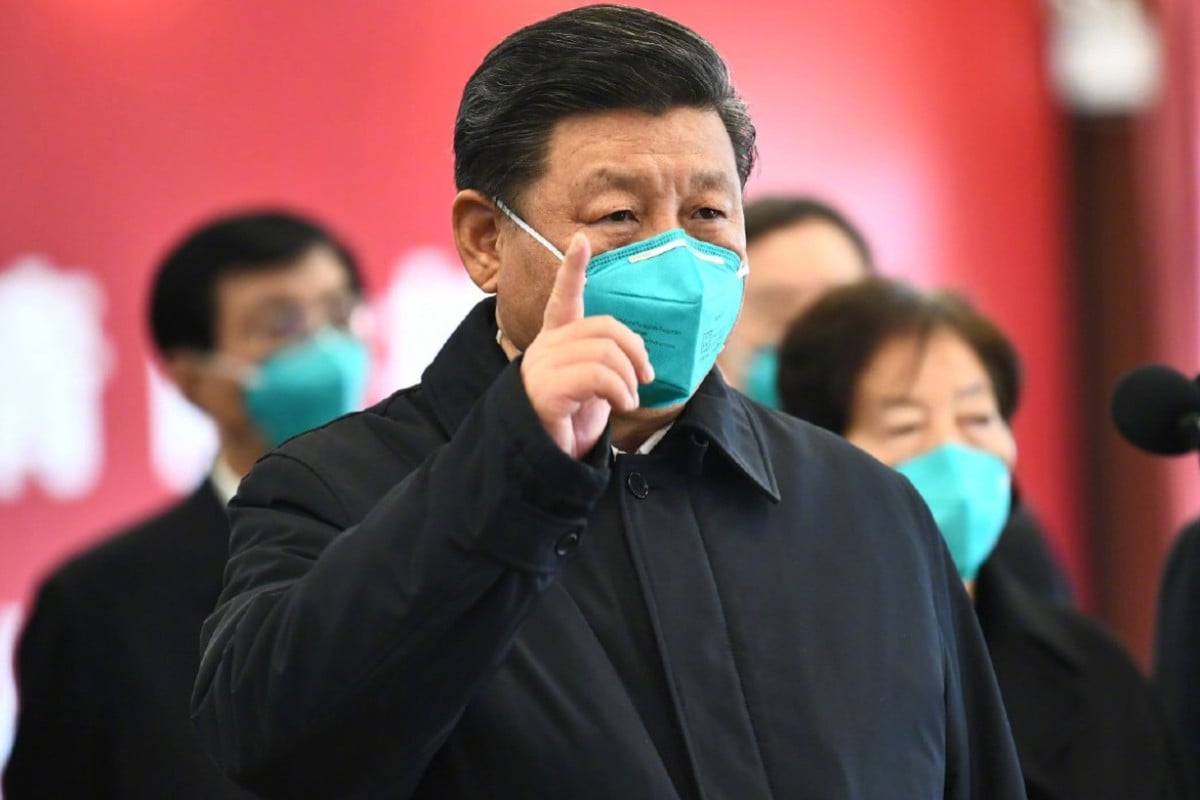
China was producing 116 million masks per day of February 29, including a mix of disposable and high-end masks like the American-designed N95 model worn by President Xi Jinping on his trip on Tuesday to Wuhan. Photo: Xinhua

The Liu family factory has been making diapers and baby products in the Chinese city of Quanzhou for over 10 years, but in February, for the first time, it started making face masks, as demand soared spectacularly due to the coronavirus outbreak.

The business – which employs 100 people in the Southeastern Fujian province – has added two production lines to make up to 200,000 masks a day.
And while the decision was primarily commercial, “encouragement” from the Chinese government – in the form of subsidies, lower taxes, interest-free loans, fast-track approvals for expansion and help alleviating labour shortages – made the decision an obvious one, said Mr Liu who preferred only to give his family name.
“The government is advocating an expansion in production,” Liu said. “With faster approvals, producers need to prioritise the government’s needs over exports.”
WHO declares coronavirus crisis a pandemic
The factory is one of thousands of refitted pop-ups around China making masks and other protective equipment for the first time, part of a massive industrial drive to respond to the spread of the coronavirus.
Before the outbreak, China already made about half the world’s supply of masks, at a rate of 20 million units a day. That rose to 116 million as of February 29, according to China’s state planning agency, a mix of disposable and high-end masks like the American-designed N95 model worn by President Xi Jinping on his trip on Tuesday to Wuhan, the epicentre of the outbreak.

This exponential jump is the result of a wartime-like shift in industrial policy, with Beijing directing its powerful state-owned enterprises to lead the nationwide mask-making effort, and the country’s sprawling manufacturing engine following their lead.

For me, this is the big advantage of China, the speed Thomas Schmitz

“For me, this is the big advantage of China, the speed,” said Thomas Schmitz, president of the China branch of Austrian engineering giant Andritz, which has seen a big uptick in demand for its wet wipe-making machines in recent weeks, also due to the virus. “When you need to run, people know how to run, and this is something which has been lost in other countries since their industrial heydays.”

Chinese oil and gas major Sinopec upped production of mask raw materials such as polypropylene and polyvinyl chloride in January. This week, it set up two production lines in Beijing to produce melt-blown non-woven fabric, intended to make four tonnes of the fabric each day, which can then be used to produce 1.2 million N95 respirators or six million surgical masks a day.

The maker of China’s new J-20 stealth fighter jet, Chengdu Aircraft Industry Group, repurposed part of its factory to design a mask production line, according to local media reports. The Sichuan Daily said 258 of the company’s engineers spent three days fast-tracking development of an assembly line with more than 1,200 components.

Coronavirus: From mysterious origins to a global threat
More than 2,500 companies in China have reportedly started making masks, among them 700 technology companies including iPhone assembler Foxconn and smartphone makers Xiaomi and Oppo, in an extraordinary mobilisation of resources.

The result resembles “the war effort” in the middle of the last century in the United States and western Europe, but arguably no other nation could undergo such a transformation so quickly today.

It is a reminder of what can happen in a centrally-planned economy with a strong manufacturing base, but also brings into sharp focus some of the geopolitical issues which have characterised China’s at-times difficult relationship with the rest of the world, particularly the European Union and US, over the past couple of years.

China’s dominance in manufacturing has become all the more evident as the rest of the world scrambles to shore up their own dwindling medical supplies, leading many to wonder why the world is so dependent on it for vital supplies.

The lesson for Washington is not that we need to emulate the Chinese economic model, but rather that we need to better steward the industrial base in key sectors Rush Doshi

The Italian government, which is dealing with the highest number of coronavirus cases and deaths after China, is to take shipment of 1,000 ventilators, 2 million masks, 100,000 respirators, 200,000 protective suits and 50,000 testing kits from China.
Italian foreign minister Luigi Di Maio said after a phone call with Chinese counterpart Wang Yi, they had agreed the export deal in the same week that European neighbours France and Germany banned masks from being exported because of low domestic supplies.
The Italy export deal showed that “China is emerging as a global public goods provider as the US proves unable and unwilling to lead,” said Rush Doshi, the director of the China Strategy Initiative at the Washington-based Brookings Institute think tank.
“China’s ability to produce what is needed to fight coronavirus is not simply a product of its economic model – it’s also a product of its industrial capacity,” Doshi said. “The US once had this capacity too, but it has lost important parts of it. The lesson for Washington is not that we need to emulate the Chinese economic model, but rather that we need to better steward the industrial base in key sectors.”

The frustration is felt acutely by Michael Einhorn, president of medical equipment distributor Dealmed-Park Surgical in New York, who has been trying to source stock from China for weeks, “but cannot get straight answers” from vendors.

Unaware that Wuhan was still under heavy economic lockdown,
 Einhorn said he placed an order with a private seller in China’s virus-stricken city last week, but that the goods had not been shipped.
“Everyone is running out here, people are panicking in hospitals and we want to be able to help our most important customers,” Einhorn said. “We are dealing with hospitals that do not have products, how in the United States of America in 2020 did this happen?”
With the number of confirmed coronavirus cases in China falling daily, it is not inconceivable that the sort of export deal struck with Italian leaders becomes commonplace, although for now, it deal can be chalked up as a significant public relations coup for Beijing.

The World Medical Association is unable to specify how many masks are required to supply frontline medical staff in virus-hit areas, but said that “this crisis should be a wake up call for politicians and societies to make the necessary investment in emergency preparedness and to look into the vulnerability of our supply chains”.

Australian-listed manufacturer Eagle Health announced on Friday that it had installed production lines at its Xiamen factory in southern China to make 300 million masks a year and said it had already received orders from China and would be securing further larger orders internationally.

The group, which normally makes products including amino acids, protein supplements and lozenges in China, said it would prioritise meeting the large domestic demand, but was aware of an impending global shortage.

Eagle Health has already commenced production of its first order of 3.2 million medical masks for the Yiling Hospital Management Group in China, a process which will take 10 days. It has other smaller orders from Chinese government agencies and expects to receive more orders outside China.

The decision to make more masks came from increased demand. These are opportunities. The global demand for high quality masks will be significant Xu Gang

“The decision to make more masks came from increased demand. These are opportunities,” said chief executive Xu Gang. “The global demand for high quality masks will be significant. Imagine when the schools open. The situation will take some time to peak.”
Last week, the Australian Dental Association said supplies of masks at many practices were expected to run out within four weeks. The Australian government has since arranged a supply of 54 million masks for both the dental and medical industries.
At the same time, the US only has 1 per cent of the 3.5 billion masks it would need to counter a serious outbreak, Bloomberg reported.
While China has no quota on the volume of masks that had to be hived off for local consumption, the government has said domestic demand needs to be prioritised.

Businesses are free to export but overseas demand has yet to explode like it has in China, said Fujian factory owner Liu.

Wendy Min, sales director of Pluscare, a manufacturer based near the virus’ epicentre in Hubei province, said her company is making 200,000 masks per day, much of which are sold to the government, with exports still restricted by partial lockdown of workers and cargo transport.

“We previously exported to Europe, South America and other parts of Asia,” Min said. “But at the moment we can’t export. We are trying to discuss this with the government, but we cannot wait any more – we have to export soon.”

Min said that while she was receiving countless cold calls up until last week from people in China looking for masks, these have stopped, perhaps unsurprising given the abundance in supplies becoming available.

An influx of Chinese-made masks, though, is likely to be welcomed in other virus-stricken parts of the world.

Self-quarantine of all international travellers to Beijing as China fights import of coronavirus
Miguel Luiz Gricheno, CEO of Brazilian mask manufacturer Destra, said that his company is making 30,000 masks a day, but cannot meet local demand due to a lack of supplies, including the non-woven fabric from which masks are made.
“In disposable masks, most Brazilian companies are paralysed due to the lack of raw materials,” Gricheno said. “With the arrival of the coronavirus in Brazil, the demand has increased a lot but the main raw material comes from abroad.”
However, a short-term supply fix will not answer underlying questions about how so many countries found themselves in such dire straits, meaning the geopolitical fallout of the coronavirus will be extensive.
Decades of weak industrial policy helped elect US President Donald Trump, who said he would bring manufacturing jobs back to America at China’s expense. While he has waged a bruising two-year trade war with China in response, the current situation shows just how difficult it will be to change the global manufacturing processes, which are so heavily controlled by China.

One of the great flaws of globalisation is that everyone wanted things cheaper, but did you compromise your health care infrastructure in the process? Stephen Roach

“In the guise of trying to improve efficiency and create value for price-sensitive consumers, we’ve created a global production network that is very difficult to unwind,” said Stephen Roach, a professor of economics at Yale University and a veteran China watcher. “One of the great flaws of globalisation is that everyone wanted things cheaper, but did you compromise your health care infrastructure in the process.
Reuters reported that Trump is considering invoking the emergency provisions of the Defence Production Act, which would allow the government to instruct companies to alter production to help address the domestic shortage of medical supplies like masks. If a company is producing 20 per cent N95 masks and 80 per cent standard masks, the White House could order them to rejig the ratio, an unnamed official said.
The New York Times reported on Wednesday that the White House is preparing an executive order that would allow the government to buy medical supplies from overseas in the hope that it will incentivise companies to make them within the US.

But these changes still do not give Trump the sort of sweeping powers enjoyed by Chinese counterpart Xi.

“When you have a pluralistic, democratic situation that Trump is overseeing, it becomes more unwieldy” to take the steps necessary to address a crisis situation, said Harry Broadman, chair of the emerging markets practise at the Berkeley Research Group and a senior US government official in the 1980s and 1990s.

“That is why I think Trump looks at Xi with envy, because he doesn’t have to deal with a disparity of views or democratic interests,” Broadman said. “I think Trump is at heart a bilateral guy, as you saw with the phase one [US-China] trade deal and the state-to-state purchases. That is why he likes dealing with [Russian President Vladimir] Putin and Xi, because each of them can move mountains. I think Trump is very envious of that ability.”

Source: SCMP
24/02/2020

China welcomes ‘encouraging developments’ in South Sudan as rivals form unity government

  • Power-sharing agreement between rebel leader Riek Machar and President Salva Kiir gives hope to ending the conflict
  • Beijing has invested tens of millions of dollars in the country’s oilfields and sent more than 1,000 peacekeeping troops there
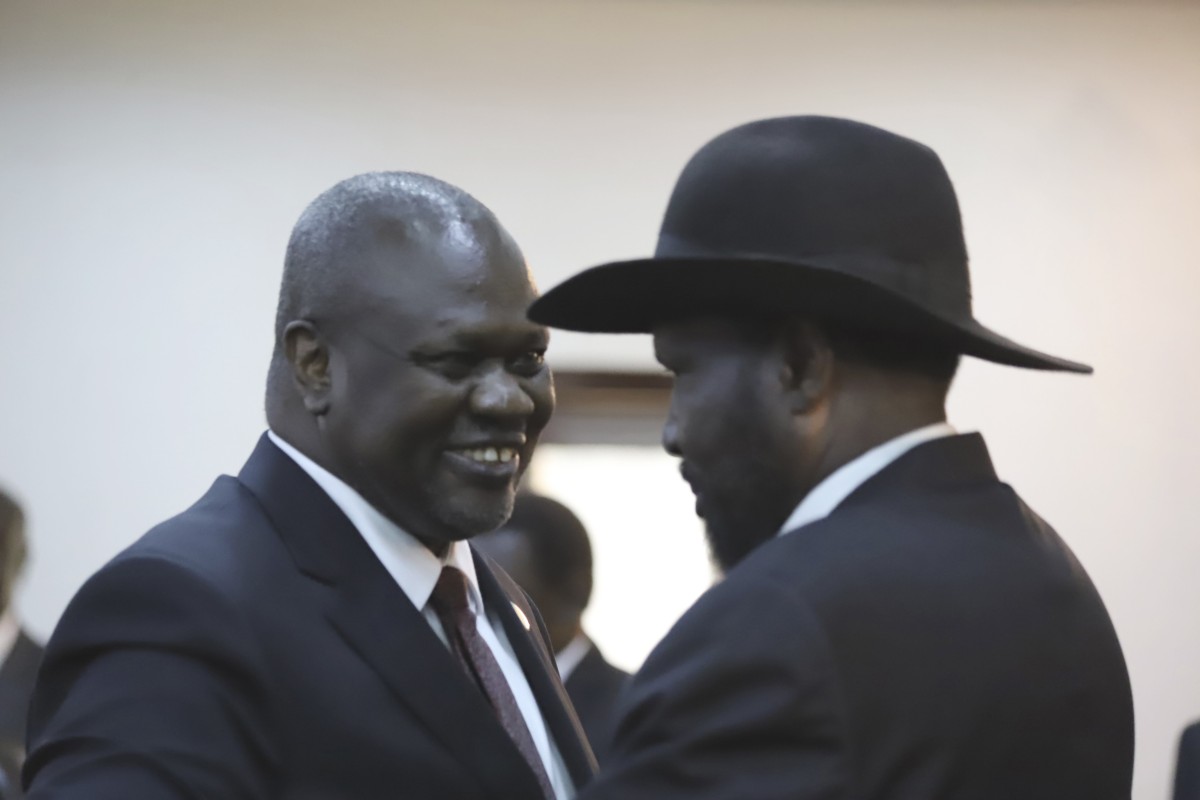
Rebel leader Riek Machar (left) and President Salva Kiir greet each other after the swearing-in ceremony at the State House in Juba on Saturday. Photo: AP

Beijing has welcomed “encouraging developments” in the South Sudan peace process after rebel leader Riek Machar and President Salva Kiir agreed to form a transitional coalition government.

Machar, the Sudan People’s Liberation Movement-In Opposition (SPLM-IO) leader, was among four vice-presidents sworn in on Saturday in the capital, Juba, in a power-sharing deal that gives hope to ending the more than six years of conflict which has killed some 400,000 people and displaced millions more.

“The Chinese side commends and welcomes these encouraging developments, especially the crucial consensus reached between President Kiir and Machar,” the Chinese embassy in Juba said in a statement.

Stability in South Sudan is important for China, which has invested tens of millions of dollars in the country’s oilfields as it seeks to meet energy needs at home. China National Petroleum Corporation (CNPC) owns a 41 per cent stake in South Sudan’s largest oil consortium, Dar Petroleum Operating Company, while Sinopec, another Chinese state-owned firm, holds a 6 per cent stake.

Stability in South Sudan is important for China, which has major investments in the country’s oilfields. Photo: Reuters
China has also sent more than 1,000 troops to the United Nations’ peacekeeping mission in South Sudan, and has not followed the United States and other Western nations in imposing sanctions on leading political and military figures.

“We trust that the relevant parties of South Sudan will resolve the remaining issues in the spirit of mutual trust and understanding, and start a new chapter in the history of South Sudan,” the embassy statement added.

China has offered to help rebuild the country, promising to supply a unified security force that is supposed to be formed from the rival factions as part of the peace process. It has also helped to set up military camps to accommodate both government troops and members of the armed opposition.

Since the peace deal was signed between Kiir and rebel factions in September 2018, China said it had provided diplomatic and other support to military camps and training centres including 1,500 tonnes of rice, 2,500 tents, 50,000 blankets and 1,440 boxes of medicine.

Riek Machar (right) is sworn in as the first vice-president of South Sudan. Photo: AFP
Machar was sworn in as the first vice-president alongside three others – James Wani Igga, Taban Deng Gai and Rebecca Nyandeng. Gai, a former ally of Machar who switched to the government side, was recently sanctioned by the US over serious human rights abuses. Nyandeng is the widow of John Garang, who led a long struggle for independence from Sudan before he died in a helicopter crash in 2005.

“I have forgiven my brother Riek Machar. I also ask for his forgiveness and I also forgive all those who still are holding out on this peace agreement,” Kiir said at a ceremony at the State House attended by regional leaders and diplomats.

After the swearing-in, Machar vowed to work together to end the suffering of South Sudanese.

“I reiterate my commitment to work closely with President Kiir to implement the agreement in letter and spirit,” Machar said.

From Angola to Zambia, China’s African partners brace for coronavirus blow to trade

14 Feb 2020

The South Sudanese have seen more war than peace since the East African nation – whose oilfields contribute about 98 per cent of the government’s revenue – seceded from the Republic of Sudan in 2011. Kiir and Machar formed the independent government but disagreements followed, leading to Machar’s sacking, sparking a bloody war along ethnic lines.

They again agreed to work together in 2015, but the deal fell apart a year later following renewed fighting. After international pressure and peace talks, a new deal was signed in September 2018, but Kiir and Machar have had to push back two deadlines to form the coalition government as they could not agree on issues such as having a unified army and the number of states – highly contentious since it affects the control of oil-rich regions. Machar also wanted his security assured.

On Thursday, Kiir said he had agreed to abolish the 32 states he created in 2015 and revert to the original 10 states.

According to a report released last week on China’s approach to UN peacekeeping in the region, Beijing had used its “economic leverage” in South Sudan.

“China has used its leverage to encourage the government and the opposition parties to negotiate, to come to an agreement, and to implement the ceasefire agreements,” said the report by the Norwegian Institute of International Affairs. “It has reportedly used its economic leverage by signalling that it would be unable to renew and expand its support to the South Sudanese government and the economy as long as the fighting was ongoing.”

Africa is a test lab for how China approaches international security and peacekeeping

8 Aug 2019

South Sudan had also provided an opportunity for Chinese soldiers to put their skills to the test on overseas missions and during armed conflict.

“South Sudan became a real-world laboratory [for China] to test the boundaries of its non-interference principle,” the report said.

Obert Hodzi, an international relations lecturer at the University of Liverpool in England, also said earlier that it was a way for China’s military to get the combat experience it needed.

“South Sudan provides ample opportunities for different segments of the Chinese army to practise, test their equipment and ability to conduct successful missions abroad,” Hodzi said.

Source: SCMP

30/04/2019

Boxed in: $1 billion of Iranian crude sits at China’s Dalian port

SINGAPORE (Reuters) – Some 20 million barrels of Iranian oil sitting on China’s shores in the northeast port of Dalian for the past six months now appears stranded as the United States hardens its stance on importing crude from Tehran.

Iran sent the oil to China, its biggest customer, ahead of the reintroduction of U.S. sanctions last November, as it looked for alternative storage for a backlog of crude at home.

The oil is being held in so-called bonded storage tanks at the port, which means it has yet to clear Chinese customs. Despite a six-month waiver to the start of May that allowed China to continue some Iranian imports, shipping data shows little of this oil has been moved.

Traders and refinery sources pointed to uncertainty over the terms of the waiver and said independent refiners had been unable to secure payment or insurance channels, while state refiners struggled to find vessels.

The future of the crude, worth well over $1 billion at current prices, has become even more unclear after Washington last week increased its pressure on Iran, saying it would end all sanction exemptions at the start of May.

“No responsible Chinese company with any international exposure will have anything to do with Iran oil unless they are specifically told by the Chinese government to do so,” said Tilak Doshi of oil and gas consultancy Muse, Stancil & Co in Singapore.

Iran previously stored oil in 2014 at Dalian during the last round of sanctions that was later sold to buyers in South Korea and India. reut.rs/2yo9Se6

China last week formally complained to the United States over the unilateral Iran sanctions, but U.S. officials have said Washington is not considering a further short-term waiver or a wind-down period.

The 20 million barrels is equal to about a month’s worth of China’s imports from Iran over the past six months, or about two days of the country’s total imports.

Iran says it will continue to export oil in defiance of U.S. sanctions.

A senior official with the National Iranian Tanker Company (NITC), who spoke on condition of anonymity, told Reuters: “We will continue to sell our oil.”

“Iran is now desperate and will deal with anyone with steep discounts as long as they get paid somehow,” said Doshi.

SOME OIL TAKEN

Some Iranian oil sent to Dalian has moved, according to a ship tracking analyst at Refinitiv.

Dan, a supertanker owned by NITC moved 2 million barrels of oil from Dalian more than 1,000 km (620 miles) to the south to the Ningbo Shi Hua crude oil terminal in March, according to Refinitiv data.

Ningbo is home to Sinopec’s Zhenhai refinery, one of the country’s largest oil plants with a capacity of 500,000 barrels a day and a top processor of Iranian oil.

Sinopec declined to comment.

The Iranian tanker was chartered by state-run Chinese trader Zhuhai Zhenrong Corp, according to Refinitiv analyst Emma Li. The NITC official confirmed the oil was taken by Zhuhai Zhenrong.

Zhenrong was started in the 1990s and brokered the first oil supply deals between Iran and China. At that time, Iran was supplying oil to China to pay for arms supplied by Beijing during the 1980-88 Iran-Iraq war. Zhuhai Zhenrong still specializes mainly in buying Iranian oil.(reut.rs/2IHlvEx)

An official at the general manager’s office with Zhuhai Zhenrong’s office in Beijing said he could not immediately comment. The company did not reply to a fax seeking comment.

For now, more Iranian oil is heading to China, with the supertankers Stream and Dream II due to arrive in eastern China from Iran on May 5 and May 7, respectively, Refinitiv data showed.

Some of this crude may be from Chinese investments into Iranian oilfields, a sanctions grey area.

Whether China will keep buying oil from Iran remains unclear, but analysts at Fitch Solutions said in a note “there may be scope for imports via barter or non-compliance from … China.”

Muse, Stancil & Co’s Doshi said the only way to get the Iranian oil out of Dalian now was by cheating.

“Only rogue parties might try to cheat the system and try to pass the Iranian oil at Dalian as something else via fraudulent docs. But I doubt this is easy or can amount to much in terms of volume.”

(MAP: Iranian supertanker frees some oil from China storage in March, tmsnrt.rs/2W1FJvK)

Source: Reuters

08/04/2019

Shell enters China’s shale oil scene with joint study with Sinopec

SINGAPORE (Reuters) – Royal Dutch Shell has entered China’s shale oil sector, signing an agreement with state-owned Sinopec to study an East China block, part of the nation’s early efforts to unlock the potentially massive unconventional resource.

China is already in the initial stages of developing its vast shale gas resources, with production last year making up just 6 percent of total gas output after more than a decade of work. China’s shale oil is at an even more basic phase due to challenging geology and hefty development costs, experts said.

Shale oil makes up less than 1 percent of China’s crude output after several years of development, according to Angus Rodger, research director of Asia-Pacific upstream at Wood Mackenzie.

“China’s shale oil has very low permeability, which means very low per well output that makes the economics hard to work,” said an oil and gas official with China’s Ministry of Natural Resources (MNR). The official declined to be named because he’s not authorized to speak with the press.

Sinopec said on Monday it had agreed with Shell to study the Dongying trough of Shengli in China’s eastern province of Shandong, without giving further details.

Shell confirmed the joint study agreement, but did not offer further comment.

That makes Shell one of the few international oil and gas explorers venturing into China’s shale oil sector, and follows the Anglo-Dutch company’s exit from shale gas drilling in Sichuan province in the southwest after spending at least $1 billion (766.22 million pounds) and getting unsatisfactory results.

Unlike shale gas resources, which are highly concentrated in Sichuan, most of China’s shale oil is trapped in eastern regions such as the Songliao and Bohai Rim basins. North China’s Ordos and Junggar basins are also believed to hold large shale oil resources, the experts said.

The Dongying trough is part of the Bohai Rim basin, where top Chinese oil and gas group China National Petroleum Corp (CNPC) said in February that it is developing another small shale oil field with an annual output of 50,000 tonnes this year.

In 2013, U.S. energy firm Hess Corp signed a production-sharing contract with PetroChina, CNPC’s listed arm, to develop the Malang block of Santanghu basin in the northwest region of Xinjiang, China’s first shale oil deal.

Hess quit the block around late 2014 due to poorer-than-expected drilling prospects and as global oil prices plunged, said the MNR official.
“The understanding of geology, resource and the best recovery techniques (for shale oil) has only just begun,” said Woodmac’s Rodger.
Sinopec is hoping Shell’s expertise in shale oil exploration could help the Chinese state major turn around its fortunes at Shengli oilfield as the reserves at the giant conventional oilfield are depleting rapidly, said Rodger.
Source: Reuters
Law of Unintended Consequences

continuously updated blog about China & India

ChiaHou's Book Reviews

continuously updated blog about China & India

What's wrong with the world; and its economy

continuously updated blog about China & India