Archive for ‘Slovakia’

25/02/2020

Tesco completes China exit with 275 million pound stake sale

LONDON (Reuters) – Britain’s biggest retailer Tesco (TSCO.L) has completed its exit from China with the 275 million pound sale of its joint venture stake to state-run partner China Resources Holdings (CRH).

Having struggled to crack the Chinese market, Tesco established the Gain Land venture with CRH in 2014, combining the British group’s 131 stores in China with its partner’s almost 3,000.

The disposal of its 20% stake allows Tesco to further simplify and focus the business on core operations, it said on Tuesday, adding that the proceeds will be used for general corporate purposes.

The deal is scheduled to complete on Feb. 28.

Shares in Tesco were up 0.7% at 0816 GMT, extending its gains over the last year to 12.4%.

“This extra 275 million pounds of ‘forgotten value’ should be accretive to most street valuations,” said Bernstein analyst Bruno Monteyne.

After costly exits from Japan and the United States and the sale of its South Korean business, Tesco signalled in December a further retreat from its once lofty global ambitions by starting a review of its operations in Thailand and Malaysia – its last remaining wholly owned businesses in Asia.

A sale of its operations in Thailand and Malaysia would mean Tesco’s only remaining overseas operations, apart from Ireland, would be its central European division, comprising stores in the Czech Republic, Hungary, Poland and Slovakia.

The Asian exit could be one of the last acts of Tesco CEO Dave Lewis, who will be succeeded by Ken Murphy in October.

Bernstein’s Monteyne expects Tesco to start a 1 billion pound share buyback programme in its 2020-21 financial year.

“With this transaction and the possible sale of Thailand and Malaysia, Tesco’s biggest short-term concern could be how to efficiently return cash to shareholders,” he said.

Source: Reuters

18/01/2020

Why the ‘honeymoon is over’ between the Czech Republic and China

  • President Milos Zeman says Beijing has not fulfilled its promises and he will not attend this year’s 17+1 summit
  • He had hoped the country would be an ‘unsinkable aircraft carrier’ for Chinese investment in Europe, but now Zeman has changed his tone
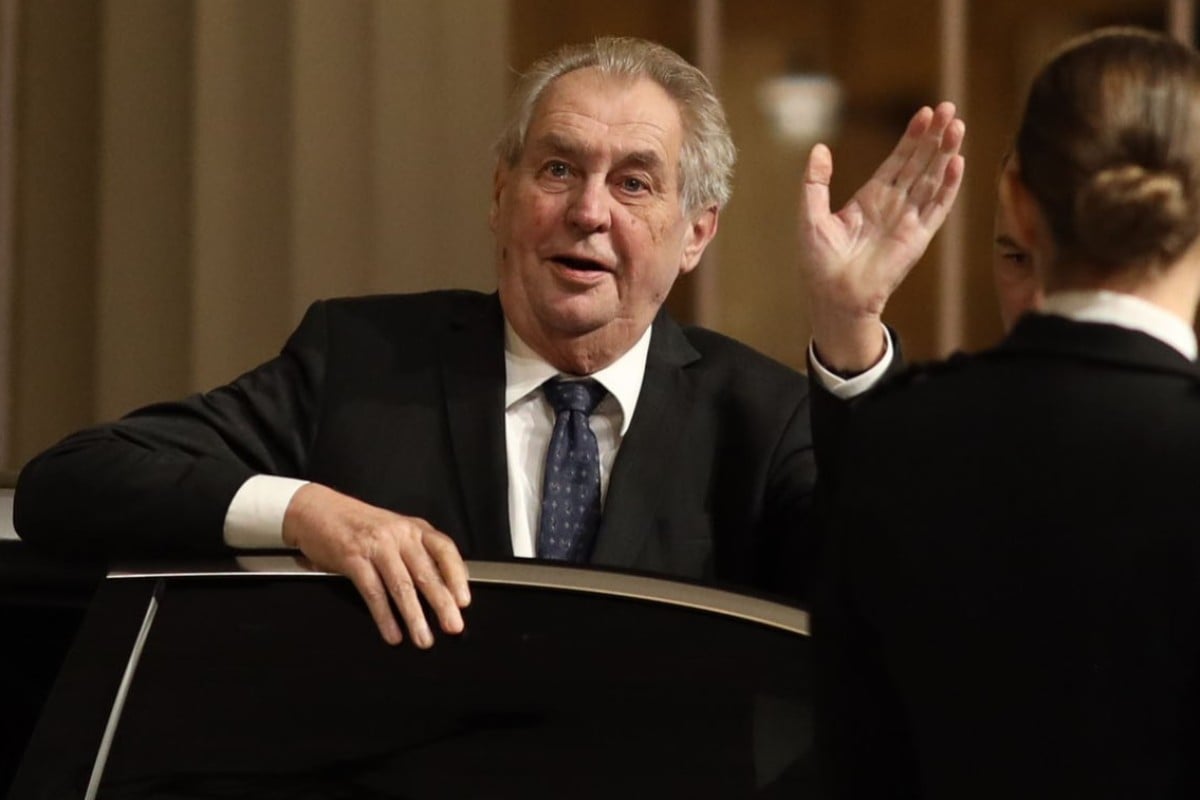
Czech Republic President Milos Zeman has voiced disappointment over China’s lack of investment in the country. Photo: AFP
Czech President Milos Zeman’s decision to skip China’s summit with European leaders in April shows the “honeymoon is over” between Prague and Beijing, analysts say, as it tries to shake up the relationship to push for more investment.
And China could face similar trouble with other nations looking for more at this year’s “17+1” summit with Central and Eastern European nations in Beijing.
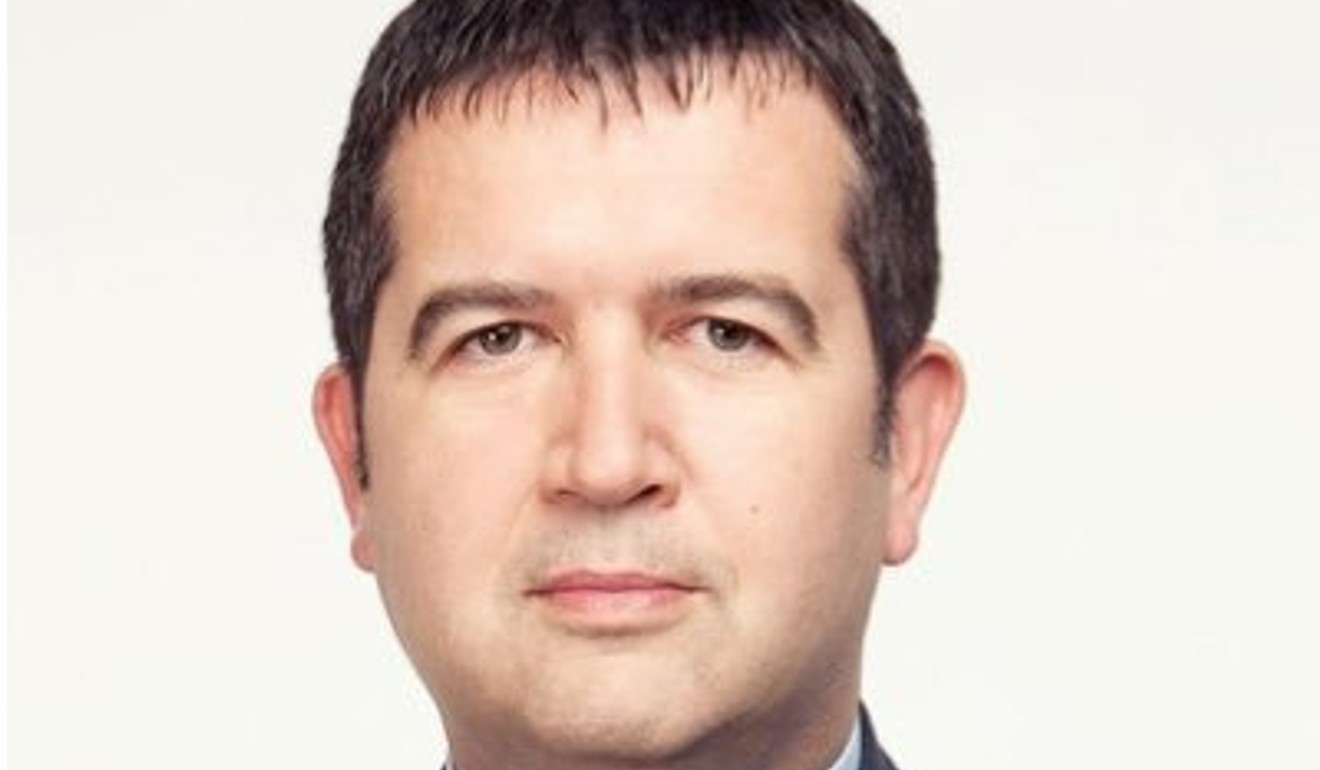
Top leaders usually attend the gathering, but Zeman on Sunday said he would not be going, and that China had not “done what it promised” by failing to invest more in his country. He would instead send Deputy Prime Minister Jan Hamacek, which he said was “adequate to the level of cooperation”.
At last year’s summit in Croatia, Prague was represented by Prime Minister Andrej Babis, who was diplomatically on par with the Chinese representative, 
Premier Li Keqiang.

But it is China’s turn this year, and President Xi Jinping will be the host – meaning heads of state are expected to attend. The 17+1 grouping was launched by Beijing in 2012.

Deputy Prime Minister Jan Hamacek will represent Prague at the 17+1 summit. Photo: Twitter
Zeman was a strong advocate for deepening economic ties with China and investments were on the rise, for a time. But Zeman and other Czech leaders have increasingly questioned the nature of the relationship, especially as the economic benefits have dwindled.
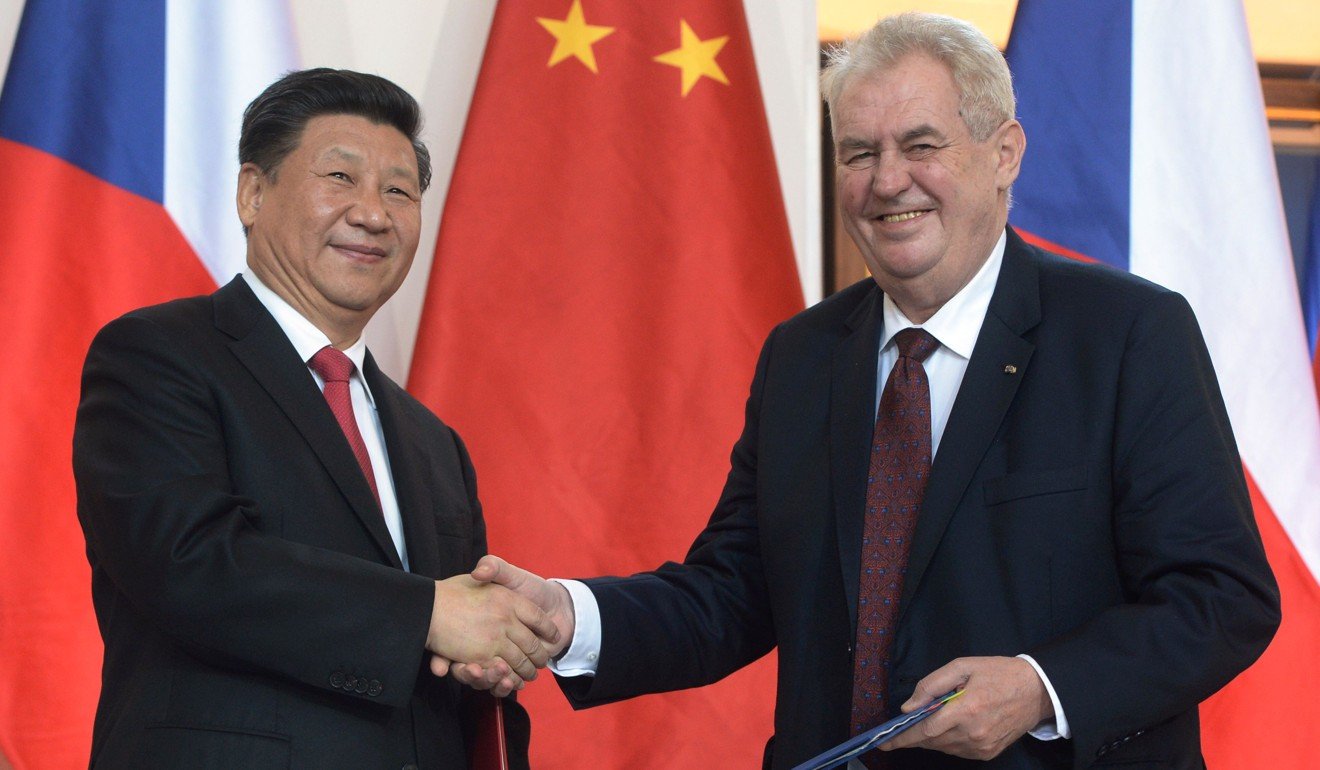
Relations with China grew after Zeman, who is in his second term as president, took office in 2013. The peak came in 2016, when Xi visited the country and promised more Chinese investment. That year, Zeman said he hoped his country would be an “unsinkable aircraft carrier” for Chinese investment in Europe.

But since then, the investments have faltered, not just in the Czech Republic, but across Central and Eastern Europe, and Zeman has changed his tone. In April, he called the lack of investment in his nation a “stain on the Czech-China relationship”, in an interview with Chinese state broadcaster CCTV.

Chinese President Xi Jinping meets his Czech counterpart Milos Zeman during a visit to Prague in 2016, when he promised more investment. Photo: AFP
“I suppose he feels that promises made to him personally were not fulfilled, since he has had personal contact with Xi Jinping on a number of occasions … he surely feels that his commitment to China has not been reciprocated,” said Jeremy Garlick, assistant professor of international relations at the University of Economics, Prague.

Zeman has visited China five times and was the only EU leader to attend a Chinese military parade in 2015 to mark the 70th anniversary of the end of World War II.

I suppose he feels that promises made to him personally were not fulfilled, since he has had personal contact with Xi Jinping on a number of occasions Jeremy Garlick, University of Economics, Prague
Rudolf Furst, a senior researcher at Charles University in Prague, said Zeman had given up his unequivocal support for a pragmatic pro-Chinese agenda.

“Chinese investments flow in Czechia have remained low, and not matching the Czech structural needs for stimulating the GDP growth,” he said.

Most of the 17+1 member states, except for Hungary and Greece, were now “perceiving the Chinese investment promises as merely virtual”, Furst said. “The 2012 new wave of China’s honeymoon is over.”

Rhodium Group has tracked Chinese foreign direct investment data in Europe since 2000. Its data shows that while total Chinese investment in the Czech Republic had grown to about 1 billion (US$1.1 billion) by 2018, growth has been slow, while neighbouring countries like Italy and Germany had some 15 to 20 times more investment in their economies.

Cumulative Chinese foreign direct investment in the Czech Republic between 2000 and 2017 sat at about 600 million, and grew to 1 billion in 2018, while that in neighbour Germany grew from 20.6 billion to 22.2 billion over the same period.

The picture is much the same for Eastern Europe as a whole – Austria, Bulgaria, the Czech Republic, Hungary, Poland, Romania and Slovakia received just 2 per cent of China’s overall investment in Europe in 2018, according to the data.

Countries like France, Germany and Britain meanwhile received 9, 12 and 24 per cent, respectively.

Czech Republic becomes unlikely front line in China’s soft power war

14 Dec 2019

Other Czech politicians have also taken a tougher line on China. Babis warned of a “considerable” trade deficit with China in 2018. The country exported US$1.8 billion of goods to China in the first nine months of last year, down 4.3 per cent from a year earlier. But it imported US$11.7 billion of products from China – by far its largest source of imports.

And after Zeman’s announcement this week, the Green Party, which holds a handful of seats in the Czech Senate, called for Prague to pull out of the 17+1 platform altogether.

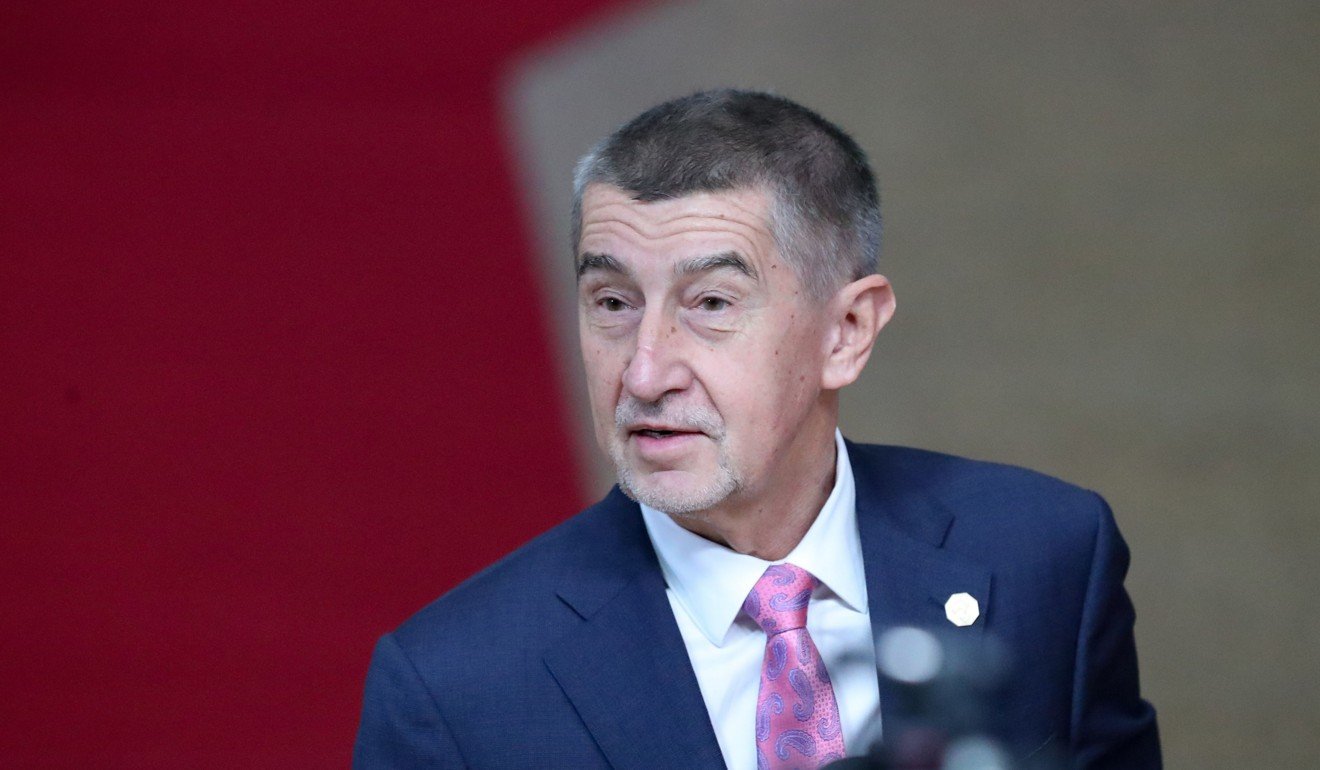
Prime Minister Andrej Babis warned of a “considerable” trade deficit with China in 2018. Photo: AFP
Richard Turcsanyi, director of the Central European Institute of Asian Studies at Palacky University in the Czech Republic, said both Prague and Beijing were expecting too much.

“I see the current sharp downturn of Czech-China relations being related to very high and unrealistic expectations which existed perhaps on both sides, driven to a large extent by the ignorance of each other,” he said.

“Due to the impressive economic growth of China and also its international economic expansion, many expected that China could quickly become a significant economic actor in the Czech Republic,” he said.

“In reality, the Czech Republic and China are not natural trading or investment partners. They are more of competitors when it comes to moving up the value chain, rather than complementary economic partners – contrary to what has been claimed for years as part of the diplomatic exchanges.”

Political tensions with China have also increased, including over security allegations about Huawei Technologies, and sensitive issues like Taiwan and Tibet.

This week, Shanghai suspended official contact with the Czech capital Prague after it signed a sister city agreement with Taipei – following Prague cancelling its deal with Beijing in October over a “one China” pledge. Shanghai was also a sister city with Prague.

And although Zeman has been critical of the US-led campaign against Huawei, Babis ordered Czech government institutions to stop using products from the Chinese tech giant last year.

“There has been a breakdown of trust in China, at the level of the public, the media, and now even the president,” Garlick said.

Source: SCMP

06/07/2019

Chinese state councilor to visit Poland, Slovakia, and Hungary

BEIJING, July 6 (Xinhua) — Chinese State Councilor and Foreign Minister Wang Yi will visit Poland, Slovakia and Hungary from July 7 to 13, at the invitation of Polish Foreign Minister Jacek Czaputowicz, Slovak Foreign Minister Miroslav Lajcak, and Hungarian Foreign Minister Peter Szijjarto respectively.

He will also co-host the second plenary session of China-Poland Intergovernmental Cooperation Committee with Czaputowicz and the second China-Hungary “Belt and Road” working group meeting with Szijjarto during the visit, foreign ministry spokesperson Geng Shuang said Saturday in Beijing.

Source: Xinhua

Law of Unintended Consequences

continuously updated blog about China & India

ChiaHou's Book Reviews

continuously updated blog about China & India

What's wrong with the world; and its economy

continuously updated blog about China & India