Archive for ‘Confucius’

27/12/2019

Exhibition on Confucian culture opens in Beijing

BEIJING, Dec. 27 (Xinhua) — An exhibition featuring Confucian culture kicked off at the National Museum of China Friday.

The exhibition displays more than 700 pieces of cultural relics, documents and artworks related to Confucian culture in four sections to reveal the life and thoughts of Confucius, the development and spread of Confucianism, as well as artworks themed around Confucius.

An educator and philosopher, Confucius (551-479 BC) founded a school of thought, deeply influential on later generations, known as Confucianism. He was also the first to set up private schools in China that enrolled students from different social classes.

The exhibition will last until March 27.

Source: Xinhua

05/06/2019

China runs Confucian culture courses for religious leaders in bid to boost control

  • Communist Party says those taking part pledged to ‘cultivate the Chinese cultural character of our nation’s religions’
  • Confucius has been rehabilitated by party in recent years as a means of rallying patriotism and countering foreign influences
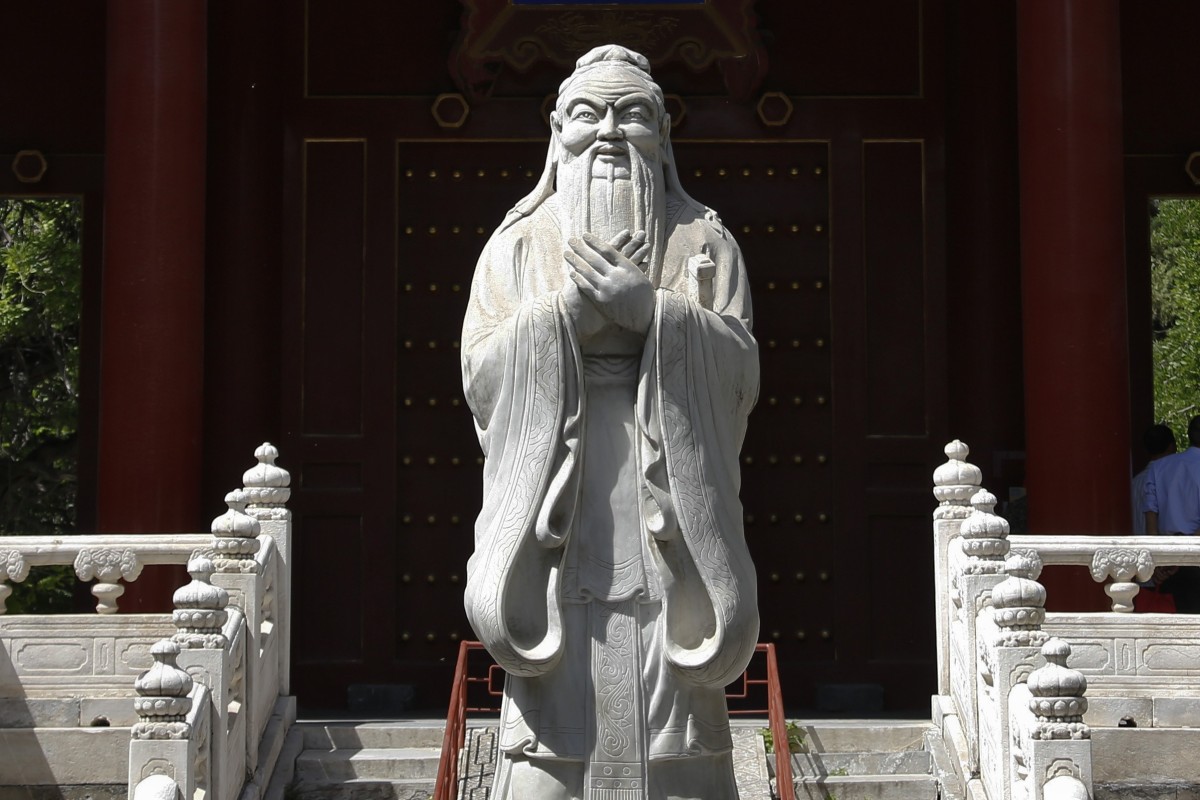
The Communist Party for decades attacked the sage as a symbol of feudalism, but now Confucianism has been elevated. Photo: AP
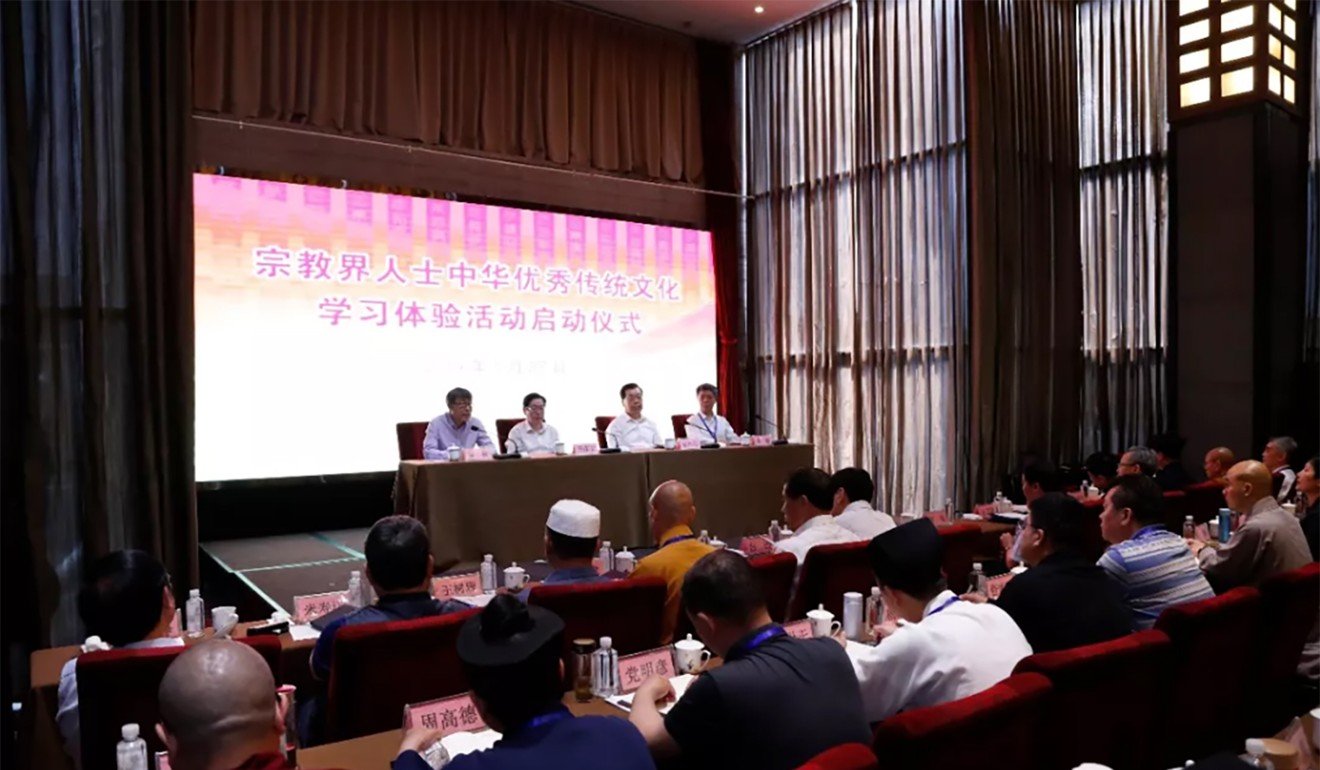
China has begun five-day Confucian culture immersion courses for religious leaders in the sage’s hometown as part of a campaign to extend government control over faith communities through a

process of Sinicisation

.

The ruling Communist Party’s United Work Front Department said in a news release on Monday that the activity was designed to ensure the primacy of traditional Chinese values above all.

“To hold activities here … is a collective tribute to excellent traditional Chinese culture and a conscious identification and integration with Chinese culture,” said the release, posted on the department’s website.

Participants pledged to “cultivate the Chinese cultural character of our nation’s religions so that our nation’s religions are rooted in the fertile soil of excellent traditional Chinese culture, and to ceaselessly and deeply advance the Sinicisation of our nation’s religions”, it said.

The five-day immersion courses are being held in the sage’s hometown of Qufu. Photo: United Front Work Department

President Xi Jinping has launched the harshest crackdown in decades on religious practices, especially those viewed as foreign such as Christianity and Islam, while at the same time elevating home-grown Confucianism.

While for decades the officially atheistic Communist Party attacked Confucius as a symbol of feudalism, he has been thoroughly rehabilitated in recent years as a means of rallying patriotism and countering foreign influences.

Confucianism’s emphasis on strict social organisation, advancement through study and exam taking, adherence to hierarchy and maintenance of social harmony appeals especially to the heavily bureaucratic party, which brooks no challenge to its authority.

Xi has repeatedly called for religious leaders and believers to be guided by “socialist core values”. Party bureaucrats overseeing religion have demanded that key religious tenets and texts such as the Bible and Koran be interpreted “in conformity with the demands of modern Chinese development and excellent traditional Chinese culture”.

That has been accompanied by a campaign of removing crosses and bulldozing many churches, destroying mosques and locking an

estimated 1 million Chinese Muslims

in camps where they are forced to renounce Islam and their cultural traditions.

Despite international condemnation, China claims it upholds freedom of religion and is seeking only to ensure regulations are followed while discouraging religious extremism and violence.
Those participating at the launch of the five-day course included the president of the Chinese Taoist Association, vice-president of the Chinese Islamic Association, chairman of the Chinese Catholic Patriotic Association and president of the Chinese Christian Association.
Confucius was believed to have been born in the 6th century BC in the eastern town of Qufu. He is credited with authoring or editing key texts of statesmanship and social order, particularly the Analects that contain his key aphorisms and teachings.
The sage’s legacy is also invoked in the name of the 
Confucius Institutes

, quasi-academic bodies set up in colleges and other centres of education around the world.

Several US universities have rejected offers to open Confucius Institutes on their campuses or declined to renew contracts over concerns about Chinese government political influence.
Source: SCMP
28/07/2015

Confucius says, Xi does | The Economist

TWO emerging cults are on display in Qufu, a city in eastern China where Confucius was born. One surrounds the ancient sage himself. At a temple in his honour, visitors take turns to bow and prostrate themselves before a large statue of Confucius seated on a throne. For each obeisance, a master of ceremonies chants a wish, such as for “success in exams” or “peace of the country”. On the other side of the city the tomb of Confucius is the scene of similar adoration—flowers adorn it as if he were a loved one recently lost.

The other cult in Qufu surrounds the country’s president, Xi Jinping. People still recall with excitement the trip he made to the city in 2013. It was the first by a Communist Party chief in more than two decades; in fact, though Mr Xi has visited Qufu he has not, since becoming China’s leader, paid respects at the birthplace of Mao Zedong at Shaoshan in Hunan province. Today plates decorated with Mr Xi’s image are for sale in Qufu’s trinket shops. His beaming face is on display on a large billboard outside the Confucius Research Institute, together with a quotation from the modern sage: “In the spread of Confucianism around the world, China must fully protect its right to speak up,” it begins.

Since he came to power in 2012, Mr Xi has sought to elevate Confucius—whom Mao vilified—as the grand progenitor of Chinese culture. He did not go so far as to pay homage at the Confucius temple in Qufu, where Mao’s Red Guard mobs once wrought havoc (one of their slogans, “Revolution is not a crime”, still survives daubed on a stone tablet). Neither did his few published remarks include explicit praise for Confucian philosophy, which still raises hackles among party hacks brought up to regard it as the underpinning of “feudal” rule in premodern China.

To emperors, who were regular visitors to Qufu, Confucianism was practically a state religion. “Uncle Xi”, for all the mini-cult surrounding him, does not seem keen to be viewed as a latter-day emperor. But like leaders of old, he evidently sees Confucianism as a powerful ideological tool, with its stress on order, hierarchy, and duty to ruler and to family. Unlike the party’s imported, indigestible Marxist dogma, Confucianism has the advantage of being home-grown. It appeals to a yearning for ancient values among those unsettled by China’s blistering pace of change.

Though the party has quietly been rehabilitating Confucius for some time, under Mr Xi the pace has quickened. In February 2014 he convened a “collective study” session of the ruling Politburo at which he said that traditional culture should act as a “wellspring” nourishing the party’s values. Official accounts of the session made no mention of Confucius, but party literature made it clear that the values Mr Xi spoke of—such as benevolence, honesty and righteousness—were those espoused by the philosopher. In September Mr Xi became the first party chief to attend a birthday party for Confucius (who turned 2,565). China, he told assembled scholars from around the world, had always been peace-loving—a trait, he said, that had “very deep origins in Confucian thinking”. In May state media reported that the link between Marxism and Confucianism, which some might consider rather tenuous, was the “hottest topic” in the study of humanities in 2014.

Add plenty of sage

Under Mr Xi the party has tweaked its ideological mantras to sound more Confucian. At the party congress in 2012 that marked Mr Xi’s assumption of power, slogans about “core socialist values” were distilled into 12 words, each formed by two Chinese characters and plastered all over Beijing and other cities. The ideas are a hotch-potch. Some are strikingly Western, such as democracy, freedom and equality. There is a nod to socialism with “dedication to work”. Others, such as harmony and sincerity, look more Confucian. Zhang Yiwu of Peking University notes a similarity with the “shared values” adopted by Singapore’s government in 1991. Authoritarian Singapore, where officials hold Confucianism in high regard, has been an inspiration to China, Mr Zhang says.

via Confucius says, Xi does | The Economist.

08/12/2013

China sees renewed enthusiasm for Confucius – Xinhua | English.news.cn

The Chinese President\’s recent remarks on reviving the country\’s traditional culture have refocused attention on Confucius and sparked vibrant discussions about how the ancient sage can inspire modern China.

Confucius

Confucius (Photo credit: JayPLee)

During his visit to Confucius\’ hometown of Qufu in east China\’s Shandong Province in late November, Xi Jinping said scholars should follow the rules of \”making the past serve the present\” and \”keeping the essential while discarding the dross\” when researching ethics passed on from the nation\’s forefathers.

Xi called for the promotion of morality across society and \”a pursuit of a beautiful and lofty moral realm from generation to generation.\” He also stressed the importance of cultural prosperity while talking with experts at the Confucius Research Institute during his stay in Qufu.

His comments have helped draw a wider readership for the country\’s ancient philosophical classics, which have seen brisk sales in recent days, leading publishing houses to hastily print additional copies.

A bookseller with TMall, a large Chinese e-commerce platform, told Xinhua that some previously less-known works that interpret Confucian teachings have sold out, \”but orders have continued to flood in.\”

Xi\’s positive remarks indicate there has been a \”consensus\” on the value of traditional Chinese culture, characterized by Confucianism, with a history of about 2,500 years, according to Yang Chaoming, head of the Confucius Research Institute.

Yang Yitang, another Confucian researcher in Shandong, believed that the leader\’s emphasis on traditional culture showcases the confidence and pride of the Chinese nation. \”In the country\’s rich ancient culture, the 90-year-old Communist Party of China (CPC) has found its DNA and the nourishment to grow,\” he said.

Preaching moral righteousness, harmony and peace, in addition to hierarchy and order, Confucian doctrines were generally worshipped by ancient monarchs, but denounced a century ago by some intellectuals who blamed Confucian thought for China\’s decline at the time. The anti-Confucius sentiment later climaxed during the Cultural Revolution.

However, the official endorsement of the ancient thinker has become increasingly clear. In September, the State Council released a draft plan to move the present Teachers\’ Day, Sept 10, to what is believed to be the birthday of Confucius (551-479 BC) on Sept. 28.

In another sign, a communique issued following a key CPC meeting that concluded last month highlighted the need to build a socialist culture, enhance the country\’s cultural soft power and improve education in traditional culture.

The doctrines of the much-revered thinker have been spread worldwide with the establishment of more than 420 Confucius Institutes in over 100 countries to teach Chinese language and culture.

via Xinhua Insight: China sees renewed enthusiasm for Confucius – Xinhua | English.news.cn.

Law of Unintended Consequences

continuously updated blog about China & India

ChiaHou's Book Reviews

continuously updated blog about China & India

What's wrong with the world; and its economy

continuously updated blog about China & India