Archive for ‘Mandarin’

09/10/2019

US imposes China visa restrictions over Uighur issue

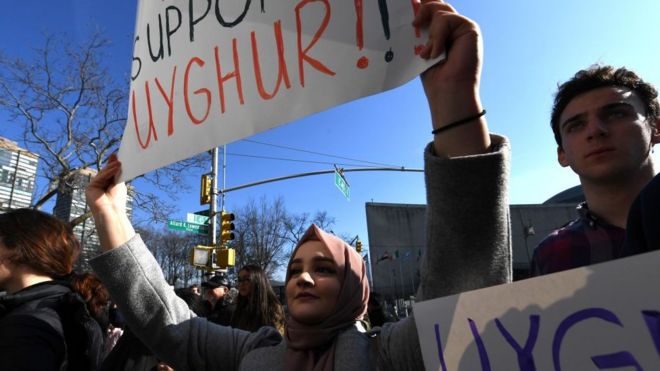
Uighur protesters demonstrating in the US in FebruaryImage copyright GETTY IMAGES
Image caption Protests calling for Uighur freedom have been happening all year

The US has said it will impose visa restrictions on Chinese officials accused of involvement in repression of Muslim populations.

It follows the decision on Monday to blacklist 28 Chinese organisations linked by the US to allegations of abuse in the Xinjiang region.

US Secretary of State Mike Pompeo said the Chinese government had instituted “a highly repressive campaign”.

China has dismissed the allegations as groundless.

In a statement, Mr Pompeo accused the Chinese government of a string of abuses against Uighurs, ethnic Kazakhs, Kyrgyz Muslims and other minority Muslim groups.

These included “mass detentions in internment camps; pervasive, high-tech surveillance; draconian controls on expressions of cultural and religious identities; and coercion of individuals to return from abroad to an often perilous fate in China”.

China has rebuffed the US moves.

“There is no such thing as these so-called ‘human rights issues’ as claimed by the United States,” foreign ministry spokesman Geng Shuang said on Monday.

“These accusations are nothing more than an excuse for the United States to deliberately interfere in China’s internal affairs.”
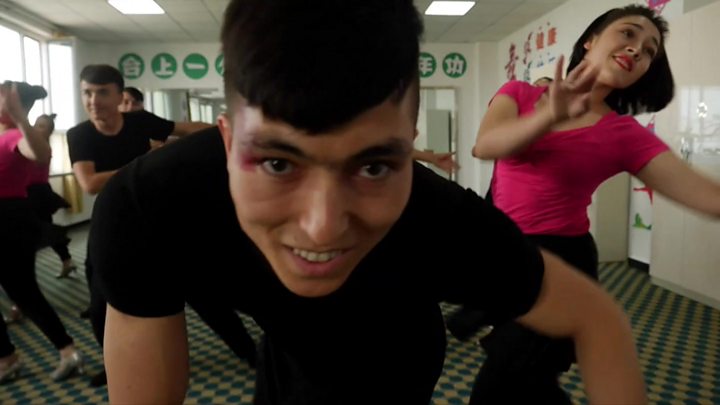
Media caption The BBC visits the camps where China’s Muslims have their “thoughts transformed”

Visa restrictions are to be imposed on Chinese government and Communist Party officials, as well as their family members.

“The United States calls on the People’s Republic of China to immediately end its campaign of repression in Xinjiang, release all those arbitrarily detained, and cease efforts to coerce members of Chinese Muslim minority groups residing abroad to return to China to face an uncertain fate,” the US statement said.

The US and China are currently embroiled in a trade war, and have sent delegations to Washington for a meeting about the tensions later this week.

What is the situation in Xinjiang?

China has been carrying out a massive security operation in Xinjiang, in its far west, in recent years.

Human rights groups and the UN say China has rounded up and detained more than a million Uighurs and other ethnic minorities in vast detention camps, where they are forced to renounce Islam, speak only in Mandarin Chinese and learn obedience to the communist government.

But China says they are attending “vocational training centres” which are giving them jobs and helping them integrate into Chinese society, in the name of preventing terrorism.

Media caption The BBC’s John Sudworth meets Uighur parents in Turkey who say their children are missing in China

There have been increasingly vocal denunciations from the US and other countries about China’s actions in Xinjiang.

Last week, Mr Pompeo alleged that China “demands its citizens worship government, not God” in a press conference in the Vatican.

And in July more than 20 countries at the UN Human Rights Council signed a joint letter criticising China’s treatment of the Uighurs and other Muslims.

Who are the Uighurs?

Uighurs are ethnically Turkic Muslims. They make up about 45% of the Xinjiang region’s population; 40% are Han Chinese.

China re-established control in 1949 after crushing short-lived state of East Turkestan.

Since then, there has been large-scale immigration of Han Chinese and Uighurs fear erosion of their culture.

Xinjiang is officially designated an autonomous region within China, like Tibet to its south.

Source: The BBC

14/02/2017

When It Comes to Mandarin, Bill Gates Is No Mark Zuckerberg – China Real Time Report – WSJ

Two years ago, Bill Gates admitted one of his life regrets was never becoming conversant in any foreign language.

Mr. Gates, 61 years old, has made some progress. Over the weekend, he gave a 12-word welcome in Mandarin in an opening video for his new blog on Chinese social network WeChat.

“Hello,” he said in Chinese. “Welcome to my official WeChat account.”

Mr. Gates is the latest U.S. tech executive to risk ridicule by speaking publicly in Chinese, joining Facebook’s Mark Zuckerberg and Uber’s Travis Kalanick. But his brief, accented remarks made clear that while he might rival Mr. Zuckerberg in entrepreneurship and philanthropy, the Microsoft Corp. founder is a less formidable challenger in Chinese oration.

“His Chinese pronunciation is not quite as good as Zuckerberg’s,” announced China’s official Global Times newspaper on Weibo, China’s equivalent of Twitter.

Chinese viewers online gave mixed reviews, with some encouraging his effort (“Great!”) and others panning it (“There appears to be a big difference between his Chinese and English”).

Mr. Gates had praised Mr. Zuckerberg’s fluency in Chinese as “incredible” in a 2015 Reddit question-and-answer session.“I feel pretty stupid that I don’t know any foreign languages,” wrote Mr. Gates in the Reddit Q&A. “I took Latin and Greek in high school and got As and I guess it helps my vocabulary but I wish I knew French or Arabic or Chinese. I keep hoping to get time to study one of these—probably French because it is the easiest.”

Mr. Gates’s attempt at Chinese was occasioned by the launch of his new WeChat account “gatesnotes.” In China, public figures often use WeChat official accounts to share their opinions and musings with fans. For foreign business leaders, WeChat has become a go-to option as both Facebook and Twitter are blocked in China. Mr. Gates’ new WeChat account appears to be a Chinese version of his English blog by that name.

Mr. Gates was an early adopter of Chinese social media, launching an account on microblogging platform Weibo in 2010, where he has posted sporadically. He now has 3.2 million Weibo followers compared with 33 million on Twitter.

The new WeChat account isn’t verified but claims to be the official account for Mr. Gates. It was set up by Bridge Consulting Co. Ltd., a Chinese joint venture of international health consulting company Global Health Strategies. Global Health Strategies lists the Gates Foundation as a client and donor on its website.

The WeChat account said Mr. Gates will use the space to share his thoughts on people he meets, books he has read and lessons learned, with topics ranging from health to energy and resources. It had drawn more than 100,000 views and over 9,000 “likes” by late Monday, although the only content so far is the welcome video and a note saying regular posts will begin Tuesday.

Bridge Consulting describes its mission as “shaping and promoting the images of international celebrities on Chinese social media”, according to a job ad posted by the company.

Andre Shen, a former media consultant with the Bill & Melinda Gates Foundation in China, is listed as founder of the company, according to regulatory filings. Mr. Shen said in an email he had to check with Mr. Gates’s team in Seattle before making any public statements.

Chinese has become increasingly popular among U.S. entrepreneurs as they seek to get a foot in the door of the world’s biggest internet market. Facebook appears to be in the lead, with Mr. Zuckerberg giving bravura performances such as a half-hour-long speech in Mandarin in Beijing. Facebook Senior Vice President Vaughan Smith and incoming virtual reality chief Hugo Barra have also studied the language.

So far, Uber’s Mr. Kalanick is closer to Mr. Gates than Mr. Zuckerberg in Mandarin prowess, though he has peppered his English speeches in Beijing with the occasional Chinese phrase, like “Hello, students”, to cheers from the crowd.

Source: When It Comes to Mandarin, Bill Gates Is No Mark Zuckerberg – China Real Time Report – WSJ

Tags:
Law of Unintended Consequences

continuously updated blog about China & India

ChiaHou's Book Reviews

continuously updated blog about China & India

What's wrong with the world; and its economy

continuously updated blog about China & India