Archive for ‘Culture’

15/06/2012

* Toilets Become a Battle Cry in India

NY Times: “You could be forgiven for thinking that safety is the top concern for travelers brave enough to venture on Indian railways. It’s not. Unclean toilets appear to be their main grouse, according to a recent survey.

Across India, toilets appear to be the new battleground on which wars are being waged, whether it’s about hygiene, austerity, gender equality or corruption.

On India Ink, we’ve previously written how sanitation is a dump in India, with more than half of all households having no toilet facilities.

Even Bill Gates, one of the world’s richest people, has made his new mission to “reinvent the toilet.” “One of my ultimate dreams now is to reinvent the toilet — find a cheaper alternative to the flush toilet that does not require running water, has smell characteristics better than the flush toilet and is cheap,” he told the Times of India newspaper.

But it’s mostly the women in India who are paying a price for toilets -– literally. On Thursday Jim Yardley wrote in The New York Times that unlike men, many women in Mumbai often have to pay to urinate –- an injustice that has started a “Right to Pee” campaign.

Toilets have also been flushed into the austerity debate last week, when India’s Planning Commission ran up a 3 million rupee, or $54,100, bill for renovating the toilets at its headquarters, a move viewed by some as lavish and a drain on public funds. That was followed by news that the western state of Goa had given 2 million rupees, or $35,700, to build a single air-conditioned toilet in the constituency of the former chief minister of the state.

Think that raises a stink? In India, where the government is reeling with corruption scandals, the innocuous toilet made a brief swirl when many reportedly went missing. According to an April report in an Indian daily, the Telegraph, the federal government says it delivered about 87.1 million toilets to households across villages over the last decade. But the census shows that only about 51.6 million had toilets in 2011. That’s a case of 35 million missing toilets.”

via Toilets Become a Battle Cry in India – NYTimes.com.

Another example of discrimination against women in India.  See: https://chindia-alert.org/2012/06/14/india-the-worst-big-country-to-be-a-woman/

See also: Will India overtake China in 25 years?

13/06/2012

* China football ex-chiefs Nan Yong and Xie Yalong jailed

BBC News: “Two ex-heads of China’s football league have been jailed for 10-and-a-half years each for corruption, making them the most senior football officials sentenced. Nan Yong and his predecessor Xie Yalong were both accused of accepting bribes. Nan was also fined 200,000 yuan ($31,400; £20,200) and Xie is set to have personal assets and illegal takings confiscated.

China has increased efforts to clean up the game, hit by a series of scandals.

Nan, charged with 17 counts of taking bribes, was sentenced by a court in Tieling in north-eastern China. Xie, who was sentenced in Dandong, denies the charges against him adding that he only confessed to the allegations under torture. More than 900,000 yuan in personal assets and illegal takings of his are set to be confiscated.

Several other verdicts have also been delivered in similar cases in other cities, Chinese media reported.

In Dandong, a former national team captain was also sentenced to 10 years and six months in jail and fined 200,000 yuan. Four former national team players were sentenced in Shenyang for to up to six years’ jail and fined 500,000 yuan for taking bribes and match fixing.

via BBC News – China football ex-chiefs Nan Yong and Xie Yalong jailed.

09/06/2012

* India’s Failed Food System

NY Times: ““Spurred by agricultural innovation and generous farm subsidies, India now grows so much food that it has a bigger grain stockpile than any country except China, and it exports some of it to countries like Saudi Arabia and Australia,” Vikas Bajaj writes in The New York TImes. “Yet one-fifth of its people are malnourished — double the rate of other developing countries like Vietnam and China — because of pervasive corruption, mismanagement and waste in the programs that are supposed to distribute food to the poor. ”

The biggest gap is the inefficient, corrupt system used to get the food to those who need it. Just 41.4 percent of the grain picked up by the states from federal warehouses reaches Indian homes, according to a recent World Bank study. Critics say officials all along the chain, from warehouse managers to shopkeepers, steal food and sell it to traders, pocketing tidy, illicit profits. Poor Indians who have ration cards often complain about both the quality and quantity of grain available at government stores, called fair price shops.”

via Indias Failed Food System – NYTimes.com.

See also: How close will India be in 25 years?

Tags: ,
29/05/2012

* Former Chinese rail minister expelled from Party

China Daily: “Liu Zhijun violated discipline and will face judicial investigationLiu Zhijun, former railway minister, was expelled from the Communist Party of China due to serious disciplinary violations, according to a decision by the Central Commission for Discipline Inspection announced on Monday.

Liu, 59, was also blamed for fostering corruption throughout the railway system. The disciplinary watchdog said Liu had taken advantage of his position to help Ding Yuxin, board chairwoman of Beijing Boyou Investment Management Corp, make huge illicit gains. He was also charged with accepting a large number of bribes and leading a corrupt life. His illicit gains have been confiscated and he will be handed over to the judicial department for further investigation. His disciplinary violations may include criminal acts, the watchdog said.

Lin Zhe, a professor at the Party School of the Central Committee of the CPC who specializes in fighting corruption, said Liu will probably face severe punishment. “Expelling Liu from the Party means his political life has ended,” she said, adding such punishment for an official is very heavy. However, Lin added Liu’s case will not be brought to court any time soon, “because the case is complicated”, and more time is needed to investigate. No matter what achievements an official has made, no matter how high his position was, the authority will deal with corruption without fear or favor, Lin added.

Li Chengyan, head of Peking University’s clean government research center, said the case is being treated seriously. “Lius punishment, after a one-year investigation, shows our government attaches great importance to the case.” The announcement on Monday is the latest development in the investigation.

Liu was appointed vice-minister of railways in 1996 and minister in 2003. He was removed from his post in February last year. At least eight senior officials at the Ministry of Railways have been sacked in the past two years and placed under investigation. They include, Zhang Shuguang, former deputy chief engineer at the ministry, Luo Jinbao, former board chairman of China Railway Container Transport Co and Su Shunhu, former deputy chief of the ministrys transport bureau.”

via Former rail minister expelled from Party |Politics |chinadaily.com.cn.

21/05/2012

* What the Chinese want

This is a much longer than usual post.  But if you are interested in either Chinese mentalilty or, more importantly, thinking of trading in China, this is a must read.

Consumers in China are increasingly modern in their tastes, but they are not becoming ‘Western.’ How the selling of coffee, cars and pizza sheds light on a nation racing toward superpower status.

By TOM DOCTOROFF, author of the book “What Chinese Want: Culture, Communism & The Modern Chinese Consumer.”

Apple has taken China by storm. A Starbucks can be found on practically every major street corner in coastal cities and beyond. From Nike to Buick to Siemens, Chinese consumers actively prefer Western brands over their domestic competitors. The rise of microbloggers, the popularity of rock bands with names like Hutong Fist and Catcher in the Rye, and even the newfound popularity of Christmas all seem to point toward a growing Westernization.

But don’t be deceived by appearances. Consumers in China aren’t becoming “Western.” They are increasingly modern and international, but they remain distinctly Chinese. If I’ve learned anything from my 20 years working as an advertising executive in China, it is that successful Western brands craft their message here to be “global,” not “foreign”—so that they can become vessels of Chinese culture.

Understanding China’s consumer culture is a good starting point for understanding the nation itself, as it races toward superpower status. Though the country’s economy and society are evolving rapidly, the underlying cultural blueprint has remained more or less constant for thousands of years. China is a Confucian society, a quixotic combination of top-down patriarchy and bottom-up social mobility. Citizens are driven by an ever-present conflict between standing out and fitting in, between ambition and regimentation. In Chinese society, individuals have no identity apart from obligations to, and acknowledgment by, others. The clan and nation are the eternal pillars of identity. Western individualism—the idea of defining oneself independent of society—doesn’t exist.

Various youth subtribes intermittently bubble to the surface—see the recent rise of “vegetable males” (Chinese metrosexuals) and “Taobao maniacs” (aficionados of the auction website Taobao). But self-expression is generally frowned upon, and societal acknowledgment is still tantamount to success. Liberal arts majors are considered inferior to graduates with engineering or accounting degrees. Few dare to see a psychologist for fear of losing “face”—the respect or deference of others—or being branded sick. Failure to have a child is a grave disappointment.

The speed with which China’s citizens have embraced all things digital is one sign that things are in motion in the country. But e-commerce, which has changed the balance of power between retailers and consumers, didn’t take off until the Chinese need for reassurance was satisfied. Even when transactions are arranged online, most purchases are completed in person, with shoppers examining the product and handing over their cash offline.

Even digital self-expression needs to be safe, cloaked in anonymity. Social networking sites such as Sina Weibo (a Chinese version of Twitter), Renren and Kaixing Wang (Chinese versions of Facebook) have exploded. But users hide behind avatars and pseudonyms. A survey conducted by the advertising firm JWT, where I work, and IAC, the Internet holding company, found that less than a third of young Americans agreed with the statement “I feel free to do and say things [online] I wouldn’t do or say offline,” and 41% disagreed. Among Chinese respondents, 73% agreed, and just 9% disagreed.

Chinese at all socioeconomic levels try to “win”—that is, climb the ladder of success—while working within the system, not against it. In Chinese consumer culture, there is a constant tension between self-protection and displaying status. This struggle explains the existence of two seemingly conflicting lines of development. On the one hand, we see stratospheric savings rates, extreme price sensitivity and aversion to credit-card interest payments. On the other, there is the Chinese fixation with luxury goods and a willingness to pay as much as 120% of one’s yearly income for a car.

Every day, the Chinese confront shredded social safety nets, a lack of institutions that protect individual wealth, contaminated food products and myriad other risks to home and health. The instinct of consumers to project status through material display is counterbalanced by conservative buying behavior. Protective benefits are the primary consideration for consumers. Even high-end paints must establish their lack of toxicity before touting the virtues of colorful self-expression. Safety is a big concern for all car buyers, at either end of the price spectrum.

To win a following among Chinese buyers, brands have to follow three rules.

First and most important, products that are consumed in public, directly or indirectly, command huge price premiums relative to goods used in private. The leading mobile phone brands are international. The leading household appliance brands, by contrast, are cheaply priced domestic makers such as TCL, Changhong and Little Swan. According to a study by the U.K.-based retailer B&Q, the average middle-class Chinese spends only $15,000 to fit out a completely bare 1,000-square-foot apartment.

Luxury items are desired more as status investments than for their inherent beauty or craftsmanship. The Chinese are now the world’s most avid luxury shoppers, at least if trips abroad to cities like Hong Kong and Paris are taken into account. According to Global Refund, a company specializing in tax-free shopping for tourists, the Chinese account for 15% of all luxury items purchased in France but less than 2% of its visitors.

Public display is also a critical consideration in how global brands are repositioning themselves to attract Chinese consumers. Despite China’s tea culture, Starbucks successfully established itself as a public venue in which professional tribes gather to proclaim their affiliation with the new-generation elite. Both Pizza Hut and Häagen Dazs have built mega-franchises in China rooted in out-of-home consumption. (The $5 carton of vanilla to be eaten at home is a tough sell in China.)

The second rule is that the benefits of a product should be external, not internal. Even for luxury goods, celebrating individualism—with familiar Western notions like “what I want” and “how I feel”—doesn’t work in China. Automobiles need to make a statement about a man on his way up. BMW, for example, has successfully fused its global slogan of the “ultimate driving machine” with a Chinese-style declaration of ambition.

Sometimes the difference between internal versus external payoffs can be quite subtle. Spas and resorts do better when they promise not only relaxation but also recharged batteries. Infant formulas must promote intelligence, not happiness. Kids aren’t taken to Pizza Hut so that they can enjoy pizza; they are rewarded with academic “triumph feasts.” Beauty products must help a woman “move forward.” Even beer must do something. In Western countries, letting the good times roll is enough; in China, pilsner must bring people together, reinforce trust and promote mutual financial gain.

Emotional payoffs must be practical, even in matters of the heart. Valentine’s Day is almost as dear to the Chinese as the Lunar New Year, but they view it primarily as an opportunity for men to demonstrate their worthiness and commitment. In the U.S., De Beers’s slogan, “A Diamond is Forever,” glorifies eternal romance. In China, the same tagline connotes obligation, a familial covenant—rock solid, like the stone itself.

The last rule for positioning a brand in China is that products must address the need to navigate the crosscurrents of ambition and regimentation, of standing out while fitting in. Men want to succeed without violating the rules of the game, which is why wealthier individuals prefer Audis or BMWs over flashy Maseratis.

Luxury buyers want to demonstrate mastery of the system while remaining understated, hence the appeal of Mont Blanc’s six-point logo or Bottega Veneta’s signature cross weave—both conspicuously discreet. Young consumers want both stylishness and acceptance, so they opt for more conventionally hip fashion brands like Converse and Uniqlo.

Chinese parents are drawn to brands promising “stealthy learning” for their children: intellectual development masked as fun. Disney will succeed more as an educational franchise—its English learning centers are going gangbusters—than as a theme park. McDonald’s restaurants, temples of childhood delight in the West, have morphed into scholastic playgrounds in China: Happy Meals include collectible Snoopy figurines wearing costumes from around the world, while the McDonald’s website, hosted by Professor Ronald, offers Happy Courses for multiplication. Skippy peanut butter combines “delicious peanut taste” and “intelligent sandwich preparation.”

Even China’s love affair with Christmas—with big holiday sales and ubiquitous seasonal music, even in Communist Party buildings—advances a distinctly Chinese agenda. Santa is a symbol of progress; he represents the country’s growing comfort with a new global order, one into which it is determined to assimilate, without sacrificing the national interest. The holiday has become a way to project status in a culture in which individual identity is inextricably linked to external validation.

The American dream—wealth that culminates in freedom—is intoxicating for the Chinese. But whereas Americans dream of “independence,” Chinese crave “control” of their own destiny and command over the vagaries of daily life. Material similarities between Chinese and Americans mask fundamentally different emotional impulses. If Western brands can learn to meet China’s worldview on its own terms, perhaps the West as a whole can too.”

http://online.wsj.com/article/SB10001424052702303360504577408493723814210.html?mod=WSJ_hp_mostpop_read

19/05/2012

* Rich in kindness

China Daily: “Billionaire behind major philanthropic projects says there’s always more to do.

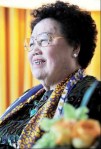
Entrepreneur and philanthropist Chan Laiwa, also known as Chen Lihua, is no stranger to lists of the world’s richest people, from Forbes to Hurun. But the self-made billionaire finds there is “so much” beyond wealth. “While wealth does come through our hard work and efforts, it is not the ultimate goal and is not above everything,” Chan, 71, says in her Manhattan hotel room the day before she was honored at an April gala as one of Time magazine’s 100 Most Influential People for 2012.

Such sentiments might seem standard from any rich person concerned with public image, but Chan in person – sincere, humble and thoughtful – makes people around her feel at ease. She impresses most with her passion for art, particularly of sandalwood, a medium she has loved since she was a girl. Born into a family of Manchu, the ethnic group that led Chinas last imperial dynasty, the Qing 1644-1911, Chan spent most of her childhood in the Summer Palace in Beijing. She is a descendant of a noble Manchu family of the Yellow Banner Clan, some members of which were ministers of state under the Qing emperor.

Chan’s childhood home was furnished with red sandalwood, a material used in the emperors’ palace in bygone times. “As I grew older, I felt the need to preserve this important part of Chinese culture,” recalls Chan, who opened a furniture factory in the 1980s and began making old-style pieces modeled after those from Beijing’s Palace Museum, more widely known as the Forbidden City.

In 1999, Chan fulfilled a childhood dream by investing in a $16 million red sandalwood museum in the capital. The thousands of treasures displayed there include a scale model of a corner tower in the Forbidden City, a reproduction of the memorial gateway carved with 320 dragons from Longquan Temple in Shanxi province, and a number of intricate furniture pieces and sculptures.

She made her fortune in the 1990s through a series of real estate ventures involving her Fu Wah International Group, the Hong Kong company fashioned out of Chan’s furniture store. The businesswoman later moved to Beijing for more opportunities. Chan was recently voted among Time magazines 100 Most Influential People in the World for 2012.

via Rich in kindness|People|chinadaily.com.cn.

25/04/2012

* Four men move a mountain for their offspring

Snowy mountains (probably 'white-horse mountai...

Snowy mountains Yunnan, China (Photo credit: Wikipedia)

China Daily: “For years the people of Zhongzhai village, Wenshan, Yunnan province, have been blocked from the outside world by a mountain. But after six years, four men have finally carved a five kilometer stretch out of the remote mountainous area.

The four families endured years of hardship, one man even partly losing the function of his hand, spending all their saving on clearing the hilly road and building an enormous debt of 80,000 yuan $11,895 despite each family only earning 500 yuan a year. But the group – who have been dubbed the “Modern Yu Gong” say it has all be worth it, “As long as our children get a way to go to school,” said one.

Yu Gong was an old man in Chinese fable who was determined to dig away two big mountains in front of his family home, which caused his family great inconvenience. His famous words read: “I will soon be dead, but I have children, and when my children are dead, there are still my grandchildren. My family will grow and grow and the mountain will get smaller and smaller. With such determination, surely it is possible to move the mountains!”

via Four men move a mountain for their offspring[1]|chinadaily.com.cn.

It so happens that Yu Gong Yi Shan – Foolish Old Man Moves Mountains was one of Chairman Mao’s favourite fables. Fortunately, his successor Deng Xiaoping and his successors followed through with this endeavour – http://www.imdb.com/title/tt1312185/plotsummary

05/04/2012

# Deciphering Chinese names

Chiang Kaishek with Muslim General Ma Fushou a...

There are around 100 common Chinese surnames and, apart from possibly Ma (), there is no religious or regional clustering. The colloquial for ‘the public’ is lao bai xing, which literally means “old hundred surnames”. The surname Ma, more often than not, is used by Muslim Chinese; and is thought to be derived from the Prophet Mohammed.

Traditionally, for many centuries, most Chinese families followed the standard practice of using three mono-syllabic words for their names, such as Sun Yatsen, father of modern China.
Maybe surprisingly, Dr Sun is revered in both the Peoples’ Republic and Taiwan. Both have huge memorials to him. The photo courtesy –
http://hcyip.wordpress.com/tag/nanjing-massacre/ – is of the mainland memorial.

The first, Sun (), is the family or clan name. After all what is most important, your antecedents, of course rather than you yourself – back to the collective mindset of Chinese.

The second, Yat, is the ‘generation name’. It is given by the parents to each of the siblings. So, all of Yatsen’s brothers and sisters would have Yat plus another word as their name. And, indeed, all his paternal first cousins. In some families, the boys and girls may have variants of this name.

If the family is conforming to old traditions, then the middle name (the generation name) is taken from a poem specially composed for the family, with each generation taking a successive word from the poem. Typically, the poem will be about something noble and aspirational, such as: “World peace, national unity; Social harmony, family prosperity”. So, the first generation’s middle name will be world, the next peace and so forth. Of course, in most families, long before they reach the eighth generation, some successor would have thought to create his own couplet to be more modern and so the cycle restarts.

The third, sen, is the personal name and can be any word in the Chinese vocabulary. Having said that, some words are regarded as more masculine and others more feminine.

Just to confuse everyone, some families use the second name as the personal name and third as the generation name. So, for example, Sun Yatsen’s wife Madam Sun was named Soong Chingling and her two sisters were Soong Ailing and Soong Meiling. Although Sun and Soong sound similar, Soong is a differnt name altogether () incidentally, Meiling was Chiang Kaishek‘s wife, Madame Chiang.

Despite being a feudal society until recent times, women kept their names after marriage. So the wife of the disgraced leader Bo


Xilai is Gu Kailai; rarely – but confusingly – called Bogu Kailai.
In places like Singapore and Hong Kong sometimes married women, esp business women, would keep their maiden name along with the husband’s surname, making it four names. Sort of like the British ‘double-

barrelled‘ surnames such as the actress Helene Bonham Carter.

Most Chinese who live in Hong Kong, Singapore, Taiwan and other enclaves of Chinese emigrees tend to keep to the traditional way of naming.

Her Excellency Wu Yi, Vice Premier of the Peop...

But since the revolution in 1949 and especially since the Cultural Revolution in the 70s, many mainland Chinese have stopped using the generation name and use just one name after the surname such as Madame Wu Yi, retired senior leader who led China into the WTO and who managed the SARS crisis of early 2000s.

This causes huge problems for the authorities as, it is not uncommon, at roll call in school, several kids would raise their hands– for example – to Wang Ta (= Wang senior). The authorities are encouraging parents to revert to a middle name when naming their children.

30/03/2012

* Senior leader underlines infrastructure building in Xinjiang

Maps of Xinjiang Uygur Autonomous Region of Ch...

Maps of Xinjiang Uygur Autonomous Region of China Español: Región autónoma de Xinjiang (Photo credit: Wikipedia)

Xinhua: “Senior Chinese leader Zhou Yongkang on Thursday demanded infrastructure be improved in the western Xinjiang Uygur autonomous region through projects supported by central government.

Zhou, a member of the Standing Committee of the Political Bureau of the Communist Party of China CPC Central Committee, urged authorities to give more support to the construction of major projects in the region, including irrigation systems, reservoirs, railways, electricity and natural gas schemes. Antiquated public facilities had created a major bottleneck constraining the regions development, Zhou said at a meeting attended by representatives from the National Development and Reform Commission, the central bank, and ministries of finance, railways, and water resources. These departments and a group of large state-owned enterprises and commercial banks have been tasked to assist the projects.

Three Uyghur girls at a Sunday market in the o...

Zhou called for more financial support and administrative coordination to push forward these projects, which he said will help enhance the regions capability of self-initiated development, ensure sound economic and social development, and create more jobs. The projects should benefit Xinjiang by improving people’s livelihoods, promoting ethnic solidarity and maintaining social stability, according to Zhou. He also demanded efforts to avoid illegal land use, prevent excessive exploitation of resources and protect the environment in Xinjiang.”

via Senior leader underlines infrastructure building in Xinjiang – Xinhua | English.news.cn.

26/03/2012

* Indian Govt orders probe into allegation of bribe by Army chief

Times of India: “The government on Monday ordered a CBI inquiry into the allegation made by Army chief Gen V K Singh that he was offered a Rs 14 crore bribe by a lobbyist. A CBI probe was ordered by defence minister A K Antony in the wake of the Army

General V K Singh at a function at St. Paul's ...

chiefs allegation, defence ministry officials said.

Earlier, both houses of Parliament were adjourned till 2pm after the opposition MPs created a ruckus over the disclosures made by the Army chief. Terming Gen Singhs allegations as “serious”, Antony told reporters outside Parliament, “We have to handle it…I have taken action.” When asked if the Army chief had informed him about the bribe offer, he said, “Parliament is in session.”

In an interview to a newspaper, the Army chief alleged that an equipment lobbyist offered him a bribe of Rs 14 crore, which he had reported to the Defence Minister. He said the lobbyist offered him the bribe in order to have a tranche of 600 sub-standard vehicles of a particular make cleared for purchase. “Just imagine, one of these men had the gumption to walk up to me and tell me that if I cleared the tranche, he would give me Rs 14 crore. He was offering a bribe to me, to the Army chief. He told me that people had taken money before me and they will take money after me,” Gen Singh said.”

via Govt orders CBI probe into allegation of bribe by Army chief – The Times of India.

Wow, bribery at the highest levels!

Related page: https://chindia-alert.org/china-2011-roundup/india-2011-roundup/

Law of Unintended Consequences

continuously updated blog about China & India

ChiaHou's Book Reviews

continuously updated blog about China & India

What's wrong with the world; and its economy

continuously updated blog about China & India