Archive for ‘Happiness’

13/05/2020

Xinhua Headlines-Xi Focus: Xi stresses achieving moderately prosperous society in all respects

Chinese President Xi Jinping, also general secretary of the Communist Party of China Central Committee and chairman of the Central Military Commission, learns about poverty alleviation efforts at an organic daylily farm in Yunzhou District of Datong City, north China’s Shanxi Province, May 11, 2020. (Xinhua/Li Xueren)

— Xi stressed addressing the difficulties faced by enterprises in resuming production and operation.

— Xi underscored lifting the remaining poor population out of poverty.

— Xi required implementing pro-employment policies.

TAIYUAN, May 12 (Xinhua) — Chinese President Xi Jinping has stressed efforts to complete building a moderately prosperous society in all respects, and ride on the momentum to write a new chapter in socialism with Chinese characteristics for a new era.

Xi, also general secretary of the Communist Party of China (CPC) Central Committee and chairman of the Central Military Commission, made the remarks during an inspection tour in north China’s Shanxi Province.

Xi called for efforts to overcome the adverse impacts of the COVID-19 epidemic and make greater strides in high-quality transformation and development to ensure that the target of poverty eradication is reached and the building of a moderately prosperous society in all respects is completed.

During the tour from Monday to Tuesday, Xi inspected work on coordinating the regular epidemic response with economic and social development, and on consolidating the poverty eradication results.

While visiting an organic daylily farm in Yunzhou, Datong City, on Monday, Xi said what he cares about the most after poverty eradication is how to consolidate the achievements, prevent people from falling back into poverty, and make sure rural people’s incomes rise steadily.

He said an important benchmark to evaluate an official’s job performance is to see the amount of good and concrete services he or she has delivered to the people.

When visiting a community of relocated villagers, Xi said relocation is not only about better living conditions but also about chances to get rich. He called for follow-up support to residents with tailor-made rural business projects to ensure sustainable development.

Highlighting that whether the people can benefit shall be a top concern, Xi demanded more supporting policies be put in place in terms of industrial development, financing, agricultural insurance, among others.

Xi applauded the strenuous efforts made by primary-level officials on helping people fight poverty.

At the home of villager Bai Gaoshan, Xi chatted with Bai’s family as they sat on a “kang” — a bed-stove made out of clay or bricks in north China.

Chinese President Xi Jinping, also general secretary of the Communist Party of China Central Committee and chairman of the Central Military Commission, learns about poverty alleviation efforts in a village of Xiping Township in Datong City, north China’s Shanxi Province, May 11, 2020. (Xinhua/Xie Huanchi)

Xi said the CPC wholeheartedly seeks happiness for the Chinese people, having stopped collecting agricultural taxes and fees, helping the impoverished rural residents with housing and medical service, training them with skills, and finding ways for them to live a prosperous life.

“I believe our villagers will enjoy better days ahead,” Xi said.

On top of that, he called for consolidating achievements in poverty alleviation, and then focusing on rural vitalization to ensure a better life for rural residents.

He then went on to visit the 1,500-year Yungang Grottoes, a “treasure house” of artifacts featuring elements blending Chinese and foreign cultures, as well as cultures of China’s ethnic minorities and the Central Plains.

Xi stressed that historical and cultural heritages are irreplaceable precious resources, and protecting them should always be put in the first place in tourism development.

Noting that tourism should not be over-commercialized, Xi said tourism should become a way for the Chinese to understand and appreciate the culture of the nation and enhance their cultural confidence.

The historical implications of communication and integration behind the Yungang Grottoes should be further explored to enhance the sense of community for the Chinese nation, said Xi.

During a research tour in a stainless steel manufacturer in the provincial capital Taiyuan on Tuesday morning, Xi said products and technology are the lifeline of businesses, calling for more efforts in technological innovation to make a greater contribution to the development of advanced manufacturing.

He also called on businesses to strictly implement epidemic prevention and control measures to ensure the safety and health of their workers, while promoting the resumption of work and production to make up for the time lost.

Chinese President Xi Jinping, also general secretary of the Communist Party of China Central Committee and chairman of the Central Military Commission, waves to workers during a research tour in a stainless steel manufacturer in Taiyuan, capital city of north China’s Shanxi Province, May 12, 2020. (Xinhua/Li Xueren)

Later on, Xi went to check the ecological protection work of the Fenhe River in the city, and urged the incorporation of environment protection, energy revolution, green development, and economic transformation.

After hearing the work reports of the CPC Shanxi Provincial Committee and the provincial government on Tuesday afternoon, Xi stressed that no relaxation is allowed in epidemic prevention and control, noting that efforts should be made to guard against both imported infections and domestic rebounds, improve regular prevention and control mechanism, and prevent new outbreaks.

Xi called for efforts on more promptly and effectively addressing the difficulties faced by enterprises in resuming production and operation, on solid implementation of all the policies and measures for expanding domestic demand, and on strengthening the competitiveness and quality of the real economy, especially the manufacturing industry.

Chinese President Xi Jinping, also general secretary of the Communist Party of China Central Committee and chairman of the Central Military Commission, speaks with workers during a research tour in a stainless steel manufacturer in Taiyuan, capital city of north China’s Shanxi Province, May 12, 2020. (Xinhua/Xie Huanchi)

Continuous efforts should be made to promote the adjustment and optimization of China’s industrial structure, and scientific and technological innovations should be greatly enhanced to continue achieving breakthroughs in new infrastructures, technologies, materials, equipment as well as new products and business models, Xi said.

He stressed overcoming the difficulties and obstacles facing reforms in key areas, including state-owned enterprises and assets, the fiscal, tax, and financial system, business environment, the private sector, domestic demand expansion, and urban-rural integration.

Xi also highlighted efforts to improve the country’s system and mechanism for opening-up.

China will uphold the concept that lucid waters and lush mountains are invaluable assets, and steadily implement the national strategy for ecological protection and high-quality development of the Yellow River basin, he said.

More should be done to accelerate institutional innovation and strengthen the implementation of institutions to help form a green way of production and living, he said.

Efforts should be made to solidify the foundation for the development of agriculture and rural areas, beef up policy support for grain production and lift the remaining poor population out of poverty, Xi said.

Authorities should adhere to the people-centered development philosophy and ensure the bottom line of people’s livelihood, Xi said. He added that efforts should be made to implement pro-employment policies and facilitate the employment of key groups such as college graduates, veterans, rural migrant workers and urban people facing difficulties.

Efforts should be expedited to improve the weak areas in the public health system exposed by the epidemic and shift the focus of social governance to the primary levels, Xi said.

The rich and colorful local history and culture as well as revolutionary cultural resources should be fully drawn on and used to promote cultural advancement, Xi said.

He stressed consistent efforts to promote core socialist values to guide Party cadres as well as the public to enhance morality, cultivate good ethics and strengthen cultural confidence.

Xi also called for efforts to improve the Party’s political ecosystem, strictly observe the Party’s political discipline and rules and fight against corruption and undesirable conduct.

Source: Xinhua

27/09/2019

Shuping Wang: Whistleblower who exposed HIV scandal in China dies

Photo of Shuping WangImage copyright HAMPSTEAD THEATRE
Image caption “Speaking out cost me my job, my marriage and my happiness at the time,” Dr Wang said

A whistleblower who exposed HIV and hepatitis epidemics in central China in the 1990s, potentially saving tens of thousands of lives, has died aged 59.

Dr Shuping Wang lost her job, was attacked, and had her clinic vandalised after she spoke out.

She died in Utah in the US, where she moved after the scandal.

A play inspired by her life is currently running in London, with the playwright calling her a “public health hero”.

Dr Wang never returned to China after leaving, saying it did not feel safe.

Why did Dr Wang speak out?

In 1991 in the Chinese province of Henan, Dr Wang was assigned to work at a plasma collection station. At the time, many locals sold their blood to local government-run blood banks.

It wasn’t long before she realised the station posed a huge public health risk.

Poor collection practices, including cross-contamination in blood-drawing, meant many donors were being infected with hepatitis C from other donors.

She warned senior colleagues at the station to change practices, but was ignored and according to her own account, was told that such a move would “increase costs”.

Undeterred, she reported the issue to the Ministry of Health. As a result, the ministry later announced that all donors would need to undergo hepatitis C screening – reducing the risk of the disease being spread.

But because of her whistleblowing, Dr Wang said, she was forced out of a job.

Her seniors said her actions had “impeded the business”. She was transferred, and assigned to work in a health bureau. But in 1995, she uncovered another scandal.

Dr Wang at workImage copyright HAMPSTEAD THEATRE

Dr Wang discovered a donor who had tested HIV positive – but had still sold blood in four different areas.

She immediately alerted her seniors to test for HIV in all the blood stations in Henan province. Again, she was told this would be too costly.

She decided to take things into her own hands, buying test kits and randomly collecting over 400 samples from donors.

She found the HIV positive rate to be 13%.

She took her results to officials in the capital, Beijing. But back home, she was targeted. A man she described as a “retired leader of the health bureau” came to her testing centre and smashed her equipment.

When she tried to block him, he hit her with his baton.

‘I’m not a man. I’m a woman’

In 1996, all the blood and plasma collection sites across the country were shut down for “rectification”. When they re-opened, HIV testing was added.

“I felt very gratified, because my work helped to protect the poor,” she said. But others were not happy.

At a health conference later that year, a high-ranking official complained about that “man in a district clinical testing centre [who] dared to report the HIV epidemic directly to the central government”.

“He said, [who is] the guy – how dare he [write] a report about this?” Dr Wang told the BBC’s Woman’s Hour in an interview earlier this month.

“I stood up and said I’m not a man. I’m a woman and I reported this.”

Later that year, she was told by health officials that she ought to stop work. “I lost my job, they asked me to stay home and work for my husband,” Dr Wang said.

Her husband, who worked at the Ministry of Health, was ostracised by his colleagues. Their marriage eventually broke down.

A scene from The King of Hell's PalaceImage copyright HAMPSTEAD THEATRE
Image caption A scene from The King of Hell’s Palace

In 2001, Dr Wang moved to the US for work, where she took the English name “Sunshine”.

In the same year, the Chinese government admitted that it faced a serious AIDS crisis in central China. More than half a million people were believed to have become infected after selling their blood to local blood banks.

Henan, the province that Dr Wang had worked in, was one of the worst hit.

The government later announced that a special clinic had been set up to care for those suffering from Aids-related illnesses.

Several years later, Dr Wang re-married and moved with her husband Gary Christensen to Salt Lake City, where she began working at the University of Utah as a medical researcher.

But her past followed her. In 2019, she said, Chinese state security officers made threatening visits to relatives and former colleagues in Henan, in an attempt to cancel the production of a play inspired by her life.

She refused, and the play titled “The King of Hell’s Palace” premiered at London’s Hampstead Theatre in September.

Dr Wang died on 21 September while hiking in Salt Lake City with friends and her husband. It’s thought she may have had a heart attack.

Dr Wang with playwright Frances Ya-Chu
Image caption Dr Wang with playwright Frances Ya-Chu

“Speaking out cost me my job, my marriage and my happiness at the time, but it also helped save the lives of thousands and thousands of people,” she had told the Hampstead Theatre website in an interview just one month before her death.

“She was a most determined, relentless optimistic and most loving woman,” wrote her friend David Cowhig after news of her death.

“She chose the English name Sunshine for a reason. Perhaps her exuberance and love for the outrageous – made possible [the] perseverance she had.”

Source: The BBC

30/01/2017

Inside India’s first department of happiness – BBC News

On a crisp weekday afternoon recently, hundreds of men and women, young and old, thronged a dusty playground of a government high school in a village in India’s Madhya Pradesh state.

Hemmed in by mobile towers and squalid buildings, the ground in Salamatpur was an unusual venue for a government-sponsored programme to “spread cheer and happiness”.

Undeterred by the surroundings and egged on by an energetic emcee, children in blue-and-white school uniforms, women in bright chiffon saris, and young men in jeans and t-shirts participated in games and festivities all morning. Under a tatty awning, people sprawled and a DJ played some music over crackling speakers. People left some food and old clothes for donation near a “wall of giving”.

Denmark the ‘happiest country’ and Burundi ‘the least happy’

UAE government selects ‘happiness officers’

Bhutan PM casts doubts over Gross National Happiness

Mental health and relationships ‘key to happiness’

Venezuela to create ‘ministry of happiness’

On the field, children raced in gunny sacks. A dozen girls, hands tied to their back, sprinted to get their teeth into knotty jalebis, a popular sweet. Women, squealing with delight, competed in tug-of-war contests. Jaunty men from a dancing school vowed the crowd with hip-hop dance moves. A four-year-old girl provided a rousing finale with her Bollywood-style hip-swinging gyrations. At the end of it all, beaming participants received glossy certificates.

On the dais crowded with officials and village leaders, there was mirthful insistence that “happiness week” had kicked off well. Videos and pictures of festivities from all over the state poured into the phones of excited officials: these included grannies tugging rope and grandfathers running with spoons in their mouths, among other things.

A week-long ‘happiness week’ saw girls participating in jalebi races

…and older villagers running with spoons in their mouth

The fun and games were part of a week-long Happiness Festival, organised by the ruling BJP government in what is India’s second largest state, home to more than 70 million people. They also provided a glimpse of the rollout of what is the country’s first state-promoted project to “to put a smile on every face”.

“Even in our villages, people are becoming introverted and self-centred because of TV and mobile phones. We are trying to get people out of homes, come together, and be happy. The aim is to forget the worries of life and enjoy together,” said Shobhit Tripathi a senior village council functionary.

‘Positive mindset’

At the heart of this project is the newly-formed Department of Happiness – the first of its kind in India – helmed by the state Chief Minister Shivraj Singh Chouhan himself.

The yoga-loving three-term 57-year-old leader of the ruling BJP believes the “state can help in ensuring the mental well being of its people”.

Under him a gaggle of bureaucrats and a newly formed State Institute of Happiness are tasked with the responsibility of “developing tools of happiness” and creating an “ecosystem that would enable people to realise their own potential of inner well being”. The department also plans to run some 70 programmes and develop a Happiness Index for the state.

Mr Chouhan, who taught philosophy in a local college before embarking on a successful career in politics, told me he had been thinking for a long time on how to “bring happiness in people’s lives”.

He then had an epiphany. Why couldn’t his government run programmes to help citizens have a “positive mindset”? One report said that he was prodded by a popular guru.

The tug-of-war games were keenly contested

Many village children participated in dances

There is more joy sometimes, Mr Chouhan told me, “being poor than being wealthy”.

But one wonders if people would be happy enough if the state was efficient in delivering basic services and be seen to be fair to all its people.

After all, Madhya Pradesh continues to be among India’s poorest states. More than a third of its people are Dalits (formerly known as untouchables) and tribespeople, among the most underprivileged. The world’s worst industrial accident happened in the state capital, Bhopal, in 1984, killing hundreds of people, and thousands of survivors are still fighting for compensation.

Despite impressive strides in farming, infrastructure and public services in recent years, illiteracy, undernourishment and poverty remain major challenges. When Mr Chouhan announced his plan last year, critics warned that the state would have to first deal with several “unhappy areas to make people happy”.

Bureaucracy of happiness?

Mr Chouhan agreed that providing food and shelter remained the primary responsibility of the state. But he said he was also worried about “families breaking up, rising divorces, and the increasing number of single people”. He spoke about the anomie of modern life, and how unwieldy aspirations lead to “excess stress and result in high suicide rates”.

He said that the state, borrowing from religious texts and folk wisdom, can help spread the virtues of “goodness, altruism, forgiveness, humility and peace”.

“We need people to have a positive mindset. We will try to achieve this through school lessons, yoga, religious education, moral science, meditation and with help from gurus, social workers and non-profits. It will be a wide ranging programme,” he said.

I wondered whether all this would spawn another gargantuan bureaucracy of happiness and invite allegations of cultural indoctrination by a government run by a Hindu nationalist party.

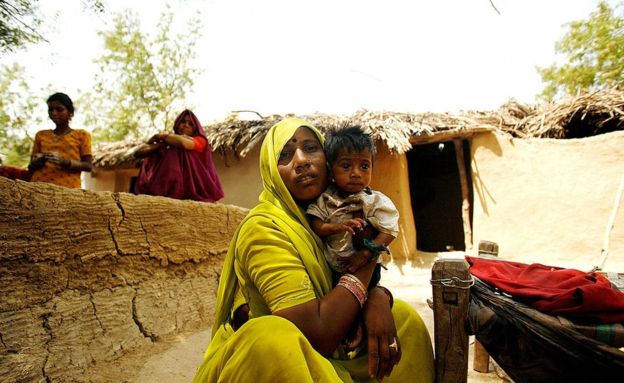
n this picture taken, 04 May 2007, Indian malnourished child, Viru (R) is comforted by his mother outside their hut at a village in Shivpuri district some 113 kms from Gwalior.Madhya Pradesh is among India’s poorest states
Don’t worry, Iqbal Singh Bains, the senior-most official in the department of happiness assured me. He’s also the top bureaucrat in the energy department.

“This is not about officials delivering happiness. This is not about preachy governance. You cannot deliver happiness to people. You can only bring about an enabling environment. The journey will be yours alone, the government is there to lend you a helping hand,” he told me.

Lending a hand would be more than 25,000 “happiness volunteers” who have signed up with the government. Government workers, teachers, doctors, homemakers and assorted people will work in the state’s 51 districts, holding “happiness tutorials and programmes”. Some 90 of them have already been trained.

‘Inner demons’

Sushil Mishra is one of them. The 48-year-old school teacher, who lives and works in remote Umaria, has already conducted four hour-long happiness classes at a secondary school, a student’s hostel, and government offices.

The classes, as he tells me, essentially have turned into confessionals, where participants talk about their good and not-so-good deeds, and pledge to improve themselves. Mr Mishra says it’s a challenge to create a relaxing, informal environment, where people can “wrestle with their inner demons”.

“Then they can listen to the voice of their soul, they are in touch with inner feelings. Nothing is forced.”

Madhya Pradesh is not the first place to try to “spread happiness”. But the jury is out on whether the state can play the role of a philosopher-counsellor-evangelist and make citizens happy.

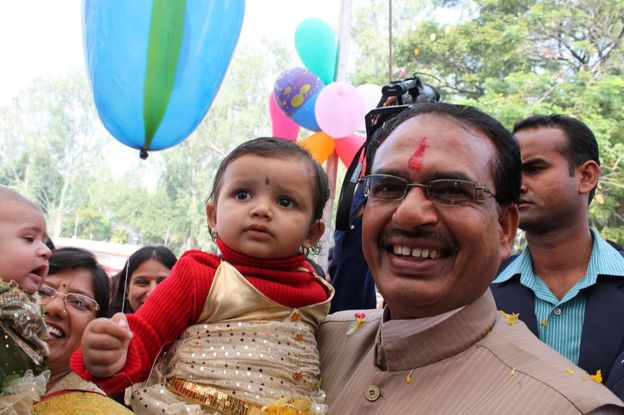
In this photograph taken on October 5, 2011, Chief Minister for the central Indian state of Madhya Pradesh Shivraj Singh Chouhan (R) poses with a child at a function to honour the 'girl child' in Bhopal
The ‘happiness programme’ is the brainhild of chief minister Shivraj Singh Chouhan

Three years ago, Bhutanese PM Tshering Tobgay cast doubts on the country’s popular pursuit of Gross National Happiness (GNH), saying that the concept was overused and masked problems with corruption and low standards of living. In 2013, Venezuela announced a “ministry of happiness”, but it did not stop the country from descending into social and economic chaos. Last year, United Arab Emirates announced the creation of a minister of state for happiness to “create social good and satisfaction”.

Many like sociologist Shiv Visvanathan believe the state has no right getting into the business of spreading happiness. Happiness, they say, is no laughing matter and its relationship with ambition is complex.

“The state cannot start defining what exactly contributes to mental well being. The state cannot colonise the subconscious. What happens to dissenting imagination or civil society? Trying to impose something as abstract as happiness on its people is not only bizarre, but downright dangerous,” said Dr Visvanathan.

Mr Chouhan obviously believes otherwise. In November, 24 of his ministers were sent five questions to find out how happy they were. A score of less than 22 meant that the respondent wasn’t happy.

Nobody knows the answers yet.

Source: Inside India’s first department of happiness – BBC News

11/05/2014

Study: Happiness, Money Matter Most to Indians – India Real Time – WSJ

Happiness matters most to the average Indian. At the same time, the average Indian care more about their pay than most do in South Asia. In fact, Indians care more about their paycheck than people in the U.S. or Europe.

Those findings, recently released by the Paris-based Organisation for Economic Co-operation and Development, was based on a survey of more than 60,000 people about their quality of life. Respondents were asked to rank 11 categories – from income and job satisfaction to personal health and safety – in order of what mattered most to them.

Life satisfaction, or happiness, OECD found, was most important to people world-over. More than 75% of those surveyed reported more positive experiences in a day over negative experiences. Respondents from Iceland, Japan and New Zealand felt the most positive, while those in Greece and Turkey showed the lowest levels of happiness.

Personal health was second-most important concern. China, Canada, France and Australia were among countries that ranked personal health as most important to them, even over happiness, safety and a stable income.

World-over, civic engagement, or greater participation in public policies, occupied a lowly position in rankings. Fewer than two-fifths of those surveyed said they trusted their national governments — but also said fixing the state of affairs in their country wasn’t a priority.

The world’s biggest-ever election is underway in India, for instance, yet the nearly 600 Indians OCED surveyed, ranked civic engagement, or greater participation in public policies, as least-important to them.

India’s South Asian neighbors — China, Pakistan, Bangladesh and Sri Lanka – were no different. Civic engagement was least-important to people across the four countries. Respondents in each of these countries differed about what mattered most to them.

While Indians and Chinese picked happiness and health care, respectively, respondents from Pakistan named safety as their top concern. Education mattered the most to people in Sri Lanka.

via Study: Happiness, Money Matter Most to Indians – India Real Time – WSJ.

Enhanced by Zemanta
05/11/2012

* China authorities pushing happiness amid rising discontent

It was the tiny mountain kingdom of Bhutan that started the notion of a Gross Happiness Index. UK’s Premier Cameron had a brief stab at tit. And now the world’s most populous country is having ago.  Maybe it will be taken seriously in due course!

SCMP: “With dissatisfaction growing over corruption, inequality, food safety and numerous other social problems, mainland authorities are shifting their focus from economics to emotions.

Simply put, they want everyone to be happy.

7ddb041e4a4800a11fd8168924f97f5d.jpg

From Beijing to Ningxia, local, provincial and regional leaders have been setting up “happiness indexes” or otherwise tailoring programmes, projects and policies to increase people’s satisfaction with their lives, as well as, of course, with the government.

Eighteen provinces and more than 100 cities have jumped on the happiness bandwagon in recent years, according to a report in Beijing News last week.

The campaign has helped the Communist Party set the stage for its 18th national congress, which opens this week amid increased incidents of social unrest.

While most analysts welcome the increased focus on people’s welfare, some caution that happiness is hard to measure and suggest the party would be better off advancing concrete policies for social change.

The public has been less forgiving, mercilessly ridiculing the policy on the internet.

“Without a constitutional government and democracy, a ‘Happy China’ will only be a fable,” said Professor Hu Xingdou, who is a commentator at the Beijing University of Technology.

“There are so many things that the authorities could do to improve the public’s satisfaction, such as protecting civil rights, building a democratic country, fighting corruption, stopping illegal land grabs and cutting taxes.”

Reform-minded Guangdong party secretary Wang Yang became perhaps the most prominent – and widely mocked – proponent of the public satisfaction drive last year when he outlined his proposal for a “Happy Guangdong” province.

As part of the plan, Wang allocated 423 billion yuan (HK$521 billion) for projects to improve people’s livelihood. He said he would attempt to reduce the province’s gross domestic product growth from a breakneck 12.5 per cent to a more manageable level of 8 per cent.

To measure his success, Wang set up an index of individual economic indicators, including employment, income, education, health care, crime, housing, infrastructure, social security and the environment.

But Wang was hardly the first to try out such a scheme. His now-disgraced rival, former Chongqing boss Bo Xilai, also pledged to slow the local growth rate after his city was named the mainland’s happiest in 2010.

In Beijing, local propaganda authorities even aired a seven-episode television series in August offering advice to those who are unhappy.

In it, a professor with a psychology degree from Harvard University instructed people on how to find their inner peace, rather than find fault with the government.

Jiangyin city, Jiangsu province, had one of the earliest satisfaction drives. The local government set up its happiness index in 2007, promising to improve the city’s employment, income, public safety and heath care, as well as reducing pollution.

The programme has been a rousing success, if you believe the government’s survey. Within three years, Jiangyin found that 95.87 per cent of its residents felt happy.

Professor Xu Guangjian, of Renmin University’s School of Public Administration and Policy, said he had not seen a single regional government that had been able to convincingly survey the public’s level of happiness. “The factors behind unhappiness are obvious,” he said.

Surveys conducted by Guangdong’s newspapers and government think tanks suggest the main source of most people’s gripes is the government, with many pointing to failures in job creation, social welfare, medical services, housing, pollution, food safety and soaring prices.

And there may be a new source of public dissatisfaction: satisfaction drives.

“It’s very difficult to measure happiness and there’s a subtle growing dislike of the authorities’ overwhelming happiness campaigns,” said Professor Xing Zhanjun, of the Centre for Quality of Life and Public Policy at Shandong University. “The public is starting to mock the word these days.”

Nonetheless, central government authorities have been eager to extend the policy. Many local governments picked up the satisfaction agenda after Premier Wen Jiabao made happiness and human dignity central elements of his 2010 work report.

In the run-up to the party congress, China Central Television (CCTV) has been running a series of segments for it which it conducted 3,500 man-on-the-street interviews in an attempt to measure the mainland’s “gross national happiness”.

Many have dismissed the series as superficial. CCTV reporters simply ask people whether they are happy and an overwhelming majority answer “yes”.

But the segments have not been without their enlightening moments, such as when a reporter pulled one interviewee out of a queue. “I am unhappy because when I answered your question, I lost my place in the queue,” the person said.

Professor Steve Tsang Yui-sang, director of the University of Nottingham’s China Policy Institute, said Beijing, if it were truly serious about reform, would appoint independent research institutes to survey main obstacles to happiness.

“It can cost as little as several hundred thousand yuan and would be much cheaper than CCTV’s street survey with some 70 camera crews,” Tsang said.”

via China authorities pushing happiness amid rising discontent | South China Morning Post.

Law of Unintended Consequences

continuously updated blog about China & India

ChiaHou's Book Reviews

continuously updated blog about China & India

What's wrong with the world; and its economy

continuously updated blog about China & India