Archive for ‘mountaineering’

11/05/2020

Mt. Qomolangma remeasuring team to work on route to peak

(InTibet) CHINA-TIBET-MOUNT QOMOLANGMA-REMEASUREMENT-ROAD CONSTRUCTION (CN) Members of a road construction team depart from the advance camp at an altitude of 6,500 meters of Mount Qomolangma in southwest China’s Tibet Autonomous Region, May 10, 2020. A road construction team will work on a route to the peak of Mount Qomolangma on May 12 if weather conditions permit. China initiated a new round of measurement on the height of Mount Qomolangma, the world’s highest peak, on April 30. The measurement team consists of members from the Ministry of Natural Resources and the national mountaineering team. (Xinhua/Sun Fei)

MOUNT QOMOLANGMA BASE CAMP, May 10 (Xinhua) — A road construction team will work on a route to the peak of Mount Qomolangma on May 12 if weather conditions permit.

In order to complete missions of building a route to the peak and transporting materials to camps below 8,300 meters above sea level, members of road construction and transportation teams departed for a camp at an altitude of 7,028 meters from the advance camp at an altitude of 6,500 meters at 7:00 a.m. Sunday.

The members eliminated potential safety hazards along the route and arrived at the camp at 2:00 p.m.

On May 12, a total of 12 guides will depart from the camp at an altitude of 7,028 meters to transport materials to another camp.

China initiated a new round of measurement on the height of Mount Qomolangma, the world’s highest peak, on April 30. The measurement team consists of members from the Ministry of Natural Resources and the national mountaineering team.

Since the founding of the People’s Republic of China in 1949, Chinese surveyors have conducted six rounds of scaled measurement and scientific research on Mount Qomolangma and released the height of the peak twice in 1975 and 2005, which was 8,848.13 meters and 8,844.43 meters respectively.

Source: Xinhua

15/02/2019

China Focus: Qomolangma reserve bans ordinary tourists in core zone

LHASA, Feb. 14 (Xinhua) — Mount Qomolangma National Nature Reserve in China’s Tibet Autonomous Region has banned ordinary tourists from entering its core zone to better conserve the environment of the world’s highest mountain.

But for travelers who have a climbing permit, the mountaineering activities will not be affected, according to the reserve which was set up in 1988.

Covering an area of around 33,800 square km including a 10,312-square km core zone, the reserve is home to one of the world’s most vulnerable ecosystems.

Recently, a report went viral online claiming the Qomolangma base camp was “permanently closed due to heavy pollution.” But local authorities denied the claim.

Kelsang, deputy director with the reserve’s administration, said ordinary tourists are banned from areas above Rongpo Monastery, around 5,000 meters above sea level. A new tent camp will be set up nearly two km away from the original one.

Between each April and October, villagers from Dingri County usually set up black tents at the foot of Mount Qomolangma, providing tourists accommodation as a means of earning money.

Though ordinary visitors can’t go beyond the monastery, it won’t affect them from appreciating the mountain.

“The new tent camp for ordinary tourists can still allow them to clearly see the 8,800-meter-plus mountain,” Kelsang said.

Travelers who have a climbing permit can go to the base camp at an altitude of 5,200 meters. Kelsang said the mountaineering activities have been approved by the regional forestry department.

Decades after the epic climb to the world’s peak, Tibetans at the foot of Mount Qomolangma have conquered poverty by receiving professional and amateur mountaineers and tourists, who have also posed an environmental challenge to the mountain.

To conserve the environment surrounding Mount Qomolangma, China carried out three major clean-ups at an altitude of 5,200 meters and above last spring, collecting more than eight tonnes of household waste, human feces and mountaineering trash.

This year, the clean-up will continue, and the remains of mountaineering victims above 8,000 meters will be centrally dealt with for the first time.

Meanwhile, the number of people who stay at the base camp will be kept under 300.

Currently, there are 85 wildlife protectors in the reserve, and 1,000 herders have part-time jobs patrolling and cleaning up garbage.

“These measures aim to strike a balance between various demands such as environmental protection, local poverty relief, mountaineering and education,” said Wang Shen, county chief of Dingri at the mountain foot.

Source: Xinhua

03/12/2018

Tuhin Satarkar, First Indian To Scale Sahayadri Mountain Range In 12 Days

Tuhin Satarkar, First Indian To Scale Sahayadri Mountain Range In 12 Days

A climb like this has never been done and I was thrilled to do this, Tuhin Satarkar said.


NEW DELHI: Bouldering sensation Tuhin Satarkar pushed his limits as he scaled three routes in the treacherous Sahayadri mountain range in 12 days, from November 16 to 28, to become the first Indian to ever achieve the feat, it was announced today.

In this project the Pune-based climber set out to climb three peaks in the Sahayadri mountains on a 12-day camping trip.

It was a true test of endurance, speed and invention as he studied the rock faces, set the route, successfully executed the climbs, and moved on to the next destination all within the 12 days he set out to complete the project.

The climb took him to Dhodap, Jivdhan and Naneghat, three famous peaks which are known to have been ascended by Chatrapati Shivaji Maharaj and his Marathi Malvas.

“The Sahayadri range has one of the most daunting mountains in Maharashtra. Being a Maharashtrian, I was excited to get an opportunity to pay tribute to Chatrapati Shivaji Maharaj and his band of Marathi Malvas,” the Red Bull athlete said.

“I would like to thank Red Bull for their continued support. It has been an exciting test for me- three climbs, across three forts and one ancient route in 12 days is definitely a challenge. A climb like this has never been done and I was thrilled to do this,” he added.

COMMENT

The Red Bull athlete Tuhin is the finest of India’s current generation of climbers. Inspired by his parents, who were both climbers, Tuhin took to the vertical sport at the age of eight and has been pushing boundaries ever since.

22/05/2017

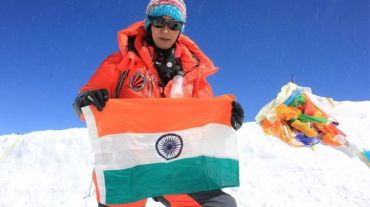
Indian woman ‘sets new Everest dual ascent record’ – BBC News

An Indian has climbed Mount Everest twice in under a week in what may be a new woman’s record for fastest double ascent of the world’s highest peak.

Anshu Jamsenpa, a 37-year-old mother-of-two, reached the summit on 16 and 21 May, tourism official Gyanendra Shrestha confirmed to BBC Nepali.

The current Guinness record for woman’s fastest double ascent is seven days.

News of Ms Jamsenpa’s climbs came as at least three climbers were killed on the mountain over the weekend.

An Australian climber died on the Tibetan side, while a Slovak and an American died on the Nepalese side. Rescuers have failed to locate a fourth climber – who is from India – who disappeared shortly after reaching the summit.

Hundreds of mountaineers are hoping to scale the world’s highest peak before the monsoon sweeps in next month.


It’s the second time Ms Jamsenpa, who is from the Indian state of Arunachal Pradesh, has notched up an Everest double ascent. Her previous feat was in 2011, but those ascents came 10 days apart.

She will now have to approach Guinness World Records to register her climbs after they have been certified by Nepal’s ministry of tourism.

The current woman’s record was set by Nepalese climber Chhurim Sherpa in 2012.

Apart from her two double ascents, Ms Jamsenpa also scaled the mountain in 2013.Her husband, Tsering Wange, told the BBC that her plan was always to do a double ascent twice, but her second attempt did not succeed in 2014 due to an avalanche and in 2015 because of the devastating Nepal earthquake.

Source: Indian woman ‘sets new Everest dual ascent record’ – BBC News

Law of Unintended Consequences

continuously updated blog about China & India

ChiaHou's Book Reviews

continuously updated blog about China & India

What's wrong with the world; and its economy

continuously updated blog about China & India