Archive for ‘Social & cultural’

15/02/2019

Fire alarms “faulty” at Delhi blaze hotel, prompting mass reinspections

NEW DELHI (Reuters) – A hotel that caught fire in the Indian capital on Tuesday, killing 17 people, passed safety checks 14 months ago, but an investigation has revealed breaches of regulations, such as faulty alarms, prompting a mass reinspection of other hotels.

Poorly enforced regulations lead to thousands of deaths in fires across India every year and officials in New Delhi say an overstretched fire service is hampering safety efforts.

The Hotel Arpit Palace passed a fire safety check in December 2017, but a copy of the initial police investigation seen by Reuters showed several breaches of fire regulations, including a lack of signs to guide guests to exits and fire alarms that did not work.

Delhi’s fire service, which is responsible for safety inspections as well as fighting fires, is now reviewing certificates issued to more than 1,500 hotels in one of India’s tourist hubs, a senior fire official told Reuters.

“Fire officers have to do a lot of work,” said Vipin Kental, Delhi’s chief fire officer. “We have to be inspectors and fight fires. We do not have the manpower.”

The city has around 1,700 firefighters, he said, which is less than an eighth of the number in New York, a city with less than half of Delhi’s population.

PREVENTABLE TRAGEDY

The fire is believed to have begun on the hotel’s first floor, spreading quickly through wood-panelled corridors, police say. Among the dead were members of a wedding party from Kerala and a two Buddhist pilgrims from Myanmar.

“From the outside, the building looked intact, but inside everything was completely charred,” a police officer told Reuters.

Two of the 17 died after jumping out of windows in desperation after failing to find emergency exits, added the officer, who declined to be named as he is not authorised to talk to the media.

“Fire preparedness is a matter of shockingly low priority in most parts of the country,” said an editorial in the Indian Express, one of the country’s leading newspapers.

A 2018 study by India’s home ministry that found the country had just 2,000 of more than 8,500 fire stations it needs.

More than 17,000 people died in fires in 2015, according to data from the ministry, the last year for which figures are available, one of the largest causes of accidental death in India.

Fire safety is an issue for shanty towns and some of the country’s most expensive real estate.

A day after the Arpit Palace disaster, more than 250 makeshift homes were destroyed in a slum in Paschim Puri, a poor area of New Delhi, though no one was killed.

In 2017, 14 people were killed during a birthday party at a high-end bar in India’s financial capital Mumbai.

In several upscale neighbourhoods in Delhi, police shut hundreds of shops and restaurants last year for trading on floors meant for residential use, though many continue to operate illegally, residents say.

By the boarded-up Arpit Palace in the Karol Bagh area of New Delhi, wires from adjacent hotels still trail across the street, though staff there told Reuters they were complying with fire regulations.

Adding to the safety problems, poorly paid staff in the hotel and restaurant industries are often unable to help guests when fires break out, Kental said.

“They are not trained. They don’t know what to do in the event of a fire,” he said.

Source: Reuters

14/02/2019

Vice premier urges solid efforts for biodiversity conservation

CHINA-BEIJING-HAN ZHENG-BIODIVERSITY CONSERVATION-MEETING (CN)

Chinese Vice Premier Han Zheng, also a member of the Standing Committee of the Political Bureau of the Communist Party of China Central Committee, presides over a meeting of China National Committee for Biodiversity Conservation in Beijing, capital of China, Feb. 13, 2019. (Xinhua/Wang Ye)

BEIJING, Feb. 13 (Xinhua) — Chinese Vice Premier Han Zheng on Wednesday stressed solid efforts to further protect biological diversity.

Han, also a member of the Standing Committee of the Political Bureau of the Communist Party of China Central Committee, made the remarks when presiding over a meeting of China National Committee for Biodiversity Conservation.

Despite the substantial progress that has been made, more needs to be done to stop the current decline in biodiversity, he said.

In order to offer the highest level of protection for biodiversity, Han stressed establishing a management system for protected nature areas by establishing a network of national parks, nature reserves and parks.

He urged stepping up protection of wild fauna and flora with strengthened oversight and cracking down on related illegalities, adding that biodiversity should be supported with the optimal institutional and legal framework.

Han also called for making preparations to host the 15th meeting of the Conference of the Parties to the Convention on Biological Diversity in China next year.

Source: Xinhua

13/02/2019

China, UK should handle differences properly, enhance strategic mutual trust: Ambassador

LONDON, Feb. 12 (Xinhua) — China and UK should keep the long-term interests and larger picture in mind, look at each other’s development as opportunities, respect each other’s sovereignty, security and right to development, handle our differences properly and enhance strategic mutual trust, Chinese Ambassador to Britain Liu Xiaoming has said.

The Chinese diplomat made the remarks while attending the Chinese New Year Dinner by the Cities of London and Westminster Conservative Association on Monday night.

“If we compare China-UK relations to a building, it could not stand tall without a solid foundation. This foundation is the mutual confidence between our two countries,” he said.

Recalling that the world economy is under downward pressure, with surging protectionism and unilateralism making things doubly difficult. Against this situation, Liu said it is all the more important that China and the UK advocate free trade, oppose protectionism and promote open cooperation.

“We hope that the UK would continue to provide a fair, transparent and non-discriminatory business environment for Chinese companies. We hope you will make successful Chinese companies such as Huawei feel welcome here in Britain, and convince them that the UK is a trustworthy place to put their money,” said the Chinese ambassador.

Liu said both China and the UK are known for their profound cultural heritage and important contribution to the progress of human civilization.

“I hope that in the new year our two countries will continue to enhance cultural and people-to-people exchanges, and deepen mutual understanding and strengthen friendship.”

The ambassador also hoped that people from all walks of life in both China and UK will join hands to cement the foundation for a solid and magnificent edifice of bilateral relations.

British Prime Minister Theresa May sent a congratulatory message to the event, saying that it is an important moment to recognize the contribution of the Chinese community in London and across the whole of the United Kingdom.

“The Chinese community’s expanding business expertise, scientific inquiry and cultural heritage and traditions are of immense value to our country – not least here in London, where the vibrancy of Chinatown stands as a strong beacon for the Chinese community and a reminder of all that they have contributed to our society,” she said.

Source: Xinhua

10/02/2019

Across China: Winter tourism spurs villagers’ entrepreneurship

CHANGCHUN, Feb. 9 (Xinhua) — Lu Caishu sold his 110 cows to support his small tourism business in Erhe, a village in northeastern China’s Jilin Province, known for thick snow during the winter.

Lu’s decision was considered risky two years ago, especially among villagers who mostly had a stable income from raising cattle, but Lu was convinced that the tourism industry would offer a more lucrative and sustainable way to make money.

In 2018, the money Lu invested in his business began to pay off. During the winter, his business received over 5,000 customers, bringing in nearly 300,000 yuan (about 44,500 U.S. dollars)

“It only takes me three to four months to take care of my business, but I had to work for a whole year when I used to make a living on raising cattle,” Lu said.

Lu not only runs one of the most profitable guesthouses in the village but also set up a travel company to further enhance the reputation of the businesses, allowing household investors to receive dividends by the end of the year.

More ambitious villagers began to start their own guesthouses and cash in on booming tourism as profits have snowballed over the years. There are now 50 guesthouses and restaurants in the village owned by 126 households.

Erhe attracts more than 8,000 tourists on average each winter. The number is expected to reach 100,000 this year, according to the local tourism sector.

“I’ve always wanted to start my own business, and the winter tourism helps me realize the dream,” said Sun Linlin, who invested over 2 million yuan in her guesthouse.

Sun’s guesthouse, now the biggest in Erhe, receives nearly 400 customers each day during the peak season.

“There is huge potential in winter tourism as more townspeople seek the rural lifestyle to reduce the pressure they face in big cities,” she said.

Erhe’s total tourism revenue reached 10 million yuan last winter. More than 80 percent of the villagers now work in the industry, and over 60 percent run their own businesses. Restaurants, guesthouses, souvenir shops, theatres and snow museums have sprung up in the village.

The booming tourism also attracts more villagers who previously moved to bigger cities for better opportunities to come home and get a slice of the cake.

“I had never imagined snow would become Erhe’s most valuable asset,” said Liu Hongcai, owner of a brewery that sells grain alcohol to local restaurants and tourists.

“I have my own business and can stay with my family. It is the best time of my life,” he said.

Source: Xinhua

10/02/2019

Ancient northern town welcomes overseas students to celebrate Chinese New Year

TAIYUAN, Feb. 9 (Xinhua) — More than 100 overseas students have been invited to an ancient town in north China’s Shanxi Province to join celebrations for Chinese New Year (Spring Festival), which falls on Feb. 5.

“An opening Pingyao welcomes you” is the celebration of the ancient town of Pingyao, running from Jan. 28 to Feb. 20. More than 100 students across the world participated in the opening ceremony on Jan. 28.

The students took part in celebrations, watching traditional performances, such as opera, acrobatics and magic shows, joining in the Spring Festival Gala, lantern shows, cultural exhibitions, and learning about the local customs.

Farhad Farzad, an Afghan student studying Chinese in a university in the city of Taiyuan, Shanxi’s capital, said it was the first time for him to celebrate Spring Festival. He wrote “happy new year” in Chinese with a writing brush.

Chisom Nwosu, from Nigeria, said that the festival atmosphere in Pingyao was jubilant and the performances were great. It was her chance to gain a better understanding of traditional Chinese folk culture.

Pingyao became a UNESCO world cultural heritage in 1997. It is famous for its well-preserved ancient city walls.

In the 1980s, there were rarely foreign visitors in Pingyao. However, the figure soared to 115,000 last year. The ancient town has received more than 1.5 million foreign tourists since 1997.

Source: Xinhua

09/02/2019

India court hands 7 Muslim men life sentences for killings that sparked 2013 riots

NEW DELHI (Reuters) – An Indian court on Friday sentenced seven Muslim men to life in prison for the murder of two Hindu men in 2013 in the northern state of Uttar Pradesh, an incident that had sparked religious riots killing about 65 people and displacing thousands.

The riots began in the district of Muzaffarnagar, 130 km (81 miles) northeast of New Delhi, and spread to other areas in the country’s most populous state months before the 2014 election won by Prime Minister Narendra Modi’s Hindu nationalist party.

A court in Muzaffarnagar sentenced the men after they were found guilty of killing the two Hindus in the village of Kawal on Aug. 27, 2013, prosecutor Rajeev Sharma told Reuters.

Reuters could not immediately contact the families of the convicted men.

Nearly all the victims here of the riots were Muslims, including about 12,000 people who were made temporarily homeless due to the unrest that polarised western Uttar Pradesh on religious lines.

Source: Reuters

08/02/2019

Spotlight: Chinese New Year celebrations delight other side of the Pacific

NEW YORK, Feb. 7 (Xinhua) — While Chinese New Year celebrations are in full swing in China, cultural activities held across North America to mark the most important festival of China are no less enthralling, spreading the joy to the other side of the Pacific.

Dragon and lion dances, Chinese cuisines, Peking opera performances, light shows… a flurry of events in the United States and Canada have deepened people’s understanding of the meaning and charm of the festival. And sometimes, they may even find themselves a bit richer when they are bestowed with red packets of “lucky money,” part of the festival tradition.

A FEAST FOR EYES AND PALATES

Chinese Lunar New Year, or Spring Festival, fell on Feb. 5 this year. In China, celebrations begin about a week in advance and end with the Lantern Festival on the 15th day of the new year. It is an occasion for family members to reunite, bid farewell to the past year and celebrate the advent of a new spring, with its promise of renewal and hope.

The value placed in family and the universal wish for a new start partly explain why the traditional Chinese festival can so easily transcend borders and be embraced elsewhere. For kids who are not worldly enough to grasp the significance behind it, colorful events such as dragon dances and delicious Chinese food prove to be reason enough to enjoy the festival.

In New York, the landmark Empire State Building was glowing red, blue and yellow on Monday and Tuesday for the Chinese New Year. It is for the 19th consecutive year that the 443-meter skyscraper above midtown Manhattan shone in honor of the Chinese New Year.

The light show event will allow “native New Yorkers to experience a bit of beauty of the Chinese traditional cultural festival,” said Chinese Consul General in New York Huang Ping.

In Times Square, an array of calligraphers from both China and the United States on Tuesday gave away their handwritings of “Fu,” a Chinese character meaning fortune and luck, and red scarfs printed with the same character to hundreds of visitors at the “Crossroad of the World.” Receivers of the gifts, upon learning the meaning of Fu character, were filled with joy and expressed their best wishes to the Chinese people around the world.

During an NBA game at Madison Square Garden on Wednesday, spectators enjoyed dragon and lion dances during halftime. They also received giveaways including red packets as well as pig dolls as the New York Knicks team celebrated the Chinese lunar Year of the Pig. A spectator won 600 U.S. dollars during a game called ‘Name the Pig.’

In Chicago, more than 70 guests crowded a Chinese restaurant on Monday to enjoy traditional Chinese cuisine and the legendary “face-changing” performance. Performers of “face-changing” instantly switched masks by raising a hand, swinging a sleeve or tossing the head, to the thunderous applause and cheers from the audience.

“It is amazing and exciting. I have never seen it before,” Rhonda McDonald, who came from the U.S. city of Houston to attend the celebration, told Xinhua, “I love Chinese food and Chinese culture. Every year, my kids and I celebrate the Chinese New Year.”

In San Francisco, Mayor London Breed, dressed in red that represents happiness and good luck in Chinese culture, on Tuesday launched official celebrations of Chinese New Year in the city’s Chinatown.

Among the crowd, a 15-year-old high school student named Logan said he was happy to be a part of the exciting celebrations, and he came for the event every year.

“Each new year is different, and I can always feel something new from the thrilling festivities,” Logan said.

Breed said that there will be a market fair this week in Chinatown, where one can find flowers and goodies, such as red packets for kids and oranges which in Chinese are a popular symbol for “good luck.” She will also attend San Francisco’s grand Chinese New Year Parade scheduled for Feb. 23, a Chinatown tradition that dates back to the 1860s.

The parade will feature beautiful floats, outfits, costumes, firecrackers, newly crowned Miss Chinatown U.S.A, as well as the dance performance of an 88-meter-long golden dragon operated by 180 men and women from a local martial arts group.

The Niagara Falls on Canada side was lit up in red to celebrate the Chinese New Year in Ontario, Canada on Tuesday. On the night of Jan. 28, the CN Tower in Toronto was lit up in red to celebrate the Chinese New Year, the fifth consecutive year to do so.

A FESTIVAL FOR CLOSER TIES

By celebrating the Chinese New Year together, people from both sides of the Pacific have deepened their understanding of each other’s cultures and made the ties closer, officials have said.

“There is no better way than to celebrate the Chinese New Year through cultural exchanges,” said David Whitaker, CEO of Choose Chicago, the official tourism organization for the city, on Tuesday as the city kick off Chinese New Year celebrations.

“The more we learn about China, the better we understand each other,” Whitaker told Xinhua.

During a show titled “Charming Beijing-Tianjin-Hebei” featuring Chinese artists performing folk music, Tai Chi, Peking opera, acrobatic and martial arts, on Jan. 25, Vice Mayor of Beverly Hills John Mirisch said his city enjoys a great relationship with China.

“We welcome the Chinese, and think sharing some of their interesting cultural experiences with American audiences right here in Beverly Hills makes us understand and appreciate each other more.”

The Empire State Building’s lighting of Lunar New Year serves as a symbol of friendship between the peoples of the United States and China, said Huang, the consul general.

After putting a Chinese couplet on the door of the governor’s office at the Missouri State Capitol in Jefferson City, Missouri Governor Mike Parson and First Lady Teresa Parson held a Chinese Lunar New Year reception at their mansion on Monday evening.

“I truly appreciate how the Asian American community has come from across the state to Jefferson City to celebrate the Lunar New Year in the Missouri State Capitol. We’re excited to have this opportunity to share the diversity and cultural traditions of all Missouri,” Parson said. “Rest assured that we will continue to lead the state with a noble vision and an open heart.”

Source: Xinhua

06/02/2019

Hindu right-winger arrested for re-enacting Gandhi assassination

Pooja Pandey, leader of the Hindu Mahasabha, shooting at an effigy of Gandhi with an air pistolImage copyrightSCREENGRAB
Image captionPooja Pandey, leader of the Hindu Mahasabha, shooting an effigy of Gandhi with an air pistol

A leader of a fringe Hindu right-wing group in India has been arrested after a video of her shooting an effigy of Mahatma Gandhi went viral.

The Hindu Mahasabha had organised an event to “celebrate” the 71st anniversary of Gandhi’s assassination.

In the video, Pooja Pandey shoots the effigy with an air pistol after garlanding a picture of Nathuram Godse, who shot the independence leader.

Gandhi has long been seen as too moderate by some right-wing Hindus.

Police had been seeking Ms Pandey’s arrest since the video, believed to have been released by her group, emerged last week.

Two police teams were deployed to track her and her husband, who also features prominently in the footage.

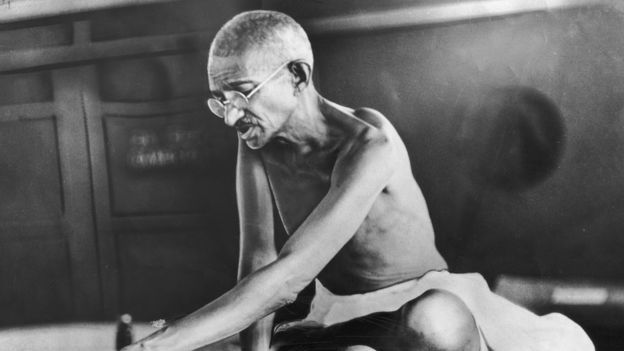
Circa 1935: Indian spiritual and political leader Mahatma Gandhi (1869 - 1948)Image copyrightGETTY IMAGES
Image captionNathuram Godse shot Mahatma Gandhi on 30 January 1948

They had already made several other arrests in connection with the video which was shot on 30 January – the day Gandhi was killed.

“We arrested nine people within a week and are searching for two more suspects in the case,” police officer Neeraj Jadaun told the BBC.

Godse, who shot Gandhi in the chest three times at point-blank range on 30 January 1948, was an activist with nationalist right-wing groups, including the Hindu Mahasabha.

Hindu hardliners in India accuse Gandhi of having betrayed Hindus by being too pro-Muslim, and even for the division of India and the bloodshed that marked Partition, which saw India and Pakistan created after independence from Britain in 1947.

This is not the first time the controversial fringe group has tried to glorify Godse and celebrate Gandhi’s assassination.

In 2015, the group announced plans to install statues of Godse across six districts in the southern state of Karnataka, sparking protests across the state.

Source: The BBC

06/02/2019

Xinhua Headlines: Chinese New Year celebrations touch hearts around world

Xinhua Headlines: Chinese New Year celebrations touch hearts around world

Lion dance is performed during the 2019 Spring Festival parade in downtown Antwerp, Belgium, on Feb. 2, 2019. (Xinhua/Zheng Huansong)

BEIJING, Feb. 5 (Xinhua) — For centuries, the Lunar New Year has been the most important festival in China and a large part of Asia. People leave behind the worries and troubles of the past year and move on to a new spring full of hope and life.

Today, the festival has become a worldwide holiday as China plays a bigger role in world affairs and people all around the world share the wish to leave uncertainties behind and usher in a peaceful and prosperous year ahead. As the Chinese New Year falls on Tuesday, major cities across the globe are vying to hold the greatest celebration of this traditional festival outside China.

YEAR OF PIG

Tuesday marks the first day of the Year of the Pig in the Chinese Zodiac. The Chinese Zodiac is based on a twelve-year cycle, and each year in that cycle is under a certain animal sign. It is believed people are born with the positive traits of their zodiacs. For example, babies born in this Year of the Pig are expected to be kind and fortunate.

Peppa, the sweet little piglet from a British animated TV series, has become a media sensation in this Year of the Pig. A nationwide cinema release, “Peppa Celebrates Chinese New Year,” co-produced by Alibaba Pictures, debuted in China on Tuesday. Its promotional video named “What’s Peppa” went viral and clocked some 1.5 billion hits on Chinese social media platforms such as Weibo and Wechat.

“Peppa is the perfect ambassador for the Year of the Pig celebrations as it is the most iconic pig on screen,” said Oliver Dumont, president, Family & Brands, of the leading Canadian entertainment conglomerate Entertainment One (eOne), which owns Peppa Pig and is a co-producer of the movie.

Other than the Chinese film, a two-part episode special of Peppa Pig has been created specifically for the Chinese New Year. “This is a great opportunity to promote and share the Chinese language and culture all around the world,” Dumont said.

In the movie and TV episode, Peppa learns what the Chinese New Year is about and experiences many of its traditions with her family, teaching dozens of millions of fans about Chinese culture.

The Chinese New Year, also known as the Spring Festival, is the most important festival in China. Celebrations begin about a week in advance and end with the Lantern Festival on the 15th day of the new year. Receiving red packets of “lucky money,” having big family meals and welcoming the God of Wealth with deafening firecrackers are among the many highlights of the festivities.

WORLDWIDE PARTY

For other parts of the world, the Chinese New Year has become a great occasion to enjoy exotic food, culture and to party. Organizers in cities around the world are racking their brains vying to stage the most brilliant celebration outside China.

–In London

The Science Museum of Britain celebrated the Chinese New Year by hosting exhibitions on science development in China. While enjoying Chinese delicacies and new year traditions, visitors experienced ancient Chinese inventions through augmented reality glasses, learned about Chinese fossils and watched presentations on the recent development of Chinese space technology.

Aleksandar Zivanovic, an engineer and regular visitor of the museum, found the European Space Agency’s introduction of the Chinese space program most fascinating. “It’s a nice way to celebrate the Chinese New Year, and a good way to find out about Chinese culture and what’s going on in Chinese science,” he said.

Celebrations in London will last a month with a series of activities culminating in the Trafalgar Square parade on Feb. 10, which organizers say to be the biggest Chinese New Year celebration outside Asia.

–In Sydney

Sydney’s signature Harbor Bridge is glowing red and pink to provide a breathtaking setting for the Chinese New Year celebrations.

A spectacular 5-meter-tall matrix-style steel pig lantern glows by the landmark Sydney Opera House. Another 11 giant lanterns representing the remaining zodiac animals, including an elaborate eight-meter stack of monkeys, an electric sheep and a six-meter-tall inflatable ox, light up the Sydney Harbor.

Sydney has been celebrating the lunar new year for 22 years. This year’s events will include the lunar lanterns exhibition, Chinatown celebrations, community performances, dragon boat races and lion dances across the city. “It’s a celebration for our Asian community, but it’s a wonderful educational experience for the rest of us,” Mayor of Sydney Clover Moore said.

–In New York

The Empire State Building, landmark of Manhattan, New York, is glowing red, blue and yellow Monday for the Chinese New Year.

A window display featuring pigs in a traditional Chinese style has also been installed in the building’s lobby windows on Fifth Avenue. Visitors can appreciate pigs as portrayed in various art forms, including clay sculptures, paper cuts, sugar-figure blowing and lanterns.

It is for the 19th consecutive year that the Empire State Building, standing 443 meters above midtown Manhattan, shines in honor of the Chinese New Year.

New York is also known around the world for the splendid firecracker shows that light up the Hudson River and parts of the city during Chinese New Year celebrations.

New York and some other U.S. states have made the lunar new year a public holiday. This is particularly unusual given that the Chinese New Year does not have a set date on the Gregorian calendar. Instead, it falls on a day between Jan. 21 and Feb. 20 each year.

In addition to being widely celebrated across the globe, the lunar new year is also a public holiday and important national festival in many countries such as Vietnam, Indonesia and South Korea.

The Chinese New Year has become an international event as its traditions and values touch the hearts of people all around the world. As Chinese President Xi Jinping has said, the vision, concepts and values of China’s traditional culture are also valuable for addressing the issues that humanity faces.

BEST WISHES FROM WORLD LEADERS

The Chinese New Year also offers an opportunity for foreign leaders to extend best wishes to the Chinese people, seeking closer ties with China, attracting Chinese tourists and consolidating support from Chinese communities.

For example, in a congratulatory video speech, Japanese Prime Minister Shinzo Abe spoke Chinese to wish the Chinese people a happy new year. He pledged to relax visa policies for Chinese students studying in Japan and called for more people-to-people exchanges between the two countries. Abe also expressed the wish that bilateral ties further improve in the new year.

New Zealand Prime Minister Jacinda Ardern posted her lunar new year’s wishes on social media. She took the opportunity to thank the Chinese community in New Zealand for its hard work and contributions. Ardern expressed the hope to strengthen ties with China, boosting cooperation in trade, education and tourism.

Pakistani President Arif Alvi, President of Argentina Mauricio Macri, President of Afghanistan Ashraf Ghani, Austrian President Alexander Van der Bellen and other world leaders also sent videos or messages to wish the Chinese people a happy lunar new year.

Source: Xinhua

04/02/2019

Year of the Pig: Is it really a problem for Muslims?

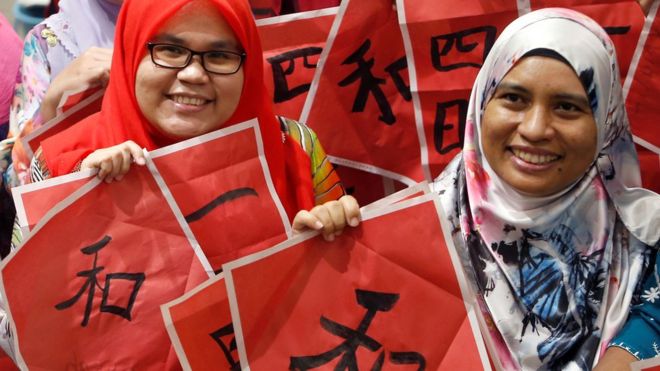
Malay teachers in Kuala Lumpur pose at a Chinese calligraphy event in conjunction with the upcoming Year of the PigImage copyrightREUTERS
Image captionMuslim teachers attend a Chinese calligraphy event in Kuala Lumpur, Malaysia to mark the Year of the Pig

Communities around the world are gearing up to celebrate the lunar new year, which this time ushers in the Year of the Pig.

New Year celebrations usually mean the animal is depicted everywhere – in decorations, toys, gifts and advertising.

But the pig, the last animal on the Chinese zodiac calendar, is considered unclean by Muslims and a sin to consume. So does this cause problems for people celebrating lunar new year in Muslim-majority countries in South East Asia?

Like most Chinese-Malaysian families, the lunar new year is serious business for the Chow family, who live in the sleepy town of Batu Pahat in Johor, Malaysia.

This year is particularly significant because Chow Yoon Kee, his wife Stella and their daughter were all born in pig years.

“We will display lots of lucky pig ornaments at home and of course, have our relatives, friends, workers and neighbours over to visit, no matter what race or religion. Celebrations are for all,” said Mr Chow, a floor manager at a local biscuit factory.

He isn’t worried about his celebrations offending fellow residents as he believes there is no sign of new year controversy.

“There was a lot of fuss last year,” he recalls, when it was the Year of the Dog, also seen as impure animals by some Muslims.

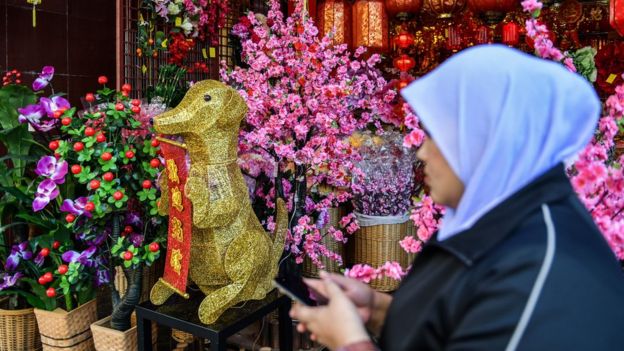
A Muslim woman walks past a golden canine statue ahead of the Lunar New Year celebrations in Kuala Lumpur's ChinatownImage copyrightAFP
Image captionMalaysian authorities trod cautiously last year, being careful not to overdo the canine decorations

Malaysia is multicultural but the official religion is Islam, and there have been increasing reports of intolerance towards activities and actions considered insulting to Muslims.

So many shops and merchants avoided using images of dogs in fear of offending Muslim communities.

But Mr Chow feels local authorities have overlooked the feelings of the Chinese community, who actually celebrate the holiday.

“Malaysia is a country made up of many races, it isn’t just Malay Muslims. We have Chinese and Indian communities too, as well as other religions like Christianity, Hinduism, Taoism and Buddhism so we should be respecting each other’s beliefs and celebrations.”

But he adds that “the spirit of censorship” did not seem to carry on into the pig year.

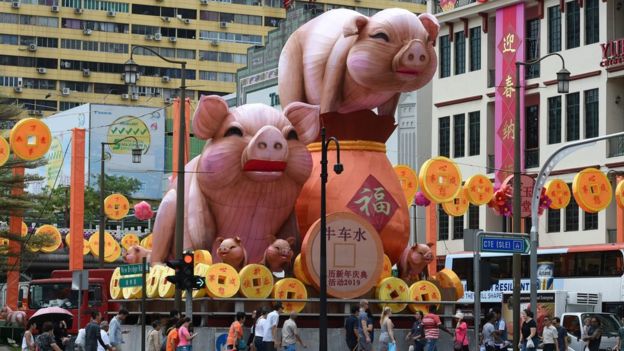
Pig decorations for the upcoming Lunar New Year in Chinatown, SingaporeImage copyrightAFP
Image captionThat’s some pig! Celebrations are under way in Chinatown, Singapore

Each animal of the Chinese zodiac is believed to have its own unique traits and qualities. Those born in the year of the pig are said to be intelligent, compassionate and loyal.

Does it matter if one’s zodiac animal isn’t welcome?

“There’s absolutely no reason to worry,” said Kuala Lumpur-based Feng Shui consultant Joey Yap. He told the BBC there didn’t seem to be any sensitivities around celebrations in Malaysia this year, compared to last.

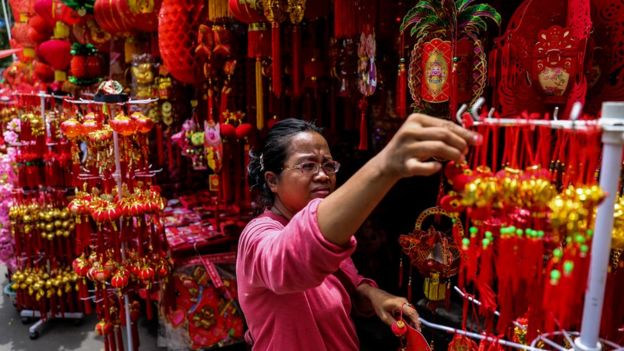
A woman at a shop selling Lunar New Year decorations in Jakarta, IndonesiaImage copyrightGETTY IMAGES
Image captionRed decorations galore in Jakarta’s Chinatown

“Pigs will be fine,” he said, adding that whether you display objects or not “does not affect one’s personal luck”.

“Colours, emblems; they all aren’t important. In reality, one’s luck all boils down to one’s actions, so embrace positivity,” he said.

‘The first pigs Muslims can eat’

Even though it’s the world’s most populous Muslim nation, the lunar new year is a national holiday in Indonesia. Public celebrations are widely accepted – lanterns, colourful parades and performances are often seen in many cities.

Merry Olivia in Jakarta said her Muslim friends welcomed the image of pigs.

Pig shaped cookiesImage copyrightDAPUR MAMA LOE
Image captionBaker Valeria Rita says her special cookies were a holiday hit with Muslim customers

“I grew up with many Indonesian Muslims so I know pigs will not make them feel uneasy,” she said, adding that the creatures looked more “festive” than other zodiac animals.

“If you compare pigs with snakes, pigs are more adorable so people would rather buy decorations embellished with them. Not many people in Jakarta like snakes.”

Baker Valeria Rita was rolling out special treats in time for the new year: pig shaped cookies with sweet pineapple jam fillings.

She said the response had been really good. “Orange or tangerine is a popular symbol for the lunar new year. This year, we decided to create pig-shaped treats and the quota for pre-orders was full within two weeks.”

Many of her customers are also Muslim.

“They buy my cookies for Chinese colleagues and friends who celebrate the holiday. Some also order for themselves because they like the pigs,” she said, sharing a joke made by her best friend, also a Muslim. “My goodies were the first pigs Muslims are allowed to eat.”

‘I don’t want to offend’

But it’s a different situation for 24-year-old Rangga Sastrajaya, from Bogor city. He bought pig toys and decorations but remains cautious in displaying them openly as he feels many Indonesians still do not accept cultural diversity.

“I could wear pig shirts or display pig-themed decorations at home but I will be quite careful in showing them off in public because I do not want to offend anyone,” he admitted.

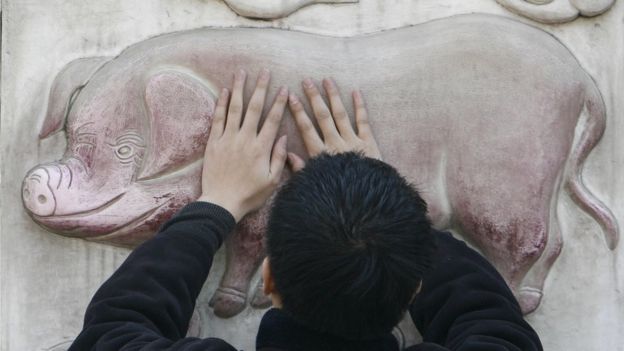
A man rubs his hands on a sculpture of a pig for good luckImage copyrightAFP
Image captionWill the new year spirit provoke widespread resentment among conservative Muslims?

But there are those who condemn the festivities. Forum Muslim Bogor (FMB), a conservative Islamic organisation in West Java, released a letter demanding the cancellation of festivities. They said it was “inappropriate” for Muslims because it could “undermine Islamic faith”.

Their actions follow other groups like Pemuda Pancasila (PP) and the Malayan Persatuan Forum Komunikasi Pemuda Melayu (PFKPM), who previously condemned the celebrations by Chinese communities.

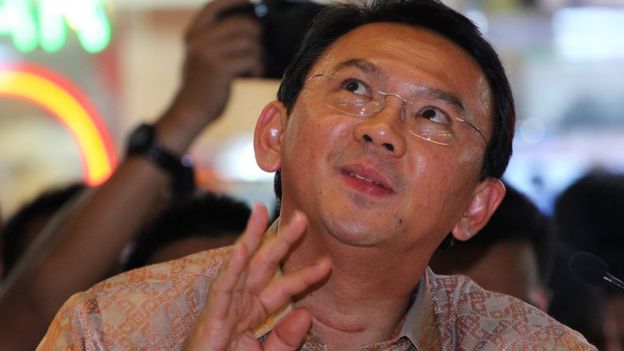
Ahok in the Mako Brimob prisonImage copyrightGETTY IMAGES
Image captionIn 2017 Chinese-Christian Jakarta governor Basuki Tjahaja Purnama was jailed for blasphemy against Islam

Analyst Thung Ju-Lan from the Indonesian Institute of Science considers such sentiments the “impact of intolerant and political narratives”, the same kind which rocked Jakarta two years ago.

Massive protests took place against former governor Basuki “Ahok” Tjahaja Purnama, a Christian of Chinese descent who was found guilty of blasphemy – a trial seen as a test of Indonesia’s religious tolerance.

“It is the impact of the gubernatorial election in Jakarta, in Ahok’s case. The same sentiment has been spreading,” she told the BBC.

“The problem of intolerance continues because we have narrow understandings of what is actually happening. The more we do not understand, the more intolerant we are.”

In the case of celebrating the lunar new year, many Indonesian Muslims feel it is “more religious than cultural”.

But one politician has spoken out in defence of the Chinese community. Religious Affairs Minister Lukman Hakim Saifuddin encouraged beliefs of people from different cultures, faiths, and traditions to be respected.

“Regardless of what people understand about such celebrations, I invite all to respect tradition,” he said.

Source: The BBC

Law of Unintended Consequences

continuously updated blog about China & India

ChiaHou's Book Reviews

continuously updated blog about China & India

What's wrong with the world; and its economy

continuously updated blog about China & India