Chindia Alert: You’ll be Living in their World Very Soon
aims to alert you to the threats and opportunities that China and India present. China and India require serious attention; case of ‘hidden dragon and crouching tiger’.
Without this attention, governments, businesses and, indeed, individuals may find themselves at a great disadvantage sooner rather than later.
The POSTs (front webpages) are mainly 'cuttings' from reliable sources, updated continuously.
The PAGEs (see Tabs, above) attempt to make the information more meaningful by putting some structure to the information we have researched and assembled since 2006.
India has overtaken China and become the world’s most populous country, according to an academic who believes that Beijing has overestimated the number of its citizens by as much as 90 million.
With none of the infamous birth control policies that China enforced for decades, India had been expected to become No 1 in the next five to ten years.
However, Yi Fuxian, a researcher and critic of China’s one-child policy, says that the Chinese authorities have greatly overstated the country’s real fertility rate since 1990.
At a conference in Beijing, Mr Yi concluded that China was home to 1.29 billion people at the end of last year, not the 1.38 billion that is Beijing’s official estimate.Mr Yi’s calculations would put China’s population lower than that of India, whose government estimates that the Indian population is 1.33 billion. Yesterday China’s “ministry of births”, the national health and family planning commission, rejected his claims.
“Some people ignored the birth population data issued by the state statistics bureau after revision, make no analysis on the raw data of population census and random surveys, directly gathered, and believe 2015’s total fertility rate is 1.05,” the commission said. “This is completely not in accordance with the real situation.” It said the 2016 fertility rate — births per woman — was 1.7.
Mr Yi, a scientist at the University of Wisconsin-Madison, whose book Big Country with an Empty Nest was published in Hong Kong and banned on the mainland, said that the government’s denial came as no surprise.
“I am confident in my research,” he told The Times. If the public knew the true numbers then they and policymakers would have stopped the policies and the commission would have been closed years ago, he added.
He called on China to abolish all restrictions rather than just allowing two children per family, a reform introduced last year.
Its one-child policy was introduced in 1979 and was phased out gradually. There were many exceptions: ethnic minorities were exempt and some families could have a second child if the first was a girl.
The title of the world’s most populous nation probably remains with China for the time being, according to other experts. He Yafu, an independent demographer in Guangdong province, said China’s official population statistics probably are inflated “but it’s impossible to be that much [90 million]”.“China’s population must have exceeded 1.3 billion but is less than 1.4 billion. Figures from social insurance and other areas can also prove that it’s definitely more than 1.3 billion,” Mr He said.
“It’s already too late to abolish the family planning policy because according to surveys, even if the policy was totally relaxed only 5 per cent of families will have a third child. Therefore policy-loosening won’t have too much effect on China’s birthrate.”On online forums Chinese people debated the news. “We don’t want to wear the hat of world’s No 1 population country,” wrote one poster on Sina Weibo, the Chinese equivalent of Twitter. “Hurry up to give it to India!”
Another sympathised with Mr Yi’s sceptical view of official Chinese statistics, saying: “It’s very normal. The family planning commission made up data for its own long existence, which already wasn’t news a long time ago.”
MOST lovers of Chinese martial arts take the magical aspects of kung fu, as demonstrated by the flying fighters of legend and film, with a pinch of salt. But Wei Lei built his career in China on a claim that his mastery of tai chi, a branch of kung fu, had given him supernatural power. In a programme about kung fu that was broadcast on state television in 2015, Mr Wei demonstrated that he could keep a dove standing on his hand with an invisible force-field and smash the inside of a watermelon without damaging its rind.
The broadcaster itself appeared to be among the credulous.There were many sceptics, too. Earlier this year one of them stepped forward to challenge Mr Wei: Xu Xiaodong, a practitioner of mixed martial arts—a fighting form drawing on Eastern and Western traditions that began to take off in America in the 1990s (and is picking up fans in China). Mr Xu mocked tai chi as a slow-motion form of aerobics. Last month the two men decided to settle their argument in hand-to-hand combat. The fight on April 27th was quick and decisive. Just 12 seconds in, Mr Wei ended up on the ground, his nose bleeding.
A fist-fight in China turns into a clash between tradition and modernity
A video of the clash spread rapidly online. Some commentators in China sided with Mr Xu, and urged him to expose other kung fu “masters”. Mr Xu promised to do so. His aim, he said, was not to disparage Chinese martial arts, but to expose deceitful practitioners.
But many netizens accused Mr Xu of trying to besmirch the country’s ancient fighting techniques: how, they asked, could a single fight prove anything? Guancha.cn, a news portal, said Mr Xu’s posts over the years on Weibo, a microblog website, had insulted the Chinese army and Mao Zedong. Ye Yincong of Lingnan University in Hong Kong wrote that the reaction demonstrated a common tendency in China to view the world in terms of a struggle between Chinese tradition and Western influence.
Some kung-fu fighters have expressed willingness to take up Mr Xu’s challenge. But faced with a barrage of hate messages, Mr Xu appears to have lost his zeal. On May 4th he appeared in a live video-stream, looking stressed. “I have lost my career and everything,” he said, implying the pressure had been affecting his work as a mixed-martial-arts coach.
The authorities appear eager to put an end to the debate. China’s president Xi Jinping is a fan of traditional Chinese culture, and says he wants to use it promote the country’s “soft power” abroad. The recent criticism of kung fu may have triggered too much questioning of it for his taste. On May 7th Mr Xu’s Weibo account was deleted, as was some of the online reporting and commentary about his fight with Mr Wei. Mr Xu told the BBC that he would keep quiet from now on, and study traditional Chinese martial arts.
An Indian has climbed Mount Everest twice in under a week in what may be a new woman’s record for fastest double ascent of the world’s highest peak.
Anshu Jamsenpa, a 37-year-old mother-of-two, reached the summit on 16 and 21 May, tourism official Gyanendra Shrestha confirmed to BBC Nepali.
The current Guinness record for woman’s fastest double ascent is seven days.
News of Ms Jamsenpa’s climbs came as at least three climbers were killed on the mountain over the weekend.
An Australian climber died on the Tibetan side, while a Slovak and an American died on the Nepalese side. Rescuers have failed to locate a fourth climber – who is from India – who disappeared shortly after reaching the summit.
Hundreds of mountaineers are hoping to scale the world’s highest peak before the monsoon sweeps in next month.
It’s the second time Ms Jamsenpa, who is from the Indian state of Arunachal Pradesh, has notched up an Everest double ascent. Her previous feat was in 2011, but those ascents came 10 days apart.
She will now have to approach Guinness World Records to register her climbs after they have been certified by Nepal’s ministry of tourism.
The current woman’s record was set by Nepalese climber Chhurim Sherpa in 2012.
Apart from her two double ascents, Ms Jamsenpa also scaled the mountain in 2013.Her husband, Tsering Wange, told the BBC that her plan was always to do a double ascent twice, but her second attempt did not succeed in 2014 due to an avalanche and in 2015 because of the devastating Nepal earthquake.
CHINESE officials describe the far western province of Xinjiang as a “core area” in the vast swathe of territory covered by the country’s grandiose “Belt and Road Initiative” to boost economic ties with Central Asia and regions beyond.
They hope that wealth generated by the scheme will help to make Xinjiang more stable—for years it has been plagued by separatist violence which China says is being fed by global jihadism. But the authorities are not waiting. In recent months they have intensified their efforts to stifle the Islamic identity of Xinjiang’s ethnic Uighurs, fearful that any public display of their religious belief could morph into militancy.Xinjiang’s 10m Uighurs (nearly half of its population) have long been used to heavy-handed curbs: a ban on unauthorised pilgrimages to Mecca, orders to students not to fast during Ramadan, tough restrictions on Islamic garb (women with face-covering veils are sometimes not allowed on buses), no entry to many mosques for people under 18, and so on.
But since he took over last August as Xinjiang’s Communist Party chief, Chen Quanguo has launched even harsher measures—pleased, apparently, by his crushing of dissent in Tibet where he previously served as leader. As in Tibet, many Xinjiang residents have been told to hand their passports to police and seek permission to travel abroad. In one part of Xinjiang all vehicles have been ordered to install satellite tracking-devices. There have been several shows of what officials call “thunderous power”, involving thousands of paramilitary troops parading through streets.
Last month, new rules came into effect that banned “abnormal” beards (such as the one worn by the man pictured in front of the main mosque in Kashgar in south-western Xinjiang). They also called on transport workers to report women wearing face veils or full-body coverings to the police, and prohibited “naming of children to exaggerate religious fervour”. A leaked list of banned names includes Muhammad, Mecca and Saddam. Parents may not be able to obtain vital household-registration papers for children with unapproved names, meaning they could be denied free schooling and health care.
Residents have also been asked to spy on each other. In Urumqi, the region’s capital, locals can report security threats via a new mobile app. People living in Altay in northern Xinjiang have been promised rewards of up to 5m yuan ($720,000) for tip-offs that help capture militants—over 200 times the local income per person.
Across Xinjiang residents have been asked to inform the authorities of any religious activities, including weddings and circumcisions. The government is also testing its own people’s loyalty. In March an official in Hotan in southern Xinjiang was demoted for “timidity” in “fighting against religious extremism” because he chose not to smoke in front of a group of mullahs.
Mr Chen is widely rumoured to be a contender for a seat in the ruling Politburo in a reshuffle due late this year. Displays of toughness may help to ingratiate him with China’s president, Xi Jinping, who has called for “a great wall of iron” to safeguard Xinjiang. Spending on security in Xinjiang was nearly 20% higher in 2016 than the year before. Adverts for security-related jobs there increased more than threefold last year, reckon James Leibold of La Trobe University and Adrian Zenz of the European School of Culture and Theology at Korntal, Germany.
Uighurs have been blamed for several recent attacks in Xinjiang. In one of them in February, in the southern prefecture of Hotan, three knife-wielding men killed five people and injured several others before being shot dead by police (local reports suggested the violence occurred after a Uighur family was punished for holding a prayer session at home). Officials may be congratulating themselves on the success of their tactics; reported large-scale attacks by Uighurs inside and outside Xinjiang have abated in the past 18 months. Yet as in Tibet, intrusive surveillance and curbs on cultural expression have fuelled people’s desperation. “A community is like a fruit,” says a Uighur driver from Kashgar. “Squash it too hard and it will burst.”
Shyam Divan was arguing a crucial petition challenging a new law that makes it compulsory for people to submit a controversial biometric-based personal identification number while filing income tax returns.
“My fingerprints and iris are mine and my own. The state cannot take away my body,” a lawyer told India’s Supreme Court last week
Defending this law, the government’s top law officer told the court on Tuesday that an individual’s “right to body is not an absolute right”.
“You can have right over your body but the state can restrict trading in body organs, so the state can exercise control over the body,” Attorney General Mukul Rohatgi said.At the heart of the latest challenge are rising concerns over the security of this mega biometric database and privacy of the number holders. (The government says it needs to link the identity number to income tax returns to improve compliance and prevent fraud.)
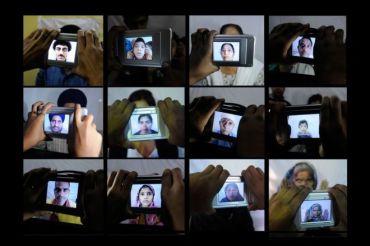
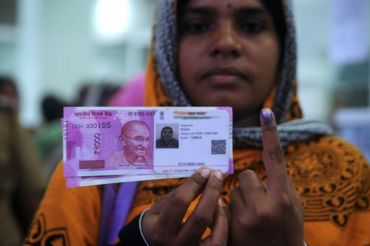
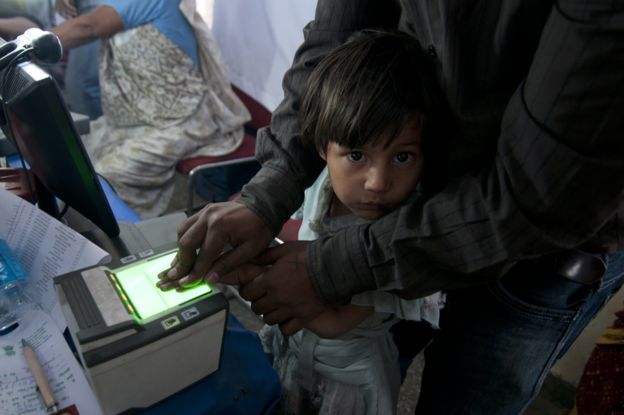
India’s biometric database is the world’s largest. Over the past eight years, the government has collected fingerprints and iris scans from more than a billion residents – or nearly 90% of the population – and stored them in a high security data centre. In return, each person has been provided with a randomly generated, unique 12-digit identity number.
For a country of 1.2 billion people with only 65 million passport-holders and 200 million with driving licenses, the portable identity number is a boon to the millions who have long suffered for a lack of one.
Indians will need the identity number to receive benefits from more than 500 welfare schemes
States have been using the number, also called Aadhaar (Foundation), to transfer government pensions, scholarships, wages for a landmark rural jobs-for-work scheme and benefits for cooking fuel to targeted recipients, and distribute cheap food to the poor.
Over the years, the number has taken a life of its own and begun exerting, what many say, is an overweening and stifling control over people’s lives. For many like political scientist Pratap Bhanu Mehta, Aadhaar has transmuted from a “tool of citizen empowerment to a tool of state surveillance and citizen vulnerability”.
People will soon need the number to receive benefits from more than 500 of India’s 1,200-odd welfare schemes. Even banks and private firms have begun using it to authenticate consumers: a new telecom company snapped up 100 million subscribers in quick time recently by verifying the customer’s identity through the number.
‘Forcibly linked’
People are using the number to even get their marriages registered. The number, says Nikhil Pahwa, editor and publisher of Indian news site MediaNama, is “being forcibly linked to mobile numbers, bank accounts, tax filings, scholarships, pensions, rations, school admissions, health records and much much more, which thus puts more personal information at risk”.
Some of the fears are not without basis.
The government has assured that the biometric data is “safe and secure in encrypted form”, and anybody found guilty of leaking data can be jailed and fined.
But there have already been a number of leaks of details of students, pensioners and recipients of welfare benefits involving a dozen government websites. Even former Indian cricket captain MS Dhoni’s personal information was mistakenly tweeted by an overzealous enrolment service provider.
The fingerprints and iris scans are stored in high security data centres
Now a disturbing report by The Centre for Internet and Society claims that details of around 130-135 million Aadhaar numbers, and around 100 million bank numbers of pensioners and rural jobs-for-work beneficiaries have been leaked online by four key government schemes.
More than 230 million people nationwide are accessing welfare benefits using their numbers, and potentially, according to the report, “we could be looking at a data leak closer to that number”. And linking the number to different databases – as the government is doing – is increasing the risk of data theft and surveillance.
The chief law officer believes that the outrage over the leaks is “much ado about nothing”.
“Biometrics were not leaked, only Aadhaar numbers were leaked. It is nothing substantial. The idea is biometrics should not be leaked,” Mukul Rohtagi told the Supreme Court on Tuesday.
The government itself has admitted that it has blacklisted or suspended some 34,000 service providers for helping create “fake” identification numbers or not following proper processes. Two years ago, a man was arrested for getting an identification number for his pet dog. The government itself has deactivated 8.5 million numbers for incorrect data, dodgy biometrics and duplication. Last month, crop loss compensation for more than 40,000 farmers was delayed because their Aadhaar numbers were “entered incorrectly by banks”.’
‘Mass surveillance’
There are also concerns that the number can be used for profiling. Recently, authorities asked participants at a function in a restive university campus in southern India to provide their Aadhaar identity numbers. “This is not only a matter of privacy. The all pervasiveness of the Aadhaar number is a threat to freedom of expression, which is a constitutional right,” Srinivas Kodali, who investigated the latest report on data leaks, told me.
Critics say the government is steaming ahead with making the number compulsory for a range of services, violating a Supreme Court order which said enrolment would be voluntary. “The main danger of the number,” says economist Jean Dreze, “is that it opens the door to mass surveillance.”
Details of millions of Aadhaar number holders have been leaked
Nandan Nilekani, the technology tycoon who set up the programme popularly known by its acronym UIDAI, believes concerns about the safety of the biometric database are exaggerated.
He says the identity number has cut wastage, removed fakes, curbed corruption and made substantial savings for the government. He insists that the programme is completely encrypted and secure. “It’s like you are creating a rule-based society,” he told Financial Times recently, “it’s the transition that is going on right now.”
Abused
More than 60 countries around the world take biometric data from its people, says Mr Nilekani. But then there are nagging concerns worldwide about these databases being abused by hackers and state intelligence.
In 2016, personal details of some 50 million people in Turkey were reportedly leaked. (Turkey’s population is estimated at 78 million.) In 2015, hackers stole more than five million fingerprints after breaching US government networks. In 2011, French experts discovered a hack involving the theft of millions of people’s data in Israel.
Pratap Bhanu Mehta has written that the lack of a “clear transparent consent architecture, no transparent information architecture, no privacy architecture worth the name [India doesn’t have a privacy law], and increasingly, no assurance about what exactly you do if the state decides to mess with your identity” could easily make Aadhaar a “tool of state suppression”.
So a lot of lingering doubts remain. How pervasive should an identity number be? What about the individual freedom of citizens? How do you ensure the world’s biggest biometric database is secure in a country with no privacy laws and a deficient criminal justice system?
In many ways, the debate about Aadhaar is also a debate about the future of India. As lawyer Shyam Divan argued forcefully in the top court, “people are reduced to vassals” when the state controls your body to this extent.
CHINESE parents pride themselves on the importance they attach to education; it is, they say, the most important gift they can bestow on the next generation.
That makes them all the more willing to shell out, if they can afford it, on expensive boarding schools which they believe will enable their children to concentrate fully on their studies. Poor families in the countryside pack their children off to board, too. But that is because they have no choice: daily commuting would be too expensive or arduous. In the cities, boarding schools are usually far grander. Attending them is more a badge of privilege than evidence of pragmatism.There is considerable demand for such urban schools. In many rich countries, parents often fret about sending their children away to board, partly because of the high cost and partly because these days many parents prefer to have their children with them. In China, by contrast, it is considered very normal for a couple to live apart from their child (they usually only have one). For urban boarders, the distance is seldom great: parents usually send their children to schools very close to where they live.
Boarding school offers an alternative to foisting a child on grandparents, which parents often do, sometimes for days on end. It may be costly, but parents reckon that such schools can do more to help children study after class than the elders can at home. In a country where siblings are so rare, many also see communal living as good for their offspring. Some 3.5m children now board in cities, around 4% of the urban school population. The vast majority of them do so at high school (8% of secondary-school pupils board, compared with 1% of primary schoolers).
A few of the boarding schools court the country’s elite by offering to prepare children for admission to universities abroad (in China, foreign education is another much-desired symbol of privilege). The redbrick quadrangle of the recently built Keystone Academy in a suburb of Beijing resembles a boarding school in New England. The institution’s annual boarding fee of 360,000 yuan ($52,000) is higher than tuition at Harvard University.
But the most expensive boarding schools may have had their heyday. Many parents with that much cash to spare would often prefer to send their children to board abroad: enrolments in American and British boarding schools are rising fast. Social trends are also changing. A wife who can afford not to work—and who has time to parent a child—is increasingly seen as someone who enjoys high status: traditional gender roles are making a comeback. In 2014 Yin Jianli, a popular author and former teacher, included an essay entitled “Boarding is a Bad System” in a book she wrote about education. It argued that if dorm-life really fostered the “sense of collectivism” that its proponents claim, then children from orphanages would score top marks. She said that mothers should be more involved in child-rearing.
For ordinary middle-class parents, less fancy state-run boarding schools are becoming more affordable: often they cost only a few thousand yuan a year. But even their future may be threatened. President Xi Jinping’s anti-graft drive is making it harder to secure a place in the best ones by using the once common methods of paying backhanders and pulling strings. These days having a child at a good state boarding-school can be a sign of corruption. No one wants that badge.
One of China’s top universities is preparing to open a campus at the heart of British academic life, just months after President Xi Jinping called for Chinese universities to be transformed into strongholds of Communist party rule.
Peking University, an elite Beijing institution where Mao Zedong once worked as a librarian, will open a branch of its HSBC Business School in Oxford early next year, financial magazine Caixin reported on Thursday.
The school is setting up camp in Foxcombe Hall, which it recently purchased for a reported £8.8 million (US$11.97 million). The 19th century manor was home to the eighth earl of Berkeley.
Peking University said courses at its Oxford campus, which is not connected to the University of Oxford, would focus on “professional knowledge of China’s economy, financial market and corporate management”.
Wen Hai, its dean, said Peking University had beaten off competition from three rivals, including an unnamed Oxford college, by offering a “very tempting price” that left the sellers “little room to say ‘no’”.
Wen said the university had been able to do so thanks to its close ties to China’s Communist Party. Those connections allowed it to “to expedite the transfer of money transfer needed for the acquisition” despite tight capital controls imposed by Beijing in an attempt to stop firms and citizens shifting large sums of money overseas.
Last summer’s vote by the United Kingdom to leave the European Union, which has seen the pound plummet against the Chinese yuan, will also have helped the buyers.
Caixin said the university’s decision to expand into the “city of dreaming spires” came as Beijing pondered ambitious plans to boost the global standing of China’s top universities. Peking University, currently ranked the world’s 29th best university, had been handed billions of yuan by the government to “improve its research facilities and recruit teaching staff from top universities abroad to boost its international profile”, it said.
International schools in China attract more pupils
Prestigious British schools have set their sights on mainland China over the last 15 years with public schools including Harrow, Dulwich College and Wellington all opening spin-offs. British universities have also made moves into the mainland, where it is now possible to study at campuses operated by the University of Nottingham and the University of Liverpool. Last month the University of Leicester said it would open a campus in the north-eastern province of Liaoning.
Peking University described its Oxford campus, designed for students from both Europe and China, as “a bold step” and “an important milestone for the development of China’s higher education, given its inferior position globally over the past century”.
“It is our hope that the new initiative in Oxford will further strengthen the school’s international reputation as well as its teaching and research capabilities,” Lin Jianhua, its president, said in a statement.
The acquisition comes a few months after Xi, whom liberal scholars accuse of presiding over a severe clampdown on freedom of expression, declared Chinese universities should be party “strongholds”.China’s top colleges to face ideological inspections
Echoing a 1932 speech by Joseph Stalin, Xi called teachers “engineers of the human soul” whose “sacred mission” was to help students “improve in ideological quality [and] political awareness”.
Mainland China now has two universities in the world’s top 40, according to the Times Higher Education rankings. Even so, senior Communist party leaders have looked abroad to educate their offspring.
Xi Jinping’s daughter, Xi Mingze, studied at Harvard while Bo Guagua, the son of jailed party chief Bo Xilai, studied PPE at Balliol in Oxford where he built a reputation as an inveterate party animal.
“[It was like when] you take the cork out of a champagne bottle and it explodes for a bit,” Andrew Graham, the college’s former master, told the BBC in a recent series about the scandal-hit Bo family.
The western Indian state of Gujarat has passed a law making the slaughter of cows punishable with life imprisonment.
Under an amendment to the state’s Animal Preservation Act, those found guilty of transporting beef will also be jailed for 10 years.
The cow is considered sacred by India’s Hindu majority, and killing cows is illegal in many states.
But the new amendment means Gujarat now has the toughest laws on the issue in the country.
Offenders will face heavy fines, as well as time behind bars. The penalty for either act has been doubled from 50,000 rupees ($771; £618) to 100,000 rupees.
Why India man was lynched over beef rumours
Why the humble cow is India’s most polarising animal
India meat traders strike over closures
Gujarat Minister of State Pradipsinh Jadeja told reporters that the cow was a symbol of Indian culture and the amendments to the act had been made “in consultation with the people”.
Chief Minister Vijay Rupani has also spoken repeatedly of “harsh” punishment for those who kill cows.
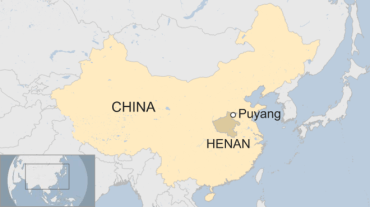
A stampede at a primary school in central China has left two children dead and 20 injured, state media said.Xinhua news agency said students were crowded into a toilet during the morning break in Puyang when others began pushing their way in.
Another report in a Chinese newspaper claimed the toilet’s wall collapsed from the pressure of the crush.All the injured have been taken to hospital, where some are reported to be in a serious condition.
Puyang county’s government told the Associated Press the incident was under investigation, but declined to provide further details.
It happened at the Number Three Experimental Primary School in Puyang county in Henan province on Wednesday morning.
Similar deadly incidents have happened before.Six children died and 25 were injured in a stampede on a school staircase in South West China in 2014.
MUCH grumbling accompanied the start on March 4th of this year’s season of the Chinese Super League (CSL), the uppermost tier of professional football in China. Managers of its 16 clubs have been gnashing their teeth at a change of rules which was suddenly announced just a few weeks before the first matches. Teams are now allowed to field a maximum of three foreigners.The clubs would have preferred more notice. Many of them have only just acquired even more foreign players. All now have at least four, the previous maximum per side in any CSL game. (One of them, a Brazilian called Oscar, is pictured in a CSL match—he was transferred to Shanghai SIPG from Chelsea, an English club, for £60m, or about $75m, in December.)
Last year China spent more than $450m on footballers, the fifth-largest such outlay by any country.
But all this money has not improved the dismal state of Chinese football. The men’s national team ranks 82nd in the world. In October an embarrassing 1-0 defeat to war-torn Syria triggered protests by hundreds of fans in the city of Xi’an where the match was played. Local media say the Chinese Football Association announced its new rules on orders “from above”. They impose a levy on big transfers and demand that one-sixth of clubs’ spending must be on youth training.
Officials have also been trying to curb the buying of stakes in foreign clubs—Chinese investors shelled out about $2bn on them last year. The government says this is part of an economy-wide clampdown on currency outflows. But it also wants to make the point that foreign talent won’t necessarily help China’s. The government has recently scuppered several investment deals. A Chinese consortium bought AC Milan, an Italian club, for $825m in August, but has been unable to move money out of China to complete the purchase.
Rather than simply moaning about the new rules, clubs have been devising ways of dodging them. Teams must now field at least one Chinese player under 23 each week. Some coaches simply replace them early in the game with older hands.






 Details of millions of Aadhaar number holders have been leaked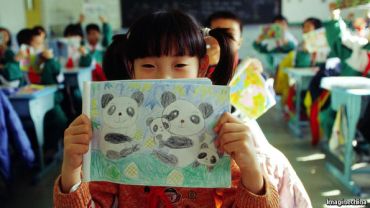




 CHINDIA ALERT: You'll be living in their world, very soon