Archive for ‘Social & cultural’

08/03/2017

The partition of India: “Viceroy’s House” is an antidote to colonial triumphalism | The Economist

THE fetishisation of British Imperialism is inescapable. Last December, Theresa May cited the East India Company as an example of Britain’s historical trading prowess. Contestants on a recent season of “The Apprentice”, an entrepreneurial reality show, created batches of “Colony Gin”; Marks & Spencer, a retailer, included an “Empire Pie” as part of its Gastropub collection. This nostalgia is borne out by a YouGov poll from 2016, which found that 44% of respondents are proud of Britain’s colonial history.

Those colonised, though, see the empire rather differently. A charge sheet of Britain’s efforts in India—and every territory colonised can produce an equivalent—might list partition, the man-made Bengal famine in 1943 (which resulted in an estimated 3m deaths), the wretched labour system of indenture and the looting of state wealth. Partition alone resulted in 1m deaths and created 15m refugees in a matter of weeks; Hindus and Sikhs fled their homes in what was the become the Muslim state of Pakistan, while Muslims in India took flight in the opposite direction.

“Viceroy’s House”, a new film written and directed by Gurinder Chadha, seeks to document Britain’s role in partition and the cleaving of the Punjab region. In the final months of the Raj, Lord Mountbatten (Hugh Bonneville) arrives to oversee the transfer of power to Hind Swaraj (Indian Home Rule), and reconcile the demands of independence leaders such as Mahatma Gandhi and Jawaharlal Nehru with those of Muhammad Ali Jinnah. Sir Cyril Radcliffe (Simon Callow)—who had never set foot in India before—is drafted in to assess how 175,000 square miles, home to 88m people, should be split. Ms Chadha carefully balances high politics with its impact on ordinary citizens; relations between Hindu, Sikh and Muslim staff become tense as the prospect of annexing India’s Muslim-majority regions emerges.

The film is good in exposing the Machiavellian motives behind this rushed decision, as well as the gut-wrenching suffering that followed (the house, which “makes Buckingham Palace look like a bungalow”, becomes a camp for the displaced). It is not perfect, however. “Viceroy’s House” absolves everyone—Lord Mountbatten, the British, Hindus, Sikhs, Muslims—of blame for the suffering. Some critics have complained that it does not give any attention to the Indian independence struggle, or catalogue the horrors of British rule. These are deserving of films in their own right; Ms Chadha’s decision to focus her lens solely on how partition unfolded is a wise one.

With millions of people involved in the story of partition, “Viceroy’s House” was always going to be a tricky undertaking, likely to be deemed unsatisfactory by many. Ms Chadha tells the story of this multifaceted moment in the region’s history through the lens of one building, framing it as the tale of “the people’s partition” rather than dealing in factionalism and blame. She has subverted the period-drama genre—how many period dramas close on a shot of a desperate refugee camp?—to produce something akin to a “Dummy’s Guide to partition”.

Yet even as a superficial primer, “Viceroy’s House” fills a gap in Britain’s collective consciousness and cultural memory. In the canon of modern British films about India, partition features in “Gandhi” (1982) and “Midnight’s Children” (2012) but gets scant treatment elsewhere. “Viceroy’s House” stands out from these offerings as a British film narrated with heart, soul and profound sadness by a Punjabi film-maker with a personal investment in the story: the closing credits reveal that Ms Chadha’s grandmother lost a child to starvation while fleeing to India.

It will be hard for some to maintain a sense of nostalgia and triumphalism for Britain’s empire after watching “Viceroy’s House”: Ms Chadha intersperses the drama with Pathé news footage of communal violence and Churchill’s dejected newscasts explaining the collapse of law and order. The film has ensured that partition, which is rarely taught in British high schools, has a place in the nation’s shared public culture again. Too right. Partition is as much a part of modern Britain—home to 700,000 Indian and Pakistani Punjabis, many of whom are the children, grandchildren and great-grandchildren of partition—as butter chicken, saag paneer, naan, bhangra and Bollywood.

Source: The partition of India: “Viceroy’s House” is an antidote to colonial triumphalism | The Economist

24/02/2017

The missing middle: Women in South Asian politics have not empowered women | The Economist

ON THE Indian subcontinent, as in no other part of the world, women have risen to the pinnacle of politics. Indira Gandhi of India, Benazir Bhutto of Pakistan and Aung San Suu Kyi of Myanmar are all famous names. Less well known is that Sri Lanka was the first country ever to elect a woman prime minister, or that it has also had a female president. For 22 of the past 25 years Bangladesh, a largely Muslim country with more people than France and Germany combined, has been led by a woman. And the chief ministers of numerous country-sized Indian states, from West Bengal in the east to Tamil Nadu in the south, have also been women.

India’s democracy is not pretty; these are the winners of bare-knuckle contests.

Yet for all such headline-grabbing successes, the fine print tells a different story. Although there has been steady progress in such things as stamping out female infanticide and spreading women’s education, statistics continue to reveal a stark sex divide. At 27%, the share of Indian women who work, for instance, is less than half the level in China or Brazil (and also in neighbouring Bangladesh, although slightly higher than in Pakistan). In 2012 a household survey found that four-fifths of Indian women needed their husband’s or family’s permission to visit a local clinic. A third said they would not be able to go alone. More than half also said they could not visit a shop, or even a friend, without someone else’s approval. For many, the very idea of going out was alarming: 70% said they would feel unsafe working away from home, and 52% thought it normal for a husband to beat his wife if she ventured out without telling him. In November, following a shock government move to scrap higher-denomination banknotes, a domestic violence hotline in the city of Bhopal in central India registered a doubling of calls, largely from women whose spouses had discovered they had secretly been saving cash.

On your bike

For wealthy and middle-class Indian women, freedoms have steadily grown: Anubha Bhonsle, a television anchor, recalls the strangeness of being the sole female driver of a motor scooter on many streets when she started commuting 15 years ago. “No one would give a second glance now,” she says. Yet in many professions women remain rarities. Barely 10% of the 700 judges in India’s higher courts are female, and only 17% of the 5,000 officers in the Indian Administrative Service, the elite corps of bureaucrats that runs the country.

Women are scarce even in politics. In the lower house of India’s parliament only 12% of MPs are women. State legislatures are similarly male. True, women’s share of seats has risen, but slowly: 50 years ago the proportion of women in the lower house was 6%.

It is only in village and district councils that women hold much sway, but this is partly due to laws that assign either a third or half of seats to female candidates. Earlier this month tribesmen objecting to efforts to impose a women’s quota in local elections rioted in Nagaland, a state on the border with Myanmar that is one of the few exceptions to such rules. Naga men insist that local custom precludes female village chiefs.

Such troubles reveal one cause of slow progress to sexual equality: Indian politicians have generally found it more rewarding to cater to subgroups defined by caste, religion, ethnicity, language or local grievance, rather than to broader categories such as women. This is equally true of female politicians, and of regional leaders less constrained by democracy. Sheikh Hasina, the current, iron-fisted prime minister of Bangladesh, has recently moved to reduce the legal age of marriage from 18 to 16. Given that child marriage is already common, especially in the impoverished countryside, women’s-rights activists are upset. But analysts explain that apa, or “big sister”, who has hounded opposition parties including Islamists, is looking for ways to deflect conservative anger. In order to succeed female politicians in the region often make a point of acting tough. Mamata Banerjee, the diminutive but formidable chief minister of West Bengal, once dragged a male colleague out of the well of parliament by the collar when she was an MP in Delhi. Like Sheikh Hasina and Mayawati, a former chief minister of Uttar Pradesh, as well as Jayalalithaa, a recently deceased former film star and long-serving chief minister of Tamil Nadu, Ms Banerjee has carefully repressed her sexuality. These women are ostentatiously “married” to their cause or their party.

Such care is understandable. Male rivals have not shied from using sex to malign female politicians. One party leader in Uttar Pradesh lost his job for accusing Mayawati, who comes from a downtrodden caste, of “selling tickets like a prostitute”. A colleague went further against Sonia Gandhi, the leader of the opposition Congress party. Absurdly, he accused the head of the Gandhi dynasty of having worked for a Pakistani escort agency.

With so many obstacles blocking the path to power, it is hardly surprising that so many of the region’s successful female politicians got a head start. Amrita Basu of Amherst College finds that more than half of India’s female MPs in the past decade had family members who preceded them in politics. Quite often such dynastic links have been dramatic. Ms Suu Kyi in Myanmar and Sheikh Hasina are both daughters of slain independence heroes. Sonia Gandhi and Khaleda Zia, a former Bangladeshi prime minister and bitter rival to Sheikh Hasina, are both widows of assassinated leaders. Both Jayalalithaa and Mayawati entered politics as devoted lieutenants to charismatic, populist politicians; in Jayalalithaa’s case her mentor also played the lead in many of her films.

For women to play a more normal political role in the subcontinent, perhaps it is in films, and in popular culture in general, that change needs to happen first. All too often on the region’s screens, actresses who are paid a fraction of what male stars get portray women who lack agency in their lives. There is, though, an inkling of change. This season’s blockbuster and already the highest-earning film in Bollywood history, “Dangal”, tells the heart-warming story of sisters who become champions in the male-dominated sport of wrestling. Yet the main hero is not one of the girls, but the father, a former wrestler, who bends them to his will.

Source: The missing middle: Women in South Asian politics have not empowered women | The Economist

24/02/2017

“Kung Fu Grandma” Practices Chinese Martial Arts for Nine Decades – YouTube

Don’t let Zhang Hexian’s age fool you as the 94-year-old has a particular set of skills that make her a nightmare for thugs anywhere. The resident of Ninghai County in east China’s Zhejiang Province has been practicing Chinese martial arts since she was four and through the years she has refined her skills with great diligence and effort to become affectionately known as “Kung Fu Grandma”.

Regarded as “the village of martial arts,” nearly everyone in the village where Zhang lives practices kung fu. As the eighth descendant of her family, Zhang learned kung fu under her father’s instruction at the age of four and has continued to practice throughout nine decades. “My dad took me to sleep at that time. When we woke up in the morning, we started practicing kung fu in bed. I learned basic martial arts skills such as pushing palm and throwing a punch at an early age,” said Zhang Hexian.

Practicing kung fu has become a daily routine in Zhang’s life. Every morning, Zhang does kung fu exercises without feeling tired. Apparently she is in good health. “She wakes up very early and does physical exercises every morning. She usually runs around the village for morning exercise,”said Zhang’s son Feng Chuanyin.

Zhang recalled that she once fought against a bully when she was young. The bully was beating his wife when Zhang saw him. To uphold justice, Zhang grabbed his collar, ripped his shirt off and urged him to behave well. Apart from being a deterrent to hooligans and ruffians, Zhang is also a warm-hearted woman willing to help others, which is one of the secrets of her longevity. “She always has a good mood with a positive attitude. Helping others is also good for her health,” said Feng.

More on: http://www.cctvplus.com/news/20170215…

Tags:
24/02/2017

Dancing noodle vendor is China’s latest celebrity chef | South China Morning Post

A chef in southwest China became an instant celebrity after a video of him dancing while making noodles became an online sensation during the Lunar New Year holiday, according to a newspaper report.

Tian Bo, 31, was an ordinary cook of a noodle restaurant in Chengdu, the capital of Sichuan province, before he began to sway his body with coquettish look when making noodles to attract more customers, the West China City Daily reported.His signature dish, “longevity noodle,” comprises just one noodle long enough to fill a bowl and is a specialty in the historic town of Huanglongxi.

Tian told the Daily that he resorted to dancing while serving noodles in March last year when the restaurant was almost deserted and he was under enormous pressure. He fine-tuned his performance, adding pop music and coyish facial expressions.

Spinning, jumping and waving the noodles in his hand, Tian leers at the onlookers from time to time, according to the video circulated online.

After the video of his noodle performance made headlines online, his fortunes changed. Tourists arrived in town to seek him out and some even offered his a job with better pay.

Tian said he was merely acting at the restaurant and was not flirtatious in real life. He said he would stay at the restaurant for the time being but hoped to start his own noodle shop one day.

His video got mixed reviews on social media. “He is so tantalising. I just stared at the little brother and did not think about the noodles, ” said one Weibo blogger.

Said another: “I’ve seen him and I think he works too hard. He must get so tired from dancing and making noodles for long time.”

Source: Dancing noodle vendor is China’s latest celebrity chef | South China Morning Post

Tags:
23/02/2017

Wayne Rooney: Man Utd captain’s agent in China to discuss potential move – BBC Sport

Wayne Rooney’s agent Paul Stretford is in China to see if he can negotiate a deal for the forward to leave Manchester United.

There are no guarantees of success and it is thought a deal remains highly unlikely before the Chinese transfer window closes on 28 February.

But the fact Stretford has travelled to China is a clear indication United boss Jose Mourinho would let Rooney, 31, go.

And if he does not leave this month it seems certain he will go in the summer.Rooney has fallen down the pecking order at United under Mourinho.

Rooney should stay – Phil Neville

Mourinho not ruling out Rooney exit

Would a China move work for Rooney?

The England captain has been made aware of interest in him from the Chinese Super League for some time, although it is not known which clubs Stretford has spoken to.

Beijing Guoan, believed to be the favourite team of Chinese President Xi, had been seen as one of the favourites to sign Rooney but sources close to the club have told BBC Sport they are not interested in signing him.

Because of new restrictions on overseas players, Jiangsu Suning and Tianjin Quanjian look like the most likely remaining options.

However, the England captain’s representatives have already spoken to Tianjin Quanjian and their coach, Fabio Cannavaro, said talks did not progress.

On Tuesday, Mourinho said he did not know whether Rooney, who has only just returned to training after a hamstring injury, would still be at Old Trafford in a week’s time.

It is not known whether this latest development will affect Rooney’s chances of being involved in Sunday’s EFL Cup final against Southampton.

They had appeared to have increased after Henrikh Mkhitaryan limped out of Wednesday’s 1-0 Europa League win against Saint-Etienne.

If Rooney follows former team-mate Carlos Tevez to the Chinese Super League, it would almost certainly cost him any chance of making the seven appearances he needs to become England’s most capped player.

Rooney’s preference is understood to be to remain with United for the rest of his contract, which expires in 2019, but a lack of time on the pitch is forcing him to consider alternatives.

Rooney is United’s record goalscorer and has won five Premier League titles and a Champions League trophy since joining them as an 18-year-old for £27m from Everton in 2004.

The forward, who has started only three games since 17 December, has said he would not play for an English club other than United or Everton.

The big difference between Chinese Super League clubs’ transfer process and their Premier League counterparts is the preparation.

English top-flight clubs have extensive scouting departments with links around the world. They identify players months in advance, watch many live games and base their decision on an extensive process._94799249_oscar_getty


Oscar moved to Shanghai SIPG from Chelsea in a £60m deal in December and scored on his debut for his new club

In CSL, the process is more agent-led. Most of the clubs are approached with recommendations for a position they are recruiting in, rather than seeking out players themselves.

Foreign players coming in on large fees are commanding three-, four-, five-year deals, even at the end of their career. They have the upper hand in negotiations and wouldn’t leave European football without long-term financial guarantees.

However, the Chinese government is concerned about capital leaving the country and it is difficult for these big transactions to exist while they are trying to crack down in other areas.

I think we will see a levelling out in fees. The £15m-£20m transfers will continue to happen for the next few years, but maybe we won’t see the likes of the £60m deal that brought Oscar to China.

Source: Wayne Rooney: Man Utd captain’s agent in China to discuss potential move – BBC Sport

Tags:
17/02/2017

Soccer Dreams in China’s Rust Belt – China Real Time Report – WSJ

China’s smog-choked northern province of Hebei is no stranger to lofty goals. For one thing, it has to shut down two-thirds of its steel factories by 2020.

Here comes another: becoming a provincial powerhouse in soccer. Perhaps understandably, it has given itself a few decades to do it.

The “Hebei Province’s Soccer Medium-to-Long Term Development Plan (2016-2050)” unveiled Thursday sets out plans for 1,000 “soccer campuses,” 3,000 amateur leagues and at least one club in the Chinese Super League, the country’s highest tier of professional soccer.

Such plans to pursue the “beautiful game,” as soccer is often called, are quite the departure for China. The world’s second-largest economy used to nurture its sport stars the Soviet way, by picking and grooming its talent from an early age. It still harvests most of its medals using this model. But in soccer, Beijing is trying a looser model perfected in the West: shopping for world-class players world-wide and hoping to spot homegrown talent via a grassroots network of soccer programs in local schools.

“By 2050, we must contribute to China’s bid to host the World Cup,” the Hebei Provincial Sports Bureau said.

At media conferences, officials spoke wistfully of “a soccer tourism route” and “a garden of sports,” a somewhat jarring image of Hebei, which currently produces more than twice the annual steel volume of all U.S. mills combined and is home to China’s smoggiest cities.

In its quest to become a leading purveyor of football talent, Hebei already faces some domestic competition. Fujian province, in China’s south, last month said it also has such plans. Earlier this month, so did the aluminum-producing province of Gansu, known more for its deserts than its dazzling dribbles.

More provinces are likely to follow. The central government last year put out a blueprint detailing bigger, broader goals to mint “two to three first-class soccer teams in Asia, that are internationally known.”

President Xi Jinping has a soft spot for the sport, and in 2011 made known his desire for China to both qualify for and host a World Cup tournament and ultimately to win one.

This has proven difficult. Back-to-back losses last fall all but derailed China’s dream of qualifying for the 2018 World Cup. Profligate spending to attract foreign talent led the General Administration of Sport last month to criticize Chinese teams for “burning money” on astronomical recruitment fees and wages, while “neglecting the development of homegrown players.”

Still, Hebei might have an edge. The province, where Mr. Xi spent some time early in his career as a county-level Communist Party official, won government support in a successful bid to host the 2022 Winter Olympics, despite having only a set of somewhat stumpy mountains with sporadic snow.

Some of the province’s residents aren’t exactly hopeful. “The economy is finished,” one of them wrote on the popular microblogging platform Weibo. “And you still have time to focus on soccer?”

Source: Soccer Dreams in China’s Rust Belt – China Real Time Report – WSJ

14/02/2017

When It Comes to Mandarin, Bill Gates Is No Mark Zuckerberg – China Real Time Report – WSJ

Two years ago, Bill Gates admitted one of his life regrets was never becoming conversant in any foreign language.

Mr. Gates, 61 years old, has made some progress. Over the weekend, he gave a 12-word welcome in Mandarin in an opening video for his new blog on Chinese social network WeChat.

“Hello,” he said in Chinese. “Welcome to my official WeChat account.”

Mr. Gates is the latest U.S. tech executive to risk ridicule by speaking publicly in Chinese, joining Facebook’s Mark Zuckerberg and Uber’s Travis Kalanick. But his brief, accented remarks made clear that while he might rival Mr. Zuckerberg in entrepreneurship and philanthropy, the Microsoft Corp. founder is a less formidable challenger in Chinese oration.

“His Chinese pronunciation is not quite as good as Zuckerberg’s,” announced China’s official Global Times newspaper on Weibo, China’s equivalent of Twitter.

Chinese viewers online gave mixed reviews, with some encouraging his effort (“Great!”) and others panning it (“There appears to be a big difference between his Chinese and English”).

Mr. Gates had praised Mr. Zuckerberg’s fluency in Chinese as “incredible” in a 2015 Reddit question-and-answer session.“I feel pretty stupid that I don’t know any foreign languages,” wrote Mr. Gates in the Reddit Q&A. “I took Latin and Greek in high school and got As and I guess it helps my vocabulary but I wish I knew French or Arabic or Chinese. I keep hoping to get time to study one of these—probably French because it is the easiest.”

Mr. Gates’s attempt at Chinese was occasioned by the launch of his new WeChat account “gatesnotes.” In China, public figures often use WeChat official accounts to share their opinions and musings with fans. For foreign business leaders, WeChat has become a go-to option as both Facebook and Twitter are blocked in China. Mr. Gates’ new WeChat account appears to be a Chinese version of his English blog by that name.

Mr. Gates was an early adopter of Chinese social media, launching an account on microblogging platform Weibo in 2010, where he has posted sporadically. He now has 3.2 million Weibo followers compared with 33 million on Twitter.

The new WeChat account isn’t verified but claims to be the official account for Mr. Gates. It was set up by Bridge Consulting Co. Ltd., a Chinese joint venture of international health consulting company Global Health Strategies. Global Health Strategies lists the Gates Foundation as a client and donor on its website.

The WeChat account said Mr. Gates will use the space to share his thoughts on people he meets, books he has read and lessons learned, with topics ranging from health to energy and resources. It had drawn more than 100,000 views and over 9,000 “likes” by late Monday, although the only content so far is the welcome video and a note saying regular posts will begin Tuesday.

Bridge Consulting describes its mission as “shaping and promoting the images of international celebrities on Chinese social media”, according to a job ad posted by the company.

Andre Shen, a former media consultant with the Bill & Melinda Gates Foundation in China, is listed as founder of the company, according to regulatory filings. Mr. Shen said in an email he had to check with Mr. Gates’s team in Seattle before making any public statements.

Chinese has become increasingly popular among U.S. entrepreneurs as they seek to get a foot in the door of the world’s biggest internet market. Facebook appears to be in the lead, with Mr. Zuckerberg giving bravura performances such as a half-hour-long speech in Mandarin in Beijing. Facebook Senior Vice President Vaughan Smith and incoming virtual reality chief Hugo Barra have also studied the language.

So far, Uber’s Mr. Kalanick is closer to Mr. Gates than Mr. Zuckerberg in Mandarin prowess, though he has peppered his English speeches in Beijing with the occasional Chinese phrase, like “Hello, students”, to cheers from the crowd.

Source: When It Comes to Mandarin, Bill Gates Is No Mark Zuckerberg – China Real Time Report – WSJ

Tags:
10/02/2017

Banyan: Is India a country or a continent? | The Economist

IN A speech to London’s Constitutional Club in 1931, Winston Churchill poured scorn on the idea of India. “India is a geographical term. It is no more a united nation than the equator,” he spat, a slur that invites such uniform disagreement from Indians as to disprove itself. Less well known, but more worthy of debate, is the previous line of Churchill’s speech: “India is no more a political personality than Europe,” he contended.

The personalities of both India and Europe have changed a great deal since 1931. But in explaining India to outsiders, Banyan often finds it helpful to compare it to the European Union (EU) rather than to the United States. Neither parallel does India justice, of course. The frequent comparisons to America can imbue India with a false cohesion. The less common comparison to the EU suggests a false disunity. But if the two parallels are judiciously combined, the falsities may help to cancel each other out.

One obvious example is Indian politics. This month voters took part in elections for the state legislatures of Punjab and Goa. As is often the case, turnout was higher than in India’s national election in 2014. In comparison with the United States, where races for national office, especially the presidency, overshadow state-level contests, that is a puzzle. In comparison with the EU, where elections in member states command far more attention than races for the European Parliament, it seems less strange.

The composition of India’s legislature also looks more like Strasbourg’s multicoloured mosaic than Washington’s two-tone Congress. The Lok Sabha, India’s lower house, seats as many as 35 parties. With the exception of the Bharatiya Janata Party and Congress, few of them have influence beyond one or two states. If America is the benchmark, the obvious question is why India’s voters have failed to coalesce around rival nationwide philosophies of government. But if the template is Europe, the fragmentation is easier to grasp. Few of Europe’s parties could appeal across national lines, however compelling their policies.

Another example is language. India’s constitution lists 22 “scheduled” languages. An American might wonder how it copes. But the EU, with 24 official languages, is even more polyglot. India’s national anthem had to be translated into Hindi from the original Bengali. But the EU’s anthem has no official lyrics, so as to leave open the question of what tongue to sing them in. Pick any two Indians at random, and the chance that they share the same mother tongue is less than 20%, according to data compiled by Romain Wacziarg of the University of California, Los Angeles, and his colleagues. But for the EU as a whole, according to Banyan’s calculations, the odds are less than 10%. Linguistically, then, India is neither as unified as the United States nor as divided as the EU.

National welding

The author of India’s anthem, Rabindranath Tagore, also saw value in comparing his country to both Europe and America. Like India, the United States faced the problem of “welding together into one body various races”. This challenge set both countries apart from Europe, which, Tagore felt, could take its racial unity for granted. Indeed, he saw Europe as one people divided into many states, unlike India’s many peoples “packed into one geographical receptacle”.

The gap between India’s many peoples remains large. The GDP per person of Bihar, India’s poorest state, is only a fifth of Haryana’s and little more than a tenth of Goa’s. That is a much bigger income gap than between Mississippi and Massachusetts, but comparable to the gulf between Bulgaria and Belgium.These gaps have motivated increasing numbers of Indians to move from one part of their geographical receptacle to another. The government’s latest economic survey, written by Arvind Subramanian, its chief economic adviser, calculates that interstate migration nearly doubled between the 1990s and the 2000s, yielding a migrant population of over 55m in 2011 (roughly 4.5% of India’s population). That may fall well short of American mobility, but compares favourably with the EU, where 13.6m citizens (2.7% of the total population) live in another member state.

The movement of goods tells a similar tale. In India, unlike America, state prerogatives often trump the imperatives of interstate commerce. Trade is distorted by a patchwork of local levies, which the central government is keen to replace with a new goods and services tax. The familiar sight of lorries queuing at state borders suggests an economy that is hopelessly fragmented. But again, the benchmark matters. Drawing on new data, Mr Subramanian shows that trade among India’s states is now equivalent to about 54% of GDP, rather higher than many suspected. That is low compared with America (78%), but impressive compared with the EU (20%).

Net trade is even more dramatic. India’s single market and currency allow some states to run enormous trade deficits with others. Four run deficits in excess of 20% of local output. That is far greater than the euro area has been able to sustain.

India’s divisions hamper it in its dealings with other nations. Its diplomacy has a reputation for parochialism and mal-coordination—an elephantine inability to “dance”. But perhaps it is not given enough slack. Compared with the EU, India’s foreign policy is positively twinkle-toed. India, lest it be forgotten, is as populous as 150 other countries combined. By encompassing all of these people in a single political entity, it dramatically reduces the complexity of global governance—even if it does not always feel like that. Had the republic not succeeded in refuting Churchill, had it disintegrated into multiple sovereign states, the world’s negotiating tables might have needed to accommodate dozens of additional quarrelling players. When the Americans want to talk to India, they know whom to call—however frustrating the conversation sometimes proves to be.

Source: Banyan: Is India a country or a continent? | The Economist

03/02/2017

Something to Crow About: Ivanka Trump Visits Chinese New Year Party – China Real Time Report – WSJ

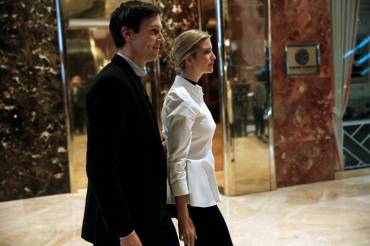
Chinese social media lit up Thursday over an appearance by Ivanka Trump and her daughter at a Lunar New Year celebration at Beijing’s embassy in Washington.

Photos and video went viral, showing Ms. Trump and 5-year-old Arabella being hosted at the Wednesday night event by China’s ambassador to the U.S., Cui Tiankai. On the Chinese microblogging site Weibo, the term #Trump’sDaughterVisitsChina’sEmbassy in Chinese quickly zoomed up to become the seventh most-searched item on Thursday.

Just as remarked, however, was the lack so far of Year of the Rooster wishes from President Trump.

“Trump’s daughter visits China’s embassy and wishes China a happy New Year! The daughter understands more than the father,” one Weibo user said.

The Lunar New Year — the most important holiday in China — is celebrated in several countries across Asia and by Chinese around the world. It has become an occasion for global leaders to offer up well wishes. In 2015, British royal Prince William wished China a happy Year of the Sheep in Mandarin in a video televised across the nation. When they were presidents, George W. Bush and Barack Obama issued Lunar New Year messages.

As the start of the Year of the Rooster officially came and went over the weekend, Chinese media noted the conspicuous absence of a similar tribute from Mr. Trump.

“Her father, the new U.S. president, has broken the tradition of sending New Year greetings to people of Chinese origin in the U.S. during their most important festival,” a China Daily slideshow of photos featuring Ms. Trump noted.

The White House didn’t immediately respond to a request for comment.

Some social media posts gave Mr. Trump the benefit of the doubt, saying the lack of new year’s greetings may not have been a deliberate snub, but the work of his advisers. Mr. Trump has vowed to get tough with China over its trade and currency policies, and his advisers have called for countering Chinese actions in the South China Sea with a naval blockade.

“To be honest, I think that Trump really maybe just forgot. He’s surrounded by anti-China people. There wouldn’t be anyone to remind him,” wrote another Weibo user. “Now it’s already too late, and to wish happy New Year under pressure from the media would mean losing face, right? So he just lets his daughter make an appearance.”

Video from the Chinese Embassy function featured Arabella and her mother being shown rooster paper cutouts and art made from melted sugar, as well as posing with costumed Chinese opera performers.

Arabella has previously endeared herself to the Chinese public after a video of her reciting Chinese poetry was widely circulated last year. On Thursday, social media users further amused themselves by analyzing her less-than-enthusiastic facial expressions captured at the embassy’s event. “She looks like I do when I don’t want to visit my relatives,” ran one.

“It looks like she’s angling for yasuiqian,” wrote another, referring to the red envelopes tucked with cash traditionally handed out to children over the holiday.

While Mr. Trump may have yet to formally extend his well wishes for the holiday Year of the Rooster, he has in other ways inspired the Year of the Rooster in China. A shopping mall in the central city of Taiyuan put up a large rooster sculpture with a Trump-like hairstyle in central China, inspiring balloons of similar design.

Source: Something to Crow About: Ivanka Trump Visits Chinese New Year Party – China Real Time Report – WSJ

30/01/2017

Inside India’s first department of happiness – BBC News

On a crisp weekday afternoon recently, hundreds of men and women, young and old, thronged a dusty playground of a government high school in a village in India’s Madhya Pradesh state.

Hemmed in by mobile towers and squalid buildings, the ground in Salamatpur was an unusual venue for a government-sponsored programme to “spread cheer and happiness”.

Undeterred by the surroundings and egged on by an energetic emcee, children in blue-and-white school uniforms, women in bright chiffon saris, and young men in jeans and t-shirts participated in games and festivities all morning. Under a tatty awning, people sprawled and a DJ played some music over crackling speakers. People left some food and old clothes for donation near a “wall of giving”.

Denmark the ‘happiest country’ and Burundi ‘the least happy’

UAE government selects ‘happiness officers’

Bhutan PM casts doubts over Gross National Happiness

Mental health and relationships ‘key to happiness’

Venezuela to create ‘ministry of happiness’

On the field, children raced in gunny sacks. A dozen girls, hands tied to their back, sprinted to get their teeth into knotty jalebis, a popular sweet. Women, squealing with delight, competed in tug-of-war contests. Jaunty men from a dancing school vowed the crowd with hip-hop dance moves. A four-year-old girl provided a rousing finale with her Bollywood-style hip-swinging gyrations. At the end of it all, beaming participants received glossy certificates.

On the dais crowded with officials and village leaders, there was mirthful insistence that “happiness week” had kicked off well. Videos and pictures of festivities from all over the state poured into the phones of excited officials: these included grannies tugging rope and grandfathers running with spoons in their mouths, among other things.

A week-long ‘happiness week’ saw girls participating in jalebi races

…and older villagers running with spoons in their mouth

The fun and games were part of a week-long Happiness Festival, organised by the ruling BJP government in what is India’s second largest state, home to more than 70 million people. They also provided a glimpse of the rollout of what is the country’s first state-promoted project to “to put a smile on every face”.

“Even in our villages, people are becoming introverted and self-centred because of TV and mobile phones. We are trying to get people out of homes, come together, and be happy. The aim is to forget the worries of life and enjoy together,” said Shobhit Tripathi a senior village council functionary.

‘Positive mindset’

At the heart of this project is the newly-formed Department of Happiness – the first of its kind in India – helmed by the state Chief Minister Shivraj Singh Chouhan himself.

The yoga-loving three-term 57-year-old leader of the ruling BJP believes the “state can help in ensuring the mental well being of its people”.

Under him a gaggle of bureaucrats and a newly formed State Institute of Happiness are tasked with the responsibility of “developing tools of happiness” and creating an “ecosystem that would enable people to realise their own potential of inner well being”. The department also plans to run some 70 programmes and develop a Happiness Index for the state.

Mr Chouhan, who taught philosophy in a local college before embarking on a successful career in politics, told me he had been thinking for a long time on how to “bring happiness in people’s lives”.

He then had an epiphany. Why couldn’t his government run programmes to help citizens have a “positive mindset”? One report said that he was prodded by a popular guru.

The tug-of-war games were keenly contested

Many village children participated in dances

There is more joy sometimes, Mr Chouhan told me, “being poor than being wealthy”.

But one wonders if people would be happy enough if the state was efficient in delivering basic services and be seen to be fair to all its people.

After all, Madhya Pradesh continues to be among India’s poorest states. More than a third of its people are Dalits (formerly known as untouchables) and tribespeople, among the most underprivileged. The world’s worst industrial accident happened in the state capital, Bhopal, in 1984, killing hundreds of people, and thousands of survivors are still fighting for compensation.

Despite impressive strides in farming, infrastructure and public services in recent years, illiteracy, undernourishment and poverty remain major challenges. When Mr Chouhan announced his plan last year, critics warned that the state would have to first deal with several “unhappy areas to make people happy”.

Bureaucracy of happiness?

Mr Chouhan agreed that providing food and shelter remained the primary responsibility of the state. But he said he was also worried about “families breaking up, rising divorces, and the increasing number of single people”. He spoke about the anomie of modern life, and how unwieldy aspirations lead to “excess stress and result in high suicide rates”.

He said that the state, borrowing from religious texts and folk wisdom, can help spread the virtues of “goodness, altruism, forgiveness, humility and peace”.

“We need people to have a positive mindset. We will try to achieve this through school lessons, yoga, religious education, moral science, meditation and with help from gurus, social workers and non-profits. It will be a wide ranging programme,” he said.

I wondered whether all this would spawn another gargantuan bureaucracy of happiness and invite allegations of cultural indoctrination by a government run by a Hindu nationalist party.

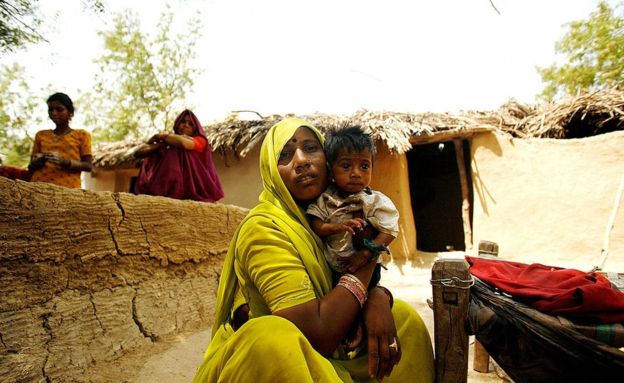
n this picture taken, 04 May 2007, Indian malnourished child, Viru (R) is comforted by his mother outside their hut at a village in Shivpuri district some 113 kms from Gwalior.Madhya Pradesh is among India’s poorest states
Don’t worry, Iqbal Singh Bains, the senior-most official in the department of happiness assured me. He’s also the top bureaucrat in the energy department.

“This is not about officials delivering happiness. This is not about preachy governance. You cannot deliver happiness to people. You can only bring about an enabling environment. The journey will be yours alone, the government is there to lend you a helping hand,” he told me.

Lending a hand would be more than 25,000 “happiness volunteers” who have signed up with the government. Government workers, teachers, doctors, homemakers and assorted people will work in the state’s 51 districts, holding “happiness tutorials and programmes”. Some 90 of them have already been trained.

‘Inner demons’

Sushil Mishra is one of them. The 48-year-old school teacher, who lives and works in remote Umaria, has already conducted four hour-long happiness classes at a secondary school, a student’s hostel, and government offices.

The classes, as he tells me, essentially have turned into confessionals, where participants talk about their good and not-so-good deeds, and pledge to improve themselves. Mr Mishra says it’s a challenge to create a relaxing, informal environment, where people can “wrestle with their inner demons”.

“Then they can listen to the voice of their soul, they are in touch with inner feelings. Nothing is forced.”

Madhya Pradesh is not the first place to try to “spread happiness”. But the jury is out on whether the state can play the role of a philosopher-counsellor-evangelist and make citizens happy.

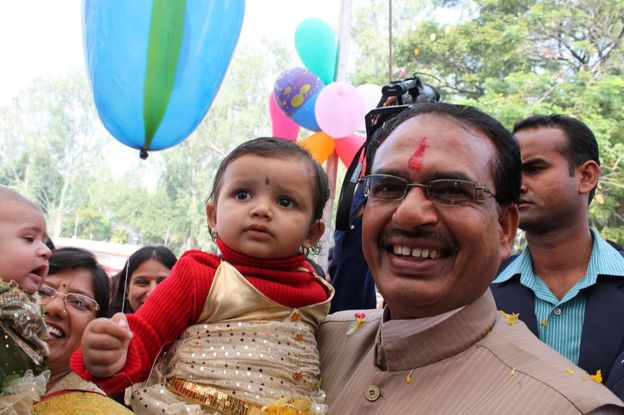
In this photograph taken on October 5, 2011, Chief Minister for the central Indian state of Madhya Pradesh Shivraj Singh Chouhan (R) poses with a child at a function to honour the 'girl child' in Bhopal
The ‘happiness programme’ is the brainhild of chief minister Shivraj Singh Chouhan

Three years ago, Bhutanese PM Tshering Tobgay cast doubts on the country’s popular pursuit of Gross National Happiness (GNH), saying that the concept was overused and masked problems with corruption and low standards of living. In 2013, Venezuela announced a “ministry of happiness”, but it did not stop the country from descending into social and economic chaos. Last year, United Arab Emirates announced the creation of a minister of state for happiness to “create social good and satisfaction”.

Many like sociologist Shiv Visvanathan believe the state has no right getting into the business of spreading happiness. Happiness, they say, is no laughing matter and its relationship with ambition is complex.

“The state cannot start defining what exactly contributes to mental well being. The state cannot colonise the subconscious. What happens to dissenting imagination or civil society? Trying to impose something as abstract as happiness on its people is not only bizarre, but downright dangerous,” said Dr Visvanathan.

Mr Chouhan obviously believes otherwise. In November, 24 of his ministers were sent five questions to find out how happy they were. A score of less than 22 meant that the respondent wasn’t happy.

Nobody knows the answers yet.

Source: Inside India’s first department of happiness – BBC News

Law of Unintended Consequences

continuously updated blog about China & India

ChiaHou's Book Reviews

continuously updated blog about China & India

What's wrong with the world; and its economy

continuously updated blog about China & India