Archive for ‘Social & cultural’

15/06/2016

India Police Probe Trade in Human Organs – India Real Time – WSJ

Police in India’s capital Delhi have uncovered a complex network illegally trading in kidneys. Suryatapa Bhattacharya report.

Earlier this month, a woman marched into a police station in India’s capital to file a domestic-abuse complaint and then made another allegation: that her husband was involved in illegal organ-trafficking.

Police said that accusation sparked a probe that had yielded 12 arrests as of Tuesday after authorities said they uncovered a complex nationwide network that was illegally trading in kidneys.

Donors, mostly poor residents of rural areas, were paid about $6,000 to give their kidneys to wealthier people in need of transplants, police said. The recipients paid more than $37,000. Traffickers produced counterfeit documents to make it appear as though the donors and recipients were related, police said. A 1994 law outlawed organ sales but permitted donations between family members.

The suspects—including five middlemen and four people who allegedly sold their own kidneys—were held on suspicion of trafficking in human organs and forgery, police said. They were in custody and couldn’t be reached for comment. It was unclear if they had legal representation.

Most countries prohibit organ selling, in part because of fears the poor and sick will be exploited by unscrupulous brokers.

Source: India Police Probe Trade in Human Organs – India Real Time – WSJ

12/06/2016

Indian Home Ministry Rejects Google Street View Proposal – India Real Time – WSJ

Virtually roaming through India’s streets using Google Street View may not be possible anytime soon, after a government official said the company had been blocked from rolling out its street-mapping feature.

A spokesman for the Home Ministry said Friday that it has rejected a plan from Alphabet Inc.’s Google to expand its maps feature that provides 360-degree panoramic images in the country, citing security concerns.

The spokesman didn’t elaborate on the worries but noted that the final decision on whether to permit Street View in India could come, “hopefully during this year,” once other governmental bodies have had their say.

A Google spokesman declined to comment.

Source: Indian Home Ministry Rejects Google Street View Proposal – India Real Time – WSJ

10/06/2016

Indian men given life for gang-rape of Danish tourist | Reuters

Five Indian men were sentenced to life in prison on Friday for raping a Danish tourist in the heart of New Delhi‘s tourist district in 2014, in a case that reignited worries about sexual violence against women in India.

The men, all in their twenties, were found guilty by a Delhi court on Monday for robbing and raping the 52-year old Dane at a secluded spot close to New Delhi railway station.

“All the five convicts have been sentenced to rigorous life imprisonment for their offences,” additional public prosecutor Atul Shrivastava, told Reuters at the court. The Dane was walking through an area of narrow lanes near Delhi’s Paharganj district, a tourist area packed with backpacker hotels, on the evening of Jan. 14, 2014, when she asked a group of men for directions to her hotel.

The men then lured the woman to an area near New Delhi railway station where they raped her and robbed her at knife-point, the prosecution said in its chargesheet.

India was shaken into deep soul-searching about entrenched violence against women after the fatal gang-rape in December 2012 of a female student on a bus in New Delhi.

The crime, which sent thousands of Indians onto the streets in protest against what many saw as the failure of authorities to protect women, encouraged the government to enact tougher jail sentences for rapists.

Police accused nine men of attacking the Danish woman in 2014. Three are juveniles being tried in a separate court while a fourth died during the trial.

Lawyer D.K. Sharma, representing the five convicted men, said his clients would appeal against the verdict.

Source: Indian men given life for gang-rape of Danish tourist | Reuters

10/06/2016

17 People Die on India’s Roads Every Hour, Report Says – India Real Time – WSJ

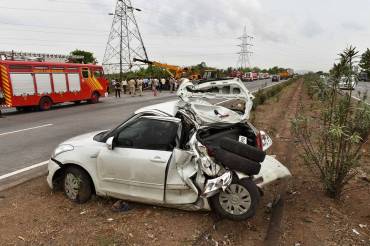
India’s roads are getting more dangerous, with 17 people dying in accidents every hour, a new government report shows.

“Much more needs to be done,” to make India’s roads safe, Sanjay Mitra, secretary of the Ministry of Roads and Transport said in the report.

The data is pretty damning. The total number of road accidents in India increased 2.5% in 2015, to 501,423. The number of people killed climbed 4.6% to 146,133. Injuries rose by 1.4%.

Road accidents also got more severe. The total number of people killed per 100 accidents was up 2.1% at 29.1 in 2015.

The Ministry of Roads and Transport said it had identified 700 “black spots” on roads, where more than five people died in the past year, and that it has earmarked 6 billion rupees ($89.9 million) to fix defects.

Source: 17 People Die on India’s Roads Every Hour, Report Says – India Real Time – WSJ

09/06/2016

‘The greatest palace that ever was’: Chinese archaeologists find evidence of the fabled imperial home of Kublai Khan’s Yuan dynasty | South China Morning Post

For centuries the imperial palace of Kublai Khan’s Yuan dynasty was shrouded in mystery.

After the dynasty collapsed, there were no clues as to where it was and it lived on only in legend through writings such as those of 13th century Venetian merchant Marco Polo.

If Polo is to be believed, the walls of “the greatest palace that ever was” were covered with gold and silver and the main hall was so large that it could easily seat 6,000 people for dinner.

“The palace was made of cane supported by 200 silk cords, which could be taken to pieces and transported easily when the emperor moved,” he wrote in his travel journal.

It was a vision of grandeur but the palace disappeared, seemingly without trace.

The Yuan dynasty lasted for a less than a century, spanning the years from 1279 to 1368, and it is widely believed that the capital of the empire was Beijing.

But in the centuries since, one question has dogged historians and archaeologists in China: just where was the dynasty’s palace?

Now experts at the Palace Museum in Beijing believe that they have some answers, clues they stumbled upon during upgrades to the heritage site’s underground power and fire-extinguishing systems.

According to historical records, the Yuan palace in Beijing was abandoned by its last emperor, Toghon Temür, who was overthrown by rebel troops that established the Ming dynasty in the 14th century.

Some experts believe the palace was razed by Ming soldiers who took over the city, while others insist the buildings were removed by Ming workers on the site of what was to become the Forbidden City.

The foundations for the sprawling Forbidden City were laid in 1406 and construction continued for another 14 years. It was the imperial palace for the Ming rulers and then the Qing dynasty until 1912.

The complex has been built up, layer by layer, but researchers sifting through the sands of archaeological time said last month that they had found evidence that at least part of the Yuan palace was beneath the site.

The researchers from the museum’s Institute of Archaeology said the proof was a 3 metre thick rammed earth and rubble foundation buried beneath the layers of Ming and Qing dynasty construction.

Institute deputy director Wang Guangyao said the foundation unearthed in the central-west part of the palace was in the same style as one uncovered in Zhangjiakou, Hebei province, in the ruins of Zhongdu, one of the four capitals of the Yuan dynasty.

Some of the rubble in the newly discovered Yuan foundation dated back even further to dynasties such as the Liao (907–1125) and the Jin (1115–1234), Wang said.

Wang said a foundation of such size was rare in Yuan buildings and could have been used to support a palatial hall.

At the very least, the find proved that the Yuan palace was built on the same site as the Ming palace, though it was still too early to say these two completely overlapped.

“At least we now know that the palace was not built somewhere else but here,” Wang said.

“From a historical perspective, it gives us evidence that the architectural history runs uninterrupted from the Yuan, to the Ming and Qing dynasties.

”The discovery has also revived debate about the Central Axis of Beijing – a 7.8km strip that runs from Yongding Gate to the Drum and Bell towers and included the Forbidden City, the Temple of Heaven and Zhongnanhai, the Communist Party leadership compound.

Many Chinese believe the axis has been the city’s “sacred backbone” since the Ming dynasty but others argue that it goes back further to the mid-13th century.

Wang said it was still too early to conclude whether the Yuan, Ming and Qing were built along the same axis.

“As archaeologists, we can only define what we have found,” Wang said. “But it gives us a direction for future exploration.”

Wang said it wasn’t easy to excavate in one of the country’s most important cultural sites and more work was still to be done.

Even if we think a certain site is important for an archaeological finding, we can’t just dig the ground up because it is not allowed,” Wang said.“All we can do is to wait and collect as much evidence as we can until sometime later, probably in a generation or two, work is done in those places and we can put all the finds together to see if they are all connected.

”The new discovery would be open to the public soon, Wang said.

Source: ‘The greatest palace that ever was’: Chinese archaeologists find evidence of the fabled imperial home of Kublai Khan’s Yuan dynasty | South China Morning Post

08/06/2016

This Is How Many Years Air Pollution Will Cut From Your Life Expectancy in India – India Real Time – WSJ

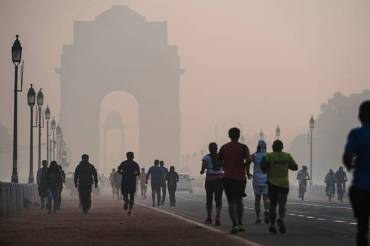
Living in India’s capital city New Delhi could shorten your life by six years because of the intensity of the air pollution there, a new report says.

Inhaling tiny air pollutants reduces the life expectancy of Indians by an average of 3.4 years, with Delhi residents losing 6.3 years, the most of all states, according to a new study by the Indian Institute of Tropical Meteorology.

Those living in West Bengal and Bihar, which have high levels of air pollution, face a reduction in life expectancy of 6.1 years and 5.7 years respectively.

The study, which used data from the latest population census of 2011, found that exposure to particulate matter 2.5 results in 570,000 premature deaths each year with an additional 12,000 caused by exposure to ozone.PM 2.5 is tiny particulate matter that is smaller than 2.5 micrometers in diameter. The air pollutants, originating from dust, soot and smoke, can penetrate deep into the lungs, increasing the risk of heart and lung diseases.

Source: This Is How Many Years Air Pollution Will Cut From Your Life Expectancy in India – India Real Time – WSJ

07/06/2016

Here’s How Indians Are Rating Narendra Modi’s Programs – India Real Time – WSJ

Two years into his five-year term, Indian Prime Minister Narendra Modi is asking his countrymen to rate a series of initiatives undertaken by his government.

Among the top scorers so far: an effort expand and modernize the railways and a program to build more roads. Toward the bottom of the favorability rankings: Mr. Modi’s Clean India campaign, which, among other things, aims to get people to use toilets instead of defecating outside.

Mr. Modi has become known for introducing a series of high-profile initiatives, from Make in India, which seeks to promote manufacturing, to pledges to build scores of so-called smart cities across the country.Of 21,770 respondents who had participated in the online survey on the government’s mygov.in website as of Tuesday morning, 70% gave a five-star rating to the government’s efforts to upgrade the rail system. People are asked to grade programs on a scale of one to five.

In the latest federal budget, the government earmarked $17 billion to improve the state-run railroad. Wi-Fi services are being rolled out at stations. And late last year, a deal was struck with Japan to help build India’s first high-speed rail line between Mumbai and Ahmedabad.

The government’s efforts to build more highways and improve the condition of roadways have also been popular with the people. More than 65% of the respondents to the survey gave these initiatives a five-star rating. The target this year is to build 9,300 miles of highways.People taking the survey also seemed satisfied by the government’s attempts to make electricity more accessible.

One of the worst performing programs, according to the current results of the survey, which is ongoing, is Swachh Bharat Abhiyaan, or the Clean India Mission. Only 33% of the respondents gave it a five-star rating. About 16% gave it score of one or two.

India’s Competitiveness and Prosperity Rankings Rise Under ModiIn October, a year into the program, another national survey also hinted at the public’s disappointment with its impact. More the 70% of those polled in that survey said the availability of public toilets hadn’t improved and their cities hadn’t become cleaner.

Mr. Modi is no stranger to crowdsourcing. He regularly encourages Indians to submit their thoughts for his weekly radio show. Prior to delivering his speech on India’s Independence Day last year, he asked citizens to submit their suggestions on what they’d like to hear him speak about. And they did, in hordes.

Source: Here’s How Indians Are Rating Narendra Modi’s Programs – India Real Time – WSJ

03/06/2016

The class ceiling | The Economist

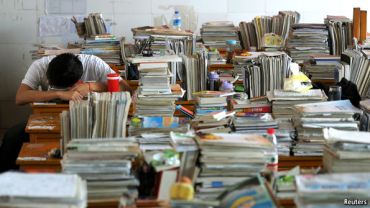
NO CAR may honk nor lorry rumble near secondary schools on the two days next week when students are taking their university entrance exams, known as gaokao. Teenagers have been cramming for years for these tests, which they believe (with justification) will determine their entire future. Yet it is at an earlier stage of education that an individual’s life chances in China are usually mapped out, often in ways that are deeply unfair.

To give more students access to higher education, the government has increased its investment in the sector fivefold since 1997. The number of universities has nearly doubled. In 1998 46% of secondary-school graduates went on to university. Now 88% of them do. About 7m people—roughly one-third of those aged between 18 and 22—now gain entry to some form of higher institution each year.

China’s universities offer more opportunity for social mobility than those in many other countries, says James Lee of Hong Kong University of Science and Technology. But the social backgrounds of those admitted have been changing. Until 1993, more than 40% of students were the children of farmers or factory workers. Now universities are crammed with people from wealthy, urban backgrounds. That is partly because a far bigger share of young people are middle-class. But it is also because rural Chinese face bigger hurdles getting into them than they used to.

The problem lies with inequality of access to senior high schools, which take students for the final three years of their secondary education. Students from rural backgrounds who go to such schools perform as well in the university entrance exams as those from urban areas. But most never get there. Less than 10% of young people in the countryside go to senior high schools compared with 70% of their urban counterparts. The result is that a third of urban youngsters complete tertiary education, compared with only 8% of young rural adults.

One reason is that junior high schools in the countryside are far weaker academically than urban ones. Local governments invest less in them per student than they do in cities. Urban parents tend to be better educated and thus better able to help children with their studies. Rural pupils often suffer from a “poverty of expectations”, says Jean Wei-Jun Yeung of the National University of Singapore: they are not encouraged to think they can succeed, so they do not try to.

Expense is a huge deterrent for many. Governments cover the costs of schooling for the nine years of compulsory education up to the age of around 15. But at senior high schools, families must pay tuition and other expenses; these outlays are among the highest in the world (measured by purchasing-power parity). Many students drop out of junior high school—which is free—because rising wages in low-skilled industrial work make the prospect of staying at school even less attractive. Millions enter the workforce every year who are barely literate or numerate. Poor nutrition is also a handicap. Stanford University’s Rural Education Action Programme has found that a high incidence of anaemia and intestinal worms in rural areas affects educational performance.

Since the 1990s more than 200m people have moved from the countryside to work in cities. Many have left their children behind because of the difficulty of getting them into urban schools: the country’s system of hukou, or household registration, makes it hard for migrant children to enjoy subsidised education in places other than their parents’ birthplace.

But migrant children who do attend schools in cities usually get a worse education than their city-born counterparts. State schools that accept migrant pupils often operate what Pei-chia Lan of National Taiwan University refers to as “apartheid school models”. In these, migrant children are taught separately from urban ones in the same school, and are even kept apart from them in the playground. Since they are forced to take senior high-school exams in the hometown of their hukou, many have little choice but to return to the countryside to attend junior high school.

Source: The class ceiling | The Economist

18/03/2016

We’re not gonna take it | The Economist

DELHI found itself under siege last month. Young men blocked roads and canals that feed people and water into the city. They looted, set fires and dragged women out of cars to rape them. The protesters, from a relatively privileged group of land-owning peasants called Jats, were agitating to be included in India’s list of “other backward classes”, which guarantees university places and government jobs.

Faced with dry taps, Narendra Modi’s government was eventually forced to concede to the demand.

This is the fury to which Somini Sengupta refers in the subtitle of her sharply observed study of India’s young, “The End of Karma: Hope and Fury Among India’s Young”. The median age in India is 27. Every month between 2011 and 2030, nearly 1m Indians will turn 18. Those coming of age this month were born well after the country started opening up its markets in 1991; they have spent their formative years in a world of optimism and rapid economic growth. But Ms Sengupta calls India “a democracy that makes promises it has no intention of keeping”. Advertisement

By 2030 the majority of Indians will be of working age. This could be what economists call a “demographic dividend”, creating a high worker-to-dependent ratio—or it could be a time bomb. India is producing nowhere near enough jobs for the tens of millions of young people joining the workforce every year.

The argument running through Ms Sengupta’s book, made of seven richly detailed portraits of young Indians, is both simple and beguiling. For centuries Indians born into wretched circumstances have accepted their lot as karma—punishment for misdeeds in past lives. This belief explains the persistence of the caste system, and the remarkable fact that a country that is home to one in three of the world’s poor has not come apart at the seams. But young people no longer accept karma, argues Ms Sengupta. Ideas of aspiration and free will have entered the Indian consciousness. Young Indians today demand the right to shape their own futures. If fury is in ample supply, so is hope.

Yet at every step the young are thwarted. It starts in the womb. A traditional preference for boys means that India has one of the most skewed sex ratios in the world: 1.13 boys for every girl, second only to China. (The ratio in America is 1.05.) One in three children under five is underweight. Nearly two-thirds of food meant for early-childhood feeding programmes is pilfered. A rare bright spot is education: in 2013, 96% of primary-school-age children were enrolled. But here, too, India fails its young. By the age of ten, only 60% of students can complete work at the level of a five-year-old. More than half cannot subtract.

Source: We’re not gonna take it | The Economist

20/02/2016

A slow awakening | The Economist

AROUND 270m people have left China’s countryside to work in urban areas, many of them entrusting their children to the care of a lone parent, grandparents, relatives or other guardians.

By 2010 there were 61m of these “left-behind children”, according to the All-China Women’s Federation. In a directive released on February 14th, the government has at last shown that it recognises the problems caused by the splintering of so many families. The document acknowledges that there has been a “strong reaction” from the public to the plight of affected children. It describes improving their lot as “urgent”.

That is clearly right. There have been numerous stories in recent years revealing the horrors some of these children endure. Last year four siblings left alone in the south-western province of Guizhou apparently committed suicide by drinking pesticide. Numerous sex-abuse cases involving left-behind children have come to light.

The new proposals look sensible enough: minors may not be abandoned entirely; local institutions such as schools and hospitals must do more to notify the authorities of cases of abuse or neglect; social workers should monitor the welfare of left-behind children. Sadly, however, the government’s suggested remedies will achieve little. They largely replicate recent laws and policies designed to protect children (not just left-behind ones), which have been almost universally unenforced. It is already illegal to allow minors to live alone, for example. There is no indication that the new recommendations will be made law or implemented any more rigorously.

The new scheme mentions the importance of giving migrants urban hukou, or household-registration certificates, which are needed to gain access to public services such as education and health care. Most migrants leave their children in the countryside because they do not have such papers. In December the government announced plans to make it easier for migrants to gain urban hukou privileges. But few casual labourers are likely to fulfil the still-onerous conditions that must be met to qualify.

A study published last year by researchers at Stanford University found that among more than 140,000 children assessed in areas such as education, health and nutrition, left-behind ones performed as well as or better than those living in the countryside with both parents. But both kinds of children lagged far behind those who grow up in cities.

Source: A slow awakening | The Economist

Law of Unintended Consequences

continuously updated blog about China & India

ChiaHou's Book Reviews

continuously updated blog about China & India

What's wrong with the world; and its economy

continuously updated blog about China & India