Archive for ‘Social & cultural’

10/07/2013

Are we talking the same language – Women and Communication at Work

Good insight from an Indian woman about Indian women at work.

Pointed out to me by Rohan Khanna. Many thanks.

Nita Kapoor's avatarNita Kapoor

The styles that men and women use to communicate have been described as “debate vs. relate”, “report vs. rapport, or “competitive vs. cooperative”. Men often seek straightforward solutions to problems and useful advice whereas women tend to try and establish intimacy by discussing problems and showing concern and empathy in order to reinforce relationships. Men focus more on trying to prove themselves to be better than the others in the group, while women want to make sure no one feels left out.

Some of these gender traits inculcated by the socialisation process show up in the issues faced by women in the corporate world. It has taken generations of struggle for women to come out of their homes and work at par with the men in this man’s world. Years into the feminist quantum leap, age old stereotype still prevails – if we women assert ourselves forcefully, people perceive us…

View original post 586 more words

01/07/2013

New China law says children ‘must visit parents’

Is China following Western countries into becoming a ‘nanny state’?

BBC: “Grown children in China must visit their parents or potentially face fines or jail, a new law that came into effect on Monday says.

File photo: a group of elderly men take a rest on their wheelchairs at a park in Beijing on 23 May 2013

China’s new “Elderly Rights Law” deals with the growing problem of lonely elderly people by ordering adult children to visit their aging parents.

The law says adults should care about their parents “spiritual needs” and “never neglect or snub elderly people”.

“Those who live far away from parents should go home often,” it adds.

But many across China are questioning how the law could be enforced, since it fails to spell out a detailed schedule dictating the frequency with which children should make parental house calls.

However, that does not mean the law is toothless.

Instead, it serves as an “educational message” to the public, while also serving as a starting point for law suits, explained Zhang Yan Feng, a lawyer with Beijing’s King & Capital Law Firm.

“It’s hard to put this law into practice, but not impossible,” Mr Zhang explained.

“If a case is brought to court on the basis of this law, I think it’ll probably end up in a peaceful settlement. But if no settlement is reached, technically speaking, court rulings can force the person to visit home certain times a month.”

“If this person disobeys court rulings, he could be fined or detained.””

via BBC News – New China law says children ‘must visit parents’.

29/06/2013

Chinese Official Sentenced to 13 Years in Sex Scandal That Was Exposed on Internet

NY Times: “Lei Zhengfu, a Chinese official who became a symbol of corruption, was convicted of taking bribes and sentenced to 13 years in prison on Friday in a scandal that exposed the sordid deal-making in Communist Party politics.

The conviction of Mr. Lei was the culmination of a fall that began when video images spread on the Internet in November showing him with an 18-year-old woman. The images, and ensuing accusations of graft and extortion, made him a much-mocked exhibit in the newly appointed Communist Party leadership’s efforts to persuade citizens that it was stamping out official graft and depravity, which have stoked deepening public ire.

Mr. Lei was sentenced days after President Xi Jinping made a new call to halt bureaucratic corruption and bribe-taking. A court in Chongqing, the municipality in southwest China where Mr. Lei once worked, dismissed his argument that a payoff of $488,000, or 3 million renminbi, he had arranged through an associate was a legitimate loan, not hush money to keep secret the video showing him with the young woman.

The court said the money amounted to a bribe.

“The sums involved were massive, and the effects were malign,” said the verdict read to Mr. Lei in the courtroom, according to Xinhua, China’s state-run news agency. “This should be sternly punished according to the law.”

China’s leaders have vowed to get rid of corrupt officials, however low or high. Before his dismissal in November, Mr. Lei was the party secretary of Beibei, a district of Chongqing. Critics said the spectacle of his trial did not make up for Mr. Xi’s failure thus far to take down senior officials, despite widespread speculation about corruption investigations in the government and the military involving powerful figures and large amounts of money.”

via Chinese Official Sentenced to 13 Years in Sex Scandal That Was Exposed on Internet – NYTimes.com.

28/06/2013

Looted statues returned to China in Pinault donation

BBC: “Two bronze animal heads, returned to China after more than 150 years, will soon be on display in their new home in Beijing’s National Museum of China.

The sculptures were bought by the Pinault family, who own French luxury group Kering, and donated to the Chinese government.

The rabbit and rat heads were looted from Beijing’s Old Summer Palace at the end of the Second Opium War in 1860.

China had tried to stop their sale when they came up for auction in 2009.

That auction ended in controversy when a Chinese man bid successfully for them, but did not pay, as a “patriotic act”.

The statues had come up for sale following the death of fashion designer Yves Saint Laurent.

Kering’s brands, which include Saint Laurent as well as Gucci and Alexander McQueen, are popular in China’s booming luxury market.

In a statement in April announcing their donation of the statues, the Pinault family said they had gone to “great efforts to retrieve these two significant treasures of China and strongly believe they belong in their rightful home”.

At a ceremony at the National Museum on Friday attended by Chinese Vice Premier Liu Yandong, Francois Pinault was awarded a certificate of donation, according to the State Administration of Cultural Heritage.

The bronze animal heads were among 12 which previously adorned a zodiac fountain in the destroyed Old Summer Palace.

The palace, known as Yuanming Yuan, was sacked by British and French forces.

The heads disappeared, but it remains unclear when, how and by whom they were taken out of China.

Of the 12, the ox, monkey, tiger, pig and horse heads have already been returned, the state-run China News Service reports.

The whereabouts of the other five animal heads, the dragon, dog, snake, sheep and chicken, are currently unknown, it adds.”

via BBC News – Looted statues returned to China in Pinault donation.

See also: https://chindia-alert.org/historical-perspectives/

28/06/2013

Death toll from Xinjiang attacks rises to 35

SCMP: “Beijing yesterday raised the death toll from a series of attacks in Turpan , Xinjiang , on Wednesday from 27 to 35.

e22b4f2d9201a0f19cff5f0782b8ea82.jpg

Twenty-four were killed by rioters, including two policemen, Xinhua said, adding that 16 of them were Uygurs. Police killed 11 rioters, while 21 police officers and civilians were injured.

Xinhua said an unspecified number of “mobsters” stormed the government office, the police station, the People’s Armed Police base and a construction site in Lukqun township, Shanshan county, at around 5.50am on Wednesday. The authorities did not mention that a PAP base was also among the targets of attacks until yesterday.

It said four suspected rioters who were injured had been detained.

It was the first Chinese-language report on the incident released by Xinhua, which carried an English report roughly seven hours after the attacks.

Neither report mentioned the number of attackers, their ethnicity or what caused the attacks. But yesterday’s report branded the incident a “violent terrorist attack”.

A visitor to Turpan yesterday said he saw a roadblock with armed police officers and about 20 police vehicles.

A resident said a helicopter arrived on the scene along with many police and soldiers.

The Global Times, a tabloid affiliated with the People’s Daily, yesterday quoted an unnamed regional official as saying that “earlier this year local police handled a case in which a store was attacked, which might have triggered that violence”.

The attack came less than two weeks ahead of the fourth anniversary of ethnic clashes between Han Chinese and Uygurs in Urumqi , the regional capital, which left nearly 200 dead. Two months ago, 15 policemen or officials and six assailants were killed in another conflict in Bachu county, Kashgar , which involved attackers armed with knives and axes and the burning of a house.

A Lukqun resident told the South China Morning Post by phone that local officials had told people to stay at home and be vigilant soon after the violence on Wednesday, adding that dozens of militia soldiers from his village were patrolling the streets.

It was the deadliest unrest in the region since the media-savvy Zhang Chunxian became regional party secretary in April 2010, less than a year after the bloody clashes in Urumqi.”

via Death toll from Xinjiang attacks rises to 35 | South China Morning Post.

See also:

28/06/2013

Exposure via internet now China’s top weapon in war on graft

SCMP: “The internet has become the primary tool for exposing corruption on the mainland, “removing a corrupt official with the click of a mouse”, according to a leading think tank’s analysis.

internet_pek06_35887719.jpg

In its Blue Book of New Media, researchers from the Chinese Academy of Social Sciences (CASS) said that 156 corruption cases between 2010 and last year were first brought to light online – compared with 78 cases to resulting from reports in traditional media.

Forty-four cases involving disciplinary violations were first exposed in some form online, while 29 cases followed print and broadcast stories. Sixteen cases citing abuses of power were exposed online; 10 were revealed in traditional media.

Among the latest officials to fall from grace thanks to online revelations was Liu Tienan , a former deputy chief of the National Development and Reform Commission.

Liu was sacked in mid-May, more than five months after an editor of the influential Caijing magazine used his microblog account to expose allegations against him.

The report said revelations online, and the rise in interest in public affairs the internet had engendered, were the main reasons more people were participating in anti-corruption efforts.

However, the report cautioned that such efforts still had a long way to go. Only five officials of above departmental rank were brought down via online exposures last year – just a fraction of the 950 officials of that level who were probed for crimes.

The mainland had 564 million internet users at the end of last year, including 309 million microbloggers, according to the China Internet Network Information Centre. The Blue Book said the online community would likely exceed 600 million this year.

The new-media boom has posed an unprecedented challenge to Communist Party rulers, experts warned, due to the easy spread of information, including rumours. The report blamed the online rumour mill on governments’ declining credibility and growing concern on the part of the public.”

via Exposure via internet now China’s top weapon in war on graft | South China Morning Post.

See also: https://chindia-alert.org/2012/04/26/understanding-social-media-in-china/

27/06/2013

Shenzhen visitor at Hong Kong jewellery fair finds and returns HK$250m bag of diamonds

SCMP: “It’s not every day that someone in Hong Kong finds a bag of diamonds worth HK$250 million lying around. Even more rare is someone who would willingly return it.

tpbje20130620344_36503091_1.jpg

But mainland tourist Fu Zhuli did just that during a trip to a local jewellery fair at the weekend.

On Sunday, the woman from Shenzhen was strolling through the exhibition hall of the Hong Kong Jewellery & Gem Fair at the Convention and Exhibition Centre when she decided to take a short break.

“I went to the café to take a rest and have some chocolate ice-cream. I saw two foreigners chatting…after a while, they left – empty-handed. After a while, when the cleaners came to take the rubbish out, I realised there was a black bag at the foot of their table,” Fu told the Shenzhen Daily.

Fu said she could recognise their faces and tell from their accents that the foreigners were from Israel and possibily from the Israeli pavillion in the hall. She went over to pick up the bag and upon opening it, was shocked to find a trove of “good quality, soy-bean-sized roughs”.

Fu, a jewellery enthusiast, estimated the price of each diamond at about 400,000 yuan to 800,000 yuan (HK$500,000 to HK$1 million) and the total parcel of gems worth at least 200 million yuan. The bag weighed about 3kg.

None of the figures she stated could be confirmed.

After Fu sat at the table “guarding the bag” and thinking of what to do for two hours, one of the young foreigners came running back into the café.

“The shirt on his back was soaked with sweat, and his face was pale. He rushed in and saw the bag with me and leaned forward, uttered some incoherent words and kept bowing and saying ‘thank you’ in Putonghua,” she recounted. “I told him off for being so careless and leaving something so precious behind.”

Asked whether she had ever thought of taking the bag, Fu said: “No, I felt I was lucky enough to have seen those nice diamonds. You know, women love jewellery.” She said that she was a Christian and that her husband, who works in the Shenzhen police force, had told her to report the finding to police immediately. She admitted that some of her friends had told her to keep the bag.

“I never thought of doing that, I just felt like [the men] would come back to get it so I just sat there and waited,” Fu told the Shenzhen Daily. “I am a very honest, simple person and I believe in sincerity.””

via Shenzhen visitor at Hong Kong jewellery fair finds and returns HK$250m bag of diamonds | South China Morning Post.

26/06/2013

Violence in China’s Xinjiang ‘kills 27’

BBC: “Riots have killed 27 people in China’s restive far western region of Xinjiang, Chinese state media report.
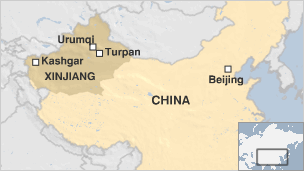
Map

The violence broke out in Turpan prefecture early on Wednesday.

Police opened fire after a mob armed with knives attacked police stations and a local government building, Xinhua news agency quoted officials as saying.

There are sporadic outbreaks of violence in Xinjiang, where there are ethnic tensions between Muslim Uighur and Han Chinese communities.

Confirming reports from the region is difficult because information is tightly controlled.

China’s state media have been quick to issue an official version of events regarding the latest round of violence in Xinjiang, but it will be tough to verify those reports.

Xinjiang lies on China’s remote north-west border and it is difficult for foreign media to travel there. Many people on both sides of the conflict are reluctant to speak to visiting journalists for fear of reprisals if they dispute the government’s stance.

Unfortunately Xinjiang usually hits international headlines when violence flares between the region’s minority ethnic Uighur Muslims and the majority Han Chinese. Many Uighurs contend that their language and religion are being smothered by an influx of Han Chinese migrants.

Xinjiang is a large geographic area rich in oil and gas deposits. Soon it will also become a major supplier of coal to China’s energy-hungry cities. The region’s fertile land also grows produce that is shipped to the rest of the country. The Han Chinese who move to Xinjiang hope to benefit from the region’s untapped resources.

The violence occurred in Turpan‘s remote township of Lukqun, about 200km (120 miles) south-east of the region’s capital, Urumqi.

The Xinhua news agency report, citing local officials, said rioters stabbed people and set police cars alight.

Seventeen people, including nine security personnel and eight civilians, were killed before police shot dead 10 of the rioters, it said.

At least three others were injured and were being treated in hospital, it added.

The Xinhua report did not provide any information on the ethnicity of those involved in the riot or on what sparked it.

But Dilxat Raxit, a spokesperson for the World Uighur Congress, an umbrella organisation of Uighur groups, told the Associated Press news agency the violence had been caused by the Chinese government’s “sustained repression and provocation” of the Uighur community.

In 2009 almost 200 people – mostly Han Chinese – were killed after deadly rioting erupted in Urumqi between the Han Chinese and Uighur communities.

In April an incident in the city of Kashgar left 21 people dead.

Uighurs and Xinjiang

Uighurs are ethnically Turkic Muslims. They make up about 45% of the region’s population; 40% are Han Chinese

China re-established control in 1949 after crushing short-lived state of East Turkestan. Since then, large-scale immigration of Han Chinese. Uighurs fear erosion of traditional culture.

The government said the violence began when “terrorists” were discovered in a building by officials searching for weapons.

But local people told the BBC that the violence involved a local family who had a longstanding dispute with officials who had been pressurising the men to shave off their beards and the women to take off their veils.

Uighurs make up about 45% of Xinjiang’s population, but say an influx of Han Chinese residents has marginalised their traditional culture.”

via BBC News – Violence in China’s Xinjiang ‘kills 27’.

See also: https://chindia-alert.org/political-factors/chinese-tensions/

21/06/2013

Tibet policy: Bold new proposals

Finally some one with a new idea for Tibet. Hopefully some progress will be made.

The Economist: “FEW outside China think the Communist Party’s strategy for Tibet is working. A combination of economic development and political repression was meant to reconcile Tibetans to Chinese rule and wean them off their loyalty to the Dalai Lama, the exiled spiritual leader. Instead disaffection is still rife, especially among the young. And all across Tibetan areas of China, Tibetans still display the Dalai Lama’s portrait, sometimes openly. Since March 2011 more than 100 Tibetans—especially in Tibetan areas of provinces bordering what China calls the Tibet Autonomous Region (TAR)—have set themselves on fire. Most have done so in part to call for the Dalai Lama’s homecoming. An overwhelming security presence and the Dalai Lama’s commitment to non-violence mean that the unrest is easily contained. Hence little has suggested that China’s leaders are concerned about the bleak implications for the future: that their rule in Tibet can be maintained only by the indefinite deployment of massive coercive force.

So for a Chinese scholar, Jin Wei, who is director of ethnic and religious studies at the Central Party School in Beijing, to call for a “creative” new approach is startling. For her to do so publicly, in an interview this month with a Hong Kong magazine, Asia Weekly, suggests that she has high-level backing. A report from a Beijing think-tank in 2009 challenged the official line that rioting in Tibet the year before was instigated from abroad. But Robert Barnett, a professor of Tibetan studies at Columbia University in New York, describes Ms Jin’s intervention as a sign that, after two decades, “debate has re-emerged within China about the government’s hard-line policies in Tibet”. Ms Jin even accused former party chiefs in Tibet of being “biased against the practice of religious affairs”. This, she said, “foreshadowed the accumulation of grievances today.”

Bold new proposals

One former party secretary in Tibet (from 1988-92) was Hu Jintao, who went on to head the party nationally for ten years until last November, when he gave way to Xi Jinping. Those who have forecast that Mr Xi might prove a bolder reformer than the cautious Mr Hu have so far seen little to back them up. Here, on Tibet, is at least a hint of a crack in the hardline consensus. Some have detected another in the appointment of Yu Zhengsheng to head the party’s main policy group on Tibet and Xinjiang, a Muslim-majority region in the north-west. Mr Yu is the head of an advisory body designed to promote national unity. Previous heads of the group have been security specialists.

This is new

Ms Jin’s analysis, though couched in the terminology of party orthodoxy, is similar to that of many foreign observers. She argues that, by demonising the Dalai Lama, and viewing any expression of Tibetan culture as potentially subversive, the party has turned even those Tibetans sympathetic to its aims against it. The struggle has evolved from “a contradiction between the central government and the Dalai Lama separatist clique into an ethnic conflict between Han Chinese and Tibetans”.

She is not advocating a new soft approach to “political” issues, such as the Dalai Lama’s call for greater autonomy for Tibet and Tibetans’ hankering after a “greater Tibet”—ie, within its historic borders, beyond the TAR. But in fact, most protests in Tibet are not about “politics”, defined like this. Many have been sparked by anger at Chinese repression—of Tibetan culture, language and tradition, or of individual protesters. It is a vicious circle, made worse by anger at the large-scale immigration into Tibet of Han Chinese.

Ms Jin has ideas on how to break the impasse. Talks with the Dalai Lama’s representatives, stalled since the most recent of nine fruitless rounds in 2010, should resume, she says. They should concentrate on “easy” issues first, setting contentious debate about Tibet’s status to one side for now. China should consider inviting the Dalai Lama to visit one of its semi-autonomous cities, Hong Kong or Macau, and eventually allowing him back to Tibet. It should also try to defuse the crisis his death will bring by agreeing with him on a chosen reincarnation from inside China’s borders. Otherwise, China risks having to deal with two incarnations: one it endorses and one in exile who is more likely to be revered by most Tibetans.”

via Tibet policy: Bold new proposals | The Economist.

21/06/2013

China: Panic during David Beckham’s visit

What a performance – not by David – but by the crowd.

Law of Unintended Consequences

continuously updated blog about China & India

ChiaHou's Book Reviews

continuously updated blog about China & India

What's wrong with the world; and its economy

continuously updated blog about China & India