Archive for ‘Petitions’

07/10/2019

Aarey protests: Supreme Court steps in to save Mumbai trees after protests

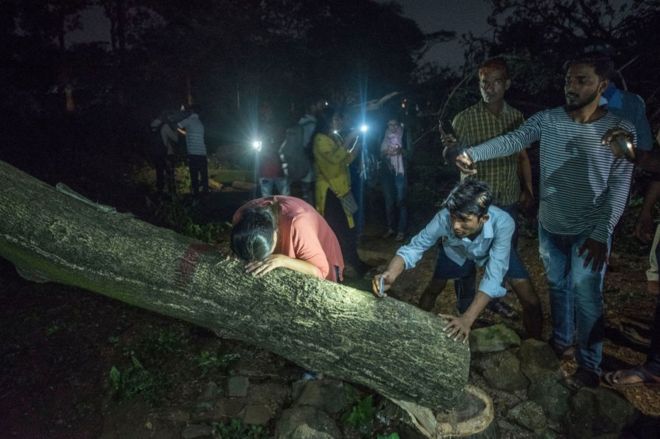
Protesters cry over felled trees in Aarey colony on October 5, 2019 in Mumbai, India.Image copyright GETTY IMAGES
Image caption Protesters cry over felled trees in Aarey colony

India’s top court has asked officials to stop cutting trees in a forested area in Mumbai city after protesters clashed with police over the weekend.

The trees, part of a green strip known as Aarey colony, were being cut to make way for a new metro rail project.

Locals have long opposed the move, and filed petitions seeking Aarey to be declared a protected area.

But a high court dismissed the petitions on Friday, sparking protests as officials began felling the trees.

They planned to cut 2,185 trees, and admitted in the Supreme Court that more than 1,500 had already been cut. But petitioners claim that officials have cut around 2,500 trees.

Local residents, students and environmental activists clashed with police on Friday as they took to the streets to stop authorities, and even broke through barricades to enter Aarey colony. More than 50 people were arrested and police imposed restrictions on public gatherings.

The protests grabbed the national spotlight over the weekend, and the Supreme Court took suo moto (without a formal complaint from any party) notice.

What did the Supreme Court say?

A special two-judge bench heard the matter on Monday after students wrote to the chief justice, asking the court to intervene and save the trees.

The court asked the state government of Maharashtra, where Mumbai is located, to not cut any more trees.
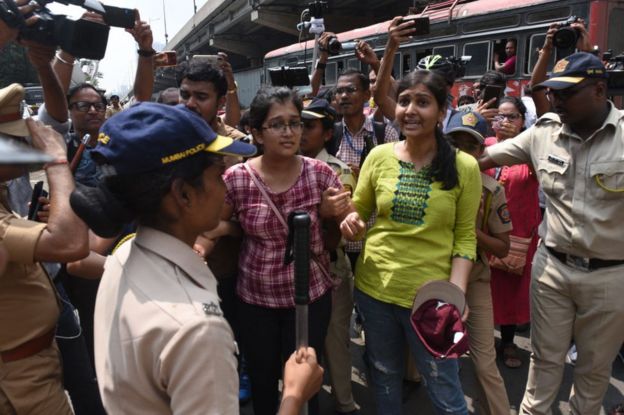
Activists were forcefully evacuated from Aarey Checknaka and taken to local Police Station at Goregaon, on October 5, 2019 in Mumbai, India.Image copyright GETTY IMAGES
Image caption Police arrested more than 50 protesters

The court also asked the government to maintain “status quo” – which means that no construction can take place – until 21 October when it will hear the matter again.

The court also ordered the release of all activists who were arrested or detained on bail.

What is Aarey colony?

Spread over 1,300 hectares (3,212 acres), Aarey is a densely forested area dotted with lakes and has the Mithi river flowing through it. It lies at the heart of Mumbai and is often referred to as its last green lung.

It’s locally known as the Aarey “milk colony” because most of the land was given to the department of dairy development in 1951. But they are allowed to grow cattle fodder only on a fraction of the land.

Activists break barricades to stop authorities from cutting at the main gate of Metro car shed , Picnic point, Aarey colony , Goregaon east, on October 5, 2019 in Mumbai.Image copyright GETTY IMAGES
Image caption Protesters broke through barricades and clashed with police on Friday

Earlier this year, officials cleared some 40 hectares of the forested area to build a zoo, complete with a night safari. And now, locals complain, another slice of it is in danger from the metro construction.

They also fear that the government will eventually clear the way for private builders to encroach on the Sanjay Gandhi National Park, which lies to the north of Aarey colony.

Officials, however, dismiss these fears as unfounded and point out that the construction for the metro only requires 30 hectares.

How crucial is the metro rail for Mumbai?

The city badly needs a “mass rapid transport system,” Ashwini Bhide, managing director of the Mumbai metro rail corporation, had told the BBC earlier.

The land in Aarey colony, she said, was “the most suitable land due to its size, shape and location”.

She has also been defending the decision to cut the trees on Twitter.

Presentational white space

India’s financial hub is congested and infamous for its crawling traffic jams.

Its colonial-era local train system ferries some 7.5 million people between the city’s suburbs and its centre on a daily basis.

Officials say that the metro will eventually carry around 1.7 million passengers every day and bring down the number of vehicles on the road by up to 650,000.

Source: The BBC

26/04/2014

Beijing’s Struggle to Keep People in Their Place – China Real Time Report – WSJ

China’s Communist Party has a message for the country’s put-upon rural residents: Don’t come to us, we’ll come to you.

Earlier this week, Beijing announced new regulations banning citizens from petitioning outside their home provinces – essentially an effort to keep the country’s poor and disgruntled from bringing their grievances to the capital.

At the same time, the Party is insisting that more of its members meet people where they live, employing “pocket cadres” whose mission is to, as the People’s Daily put it, “go the last mile, [and] have a more direct relationship with the masses.”

Chinese leaders have tried to keep aggrieved rural residents in their place before, with little success. The effort to reach out to them through this new campaign appears to be an acknowledgement of past failures. But it also betrays a nostalgia for political ideas that seem out of step with some of the major realities of the moment.

The purpose of the “pocket cadre” campaign — which has been taking place primarily in China’s countryside — is two-fold:  to listen more to the complaints of residents in various regions “by going face-to-face, through home visits to hear their voices”; and to educate the masses about what the Party is already accomplishing on their behalf.

That way, Beijing believes, Party representative will be then “better able to do practical things for the people, problem-solving things.”

The “pocket” part of the strategy, according to Xinhua, refers to satchels that cadres carry on these missions to “collect suggestions from villagers” and to cart in needed items such as salt and medicine to outlying areas that residents have requested.

More In government

China Has Already Tried Democracy. Or Has It?

Wukan: New Election, Same Old Story

China’s 2014 Holiday Schedule: Still Complicated

Volvo Discovers the Benefits of Being Chinese

Etiquette Catches On in China, Even in Government

These officials also often carry a “pocket-sized book”– which is “small in size, convenient to take along, and which can be used to commit to memory and allow Party members to convey current policies in a format that the masses can grasp easily.”

By making these treks into villages, the Party displays an interest in the daily lives of rural inhabitants, and pushes officials to play a role in resolving local disputes — while also pinpointing potential sources of discontent before they emerge.

The upside of this initiative is not inconsiderable. Rural residents appear to appreciate the concern shown by cadres, and have come to rely on both their visits and the appearance of “demand boxes“ that enable citizens to identify specific complaints but have them acted on locally.

Party representatives also have to be pleased that people who might otherwise petition higher levels for redress have a new avenue for seeking out officials to help solve their problems.

Finally, there’s the chance that this experiment, which is largely targeted on the Chinese countryside, could be employed elsewhere in the country, and provide a precursor for greater political dialogue in the society.

via Beijing’s Struggle to Keep People in Their Place – China Real Time Report – WSJ.

Enhanced by Zemanta
01/01/2013

* Reform now or there’ll be a revolution, Chinese leaders told

The Times: “China faces the prospect of “violent revolution” if the Government fails to implement political reform, a group of prominent intellectuals is warning six weeks after the country’s change of leadership.

Liu Xia was filmed in her house as activists pushed past the guards

The call, from 73 of China’s leading scholars, came as dramatic footage emerged yesterday of activists pushing past security officials to reach Liu Xia, the wife of the Nobel Prizewinning dissident Liu Xiaobo.

In a pointed open letter, the academics warn: “If reforms to the system urgently needed by Chinese society keep being frustrated and stagnate without progress, then … China will again miss the opportunity for peaceful reform, and slip into the turbulence and chaos of violent revolution.”

Drafted by Zhang Qianfan, a Law Professor at Peking University, the letter has garnered signatures from such prominent figures as Zhang Sizhi, a lawyer who is known in China as “the conscience of the legal world” and is best known abroad as the man who defended Mao Zedong’s widow at her 1980 trial. Other well-known signatories include Hu Xingdou, a noted economist at the Beijing Institute of Technology, and Jiang Ping, the former dean of the Chinese University of Political Science and Law.

The letter was circulated on the internet but was quickly removed from Chinese news sites, and links to it have been removed from Mr Zhang’s profile on the microblog Weibo.

Entitled “An Initiative on Reform Consensus”, it has echoes of Charter 08, a manifesto published in 2008 calling for the protection of human rights and an end to one-party rule. The main author of that manifesto, Liu Xiaobo, was arrested on charges of subversion and sentenced to 11 years’ imprisonment in December 2009.

In a separate development Hu Jia, one of China’s leading dissidents, broke through a security cordon to enter the apartment of Mr Liu’s wife, who has been kept under house arrest since her husband won the peace prize. In a video clip of the confrontation, which was posted on YouTube yesterday, a security official is shown telling Mr Hu and two other activists that it will not be possible for them to see Ms Liu. In response, the three force their way past, saying: “Who are you to tell us it’s not possible?”

Although the petition, signed by the 73 academics last week, raises the spectre of violent revolution, the demands made are not as radical as those found in Liu Xiaobo’s 2008 charter. The signatories to the latest letter urge China’s new leaders to rule according to the country’s constitution. In particular, the letter underlines the Government’s duty to protect freedom of speech, the press and the right to demonstrate, to deepen market reform and to allow for an independent judiciary.

These advocates of reform may have been encouraged by signals sent out by Xi Jinping, China’s new leader, who succeeded Hu Jintao as General Secretary of the Communist Party in November.

Commentators have noted Mr Xi’s easy-going style compared with his predecessors and his decision to do away with red carpets for officials.

He has been quoted in the state press saying: “The Government earnestly wants to study the issues that are being brought up, and wants to perfect the market economy system … by deepening reform, and resolve the issues by strengthening rule of law.”

Judged by actions, the signals sent out by the new government have been mixed. An apparent easing of internet searching restrictions, during which it was possible to search Chinese microblogs for the names of top officials for the first time in months, was followed by legislation that critics say will discourage free commenting online by requiring real-name registration for internet users.

Similar hopes that Mr Hu would prove to be a reformer, which were aired when he first took office, were later dashed by years of stagnation on political reform, a period that has come to be known by many as the “lost decade”.”

via Reform now or there’ll be a revolution, Chinese leaders told | The Times.

31/07/2012

This post supports my view that the Chinese authorities are trying very hard to listen to the people.

14/07/2012

* China top leaders vow to better handle people’s petitions

Xinhua: “China’s top leaders on Friday met representatives for a nationwide conference on the work of handling the people’s petitions, vowing to safeguard the people’s rights and interests and strengthen ties between the authorities and the people.

President Hu Jintao, Premier Wen Jiabao, Vice President Xi Jinping and Vice Premier Li Keqiang met the representatives before the conference, extending their greetings to all the government staff handling the people’s letters and calls.

Zhou Yongkang, a member of the Standing Committee of the Political Bureau of the Communist Party of China (CPC) Central Committee, and secretary of the Committee of Political and Legislative Affairs of the CPC Central Committee, also met representatives and delivered a speech at the conference.

The petitioning, also known as letters and calls, is the administrative system for hearing complaints and grievances from Chinese citizens.

The bureaus of letters and calls at all levels are commissioned to receive letters, calls, and visits from individuals or groups, and then channel the issues to respective departments, and monitor the progress of settlement.”

via China top leaders vow to better handle people’s petitions – Xinhua | English.news.cn.

Petitioning has been a historic means for members of the public, however lowly to put forward their grievances to someone high enough to deal with it. Sometimes, a petition would go all the way to the Emperor or, at least, to his chief minister.

The Chinese government is merely reaffirming this historic practice.

See also: http://en.wikipedia.org/wiki/Petitioning_(China)

Law of Unintended Consequences

continuously updated blog about China & India

ChiaHou's Book Reviews

continuously updated blog about China & India

What's wrong with the world; and its economy

continuously updated blog about China & India