Chindia Alert: You’ll be Living in their World Very Soon
aims to alert you to the threats and opportunities that China and India present. China and India require serious attention; case of ‘hidden dragon and crouching tiger’.
Without this attention, governments, businesses and, indeed, individuals may find themselves at a great disadvantage sooner rather than later.
The POSTs (front webpages) are mainly 'cuttings' from reliable sources, updated continuously.
The PAGEs (see Tabs, above) attempt to make the information more meaningful by putting some structure to the information we have researched and assembled since 2006.
Image copyright GETTY IMAGESImage caption Small groups of young people can be seen playing sports as schools, colleges and even gyms are shut.
Life in India has changed dramatically as the world’s second-most populous country grapples with the coronavirus outbreak.
Otherwise crowded and chaotic cities have quietened down as people stay home, traffic slows and even weddings shrink in size and scale.
India has confirmed 151 active cases and three deaths – but public health experts fear that the low count is the result of limited testing and under-reporting. The country has only conducted about 12,000 tests so far, partly because of a shortage of testing kits.
So it’s still unclear if and to what extent community transmission exists in India – community transmission means a patient had no known contact with another confirmed case or travelled from a country badly affected by the pandemic.
However, India’s central government, several state governments and city administrations have already responded with drastic measures.
Image copyright GETTY IMAGES
The Indira Gandhi international airport in the national capital Delhi, is the country’s busiest airport but it appears deserted nowadays.
India has barred entry to everyone, including citizens, flying from certain countries, including the UK and most European nations. It has also cancelled most entry visas to people (excluding citizens) flying in from other countries.
This has led to numerous flight cancellations.
Airlines are also struggling as fewer people are flying even within India, wary that new regulations could see them stranded away from their homes. Two of India’s top airlines are reportedly considering grounding planes amid plummeting demand for flights.
Image copyright GETTY IMAGES
Popular Indian monuments – such as the 16th Century Red Fort in Delhi – have been shut to visitors to prevent large gatherings.
Taj Mahal, the country’s most iconic monument, closed its doors on Tuesday, along with more than 140 other monuments and museums.
With fewer people visiting and closures of public places likely to go up, tourism is expected to take a huge hit across India – the Taj alone draws as many as 70,000 people a day.
Image copyright GETTY IMAGES
Bangalore, an IT hub in southern India, is among the major cities that has shut down its malls – such as the one above – and schools, colleges, cinema halls and other public places have been closed since late last week. Other major cities such as Delhi, the financial hub Mumbai and Hyderabad in the south, have done the same.
City officials have also imposed restrictions on large gatherings such as weddings, cricket matches or any public ticketed events.
Image copyright GETTY IMAGES
Some of Delhi’s busiest spots, such as Connaught Place, are mostly empty.
There has also been a significant drop in the number of people using trains, which remain the most popular form of transport in India.
Image copyright GETTY IMAGES
The service from Mumbai to Pune city – which takes about three to four hours – has seen about a 30% fall in passenger traffic, according to some estimates.
The western state of Maharashtra, where both cities are located, has reported the highest number of cases in India so far. The central railways has already cancelled 23 long distance trains going to and from Mumbai – officials say the reason is both the virus and the lower number of passengers.
Overall, more than 150 trains have been cancelled across India. This number could increase in coming days.
Image copyright GETTY IMAGES
Many holy sites, including the Golden Temple – one of the holiest shrines in Sikhism – remain open, although the footfall is much lower. It’s quite unusual to see such few people in what is one of India’s busiest shrines.
Tirumala Tirupati, the richest Hindu temple, has cancelled many of its daily rituals and is restricting the number of pilgrims for the first time.
Some major Hindu temples, such as the Siddhivinayak temple in the heart of Mumbai, and the Vaishno Devi cave shrine, have closed.
Image copyright GETTY IMAGES
City officials in Delhi have begun sanitising auto rickshaws and taxis to contain the spread of the virus.
Public transport poses a major challenge to containing the outbreak. But it continues to be used regularly across India, even as governments encourage people to stay home as much as possible.
But not all offices have work from home options, and this is especially a challenge for the millions who work in India’s informal sector – these include domestic help, street vendors and daily wage workers.
Image copyright GETTY IMAGES
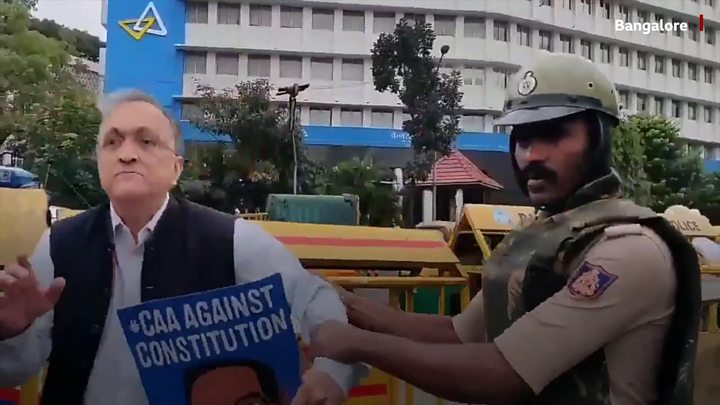
Surprisingly, sit-in protests against India’s controversial new citizenship law continue in some cities, including Delhi and Bangalore.
The most prominent of these, pictured above, is happening in Delhi’s Shaheen Bagh neighbourhood. Thousands of protesters, mostly Muslim women, have been demonstrating against the law, which critics say is anti-Muslim, since December.
But Delhi has shut down schools, colleges, gyms, night clubs, spas and swimming pools – and Chief Minister Arvind Kejriwal has said all social, political and religious gatherings with more than 50 people would be stopped.
Image copyright GETTY IMAGES
Temperature checks have become a common feature across cities – here, people are being screened before they enter the high court in the eastern city of Kolkata (formerly Calcutta).
This practice has been adopted at airports, corporate offices and several other places that remain open despite the restrictions.
Image copyright GETTY IMAGES
In the southern city of Hyderabad, students appeared for their school-leaving exams, but they came armed with masks.
Delhi, however, has postponed all school examinations.
Experts say India could impose more sweeping lockdowns as the toll climbs further.
Image copyright ANIImage caption Ms Leona was charged with sedition at a protest event in Bangalore city
An Indian woman has been arrested and charged with sedition for chanting “long live Pakistan” at a protest in the southern city of Bangalore.
Amulya Leona was participating in a demonstration against a controversial citizenship law, which critics say discriminates against Muslims.
Her comments were immediately condemned by a prominent local Muslim politician.
Asaduddin Owaisi, who was at the rally, said neither he nor his party supported India’s “enemy nation Pakistan”.
Muslim politicians in Hindu-majority India are often targeted as being “pro-Pakistan” by political rivals, particularly in the last few years. The neighbouring countries have a historically tense relationship, fighting three wars since Pakistan’s formation following the partition of India in 1947.
After the incident at the protest against the Citizenship Amendment Act (CAA) went viral, Ms Leona and her family were the target of massive outrage.
Clips of her comment were circulated widely, and her father has complained that a group of people came to his house and forced him to chant “hail mother India”. They also told him that he had not brought his daughter up properly and threatened him against getting bail for her.
Police in the district told BBC Hindi that they are investigating his complaint, adding that Ms Leona would be produced before a judicial magistrate in 14 days.
What is the CAA?
The law offers amnesty to non-Muslim illegal immigrants from three countries – Pakistan, Bangladesh and Afghanistan.
It amends India’s 64-year-old citizenship law, which currently prohibits illegal migrants from becoming Indian citizens.
Media caption Anti-citizenship law protests spread across Indian cities
It also expedites the path to Indian citizenship for members of six religious minority communities – Hindu, Sikh, Buddhist, Jain, Parsi and Christian – if they can prove that they are from Muslim-majority Pakistan, Afghanistan or Bangladesh. They will now only have to live or work in India for six years – instead of 11 years – before becoming eligible to apply for citizenship.
The government says this will give sanctuary to people fleeing religious persecution, but critics argue that it will marginalise India’s Muslim minority.
Image copyright GETTY IMAGESImage caption Discrimination against women on account of menstruation is widespread in India
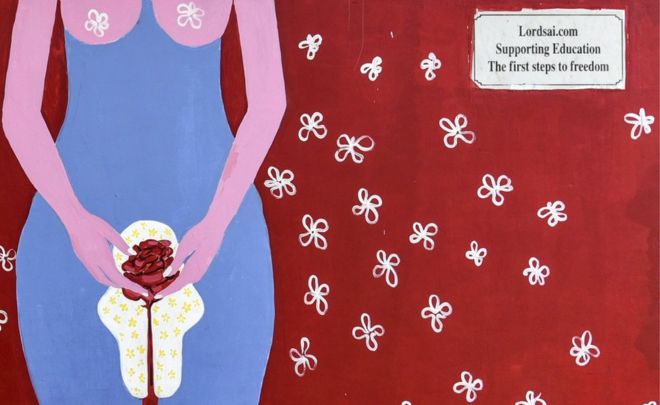
India’s uncomfortable relationship with periods is back in the headlines.
College students living in a hostel in the western Indian state of Gujarat have complained that they were made to strip and show their underwear to female teachers to prove that they were not menstruating.
The 68 young women were pulled out of classrooms and taken to the toilet, where they were asked to individually remove their knickers for inspection.
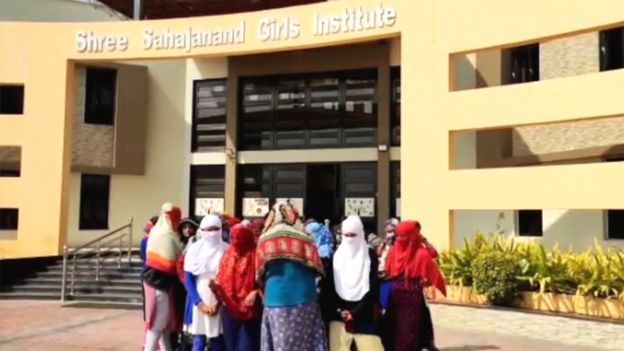
The incident took place in the city of Bhuj on Tuesday. The young women are undergraduate students at Shree Sahajanand Girls Institute (SSGI), which is run by Swaminarayan sect, a wealthy and conservative Hindu religious group.
They said a hostel official had complained to the college principal on Monday that some of the students were breaking rules menstruating women are supposed to follow.
According to these rules, women are barred from entering the temple and the kitchen and are not allowed to touch other students during their periods.
At meal times, they have to sit away from others, they have to clean their own dishes, and in the classroom, they are expected to sit on the last bench.
Image copyright BBC GUJARATIImage caption Female students gather outside the Shree Sahajanand Girls Institute (SSGI)
One of the students told BBC Gujarati’s Prashant Gupta that the hostel maintains a register where they are expected to enter their names when they get their periods, which helps the authorities to identify them.
But for the past two months, not one student had entered her name in the register – perhaps not surprising considering the restrictions they have to put up with if they do.
So on Monday, the hostel official complained to the principal that menstruating students were entering the kitchen, going near the temple, and mingling with other hostellers.
The students allege that, the next day, they were abused by the hostel official and the principal before they were forced to strip.
They described what happened to them as a “very painful experience” that had left them “traumatised” and amounted to “mental torture”.
One student’s father said that when he arrived at the college, his daughter and several other students came to him and started crying. “They are in shock,” he said.
On Thursday, a group of students held a protest on the campus, demanding action against the college officials who had “humiliated” them.
The college trustee Pravin Pindoria said the incident was “unfortunate”, adding that an investigation had been ordered and action would be taken against anyone found guilty of wrongdoing.
But Darshana Dholakia, the vice-chancellor of the university which the college is affiliated with, put the blame on the students. She said that they had broken rules and added that some of them had apologised.
However, some of the students told BBC Gujarati that they are now under pressure from the school authorities to play down the incident and not to speak of their ordeal.
On Friday, the Gujarat State Women’s Commission ordered an investigation into this “shameful exercise” and asked the students to “come forward and speak without fear about their grievances”. The police have lodged a complaint.
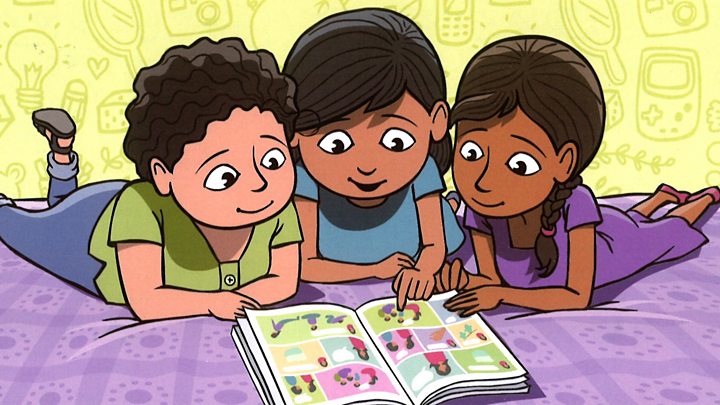
Media caption Using comics to combat India’s menstruation taboos
This is not the first time that female students have been humiliated on account of periods.
Discrimination against women on account of menstruation is widespread in India, where periods have long been a taboo and menstruating women are considered impure. They are often excluded from social and religious events, denied entry into temples and shrines and kept out of kitchens.
Increasingly, urban educated women have been challenging these regressive ideas. In the past few years, attempts have been made to see periods for just what they are – a natural biological function.
But success has been patchy.
In 2018, the top court in a landmark order threw open the doors of the Sabarimala shrine to women of all ages, saying that keeping women out of the temple in the southern state of Kerala was discriminatory.
Black market imports from China, confusing regulations and pollution concerns are undermining India’s fireworks industry
Industry sources say Diwali sales this year were down by 30 per cent
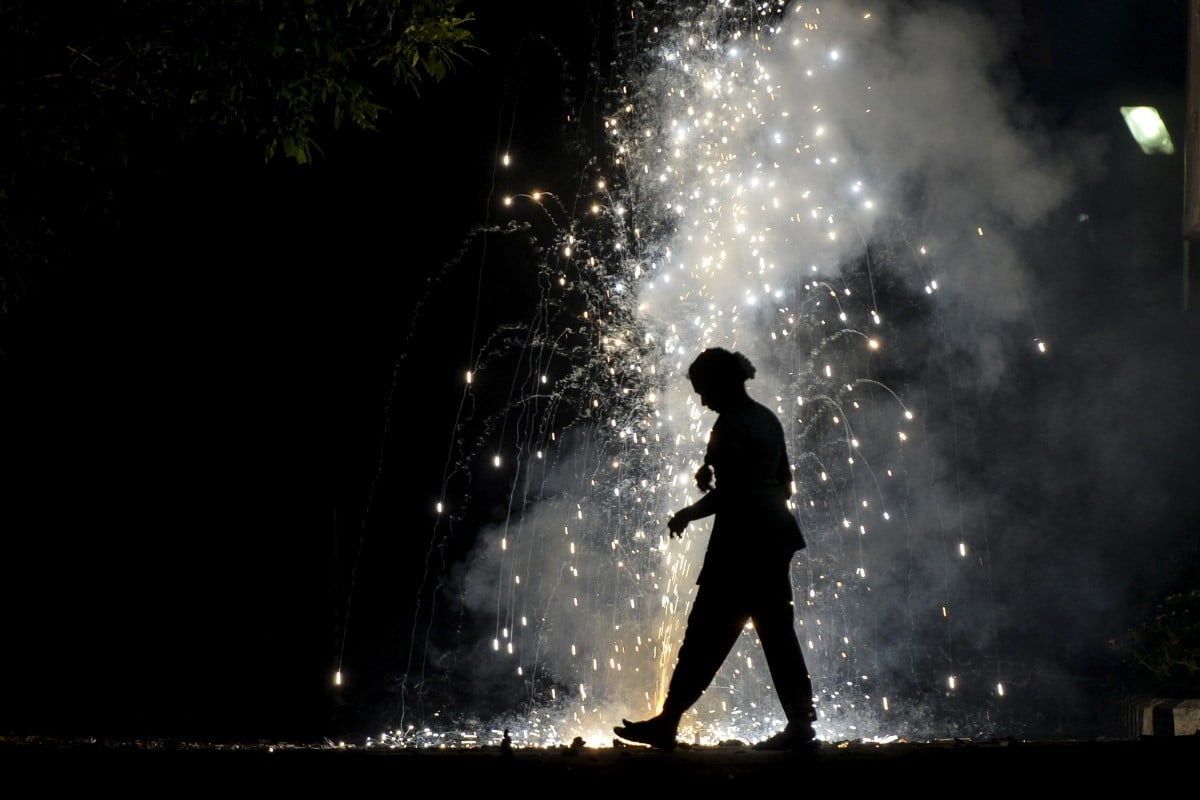
A woman is silhouetted by lit firecrackers during Diwali celebrations in Chennai. Photo: AFP
Arumugam Chinnaswamy set up his makeshift booth selling firecrackers in a Chennai neighbourhood a week ahead of Diwali, the Hindu festival of lights, with great expectations of doing a brisk trade.
Yet a week later, he has been forced to pack up more than half his stock in the hope he’ll have better luck next year.
“Four years ago, I sold firecrackers worth 800,000 rupees (US$11,288) on the eve of Diwali alone. This year, the sales have not even been a quarter of that,” said Chinnaswamy, 65, painting a grim picture that will be recognised by many in the Indian fireworks industry.
Chinnaswamy buys his firecrackers in Sivakasi, an industrial town in the southern Indian state of Tamil Nadu that produces more than 90 per cent of the country’s fireworks.
Sivakasi’s dry climate has helped to make it the firework capital of India and many production facilities in the town have been in the business for close to a century. For the most part, the industry has resisted mechanisation and still deals in handmade products. Its 1,100-plus manufacturing units provide jobs for 800,000 mostly uneducated workers and its diligent labour force have earned the town the nickname of ‘Little Japan’.
A worker lays firecrackers in an outdoor yard at a manufacturing unit involved in the production of firecrackers ahead of the Hindu festival of Diwali, in Sivakasi. Photo: AFP
But this reputation is under threat, struggling under the weight of an anti-pollution campaign, regulatory uncertainty and the arrival of cheap black-market Chinese imports. Irregular monsoons and a slowdown-induced cash crunch have not helped matters either.
Industry figures estimate the Diwali sales of India’s 80 billion-rupee firecracker industry took a 30 per cent drop this year.
A TOXIC PROBLEM
With pollution in Indian cities among the worst in the world, the government has come under pressure to do something about the nation’s toxic air – a problem that becomes more acute during Diwali due to the toxic fumes emitted when celebratory fireworks are set off. This Diwali, for instance, many areas in New Delhi recorded an Air Quality Index (AQI) of 999, the highest possible reading (the recommended limit is 60).
That makes the fireworks industry seem like an easy target when it comes to meeting government air quality targets.
Trouble began brewing in October last year when the Supreme Court banned the manufacture of traditional fireworks containing barium nitrate, a chief polluter. That decision put a rocket under the industry, as barium nitrate is cheap and is used in about 75 per cent of all firecrackers in India.
Factories in Sivakasi responded with a four-month shutdown protest that decimated annual production levels by up to a third.
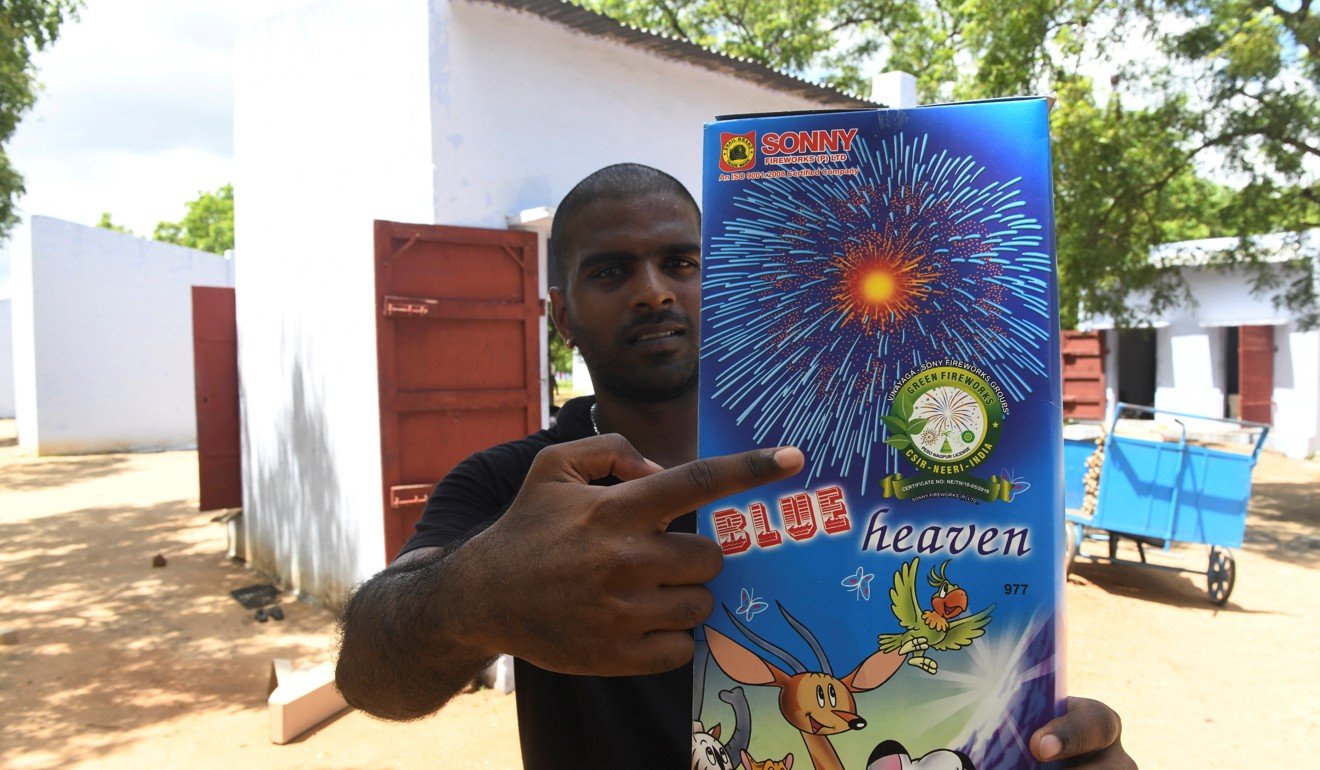
A seal denotes environment friendly ‘Green Fireworks’ at a manufacturing unit in Sivakasi. Photo: AFP
Apparently realising it had overstepped the mark – and that enforcing the Supreme Court regulations would be next to impossible – the government stepped in to rescue the industry, offering its assistance in the manufacture of environment-friendly crackers containing fewer pollutants, but it was too little, too late.
“The Supreme Court verdict was simply Delhi-centric with the vague idea of [cracking down on] urban pollution. It lacked any on-the-ground knowledge of the fireworks industry,” said Tamil Selvan, president of the Indian Fireworks Association, which represents more than 200 medium and large manufacturers.
Singapore travellers give Hong Kong a miss over Diwali long weekend
“Fireworks are low-hanging fruit for the anti-pollution drive as the industry is unorganised. Could the government or judiciary place a similar blanket ban on more pollution-causing industries like automobiles, plastics or tobacco?” asked Selvan.
CHINESE COMPETITION
The industry has also been hit by a flood of cheap Chinese firecrackers that are smuggled into the country on the black market.
In September, the country’s federal anti-smuggling agency, the Directorate of Revenue Intelligence, cautioned various government departments that huge quantities of Chinese-produced firecrackers had reached Indian soil in the lead up to Diwali.
But industry sources complain they have seen little action from the government to combat the problem.
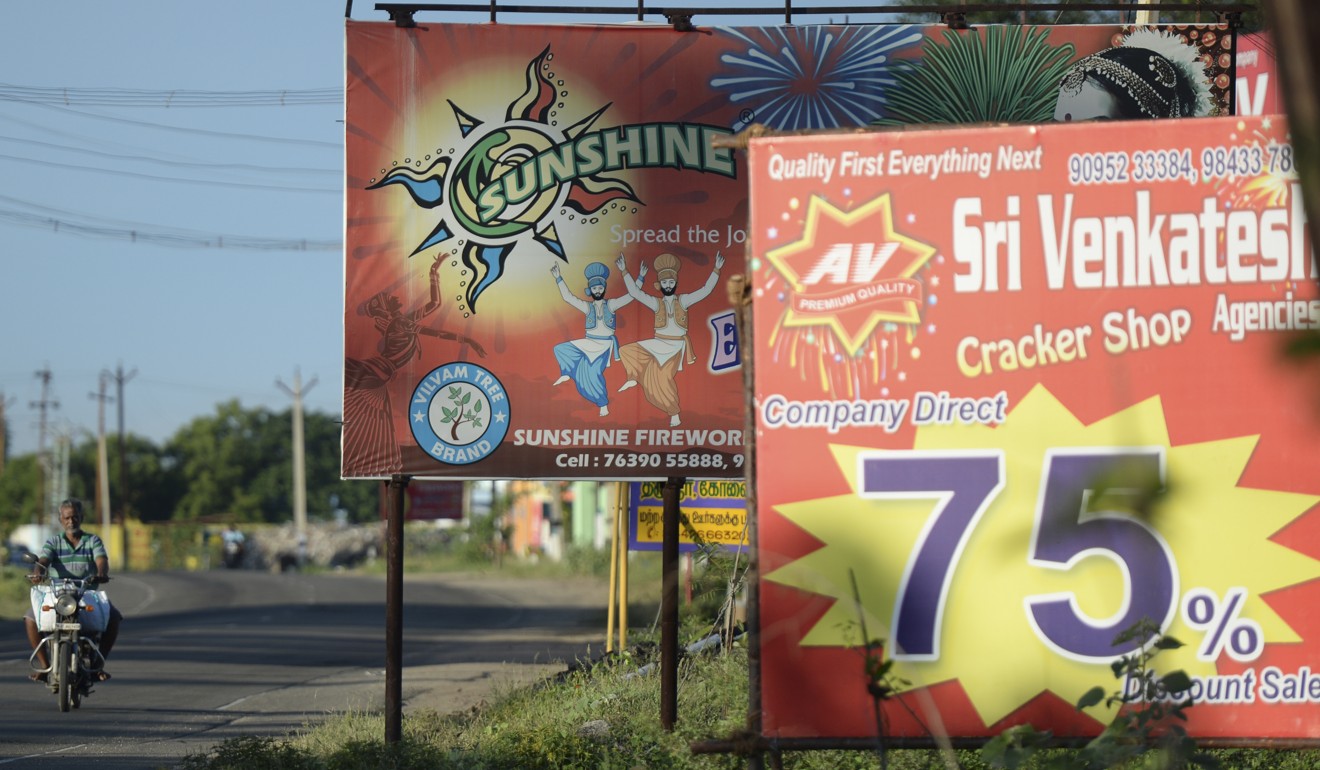
An advert for firecrackers ahead of the Hindu festival of Diwali, in Sivakasi. Photo: AFP
Legally, Indian manufacturers can neither import nor export firecrackers. The Indian firecracker industry is the second-largest in the world after China’s.
Raja Chandrashekar, chief of the Federation of Tamil Nadu Fireworks Traders, a lobbying body, said low-end Indian-manufactured firecrackers such as roll caps and dot caps – popular among children – had struggled to compete with Chinese-made pop pops and throw bombs.
“Despite our repeated complaints to government bodies, Chinese firecrackers find a way into India, particularly in the northern parts. This is severely affecting our business,” said Chandrashekar.
While more Chinese fireworks might be entering India, the effect has been to undermine the industry, resulting in fewer sales overall.
FIZZLING OUT?
The Sivakasi fireworks industry faces other problems, too. Not least among these is the use of child labour, which had been rampant until a government crackdown a few years ago, and the practice of some factories to operate without proper licences and with questionable safety standards.
But despite the darker aspects of the industry, its role goes beyond merely helping Diwali celebrations go with a bang every year.
India is crazy about gold. But can the love last as prices skyrocket?
“The livelihoods of over five million people who are indirectly involved in the business, in areas such as trade and transport, depend on the survival of the industry,” said Chandrashekar.
That survival looks increasingly in question. Dull sales of fireworks have been reported in major cities including New Delhi, Mumbai, Bangalore and Hyderabad, though exact numbers can be hard to come by due to the unregulated nature of the industry and unreliable numbers shared by manufacturers.
So great has the resultant outcry been that some cynics even wonder whether the industry is struggling as much as it claims or whether it is part of a ploy by manufacturers to gain more government concessions and avoid any further crackdown.
“These firecracker manufacturers lie through their teeth about the Diwali sales for self-serving motives such as tax avoidance. The overall business is healthy,” said Vijay Kumar, editor of the Sivakasi-based monthly magazine Pyro India News.
“Though there was a 30-40 per cent shortage in annual production, all the manufactured products have been sold this year. No large stockpile is left with any manufacturer.”
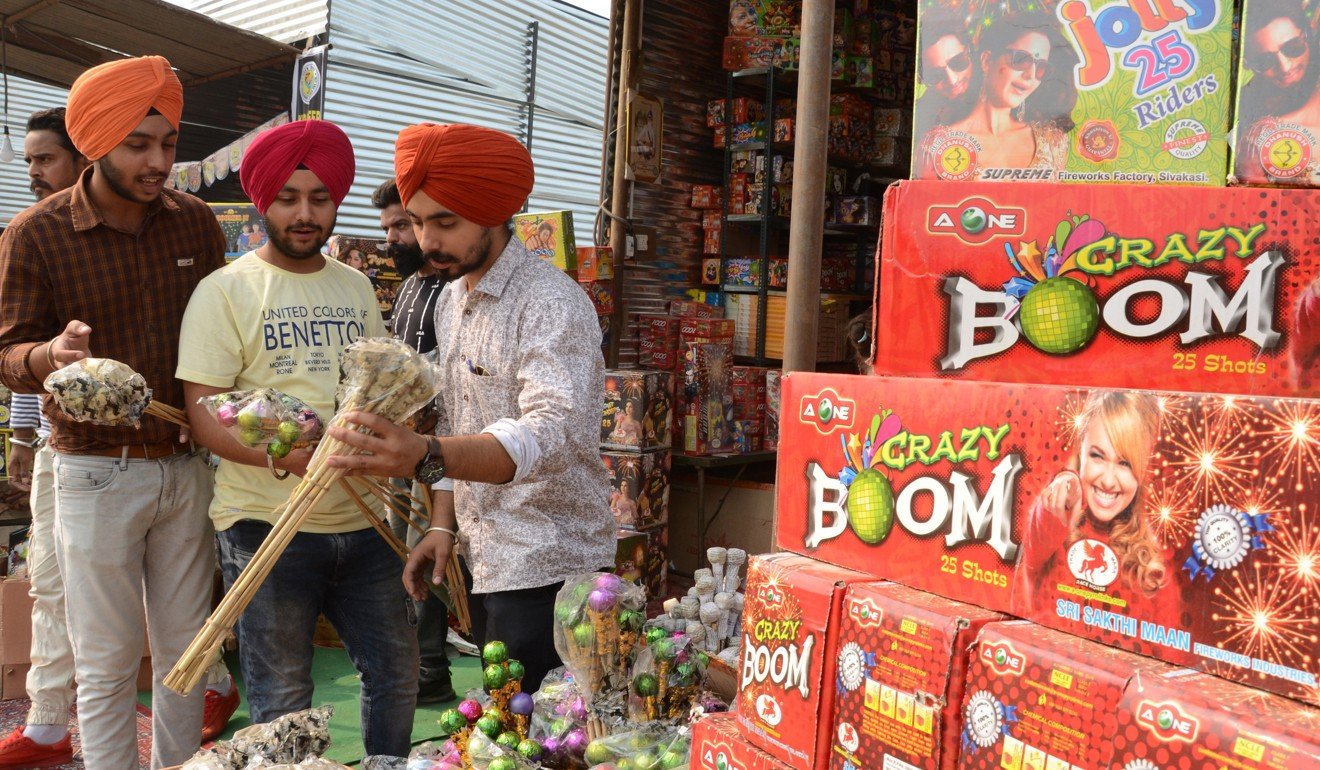
Customers buy firecrackers on the eve of the Hindu festival of Diwali in Amritsar. Photo: AFP
Still, regardless of the manufacturers’ motives, the result of the industry’s struggles has been that street sellers like Chinnaswamy have fewer fireworks to sell – and they are struggling even to sell those.
Chinnaswamy says people are confused about the government’s anti-pollution drive and about what firecrackers are now legal and this has discouraged them from buying. Despite the government’s effort to promote “green crackers” he says these are too hard to come by to be a ready solution, at least for this year.
“There was no clarity on what type of firecrackers, whether green crackers or otherwise, can be set off and at what time of the day. Many consumers even asked me whether or not the conventional firecrackers are totally banned while there was much misinformation floating about on social media,” said Chinnaswamy.
Shaking his head, all he can do is hope that next year his Diwali goes with more of a bang.
NEW DELHI (Reuters) – Tens of thousands of runners have signed up for the Indian capital’s half marathon and other races on Sunday, officials said, despite the air quality hitting dangerous levels in one of the most heavily polluted cities in the world.
New Delhi’s air quality index was around 300 on Thursday, classified as very poor and meaning prolonged exposure can cause respiratory illness.
Delhi Chief Minister Arvind Kejriwal, who has described the city as a “gas chamber” in winter, has ordered emergency measures, including restricting the number of private vehicles on the roads under an “odd-even” scheme based on number plates.
Race organisers said pollution was a worry but they would take steps to reduce the impact on runners. Hours ahead of and throughout the race, the course will be sprayed with water.
“The air quality is a concern and will remain a concern, there is no question about it,” said Vivek Singh, joint managing director of Procam International that conducts the race sponsored by telecom operator Bharti Airtel.
“The measures that we take for those few hours to give our runners a good experience have worked in the past.”
The race has been moved this year to avoid a sharp rise in pollutants during Diwali, the Hindu festival of lights, when hundreds of thousands of firecrackers are lit.
But farmers burning crop stubble in the states north of Delhi have turned the air over Delhi toxic. The forecast for the next few days and into Sunday is “very poor”.
A record 40,633 people have signed up for the 21-km, 10-km and a 5-km races. Last year there were 34,916 runners, many of whom wore masks.
A former Olympic gold medallist, Carmelita Jeter of the United States, is the international event ambassador.
Doctors have advised citizens to restrict their outdoor activities and said runners must be made aware of the risks they are taking.
“Just two weeks before the odd-even scheme comes into play, how have the civic authorities allowed more than 30,000 people to expose themselves to toxic air?” asked said Desh Deepak, senior chest physician at the city’s Ram Manohar Lohia Hospital.
Image copyright GETTY IMAGESImage caption Millions of poor Indians still defecate in the open
Two men in the central Indian state of Madhya Pradesh have been arrested for allegedly killing two Dalit (formerly untouchables) children who were defecating in the open, police say.
Roshni, 12, and Avinash, 10, were attacked on Wednesday while defecating near a village road, they said.
The children’s family told BBC Hindi that they have no toilet at home.
Millions of poor Indians defecate in the open, which especially puts women and children at risk.
Dalits are at the bottom of the Hindu caste system and despite laws to protect them, they still face widespread discrimination in India.
“The two children were beaten to death with sticks,” police superintendent Rajesh Chandel told BBC Hindi’s Shuraih Niazi. “We have registered a murder case against both the accused. They are being questioned.”
Within hours of the attack early on Wednesday morning, police arrested two upper-caste men – Rameshwar Yadav and Hakim Yadav.
Roshni and Avinash were cousins, but Roshni had been brought up by Avinash’s parents and lived with them.
Avinash’s father, Manoj, says that as a daily wage labourer, he cannot afford to build a toilet at his house. He also says he has been unable to access a government subsidy as part of a flagship scheme to build toilets for the poor.
Media caption The Dalits unblocking India’s sewers by hand
The Swachh Bharat Mission or Clean India programme seeks to end open defecation by increasing toilet infrastructure and improving sanitation across the country. When Prime Minister Narendra Modi launched the program in 2014, he vowed to make India “open defecation free” by 2 October 2019.
Manoj’s village – Bhavkhedi – has been declared “open defecation free”, a tag given by the government to villages and cities have successfully ended open defecation.
Image caption Women who go out at night to defecate are often at risk
Research has shown that while the construction of toilets has increased rapidly, lack of water, poor maintenance and slow change in behaviour have stood in the way of ending open defecation.
But many have praised Mr Modi for highlighting the issue and launching a major scheme to address it – the Bill & Melinda Gates Foundation honoured him this week, describing the Swachh Bharat Mission as “a model for other countries around the world that urgently need to improve access to sanitation for the world’s poorest.”
India is in full election mode: voting began on 11 April, and the final ballot will be cast on 19 May with results out on 23 May. Every day, the BBC will be bringing you all the latest updates on the twists and turns of the world’s largest democracy.
Ruling party candidate calls Gandhi’s killer a patriot
What is happening?
Controversial Bharatiya Janata Party (BJP) politician Pragya Thakur has made headlines again. This time it was for calling Nathuram Godse – the man who assassinated Mahatma Gandhi – a “patriot”.
Her comment was made in response to a statement by southern actor-turned politician Kamal Haasan who had said India’s first “extremist” was a Hindu”, referring to Godse.
#WATCH BJP Bhopal Lok Sabha Candidate Pragya Singh Thakur says ‘Nathuram Godse was a ‘deshbhakt’, is a ‘deshbhakt’ and will remain a ‘deshbhakt’. People calling him a terrorist should instead look within, such people will be given a befitting reply in these elections
His statement, made on Monday, was heavily criticised by the BJP, which accused him of indulging in “divisive politics” and filed a complaint against him with the Election Commission of India.
Why does this matter?
The BJP has responded by criticising Ms Thakur and asking her to publicly apologise.
“BJP does not agree with this statement, we condemn it. Party will ask her for clarification, she should apologise publicly for this statement,” party spokesperson GVL Narasimha Rao told reporters.
However, Ms Thakur’s comments do reflect the views of some right-wing Hindus who support the BJP and have long seen Gandhi as too moderate.
Godse, who shot Gandhi in the chest three times at point-blank range on 30 January 1948, was also an activist with nationalist right-wing groups, including those closely associated with the BJP.
Hindu hardliners in India accuse Gandhi of having betrayed Hindus by being too pro-Muslim, and even for the division of India and the bloodshed that marked Partition, which saw India and Pakistan created after independence from Britain in 1947.
Ms Thakur has seen her fair share of controversy. Her candidature caused outrage as she is an accused of involvement in a blast that killed seven people and injured 100 others. On 18 April, she said that police officer Hemant Karkare had died in the November 2008 Mumbai terror attacks because she had “cursed” him. She was then banned from campaigning for 72 hours as a result.
A team led by Mr Karkare had arrested her for questioning in connection with the Malegaon blast.
During her campaign, she also said she was “proud” of her part in the demolition of the 16th Century Babri mosque. In 1992, right-wing Hindu mobs razed the mosque to the ground, claiming it was built on the site of a temple destroyed by Muslim rulers. The site, which is in the city of Ayodhya, has been a religious flashpoint for Hindus and Muslims for decades.
Campaigning ends in West Bengal a day before deadline
What happened?
The Election Commission (EC) has told political parties to end their campaigning in West Bengal state, a day before the deadline in the wake of poll-related violence.
The campaign will end on Thursday at 10pm local time, and voting will be held on Sunday.
The decision comes after clashes broke out between the Bharatiya Janata Party (BJP) workers and protesters believed to be from the ruling Trinamool Congress (TMC) in Kolkata (formerly Calcutta) on Tuesday.
It happened during a roadshow of BJP chief Amit Shah. Several people were injured and vehicles were set on fire. A statue of renowned Bengali reformer Iswarchandra Vidyasagar was also vandalised in the clashes.
Both parties have accused each other of starting the violence.
Why does this matter?
Image copyright GETTY IMAGESImage caption Violence took place during BJP chief Amit Shah’s rally in Kolkata on Tuesday
The BJP welcomed the decision, saying it validated their argument that the state had “descended into anarchy” under the leadership of chief minister Mamata Banerjee.
Ms Banerjee said that the move was “undemocratic” and “it had insulted the people of Bengal”.
“Tomorrow, [Prime Minister Narendra] Modi has two meetings in Bengal. When he finishes, the campaigning also ends… Instead of punishing Amit Shah, the Election Commission has given a gift to the BJP,” she said.
Image copyright AFPImage caption Several people were injured and vehicles were set on fire during the violence
Both parties are locked into a fierce election battle to win most out West Bengal’s 42 seats. Ms Banerjee has ambitions of becoming the prime minister in case a nationwide coalition of regional parties wins enough seats.
The state has also become crucial for the BJP as it’s trying to expand its reach in the eastern state. It won only two seats in the 2014 election.
The BJP performed well in northern states like Uttar Pradesh and Rajasthan in 2014, but this time it’s expected to suffer loses against a coalition of regional parties and the main opposition Congress.
So the party is trying to make up for the losses in West Bengal.
TMC, BJP accused each other of poll violence
Image copyright GETTY IMAGES
What happened?
The war of words between West Bengal state chief minister Mamata Banerjee and the governing Bharatiya Janata Party (BJP) intensified ahead of voting on Sunday.
The latest verbal duel comes after violence was reported during BJP chief Amit Shah’s roadshow in Kolkata (formerly Calcutta) on Tuesday.
Clashes broke out between BJP supporters and protesters who were holding “Amit Shah go back” posters.
Some people suffered minor injuries and a few vehicles were set on fire.
The BJP said the protest was “orchestrated” and called it an “attempt to strangulate democracy”.
Why does this matter?
The eastern state has become politically crucial for the BJP as it has intensified campaigning in the past few days.
And that has sparked a feverish electoral battle between the BJP and Ms Banerjee’s Trinamool Congress (TMC).
“What does Amit Shah think of himself? Is he above everything? Is he god that no one can protest against him?” Ms Banerjee said.
In reply, Mr Shah accused the TMC of not following democratic norms during elections.
“Have faith in the people of Bengal that they’d face the TMC goons,” he said.
Prime Minister Narendra Modi is scheduled to hold more rallies in the coming days, so one can expect more verbal fireworks from the two leaders.
On Tuesday, the saga of the morphed Mamata meme continued
What happened?
India’s top court stepped in to release an activist belonging to India’s governing Bharatiya Janata Party (BJP) who was sent to prison for sharing a doctored image of West Bengal Chief Minister Mamata Banerjee.
Priyanka Sharma was sentenced to two weeks in prison on 10 May after she shared a picture of Bollywood star Priyanka Chopra and her husband Nick Jonas at the Met Gala – but with Ms Banerjee’s head superimposed on to Chopra’s body.
Earlier the court had said Ms Sharma could be released only if she apologised to Ms Banerjee, but later waived this condition.
Why does this matter?
The battle for West Bengal in this general election has been absolutely bruising.
The BJP, led by Prime Minister Narendra Modi himself, has been campaigning hard for votes in the state. This has brought them toe-to-toe with the state’s feisty chief minister. The fact that voting for West Bengal’s 42 seats has been split across all nine phases of voting has meant that the battle has been long and drawn-out.
And with just one phase to go before voting finally ends, the gloves are well and truly off. The two parties have traded insults on the campaign stage, their workers have attacked each other, and the violence on the ground has intensified. And now the battle has spread to cyberspace as well.
The country’s finance minister Arun Jaitley jumped at news of Ms Sharma’s release to call Ms Banerjee a dictator.
Humour, wit, sarcasm survive in a free society. They have no place in autocracies. Dictators laugh at people. They don’t like people laughing at them. Bengal, today is a case in point.
Analysts say that this political row is so bitter because the BJP has clearly identified West Bengal as one of the states where they may be able to make gains this election. This becomes more important for the party in the context of their fight in the politically crucial state of Uttar Pradesh, which sends the most number of MPs (80) to parliament.
They are up against a powerful coalition of regional parties there, and many expect them to lose seats as a result.
And PM Modi said Rahul Gandhi should be ashamed of 1984 riots
What happened?
Prime Minister Narendra Modi said that main opposition Congress party chief Rahul Gandhi should be “ashamed of himself” over his colleague’s remark on the 1984 anti-Sikh riots.
Mr Modi was replying to a controversial statement made by Sam Pitroda, who is a strategist of the Congress party.
In his reply to a question about the Congress’ role in the riots, Mr Pitroda had said “so what?”.
“I don’t think so, this is also another lie, and what about 1984? You speak about what you [Mr Modi] have done in five years. It [the riots] happened in 1984, so what?” he said.
Mr Gandhi said he was “ashamed” of Mr Pitroda’s statement, and asked him to apologise.
Mr Pitroda later said his statement was “twisted” and he did not mean to hurt sentiments.
But Mr Modi said the Congress chief “must apologise”.
“I was watching that naamdar [the dynast] told his guru that he should be ashamed of what he said. I want to ask naamdar, you pretended to scold your mentor for what? Because he exposed what was always in the Congress’s heart, and in the discussions of the naamdar family? Because he made public a family secret? Naamdar, it is you who should be ashamed,” Mr Modi said.
Why does this matter?
The controversy matters because it comes days ahead of voting for the 13 seats in the northern state of Punjab.
The BJP, which has formed a coalition with regional Shiromani Akali Dal, is locked in a bitter electoral battle with the ruling Congress in the state.
Sikhs are a majority in the state and the 1984 riots is still an emotional issue for many of them.
More than 3,000 Sikhs were killed in 1984 after the assassination of former prime minister Indira Gandhi by her Sikh bodyguards.
They were angry at her decision to send the army into the Golden Temple – Sikhism’s holiest shrine – to flush out militants earlier in the year.
The killing of Mrs Gandhi, who belonged to the Congress, saw mobs attack and murder members of the Sikh community across the country.
And both parties appear to be trying to come across as pro-Sikh ahead of the vote on 19 May.
On Sunday, Delhi voted but not enthusiastically
Image copyright GETTY IMAGESImage caption Delhi’s voter turnout was lower than in 2014
What happened?
Sunday saw India’s capital Delhi vote along with several other states in the polls – the penultimate phase of the country’s mammoth general election.
Voters turned out to vote, but in fewer numbers than they did in 2014. The election commission said that around 60% of the capital’s registered voters had actually cast ballots, which was about a five percent drop from 2014.
Delhi Chief Electoral Officer Ranbir Singh expressed disappointment, saying that the turnout did not match expectations.
Why does this matter?
The election commission is right to be disappointed – it had run a series of campaigns in the city, encouraging more people to vote.
But it was not as though polling in Delhi was an entirely smooth process. Some voters complained that their names were missing from electoral lists even though they had all the necessary documents. There were also reports that around 1,200 Electronic Voting Machines (EVMs) had malfunctioned across the city, delaying the polling process.
The fact that Delhi became a three-cornered contest after the main opposition Congress and the Aam Aadmi Party (AAP), which controls the Delhi state assembly, failed to stitch up an alliance may also have put voters off. Many analysts believe that this failure will only split voters who were against prime minister Narendra Modi’s Bharatiya Janata Party (BJP) and effectively hand them victory.
So they may have decided to just stay home, and not bother queuing up in the blistering heat – it touched 40C on Sunday.
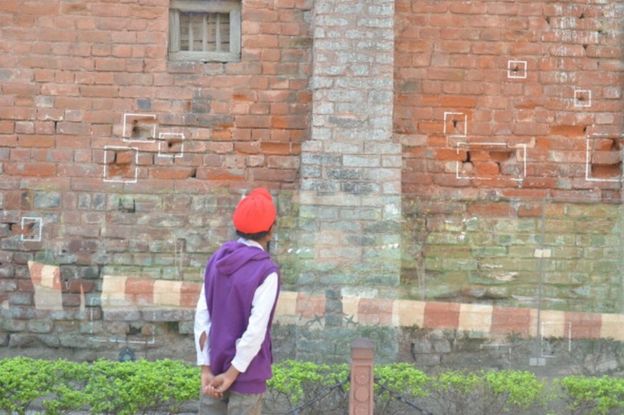
Image copyrightAFPImage captionVisitors can inspect a bullet-ridden wall at the site of the massacre
Hundreds of Indians attending a public meeting were shot dead by British troops in the northern Indian city of Amritsar in 1919. Historian Kim Wagner sifts fact from fiction as the UK House of Lords prepares to debate the massacre, including if Britain should apologise.
On 13 April 1919, Sergeant WJ Anderson witnessed first-hand the brutal massacre of hundreds of Indian civilians at Jallianwala Bagh, a public garden in Amritsar city.
“When fire was opened the whole crowd seemed to sink to the ground, a whole flutter of white garments, with however a spreading out towards the main gateway, and some individuals could be seen climbing the high wall,” Anderson later recalled.
“There was little movement, except for the climbers. The gateway would soon be jammed. I saw no sign of a rush towards the troops.”
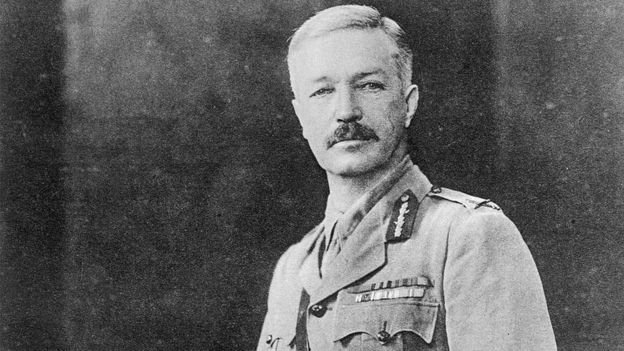
He had served as the bodyguard of Brigadier General RH Dyer, who had rushed to Amritsar a few days earlier to quell what he believed to be a major uprising.
The crowd of more than 20,000 people, however, were not armed rebels. They were local residents and villagers from the surrounding countryside who had come to listen to political speeches or simply to spend a few hours in the gardens.
It was also the day of the Baisakhi festival, which marked the anniversary of the creation of the Khalsa, or Sikh community, and annually attracted thousands of visitors and pilgrims.
The crowd comprised Hindus, Muslims and Sikhs. Most were men and young boys, including some infants; only a few women were present.
Image copyrightGETTY IMAGESImage captionBrigadier General Dyer rushed to Amritsar to quell what he believed to be a major uprising
When Gen Dyer ordered his troops to cease firing, Jallianwala Bagh resembled a battlefield strewn with corpses. Between 500 and 600 people were killed, and probably three times as many wounded. The exact numbers will never be known for certain but the official death count, reached months later, was just 379.
In recent years, much of the public debate has focused on calls for a formal British apology – the demand has been led by, among others, Indian politician and author Shashi Tharoor.
Queen Elizabeth II visited the memorial at Jallianwala Bagh in 1997 and then Prime Minister David Cameron visited in 2013 – both showed their respect yet carefully avoided making an actual apology.
In December 2017, the Mayor of London, Sadiq Khan, nevertheless urged the British government to make just such a gesture during his own visit to Amritsar.
“I am clear that the government should now apologise, especially as we reach the centenary of the massacre. This is about properly acknowledging what happened here and giving the people of Amritsar and India the closure they need through a formal apology,” he said.
Image copyrightAFPImage captionOn his 2013 visit, Cameron avoided making an actual apology but said the massacre was “deeply shameful”
Exactly what happened at Jallianwala Bagh, however, remains unclear, and a century later, the actual circumstances of the massacre are still shrouded in myth and misconceptions.
There are, for instance, people, often with a nostalgic attachment to the Empire, who still insist that Gen Dyer only opened fire as a final resort when the crowd ignored his warning to disperse – even though the general himself was quite clear that he gave no such warning.
Similarly, the idea that the shooting was necessary and prevented much worse violence conveniently ignores the fact that Indian riots in April 1919 were in each and every case precipitated by British actions.
Factual inaccuracies are also to be found at the Jallianwala Bagh memorial today. Among other things, a sign claims that 120 bodies of the victims of the massacre were recovered from what has become known as the Martyrs’ Well. It’s believed that many people jumped into the well to escape the bullets.
But there is no evidence for this story, which appears to be based on a mix-up with the infamous well at Kanpur city, where the bodies of British women and children were disposed after a massacre in 1857.
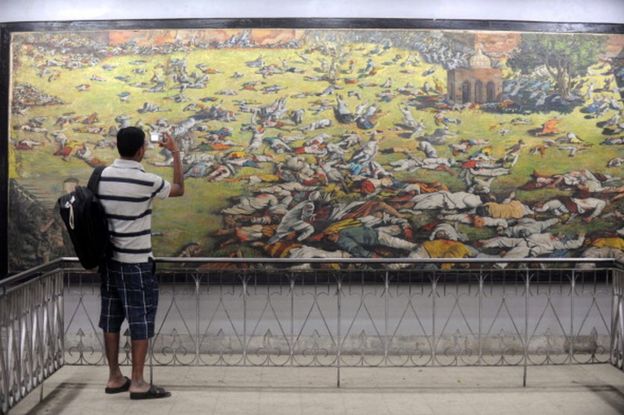
Visual depictions of the Jallianwala Bagh massacre also show machine guns being used, when the historical record is quite clear that the shooting was carried out by 50 Gurkha and Baluchi troops armed with rifles.
Gen Dyer also did not orchestrate the massacre, and deliberately trap the crowd inside the gardens, as some popular accounts have it.
Image copyrightGETTY IMAGESImage captionThe crowd were not armed rebels but local residents and villagers
In fact, it was British panic and misreading of the political turmoil in India that was at the root of the violence.
While Indian nationalists were looking forward to political reforms and greater self-determination after the end of World War One, the British were still haunted by the spectre of the 1857 “mutiny”, an uprising that is often referred to as India’s first war of independence.
So, when riots broke out in Amritsar on 10 April – and five Europeans and dozens of Indians were killed – the authorities responded with immediate and indiscriminate force. Three days later, Gen Dyer entered what he mistakenly perceived to be a war zone.
Where popular depictions show a peaceful crowd of locals quietly listening to a political speech, Gen Dyer instead perceived a defiant and murderous mob, which had only days before run rampant through Amritsar. When he ordered his troops to open fire, it was an act of fear, spurred on by a disastrously flawed threat assessment.
None of this exonerates Gen Dyer or detracts from the sheer brutality of the massacre – nor does it justify the subsequent torture and humiliation of Indians under martial law. The indisputable violence of the Jallianwala Bagh massacre hardly requires any embellishment. Nevertheless, facts matter if we are to pay our respect to those who died rather than simply perpetuate politically convenient fiction. And to understand is not the same as to condone.
Image copyrightGETTY IMAGESImage captionThere are bullet marks on a wall in the garden
Apologies and centenaries, which are essentially about the present rather than the past, are rarely conducive to an honest and nuanced reckoning with history.
An apology from a British government in the throes of Brexit, at the moment, seems highly unlikely. It it indeed doubtful whether an official acknowledgement of the massacre would be construed as more than an act of political expediency.
The question thus remains whether an apology without a genuine understanding of the past can ever provide the “closure” that so many seek.
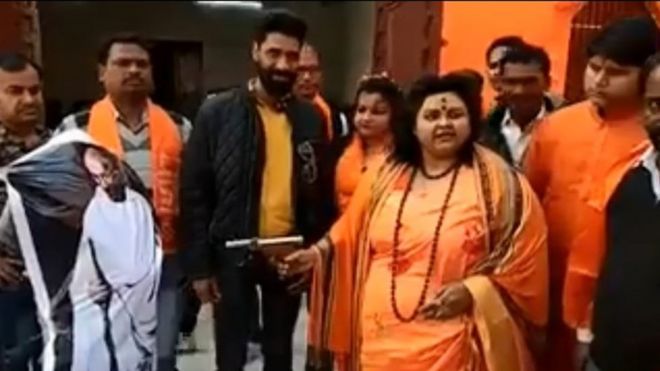
Godse, who shot Gandhi in the chest three times at point-blank range on 30 January 1948, was an activist with nationalist right-wing groups, including the Hindu Mahasabha.
Hindu hardliners in India accuse Gandhi of having betrayed Hindus by being too pro-Muslim, and even for the division of India and the bloodshed that marked Partition, which saw India and Pakistan created after independence from Britain in 1947.
This is not the first time the controversial fringe group has tried to glorify Godse and celebrate Gandhi’s assassination.
NEW DELHI (Reuters) – A Hindu nationalist group close to Prime Minister Narendra Modi’s party has urged him to resist pressure from the United States and not defer new regulations for the e-commerce sector, according to a letter seen by Reuters.
The economic wing of the group, Rashtriya Swayamsevak Sangh (RSS), which is the fountainhead of the ruling party, has written to Modi saying that changing the policy implementation date, under pressure from Washington, will hurt 130 million small Indian entrepreneurs.
“There is no need to buckle under these pressures. India must continue to chart the way best for itself and the entrepreneurs,” the Swadeshi Jagran Manch said in its letter, which was reviewed by Reuters.
The new rules, to be implemented from Feb. 1, will deal a blow to Walmart Inc and Amazon.com’s ambitions in the country. They mandate that e-commerce companies will not be allowed to sell products from firms in which they have an equity interest.
Reuters reported on Thursday the United States government had told Indian officials the new rules will hinder the investment plans of the two companies.
The rules, which will force the companies to change their business structures and raise operational costs, have sparked an extensive lobbying effort from both Amazon and Walmart, which last year invested $16 billion in Indian e-commerce company Flipkart.
Both Amazon and Walmart have sought an extension of the Feb. 1 deadline, but government sources have said that was unlikely to happen as Modi needs millions of traders by his side in an upcoming national election due by May.
On Friday, the Confederation of All India Traders, which has supported tougher scrutiny of large e-commerce players, said “the entire trading community will vote against the government if they extend the deadline”.
The e-commerce spat is the latest in a number of disputes over trade and investment relations between India and the United States.
Walmart spokesman Greg Hitt told Reuters this week the company had “engaged the (United States) administration on this issue”.
The RSS has long advocated self-reliance and opposed the opening up of the Indian economy to foreign players.
Small Indian retailers have alleged that e-commerce companies use their control over inventory from their affiliates to create an unfair marketplace that allows them to sell some products at lower prices, which hurts the businesses of brick-and-mortar retailers. Such arrangements would be barred under the new policy.
In front-page advertisements in newspapers last week, Walmart-owned Flipkart highlighted how the platform had helped transform local struggling businesses selling badminton racquets and sarees, a traditional dress.


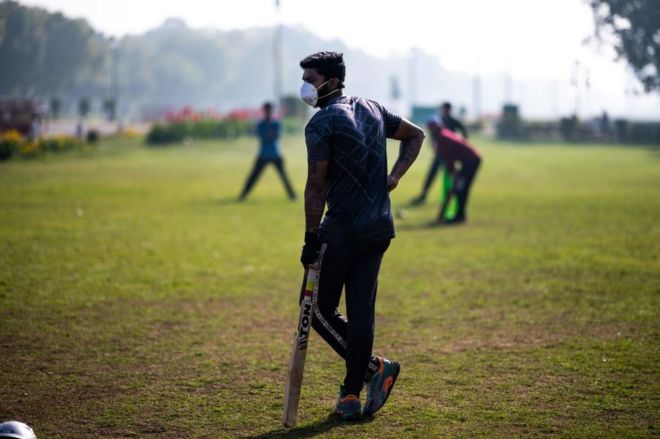 Image copyright GETTY IMAGES
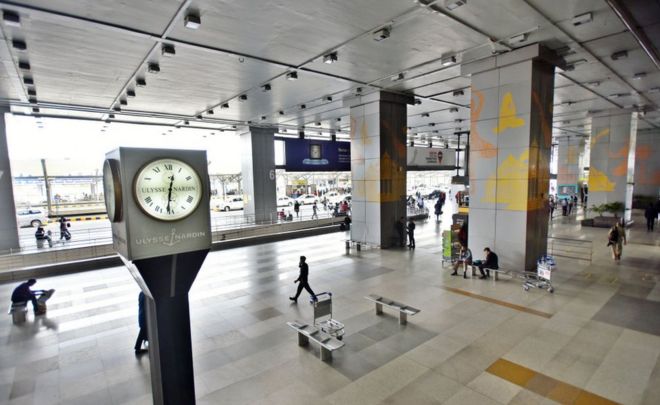 Image copyright GETTY IMAGES
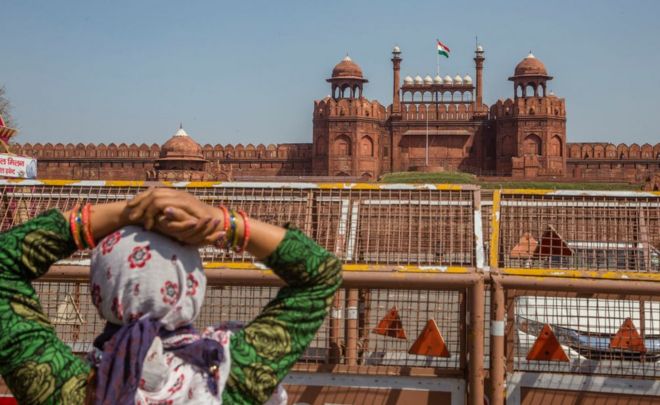 Image copyright GETTY IMAGES
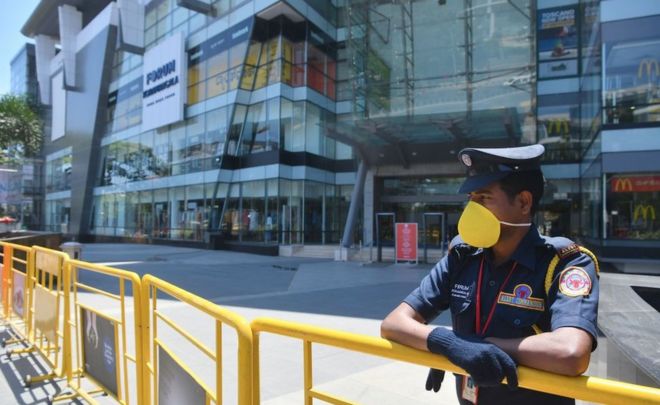 Image copyright GETTY IMAGES
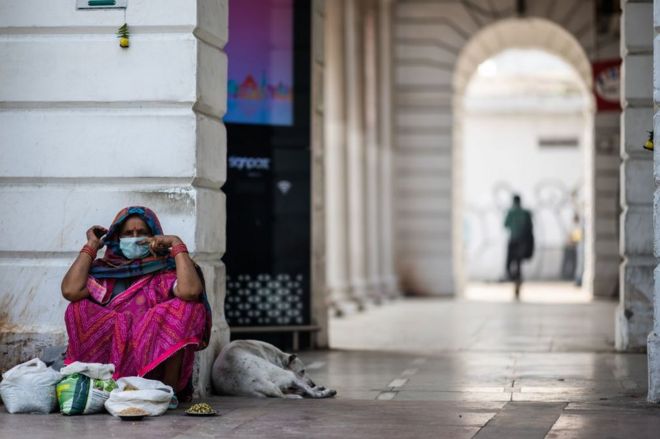 Image copyright GETTY IMAGES
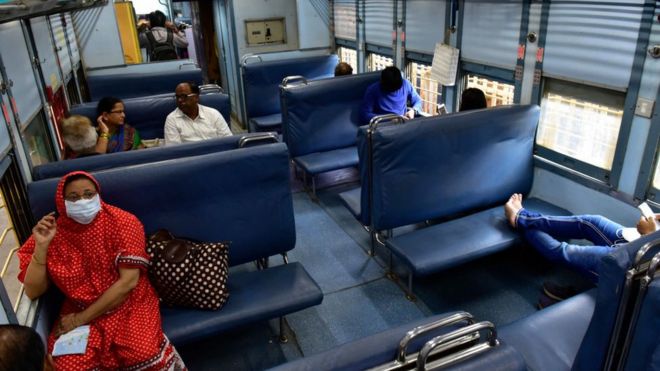 Image copyright GETTY IMAGES
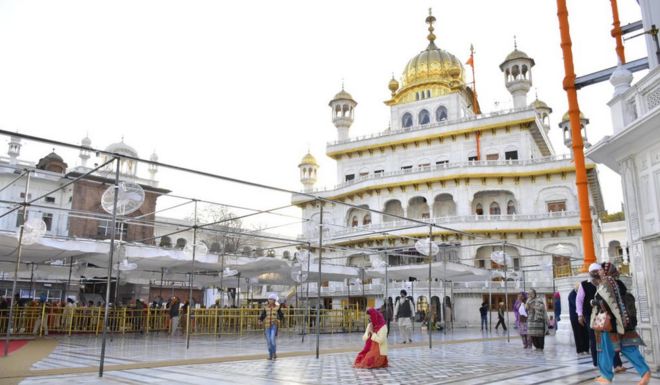 Image copyright GETTY IMAGES
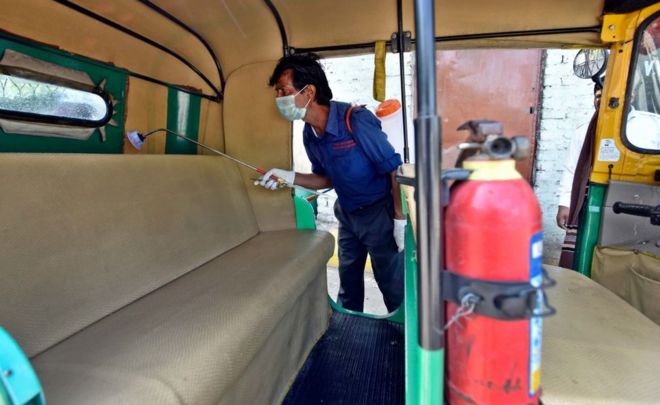 Image copyright GETTY IMAGES
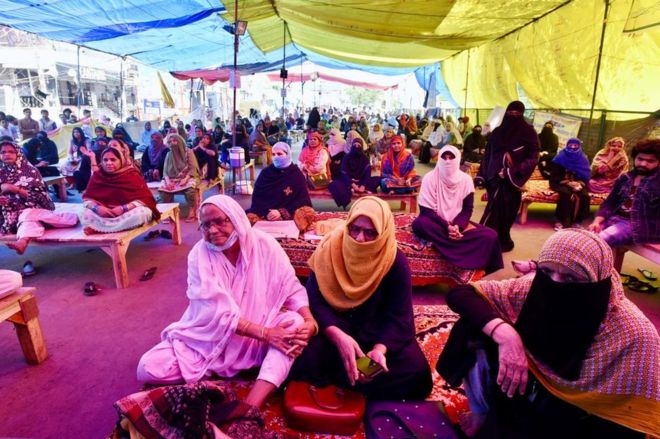 Image copyright GETTY IMAGES
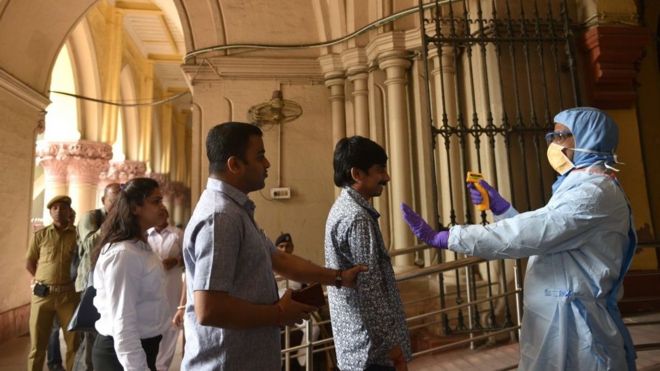 Image copyright GETTY IMAGES
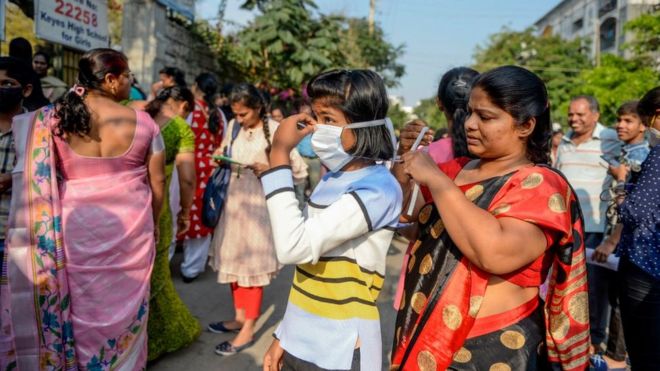 Image copyright GETTY IMAGES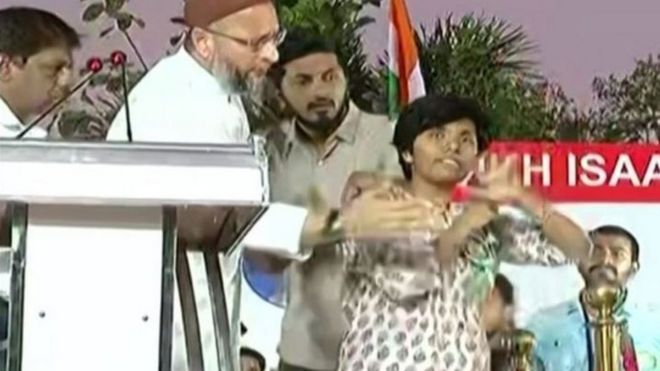




 CHINDIA ALERT: You'll be living in their world, very soon
Gandhi killer ‘patriot’ comment by BJP candidate draws outrage
India is in full election mode: voting began on 11 April, and the final ballot will be cast on 19 May with results out on 23 May. Every day, the BBC will be bringing you all the latest updates on the twists and turns of the world’s largest democracy.
Ruling party candidate calls Gandhi’s killer a patriot
What is happening?
Controversial Bharatiya Janata Party (BJP) politician Pragya Thakur has made headlines again. This time it was for calling Nathuram Godse – the man who assassinated Mahatma Gandhi – a “patriot”.
Her comment was made in response to a statement by southern actor-turned politician Kamal Haasan who had said India’s first “extremist” was a Hindu”, referring to Godse.
End of Twitter post by @ANI
His statement, made on Monday, was heavily criticised by the BJP, which accused him of indulging in “divisive politics” and filed a complaint against him with the Election Commission of India.
Why does this matter?
The BJP has responded by criticising Ms Thakur and asking her to publicly apologise.
“BJP does not agree with this statement, we condemn it. Party will ask her for clarification, she should apologise publicly for this statement,” party spokesperson GVL Narasimha Rao told reporters.
However, Ms Thakur’s comments do reflect the views of some right-wing Hindus who support the BJP and have long seen Gandhi as too moderate.
Godse, who shot Gandhi in the chest three times at point-blank range on 30 January 1948, was also an activist with nationalist right-wing groups, including those closely associated with the BJP.
Hindu hardliners in India accuse Gandhi of having betrayed Hindus by being too pro-Muslim, and even for the division of India and the bloodshed that marked Partition, which saw India and Pakistan created after independence from Britain in 1947.
Ms Thakur has seen her fair share of controversy. Her candidature caused outrage as she is an accused of involvement in a blast that killed seven people and injured 100 others. On 18 April, she said that police officer Hemant Karkare had died in the November 2008 Mumbai terror attacks because she had “cursed” him. She was then banned from campaigning for 72 hours as a result.
A team led by Mr Karkare had arrested her for questioning in connection with the Malegaon blast.
During her campaign, she also said she was “proud” of her part in the demolition of the 16th Century Babri mosque. In 1992, right-wing Hindu mobs razed the mosque to the ground, claiming it was built on the site of a temple destroyed by Muslim rulers. The site, which is in the city of Ayodhya, has been a religious flashpoint for Hindus and Muslims for decades.
Campaigning ends in West Bengal a day before deadline
What happened?
The Election Commission (EC) has told political parties to end their campaigning in West Bengal state, a day before the deadline in the wake of poll-related violence.
The campaign will end on Thursday at 10pm local time, and voting will be held on Sunday.
The decision comes after clashes broke out between the Bharatiya Janata Party (BJP) workers and protesters believed to be from the ruling Trinamool Congress (TMC) in Kolkata (formerly Calcutta) on Tuesday.
It happened during a roadshow of BJP chief Amit Shah. Several people were injured and vehicles were set on fire. A statue of renowned Bengali reformer Iswarchandra Vidyasagar was also vandalised in the clashes.
Both parties have accused each other of starting the violence.
Why does this matter?
The BJP welcomed the decision, saying it validated their argument that the state had “descended into anarchy” under the leadership of chief minister Mamata Banerjee.
Ms Banerjee said that the move was “undemocratic” and “it had insulted the people of Bengal”.
“Tomorrow, [Prime Minister Narendra] Modi has two meetings in Bengal. When he finishes, the campaigning also ends… Instead of punishing Amit Shah, the Election Commission has given a gift to the BJP,” she said.
Both parties are locked into a fierce election battle to win most out West Bengal’s 42 seats. Ms Banerjee has ambitions of becoming the prime minister in case a nationwide coalition of regional parties wins enough seats.
The state has also become crucial for the BJP as it’s trying to expand its reach in the eastern state. It won only two seats in the 2014 election.
The BJP performed well in northern states like Uttar Pradesh and Rajasthan in 2014, but this time it’s expected to suffer loses against a coalition of regional parties and the main opposition Congress.
So the party is trying to make up for the losses in West Bengal.
TMC, BJP accused each other of poll violence
What happened?
The war of words between West Bengal state chief minister Mamata Banerjee and the governing Bharatiya Janata Party (BJP) intensified ahead of voting on Sunday.
The latest verbal duel comes after violence was reported during BJP chief Amit Shah’s roadshow in Kolkata (formerly Calcutta) on Tuesday.
Clashes broke out between BJP supporters and protesters who were holding “Amit Shah go back” posters.
Some people suffered minor injuries and a few vehicles were set on fire.
The BJP said the protest was “orchestrated” and called it an “attempt to strangulate democracy”.
Why does this matter?
The eastern state has become politically crucial for the BJP as it has intensified campaigning in the past few days.
And that has sparked a feverish electoral battle between the BJP and Ms Banerjee’s Trinamool Congress (TMC).
“What does Amit Shah think of himself? Is he above everything? Is he god that no one can protest against him?” Ms Banerjee said.
In reply, Mr Shah accused the TMC of not following democratic norms during elections.
“Have faith in the people of Bengal that they’d face the TMC goons,” he said.
Prime Minister Narendra Modi is scheduled to hold more rallies in the coming days, so one can expect more verbal fireworks from the two leaders.
On Tuesday, the saga of the morphed Mamata meme continued
What happened?
India’s top court stepped in to release an activist belonging to India’s governing Bharatiya Janata Party (BJP) who was sent to prison for sharing a doctored image of West Bengal Chief Minister Mamata Banerjee.
Priyanka Sharma was sentenced to two weeks in prison on 10 May after she shared a picture of Bollywood star Priyanka Chopra and her husband Nick Jonas at the Met Gala – but with Ms Banerjee’s head superimposed on to Chopra’s body.
Earlier the court had said Ms Sharma could be released only if she apologised to Ms Banerjee, but later waived this condition.
Why does this matter?
The battle for West Bengal in this general election has been absolutely bruising.
The BJP, led by Prime Minister Narendra Modi himself, has been campaigning hard for votes in the state. This has brought them toe-to-toe with the state’s feisty chief minister. The fact that voting for West Bengal’s 42 seats has been split across all nine phases of voting has meant that the battle has been long and drawn-out.
And with just one phase to go before voting finally ends, the gloves are well and truly off. The two parties have traded insults on the campaign stage, their workers have attacked each other, and the violence on the ground has intensified. And now the battle has spread to cyberspace as well.
The country’s finance minister Arun Jaitley jumped at news of Ms Sharma’s release to call Ms Banerjee a dictator.
End of Twitter post by @arunjaitley
Analysts say that this political row is so bitter because the BJP has clearly identified West Bengal as one of the states where they may be able to make gains this election. This becomes more important for the party in the context of their fight in the politically crucial state of Uttar Pradesh, which sends the most number of MPs (80) to parliament.
They are up against a powerful coalition of regional parties there, and many expect them to lose seats as a result.
And PM Modi said Rahul Gandhi should be ashamed of 1984 riots
What happened?
Prime Minister Narendra Modi said that main opposition Congress party chief Rahul Gandhi should be “ashamed of himself” over his colleague’s remark on the 1984 anti-Sikh riots.
Mr Modi was replying to a controversial statement made by Sam Pitroda, who is a strategist of the Congress party.
In his reply to a question about the Congress’ role in the riots, Mr Pitroda had said “so what?”.
“I don’t think so, this is also another lie, and what about 1984? You speak about what you [Mr Modi] have done in five years. It [the riots] happened in 1984, so what?” he said.
Mr Gandhi said he was “ashamed” of Mr Pitroda’s statement, and asked him to apologise.
Mr Pitroda later said his statement was “twisted” and he did not mean to hurt sentiments.
But Mr Modi said the Congress chief “must apologise”.
“I was watching that naamdar [the dynast] told his guru that he should be ashamed of what he said. I want to ask naamdar, you pretended to scold your mentor for what? Because he exposed what was always in the Congress’s heart, and in the discussions of the naamdar family? Because he made public a family secret? Naamdar, it is you who should be ashamed,” Mr Modi said.
Why does this matter?
The controversy matters because it comes days ahead of voting for the 13 seats in the northern state of Punjab.
The BJP, which has formed a coalition with regional Shiromani Akali Dal, is locked in a bitter electoral battle with the ruling Congress in the state.
Sikhs are a majority in the state and the 1984 riots is still an emotional issue for many of them.
More than 3,000 Sikhs were killed in 1984 after the assassination of former prime minister Indira Gandhi by her Sikh bodyguards.
They were angry at her decision to send the army into the Golden Temple – Sikhism’s holiest shrine – to flush out militants earlier in the year.
The killing of Mrs Gandhi, who belonged to the Congress, saw mobs attack and murder members of the Sikh community across the country.
And both parties appear to be trying to come across as pro-Sikh ahead of the vote on 19 May.
On Sunday, Delhi voted but not enthusiastically
What happened?
Sunday saw India’s capital Delhi vote along with several other states in the polls – the penultimate phase of the country’s mammoth general election.
Voters turned out to vote, but in fewer numbers than they did in 2014. The election commission said that around 60% of the capital’s registered voters had actually cast ballots, which was about a five percent drop from 2014.
Delhi Chief Electoral Officer Ranbir Singh expressed disappointment, saying that the turnout did not match expectations.
Why does this matter?
The election commission is right to be disappointed – it had run a series of campaigns in the city, encouraging more people to vote.
But it was not as though polling in Delhi was an entirely smooth process. Some voters complained that their names were missing from electoral lists even though they had all the necessary documents. There were also reports that around 1,200 Electronic Voting Machines (EVMs) had malfunctioned across the city, delaying the polling process.
The fact that Delhi became a three-cornered contest after the main opposition Congress and the Aam Aadmi Party (AAP), which controls the Delhi state assembly, failed to stitch up an alliance may also have put voters off. Many analysts believe that this failure will only split voters who were against prime minister Narendra Modi’s Bharatiya Janata Party (BJP) and effectively hand them victory.
So they may have decided to just stay home, and not bother queuing up in the blistering heat – it touched 40C on Sunday.
Source: The BBC
Posted in Aam Aadmi Party (AAP), Amit Shah, Arun Jaitley, assassinated, Ayodhya, Babri mosque, Bharatiya Janata Party (BJP) politician, bjp candidate, Chief Minister, comment, Congress party chief, Delhi, Delhi Chief Electoral Officer, Election Commission, Election Commission (EC), Electronic Voting Machines (EVMs), extremist, finance minister, Gandhi killer, Hindu, Hindus, Indira Gandhi, Iswarchandra Vidyasagar, Kolkata, Kolkata / Calcutta, mahatma gandhi, Mamata Banerjee, Muslims, Nathuram Godse, outrage, patriot, PM Modi, Pragya Thakur, Priyanka Chopra, Priyanka Sharma, Punjab, rahul gandhi, Ranbir Singh, Sikh bodyguards, Trinamool Congress (TMC), Uncategorized, West Bengal | Leave a Comment »