Archive for ‘religion’

16/06/2016

Why an Indian Hindu Group Wants a Ministry of Cows – India Real Time – WSJ

Cows have long held a sacred place in India’s society, revered as holy by the country’s predominantly Hindu population. If one group gets its way they might soon have a government department devoted to their interests too.

The cow-protection unit of the right-wing Hindu group Vishva Hindu Parishad (World Hindu Council) is urging Prime Minister Narendra Modi to form a dedicated ministry for the preservation and protection of cows.

“Gou mata (mother cow) is the symbol of life, soul of our culture. She is not being given enough importance,” an official at the Bharatiya Govansh Rakshan Samvardhan Parishad (Indian Cattle Protection and Promotion Council), who didn’t wish to be named, said.

He said the “whole idea is to save the cows from getting killed.” Rearing cows will also increase milk production in the country, he added.

Slaughter of bovines has long been a fraught issue in India, but a renewed push to protect the animals came after a Hindu mob killed a Muslim man in the town of Dadri, 31 miles from New Delhi last September over rumors that he butchered a cow. The murder unleashed a wave of violence and sparked a debate over religious intolerance in the country.

There is no central law on cattle slaughter in India, though various states have introduced their own rules since Mr. Modi took power. A number of states have also tightened restrictions on the consumption of beef.

Minority groups, including around 170 million Muslims, have expressed concern over the clampdown.

The official from the Indian Cattle Protection and Promotion Council said members of his organization plan to meet ministers and members of Mr. Modi’s ruling Bharatiya Janata Party to ask them to take up the issue of a separate cow ministry in the upcoming monsoon session of Parliament, which begins in July.

“Our goal is to restore cows of bharatiya (Hindu) breed back to the country’s economy,” he added.Despite the various bans, India is the world’s largest exporter of beef, according to the U.S. Department of Agriculture. India exported 2.4 million tons of beef last year, compared with 2 million tons by Brazil. India alone accounts for nearly 24% of global beef exports.

India has also ranked first among the world’s milk-producing nations since 1998, according to India’s department of animal husbandry, dairying and fisheries. Milk production in India during the period has gone up from 17 million tons in 1950 to 146.3 million tons till last year, it said.

Source: Why an Indian Hindu Group Wants a Ministry of Cows – India Real Time – WSJ

20/02/2015

In Tibet, two celebrations coincide – China – Chinadaily.com.cn

The streets are more crowed and business is booming in Lhasa at the approach of Losar, Tibetan New Year, which coincides this year with the traditional Chinese Spring Festival.

In Tibet, two celebrations coincide

This year, New Year falls on the same day, Thursday, in both traditions. Losar dates to about 100 BC, the time of the ninth king of Tibet, Pude Gungyal. The celebration runs as long as 15 days.

Although the heavy snow that fell in Lhasa two days ago has not melted yet, residents are gearing up for the festival. Many of the hot shopping spots, such as the Ramoche Road and the Barkhor Shopping Mall, are packed with customers.

“My business is much better than last year. With the New Year festivals together, I had more shoppers,” said Basang Lhamo, a stall owner in the Barkhor market.

“I did not have time to prepare for my own Losar,” said the 38-year-old, adding that she will close her business on Tuesday, one day before New Year’s Eve.

As hordes of shoppers prepared for the festival, some bus drivers find it difficult to avoid traffic jams. “Ahead of Losar, with buses and streets crowded with people, it is hard to keep the bus moving smoothly,” said Nyima Tsering, a driver in Lhasa.

Karma Sonam, 43, a restaurant owner in the city, said his business has boomed this month. “My restaurant has been so full that my wife and our staff don’t have time for lunch most of the time,” he said. His family will travel to Xigaze for the festival, and he will give the staff a 15-day holiday.

Sonam Droma is a Tibetan woman who married a Han. They plan to spend the festival on the grassland. “It is more fun to embrace Losar in a remote grassland, as we enjoy the evening bonfire dancing and singing,” Sonam Droma, 27, said. “It is happier on the grassland.”

via In Tibet, two celebrations coincide – China – Chinadaily.com.cn.

05/02/2015

BBC News – Fresh protest against Delhi church attacks

Police in the Indian capital, Delhi, have detained dozens of people who were protesting against recent attacks on churches in the city.

Indian Christians hold placards protesting against recent attacks on churches in the Indian capital as they assemble outside the Sacred Heart Church in New Delhi, India, Thursday, Feb. 5, 2015

There have been five attacks on churches in Delhi since December.

Christian groups accuse hardline Hindus of carrying out the attacks, but police say there is little evidence for this.

Some protesters have accused India’s Hindu nationalist BJP government of not doing enough to reassure the city’s Christian minority.

Thursday’s protest came after a church in Delhi was vandalised on Monday, and an unexplained fire gutted another in December.

Protesters carrying placards reading “Enough is Enough, What are police doing?” gathered outside the city’s main Catholic Sacred Heart Cathedral in central New Delhi.

Police said the protesters were detained as they were marching towards the residence of Home Minister Rajnath Singh in a high-security area where protests are not allowed.

via BBC News – Fresh protest against Delhi church attacks.

16/01/2015

Ethnic minorities: Don’t make yourself at home | The Economist

CHINA is urbanising at a rapid pace. In 2000 nearly two-thirds of its residents lived in the countryside. Today fewer than half do. But two ethnic groups, whose members often chafe at Chinese rule, are bucking this trend. Uighurs and Tibetans are staying on the farm, often because discrimination against them makes it difficult to find work in cities. As ethnic discontent grows, so too does the discrimination, creating a vicious circle.

Breaking this circle is crucial to China’s efforts to defuse unrest in Xinjiang, Tibet and Tibetan-inhabited areas of other provinces, which collectively account for nearly one-third of China’s land area. In Xinjiang, Uighur grievances have triggered numerous outbreaks of violence. On January 12th, in what appeared to be the latest such example, six people were shot dead after allegedly attacking police in Shule, a town near China’s border with Central Asia. Uighurs are a Turkic-speaking, mostly Muslim, minority who number about 10m in Xinjiang. In 2000, 80% of them were farmers; ten years later 83% of them were.

There has been far less violence in Tibet, but separatism in the region is no less a headache for China’s leaders. There are more than 6m Tibetans in Tibet and four neighbouring provinces. The proportion of farmers fell only slightly between 2000 and 2010, from 87% to 83%. Some prefer to stay in the fields. But many others feel excluded from the benefits enjoyed by the ethnic Han Chinese, who make up more than 90% of China’s population. Neither Uighurs nor Tibetans enjoy ready access to the job market that has drawn tens of millions of Han to cities in recent years. They are unwelcome, and they know it.

In 2010 about 1% of Tibetans had settled outside the provinces that encompass their homeland, and less than 1% of Uighurs had migrated from Xinjiang, according to census data compiled by Ma Rong of Peking University. Many of the migrants are either officials or in government-sponsored education programmes. The rate of voluntary exodus from Xinjiang and Tibetan areas is slowing considerably.

Part of the problem is linguistic. Uighurs and Tibetans brought up in the countryside often have a very poor grasp of Mandarin, the official language. The government has tried to promote Mandarin in schools, but has encountered resistance in some places where it is seen as an attempt to suppress native culture. In southern Xinjiang, where most Uighurs live, many schools do not teach it.

But discrimination is a big factor, too. Even some of the best-educated Uighur and Tibetan migrants struggle to find work. Reza Hasmath of Oxford University found that minority candidates in Beijing, for example, were better educated on average than their Han counterparts, but got worse-paying jobs. A separate study found that CVs of Uighurs and Tibetans, whose ethnicities are clearly identifiable from their names (most Uighurs also look physically very different from Han Chinese), generated far fewer calls for interviews.

Government programmes help some Uighurs, Tibetans and other minorities get a better education; affirmative-action policies can boost their chances of going to university. One scheme, known as the Xinjiang Class, sends thousands of Uighurs as well as Han Chinese from Xinjiang every year to other parts of China to complete their schooling. But it also encourages them to return to Xinjiang to work among Uighurs. Official figures suggest that 50% end up going back to Xinjiang. Timothy Grose of Rose-Hulman Institute of Technology in Indiana found that most he interviewed would have preferred not to.

via Ethnic minorities: Don’t make yourself at home | The Economist.

31/12/2014

Religion in India bubbles over into politics – Businessweek

In small-town northern India, Muslims are offered food and money to convert to Hinduism. If that doesn’t suffice, they say they’re threatened. Across the country, the Christmas holiday is canceled for hundreds of government servants who spend the day publicly extolling the policies of Prime Minister Narendra Modi. Powerful Hindu nationalist leaders — some with close ties to Modi’s government — say they intend to ensure India becomes a completely Hindu nation.

But Modi himself? He has remained silent as nationalist demands have bubbled over into day-to-day politics, and amid growing fears among minority religious groups of creeping efforts to shunt them aside.

“We told him we feel insecure and fearful,” said the Rev. Dominic Emmanuel, a Roman Catholic priest who was in a delegation of religious leaders who met a few days ago with Modi. “We told him, ‘If there were just two words from your side, prime minister, we would feel so much better.'”

via Religion in India bubbles over into politics – Businessweek.

12/12/2014

Christmas celebrations: Oh what fun | The Economist

CITIES across China blink with fairy lights, fancy hotels flaunt trees and tinsel, and glossy magazine covers display festive recipes and table settings. “Joy up!” reads a sign (in English) on three illuminated trees by a shopping mall in Beijing. The Chinese are doing just that.

In the first decades of Communist rule in China Christianity was banned, along with other religions. Now there are tens of millions of Christians in China and faiths of all kinds are blossoming. But this has little to do with the country’s fast-growing fascination with Christmas. In the West the holiday is a commercialised legacy of Christian culture; in China it is almost entirely a product of Mammon. Father Christmas is better known to most than Jesus.

Well before Christmas took hold in China’s cities, its factories were churning out Christmas essentials for consumption in the West. Industrially, China is now the Christmas king. According to Xinhua, a state-run news agency, more than 60% of Christmas trinkets worldwide last year came from a single “Christmas village”—Yiwu (in fact, a city), in the eastern province of Zhejiang.

But ever more of these goodies now stay in China, to satisfy a domestic craving. Some are tailored to Chinese tastes: Father Christmases playing the saxophone, for example, are a common decoration—no-one quite knows why. This year some shops are putting Santa hats on sheep; the Chinese new year in February, another excuse for hedonism, will be sheep-themed. A shop selling sex aids in Beijing displays a mannequin with a short Santa hot-pants suit, complete with white furry leg warmers.

Christmas in China never really ends. Decorations sometimes remain up year-round. In 2016 the south-western city of Chengdu will host Asia’s first “SantaPark”—a giant Christmas-themed amusement park modelled on a Finnish attraction. It will be known as the “official home of Santa Claus” (despite Chengdu’s sweltering summers and mild winters).

Family reunions are not part of Christmas tradition in China; for most people it is a chance to enjoy public displays of lights, and, for a growing number of younger Chinese, to exchange gifts with colleagues and friends (China’s home-grown festivals are not so centred around gift-giving). As elsewhere, Christmas in China is a merry time to shop.

via Christmas celebrations: Oh what fun | The Economist.

03/11/2014

Religious Tension Escalates in North India Ahead of Muharram – India Real Time – WSJ
As Muslims across India prepare to observe the holy day of Ashura in the Islamic month of Muharram on Tuesday, religious tension between Hindus and Muslims is on the rise in some parts of northern India.

Shiite Muslims, who traditionally hold processions on the 10th day of Muharram to mourn the death of Prophet Muhammad’s grandson, have been forbidden from passing through certain Hindu neighborhoods in New Delhi.

According to Zafarul Islam Khan, head of the All India Muslim Majlis-e-Mushawarat, an umbrella organization of Muslim groups based in Delhi, in the Bawana neighborhood of northwest Delhi, a “maha panchayat,” an unelected village council, on Sunday decided that Muslim processions should be banned in public spaces, particularly those with majority Hindu populations.

Heads of nearby villages dominated by the Hindu Jat caste also attended this meeting to affirm their opposition to the public processions, Mr. Khan says members of the Muslim community told him. Members of the village council could not be reached for comment.

Muslims have, in turn, agreed to restrict their processions to a Muslim-dominated residential colony instead of the main market of Bawana, according to a report in the Times of India.

During the Ashura march — also referred to as Muharram — many Muslims weep and inflict wounds on themselves in an expression of grief for the martyrdom of Hussein, Prophet Muhammad’s grandson.

“The Muslims themselves have decided not to take their processions to Hindu areas,” said Mr. Khan, adding, “this is happening for the first time.”

After communal violence broke out in New Delhi following celebrations for the Hindu festivals of Dussehra and Diwali last month, the atmosphere in neighborhoods with mixed Hindu and Muslim populations is still tense, according to a Times of India report.

In the eastern neighborhood of Trilokpuri in the capital, tension over the construction of a platform for Hindu gatherings close to a mosque led to low intensity violence for several days, culminating in three days of riots that ended Oct. 26.

There is an ongoing conflict over public space, said Mr. Khan, which leads to small incidents of communal tension across the country.

“In my childhood, everyone took part in the [Muharram] processions,” he said, adding that increasing polarization between Hindus and Muslims have turned festivals into a point of communal tension.

Processions for Muharram often begin a few days before the 10th day, which falls on Tuesday this year. On Sunday, authorities imposed curfew-like restrictions in most parts of Srinagar, the Muslim-majority summer capital of the northern state of Jammu and Kashmir, to prevent religious processions of Shiite Muslims on the eighth day of Muharram, according to a report in Xinhua, China’s state-run news agency.

via Religious Tension Escalates in North India Ahead of Muharram – India Real Time – WSJ.

28/10/2014

Britain’s PM David Cameron Unveils Encyclopedia of Hinduism – India Real Time – WSJ

British Prime Minister David Cameron held a Diwali party in London to launch the new Encyclopedia of Hinduism, as his Conservative Party attempts to strengthen relations with the country’s large Indian community ahead of national elections next year.

The encyclopedia, which took 25 years to compile, contains 11 volumes and is published by the India Heritage Research Foundation, a nonprofit founded by Pujya Swami Chidanand Saraswati, head of the largest ashram in Rishikesh, a town in northern India.

More than 1,000 guests attended the unveiling of book in Westminster, near the Houses of Parliament. The event was organized by the United Kingdom’s ruling Conservative Party and the Conservative Party Friends of India among others.

Mr. Cameron and his wife Samantha lit a diya, or lamp, at the Diwali party that coincided with the book launch.

Andrew Feldman, chairman of the Conservative Party, said that the book, a product of research by 1,000 scholars, was a “phenomenal achievement.”

“The party wants to deepen and broaden our links with the British Indian community and with India and this event is one important step on our journey,” Lord Feldman said, according to a statement released after the event.

via Britain’s PM David Cameron Unveils Encyclopedia of Hinduism – India Real Time – WSJ.

13/08/2014

India Wants to Find the Saraswati River and Bring It Back to Life – India Real Time – WSJ

ndia’s new government says it plans to find and possibly bring back to life a long-lost river mentioned in sacred Hindu texts.

In answer to a question in Parliament Tuesday, Uma Bharti, the water resources and river development minister said India wants to “detect and revive,” the Saraswati River, described in Vedic texts.

“There are enough scientific evidences on the presence of the river Saraswati in some parts of the country through which it flowed about five to six thousand years ago,” she said on the floor of the lower house of Parliament. “Saraswati is not a myth.”

Geologists have known for more than 100 years about ancient river beds passing through northern India that could be the Saraswati, said the Times of India. But reviving the river by bringing any underground water to the surface is “an impossible task,” Umesh Chaube, professor emeritus of water resource development and hydrology at IIT –Roorkee told the Hindustan Times.

Critics were quick to suggest it would be a waste of government money and a potential wild goose chase aimed at strengthening the ruling Bharatiya Janata Party’s ties to its Hindu nationalist supporters.

A BJP spokesman did not respond to a request for the party response on Wednesday morning.

It wouldn’t be the first time that scientists have had to follow the hunches of politicians. Last year a team of government archaeologists had to excavate the ruins of an old palace in the state of Uttar Pradesh, after a famed Hindu holy man declared that there was 1,000 tons of gold buried under it. No gold was found.

via India Wants to Find the Saraswati River and Bring It Back to Life – India Real Time – WSJ.

04/08/2014

With court ban on illegal mosque loudspeakers, some Mumbai Muslims oppose street prayers too

The performance of religious practices in public spaces has occasionally caused friction in Indian cities. On July 30, the Bombay High Court addressed one particularly vexing source of strain when it asked the city police to take down all illegal loudspeakers attached to mosques in Mumbai and Navi Mumbai.

The court’s directive came in response to a public interest litigation filed by a Navi Mumbai resident against the unauthorised loudspeakers during prayer time at mosques. The court specified that all illegal loudspeakers, whether installed at mosques or at Ganesh or Navratri pandals, should be removed “irrespective of religion, caste or community”.

Even though the loudspeaker issue has been repeatedly politicised in Maharashtra (in 2010, the Shiv Sena had demanded a blanket ban on all mosque loudspeakers after the party was booked for violating noise norms at its Dussehra rally), several Muslim activists came out in support of the court directive.

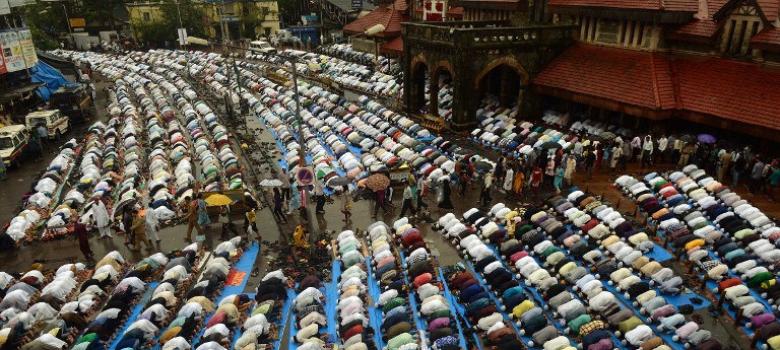
But the call to prayer being announced on loudspeakers is not the only Muslim practice that some members of other communities complain about. In densely-populated cities like Mumbai, when large numbers of devotees gather to pray their Friday namaz, the congregation often spills out of the mosques and into the streets outside, hindering traffic and pedestrian movements for up to 30 minutes.

For many Muslim activists, this phenomenon is as much of an inconvenience to the public as the loudspeakers. But they believe the government has a greater role to play in helping to solve the problem.

“Nobody really likes to pray namaz outside on the streets, because it inconveniences so many people,” said Ghulam Arif, president of the Qartaba Wisdom Club, a Mumbai-based non-profit organisation that works on social issues. The only reason the practice continues, he said, is because the community is too large to fit into the existing mosques.

“The government could give Muslims the permission to organise Friday prayers in open grounds and maidans near mosques,” said Arif.

The community has been recommending a specific solution to the problem for nearly two decades: allowing mosques to expand by granting them additional floor space index. Increasing FSI  – the ratio of plot size to the height of a building that can be erected on it  –  would mean a greater number of floors to accommodate more worshippers.

via Scroll.in – News. Politics. Culture..

Law of Unintended Consequences

continuously updated blog about China & India

ChiaHou's Book Reviews

continuously updated blog about China & India

What's wrong with the world; and its economy

continuously updated blog about China & India