Archive for ‘Religious clash’

30/12/2013

BBC News – China police kill eight in Xinjiang clash

Police in China\’s restive Xinjiang region have shot dead eight people during a violent clash on Monday, a state news portal says.

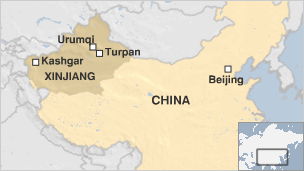
Map

The clash broke out when men armed with knives and explosives attacked a police station in Yarkand county, officials say. One person has also been arrested.

The violence comes two weeks after a riot in the region, which saw 16 people killed, including two police.

Xinjiang, home to the Muslim Uighur minority group, sees sporadic clashes.

The government traditionally blames extremists for the violence. Uighur activists, on the other hand, point to ethnic tensions and tight Chinese control as triggers for violence.


Verifying reports from the region is difficult because the information flow out of Xinjiang is tightly controlled.

News of the latest clash first emerged on the state-run regional Tianshan news portal.

Officials described the people who attacked the police station in Yarkand, near the old silk road city of Kashgar, as \”thugs carrying knives and throwing explosives\”.

It was not immediately clear if there were any police casualties. The incident is currently under investigation, officials say.

More than 100 people have been killed in Xinjiang this year in this and similar incidents, which Beijing blames on separatist \”terrorists\” from the Uighur group, says the BBC\’s John Sudworth in Shanghai.

via BBC News – China police kill eight in Xinjiang clash.

01/12/2013

Xinjiang college says approved political views needed to graduate | Reuters

College students in China\’s restive western Xinjiang region will not graduate unless their political views are approved, a university official said, as the country wages what school administrators called an ideological war against separatism.

A Uighur student attends a lesson at the Xinjiang College of Uighur Medicine in Hotan in the southwestern part of China's Xinjiang Uighur Autonomous Region September 15, 2003. REUTERS/Andrew Wong

Xinjiang is home to the Muslim Uighur ethnic group, many of whom resent controls imposed by Beijing and an inflow of Han Chinese migrants. Some Uighur groups are campaigning for an independent homeland for their people.

University officials from Xinjiang said their institutions were a frontline in a \”life and death struggle\” for the people\’s hearts and a main front in the battle against separatism, the ruling Communist Party\’s official newspaper in the region, the Xinjiang Daily, reported on Tuesday.

\”Students whose political qualifications are not up to par must absolutely not graduate, even if their professional course work is excellent,\” said Xu Yuanzhi, the party secretary at Kashgar Teachers College in southern Xinjiang, which has been an epicenter for ethnic unrest.

It is unclear if such a policy has been officially implemented throughout the region.

\”Ideology is a battlefield without gun smoke,\” Xinjiang Normal University President Weili Balati said.

\”As university leaders, we have the responsibility to do more to help students and teachers properly understand and treat religion, ethnicity and culture and help them distinguish between right and wrong,\” he said.

China blamed the East Turkestan Islamic Movement (ETIM) for an attack on October 28, when a vehicle ploughed through bystanders on Tiananmen Square in Beijing and burst into flames, killing three people in the car and two bystanders.

Uighur exiles, rights groups and some experts have cast doubt on the official accounts of what China has deemed terror attacks and foreign reporting of the incident has discussed whether it was motivated by punitive ethnic policies.

An Islamist militant group has released a speech claiming responsibility for the incident, which China\’s Foreign Ministry said should silence those who are skeptical about the threat of terror within China\’s borders.

The Uighurs are culturally closer to ethnic groups across central Asia and Turkey than the Han Chinese who make up the vast majority of China\’s population.

via Xinjiang college says approved political views needed to graduate | Reuters.

16/09/2013

China opens world’s highest civilian airport

Reuters: “China opened the world’s highest civilian airport on Monday, in a restive and remote Tibetan region of southwestern Sichuan province, which will cut journey times from the provincial capital from two days to a little more than one hour.

Local Tibetans wave hada, or traditional silk scarves, as they greet the first group of passengers who landed at Daocheng Yading Airport in Daocheng county of Garze Tibetan Autonomous Prefecture, Sichuan province September 16, 2013. The airport, at 4,411 metres (14,472 feet) above sea level, surpassed the Qamdo Bangda Airport which has an altitude of 4,334 metres (14,219 feet), and became the highest airport in the world after its inauguration on Monday, according to local media. REUTERS/China Daily

Daocheng airport in Garzi, a heavily ethnic Tibetan part of Sichuan, is 4,411 meters (14,472 feet) above sea level, and overtakes Qamdo airport in Tibet, which sits at 4,334 meters above sea level, for the title of world’s highest.

The official Xinhua news agency said flights would initially connect with Chengdu, the provincial capital, otherwise a two-day bus trip away. Flights to cities including Shanghai, Guangzhou and Chongqing will begin at a later date.

The 1.58 billion yuan ($258 million) airport, designed to handle 280,000 passengers a year, will help open up the nearby Yading Nature Reserve to tourism, Xinhua added, referring to an area renowned for its untouched natural beauty.

China has embarked upon a multi-billion-dollar program in recent years to revamp old airports and build new ones, especially in the remote west, as a way of boosting the economy.

Some of these airports have been located in Tibetan regions, whose population chafes at Chinese political control, and often have a dual military purpose so troops can be bought in quickly during periods of unrest.

Garzi has been the scene of numerous self-immolation protests against Chinese rule in the last three years or so and remains under tight security.”

via China opens world’s highest civilian airport | Reuters.

See also: https://chindia-alert.org/economic-factors/chinas-infrastructure/

08/09/2013

Jairam blames ‘forcible acquisition’ for Naxal problem

The Hindu: “Coming down heavily on PSUs for displacing tribals, Union Minister Jairam Ramesh on Sunday blamed their actions for growth of Naxalism in many areas and cautioned that the era of “forcible acquisition” was now over.

The Union Rural Development Minister said if the new Land Acquisition Act is implemented properly, it will put an end to “inhumane” displacement of tribals from forests and check Maoist menace. File photo

The Union Rural Development Minister said if the new Land Acquisition Act is implemented properly, it will put an end to “inhumane” displacement of tribals from forests and check Maoist menace.

“The record of public sector (PSUs) in displacements is worse than the record of the private sector. This is a sad truth… that more displacement has been caused by government and public sector projects than private sector projects…particularly in Naxal areas. And this is why Naxalism has grown in these areas,” the Minister said.

Mr. Ramesh slammed National Thermal Power Corporation for allegedly seeking police help for forcibly acquiring land in Keredari block of Jharkhand’s Hazaribagh district, where a villager agitating against land acquisition was shot dead two months ago.

He was addressing Hindi and regional media two days after Parliament passed the path-breaking ‘Right to Fair Compensation and Transparency in Land Acquisition, Rehabilitation and Resettlement Act, 2013’.

Criticising NTPC for the alleged forced acquisition, Ramesh said, “Companies must also learn to be sensitive, changing aspirations.”

“NTPC will face a challenge. If there is firing in an NTPC project and people get killed in that firing, they cannot acquire the land…Indian companies still believe that they can use government to forcibly acquire land. That era is gone. You cannot do forcible acquisition,” the Minister said when asked about the reported criticism by a top NTPC official of the new Land Acquisition legislation.

“If this (new) land acquisition law is properly implemented, it will defeat Naxalism,” he said, referring to incidents of “inhumane” displacement of tribals from forests for various public and private sector projects in mineral-rich states like Jharkhand, Odisha and Chhattisgarh.

The new law will be notified in three months.

Mr. Ramesh said, “Land Acquisition is the root of the Maoist issue. If you have a humane, sensitive and responsible land acquisition policy, lot of your problems relating to Naxalism would go. Tribals will be with you.

“It is a fact that many of the tribals have been displaced and they have not got proper compensation, they have not got rehabilitation and resettlement…particularly in mining of coal and irrigation projects,” he added.

Mr. Ramesh, the architect of the new Land Acquisition Bill, said the 119-year-old Land Acquisition Act, 1894, had a “very important role” in encouraging Maoist activities in Odisha, Chhattisgarh, Jharkhand, parts of tribal Maharashtra and tribal Andhra Pradesh.

When asked that 13 laws, including the Indian Railways Act, National Highways Act, Land Acquisition Mines Act and Coal Bearing Areas Acquisition and Development Act, under which bulk of the land acquisition takes place, are exempted from the purview of the Bill, the Minister said, “Within one year, all compensation, all rehabilitation and resettlement…all these Acts will come under the newly enacted legislation.””

via Jairam blames ‘forcible acquisition’ for Naxal problem – The Hindu.

See also:

08/09/2013

Army summoned to quell communal violence that kills 15 in north Indian state

Reuters: “The Indian army was called in, an unusual measure, to contain communal violence pitting Hindus against Muslims that killed at least 15 people in northern Uttar Pradesh state.

Indian army vehicles patrol on a deserted road during a curfew in Muzaffarnagar, in the northern Indian state of Uttar Pradesh September 8, 2013. REUTERS/Stringer

An army contingent of up to 800 was dispatched to the area on Saturday night, as armed gangs of Jats, a group practicing Hinduism, stormed a mosque and a village with Muslim residents, the state’s principal home secretary R.M. Srivastava said.

“We had sought assistance of the army last night after we found the violence spreading across to other villages,” Srivastava told Reuters.

“In fact, we were able to bring things under control until fresh violence broke out in (a) village Sunday morning.”

The violence erupted on Saturday following a meeting attended by Jats in Muzaffarnagar district, 140 km (90 miles) northeast of New Delhi. Police said 10 people died, including a journalist and photographer, and about 35 were injured.

Five more were killed in a fresh outbreak on Sunday morning.

A curfew was imposed in three districts,

“I would appeal to all the people there to maintain peace and do not trust or listen to any rumors,” Akhilesh Yadav, Uttar Pradesh’s chief minister, told reporters.

The Jats are demanding the rescinding of charges against members of their community in connection with a communal clash last month in which three people were killed.

Arun Kumar, a senior police official, said tensions were fuelled by an online video purporting to show the killing of two Muslim youths last month.

Local media said about 50 outbreaks of communal tension have occurred in populous Uttar Pradesh since the region’s Samajwadi (Socialist) Party came to power last year. More than 25 people have died.”

via Army summoned to quell communal violence that kills 15 in north Indian state | Reuters.

See also: 

25/08/2013

Police crack down on Ayodhya yatra

The Hindu: “With the Vishwa Hindu Parishad’s 84 Kosi Parikrama Yatra set to begin from the banks of the Saryu River on Sunday, the Uttar Pradesh administration on Saturday cracked down on the Hindu rightwing organisation, arresting over 350 of its activists across the State.

Security personnel patrol a street in Ayodhya on Friday.

The administration sealed entry points into the district as the VHP remained defiant, determined to go ahead with its yatra, which is being held in support of a Ram Mandir at the disputed site here. The yatra has been banned by the State.

BJP MLA Savitri Bai Phule, VHP’s provincial coordinator Acharya Kushmuni and Mahant Santosh Das alias Sathu Baba, a VHP office-bearer in Varanasi, were taken into preventive custody or put under house arrest, while prominent VHP leader Mahant Ram Saran Das was held at Ram Sanehi Ghat in Ayodhya.

Scores of VHP activists were arrested in various parts of the State, including Kanpur (100), Allahabad (43) and Basti (18). Arrest warrants have been issued against VHP leaders Ashok Singhal, Praveen Togadia and Ram Vilas Vedanti, Faizabad district magistrate Vipin Kumar Dwivedi said.

The police raided the VHP’s suspected hideouts, forcing many of its leaders and activists to go underground. However, according to local sources, senior leaders could appear with seers.

Lucknow IG Subash Chandra, who conducted a tour of vulnerable spots, said, “This yatra goes against tradition. We are fully prepared not to let it happen. Section 144 Cr.PC has been imposed and action will be taken against those violating it.”

Schools have been converted into temporary jails to keep those booked under Section 144.

The administration expected around 40,000 people to participate. However, the VHP maintained that no common people were invited and that politicians would not get on the dais to address the seers or participants. Around 200-250 seers would participate in the yatra, which the VHP defined as a “padhyatra [march] to awaken the Hindus within the cultural boundary [roughly 250 km] of Ayodhya.”

VHP president Praveen Togadia said that it was “not a large congregation” so the State government should not panic. It was actually a march but since the saints termed it “parikrama” it was being viewed as a traditional parikrama. The State justified the ban, pointing out that the traditional period for staging the parikrama had passed in April-May. Sharad Sharma, VHP spokesperson said, “It is the right of the seers to carry out the yatra. This is religious, not political. The government has ruined the atmosphere for its political gains.”

Amid speculation that the VHP might cancel the yatra at the last moment fearing administrative action and considering the law and order situation, Mr. Sharma said, “This will be decided at the last moment. If the seers decide to carry out rituals at the starting point itself, that will be followed. But there is no possibility of cancellation.”

Mr. Sharma lashed out at the SP government for “working under the grip of Azam Khan [Minister]” to appease Muslims, who are a votebank for the party.”

via Police crack down on Ayodhya yatra – The Hindu.

See also: 

28/06/2013

Death toll from Xinjiang attacks rises to 35

SCMP: “Beijing yesterday raised the death toll from a series of attacks in Turpan , Xinjiang , on Wednesday from 27 to 35.

e22b4f2d9201a0f19cff5f0782b8ea82.jpg

Twenty-four were killed by rioters, including two policemen, Xinhua said, adding that 16 of them were Uygurs. Police killed 11 rioters, while 21 police officers and civilians were injured.

Xinhua said an unspecified number of “mobsters” stormed the government office, the police station, the People’s Armed Police base and a construction site in Lukqun township, Shanshan county, at around 5.50am on Wednesday. The authorities did not mention that a PAP base was also among the targets of attacks until yesterday.

It said four suspected rioters who were injured had been detained.

It was the first Chinese-language report on the incident released by Xinhua, which carried an English report roughly seven hours after the attacks.

Neither report mentioned the number of attackers, their ethnicity or what caused the attacks. But yesterday’s report branded the incident a “violent terrorist attack”.

A visitor to Turpan yesterday said he saw a roadblock with armed police officers and about 20 police vehicles.

A resident said a helicopter arrived on the scene along with many police and soldiers.

The Global Times, a tabloid affiliated with the People’s Daily, yesterday quoted an unnamed regional official as saying that “earlier this year local police handled a case in which a store was attacked, which might have triggered that violence”.

The attack came less than two weeks ahead of the fourth anniversary of ethnic clashes between Han Chinese and Uygurs in Urumqi , the regional capital, which left nearly 200 dead. Two months ago, 15 policemen or officials and six assailants were killed in another conflict in Bachu county, Kashgar , which involved attackers armed with knives and axes and the burning of a house.

A Lukqun resident told the South China Morning Post by phone that local officials had told people to stay at home and be vigilant soon after the violence on Wednesday, adding that dozens of militia soldiers from his village were patrolling the streets.

It was the deadliest unrest in the region since the media-savvy Zhang Chunxian became regional party secretary in April 2010, less than a year after the bloody clashes in Urumqi.”

via Death toll from Xinjiang attacks rises to 35 | South China Morning Post.

See also:

26/06/2013

Violence in China’s Xinjiang ‘kills 27’

BBC: “Riots have killed 27 people in China’s restive far western region of Xinjiang, Chinese state media report.
Map

The violence broke out in Turpan prefecture early on Wednesday.

Police opened fire after a mob armed with knives attacked police stations and a local government building, Xinhua news agency quoted officials as saying.

There are sporadic outbreaks of violence in Xinjiang, where there are ethnic tensions between Muslim Uighur and Han Chinese communities.

Confirming reports from the region is difficult because information is tightly controlled.

China’s state media have been quick to issue an official version of events regarding the latest round of violence in Xinjiang, but it will be tough to verify those reports.

Xinjiang lies on China’s remote north-west border and it is difficult for foreign media to travel there. Many people on both sides of the conflict are reluctant to speak to visiting journalists for fear of reprisals if they dispute the government’s stance.

Unfortunately Xinjiang usually hits international headlines when violence flares between the region’s minority ethnic Uighur Muslims and the majority Han Chinese. Many Uighurs contend that their language and religion are being smothered by an influx of Han Chinese migrants.

Xinjiang is a large geographic area rich in oil and gas deposits. Soon it will also become a major supplier of coal to China’s energy-hungry cities. The region’s fertile land also grows produce that is shipped to the rest of the country. The Han Chinese who move to Xinjiang hope to benefit from the region’s untapped resources.

The violence occurred in Turpan‘s remote township of Lukqun, about 200km (120 miles) south-east of the region’s capital, Urumqi.

The Xinhua news agency report, citing local officials, said rioters stabbed people and set police cars alight.

Seventeen people, including nine security personnel and eight civilians, were killed before police shot dead 10 of the rioters, it said.

At least three others were injured and were being treated in hospital, it added.

The Xinhua report did not provide any information on the ethnicity of those involved in the riot or on what sparked it.

But Dilxat Raxit, a spokesperson for the World Uighur Congress, an umbrella organisation of Uighur groups, told the Associated Press news agency the violence had been caused by the Chinese government’s “sustained repression and provocation” of the Uighur community.

In 2009 almost 200 people – mostly Han Chinese – were killed after deadly rioting erupted in Urumqi between the Han Chinese and Uighur communities.

In April an incident in the city of Kashgar left 21 people dead.

Uighurs and Xinjiang

Uighurs are ethnically Turkic Muslims. They make up about 45% of the region’s population; 40% are Han Chinese

China re-established control in 1949 after crushing short-lived state of East Turkestan. Since then, large-scale immigration of Han Chinese. Uighurs fear erosion of traditional culture.

The government said the violence began when “terrorists” were discovered in a building by officials searching for weapons.

But local people told the BBC that the violence involved a local family who had a longstanding dispute with officials who had been pressurising the men to shave off their beards and the women to take off their veils.

Uighurs make up about 45% of Xinjiang’s population, but say an influx of Han Chinese residents has marginalised their traditional culture.”

via BBC News – Violence in China’s Xinjiang ‘kills 27’.

See also: https://chindia-alert.org/political-factors/chinese-tensions/

21/06/2013

Tibet policy: Bold new proposals

Finally some one with a new idea for Tibet. Hopefully some progress will be made.

The Economist: “FEW outside China think the Communist Party’s strategy for Tibet is working. A combination of economic development and political repression was meant to reconcile Tibetans to Chinese rule and wean them off their loyalty to the Dalai Lama, the exiled spiritual leader. Instead disaffection is still rife, especially among the young. And all across Tibetan areas of China, Tibetans still display the Dalai Lama’s portrait, sometimes openly. Since March 2011 more than 100 Tibetans—especially in Tibetan areas of provinces bordering what China calls the Tibet Autonomous Region (TAR)—have set themselves on fire. Most have done so in part to call for the Dalai Lama’s homecoming. An overwhelming security presence and the Dalai Lama’s commitment to non-violence mean that the unrest is easily contained. Hence little has suggested that China’s leaders are concerned about the bleak implications for the future: that their rule in Tibet can be maintained only by the indefinite deployment of massive coercive force.

So for a Chinese scholar, Jin Wei, who is director of ethnic and religious studies at the Central Party School in Beijing, to call for a “creative” new approach is startling. For her to do so publicly, in an interview this month with a Hong Kong magazine, Asia Weekly, suggests that she has high-level backing. A report from a Beijing think-tank in 2009 challenged the official line that rioting in Tibet the year before was instigated from abroad. But Robert Barnett, a professor of Tibetan studies at Columbia University in New York, describes Ms Jin’s intervention as a sign that, after two decades, “debate has re-emerged within China about the government’s hard-line policies in Tibet”. Ms Jin even accused former party chiefs in Tibet of being “biased against the practice of religious affairs”. This, she said, “foreshadowed the accumulation of grievances today.”

Bold new proposals

One former party secretary in Tibet (from 1988-92) was Hu Jintao, who went on to head the party nationally for ten years until last November, when he gave way to Xi Jinping. Those who have forecast that Mr Xi might prove a bolder reformer than the cautious Mr Hu have so far seen little to back them up. Here, on Tibet, is at least a hint of a crack in the hardline consensus. Some have detected another in the appointment of Yu Zhengsheng to head the party’s main policy group on Tibet and Xinjiang, a Muslim-majority region in the north-west. Mr Yu is the head of an advisory body designed to promote national unity. Previous heads of the group have been security specialists.

This is new

Ms Jin’s analysis, though couched in the terminology of party orthodoxy, is similar to that of many foreign observers. She argues that, by demonising the Dalai Lama, and viewing any expression of Tibetan culture as potentially subversive, the party has turned even those Tibetans sympathetic to its aims against it. The struggle has evolved from “a contradiction between the central government and the Dalai Lama separatist clique into an ethnic conflict between Han Chinese and Tibetans”.

She is not advocating a new soft approach to “political” issues, such as the Dalai Lama’s call for greater autonomy for Tibet and Tibetans’ hankering after a “greater Tibet”—ie, within its historic borders, beyond the TAR. But in fact, most protests in Tibet are not about “politics”, defined like this. Many have been sparked by anger at Chinese repression—of Tibetan culture, language and tradition, or of individual protesters. It is a vicious circle, made worse by anger at the large-scale immigration into Tibet of Han Chinese.

Ms Jin has ideas on how to break the impasse. Talks with the Dalai Lama’s representatives, stalled since the most recent of nine fruitless rounds in 2010, should resume, she says. They should concentrate on “easy” issues first, setting contentious debate about Tibet’s status to one side for now. China should consider inviting the Dalai Lama to visit one of its semi-autonomous cities, Hong Kong or Macau, and eventually allowing him back to Tibet. It should also try to defuse the crisis his death will bring by agreeing with him on a chosen reincarnation from inside China’s borders. Otherwise, China risks having to deal with two incarnations: one it endorses and one in exile who is more likely to be revered by most Tibetans.”

via Tibet policy: Bold new proposals | The Economist.

04/02/2013

* “Muslims have bigger problems than Rushdie”

Salman Rushdie

Salman Rushdie (Photo credit: Wikipedia)

The Hindu: “Nobel Laureate Amartya Sen said here on Sunday that the Muslim groups who protested against author Salman Rushdie’s visit to the city were distracting attention from “the real disadvantages” that the community faced.

“A lot of people who are enormously disadvantaged have enormous reasons to complain about other things,” Professor Sen said in response to a question on the controversy at the Kolkata Literary Meet, one of the events in the 37 International Kolkata Book Fair.

Professor Sen said that communities such as the Scheduled Castes, the Scheduled Tribes and the Muslims in West Bengal were not as privileged as the rest “in terms of the even-handedness of progress.”

“To subvert that issue into a completely different kind of issue and getting offended about something else — that is distracting attention from the real disadvantages that they face,” Professor Sen said.

The author of The Argumentative Indian said the militancy seen in recent developments restricted the conversation: “Anything that makes the Indian constructive argumentative tradition more militant — that people have the right [to deem an act as offensive] and therefore you cannot say those things — becomes a limitation because it restricts the conversation,” Professor Sen said.”

via The Hindu : News / National : “Muslims have bigger problems than Rushdie”.

See also: http://chindia-alert.org/political-factors/indian-tensions/

Law of Unintended Consequences

continuously updated blog about China & India

ChiaHou's Book Reviews

continuously updated blog about China & India

What's wrong with the world; and its economy

continuously updated blog about China & India