Chindia Alert: You’ll be Living in their World Very Soon
aims to alert you to the threats and opportunities that China and India present. China and India require serious attention; case of ‘hidden dragon and crouching tiger’.
Without this attention, governments, businesses and, indeed, individuals may find themselves at a great disadvantage sooner rather than later.
The POSTs (front webpages) are mainly 'cuttings' from reliable sources, updated continuously.
The PAGEs (see Tabs, above) attempt to make the information more meaningful by putting some structure to the information we have researched and assembled since 2006.
BEIJING, Feb. 6 (Xinhua) — A slew of preventive measures have been taken to contain the novel coronavirus as a growing number of Chinese people hit the road and return to work after the Spring Festival holiday, the Ministry of Transport (MOT) said Thursday.
According to big data analysis, passenger flow is expected to pick up around this weekend, said Cai Tuanjie, an official with the MOT, at a press conference.
To contain virus infections during the trips, railways, airports and other public transportation operators have intensified disinfection, ventilation and sanitation of vehicles and stations, Cai said.
Passengers will go through body temperature screening at both entrances and exits of operating public transportation stations across the country. People found to have caught a fever above 37.3 degrees Celsius will be transferred to health departments.
Meanwhile, steps have been taken to make sure vehicles are not fully booked to allow a safe distance between passengers, Cai said, adding that temporary isolation areas had been set in the vehicles to avoid cross-infections in case of emergency during the journey.
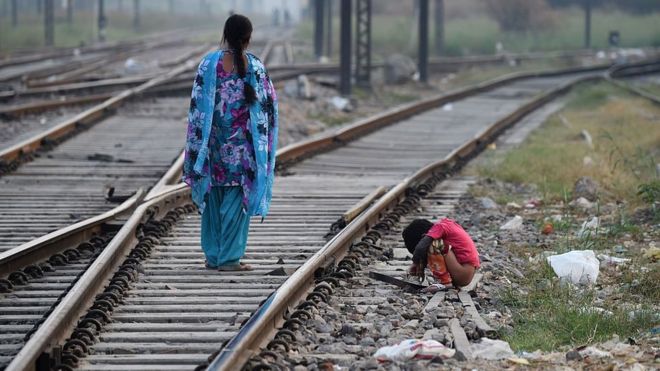
Image copyright GETTY IMAGESImage caption Millions of poor Indians still defecate in the open
Two men in the central Indian state of Madhya Pradesh have been arrested for allegedly killing two Dalit (formerly untouchables) children who were defecating in the open, police say.
Roshni, 12, and Avinash, 10, were attacked on Wednesday while defecating near a village road, they said.
The children’s family told BBC Hindi that they have no toilet at home.
Millions of poor Indians defecate in the open, which especially puts women and children at risk.
Dalits are at the bottom of the Hindu caste system and despite laws to protect them, they still face widespread discrimination in India.
“The two children were beaten to death with sticks,” police superintendent Rajesh Chandel told BBC Hindi’s Shuraih Niazi. “We have registered a murder case against both the accused. They are being questioned.”
Within hours of the attack early on Wednesday morning, police arrested two upper-caste men – Rameshwar Yadav and Hakim Yadav.
Roshni and Avinash were cousins, but Roshni had been brought up by Avinash’s parents and lived with them.
Avinash’s father, Manoj, says that as a daily wage labourer, he cannot afford to build a toilet at his house. He also says he has been unable to access a government subsidy as part of a flagship scheme to build toilets for the poor.
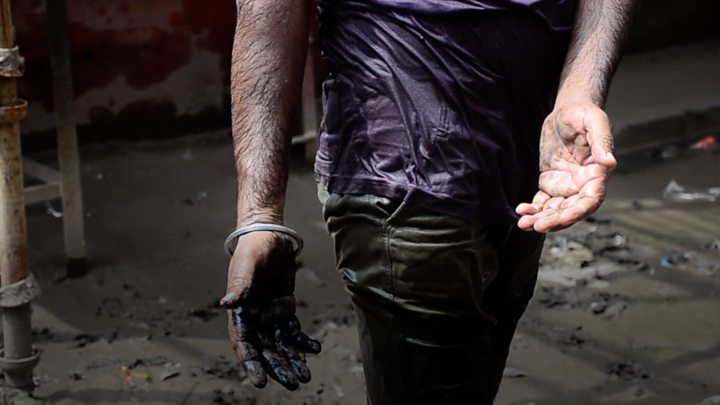
Media caption The Dalits unblocking India’s sewers by hand
The Swachh Bharat Mission or Clean India programme seeks to end open defecation by increasing toilet infrastructure and improving sanitation across the country. When Prime Minister Narendra Modi launched the program in 2014, he vowed to make India “open defecation free” by 2 October 2019.
Manoj’s village – Bhavkhedi – has been declared “open defecation free”, a tag given by the government to villages and cities have successfully ended open defecation.
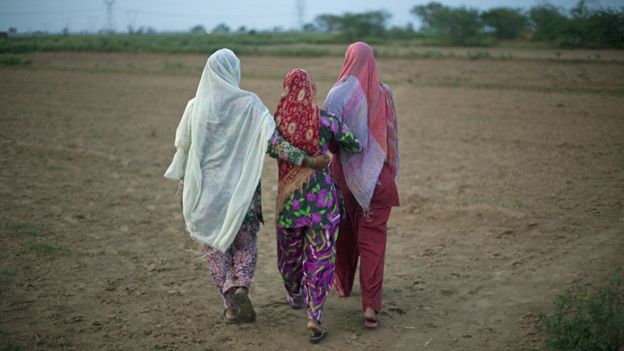
Image caption Women who go out at night to defecate are often at risk
Research has shown that while the construction of toilets has increased rapidly, lack of water, poor maintenance and slow change in behaviour have stood in the way of ending open defecation.
But many have praised Mr Modi for highlighting the issue and launching a major scheme to address it – the Bill & Melinda Gates Foundation honoured him this week, describing the Swachh Bharat Mission as “a model for other countries around the world that urgently need to improve access to sanitation for the world’s poorest.”
Image copyrightWSUPImage captionDhaka, Bangladesh: Community leader Nasima shows off her village’s new community toilet
Hi-tech loos that use little or no water and can recycle waste products safely and sustainably promise to give billions of people around the world access to much-needed sanitation. So why do so many still lack this basic amenity?
About 2.3 billion people still lack basic toilets, according to the World Health Organization (WHO). And 4.5 billion don’t have safely managed sanitation, with waste disposed in a way that won’t contaminate drinking water.
Each year contaminated water kills half a million children under five through diarrhoeal diseases, the WHO says.
So many inventors, entrepreneurs and research institutions around the world have been working on hi-tech loos that can function without the need for expensive mains sewerage systems.
Image captionMillions of people live next to unsanitary open sewers with potentially fatal consequences
One approach is taking chloride from urine, turning it into chlorine with electricity, and using that as a disinfectant, says Dr Brian Hawkins, a research scientist in nanomaterials at Duke University, North Carolina.
Activated charcoal can remove organic material and nano-membranes replace the need for septic tanks, he says.
A solar-powered toilet using this approach, developed at Duke and nearby universities, is being tested at a cotton mill in Coimbatore, India and a township in South Africa.
Currently, it can handle about 15 users a day.
New membrane technology means toilets can “get clean water out of human waste, which is pretty cool”, says Dr Alison Parker, a lecturer at Cranfield University in Bedford.
But power is needed to push waste through the membranes. So the challenge is making a self-contained loo that doesn’t need external electricity.
Image captionCranfield University’s clever loo can produce clean water from human waste
Her lab’s Nano Membrane Toilet works by “relying on the energy we can get from human waste, burning faeces, and the person lifting the lid and closing it again – so that’s not a huge amount of energy to work with,” she says.
But reverse electrodialysis, from putting faeces components on one side of the membrane and urine on the other, “gives us a little extra energy”, she says, and is “just enough to give it the boost to do what we need”.
Heating urine before it goes through the membrane to be closer to the vapour state makes it more efficient, too, says Dr Parker.
She says her lab’s waterless flush toilet is “basically ready and could be commercialised straight away”.
A challenge now is making them feasible for rural areas – the membranes need cleaning every three months, which is more easily achieved in cities.
Reducing costs
While there is lots of innovation going on, the key challenge is making sanitation affordable, says Jack Sim, World Toilet Day founder.
He remembers growing up in Singapore in the 1950s and 60s and having to use his village’s communal outhouse. It was a “very traumatic” experience, he says, involving buckets and lots of green flies.
Moving to public housing with a flushable loo was “like a miracle”, he recalls.
Image captionWorld Toilet Day founder Jack Sim (r) meets Indian Prime Minister Narendra Modi
He believes people on low incomes need to be convinced to “sacrifice something else and build a toilet first”.
But many promising products are now stuck in the “valley of death”, says Duke University’s Dr Hawkins.
This is the space between developing a successful prototype and “getting to a locked-down product you can scale up, mass produce, and find a market share”.
The aim is to get the operating expenses of clean toilets down to five cents (3.8p) per person per day, he says.
And Neil Jeffery, chief executive of Water & Sanitation for the Urban Poor, a non-profit organisation focusing on African and Indian cities, points out that it’s “not just about the toilets – it’s about how you collect waste safely, transport it, treat it, and how it’s then used”.
Most African cities only have 10-15% of households connected to mains sewerage, he says, with many urban settlements sharing pit latrines instead.
When these fill up, a lorry needs to take their contents to a treatment plant.
Image captionCrane Engineering’s waste treatment trucks will be trialled in 2019
But this can be a costly two- or three-hour drive, says Mark Hassman, project manager for the Mobile Septage Treatment System at Crane Engineering in Wisconsin.
He says the amount of waste that trucks actually bring to treatment plants is “less than 5% [of the total] in some cities”.
Instead, they dump it in ditches, mix it with rubbish and burn it, or “plop it in a ditch, and if it’s rainy season, it goes downstream”.
Mr Hassman has been leading a team designing trucks that can process 70-80% of the waste on site. So instead of emptying two pits, “they can now maybe do eight in one drive, and that hopefully reduces the cost and enables people to afford clean pit emptying,” he says.
He says the trucks are “fairly close” to producing potable water.
The trucks will have trial runs in Africa in 2019, and his company is “looking to get these units out there” commercially in 2020.
The crucial requirement is to create a market that enables companies to make a profit from loos that are also affordable for poorer households, he says.
Image captionSpecial treatment trucks can turn human waste into clean water
Lack of sanitation also has an economic impact.
The Bill & Melinda Gates Foundation, which has been running its Reinvent the Toilet Challenge since 2011, says “more than $200bn (£155bn) is lost due to healthcare costs and decreased income and productivity” as a result of poor sanitation.
This is one of the reasons why Indian Prime Minister Narendra Modi has committed $20bn to build 111 million latrines by 2019 – “the biggest toilet building project in the history of mankind”, says Mr Sim.
The goal of sanitation for all may still be “some years” away. “But I can see this problem being solved in the next decade,” he says.
Not a day too soon for the billions still suffering.
India’s lack of toilets and poor access to sanitation are holding back its children, causing stunted growth and curbing their development, a new report says.
Is India Winning the Fight Against Childhood Malnutrition?
Why Is Indian Children’s Growth So Stunted? It’s Not Why You ThinkT
he country has more than 48 million under fives with impaired growth, the largest number in the world, the report from London-based international development charity WaterAid said.
India also has 774 million people without access to adequate sanitation, and 76 million without safe water, the report said.
Children who are stunted because of malnutrition tend to be shorter and lag behind their peers cognitively. Poor access to clean water, sanitation and hygiene cause diarrhea and expose children to other intestinal infections during the crucial first two years of life.
Around 140,000 under-fives die in India every year because of diarrhea and other diseases caused by lack of access to these basic services, the report said.
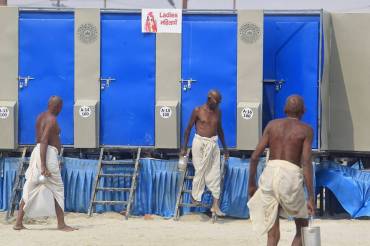
Indian Prime MinisterNarendra Modi has said in the past that he would rather build toilets than temples — setting a goal for every home in the country to have a place to go to the bathroom by 2019. But the program has suffered challenges: some Indians prefer to relieve themselves outdoors.
India is making some progress, however. The report said the percentage of its children who were stunted reduced from 48% in 2006 to 39% in 2014, the year Mr. Modi came to power.
Pakistan, India’s closest neighbor, ranked third with more than 9.8 million children who are stunted, according to the WaterAid study.
“Mahatma Gandhi never compromised on cleanliness. He gave us freedom. We should give him a clean India,” said Mr. Modi.
To honor Gandhi on the anniversary of his birth on Oct. 2, Mr. Modi earlier this month announced the launch of the Swachh Bharat, or Clean India, Mission. “I myself will set out with a broom and contribute towards this pious task” on Thursday, said Mr. Modi in an official statement. Previously called the Nirmal Bharat Abhiyan, the program will be restructured into two separate programs for urban and rural India.
Sanitation is one of the most pressing challenges India faces: almost 600 million people defecate in the open in the country.
The movement aims to “create a Clean India” by 2019 to commemorate the 150th anniversary of Gandhi’s birth. It’s an ambitious initiative, but viewed as critical to sustainable development in a country that has long ignored the most basic needs of many of its people.
As Oct. 2 draws nearer, millions of people across the country are joining daily the cleanliness drives organized by government departments, nonprofits and local community centers.
But the federal government will carry out the lion’s share of the work. Here’s what it has pledged:
The urban component is expected to cost 620 billion rupees (around $10.1 billion) over 5 years, and includes plans to eliminate open defecation, convert insanitary toilets into pour-flush ones and eradicate manual scavenging.
Manual scavenging — the practice of scraping feces out of primitive dry latrines or collecting waste from fields where villagers relieve themselves — has been illegal for decades but still persists in Indian regions lacking indoor plumbing.
In urban areas, 10 million households will be provided with around half a million public and community toilets and waste management facilities.
In rural India, 1,340 billion rupees (around $21.7 billion) has been pledged to construct around 110 million toilets across the country, said India’s rural development minister in a statement.
That’s a lot of new toilets, which if built could help prevent water-borne diseases like diarrhea, which kills almost 100,000 Indian children each year.
More toilets could also make women in India safer — in June, two teenage girls were assaulted in the northern state of Uttar Pradesh when, lacking toilets, they had gone outside to relieve themselves in the privacy of the darkness.
Mr. Modi has also directed state governments to ensure that all schools have separate toilets for boys and girls by Aug. 2015, according to a government of India press release. Many girls in India quit school when they reach puberty because of a lack of functioning toilets on the premises.




 CHINDIA ALERT: You'll be living in their world, very soon