28/04/2020
- Beijing’s Chaoyang district remains the last high-risk area in China, with virus preventive measures continuing to impact on travel and shopping plans
- China faces the dilemma of preventing a re-emerge of the pandemic, while also pushing to get its economy back to normal
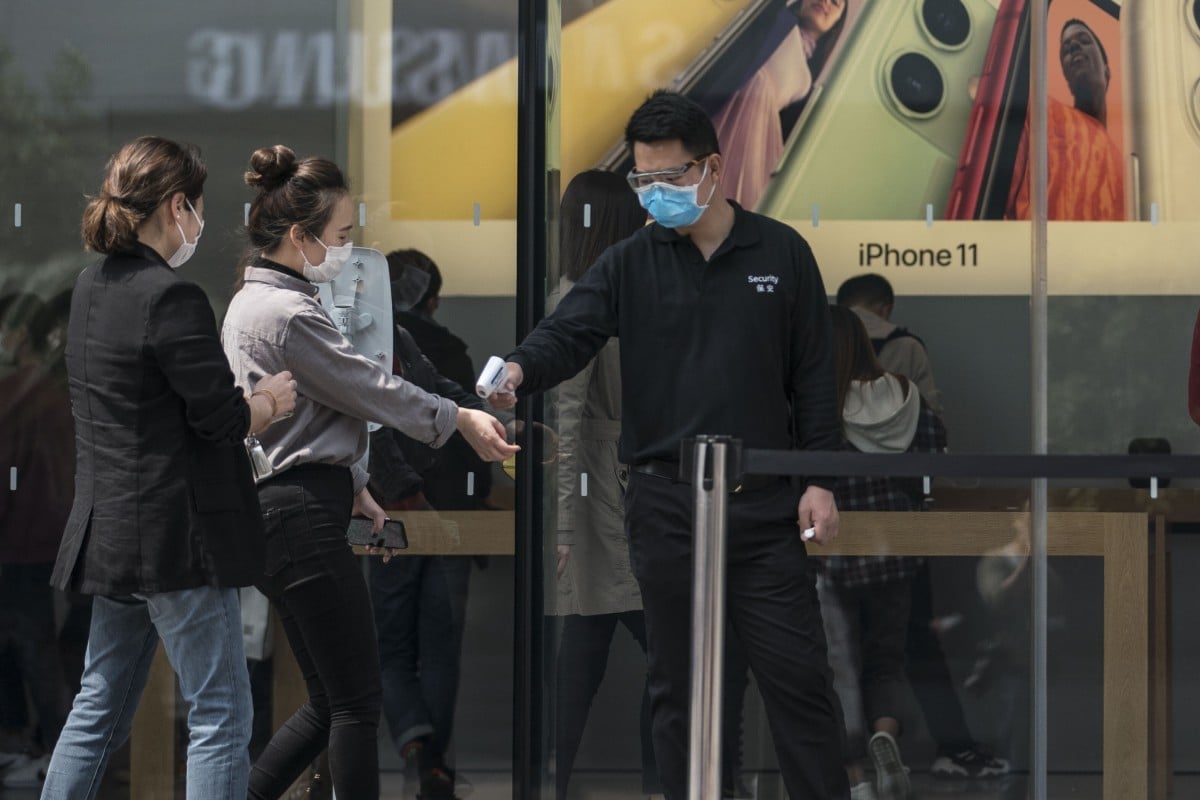
China’s continued pandemic prevention measures, coupled with still hesitant consumer demand, will inevitably lead to persistent limitations on the nation’s economic recovery, analysts said. Photo: Bloomberg
After nearly three months of being quarantined by herself in Beijing, Mary Zhao was looking forward to the upcoming long weekend at the start of May to be able to finally reunite with her parents.
But Zhao was forced to abandon her plan for the Labour Day holidays as Beijing’s upmarket Chaoyang district, where she lives, remains the only high-risk zone for coronavirus in the entire country.
If she travelled the five hours by car, or two hours via bullet train, to the neighbouring Hebei province, she would first have to undergo a 14-day quarantine before seeing her parents. Her parents would also have the same two week quarantine to look forward to once they returned home if they came to visit their daughter in Beijing.
These strict controls to prevent a re-emergence of the coronavirus outbreak are making a return to normal life impossible for many, and mean the final economic and social cost
from China’s draconian preventive measures could be much larger than expected.
Wuhan declares ‘victory’ as central Chinese city’s last Covid-19 patients leave hospital
It underscores the dilemma facing China’s leaders on how to balance the need to
and to avoid a fresh outbreak. On the surface, China may be able to declare victory as even Wuhan, the city where the virus was first detected, announced that the last Covid-19 patient had left hospital on Sunday. But fears of a renewed outbreak have kept the country’s cinemas and most schools closed, with travel between provinces discouraged.
China’s national borders also remain largely closed, with flights being cut to a minimum, and a mandatory 14-day quarantine for every arrival. In the number of places where new cases have been reported, quarantine requirements have been tightened, including Harbin and a few other cities near the border with Russia.
Chaoyang, the home to one of Beijing’s main business districts and most foreign embassies, changed its risk rating to high from low in the middle of April after three new cases were reported, dealing a fresh blow to the district’s
and forcing many of the 3.5 million residents to cancel their travel plans.
On the outskirts of Beijing, near Beijing Capital International Airport, returning migrant workers to Picun village were ordered to stop at entrance and could only be escorted inside by their landlord, with many villages and residential compounds remaining closed to outsiders.
In the high-end shopping district of Guomao, some shops also remain closed as there are few potential customers, while over in the popular Sanlitun area, metal barriers restrict access and temperature checkpoints are still required.
The landmark Apple Store in the popular Taikoo shopping centre is open, but with limited customers allowed inside, there are long queues outside. Customers are required to scan a QR code to check their movements over the last few days before entering.
Coronavirus: More schools reopen in China for students preparing for university entrance exams
“Why do I have to spend 20 minutes just to get into the Apple Store? The sun has almost melted me down,” one visitor complained to the security guards at the front of the shop.
China’s continued pandemic prevention measures, coupled with still hesitant consumer demand, will inevitably lead to persistent limitations on the nation’s economic recovery, analysts said.
Ernai Cui, an economist at research firm Gavekal Dragonomics, said on Monday that China’s cautious approach to lifting restrictions “points to a weak second quarter for consumer services”, adding additional pressure to the economic recovery.Mao Zhenhua, a researcher at the China Institute of Economics at Renmin University, said China’s preventive measures will inevitably be a drag on production, employment and exports.
Source: SCMP
Posted in 14-day quarantine, abandon, amid, Apple Store, area, back to, Beijing Capital International Airport, Beijing’s, Bloomberg, bullet train, Capital city, car, China, China Institute of Economics, China’s, cinemas, closed, continued, continuing, coronavirus, customers, daughter, dilemma, draconian, economic and social cost, economic recovery, economy, Guomao, Hebei province, high-risk, impact, Labour Day, landmark, last, long queues, May, national borders, neighbouring, normal, outbreak, pandemic, parents, Picun village, plans, preventing, preventive measures, pushing, QR code, quarantined, re-emerge, remains, Renmin University, reunite, Russia, Sanlitun area, scan, schools, shopping, struggles, Taikoo shopping centre, to get back, travel, Uncategorized, undergo, victory, Virus, while also, worries, Wuhan |
Leave a Comment »
06/04/2020
SHENYANG, April 5 (Xinhua) — Huo Chunlei, who runs a hotpot restaurant in Shenyang, capital of northeast China’s Liaoning Province, said he did not lay off any of his staff, although the restaurant is having difficulties for reopening after two months of closure in China’s nationwide measures of coronavirus control.
A few weeks after Chinese provincial-regions with low risk of the novel coronavirus gradually resumed work and production, shops and eateries have reopened, and roads become bustling again, as hundreds of millions of people confined at home for weeks in compliance with epidemic prevention rules get back to a normal life.
Huo’s restaurant has been in operation for a week. Only half of the tables are filled at dinnertime. The revenue is barely enough to cover the expenses of the house rent and employee wages, he said.
However, he said his business is able to survive because of the government’s bailout policies. For example, the approval of deferred payment of social insurance premiums for his employees alone can save him 80,000 yuan (about 11,250 U.S. dollars) a month.
“The staff are willing to stay, as we are all confident in tiding over the difficulties together,” he said.
The local governments at all levels have rolled out a slew of measures to shore up the catering business, including cutting taxes, reducing house rent as well as water and electricity fees.
The governments in Liaoning, Shandong, Jiangsu and Zhejiang provinces have issued coupons with a value ranging from 10 million yuan to 100 million yuan to encourage people to spend on dining out.
Before the production resumption, there were some consumer councils’ surveys showing that consumers had suppressed consumption desire for dining out and shopping as well as going to movie theaters, gymnasiums and tourist spots after the epidemic crisis ends.
“The so-called retaliatory consumption has not yet appeared in the catering industry, as people are still wary about the infection risk, but there will be a gradual recovery growth,” said Chen Heng, executive director of Hainan Hotel and Catering Industry Association in the southernmost Chinese province of Hainan.
“Before reopening, we increased the distances between tables, but with reduced tables, there are still many empty tables at dinner time. My restaurant used to have all seats full and even queues,” said Huo.
Like Huo, Lin Lunheng, founder of the Fuzhou Super Dinner Co. Ltd. in southeast China’s Fujian Province, is also worried about business.
“Although the chain stores have reopened, revenues have decreased by 70 percent compared with that before the epidemic. This is a big blow to restaurants,” said Lin.
The Italian style chain restaurant has offered e-coupons to draw customers.
As the spring weather is getting more and more pleasant, consumers’ desire for dining out and travel is growing. According to a survey report jointly released by the China Travel Academy and Trip.com Group on March 19, Chinese are longing for tours across the country, with Yunnan, Hainan and Shanghai among the top destinations.
Source: Xinhua
Posted in bailout, Business, bustling, catering business, China Travel Academy, compliance, coronavirus control, coupons, crisis, cutting taxes, dining out, dinnertime, eateries, electricity fees, employee, epidemic, expenses, Fujian Province, Fuzhou Super Dinner Co. Ltd., Government, gymnasiums, Hainan Hotel and Catering Industry Association, Hainan Province, house rent, industry, Italian style chain restaurant, jiangsu province, Liaoning province, local governments, movie theaters, nationwide, novel coronavirus, offers, prevention rule, production, reducing, reopened, Restaurant, resumed work, Revenue, roads, shandong province, Shanghai, Shenyang, shopping, shops, social insurance premiums, staff, stimulate, suppressed consumption, survive, top destinations, tourist spots, Uncategorized, voucher programs, wages, water, Yunnan Province, Zhejiang |
Leave a Comment »
10/02/2020
LUCKNOW (Reuters) – U.S. and European defence firms backed Indian Prime Minister Narendra Modi’s military modernisation drive at a defence exhibition on Friday, despite a lengthy procurement process running into years and limited funds.
Airbus SE (AIR.PA) and U.S.-based Lockheed Martin Corp (LMT.N) and Boeing Co. (BA.N) are eying multi-billion dollar deals under Modi’s aim to upgrade an ageing fleet of aircraft and enhance local arms manufacturing to cut imports.
“I feel encouraged overall,” Anand Stanley, President and managing director of Airbus India and South Asia, told Reuters.
“Every year the government is doing capital allocation. They are spending,” he said.
The military is also looking to buy submarines, warships and battlefield communication systems. But these have made little headway.
Airbus is offering to set up an assembly line in India in partnership with the Tata Group to produce the C295W military transport aircraft as a replacement for Indian Air Force’s Avro fleet.
The 120 billion rupee Avro replacement programme has been in the pipeline for almost a decade.
Airbus on Thursday signed a memorandum of understanding (MoU) with India’s Adani Aerospace and Defence, part of the diversified Adani Group, for aircraft services in India and South Asia.
Boeing, which has pitched its F/A-18 Block III Super Hornet fighter for the India air force and navy and is competing with Lockheed Martin’s F-21, said it plans to push India’s armed forces’ drive for modernisation through a suite of five products – the Super Hornet, KC-46 tanker, P-8I aircraft, AH-64E Apache and CH-47(I) Chinook helicopters.
The company said it wants to build a global defence and aerospace ecosystem “that creates jobs and industrial capacity with Make in India,” said Salil Gupte, president, Boeing India in a statement during the exhibition.
Boeing and Lockheed will be competing with Sweden’s Saab AB (SAABb.ST) with its Gripen fighter and France’s Dassault Aviation SA (AVMD.PA) Rafale and Russian fighter aircraft.
Lockheed Martin, as part of its fighter jet F-21 proposal for the Indian Air Force, signed an MoU with Bharat Electronics Ltd (BAJE.NS) on Friday to explore industrial opportunities around the F-21 fleet, which is essentially building up a spare and supply ecosystem.
The three aerospace giants, with huge displays at the Defence Expo 2020 held in the northern city of Lucknow, displayed miniaturised versions of the latest aircraft and helicopters that they have pitched to India.
Another French defence firm, Dassault (DAST.PA), which recently delivered its first Rafale aircraft to the government in October under a contract to supply 36 units, said it is developing its facility in central India to make the Rafale jets in the subcontinent.
Source: Reuters
Posted in Adani Aerospace and Defence, Adani group, Ageing, AH-64E Apache, air force, Airbus, Airbus India and South Asia, Airbus SE (AIR.PA), Aircraft, aircraft services, arms manufacturing, Assembly line, Avro, battlefield communication systems, Bharat Electronics Ltd (BAJE.NS), Boeing Co (BA.N), Boeing India, C295W military transport aircraft, CH-47(I) Chinook helicopter, Dassault (DAST.PA), Defence, defence exhibition, Defence Expo 2020, drive, F/A-18 Block III Super Hornet fighter, fighter jet F-21, firms, fleet, France’s Dassault Aviation SA (AVMD.PA), global, global defence and aerospace ecosystem, Gripen fighter, India, Indian Air Force, Indian Air Force’s, Indian Prime Minister Narendra Modi’s, KC-46 tanker, line up, Lockheed Marti, Lockheed Martin Corp (LMT.N), Lockheed Martin’s F-21, Lucknow, Memorandum of Understanding (MOU), Military, miniaturised versions, modernisation, MoU, navy, P-8I aircraft, Reuters, Russian fighter aircraft, shopping, South Asia, submarines, Sweden’s Saab AB (SAABb.ST), the Super Hornet, Uncategorized, update, warships |
Leave a Comment »
02/02/2019
BEIJING, Feb. 1 (Xinhua) — As a time-honored tradition for preparing for Chinese New Year, Spring Festival shopping in cities has become more rustic this year.
Pepper sauce from Guizhou, navel oranges from Jiangxi and beef shank from Anhui are part of the rural specialties Beijing-based IT engineer Zhang Xin bought for the upcoming week-long Spring Festival holiday. They are all products from poor villages.
Zhang bought some of the delicacies from e-commerce platforms, and some from a fair held in his community designed to promote products from rural areas.
The rural specialties sales boom in urban areas is a result of China’s all-out efforts to achieve its goal of lifting its rural population out of poverty by 2020.
Wholesalers, e-commerce companies and supermarkets are encouraged to establish stable and long-term cooperative relationships with impoverished villages to power the country’s poverty eradication campaign, according to a plan released Tuesday by 10 government agencies.
E-COMMERCE PUSH
Social e-commerce giant Pinduoduo showed that orders of rural specialties exceeded 55 million from Jan. 4 to Jan. 24 in its online Spring Festival fair, a record high.
A local pickle product in central China’s Hunan Province developed by the platform’s poverty-reduction program sold 15,800 bottles on the platform the day it was launched. Total sales exceeded 3.3 million yuan (490,500 U.S. dollars) so far, bringing additional income of 3,000 to 5,000 yuan for over 200 rural households.
Other e-commerce players also leverage their platforms to enrich consumers’s shopping choices while boosting sales in poor areas. Alibaba’s Taobao has invited heads of 50 counties across the country to sell their local products via live streaming.
The Spring Festival shopping season is an important opportunity for e-commerce platforms to upgrade their mechanisms in poverty reduction, so that improving sales will ensure farmers a jubilant Chinese New Year, said Pinduoduo cofounder Da Da.
SPROUTING FAIRS
Besides shopping online, rural products are coming to cities with fairs springing up in urban communities, companies and institutions to enable first-hand experience and more direct sales.
A poverty-reduction Spring Festival fair in the capital city of China’s southernmost Hainan Province gathered rural specialties from 11 counties and sold over 10 million yuan of produce in just three days.
Beijing earlier this month set up a longer-term fair to sell over 2,000 products from poor counties in seven provincial regions. The fair will be open all year round.
The State Council has decided to offer incentives for public and private institutions to purchase goods produced in the impoverished regions, while expanding the sales channels of farm produce in the areas.
Product quality in poor areas should be enhanced, with local infrastructure improved so that rural tourism can be developed, according to the guidelines released by the State Council.
Source: Xinhua
Posted in anti-poverty, China alert, rural areas, shopping, Spring Festival, Uncategorized |
Leave a Comment »



 CHINDIA ALERT: You'll be living in their world, very soon