Archive for ‘smoking’

30/03/2020

Coronavirus: India’s pandemic lockdown turns into a human tragedy

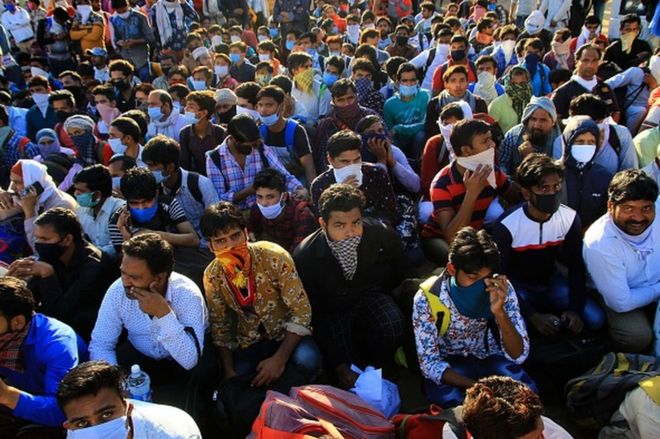
Stranded workersImage copyright GETTY IMAGES
Image caption Millions are workers are defying a curfew and returning home

When I spoke to him on the phone, he had just returned home to his village in the northern state of Rajasthan from neighbouring Gujarat, where he worked as a mason.

In the rising heat, Goutam Lal Meena had walked on macadam in his sandals. He said he had survived on water and biscuits.

In Gujarat, Mr Meena earned up to 400 rupees ($5.34; £4.29) a day and sent most of his earnings home. Work and wages dried up after India declared a 21-day lockdown with four hours notice on the midnight of 24 March to prevent the spread of coronavirus. (India has reported more than 1,000 Covid-19 cases and 27 deaths so far.) The shutting down of all transport meant that he was forced to travel on foot.

“I walked through the day and I walked through the night. What option did I have? I had little money and almost no food,” Mr Meena told me, his voice raspy and strained.

He was not alone. All over India, millions of migrant workers are fleeing its shuttered cities and trekking home to their villages.

These informal workers are the backbone of the big city economy, constructing houses, cooking food, serving in eateries, delivering takeaways, cutting hair in salons, making automobiles, plumbing toilets and delivering newspapers, among other things. Escaping poverty in their villages, most of the estimated 100 million of them live in squalid housing in congested urban ghettos and aspire for upward mobility.
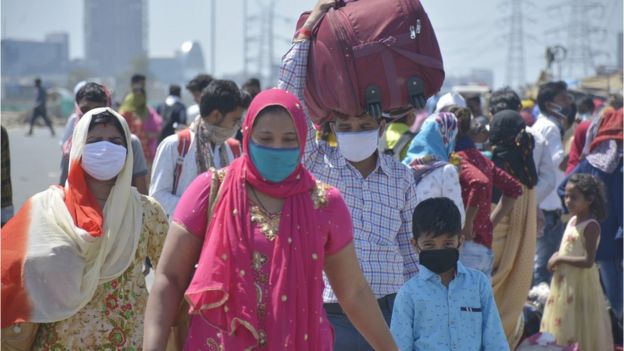
Migrant workers head home on Day 5 of the 21 day nationwide lockdown imposed by PM Narendra Modi to curb the spread of coronavirus, at NH9 road, near Vijay Nagar, on March 29, 2020 in Ghaziabad, IndiaImage copyright GETTY IMAGES
Image caption Informal workers are the backbone of India’s big city economies

Last week’s lockdown turned them into refugees overnight. Their workplaces were shut, and most employees and contractors who paid them vanished.

Sprawled together, men, women and children began their journeys at all hours of the day last week. They carried their paltry belongings – usually food, water and clothes – in cheap rexine and cloth bags. The young men carried tatty backpacks. When the children were too tired to walk, their parents carried them on their shoulders.

They walked under the sun and they walked under the stars. Most said they had run out of money and were afraid they would starve. “India is walking home,” headlined The Indian Express newspaper.

The staggering exodus was reminiscent of the flight of refugees during the bloody partition in 1947. Millions of bedraggled refugees had then trekked to east and west Pakistan, in a migration that displaced 15 million people.
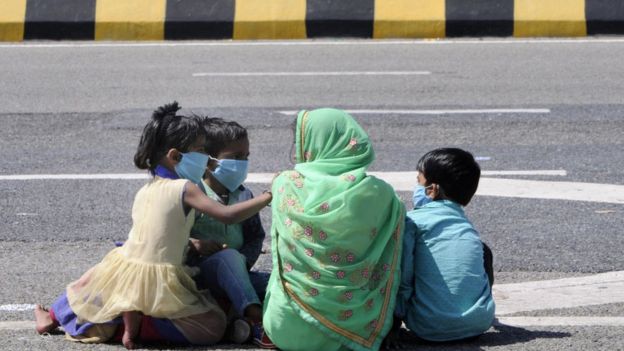
migrant worker with children headed back home pauses for break, on day 5 of the nationwide lockdown imposed by PM Narendra Modi to check the spread of coronavirus, at Yamuna expressway zero point, on March 29, 2020 in Noida, India. (Photo by Sunil Ghosh /Hindustan Times via Getty Images)Image copyright GETTY IMAGES
Image caption Migrant labourers feel they have more social security in their villages

This time, hundreds of thousands of migrant workers are desperately trying to return home in their own country. Battling hunger and fatigue, they are bound by a collective will to somehow get back to where they belong. Home in the village ensures food and the comfort of the family, they say.

Clearly, a lockdown to stave off a pandemic is turning into a humanitarian crisis.

Among the teeming refugees of the lockdown was a 90-year-old woman, whose family sold cheap toys at traffic lights in a suburb outside Delhi.

Kajodi was walking with her family to their native Rajasthan, some 100km (62 miles) away. They were eating biscuits and smoking beedis, – traditional hand-rolled cigarettes – to kill hunger. Leaning on a stick, she had been walking for three hours when journalist Salik Ahmed met her. The humiliating flight from the city had not robbed her off her pride. “She said she would have bought a ticket to go home if transport was available,” Mr Ahmed told me.

Others on the road included a five-year-old boy who was on a 700km (434 miles) journey by foot with his father, a construction worker, from Delhi to their home in Madhya Pradesh state in central India. “When the sun sets we will stop and sleep,” the father told journalist Barkha Dutt. Another woman walked with her husband and two-and-a-half year old daughter, her bag stuffed with food, clothes and water. “We had a place to stay but no money to buy food,” she said.

Then there was Rajneesh, a 26-year-old automobile worker who walking 250km (155 miles) to his village in neighbouring Uttar Pradesh. It would take him four days, he reckoned. “We will die walking before coronavirus hits us,” the man told Ms Dutt.

He was not exaggerating. Last week, a 39-year-old man on a 300km (186 miles) trek from Delhi to Madhya Pradesh complained of chest pain and exhaustion and died; and a 62-year-old man, returning from a hospital by foot in Gujarat, collapsed outside his house and died. Four other migrants, turned away at the borders on their way to Rajasthan from Gujarat, were mowed down by a truck on a dark highway.

As the crisis worsened, state governments scrambled to arrange transport, shelter and food.
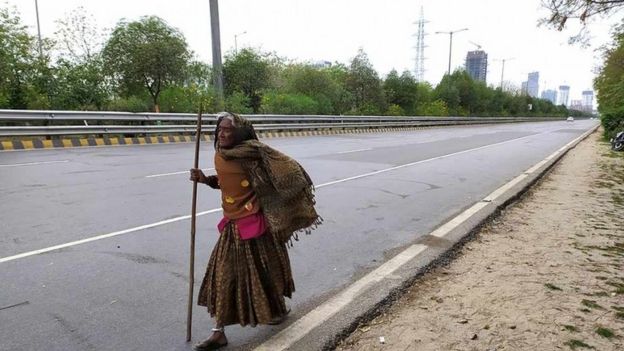
Kajodi DeviImage copyright SALIK AHMED/OUTLOOK
Image caption Ninety-year-old Kajodi Devi is walking from Delhi to her village

But trying to transport them to their villages quickly turned into another nightmare. Hundreds of thousands of workers were pressed against each other at a major bus terminal in Delhi as buses rolled in to pick them up.

Delhi chief minister Arvind Kejriwal implored the workers not to leave the capital. He asked them to “stay wherever you are, because in large gatherings, you are also at risk of being infected with the coronavirus.” He said his government would pay their rent, and announced the opening of 568 food distribution centres in the capital. Prime Minister Narendra Modi apologised for the lockdown “which has caused difficulties in your lives, especially the poor people”, adding these “tough measures were needed to win this battle.”

Whatever the reason, Mr Modi and state governments appeared to have bungled in not anticipating this exodus.

Mr Modi has been extremely responsive to the plight of Indian migrant workers stranded abroad: hundreds of them have been brought back home in special flights. But the plight of workers at home struck a jarring note.

“Wanting to go home in a crisis is natural. If Indian students, tourists, pilgrims stranded overseas want to return, so do labourers in big cities. They want to go home to their villages. We can’t be sending planes to bring home one lot, but leave the other to walk back home,” tweeted Shekhar Gupta, founder and editor of The Print.
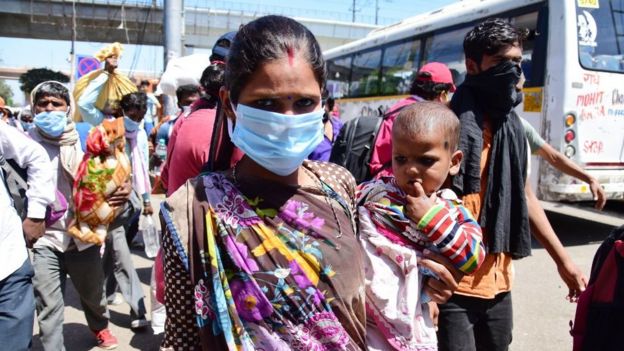
Migrant woman with a baby wearing a face mask as a preventive measure, at Anand vihar bus terminal during the nationwide lock downImage copyright GETTY IMAGES
Image caption There is a precedent for this kind of exodus during crisis

The city, says Chinmay Tumbe, author of India Moving: A History of Migration, offers economic security to the poor migrant, but their social security lies in their villages, where they have assured food and accommodation. “With work coming to a halt and jobs gone, they are now looking for social security and trying to return home,” he told me.

Also there’s plenty of precedent for the flight of migrant workers during a crisis – the 2005 floods in Mumbai witnessed many workers fleeing the city. Half of the city’s population, mostly migrants, had also fled the city – then Bombay – in the wake of the 1918 Spanish flu.

When plague broke out in western India in 1994 there was an “almost biblical exodus of hundreds of thousands of people from the industrial city of Surat [in Gujarat]”, recounts historian Frank Snowden in his book Epidemics and Society.

Half of Bombay’s population deserted the city, during a previous plague epidemic in 1896. The draconian anti-plague measures imposed by the British rulers, writes Dr Snowden, turned out to be a “blunt sledgehammer rather than a surgical instrument of precision”. They had helped Bombay to survive the epidemic, but “the fleeing residents carried the disease with them, thereby spreading it.”

More than a century later, that same fear haunts India today. Hundreds of thousands of the migrants will eventually reach home, either by foot, or in packed buses. There they will move into their joint family homes, often with ageing parents. Some 56 districts in nine Indian states account for half of inter-state migration of male workers, according to a government report. These could turn out to be potential hotspots as thousands of migrants return home.
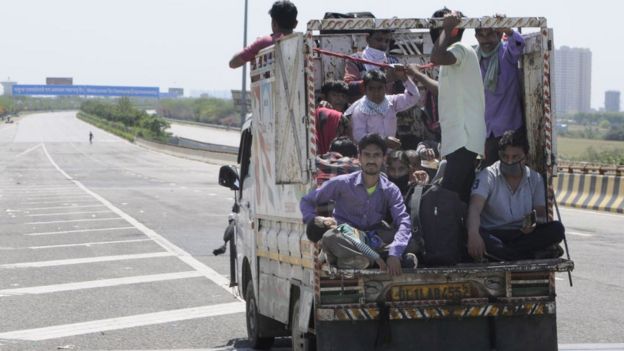
Migrant workers headed back to their towns and villages hitch a ride, on day 5 of the nationwide lockdown imposed by PM Narendra Modi to check the spread of coronavirus, at Yamuna expressway zero point, on March 29, 2020 in Noida, IndiaImage copyright GETTY IMAGES
Image caption The fleeing migrants could spread the disease all over the country

Partha Mukhopadhyay, a senior fellow at Delhi’s Centre for Policy Research, suggests that 35,000 village councils in these 56 potentially sensitive districts should be involved to test returning workers for the virus, and isolate infected people in local facilities.

In the end, India is facing daunting and predictable challenges in enforcing the lockdown and also making sure the poor and homeless are not fatally hurt. Much of it, Dr Snowden told me, will depend on whether the economic and living consequences of the lockdown strategy are carefully managed, and the consent of the people is won. “If not, there is a potential for very serious hardship, social tension and resistance.” India has already announced a $22bn relief package for those affected by the lockdown.

The next few days will determine whether the states are able to transport the workers home or keep them in the cities and provide them with food and money. “People are forgetting the big stakes amid the drama of the consequences of the lockdown: the risk of millions of people dying,” says Nitin Pai of Takshashila Institution, a prominent think tank.

“There too, likely the worst affected will be the poor.”

Source: The BBC
03/10/2019

As protests rack Hong Kong, China watchdog has Cathay staff ‘walking on eggshells’

HONG KONG (Reuters) – Staff at Cathay Pacific Airways, Hong Kong’s flagship airline, are on edge.

A Cathay Pacific Boeing 777-300ER plane lands at Hong Kong airport after it reopened following clashes between police and protesters, in Hong Kong, China August 14, 2019. REUTERS/Thomas Peter
Their city has been gripped by months of anti-government protests, and their company is feeling the wrath of China’s aviation regulator after some staff members took part or expressed support.
Since an Aug.9 directive by the Civil Aviation Authority of China (CAAC) that called for the suspension of staff who supported or participated in the demonstrations, the regulator has rejected some entire crew lists without explanation, two sources with knowledge of the matter told Reuters.
The rejections have forced Cathay to scramble, pulling pilots and flight attendants off standby while it investigates social media accounts in an effort to determine which crew member has been deemed a security threat, one of the sources said.
Other disruptions have come in the form of a huge jump in the number of plane inspections upon landing, four pilots said.
The flexing of regulatory muscle has contributed to a climate of fear within the airline, with employees telling Reuters they felt Cathay’s longer-term future as an independent company was highly uncertain and subject to Beijing’s whims.
The CAAC’s labelling of employees who support the protest as a security risk and its demand that they be suspended from flying over mainland airspace has been a de facto career killer.
Around three quarters of Cathay flights use mainland airspace and due to the directive, 30 rank-and-file staff, including eight pilots and 18 flight attendants, have been fired or resigned under pressure, according to the Hong Kong Cabin Crew Federation.
Cathay CEO Rupert Hogg and his top deputy also resigned in August amid the mounting regulatory scrutiny on the 73-year-old airline, one of the region’s most high-profile brands that draws on Hong Kong’s British heritage.
“Things changed very quickly,” said Jeremy Tam, a pro-democracy lawmaker and pilot who resigned from the airline after the CAAC directive, likening the atmosphere to a political trial. “The threat is huge and it’s almost like zero to 100 in two seconds.”
Reuters talked to 14 current and former employees for this article. Nearly all declined to be identified for fear of being fired or due to the sensitivity of the matter.
The CAAC did not respond Reuters requests for comment on the rejections of crew lists or the increase in plane checks.Cathay said in a statement it must comply with all regulatory requirements. “Quite simply, this is our licence to operate; there is no ground for compromise,” it said.
The airline declined to comment on the number of employee departures, but said any terminations took into account factors such as a person’s ability to perform their role.

DEMERIT SYSTEM

Aviation regulators around the world conduct occasional plane inspections at airports to ensure an airline is in compliance with safety regulations.

But after the CAAC’s Aug. 9 directive, the once-infrequent inspections occurred almost daily and included the new and unusual step of checking phones owned by crew for anti-China photos and messages, the pilots said, adding that this had led to flight delays.

The step-up in checks has increased the likelihood of regulators finding minor issues to write up, which pilots said had included dirt on the plane’s exterior and scratches on a fire extinguisher.

Infractions can have outsized consequences under the CAAC’s strict demerit points system, they said, noting the regulator could force Cathay to reduce its number of flights, cut destinations or in a worst-case scenario, revoke the airline’s right to fly to mainland China.

Management has urged staff to do their utmost to avoid infractions.

“It is nothing less than the survival of the airline at stake,” said a senior employee. “Management have made that abundantly clear at meetings.”

Executives are particularly sensitive after seven incidents outside mainland China in the past two months in which pre-flight checks found emergency oxygen bottles for crew were depleted.

The CAAC is more public than many regulatory peers about disclosing safety violations, warnings and punishments.

In 2017, Emirates was banned from expanding its operations for six months following two safety incidents, while flag carrier Air China Ltd was ordered last year to cut Boeing Co 737 flights by 10% after an emergency descent linked to a pilot smoking an e-cigarette in the cockpit.

Cathay declined to provide information on its points under the CAAC system but said it wanted to emphasise that there had been no impact on its flight services into mainland China.

The pilots said the high frequency of airplane checks, which one described as “very intimidatory”, was starting to recede.

A THOUSAND CUTS

Employees are also feeling pressure from other regulatory bodies.

Last week, ahead of China’s National Day on Oct.1, immigration officers at some mainland airports requested photos of crew with the Chinese flag, said a pilot at regional arm Cathay Dragon who flies to the mainland regularly.

He said to his knowledge, most pilots – many of whom are expats from Western countries – had refused but Hong Kong cabin crew were “too nervous to say no” given the scrutiny on their actions by the company and the Chinese government.
“Everyone is walking on eggshells in China,” the pilot said.
Cathay did not respond to a request for comment, while China’s Ministry of Public Security, which oversees immigration, did not respond to a request for comment during a week of public holidays.
There has been no let-up in the widespread, sometimes violent, unrest that has beset Hong Kong. Triggered by a now-withdrawn extradition bill, it has morphed into an outpouring of opposition to the former British colony’s Beijing-backed government.

The crisis has also meant a sharp drop in travel demand to Hong Kong, putting more pressure on Cathay.

Cathay’s overall passenger numbers were down 11.3% in August. Flights at Cathay Dragon, which does most of Cathay’s mainland flying, were on average 60-65% full in September, down from the usual 80%, according to estimates from two pilots.

The pilots said while the sharp drop in demand was in some ways similar in scale to that weathered by Cathay during the SARS epidemic and the global financial crisis, there were key differences that felt more threatening to the company’s future.

Some state-controlled firms such as China CITIC Bank International and Huarong International have told employees to avoid flying with Cathay, and it has been attacked by Chinese state news organisations as well as by many mainland consumers on social media.

CAAC’s Aug.9 statement which called staff who supported the protests a security risk has also put Cathay’s reputation as one of the world’s safest airlines under a cloud it does not deserve, employees said.

Many acknowledged the new management team, which oversees around 33,000 employees, has few palatable options in dealing with the situation given the sway Beijing holds over the airline’s operations.

But they lamented the loss of freedom of speech and sense of job security, saying employees are afraid to speak about anything even vaguely political or voice support for protests on social media for fear of being reported by colleagues under a whistleblower policy.

“It has become a Hong Kong company with mainland employment terms,” a pilot at Cathay Dragon said. “The risk is death by a thousand cuts.”

Source: Reuters

13/06/2019

Chinese tourists breaking rules ‘all over the place’ in Boracay

  • After a six-month closure, Boracay reopened in October with new rules that prohibit smoking, drinking, dining and littering on the beachfront. But the dos and don’ts seem to have escaped notice, especially among tourists from China and South Korea
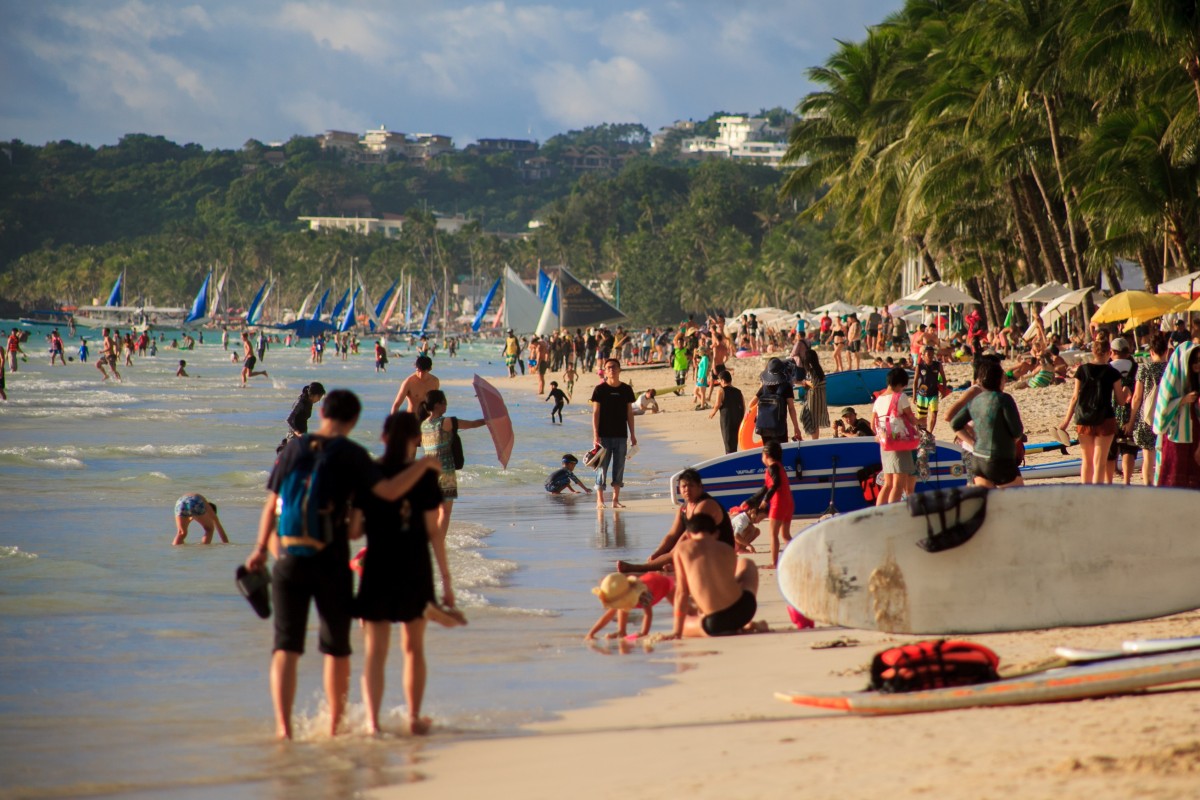
  • Tourists enjoy Boracay’s famous White Beach in January. Photo: Shutterstock
    Tourists enjoy Boracay’s famous White Beach in January. Photo: Shutterstock
    Travel has changed a lot since the 19th century. Obviously. But attitudes towards travellers have not, if the diaries of Francis Kilvert are anything to go by.
    “Of all noxious animals, the most noxious is a tourist,” the English clergyman wrote in the 1870s, and while Kilvert asserted that it was the British who were “the most vulgar, ill-bred, offensive and loathsome” of them all – a contention that might be challenged today – an increasing number of places across the globe have had their fill of imprudent outsiders, regardless of where they are from.
    The island of 
    Boracay

    , in the Philippines, the original face of overtourism in the region, is one of them. In February last year, Philippine President Rodrigo Duterte vowed to

    close

    the popular tourist hotspot, saying, “Boracay is a cesspool. It is destroying the environment of the Republic of the Philippines and creating a disaster.” The septic metaphor was no melodrama – a number of hotels, restaurants and other tourism-related businesses were dumping untreated sewage directly into the ocean, contaminating White Beach’s crystalline waters and tarnishing Boracay’s reputation. As Duterte decreed, the island shuttered for six months from April, during which time infrastructure was to be installed and new environmental requirements implemented.

    When Boracay 
    reopened

    , in October, it was heralded as a rare success in the ongoing fight against the tourist menace, despite the fact that thousands of

    islanders had been left without incomes

    , the nation’s economic growth had suffered and, heaven forfend, holidaymakers had been forced to cancel hard-earned vacations. And the rehabilitation is far from complete. In January, the Boracay Inter-Agency Task Force, the organisation overseeing the ecological overhaul, announced a 25.3 billion peso (US$485 million) action plan, which, if approved, will fund 233 projects related to the enforcement of laws and regulations, pollution control and prevention, rehabilitation and recovery of the ecosystem, and the sustainability of land activities, according to a report on Philippine news site Rappler.

    But still the tourists come, albeit in smaller numbers than before, and just as in pre-closure times, not all of them are welcome; in particular those who pay little attention to the new rules, which prohibit smoking, drinking, dining, littering, partying and fire dancing on the beachfront.
    A complaint about Chinese tourists, posted to Facebook in April. Photo: Facebook / @philippinesdefense

    On April 29, Wilson Enriquez, the Boracay Tourism Regulatory Enforcement Unit chief, revealed that tourists from China were the worst violators of these regulations, as stated in an article on the Philippines Lifestyle News website. Since the beginning of the year, 739 Chinese had been apprehended.

    “Tour guides have informed them about the ordinances but [Chinese tourists] are really stubborn,” Enriquez told the news site. Korean tourists took a distant second, with 277 apprehensions, with most infractions recorded for smoking, eating and drinking on the beach, or littering.

    Eighty per cent of the visitors Boracay received in the first quarter of this year hailed from China and South Korea, according to the local tourism office – the former accounting for almost half of all arrivals, 149,019 of 309,591 – so perhaps it is unsurprising that the Chinese break the most rules.

    One disgruntled Filipino took to social media (where else) to air their grievance, writing that Boracay had been “teeming with loud, garbage-throwing, spitting everywhere Chinese tourists” during their Holy Week visit, while another told Philippines Lifestyle News, “I saw [Chinese tourists] with my own eyes, breaking ordinances all over the place.”

    That there has been a recent rise in anti-China sentiment in the Philippines, a reaction to Duterte’s “love affair” with the Middle Kingdom, according to an article on SupChina’s website, should be noted. But really, if we want to be able to enjoy Boracay, or anywhere for that matter, for years to come, we should all stick to the rules and exercise respect for the community and environment hosting us.


    Airbnb bounces back in Japan

    A sign on the door to a block of flats in Tokyo communicating a ban on using units in the property for Airbnb, in March 2018. Photo: Reuters
    A sign on the door to a block of flats in Tokyo communicating a ban on using units in the property for Airbnb, in March 2018. Photo: Reuters
    It has been a year since Japan implemented its minpaku law, aimed at regulating short-term lets, such as those advertised on home-sharing site

    Airbnb

    . It effectively rendered hosts whose homes were not licensed illegal, and all those without the required permit were forced to delist their properties and cancel bookings. Almost 80 per cent of listings disappeared.

    However, Airbnb is back in business. In a statement published on June 6, the company said that 50,000 listings were now available in the country, as well as 23,000 rooms in hotels and ryokan. Just before the rules came into force last June, Airbnb had a total of 60,000 listings.
    Presumably the company’s efforts to appease local regulations will pay off next year, when Japan hopes to receive 40 million visitors as host of the 2020 Summer Olympics. Whether those 40 million will be welcomed by residents remains to be seen.

    Monkey troubles – wild macaque gets cheeky in Bali

    If you need any reminder that the macaques that roam Ubud’s Sacred Monkey Forest, in the uplands of the Indonesian

    island of Bali

    , are wild animals, then this tourist’s experience should jog your memory. While posing for a picture, a monkey climbed onto the lap of Sarah Wijohn, a visitor from New Zealand, had a good old scratch and then yanked down her top, almost exposing her to the world.

    Fortunately, neither Wijohn nor the primate seemed too scarred by the incident, unlike those who have written blog posts about being attacked by the animals and made videos advising how not to catch rabies from the “crazy monkey forest”.
    Here’s an idea: don’t go.
    Source: SCMP
01/06/2015

Beijing public smoking ban begins – BBC News

Public smoking in China‘s capital, Beijing, is now banned after the introduction of a new law.


Embed from Getty Images

China has over 300 million smokers and more than a million Chinese die from smoking-related illnesses every year.

Smoking bans already existed in China, but have largely failed to crack down on the habit.

These tougher regulations, enforced by thousands of inspectors, ban lighting up in restaurants, offices and on public transport in Beijing.

Analysis: Martin Patience, BBC News, Beijing

Smoking in China often seems like a national pastime. The country consumes a third of the world’s cigarettes. More than half of men smoke. It’s seen by many as a masculine trait – women, in contrast, rarely smoke.

A common greeting among men is to offer a cigarette – the more expensive, the better. A carton of cigarettes also remains a popular gift.

Anti-tobacco campaigners say many smokers are simply unaware of the health risks of their habit. They accuse the authorities of being addicted to the tax revenues generated by cigarette sales and therefore not warning smokers about the dangers.

But now there are signs the government has changed its mind. In the past, China’s leaders such as Chairman Mao and his successor Deng Xiaoping were rarely seen without a cigarette in hand. But the current President Xi Jinping has bucked the trend: he’s quit. And he’s also banned officials from smoking in public in order to set an example.

via Beijing public smoking ban begins – BBC News.

10/12/2014

China plans hike in cigarette taxes, prices to deter smokers | Reuters

China is considering raising cigarette prices and taxes, a health official said on Wednesday, as the world’s largest tobacco consumer fights to stub out a pervasive habit.

A man flicks ashes from his cigarette over a dustbin in Shanghai January 10, 2014.  REUTERS/Aly Song

Smoking is a major health crisis for China, where more than 300 million smokers have made cigarettes part of the social fabric, and millions more are exposed to secondhand smoke.

Campaigners for tougher curbs face hurdles, but reforms of the tax system offer China an opportunity to rein in tobacco use, Yao Hongwen, a spokesman for the National Health and Family Planning Commission, told a news conference.


“Our country is deepening reforms of the tax system,” he said. “We believe this presents a hard-to-come-by historic opportunity to implement a tax hike for tobacco control.”

via China plans hike in cigarette taxes, prices to deter smokers | Reuters.

25/11/2014

China considers tougher tobacco controls: Xinhua | Reuters

China, the world’s biggest tobacco market, is considering a draft regulation that would ban indoor smoking, limit outdoor smoking and end tobacco advertising, the state-run Xinhua news agency has reported.

Girls stand next to a ''No Smoking'' sign at a park downtown Shanghai April 27, 2014. REUTERS/Carlos Barria

The draft, published by the legislative affairs office of the State Council, or cabinet, and open for public consultation, included plans to curtail smoking scenes in films and TV shows, Xinhua said in a report published late on Monday.

China faces a smoking-related health crisis, with more than 300 million smokers and hundreds of millions more exposed to second-hand smoke each year. However, cigarettes are part of China’s social fabric and advocates of tougher smoking regulations have faced difficulty pushing through controls.

The government’s heavy dependence on tobacco taxes has been a major impediment to anti-smoking efforts. Last year, the tobacco industry contributed more than 816 billion yuan ($131.70 billion) to government coffers, an annual rise of nearly 14 percent.

Sources told Reuters in September that intense lobbying by the powerful state tobacco monopoly had resulted in the weakening of controversial legislation that had meant to introduce a complete advertising ban.

The draft regulation would ban indoor smoking in public places and outdoor spaces in kindergartens, schools, colleges, women’s and children’s hospitals and in fitness venues, Xinhua said. The draft also prohibits selling cigarettes to minors through vending machines.

It urged civil servants, teachers and medical staff to take the lead in tobacco control, saying teachers and medical workers would not be allowed to smoke in front of students or patients.

via China considers tougher tobacco controls: Xinhua | Reuters.

08/01/2014

China aims to ban smoking in public places by end of the year | Reuters

China aims to impose a nationwide ban on smoking in public places this year, as authorities move to stamp out a widespread practice that has taken a severe toll on citizens\’ health.

Students pose for pictures with ''big cigarette models'' during a campaign ahead of the World No Tobacco Day, at a primary school in Handan, Hebei province, May 29, 2013. REUTERS/China Daily

China, home to some 300 million smokers, is the world\’s largest consumer of tobacco, and smoking is a ubiquitous part of social life, particularly for men.

Tougher regulation of smoking is a priority this year, officials from the National Health and Family Planning Commission said this week, adding that the agency was pushing lawmakers to toughen laws on tobacco use.

\”Compared to the damage to health that smoking causes, tobacco\’s economic benefits are trivial,\” Mao Qun\’an, a spokesman for the commission, told a news conference on Tuesday.

The drumbeat to reduce tobacco use has grown steadily louder in the past few years, but experts say China\’s powerful tobacco industry, which has resisted raising cigarette prices and use of health warnings on cigarette packs, has been a tough opponent.

The nationwide smoking ban has long been in the works. Several cities have banned smoking in public places, but enforcement has been lax.

Beijing pledged in 2008 to prohibit smoking in most public venues, including government offices, but no-smoking signs are frequently ignored.

Steps recommended by the commission range from beefing up education on the dangers of tobacco to banning smoking in schools and hospitals.

An official in the tobacco control office of the Chinese Centre for Disease Control and Prevention said in December that lawmakers would consider the nationwide ban on smoking in public places this year.

The commission\’s statement follows a government circular urging Communist Party cadres and government officials not to light up in schools, workplaces, stadiums, and on public transport, among other places, so as to set a positive example.

via China aims to ban smoking in public places by end of the year | Reuters.

Enhanced by Zemanta
29/12/2013

Chinese officials banned from smoking in public – Xinhua | English.news.cn

Chinese officials are asked to \”take the lead\” in adhering to the smoking ban in public spaces.

The No Smoking sign, designed by one of the me...

The No Smoking sign, designed by one of the members of AIGA (Photo credit: Wikipedia)

According to a circular from the Communist Party of China Central Committee and the State Council, officials are not allowed to smoke in schools, hospitals, sports venues, public transport vehicles, or any other venues where smoking is banned.

Government functionaries are prohibited from using public funds to buy cigarettes, nor are they permitted to smoke or offer cigarettes when performing official duties, the circular notes.

\”Smoking remains a relatively universal phenomenon in public venues. Some officials smoke in public places, which does not only jeopardized the environment and public health, but tarnished the image of Party and government offices and leaders and has a negative influence,\” reads the circular.

The sale of tobacco products and advertisements will no longer be allowed in Party and government offices. Prominent notices of smoking bans must be displayed in meeting rooms, reception offices, passageways, cafeterias and rest rooms.

China is the world\’s largest cigarette producer and consumer. The number of smokers exceeds 300 million, with at least 740 million nonsmokers regularly exposed to secondhand smoke.

In 2003, China signed the WHO Framework Convention on Tobacco Control (FCTC) and it became effective in January 2006. The FCTC requires a reduction in tobacco supply as well as consumption. The 12th Five-Year plan (2011-2015) promised to ban smoking in public places.

Experts are widely critical of the current government effort, which lags far behind the FCTC standard, and no national law is yet in place banning smoking in indoor public places.

via Chinese officials banned from smoking in public – Xinhua | English.news.cn.

02/01/2013

* The Word From Beijing: Thank You for Not Smoking

WSJ: “China’s government has a New Year’s resolution: to stamp out smoking.

Leaders aim to reduce smokers to 25% of the population by 2015, down from 28% in 2010, according to a smoking-cessation plan the Ministry of Industry and Information Technology published recently. The work of the ministries of health, finance and foreign affairs, as well as the administrations of tobacco, safety, customs, industry and commerce, it plots moves to ban smoking in public places and end ads and sponsorships by tobacco companies.

China is home to 300 million smokers, a quarter of the world total, and they burn up a third of the world’s cigarettes, according to a study from the Brookings Institution, a Washington think tank.

The stub-smoking initiative comes weeks after World Health Organization officials urged China’s government to reduce smoking rates by at least 30% by 2025 through programs teaching that habits such as tobacco use and excessive salt intake can lead to chronic diseases and early death.

Smoking-related sicknesses kill more than one million Chinese citizens each year, according to the WHO, and smoking contributes to the country’s high rates of chronic disease—which accounts for 80% of deaths and 70% of health expenditure.

Critics of China’s tobacco plan say enforcement details are lacking. A smoking ban in public places such as hotels and restaurants, announced in 2011, has been only loosely applied.

“Apart from the legal codes legislated by various local governments on banning smoking and installing ‘no smoking’ signs in public places, there are hardly any specific rules to enforce the ban,” an editorial in the state-owned China Daily said, adding, “Besides, very few smokers have received due punishment violating the ban.” The editorial also notes that cigarette packages lack graphic health warnings—which in other parts of the world can include gruesome images.

Beijing has said long said it is determined to tackle the country’s smoking problem, but so far has had little success. Cigarettes remain cheap—available for less than $1 for a pack, according to the WHO, which recommended last year that China triple its tobacco tax to 70% to discourage young would-be smokers from buying.”

via The Word From Beijing: Thank You for Not Smoking – China Real Time Report – WSJ.

Law of Unintended Consequences

continuously updated blog about China & India

ChiaHou's Book Reviews

continuously updated blog about China & India

What's wrong with the world; and its economy

continuously updated blog about China & India