Archive for ‘sports’

09/05/2020

Xinhua Headlines: World’s factory turns to domestic market amid global coronavirus recession

— As the continued global spread of COVID-19 is weighing on the world economy, China’s foreign trade is under considerable downward pressure.

— Many export-oriented companies in China are turning to the domestic market for a lifeline while grappling with dropping overseas orders as major markets remain in the grip of the pandemic.

by Xinhua writers Zhang Yizhi, Li Huiying, Hu Guanghe, Xu Ruiqing

FUZHOU, May 9 (Xinhua) — Walking back and forth between shelves of neatly stacked shoes, some 20 live streamers dashed at the instructions of their followers on the phone, grabbing a shoe now and then from the shelves for a close-up in front of the camera.

At around eight o’clock every night, the supply chain platform 0594 in the city of Putian, east China’s Fujian Province, springs to life as live streamers flock to the exhibition area to sell shoes produced by the local manufacturers, many of which are troubled by the cancellations or delays of overseas orders amid the global coronavirus pandemic.

“To get rid of the excess inventory, many manufacturers in Putian are turning to live streaming to explore the domestic market,” said Chen Xing, general manager of 0594. “We are now cooperating with over 40 manufacturers and there will be more of them joining us in the future.”

The platform is also building an internet celebrity incubator and has so far organized seven rounds of influencer training courses enrolling more than 200 attendees.

Huang Huafang, 39, signed up for the two-day crash course in late March and soon after started her first live streaming session. She works from around 2 p.m. to 10 p.m., attracting over 500 followers and selling more than 20 pairs of shoes every day.

Though she is not a well-known live streamer, she is optimistic about the future. “There is a long way to go, but I believe live streaming is a trend. It is an essential skill for anyone who wants to market online,” said Huang.

A staff sells shoes through live streaming at an e-commerce warehouse in Putian, southeast China’s Fujian Province, May 7, 2020. (Xinhua/Lin Shanchuan)

According to Chen, the platform 0594 sold almost 130,000 pairs of shoes in April alone. As the domestic economic outlook continues to pick up, the sales target of May has been set at 200,000 pairs.

Like manufacturers in Putian, a city with a large number of export-oriented enterprises, many Chinese factories are turning to the domestic market for a lifeline, while grappling with dropping overseas orders as major markets remain in the grip of the pandemic.

ADAPT OR DIE

With decades of experience in manufacturing and developing products for overseas clients, some export-oriented companies in China are rolling out products catering to the domestic market.

After months of gloomy business, Wu Songlin, general manager of Putian-based Hsieh Shun Footwear Co., Ltd., heaved a sigh of relief as trucks loaded with therapeutic shoes tailored to the home market left his factory.

It was the first shipment for the domestic market since Wu and his partners started the company in 2010. In the past, his company only had two clients, one from Europe and the other from Japan. Business used to run smoothly and life was good.

But his factory was on the brink of a shutdown in March when the coronavirus pandemic started to ravage the global economy. No new orders came in and shipments of existing orders were requested to be delayed until June.

People work in a footwear workshop in Putian, southeast China’s Fujian Province, April 27, 2020. (Xinhua/Lin Shanchuan)

“Orders were canceled after completion of production, and our capital flow is stuck in our inventory. The pressure is mounting to keep the factory running,” Wu said. “By the end of June, workers would be left with no work to do as soon as we complete the existing orders.”

After losing almost all their orders from overseas clients, the desperate shoemaker turned to the domestic market. He called one of his old business partners and secured an order for massage footwear, which is selling like hot cakes in the domestic market as health tops the agenda in the time of the novel coronavirus.

The factory produced 10,000 pairs of massage shoes in April, and the number is expected to reach 30,000 in May, enough to keep the production lines running.

Thanks to the company’s quick adaptation, about 200 workers kept their jobs in the factory, while 20 percent were furloughed and the remaining workers were arranged to work in other companies as part of the city’s employee sharing program.

“If domestic orders keep coming in, our operation will hopefully get back to normal by September when the monthly output of massage shoes will reach 90,000,” Wu said. “By then the company will live and thrive without any orders from overseas customers.”

A woman works in a workshop of Hsieh Shun Footwear Co., Ltd. in Putian, southeast China’s Fujian Province, May 7, 2020. (Xinhua/Lin Shanchuan)

But switching to another market is not easy, explained Wu. In the past, export-oriented factories were only in charge of manufacturing, while brands would take care of sales, promotion as well as customer support.

“If you are selling to the domestic market, you need to have your own brand and marketing capacity,” he said. “Working with e-commerce platforms could be one way out, but it’s more important to understand domestic consumers and meet their needs.”

CUSTOMIZE THE FUTURE

For years, many export-focused manufactures have been trying to climb up the value chain and tap the uncharted waters of the domestic market. As the pandemic continues to spread, there is a strong push for them to embrace customized manufacturing.

In an experience store located in downtown Putian, customers line up waiting to have their feet measured on a smart device. After a few seconds, they get their readings on the phone, and a few swipes and clicks later, they place their orders with unique features, colors, and shapes.

Adjacent to the experience store, there is a flexible manufacturing workshop, which gives quick responses to orders and produces shoes following the customized demands of individual buyers.

SEMS, a longstanding sports footwear manufacturer that has established a partnership with several international brands, started to adopt flexible manufacturing years ago in an effort to adapt to the evolving domestic market.

A customer has her feet measured on a smart device in sports footwear manufacturer SEMS in Putian, southeast China’s Fujian Province, May 8, 2020. (Xinhua/Lin Shanchuan)

Customization gives consumers the benefit of products that fit their needs, and at the same time allows factories to utilize improved workflows and technology to maintain high output and omit the process of inventory and distribution, said Zhu Yizhen, the executive vice president of the company.

“Currently we only sell over 100 pairs of customized shoes a day, but we are at the dawn of a new era,” Zhu said. “We hope more companies awaken to the developing trend and join in the practice of mass customization.”

Customer to manufacturer, or C2M, which allows consumers to place orders directly to factories for customized products, has become a buzzword among export-oriented manufacturers hoping to reach domestic consumers amid the pandemic.

Li Junjie, who runs a ceramic flowerpot plant in Fujian’s Dehua County, one of the manufacturing centers of ceramics in China, did not sell a single pot to his overseas customers since the coronavirus outbreak in late January.

The factory used to export 30 percent of its flowerpots to the United States and Spain, but Li managed to make up for the lost deals by selling on domestic e-commerce platforms. Instead of bulk orders placed by foreign clients, domestic consumers tend to purchase customized products in small amounts.

Photo shows the automatic production line of a customized workshop in sports footwear manufacturer SEMS in Putian, southeast China’s Fujian Province, May 8, 2020. (Xinhua/Lin Shanchuan)

With the big data provided by e-commerce platforms, Li can tell which items will be a hit so as to increase their production and develop new products based on a thorough analysis of different consumer groups.

“Our online sales almost doubled over the past year, and we have sold over 100,000 customized pots this year, thanks to the C2M business model,” Li said.

Li’s company is one of many Chinese small and medium-sized enterprises (SMEs) that have benefited from the e-commerce giant Alibaba’s Spring Thunder Initiative, which is aimed at helping export-focused SMEs expand into new markets.

The initiative will also help some SMEs to transform and develop their business in the Chinese market through measures such as resource support, fee reductions, and fast-track processing.

Source: Xinhua

25/04/2020

Southwest China city to offer e-vouchers to boost consumption

KUNMING, April 25 (Xinhua) — Kunming, capital of southwest China’s Yunnan Province announced Friday it will issue e-vouchers worth 100 million yuan (about 14.12 million U.S. dollars) to promote consumption.

According to the Kunming Municipal Bureau of Commerce, the e-vouchers can be used for consumption in tourism, catering, and sports. The city will also issue special e-vouchers to groups of needy people.

The e-vouchers will be issued through an app online from April 28 to 30. Citizens can use the e-vouchers from May 1 to 31.

Industries in the city including tourism, catering and sports were seriously affected by the COVID-19 epidemic in the last few months.

Source: Xinhua

26/09/2019

Spotlight: China, Kazakhstan reaffirm commitment to strengthening ties

KAZAKHSTAN-CHINA-LI ZHANSHU-VISIT

Li Zhanshu, chairman of the Standing Committee of the National People’s Congress of China, meets with First President of Kazakhstan Nursultan Nazarbayev in Kazakhstan, Sept. 23, 2019. Li paid an official goodwill visit to Kazakhstan from Sept. 21 to 25 at the invitation of Dariga Nazarbayeva, speaker of the Kazakh Parliament’s Upper House, Nurlan Nigmatulin, speaker of the Kazakh Parliament’s Lower House. (Xinhua/Zhai Jianlan)

NUR-SULTAN, Sept. 25 (Xinhua) — Li Zhanshu, chairman of the Standing Committee of the National People’s Congress (NPC) of China, and Kazakh leaders have agreed here to boost mutually beneficial cooperation in various areas.

During an official goodwill visit from Saturday to Wednesday, Li met with First President of Kazakhstan Nursultan Nazarbayev and conveyed Chinese President Xi Jinping’s cordial greetings to him.

Li told Nazarbayev that China and Kazakhstan are good neighbors and the most reliable friends and partners.

Li said China and Kazakhstan have decided to develop a permanent comprehensive strategic partnership and build a community with a shared future, and their ties have become a model of interstate relations following 27 years of development since the establishment of their diplomatic relationship.

Both sides need to strengthen political mutual trust and mutually beneficial cooperation in various fields, Li said, adding that China has full confidence in the future of Kazakhstan and will continue to support the Central Asian country in pursuing its development path that suits its national conditions.

Nazarbayev told Li that China is a good friend of his country and China’s development is vital to Kazakhstan.

He said strengthening Kazakhstan-China cooperation is in line with the two countries’ interests, and Kazakhstan always prioritizes in its foreign policy cementing and developing ties with China.

At a meeting with Kazakh President Kassym-Jomart Tokayev, Li conveyed Xi’s good wishes to him.

Li said the construction of a Silk Road Economic Belt was first proposed in Kazakhstan, and both countries as permanent comprehensive strategic partners should respect, trust and support each other no matter how the global and regional situations develop.

China and Kazakhstan should improve the alignment of their development strategies and boost cooperation in production capacities, energy, agriculture, inter-connectivity, finance, cross-border e-commerce, high-technology, education, sports, culture and tourism, Li said.

Tokayev said that Kazakhstan, located in the center of the Eurasian continent, will always be a friendly neighbor of China. He praised China’s key role in maintaining global security and stability.

The Belt and Road Initiative is significant to Kazakhstan, which is ready to strengthen cooperation with China, implement bilateral agreements and achieve more outcomes.

At talks with Dariga Nazarbayeva, speaker of the Kazakh parliament’s upper house, and Nurlan Nigmatulin, speaker of the lower house, Li said the two legislatures should implement the important consensuses reached by the heads of state and facilitate bilateral cooperation with legislation and favorable policy.

Li said the two legislatures should push for the signing of an updated version of the China-Kazakhstan investment protection pact, streamline procedures for customs clearance and work permits, and create a sound investment environment.

Nazarbayeva said that strengthening Kazakhstan-China cooperation has particular significance as the world is fraught with risks and challenges, and that she expects better quality in such cooperation.

Nigmatulin said the Kazakh parliament is willing to compare notes on legislation and supervision with the NPC of China.

During his visit, Li and Kazakh Prime Minister Askar Mamin attended the opening ceremony of the China Construction Bank’s Astana office.

Li listened to a report about the Astana International Financial Center and encouraged financial institutions in the center to participate in the Belt and Road Initiative.

The Chinese top legislator also visited the site of the 2017 Astana Expo and the national museum.

Source: Xinhua

21/09/2019

Interview: China, Azerbaijan enjoy promising prospects in co-building B&R, says Chinese ambassador

BAKU, Sept. 21 (Xinhua) — China and Azerbaijan enjoy promising prospects in co-building the Belt and Road, Chinese Ambassador to Azerbaijan Guo Min said in a recent exclusive interview with Xinhua.

With a sound and steady development of bilateral relations, Guo praised the advantages of the China-proposed Belt and Road Initiative (BRI) for both sides, emphasizing Azerbaijan’s full support for and involvement in the construction of the Belt and Road.

She said Azerbaijan sees the development of relationship with China as a diplomatic priority. “China and Azerbaijan have exchanged frequent high-level visits since the beginning of this year, with mutual political trust deepening even further.”

Azerbaijani President Ilham Aliyev attended the second Belt and Road Forum for International Cooperation held in Beijing in April, said Guo, adding “the leaders of the two countries reached important consensus to further develop bilateral relations and practical cooperation in various fields.”

“Cooperation in trade, energy, transportation, humanities and other fields has yielded fruits,” she said, noting bilateral trade reached 1.5 billion U.S. dollars from January to August, an increase of 104 percent from the same period last year.

“In recent years, the two nations have been promoting cooperation in a number of areas, including education, culture, health, sports and tourism on a continuous basis,” said the ambassador.

The two countries “have exchanged the visits of culture and art figures and held a wide range of film festivals, art exhibitions and other activities to actively promote unity, mutual understanding and friendly exchanges between the people,” according to Guo.

“At the next stage, the two nations should capitalize on the existing potential and focus on more points of interest,” the ambassador said.

She described the deep traditional friendship, high-level mutual political trust and the highly complementary practical cooperation as key foundations and effective guarantees for the stability and improvement of bilateral relations.

“China is willing to work together with Azerbaijan to push Sino-Azerbaijani friendship and cooperation to a new level and benefit the two countries and their peoples,” the ambassador added.

Source: Xinhua

03/09/2019

Series of cultural events to celebrate 70th anniversary of China-Mongolia ties kick off

ULAN BATOR, Sept. 2 (Xinhua) — A series of cultural events to celebrate the 70th anniversary of the establishment of diplomatic ties between China and Mongolia kicked off at the Mongolian National Modern Art Gallery here on Monday.

Hundreds of people from various fields of both countries, including Mongolian Minister of Education, Culture, Science and Sports Yondonperenlei Baatarbileg and Chinese Ambassador to Mongolia Xing Haiming attended the opening ceremony.

“We will relive the China-Mongolia friendship through more than 20 activities including cultural performances, exhibitions, exchanges of books, watching movies and TV series and free medical exams under a broader theme called ‘Feel China’ for the 70th anniversary of the establishment of diplomatic relations between China and Mongolia,” Xing said at the ceremony.

The ambassador noted that China attaches great importance to China-Mongolia relations and is willing to deepen the alignment of the China-proposed Belt and Road Initiative and Mongolia’s Development Road Program on the basis of equality and mutual benefit.

He expressed hope that the two countries will work together to boost the friendly and mutually beneficial cooperation that brings tangible benefits to the two countries and peoples.

For his part, Baatarbileg said that the culture of any country is a guarantee of independence and the value of its people.

“I have no doubt that the cultural events can give Mongolians a deeper understanding of China’s culture,” he said, noting that the Mongolian government will support any activities aimed at promoting the history and culture of the two countries.

Visitors can partake in martial arts training, craft traditional Chinese embroidery, attend film screenings and taste a variety of Chinese foods.

The events are co-organized by China’s State Council Information Office, China’s Inner Mongolia Autonomous Region, the Mongolian Ministry of Education, Culture, Science and Sports and governor’s office of the Mongolian capital Ulan Bator.

The events run until Friday.

Source: Xinhua

17/03/2017

New rules, new dodges: Chinese football clubs are struggling with new curbs on foreign players | The Economist

MUCH grumbling accompanied the start on March 4th of this year’s season of the Chinese Super League (CSL), the uppermost tier of professional football in China. Managers of its 16 clubs have been gnashing their teeth at a change of rules which was suddenly announced just a few weeks before the first matches. Teams are now allowed to field a maximum of three foreigners.The clubs would have preferred more notice. Many of them have only just acquired even more foreign players. All now have at least four, the previous maximum per side in any CSL game. (One of them, a Brazilian called Oscar, is pictured in a CSL match—he was transferred to Shanghai SIPG from Chelsea, an English club, for £60m, or about $75m, in December.)

Last year China spent more than $450m on footballers, the fifth-largest such outlay by any country.

But all this money has not improved the dismal state of Chinese football. The men’s national team ranks 82nd in the world. In October an embarrassing 1-0 defeat to war-torn Syria triggered protests by hundreds of fans in the city of Xi’an where the match was played. Local media say the Chinese Football Association announced its new rules on orders “from above”. They impose a levy on big transfers and demand that one-sixth of clubs’ spending must be on youth training.

Officials have also been trying to curb the buying of stakes in foreign clubs—Chinese investors shelled out about $2bn on them last year. The government says this is part of an economy-wide clampdown on currency outflows. But it also wants to make the point that foreign talent won’t necessarily help China’s. The government has recently scuppered several investment deals. A Chinese consortium bought AC Milan, an Italian club, for $825m in August, but has been unable to move money out of China to complete the purchase.

Rather than simply moaning about the new rules, clubs have been devising ways of dodging them. Teams must now field at least one Chinese player under 23 each week. Some coaches simply replace them early in the game with older hands.

Source: New rules, new dodges: Chinese football clubs are struggling with new curbs on foreign players | The Economist

23/02/2017

Wayne Rooney: Man Utd captain’s agent in China to discuss potential move – BBC Sport

Wayne Rooney’s agent Paul Stretford is in China to see if he can negotiate a deal for the forward to leave Manchester United.

There are no guarantees of success and it is thought a deal remains highly unlikely before the Chinese transfer window closes on 28 February.

But the fact Stretford has travelled to China is a clear indication United boss Jose Mourinho would let Rooney, 31, go.

And if he does not leave this month it seems certain he will go in the summer.Rooney has fallen down the pecking order at United under Mourinho.

Rooney should stay – Phil Neville

Mourinho not ruling out Rooney exit

Would a China move work for Rooney?

The England captain has been made aware of interest in him from the Chinese Super League for some time, although it is not known which clubs Stretford has spoken to.

Beijing Guoan, believed to be the favourite team of Chinese President Xi, had been seen as one of the favourites to sign Rooney but sources close to the club have told BBC Sport they are not interested in signing him.

Because of new restrictions on overseas players, Jiangsu Suning and Tianjin Quanjian look like the most likely remaining options.

However, the England captain’s representatives have already spoken to Tianjin Quanjian and their coach, Fabio Cannavaro, said talks did not progress.

On Tuesday, Mourinho said he did not know whether Rooney, who has only just returned to training after a hamstring injury, would still be at Old Trafford in a week’s time.

It is not known whether this latest development will affect Rooney’s chances of being involved in Sunday’s EFL Cup final against Southampton.

They had appeared to have increased after Henrikh Mkhitaryan limped out of Wednesday’s 1-0 Europa League win against Saint-Etienne.

If Rooney follows former team-mate Carlos Tevez to the Chinese Super League, it would almost certainly cost him any chance of making the seven appearances he needs to become England’s most capped player.

Rooney’s preference is understood to be to remain with United for the rest of his contract, which expires in 2019, but a lack of time on the pitch is forcing him to consider alternatives.

Rooney is United’s record goalscorer and has won five Premier League titles and a Champions League trophy since joining them as an 18-year-old for £27m from Everton in 2004.

The forward, who has started only three games since 17 December, has said he would not play for an English club other than United or Everton.

The big difference between Chinese Super League clubs’ transfer process and their Premier League counterparts is the preparation.

English top-flight clubs have extensive scouting departments with links around the world. They identify players months in advance, watch many live games and base their decision on an extensive process._94799249_oscar_getty


Oscar moved to Shanghai SIPG from Chelsea in a £60m deal in December and scored on his debut for his new club

In CSL, the process is more agent-led. Most of the clubs are approached with recommendations for a position they are recruiting in, rather than seeking out players themselves.

Foreign players coming in on large fees are commanding three-, four-, five-year deals, even at the end of their career. They have the upper hand in negotiations and wouldn’t leave European football without long-term financial guarantees.

However, the Chinese government is concerned about capital leaving the country and it is difficult for these big transactions to exist while they are trying to crack down in other areas.

I think we will see a levelling out in fees. The £15m-£20m transfers will continue to happen for the next few years, but maybe we won’t see the likes of the £60m deal that brought Oscar to China.

Source: Wayne Rooney: Man Utd captain’s agent in China to discuss potential move – BBC Sport

Tags:
17/02/2017

Soccer Dreams in China’s Rust Belt – China Real Time Report – WSJ

China’s smog-choked northern province of Hebei is no stranger to lofty goals. For one thing, it has to shut down two-thirds of its steel factories by 2020.

Here comes another: becoming a provincial powerhouse in soccer. Perhaps understandably, it has given itself a few decades to do it.

The “Hebei Province’s Soccer Medium-to-Long Term Development Plan (2016-2050)” unveiled Thursday sets out plans for 1,000 “soccer campuses,” 3,000 amateur leagues and at least one club in the Chinese Super League, the country’s highest tier of professional soccer.

Such plans to pursue the “beautiful game,” as soccer is often called, are quite the departure for China. The world’s second-largest economy used to nurture its sport stars the Soviet way, by picking and grooming its talent from an early age. It still harvests most of its medals using this model. But in soccer, Beijing is trying a looser model perfected in the West: shopping for world-class players world-wide and hoping to spot homegrown talent via a grassroots network of soccer programs in local schools.

“By 2050, we must contribute to China’s bid to host the World Cup,” the Hebei Provincial Sports Bureau said.

At media conferences, officials spoke wistfully of “a soccer tourism route” and “a garden of sports,” a somewhat jarring image of Hebei, which currently produces more than twice the annual steel volume of all U.S. mills combined and is home to China’s smoggiest cities.

In its quest to become a leading purveyor of football talent, Hebei already faces some domestic competition. Fujian province, in China’s south, last month said it also has such plans. Earlier this month, so did the aluminum-producing province of Gansu, known more for its deserts than its dazzling dribbles.

More provinces are likely to follow. The central government last year put out a blueprint detailing bigger, broader goals to mint “two to three first-class soccer teams in Asia, that are internationally known.”

President Xi Jinping has a soft spot for the sport, and in 2011 made known his desire for China to both qualify for and host a World Cup tournament and ultimately to win one.

This has proven difficult. Back-to-back losses last fall all but derailed China’s dream of qualifying for the 2018 World Cup. Profligate spending to attract foreign talent led the General Administration of Sport last month to criticize Chinese teams for “burning money” on astronomical recruitment fees and wages, while “neglecting the development of homegrown players.”

Still, Hebei might have an edge. The province, where Mr. Xi spent some time early in his career as a county-level Communist Party official, won government support in a successful bid to host the 2022 Winter Olympics, despite having only a set of somewhat stumpy mountains with sporadic snow.

Some of the province’s residents aren’t exactly hopeful. “The economy is finished,” one of them wrote on the popular microblogging platform Weibo. “And you still have time to focus on soccer?”

Source: Soccer Dreams in China’s Rust Belt – China Real Time Report – WSJ

11/08/2016

‘Primordial Girl’ or: How China Learned to Stop Gold-Medal Worship and Love Sporting Effort – China Real Time Report – WSJ

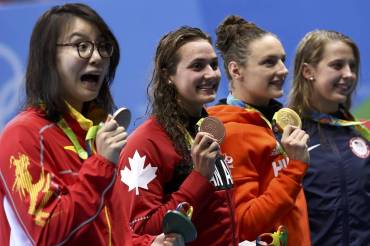
For two days in row, Chinese swimmer Fu Yuanhui clambered out of the Olympic pool in Rio clueless about her breakthrough performances: breaking personal records and clinching a bronze medal.

Each time a poolside reporter had to break the news to the bubbly 20-year-old, whose vivacious epiphanies on live television have broken the Chinese internet.“I was so fast! I’m really pleased!” Ms. Fu exclaimed Monday after learning that she swam the 100-meter backstroke semifinal in 58.95 seconds, a new personal best. “I’ve already… expended my primordial powers!”

After Tuesday’s final, when told that she trailed the silver medalist by just 0.01 second, Ms. Fu replied, “Maybe it’s because my arms are too short.”

Her gleeful candor made her an overnight online sensation. Fans feted her as “Primordial Girl” in online memes and viral videos spoofing her exuberant expressions. Her Weibo microblog following swelled more than sixfold to 3.8 million users.

China has a new sports star, and never mind that she didn’t finish first. In a country long obsessed with winning gold medals, Ms. Fu’s newfound fame seemed to signal shifting social perceptions about the meaning of sport.

“‘Primordial Girl’ and the netizens who appreciate her have taught all of us a lesson: sport is about the struggle and, especially, enjoyment, but most definitely not about spinning gold,” the Communist Party’s flagship newspaper, People’s Daily, said in a Tuesday commentary.

“The warm support from netizens,” according to the newspaper, “shows that public attitudes toward competitive sport and the Olympics have sublimated to a higher level.

”Ms. Fu’s fans, for their part, credited her “authentic” demeanor, which contrasted with the mild mien typical of Chinese Olympians. “We love your happy optimism and strong personality,” a Weibo user wrote on Ms. Fu’s microblog. “That’s what makes a true athlete.

”Winning used to be everything for China’s Olympians, virtually all of whom came through a grueling state-run sports regime that fetishized success. Athletes who strike gold can expect fame and fortune, while those who disappoint often suffer neglect or even ignominy.

Liu Xiang, a hurdler who became the first Chinese man to win an Olympic gold in athletics at the 2004 Athens Games, saw public adulation turn into anguish and anger at the Beijing Games four years later, when an injury forced him to withdraw just before running his first race.E

China nonetheless crowned a grandly staged Beijing Olympics by topping the gold-medal tally for the first time, with 51 in all. Their gold haul dropped to a second-place 38 at the 2012 Games in London, and some Chinese pundits expect a further slip in Rio, to between 30 and 36.

State media, for its part, has tried to manage public expectations about China’s ebbing gold rush.

“As we mature in mentality, learn how to appreciate competition, and become able to calmly applaud our rivals, we’d showcase the confidence and tolerance of a great country,” state broadcaster China Central Television said Sunday in a Weibo post after a goldless first day.

“We still need our first gold medal to boost morale, but what we really need is to challenge ourselves, surpass ourselves,” CCTV said. By Tuesday Chinese athletes had racked up eight golds, alongside three silvers and six bronzes.The message seems to be filtering through, with many Chinese fans appearing more tolerant of athletes who underperformed.

Among the beneficiaries was Ning Zetao, a swimmer who won widespread popularity at last year’s world championships with his boyish good looks—and a 100-meter freestyle gold.

After crashing out of the same event in Rio at the semifinal stage on Tuesday, the 23-year-old appeared philosophical about his failure.

“I’ve done my best,” he told a CCTV reporter.

His comments found a receptive audience among his Weibo fandom. “This is Ning Zetao’s first time participating in the Olympics,” one user wrote. “Don’t give him too much pressure!”

Source: ‘Primordial Girl’ or: How China Learned to Stop Gold-Medal Worship and Love Sporting Effort – China Real Time Report – WSJ

11/02/2014

UPDATE 4-Olympics-India returns to the Games as IOC lifts ban | Reuters

India has returned to the Olympic fold after the IOC lifted a ban on the country’s Olympic association on Tuesday, and its athletes will now be able to march behind the Indian flag at the closing ceremony of the Sochi Winter Games.

Deutsch: Logo des IOC

The country’s athletes have been competing in Russia under the Olympic flag due to the suspension, imposed after it held a 2012 Indian Olympic Association (IOA) election in which a corruption-tainted official was voted in as secretary general.

“It is the first time in Olympic history that a suspension of a National Olympic Committee has been lifted during the Games,” International Olympic Committee spokesman Mark Adams told reporters.

He said the IOC had discussed the matter early on Tuesday and ruled that elections held on Sunday had fulfilled all criteria for the country’s immediate reinstatement.

“We observed the general assembly (on Sunday). We are happy with the changes,” Adams said, adding the IOC’s prerequisite to ban any tainted officials from elections had been fully met.

On Sunday, the IOA voted in a new set of officials with World Squash Federation chief N. Ramachandran elected president, paving the way for the Olympic reinstatement of the world’s second most populous nation.

All India Tennis Association chief Anil Khanna became treasurer in polls which marked the exit of corruption-tainted Abhay Singh Chautala and Lalit Bhanot from the IOA.

via UPDATE 4-Olympics-India returns to the Games as IOC lifts ban | Reuters.

Enhanced by Zemanta
Law of Unintended Consequences

continuously updated blog about China & India

ChiaHou's Book Reviews

continuously updated blog about China & India

What's wrong with the world; and its economy

continuously updated blog about China & India