Archive for ‘Toilet’

03/10/2019

Discover China: Run-down house finds new life as deluxe hotel

FUZHOU, Oct. 3 (Xinhua) — Zheng Yangmei, 35, has mixed feelings about working as a receptionist in her childhood home, a 400-year-old country lodge that has been adapted into a luxury hotel in southeast China’s Fujian Province.

The new profession gives her a different angle to perceive the beauty of the ancestral house built sustaining Tang Dynasty (618-907) architecture style, as experts marveled.

The restoration is beyond her family clan’s imagination, which keeps the historic details of the dilapidated residence as much as possible, while replacing the interior with modern decor suitable for comfortable living.

The place of a stinky hog pen in the yard, which Zheng remembers, is turned into a tea pavilion decorated with a neutral color palette. But the lodge is still roughly what she remembers, wood carvings, stone mills and the grey-tile roofs.

Tucked away in the idyllic village of Banding, an hour’s drive north of Fuzhou, the provincial capital, the old house offers a breathtaking view in the backdrop of lush mountains and a vast expanse of paddy fields.

Named “Sanluocuo,” or three juxtaposed houses, the wood and stone complex covers an area of 3,000 square meters and consists of over 200 dark shabby rooms, where Zheng spent part of her childhood life bunking with her parents and two siblings in a 25-square-meter room.

Since the mid 16th century, it has been held by the extended Zheng family clan. Zheng remembers that there were over 200 members living in the houses when she was there.

“There was no toilet, no tap water in each house,” said Zheng, whose family moved out of the aged buildings when she was 8, as they could no longer fix the house. Instead, they built new two-story brick houses 1,000 meters away.

The old buildings were completely abandoned by all the villagers in the early 2000s, Zheng recalled.

She left the village for college study at the age of 19 and then worked as a vet in several pig farms in more prosperous towns, until 2013 when she got married and returned to the village to raise her kids.

“Villagers seldom went back to the buildings, considering the place pretty spooky, with filthy water, messy electric wires hung in the air like spider webs and cracks on walls,” said Zheng, a mother of two daughters.

Elders of the family clan called on the clan members to raise funds to fix leaky roof tiles, control termites, and straighten leaning walls to prevent the ancestral houses from completely collapsing, but nobody would imagine it can be fixed in a way that the hotel developer later did.

With the local government-initiated plan for preserving ancient folk houses, a property company came in investing 150 million yuan (20.98 million U.S. dollars) to rehab the obsolete buildings.

After two years of reconstruction, “Sanluocuo” was turned into a trendy boutique hotel with centuries-old wooden beams, garden-like atriums, earthen walls and contemporary luxury.

The transformative creation of “Sanluocuo” is among the artworks selected for the China Pavilion overseas show at the ongoing Biennale de Curitiba 2019 in Brazil, as a model for “building a future countryside.”

“We actually leased the complex from the villagers for the renovation. The old rooms were very small. So we converted the original 200 cramped rooms into 40 guest rooms to make them comfortable for living, but we pay the rents based on 200 rooms to the villagers,” said Zhang Yiwen, operations manager of the project.

Targeted at high-flown customers, the hotel rooms in “Sanluocuo” are priced on average at over 600 yuan per night even in the off season.

Visitors can touch the original wood pillars with deep cracks, and decayed rammed-earth walls with weeds, while enjoying hot bath and clean toilets with heated seats inside each room.

The hall that used to house the Zheng family shrine and warehouses have been converted to galleries, restaurants, bars and stores attached to the hotel, which help the village unleash its cultural potential, and once again become a place that villagers like hanging around in leisure time.

The project has triggered an online sensation, after visitors post their travel photos inside the hotel, showing off their cultural and stylish taste on social media.

Zhang said weeks ahead of the National Day holiday, all of the 40 rooms were booked out.

Zheng and 30 other villagers are employed in the hotel, which has also sparked an entrepreneurial enthusiasm in the village. Zhang said the hotel is willing to help villagers open small inns, eateries and stores selling souvenirs and local delicacies, to further improve the village’s tourist potential.

Zhang said the real estate developer of “Sanluocuo,” Land Shine, has leased two more clusters of such old residence from a neighboring village, as folks bear wishes that their obsolete ancestry complex could shine as well as “Sanluocuo.”

Source: Xinhua
26/09/2019

India: Two held for killing children for ‘defecating in the open’

Representational image an Indian child defecating in the openImage copyright GETTY IMAGES
Image caption Millions of poor Indians still defecate in the open

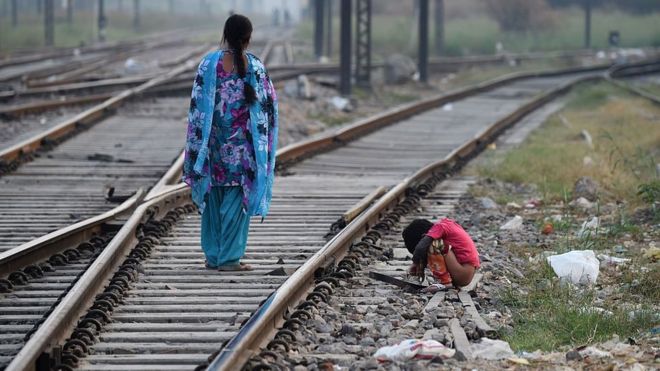
Two men in the central Indian state of Madhya Pradesh have been arrested for allegedly killing two Dalit (formerly untouchables) children who were defecating in the open, police say.

Roshni, 12, and Avinash, 10, were attacked on Wednesday while defecating near a village road, they said.

The children’s family told BBC Hindi that they have no toilet at home.

Millions of poor Indians defecate in the open, which especially puts women and children at risk.

Dalits are at the bottom of the Hindu caste system and despite laws to protect them, they still face widespread discrimination in India.

“The two children were beaten to death with sticks,” police superintendent Rajesh Chandel told BBC Hindi’s Shuraih Niazi. “We have registered a murder case against both the accused. They are being questioned.”

Within hours of the attack early on Wednesday morning, police arrested two upper-caste men – Rameshwar Yadav and Hakim Yadav.

Roshni and Avinash were cousins, but Roshni had been brought up by Avinash’s parents and lived with them.

Avinash’s father, Manoj, says that as a daily wage labourer, he cannot afford to build a toilet at his house. He also says he has been unable to access a government subsidy as part of a flagship scheme to build toilets for the poor.

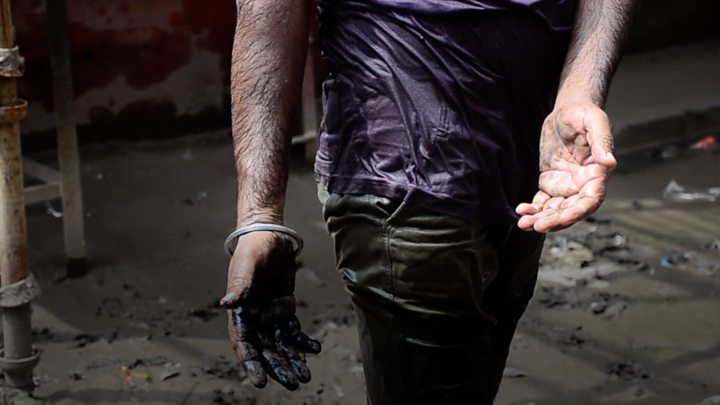
Media caption The Dalits unblocking India’s sewers by hand

The Swachh Bharat Mission or Clean India programme seeks to end open defecation by increasing toilet infrastructure and improving sanitation across the country. When Prime Minister Narendra Modi launched the program in 2014, he vowed to make India “open defecation free” by 2 October 2019.

Manoj’s village – Bhavkhedi – has been declared “open defecation free”, a tag given by the government to villages and cities have successfully ended open defecation.

Women walking away from camera in Indian field
Image caption Women who go out at night to defecate are often at risk

Research has shown that while the construction of toilets has increased rapidly, lack of water, poor maintenance and slow change in behaviour have stood in the way of ending open defecation.

But many have praised Mr Modi for highlighting the issue and launching a major scheme to address it – the Bill & Melinda Gates Foundation honoured him this week, describing the Swachh Bharat Mission as “a model for other countries around the world that urgently need to improve access to sanitation for the world’s poorest.”

Source: The BBC

30/09/2016

Glass loos with a view open in China – BBC News

Whatever will the Chinese think of next?

China’s recent obsession with glass tourist attractions has gone round the U-bend with the opening of some see-through treetop public toilets.

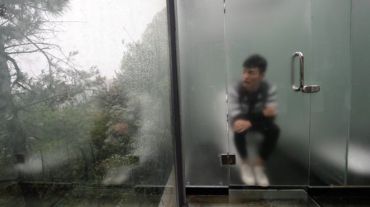
The loos, near Shiyan Lake in southern Hunan province, have fabulous views of both the forest below and other people using the facilities.

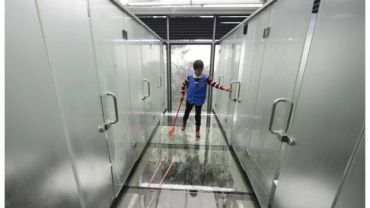
Cubicle walls, even those between the men’s and women’s sections, are only separated by lightly frosted glass.

But state media said few visitors dared use the loos on their opening day.

Image copyrightBARCROFT IMAGESImage caption

Shy users of the urinals may take comfort from the privacy barriers between them, though not in the fact they are made of glass

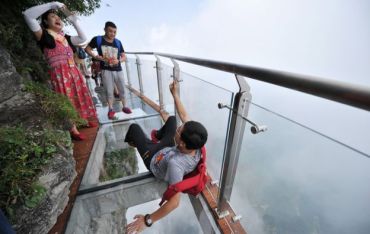
Despite a boom in the construction of glass bridges and walkways in scenic locations in China in recent years – in some cases so popular they had to be closed – these are thought to be the first entirely glass public bathrooms in the country.

However, it not the first time those busting to go have been exposed a little more than they might like by the enthusiasm for glass.

There were reports recently of some male toilets in a university dorm in Hunan which included one very public cubicle.

Image copyrightBARCROFTImage captionUnusually, a head for heights is a requirement for a job as a cleaner there

Image copyrightBARCROFTImage caption Awkward: cubicle walls are only lightly-frosted, even between the men’s and women’s sections

News of the wide-view WCs at Shiyan Lake sparked a range of reactions online.Responding to a Facebook post about it by state television channel CCTV, Ejike Nnadi summed up the feelings of many: “Hell no.”

Others were more taken by the idea. “You’ll be surprised by what you can tolerate when you really, really need to go,” said one post.

Another nodded towards another modern use for restrooms: “I’d be in there ’til my battery hit zero if there was signal in there!”

Image copyrightBARCROFTImage captionThe well-lit lavs are built on a steep hillside

Tina Chen took a dimmer view of all such projects though. “(It) is not about being shy, just again someone had extra money to waste.”

Image copyrightGETTY IMAGESImage caption Unusual glass structures have provided popular photo ops for tourists across China

Awkward or not, it is hoped that these bathrooms for the brave will encourage tourists to visit the countryside around Changsha city and admire the spectacular autumn colours of its forests.

Source: Glass loos with a view open in China – BBC News

Law of Unintended Consequences

continuously updated blog about China & India

ChiaHou's Book Reviews

continuously updated blog about China & India

What's wrong with the world; and its economy

continuously updated blog about China & India