Archive for ‘sociology professor’

25/08/2019

More Chinese men open to the idea of becoming stay-at-home fathers

  • The traditional view that the man of the house must be the breadwinner may be crumbling, according to a recent survey
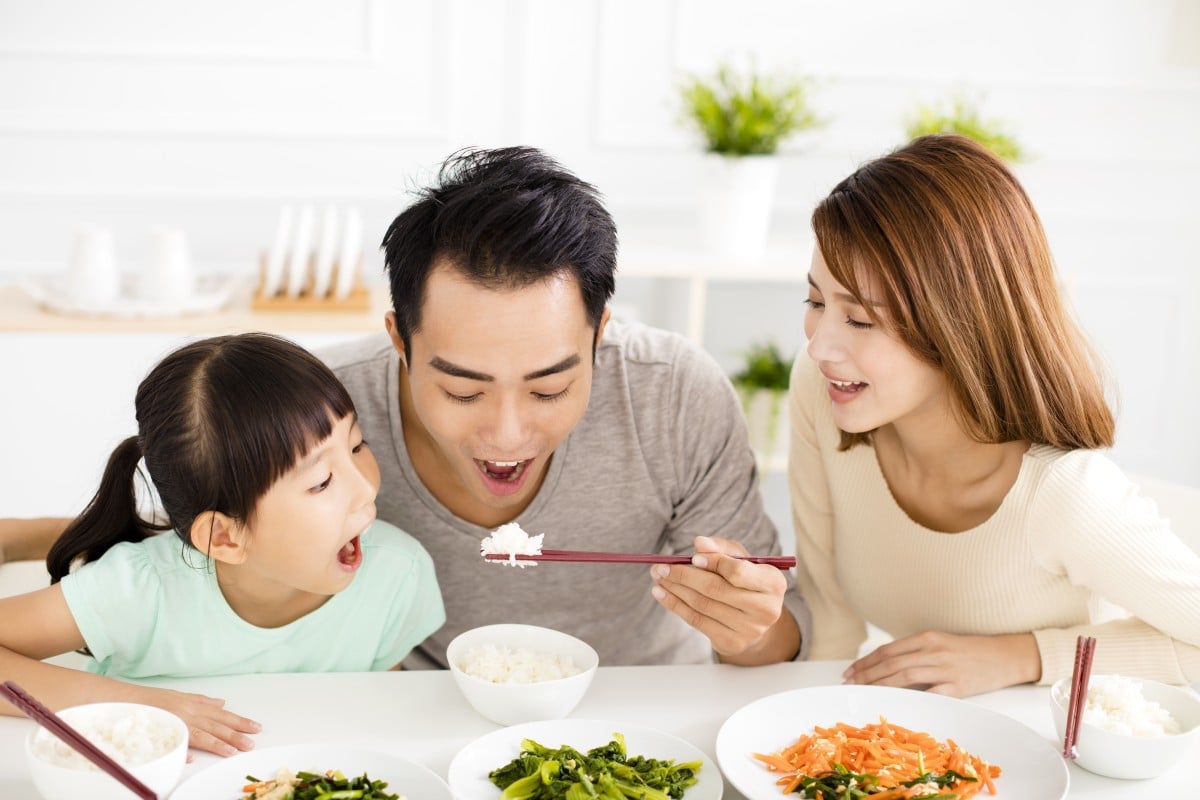
Just over half of the men questioned said they were in favour of stay-at-home fathers. Photo:Shutterstock
More Chinese husbands are open to the idea of becoming stay-at-home fathers in a shift away from traditional mores, according to a recent survey.
The idea that the man of the house should be the breadwinner, while child care and domestic duties are the woman’s duties, is deep-rooted in Chinese culture.
But the survey, jointly conducted by the state-run China Youth Daily and questionnaire website wenjuan.com earlier this month, found that 52.4 per cent of male respondents supported the idea of men being a full-time carer.
The number in favour was lower among women, just 45.8 per cent of whom supported the idea.
But however keen men may be about the idea, there may also be practical difficulties.

Yu Xiang, a middle schoolteacher in Shanghai who has a six-month-old daughter, said he was willing to be a stay-at-home father but in reality it was not practical to do that because his wife, who is also a teacher, did not earn enough to support the family.

He also said his wife was not happy leaving him to do the housework, adding that she often scolded him for doing it badly. “She also said he would not feel comfortable letting me take care of our daughter,” he said. “She says I am too careless.”

Chinese father decides to drop in on daughter’s school … via helicopter

Robin Ge, a financial manager from Shanghai, admitted he took a more old-fashioned view of household duties.

The father of a five-year-old boy said he would not accept the idea of becoming a stay-at-home father even if his wife, an office worker, started earning more than him.

“Perhaps I am a traditional Chinese man,” he said. “I believe men should earn more than women. I remember my father told me years ago that a man’s status in his family is determined by his economic status. Compared with stay-at-home mothers, the acceptance rate for stay-at-home fathers among the public is very low.

“I agree that a father caring for the kids has benefits, such as helping the kid to be brave and responsible. However, that doesn’t mean a man needs to be full-time father. What he should do is to spend much of his spare time caring for and playing with his kid.”

The survey questioned 1,987 married people, some 89.2 per cent of whom were parents. Sixty per cent of the respondents agreed that the stereotypical view of the husband being the breadwinner put fathers off staying at home to look after the children.

However, the number of women who said they were opposed to the idea of stay-at-home fathers, 30.9 per cent, was slightly higher than the 28 per cent of men who did not support the notion.

But women whose husbands have given up their jobs to look after the children generally appreciated what they had done.

“I don’t think a man who stays at home is a failure in life. His sacrifice helps me so much and I really am grateful for his support,” a woman wrote on China’s leading parental website ci123.com, adding that this kind of family is more stable and the relationship between husband and wife is more harmonious.

Chinese father takes daughter, 10, to top school’s open day despite her being on an IV drip

Zhang Baoyi, a sociology professor at the Tianjin Academy of Social Sciences, said he believed attitudes would change as society evolved.

“To embrace this practice, we need to recognise the contribution and value of homemakers,” Zhang told China Youth Daily.

“The fact that dads are willing to be more involved in their children’s lives shows that the traditional mentality of ‘career husband and domestic wife’ is changing.”

Zhang also said that more parents in general were willing to stay at home to provide full-time child care because they were attaching increasing importance to their children’s education.

“The number of stay-at-home fathers or mothers is increasing,” he said.

“Couples should adjust the [family] model … according to their economic conditions and abilities to educate the children.”

Source: SCMP

10/04/2019

Hong Kong ‘Umbrella’ protesters found guilty of public nuisance

Media caption The “Umbrella Movement” activists said they would continue to strive for democracy

Nine pro-democracy activists in Hong Kong have been found guilty of public nuisance charges for their role in a civil disobedience movement that called for free elections in the city.

Among them are three prominent activists, seen as figureheads of Hong Kong’s pro-democracy movement.

They could be jailed for up to seven years for their part in the “Umbrella Movement” protests of 2014.

Thousands marched demanding the right for Hong Kong to choose its own leader.

Those convicted include the so-called “Occupy trio” – sociology professor Chan Kin-man, 60, law professor Benny Tai, 54, and Baptist minister Chu Yiu-ming, 75.

They are seen as the founders of the movement that galvanised protesters in their campaign of civil disobedience.

“No matter what happens today… we will persist on and do not give up,” Mr Tai told reporters ahead of the verdict.

Mr Tai, Mr Chan and five others were found guilty of two charges of public nuisance, and Mr Chu and one other of just one charge.

A large crowd gathered outside the court on Thursday to support them. It is not yet clear when they will be sentenced.

Presentational grey line
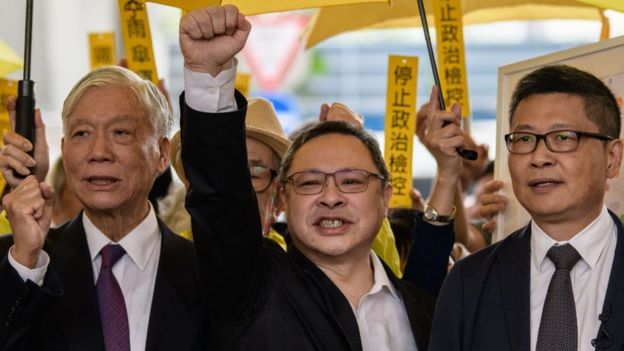
Chu Yiu-ming, Benny Tai, Chan Kin-manImage copyrightAFP
Chu Yiu-ming, Benny Tai and Chan Kin-man (left to right) were charged under colonial-era laws that carry possible jail terms of up to seven years

Like just another day

By Martin Yip, BBC News Chinese, Hong Kong

The nine defendants walked into the court building looking refreshed and in high spirits. All but one said a few words in what might have been their last hours of freedom before their predicted jail term.

Delivering his verdict, Justice Johnny Chan said the defendants had caused a nuisance – by occupying major roads – leading to injuries among civilians. The nine looked calm and not particularly emotional. They were later released on bail. Benny Tai, Chan Kin-man and Chu Yiu-ming smiled as they passed me, as if it was just another day.

They are yet to say if they will appeal. The court was adjourned for the day as the lawyers are yet to finish their mitigation submissions. The sentences have yet to be announced.

The broader pro-democracy camp already has bad relations with Beijing. Activists and politicians did express their anger but political analysts also warn that people might simply leave the movement out of frustration.

“Some people might feel dispirited and helpless. I hope they can see that other people haven’t given up,” Benny Tai told BBC News Chinese ahead of today’s verdict.

Seventy nine days of sit-in protests have already changed Hong Kong a lot. But today’s verdict might serve more as a reminder that this city remains divided.

Presentational grey line

What has the reaction been?

At the trial Judge Johnny Chan rejected the idea that this would have a substantial impact on society.

“It cannot be reasonably argued that a charge of conspiracy to cause public nuisance would generate a chilling effect in society,” he wrote in his ruling.

But rights groups criticised the ruling, with Humans Rights Watch saying the court was “sending a terrible message”.

“[This] will likely embolden the government to prosecute more peaceful activists, further chilling free expression in Hong Kong,” said researcher Maya Wang in a statement to the BBC.

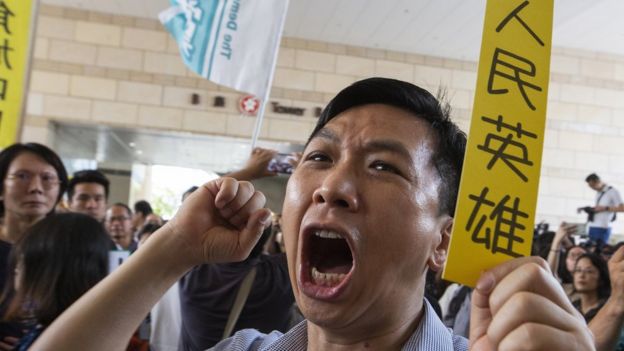
A pro-Democracy activist holds a piece of yellow paper with a slogan in Chinese saying "People"s Hero"Image copyrightEPA
One pro-democracy supporter outside the court held up a sign saying “People’s Hero”

Lord Chris Patten, the last British governor of Hong Kong, released a statement saying that it was “appallingly divisive to use anachronistic common law charges in a vengeful pursuit of political events which took place in 2014”.

This verdict comes after a string of frustrations for pro-democracy activists. In the last few years the courts have removed six lawmakers for changing their swearing in oaths to include protest phrases. Others have also been disqualified from running for office.

What were the protests about?

The protests started in reaction to a decision made by China that it would allow direct elections in 2017, but only from a list of candidates pre-approved by Beijing.

Beijing is highly sensitive about Hong Kong’s status and any calls for more autonomy from China.

The former British colony was handed back in 1997 on condition it would retain “a high degree of autonomy, except in foreign and defence affairs” for 50 years.

Many people in Hong Kong believe they should have the right to elect their own leader.

In 2014, the three activists’ calls for non-violent civil disobedience joined with student-led protests and snowballed into the massive demonstrations.

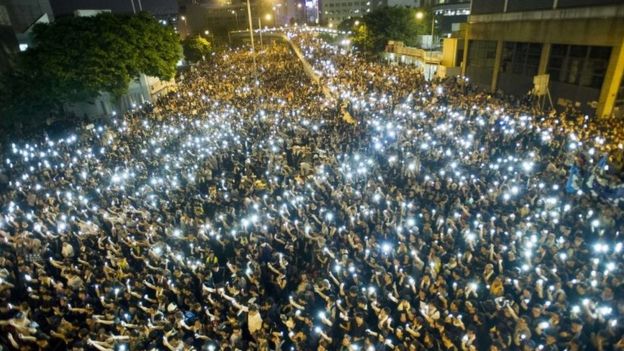
Tens of thousands of people camped in the streets and demanded the right to fully free leadership elections.

Hong Kong protests (Sept 2014)Image copyrightAFP The pro-democracy protests bought an area of central Hong Kong to a standstill for weeks in 2014

The protests became known as the “Umbrella Movement” after people used umbrellas to shield themselves from pepper spray fired by police to disperse the crowd.

Protesters accused the Chinese government of breaking its promise to allow full democracy in Hong Kong, and of encroaching more and more on the region.

But the number of protesters dwindled to just a few hundred as the weeks dragged on and they ultimately failed to achieve their goal.

Source: The BBC

Law of Unintended Consequences

continuously updated blog about China & India

ChiaHou's Book Reviews

continuously updated blog about China & India

What's wrong with the world; and its economy

continuously updated blog about China & India