Archive for ‘South Korea’

12/02/2019

Trade talk hopes and shutdown deal buoy stocks

LONDON (Reuters) – World shares and bond yields rode a renewed surge in risk appetite on Tuesday, as investors were optimistic about U.S.-China trade talks and cheered Washington’s deal to avoid another government shutdown.

Tokyo’s Nikkei set the tone with its best day of the year so far and Europe wasted little time in trying to lift the STOXX 600 back to the two-month high it set last week.

Germany’s DAX jumped more than 1.2 percent, after rising 1 percent on Monday, and Paris and Milan were up 0.8 percent, while London’s FTSE approached a four-month peak despite ongoing Brexit uncertainty.

The dollar hovered at a two-month high and the Australian dollar also gained. The yen and Swiss franc dipped while U.S. Treasury and German bund yields edged up as investors jettisoned safe havens.

“We have had two bits of relatively good news overnight – optimism about the U.S. shutdown not resuming and optimism about a trade deal,” said Societe Generale strategist Kit Juckes.

“Equities are higher, bond yields are a little bit higher, yen and Swiss franc weakest overnight of the major currencies so it’s sort of risk-on rules OK!”

Juckes said he reckoned there was now a 75 percent chance that a ratcheting up of U.S. tariffs on Chinese goods at the start of March will be avoided and a 95 percent chance that another U.S. government shutdown will be dodged.

Those odds got a boost on Monday after U.S. lawmakers reached a tentative deal on border security funding, though aides cautioned that it did not contain the $5.7 billion President Donald Trump wants to build a wall on the Mexican border.

S&P 500 e-mini futures were up nearly 0.5 percent, pointing to a solid start on Wall Street later after a choppy day on Monday.

U.S. and Chinese officials expressed hopes the new round of talks, which began in Beijing on Monday, would bring them closer to easing their months-long trade war.

Beijing and Washington are trying to hammer out a deal before a March 1 deadline, without which U.S. tariffs on $200 billion worth of Chinese imports are scheduled to increase to 25 percent from 10 percent.

“There will be no winner in a trade war. So at some point they will likely strike a deal,” said Mutsumi Kagawa, chief global strategist at Rakuten Securities in Tokyo.

BIG IN JAPAN

MSCI’s broadest index of Asia-Pacific shares outside Japan edged up 0.3 percent.

Shanghai rose 0.35 percent, South Korea’s KOSPI climbed 0.6 percent and Australian shares gained 0.3 percent.

The Nikkei rallied though, shooting up 2.6 percent after closing on Friday at its lowest level since early January. The Tokyo market was closed on Monday.

With the yen backtracking again, shares of exporters such as automakers and machinery makers led the charge. Separately, Deutsche Bank noted it was 20 years since Japan cut interest rates to zero, something now standard in large parts of Europe.

The dollar held firm, having gained for eight straight sessions against a basket of six major currencies until Monday, its longest rally in two years.

Although the Federal Reserve’s dovish turn dented the dollar earlier this month, some analysts noted the U.S. currency still has the highest yield among major peers and that the Fed continues to shrink its balance sheet.

“The dollar is the market’s pet currency at present regardless of whether concerns about the global economy are on the rise,” currency strategists at Commerzbank said in a note.

The dollar popped up to a six-week high of 110.65 yen. In contrast, the euro dropped to as low as $1.1267, its weakest in 2-1/2 months, and last traded at $1.1277.

In commodity markets, oil prices also ticked up as traders weighed support from OPEC-led supply restraint and a slowdown in the global economy.

U.S. crude futures traded at $52.68 per barrel, up 0.5 percent. Brent crude rose 0.6 percent to $61.89 per barrel. Gold was a touch stronger at $1,312 an ounce.

Source: Reuters
05/12/2018

Seoul voices concerns as more Chinese military aircraft spread their wings in South Korean air defence zone

Lee Jeong-ho reports on China's diplomacy for the Post. He also covers East Asian security and defence stories. ” data-title=”<a href="/author/lee-jeong-ho">Lee Jeong-ho</a>” data-html=”true” data-template=”

” data-original-title=””> 

6SHARE

Related Articles

South Korea has voiced its frustration about repeated intrusions into its air defence identification zone by Chinese military aircraft, moves that analysts say reflect Beijing’s opposition to strengthening ties between Seoul, Tokyo and Washington.

South Korean authorities said a Chinese plane, possibly a Shaanxi Y-9 electronic warfare and surveillance aircraft flew into the Korean zone Monday last week without notice. The plane entered near Socotra Rock in the Sea of Japan, or East Sea, at about 11am and flew out and into Japan’s air defence identification zone about 40 minutes later.

The plane re-entered the South Korean air defence zone, near the southeastern city of Pohang, at about 12.43pm. Then it travelled up to South Korea’s Exclusive Economic Zone in the Sea of Japan, cutting between the South Korean mainland and Ulleung island.

It was unusual for a Chinese aircraft to have taken that route. The plane was reported to have left the zone at 3.53pm.

Air defence identification zones are not covered by any international treaty and it is standard practice to notify the country concerned before entering its airspace.

The aircraft did not enter South Korean territorial airspace, which under the United Nations Convention on the Law of the Sea is defined as 12 nautical miles from shore.

According to the South Korean Air Force, the number of Chinese military aircraft entering its identification zone is rising. In 2016, there were about 60 incursions, 70 in 2017 and 110 were reported up to September this year.

Seoul called Du Nongyi, the Chinese military attaché to South Korea, to its defence ministry after Monday’s incident to expressed its “serious concerns” and called for “measures to prevent recurrences”.

A middle-ranking South Korea Air Force officer said Seoul paid “extra attention” to the incident.

Security analysts said the flights were a demonstration of China’s worries about increased US military activity in the region if US-North Korea negotiations failed.

Sending military planes over area allowed China to extend its surveillance and sent a message that it was watching and, if necessary, willing to act to protect its interests in the region, analysts said.

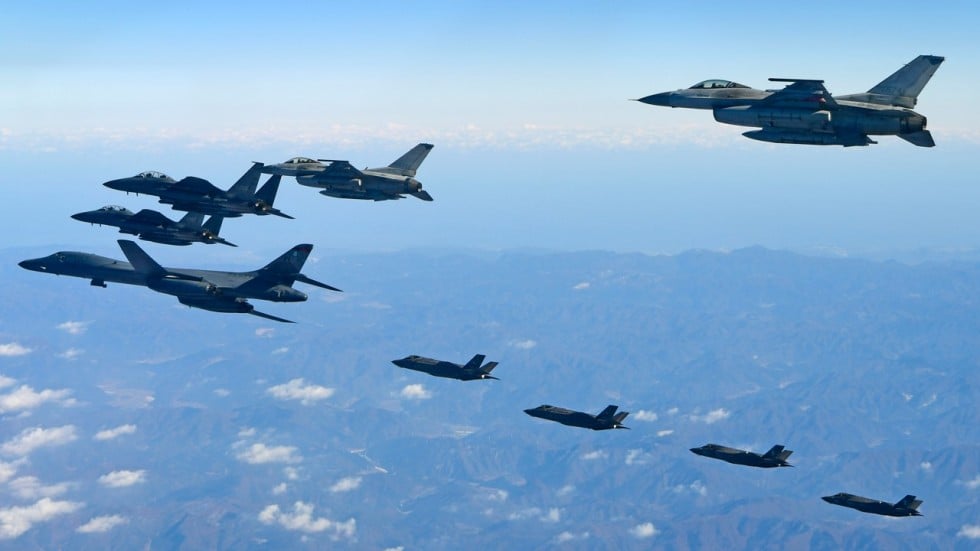
The US has sent military assets, including nuclear-capable B-52 bombers, to the Sea of Japan, prompting criticism from Beijing and Pyongyang. The US has long said North Korea’s behaviour was justification for joint military exercises with South Korea. These were stepped down this year to encourage Pyongyang at the negotiation table but could be stepped up again if talks on denuclearisation fail.

“China’s moves are part of its grand strategy to exert greater influence, presence, and pressure in the Indo-Pacific region … Possible failure of US-North Korea negotiations would be in [Beijing’s] calculations,” said Ryo Hinata-Yamaguchi, a visiting professor at Pusan National University in South Korea and adjunct fellow at the Pacific Forum – a donor-funded, non-profit foreign policy research institute based in Honolulu, Hawaii.

“I expect the [US-South Korea] exercises to resume at full scale [if] the US-North Korea negotiations or inter-Korean relations deteriorate … when both Washington and Seoul view that [the drills are] necessary.”

Zhao Tong, a fellow with the nuclear policy programme at the Carnegie-Tsinghua Centre for Global Policy in Beijing, said Monday’s overflight had several meanings.

The resumption of US-South Korea drills and Japan’s recent military modernisation “would be viewed by China as a direct threat to its own security and the overfly of Chinese aircraft could be used to send a deterrence signal”.

“Japan, in particular, is hosting increasingly advanced US military assets on its territory. Chinese reconnaissance aircraft flying in the Sea of Japan can help it keep an eye on what is going on in that region,” Zhao said.

Beijing fears the strengthening of an alliance network between the South Korea and Japan and, consequently, the completion of a US-South Korea-Japan triangle, often referred to as an Asian Nato.

South Korea and Japan signed a military intelligence pact in 2016, which China criticised as a deal between countries that shared a “cold-war mentality”.

“For China, the formation of a US-South Korea-Japan alliance triangle would be one of their biggest concerns as it would essentially be a powerful containment strategy against Beijing,” Hinata-Yamaguchi said.

“China would take, and has taken, measures to avoid the formation of an US-South Korea-Japan alliance triangle, such as the [push for] ‘three positions’ promised between China and the South Korea in the autumn of 2017,” Hinata-Yamaguchi said.

But Beijing played down the flight and called it a “routine arrangement”.

Ren Guoqiang, spokesman at the Ministry of National Defence, said last week that Chinese forces were “in line with the international law and practice” and the South Korea side “didn’t have to be too surprised about it”.

The ministry did not respond to requests for further comment.

Law of Unintended Consequences

continuously updated blog about China & India

ChiaHou's Book Reviews

continuously updated blog about China & India

What's wrong with the world; and its economy

continuously updated blog about China & India