Chindia Alert: You’ll be Living in their World Very Soon
aims to alert you to the threats and opportunities that China and India present. China and India require serious attention; case of ‘hidden dragon and crouching tiger’.
Without this attention, governments, businesses and, indeed, individuals may find themselves at a great disadvantage sooner rather than later.
The POSTs (front webpages) are mainly 'cuttings' from reliable sources, updated continuously.
The PAGEs (see Tabs, above) attempt to make the information more meaningful by putting some structure to the information we have researched and assembled since 2006.
BEIJING, March 3 (Xinhua) — When talking about the development of intellectual property (IP) in China, World Intellectual Property Organization (WIPO) Director General Francis Gurry said “it’s a remarkable journey and a remarkable story.”
Born at the start of reform and opening-up, China’s IP cause has taken only decades to accomplish what the western IP system took hundreds of years to develop. While developing and improving its IP system, China has been active in international cooperation to boost global IP governance.
ACTIVE IN INT’L COOPERATION
Starting from zero at the beginning of its reform and opening-up, China has established a relatively complete IP legal system in line with prevailing international rules, joined almost all major related international treaties, and developed cooperative relations with over 80 countries and international or regional organizations in a relatively short period of time.
China has always been a follower, participant and upholder of the international rules of IP, Shen Changyu, commissioner of the National Intellectual Property Administration, told Xinhua in a recent interview.
China is an active participant in multilateral and bilateral affairs within the framework of WIPO to promote and improve global IP governance, Shen added.
In recent years, international cooperation with China on IP protection has has continuous innovative progress. IP cooperation under the Belt and Road Initiative has in particular achieved practical results.
In 2019, China and the European Union (EU) completed an eight-year negotiation on an agreement to protect geographical indications (GI), which included 275 GI from each of the two sides in the appendix, such as EU’s Irish whiskey and traditional Chinese Shaoxing wine.
With the ratification of Indonesia on Jan. 28, the Beijing Treaty on Audiovisual Performances will take effect for its 30 contracting parties on April 28.
The Beijing treaty, adopted by WIPO member states in 2012, fills a gap in the international treaty on the comprehensive protection of performers in audiovisual performance.
PROTECTION WITHOUT DISCRIMINATION
IP is not only an important strategic resource of a country, but also a booster of technological innovation and a bridge of trade globalization. China is a protector and creator of IP.
Statistics show that by the end of 2019, China had led the world in patent and trademark applications for several years running.
According to data from the WIPO for 2017 and 2018, China was the second largest applicant for international patent applications submitted through the Patent Cooperation Treaty, and the third largest for trademark registration under the Madrid System.
After about 40 years of development, China’s IP governance capability is in line with that of the international community and its IP protection has reached the international standard, which is fully recognized by the world, said Shan Xiaoguang, dean of Shanghai International College of IP at Tongji University.
In the process of advancing the development of its IP system, China has made great efforts to enhance protection and optimize policies, insisting on providing effective protection without discrimination for both domestic and foreign enterprises.
Foreign plaintiffs are able to win and receive injunctions in patent infringement cases brought in China according to the law, Patently-O, a U.S. leading patent law blog, wrote, adding that China’s IP protection practice is fair and just.
China’s effective protection brings huge benefits to foreign IP holders every year. Statistics show that the country paid 34 billion U.S. dollars for IP royalties in 2019.
China has strengthened IP protection with an open attitude, making it a magnet for global trade and innovative activities.
Global innovative activities occur mostly in metropolitan hotspots in China, Germany, Japan, South Korea and the United States, according to the 2019 edition of WIPO’s “World Intellectual Property Report.”
According to Doing Business 2020, an annual report published by the World Bank, China jumped to 31st in its ranking for ease of doing business and is among the top 10 improvers for a second consecutive year.
CHINESE WISDOM
Advanced experience accumulated during the rapid growth of the IP cause in China over the past decades has attracted worldwide attention.
China places IP at a strategic high level, pays attention to IP protection in all economic fields, and has shown its determination of long-term policy for decades, which set up examples for other countries, said Gurry.
Renata Righetti Pelosi, president of the International Association for the Protection of Intellectual Property, pointed out two reasons for the rapid development of the IP cause in China.
On the one hand, the needs of economic operators in China have increasingly overlapped with those in the world, and the two sides have reached more consensuses on IP protection, Pelosi said.
On the other, China has many IP talents with a global vision, who are leading the rapid growth of this sector, she added.
Through academic exchanges and personnel training, China is also actively contributing its wisdom to global IP governance and is more confident about joining global IP cooperation.
The first batch of students from countries that joined the Belt and Road construction successfully graduated from China with master’s degrees in IP in 2018, bringing the knowledge and experience of IP protection they learned from China to the world.
As global IP governance is facing new challenges posed by a new phase of development and a new round of scientific and technological revolution has brought great changes to the industry, many industries spawned by new technologies have gone beyond the scope of protection of the original IP system.
In the new round of scientific and technological revolution and industrial transformation, countries should learn from each other with a more open and inclusive attitude, said Shan, adding that China has led the world in such technological fields as artificial intelligence, big data and life science, and accumulated valuable experience on IP protection in related industries, which is conducive to solving global challenges.
Plunges in official and private sector purchasing managers’ indices amid the coronavirus outbreak prompted sharp revisions of economic forecasts
Analysts expect China to enact additional fiscal and monetary stimulus but stop short of massive support enacted after the global financial crisis in 2008
Due to the outbreak of the coronavirus, the once unthinkable scenario in which China’s economy posts a zero growth rate or even an absolute contraction compared to the previous quarter is now seen as a real possibility. Photo: AP
The odds are rising that China will report a sharp deceleration in growth – or even a contraction in the first quarter as a result of the impact of the coronavirus epidemic.
The outbreak has paralysed the country’s manufacturing and service sectors, putting Beijing in the difficult position of either forgoing its economic growth goal for 2020 or returning to its old playbook of massive debt-fuelled economic stimulus to support growth.
The larger-than-expected deterioration in the official and private sector purchasing managers’ indices for both the manufacturing and services sectors to all-time lows in February – the first available economic indicators showing the extent of the economic damage done by the epidemic – has prompted economists to slash their Chinese growth forecasts.
Several are even expecting the once unthinkable scenario in which China’s economy posts a zero growth rate or even an absolute contraction compared to the previous quarter, even though the weakness is likely to be only short-lived.
A contraction in first quarter growth would be the first since the end of the Cultural Revolution in 1976.
A report published by the East Asian Institute at the National University Singapore noted that China could report a contraction of 6.3 per cent in the first quarter from the first quarter of 2019, while the growth rate for 2020 is set to fall well short of the 5.6 per cent needed by Beijing to meet its economic goal.
If China still wants to achieve an average 5.6 per cent growth for 2020, it would have to engineer a growth rate of as high as 12.7 per cent in the second half of the year, according to the report by Bert Hofman, Sarah Tong and Li Yao.
“The question is whether this is feasible and whether the consequences in terms of increased debt and potentially less productive investment are worth the price,” according to the report.
What is gross domestic product (GDP)?
China’s headline year-over-year gross domestic product (GDP) growth rate has hovering in a narrow range between 6 per cent and 7 per cent for 18 consecutive quarters until the end of 2019, but a sharp dip in the otherwise steady growth trajectory in the world’s second largest economy would send fresh warning signs about the risks of relying excessively on China as a production base and consumption market, particularly for large multinationals from Hyundai to Apple.
An official recognition of an economic contraction, even a brief one, would break a long tradition of China reporting consistent growth to prove the Communist Party’s ability to manage the economy and to rally the whole country to achieve one historical milestone after another.
insisted last week that China would realise the vision of building up a “comprehensively well-off” society by 2020, an inheritance from China’s former paramount leader Deng Xiaoping and a major gauge of progress to realise Xi’s grand “Chinese dream” by the middle of the century.
One key but loosely defined parameter for achieving a “comprehensively well-off” society is that the size of the economy at the end of this year will be double that of 2010.
To achieve that, economists calculate that China must achieve a 5.6 per cent growth this year, although Beijing has been vague about the specific target, although this now seems out of reach barring massive stimulus or a redefinition of the goal.
Louis Kuijs, head of Asia economics at Oxford Economics, said his group has cut its forecast for the year-on-year growth rate to 2.3 per cent for the first quarter and 4.8 per cent for 2020 overall, adding that it would be next to impossible for China to make up the lost ground during the reminder of the year given the impact of the coronavirus
on the rest of the world, particularly South Korea, Japan and Italy, who are all major trading partners.
It will be extremely difficult, to say the least, to meet the annual growth targets for 2020 set previously. It would require massive, unreasonable amounts of stimulus, if it is at all possible, given the headwinds Louis Kuijs
“It will be extremely difficult, to say the least, to meet the annual growth targets for 2020 set previously. It would require massive, unreasonable amounts of stimulus, if it is at all possible, given the headwinds,” Kuijs said.
Instead, it would “make much more sense” for the Chinese leadership to play down the need to literally meet the previously set economic target,” he added.
Beijing’s social and economic development targets for this year have not yet been made public, even though Xi has pledged that the government would still achieve them despite the challenge posed by the virus outbreak.
The full-year targets covering growth, employment and inflation are usually released at the National People’s Congress, the ceremonial gathering of China’s legislature in early March, but this key annual event has been postponed due to the threat of the coronavirus, which has infected over 80,000 people and killed more than 2,900 in the country as of Tuesday.
China’s National Bureau of Statistics is due to publish first quarter GDP growth data in mid-April, with combined industrial production, retail sales and fixed-asset investment data for January and February due next week.
They will offer a clearer picture of how much the coronavirus epidemic has damaged China’s growth in the first two months of this quarter, although the damage it has caused in China and the rest of the world is hard to measure because the epidemic is still evolving.
Production among manufacturing companies across China, except in the virus epicentre of Wuhan, Hubei province, have been gradually returned to normal, with firms that have close ties to local governments and access to financial resources resuming production faster than the much larger number of small businesses.
Chinese diaspora fights coronavirus discrimination in the US
The latest data from China’s industry ministry showed that only 32.8 per cent of
had restarted production as of the middle of last week, an increase of just 3.2 percentage points from three days earlier. But even among the larger enterprises the government is trying to help, many are not running at full capacity due to disrupted logistics that have impeded the delivery of raw materials to factories and finished products to customers.
A shortage of workers due to travel barriers erected to stem the spread of the virus, or local regulations that prevent factories from resuming full operations until they have implemented sufficient health safeguards, are also hampering efforts.
Foxconn, which assembles most of Apple’s iPhones in China, said normal production is not expected to resume until the end of March.
China, though, has limited its economic aide policies to “targeted” fiscal and monetary moves, avoiding the massive stimulus it undertook in 2008 in response to the global financial crisis that led to the negative side-effects of high debt and unproductive investments.
[China] will be cautious about the scale of any intervention. The size of the stimulus will likely depend on how quickly economic activity recovers on its own Andy Rothman
Andy Rothman, a San Francisco-based strategist for investment fund Matthews Asia and a long-time watcher of the Chinese economy, said China will report a sharp fall in economic activity in the first quarter and that it “is prepared to implement a stimulus”.
“But [China] will be cautious about the scale of any intervention. The size of the stimulus
will likely depend on how quickly economic activity recovers on its own,” Rothman said.
China’s ruling Communist Party has never reported a contraction in economic growth since the country started the reform and opening up movement in 1978.
Even in 1990, when China was hit by Western sanctions following the crackdown on the 1989 pro-democracy movement, the country still reported an annual growth of 3.8 per cent.
The larger-than-expected fiscal and monetary policy stimulus will help make meeting the targets for 2020 less challengingLiu Li-Gang
In the history of quarterly GDP growth rates – China started to report such data in 1994 going back to 1992 – the lowest growth rate on record of 6.0 per cent was in the third and fourth quarters of 2019.
The most recent year that China admitted to an economic contraction was 1976, the final year of the Culture Revolution and the year when chairman Mao Zedong died.
Liu Li-Gang, the chief China economist for Citigroup Global Markets Asia in Hong Kong, said Beijing has the policy reserves to keep economic growth on track, including increasing the fiscal deficit and loosening monetary policy.
“The lower GDP growth [in the first quarter] means that larger fiscal and monetary policy easing will be needed,” Liu said. “The larger-than-expected fiscal and monetary policy stimulus will help make meeting the targets for 2020 less challenging.”
Image copyright GETTY IMAGESImage caption Authorities are also asking overseas Chinese to reconsider travel plans
Travellers from countries with severe coronavirus outbreaks who arrive in some parts of China will have to undergo a 14-day quarantine, state media say.
Travellers from the virus hotspots of South Korea, Japan, Iran and Italy arriving in the capital will have to be isolated, a Beijing official has said.
Shanghai and Guangdong announced similar restrictions earlier.
Authorities are worried the virus might be imported back into the country.
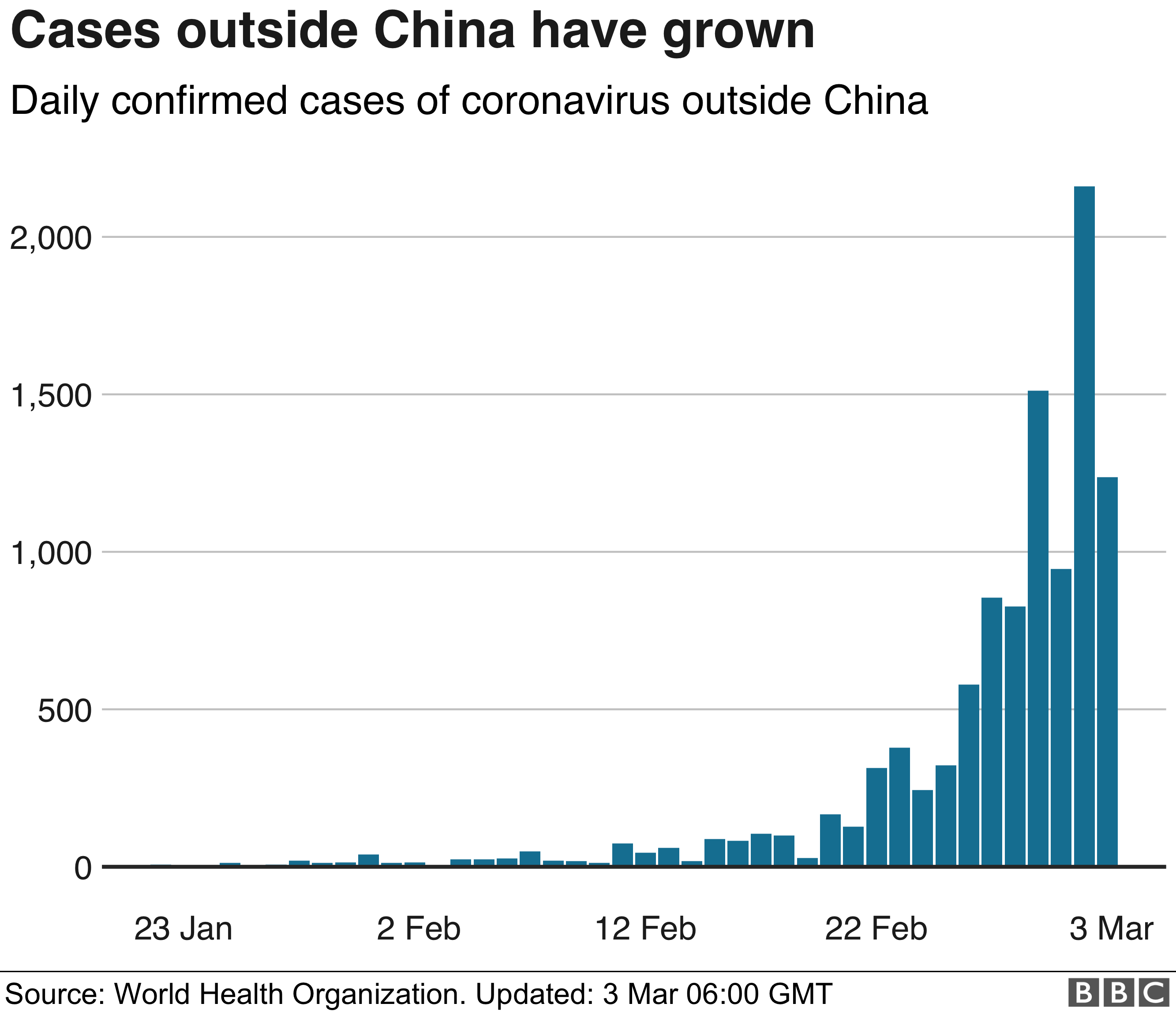
Although most virus deaths have been in China, Monday saw nine times more new infections outside China than in.
Shanghai said it would require new arrivals from countries with “relatively serious virus conditions” to be isolated, without naming the countries.
Authorities are also asking overseas Chinese to reconsider travel plans.
“For the sake of your family’s health and safety, please strengthen your precautions, carefully decide on your travel plans and minimise mobility,” officials in one southern Chinese province said.
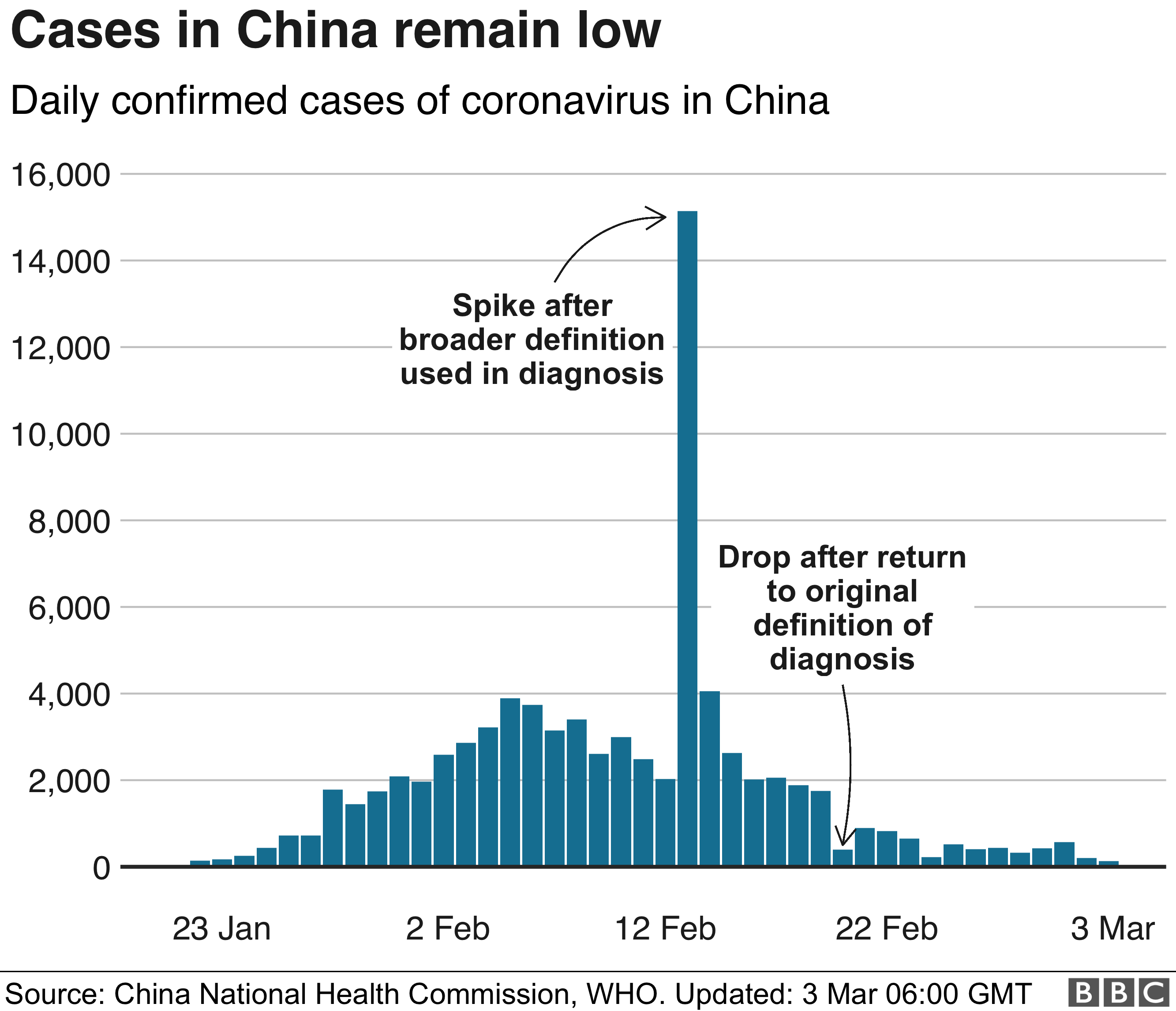
China reported 125 new virus cases on Tuesday – the lowest number of new daily infections in six weeks. There were also 31 more deaths – all in Hubei province, where the virus emerged.
In other developments:
Finance ministers from the G7 countries have said they are “ready to take action”, including fiscal measures to aid the response to the virus and support the global economy
The Pope, who had cancelled a Lent retreat for the first time in his papacy because he was suffering from a cold, has tested negative for the virus, Italian media report
South Korean President Moon Jae-in has put the country into a “state of war” and ordered all government departments to shift to a 24-hour emergency system
Jailed British-Iranian woman Nazanin Zaghari-Ratcliffe is in good health, Iran’s judiciary has said. She was assessed after her husband said she was showing symptoms of Covid-19
Media caption Julie, who lives in Singapore, was diagnosed with coronavirus and then put into isolation
How are different countries affected?
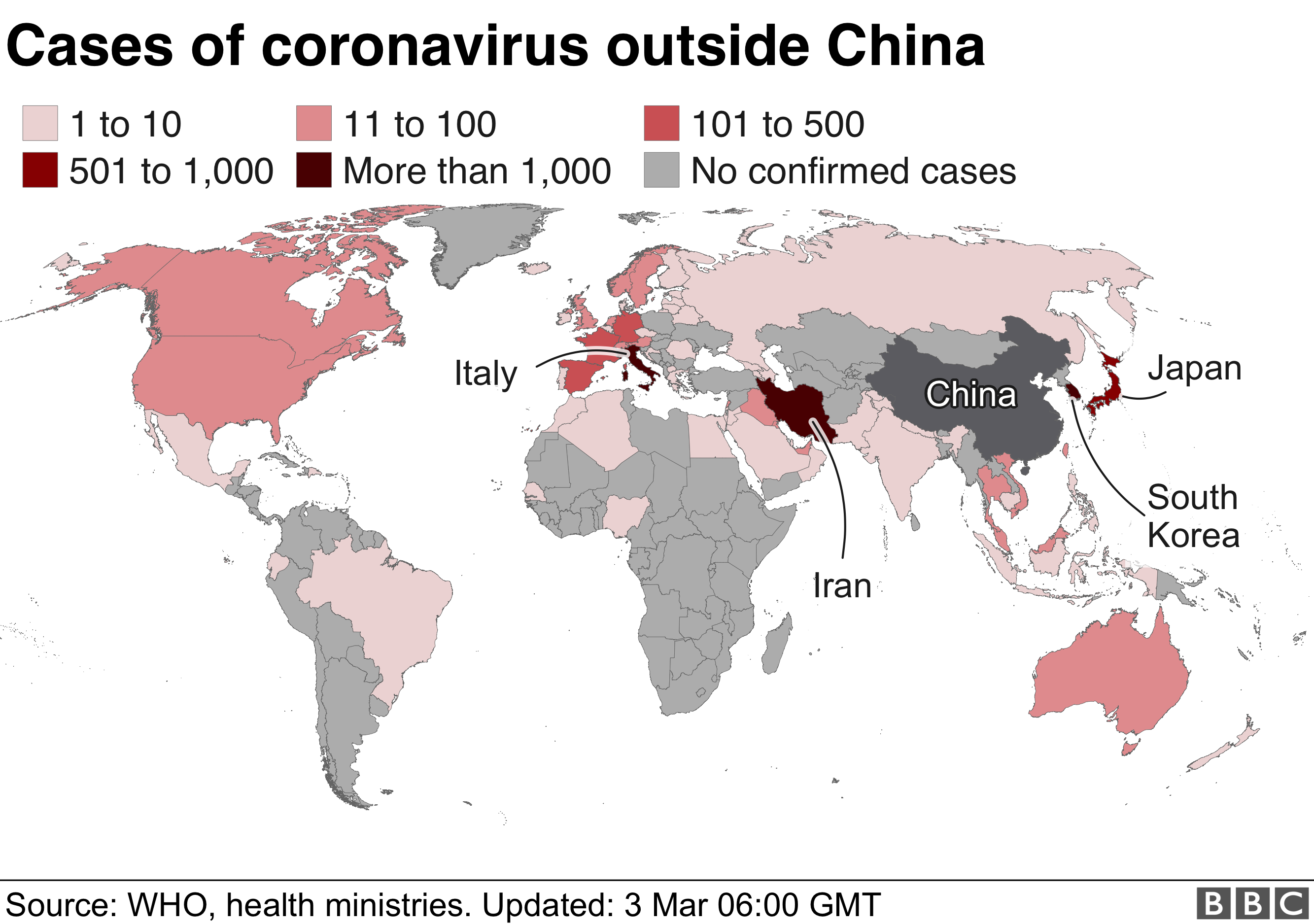
There are now almost 90,000 cases worldwide in about 70 countries, although the vast majority – just under 90% – remain in China, and most of those are in Hubei province where the virus originated late last year.
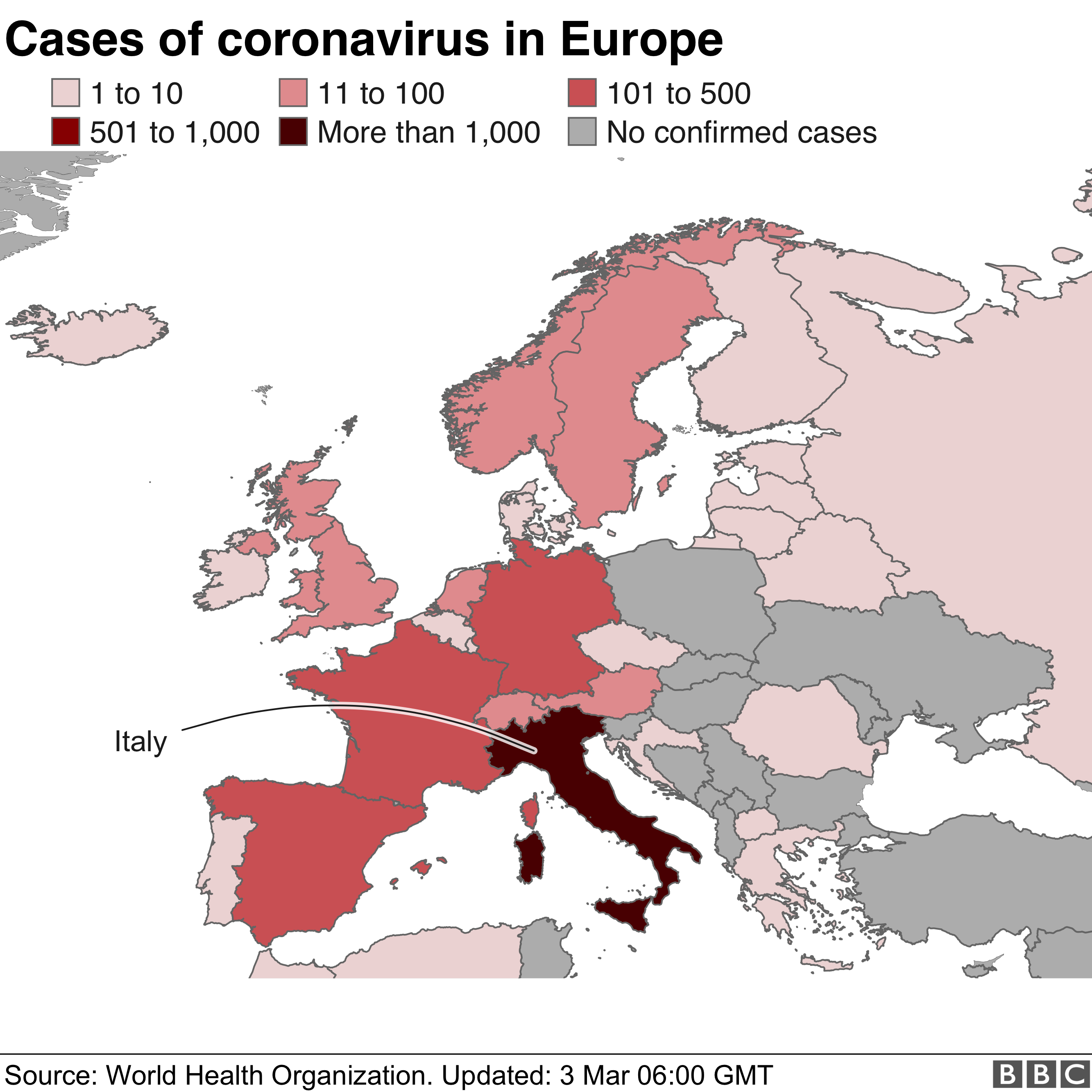
Of the nearly 8,800 cases outside China, 81% are in four countries – Iran, South Korea, Italy and Japan.
One of the countries worst affected outside China – Italy – said on Monday that the death toll there had risen by 18 to 52. There are 1,835 confirmed cases, most of them in the Lombardy and Veneto areas of the north. Nearly 150 people are said to have recovered.
However, the country is seeing a slowdown in new cases. On Monday, the authorities said there were 258 new cases of the virus – a 16% increase on the previous day – after new cases spiked by 50% on Sunday.
On Tuesday, Iran said the latest death toll from the virus was 77 – although the real figure is believed to be much higher. More than 2,300 people are said to be infected, including senior political figures. The head of Iran’s emergency medical services, Pirhossein Kolivand, was one of them, the Ilna news agency reported on Tuesday.
Some 23 MPs are also reported to have tested positive for the virus, and an official close to the Supreme Leader, Ayatollah Ali Khamenei, was reported on Monday to have died of the disease.
Health officials in the US state of Washington said on Monday that four more people had died, bringing the total there to six. They are the only deaths in the US so far. Local officials say they are buying a hotel to convert it into an isolation hospital.
On Tuesday, Ukraine confirmed its first case of coronavirus, while Portugal, Iceland, Jordan, Tunisia, Armenia, Latvia, Senegal, Morocco and Andorra confirmed their first cases on Monday.
How deadly is Covid-19?
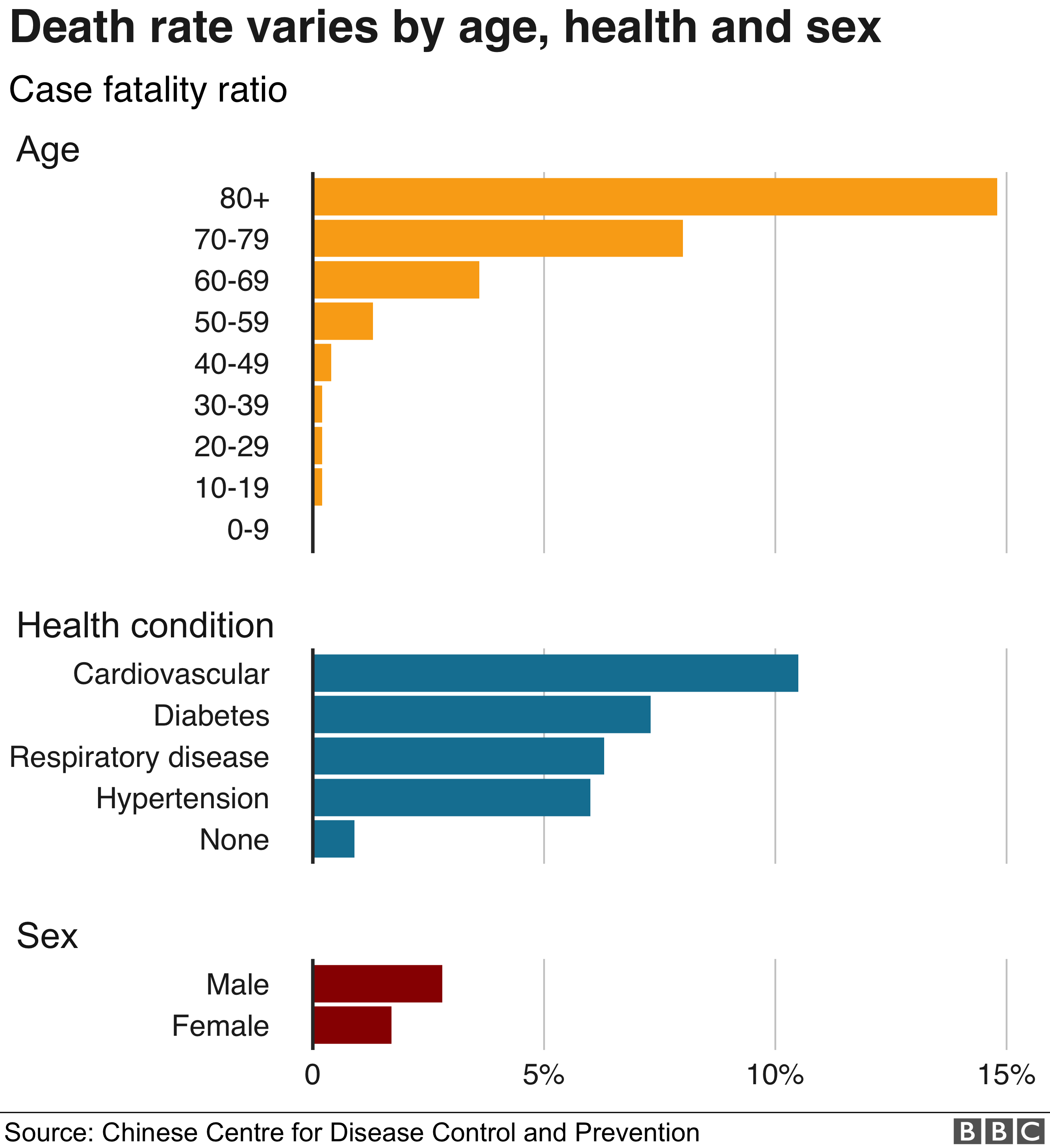
The WHO says the virus appears to particularly affect those over 60, and people already ill.
In the first large analysis of more than 44,000 cases from China, the death rate was 10 times higher in the very elderly compared to the middle-aged.
Most patients have only mild symptoms and the death rate appears to be between 2% and 5%, the WHO said.
By comparison, seasonal flu has an average mortality rate of about 0.1%, but is highly infectious – with up to 400,000 people dying from it each year.
Other strains of coronavirus, such as Severe Acute Respiratory Syndrome (Sars) and Middle East Respiratory Syndrome (Mers), have much higher death rates than Covid-19.
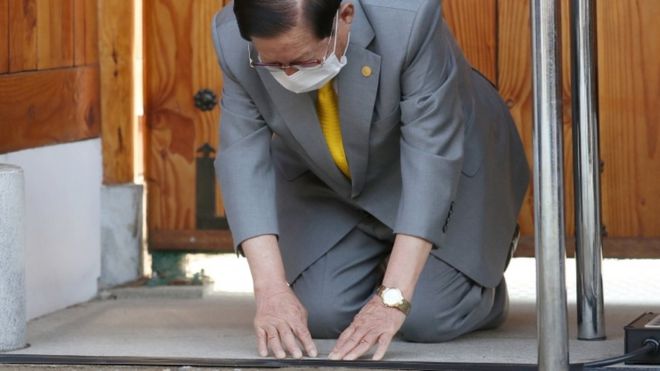
Image copyright EPAImage caption Lee Man-hee is the founder of the Shincheonji Church
The head of the religious sect that has been at the centre of the coronavirus outbreak in South Korea has apologised to the nation for the disease’s spread.
Lee Man-hee, the leader of the Shincheonji Church of Jesus, got on his knees and bowed at a news conference.
About 60% of the country’s more than 4,000 confirmed cases are sect members.
On Monday, South Korea – the biggest hotspot outside China – reported 476 new cases, bringing the total number to 4,212. It has recorded 26 deaths.
Prosecutors have been asked to investigate Mr Lee on possible charges of gross negligence.
“Although it was not intentional, many people have been infected,” said the 88-year-old leader. “We put our utmost efforts, but were unable to prevent it all.”
Media caption Empty shelves as coronavirus ‘panic-buying’ hits Australia
Of the confirmed cases, 3,081 are from the southern city of Daegu and 73% of these cases have been linked to the Shincheonji Church near there.
In the capital Seoul, the mayor urged the city’s 10 million residents to work from home and to avoid crowded places.
But church spokesman Kim Shin-chang told the BBC they had provided a list of members, students, and buildings to authorities.
“We were worried about releasing this information because of the safety of our members,” Mr Kim said.
Media caption ‘We’re often persecuted’: Spokesman for virus-hit S Korean church defends secrecy
Mr Lee claims he is the second coming of Jesus Christ and identifies as “the promised pastor” mentioned in the Bible who will take 144,000 people to heaven with him.
The Shincheonji Church is labelled as a cult within South Korea and also in the Christian community, which results in the group often being discriminated against, persecuted or criticised, Mr Kim told the BBC.
What’s the global situation?
The number of people killed worldwide by the coronavirus has exceeded 3,000, as China reported 42 more deaths. More than 90% of the total deaths are in Hubei, the Chinese province where the virus emerged late last year.
But there have also been deaths in 10 other countries, including more than 50 in Iran and more than 30 in Italy.
Worldwide, there have been almost 90,000 confirmed cases, with the numbers outside China now growing faster than inside China.
In other developments:
In the UK, where there are 36 confirmed cases, Prime Minister Boris Johnson has called a meeting of the emergency Cobra committee on Monday
Indonesia – one of the world’s most populous countries – has announced its first confirmed cases of coronavirus, a 64-year-old woman and her 31-year-old daughter, currently being treated at a Jakarta hospital
Iceland and Andorra also reported their first confirmed cases on Monday
Share prices in Asia and in Europe rose after central banks pledged to intervene to help protect markets from the impact of the coronavirus. Concerns about the outbreak last week wiped more than $5tn (£3.9tn) from global stocks
US sportswear giant Nike has closed its European headquarters in Hilversum city in the Netherlands after an employee tested positive for the virus
In the European hotspot of Italy, the number of infections doubled in 48 hours, the head of the country’s civil protection body said on Sunday.
There have been at least 34 deaths and 1,694 confirmed cases. Amazon said two of its employees in Italy have the virus and are under quarantine.
Countries including Qatar, Ecuador, Luxembourg and Ireland all confirmed their first cases over the weekend. On Monday, Ecuador reported five new cases of the disease, bringing the total number of infected patients in the country to six.
The US state of New York has also confirmed its first case. The patient is a woman in her 30s who contracted the virus during a recent trip to Iran. Two people have died in the US, both in the state of Washington.
A spokesman from China’s National Health Commission said the next stop would be to “focus on the risks brought by the resumption of work”.
China’s economy has taken a hit – with factory activity falling at a record rate.
On Monday, a man was sentenced to death by a Chinese court for fatally stabbing two officials at a virus checkpoint, news agency AFP reported.
Ma Jianguo, 23, refused to co-operate with officials – though it is not clear what he was told to do – and stabbed two checkpoint officials.
What has the WHO said?
On Sunday, the World Health Organization (WHO) said the virus appears to particularly affect those over 60, and people already ill.
It urged countries to stock up on ventilators, saying “oxygen therapy is a major treatment intervention for patients with severe Covid-19”.
In the first large analysis of more than 44,000 cases from China, the death rate was 10 times higher in the very elderly compared to the middle-aged.
But most patients have only mild symptoms and the death rate appears to be between 2% and 5%, the WHO said.
By comparison, the seasonal flu has an average mortality rate of about 0.1%, but is highly infectious – with up to 400,000 people dying from it each year.
Other strains of coronavirus, such as Severe Acute Respiratory Syndrome (Sars) and Middle East Respiratory Syndrome (Mers), have much higher death rates than Covid-19.
Cooperation on ‘soft’ issues like public health can provide an ‘opportunity for improvement’ in the nations’ broader relationship, international affairs expert says
Foreign ministers agree to do all they can to ensure Chinese President Xi Jinping’s planned visits to east Asian neighbours go ahead later this year
South Korea on Thursday reported 505 new coronavirus cases, its largest increase yet. Photo: AP
has created a fresh challenge to Beijing’s delicate relationship with its northeast Asian neighbours, but experts say the unprecedented public health crisis could draw them closer, at least for now.
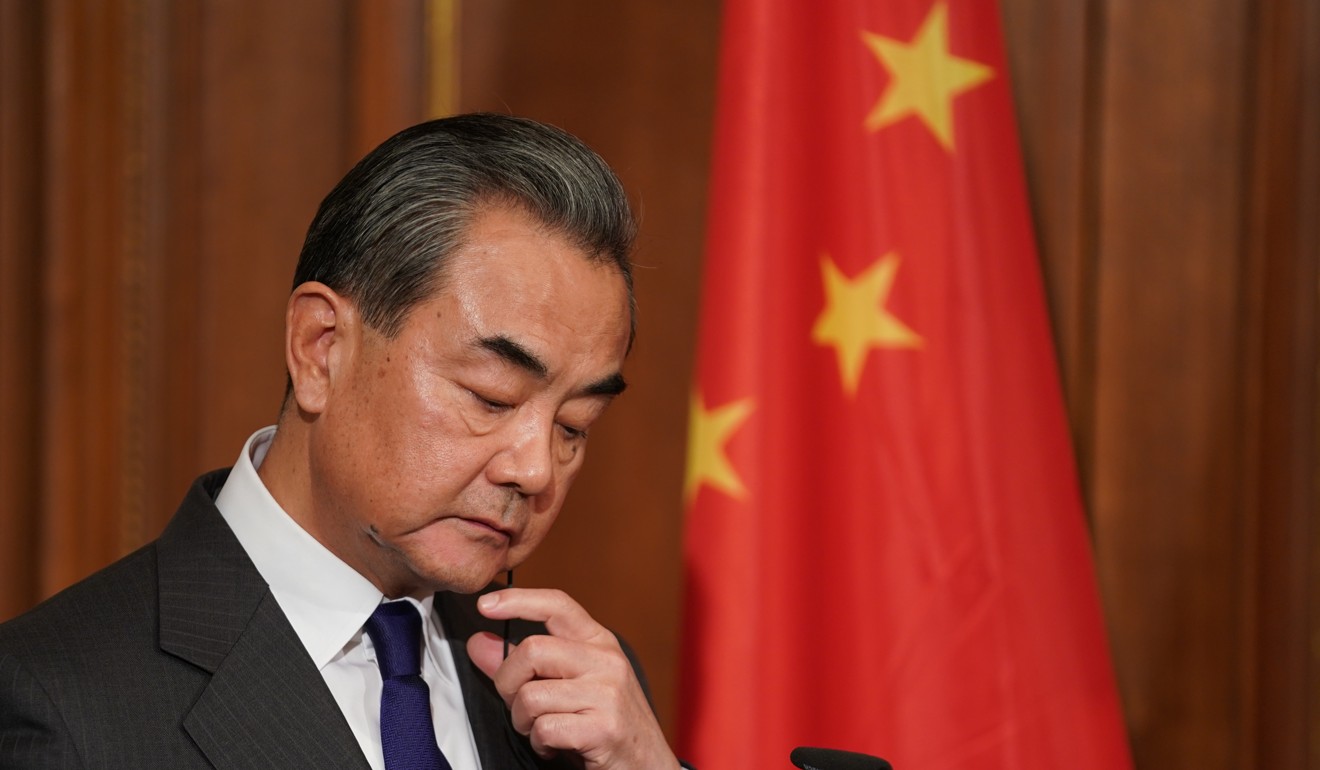
China’s Foreign Minister Wang Yi held separate conversations with his South Korean and Japanese counterparts on Wednesday as Beijing scrambles to deal with the growing risk of imported infections from the two countries.
In a sign of the “strong momentum at the leadership level on both sides”, Wang and Japanese Minister for Foreign Affairs Toshimitsu Motegi agreed to ensure Chinese President Xi Jinping’s state visit to Japan later this year goes ahead as planned, despite mounting fears the virus outbreak will become a pandemic.
China’s foreign ministry said on Thursday that Yang Jiechi, Wang’s predecessor and Xi’s top aide on foreign affairs, would visit Japan on Friday. His trip is expected to pave the way for Xi’s high stakes visit in the spring, observers said.
But Benoit Hardy-Chartrand, an international affairs expert at Temple University in Tokyo, said that if the outbreak did not subside in the next few weeks, Japanese Prime Minister Shinzo Abe’s government would come under intense pressure to delay the visit.
“Despite reassuring official pronouncements, no one would be surprised if the visit was postponed to a later date,” he said. “With an already declining approval rate, the Abe administration would be hard-pressed to go ahead with the summit.”
During her phone call with Wang, South Korean Foreign Minister Kang Kyung-wha urged China to refrain from carrying out what she described as “excessive” restrictions and forcible quarantine measures against visitors from her country, the Yonhap news agency reported.
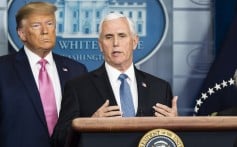
White House announces coronavirus ‘coordinator’ to lead response under Pence
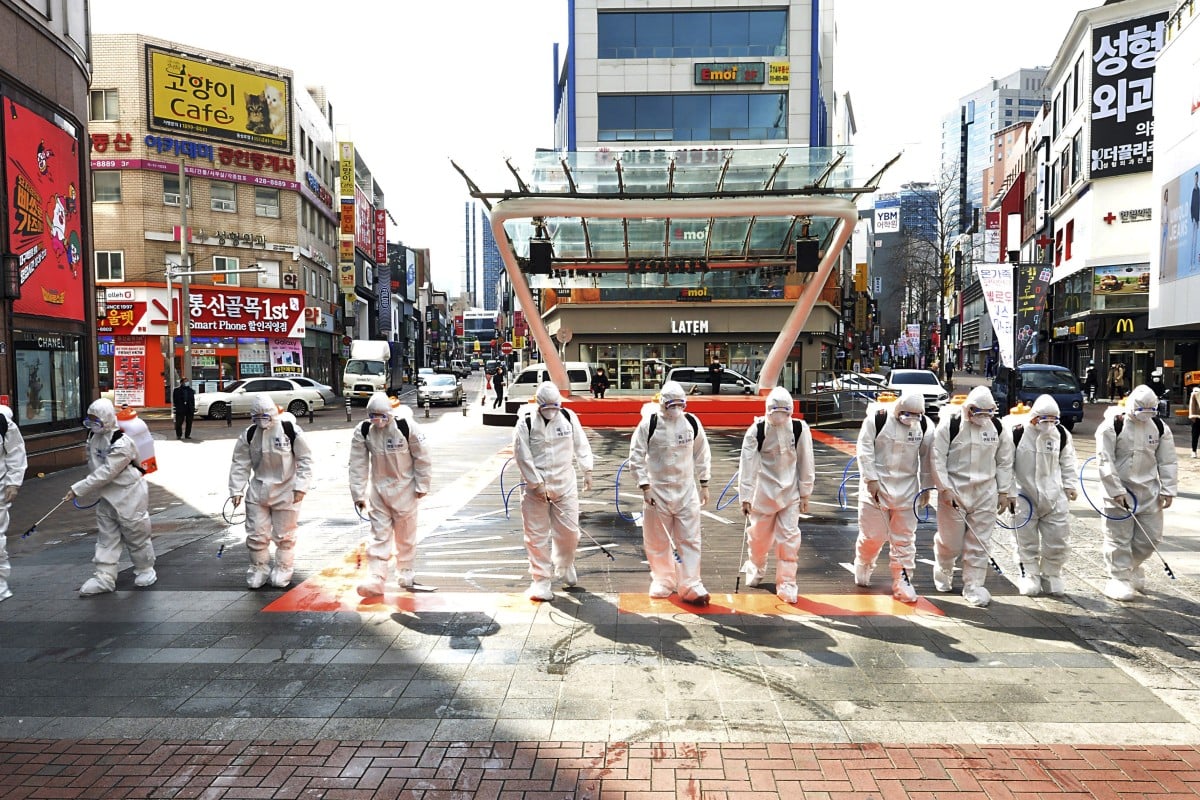
on Thursday reported 505 new coronavirus cases – its largest increase yet and the first time any country has confirmed more daily cases than China. The outbreak has now spread to more than 30 countries and killed more than 2,800 people.
US-CHINA TRADE WAR
In the cities of Qingdao and Weihai in east China’s Shandong province – both of which are home to large South Korean and Japanese communities – local authorities have begun to quarantine arrivals from the two countries, while similar measures targeting South Koreans in particular have been introduced in Shenyang and Nanjing.
This is the first time China, where the coronavirus originated and which earlier criticised other nations for overreacting to the outbreak, has introduced country-specific measures in the name of disease control.
The move sparked fierce criticism in South Korea, with more than 750,000 people signing an online petition calling for a ban on Chinese visitors.
The foreign ministry in Seoul said that about 40 nations and regions had imposed some sort of restrictions on South Korean visitors.
Both South Korea and Japan – which were among the first to offer support and aid to China when the epidemic took hold – have imposed only partial restrictions on Chinese travellers, mostly those from Hubei, the province at the centre of the contagion.
Wang again thanked South Korea for its support and defended China’s control measures, saying they were necessary to reduce the cross-border movement of people and restrict the spread of the disease, China’s foreign ministry said.
China’s Foreign Minister Wang Yi. Photo: EPA-EFE
Yonhap said both Wang and Kang also agreed that Xi’s proposed trip to South Korea in the first half of the year would proceed as planned.
Chinese experts said the coronavirus had deepened distrust and antagonism towards China in both countries, with many South Koreans and Japanese blaming China for the spread of the disease.
Li Wen, an expert from the China Institute of International Studies, said the coronavirus crisis had seen the rise of the “China threat” in South Korea, with its government under enormous pressure to get tough on its giant neighbour.
According to Yonhap, Kang urged South Korean diplomats in China earlier this month to help minimise any negative impact the epidemic might have had on relations between the two countries.
Hardy-Chartrand said relations between China and South Korea remained tense because of Seoul’s deployment of the American-madeTHAAD missile defence system, which in turn led to Beijing introducing unofficial sanctions that caused resentment among South Koreans.
Hongkongers stuck in Japan with airlines reluctant to fly them home
28 Feb 2020
But the latest spat over the control measures was unlikely to be a major obstacle to regional relations, he said.
“Overall, cooperation on so-called soft issues like public health, as we are witnessing at the moment, can provide an opportunity for further improvement in the broader relationship, at least in the short term,” he said.
China-Japan relations might also benefit from closer cooperation on disease control given uncertainty in the region over the US-China trade war, the North Korean denuclearisation impasse, the United States’ commitment to its allies, and the coronavirus outbreak, he said.
“I am less sanguine about the mid- to long-term prospects for Sino-Japanese relations, given that the sources of the tensions that we saw from 2010 to 2017, namely the East China Sea territorial dispute and other historical issues, remain wholly unresolved,” he said.
According to a Pew study in December, 85 per cent of Japanese have an unfavourable view of China, the highest among 34 countries surveyed, while 63 per cent of South Koreans see China negatively.
Around 200 Shincheonji Church of Jesus members continued to meet in the Chinese city amid rumours of virus, but ‘no one took [claims] seriously’ at first
Around half the Covid-19 cases in South Korea have been linked to members of the religious group
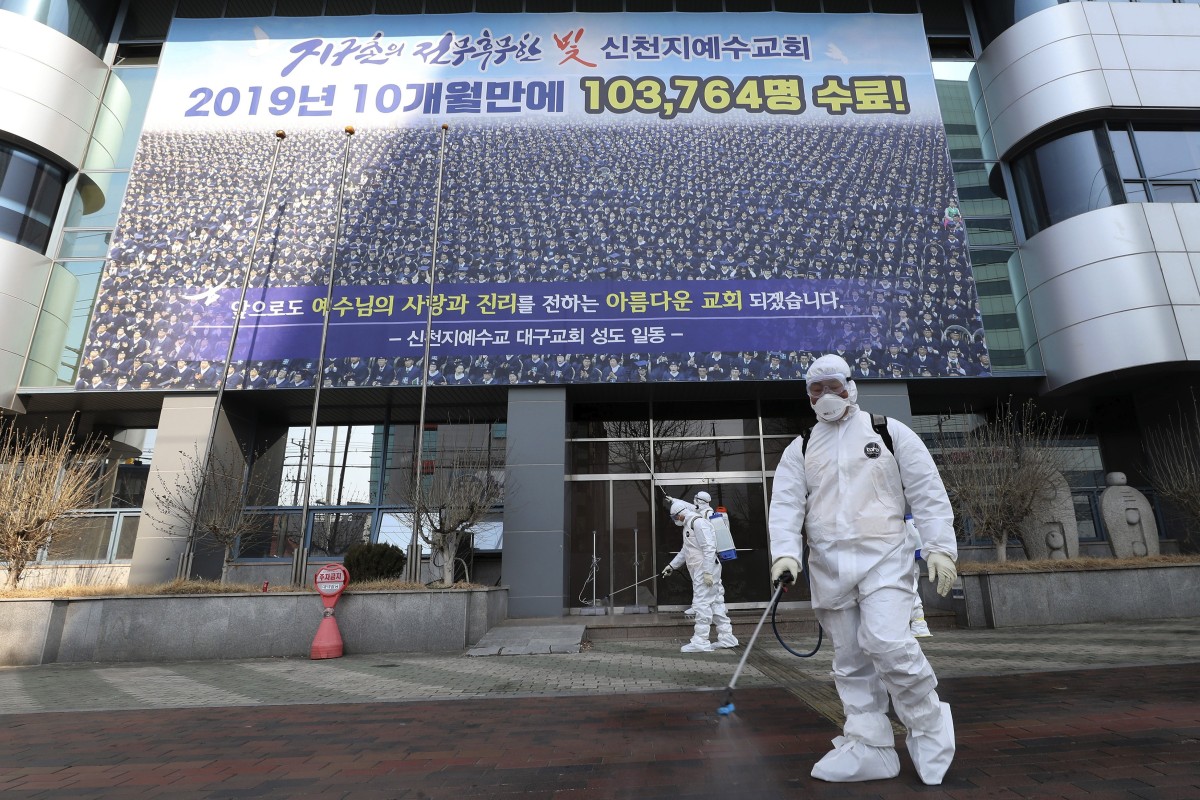
The Shincheonji church in Daegu has been linked to a cluster of infections. Photo: Yonhap via AP
Members of the Christian sect linked to a cluster of coronavirus cases in South Korea held meetings in Wuhan until December, only stopping when they realised that their community had been hit by Covid-19, the previously unknown disease caused by the virus.
The South China Morning Post has learned that the Shincheonji Church of Jesus in Wuhan, the Chinese city at the centre of the epidemic, has around 200 members, most of whom are currently under quarantine outside the city.
“Rumours about a virus began to circulate in November but no one took them seriously,” said one member, a 28-year-old kindergarten teacher.
“I was in Wuhan in December when our church suspended all gatherings as soon as we learned about [the coronavirus],” said the woman, who declined to be named because of the sensitivity of the matter.
She said the group was continuing to share sermons and teachings online, but most members had returned home at the start of the Lunar New Year holiday in late January.
The 250,000-member Shincheonji Church of Jesus is regarded by mainstream Christian groups as a secretive and unorthodox sect. Its founder, Lee Man-hee, has claimed that he is the second coming of Jesus Christ.
Around half the Covid-19 infections in South Korea have been linked to a branch of the church in Daegu.
Coronavirus spreads through Europe from Italy to Austria, Croatia, Tenerife
26 Feb 2020
According to the Korea Centres for Disease Control and Prevention, there were 977 confirmed cases as of Tuesday – the second highest number outside China – and 11 deaths.
Of the 84 new cases reported on Tuesday, over half were recorded in Daegu city.
Coronavirus: Churches on high alert as South Korea confirms huge rise in infections
A member of the church from Daegu reportedly visited China in January, and health officials in South Korea are investigating whether a cluster of infections in Cheongdo city is linked to a three-day funeral ceremony held at a local hospital.
Chinese sources said that the Shincheonji church has about 20,000 members in China – most of whom live in major cities such as Beijing, Shanghai, Dalian, Changchun and Shenyang.
One Christian pastor in Hubei province, who declined to be named, said that Shincheonji church members were hard-working and some continued to proselytise even during the outbreak.
Chinese cities quarantine travellers from South Korea amid spike in coronavirus cases
25 Feb 2020
The Wuhan kindergarten teacher said she was confident that the recent mass outbreaks in South Korea were not linked to Shincheonji church members from the city.
“I don’t think the virus came from us because none of our brothers and sisters in Wuhan have been infected. I don’t know about members in other places but at least we are clean. None of us have reported sick,” she said.
“There are so many Chinese travelling to South Korea, it’s quite unfair to pin [the disease] on us.”
Coronavirus: China reports 508 new Covid-19 cases, with only nine outside outbreak epicentre
She sidestepped questions on whether church members had travelled from Wuhan to South Korea after the outbreak.
The teacher said that in 2018 the Wuhan group’s “holy temple” in Hankou district had been raided by police “who branded us a cult”, but members continued to worship in small groups.
“We are aware of all the negative reporting out there after the outbreak in South Korea, but we do not want to defend ourselves in public because that will create trouble with the government,” she said. “We just want to get through the crisis first.”
Airfares from South Korea to China shoot up amid Covid-19 fears
25 Feb 2020
Bill Zhang, a 33-year-old Shanghai resident and a former missionary with Shincheonji, said the group’s secretive nature made it hard for the authorities to effectively crackdown on its activities.
He said the Shanghai branch held its main meetings on Wednesdays and Saturdays, attracting 300 to 400 people at a time.
“The Shincheonji church in Shanghai has been raided many times and police spoke to church leaders regularly.
“But the church members simply continued their meetings in smaller groups of eight-to-10 people and regrouped when the surveillance was relaxed.”
Zhang continued: “Shincheonji holds that it is the only real church that upholds the biblical truth and all other churches – mainstream or cults – are evil.”
Following an appeal by the World Anti-Doping Agency (Wada) to the Court of Arbitration for Sport (Cas), the decision has been overturned.
An eight-year ban was imposed on Sun because this was his second offence.
He had served a three-month suspension in 2014 for taking prohibited stimulant Trimetazidine.
Sun told China’s Xinhua news agency that he plans to appeal against the decision.
He said: “This is unfair. I firmly believe in my innocence.”
Cas said its decision can be challenged before the Swiss Federal Tribunal within 30 days.
Sun had told an appeal hearing in November that he missed a test because testers failed to prove their identity when they arrived at his home.
He also denied a vial containing his blood samples was smashed with a hammer.
‘You’re a loser, I’m a winner’ – ugly scenes as GB’s Scott refuses to share podium with Sun
Cas said: “The athlete failed to establish that he had a compelling justification to destroy his sample collection containers and forego the doping control when, in his opinion, the collection protocol was not in compliance with the ISTI (international standard for testing and investigations).
“As the Cas panel noted, it is one thing, having provided a blood sample, to question the accreditation of the testing personnel while keeping the intact samples in the possession of the testing authorities; it is quite another thing, after lengthy exchanges and warnings as to the consequences, to act in such a way that results in destroying the sample containers, thereby eliminating any chance of testing the sample at a later stage.”
Wada welcomed the ruling, and added that it was “satisfied that justice in this case has been rendered”.
At the 2019 World Aquatics Championships in July, Sun won gold in the 200m freestyle but Britain’s Duncan Scott refused to share the podium with him.
Australian Mack Horton took a similar stance after the 400m freestyle, years after accusing him of being a “drug cheat”.
Scott said on Friday: “I fully respect and support the decision that has been made.
“I believe in clean sport and a level playing field for all athletes and I trust in Cas and Wada to uphold these values.”
Sun’s results prior to, during and after the championships will stand because he has not tested positive for doping.
He has won 11 world titles since 2011, including two golds at last year’s event in Gwangju, South Korea.
When Fina originally cleared him, it said that testers had breached several rules, including failing to produce authorisation letters and a nursing licence. Sun was subsequently issued with a warning.
The Cas appeal was heard in public. The only previous time that had happened was in 1999 when Ireland’s triple Olympic swimming champion Michelle Smith de Bruin failed with her appeal against a four-year ban for tampering with an anti-doping sample.
‘You’re disrespecting your country’ – reaction
Adam Peaty, British Olympic 100m breaststroke champion: “Very good. For anyone that’s been banned once, potentially it’s a mistake.
“You’re looking at it twice – you’re a fool. I believe that you’re disrespecting the sport, you’re disrespecting yourself and you’re disrespecting your country.”
Lizzie Simmonds, British two-time Olympian & former European champion: “I once called this man the Harry Houdini of doping control, but it seems that justice has finally been served.
“Imagine there will be a few very relieved freestylers waking up across the world.
“Given the damning length of this sentence, it seems inconceivable that he originally just received a slap on the wrist from Fina.
“A strong message to those who cheat, but I hope an even stronger message to those who seek to protect bureaucratic harmony over sporting integrity.”
James Guy, British four-time world swimming champion: “The truth always comes out.”
Around two thirds of the total number of flights scheduled every day in February were cancelled, placing huge financial pressure on airlines and airports
China’s aviation industry has also been affected by a series of restrictions by other countries and airlines, with British Airways extending its suspension until mid-April
The cancellation of around 10,000 flights a day, or around two thirds of the total number of flights scheduled every day in February, has placed huge financial pressure on airlines and airports. Photo: Kyodo
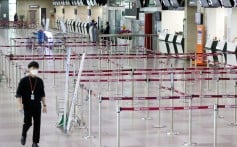
A one-way air ticket from the coastal economic hub of Shanghai to the inland municipality of Chongqing, a journey of over 1,400km (870 miles), now costs less than a cup of coffee, with Chinese airlines slashing prices in a bid to boost weak domestic demand amid the coronavirus outbreak.
The cancellation of around 10,000 flights a day, or around two thirds of the total number of flights scheduled every day in February, has placed huge financial pressure on airlines and airports.
The Civil Aviation Administration of China said in a notice on Tuesday that flights should resume gradually as part of the country’s efforts to return economic and social life back to normal, but passengers are still reluctant to fly with the deadly outbreak still not fully under control.
The one-way flight from Shanghai to Chongqing is being offered for just 29 yuan (US$4.10) by China’s biggest low-cost carrier, Spring Airlines, as a special offer for its frequent flyer club members, while a tall caffe latte at Starbucks in China costs 32 yuan (US$4.5).
Many Chinese carriers do receive subsidies for operating key domestic routes, so this also skews the economics as well Luya You
A one-way ticket from Shanghai to Harbin, the capital of the northern Heilongjiang province, a distance of over 1,600km (994 miles), costs just 69 yuan (US$9.80).
Shenzhen Airlines, a division of state-owned carrier Air China, is also running special offers to Chongqing, with a one-way ticket for the 1000km (621 miles) journey from Shenzhen costing just 100 yuan (US$14), around 5 per cent of the standard price of 1,940 yuan (US$276).
Chengdu Airlines, a unit of Sichuan Airlines, which counts China Southern Airlines as a shareholder, is also offering cheap one-way flights from Shenzhen to Chengdu, a distance of over 1,300km (808 miles), for just 100 yuan.
“Considering lower average costs of operating in mainland China, carriers could potentially offer deeper discounts while making slim profits or just breaking even,” said Luya You, an aviation analyst with Bank of Communication International. “As outbreak numbers stabilise or even decline, carriers will likely adjust their fares as well, so these low fares will not last if the situation quickly turns for the better.
“Many Chinese carriers do receive subsidies for operating key domestic routes, so this also skews the economics as well. If it is a key route, for example, the carrier may choose to continue operating regardless of fares or loads as the route constitutes a major link in the domestic network infrastructure.”
China’s aviation authority confirmed earlier this month that between January 25 and February 14, which included the Lunar New Year holiday, the average daily passenger traffic in China was just 470,000, representing a 75 per cent drop from the same period last year.
China’s aviation industry has also been affected by a series of restrictions by other countries and airlines, with British Airways last week extending its suspension of flights to China until after the Easter holiday in mid-April following travel advice from the British government.
The novel coronavirus, which causes the disease officially named Covid-19, has infected more than 78,000 people and killed 2,700 in China. In recent days, South Korea, Italy and Iran have all reported a surge in new cases, raising fears over the spread of the coronavirus.
“The flight suspensions will track the outbreaks, but not likely lead them. If there are more outbreaks, expect more flight suspensions,” said Andrew Charlton, managing director of Aviation Advocacy.
SHANGHAI/SEOUL (Reuters) – Asia reported hundreds of new coronavirus cases on Wednesday, including a U.S. soldier stationed in South Korea, as the United States warned of an inevitable pandemic and outbreaks in Italy and Iran spread to other countries.
World stocks tumbled for the fifth day on fears of prolonged disruption to global supply chains, while safe-haven gold rose back toward seven-year highs and U.S. bond yields held near record lows.
Stock markets globally have wiped out $3.3 trillion of value in the past four trading sessions, as measured by the MSCI all-country index.
The disease is believed to have originated in a market selling wildlife in the central Chinese city of Wuhan late last year and has infected about 80,000 people and killed more than 2,700, the vast majority in China.
RELATED COVERAGE
Trump returns to U.S. as country warily eyes spread of coronavirus
Facebook to ban misleading ads about coronavirus
The U.S. Centers for Disease Control and Prevention urged Americans to prepare, saying that while the immediate risk there was low the global situation suggested a pandemic was likely.
“It’s not a question of if. It’s a question of when and how many people will be infected,” the CDC’s principal deputy director, Anne Schuchat, said on Tuesday.
World Health Organization (WHO) chief Tedros Adhanom Ghebreyesus, however, advised against referring to a pandemic.
“We should not be too eager to declare a pandemic without a careful and clear-minded analysis of the facts,” Tedros said in remarks to Geneva-based diplomats.
“Using the word pandemic carelessly has no tangible benefit, but it does have significant risk in terms of amplifying unnecessary and unjustified fear and stigma, and paralyzing systems. It may also signal that we can no longer contain the virus, which is not true.”
‘DON’T WAIT’
The United States has reported 57 cases of the virus. U.S. President Donald Trump, back in Washington after a visit to India, said on Twitter that he would meet U.S. officials for a briefing on the coronavirus on Wednesday.
Dr Bruce Aylward, head of a joint WHO-Chinese mission on the outbreak, told reporters on his return to Geneva that countries’ preparations should not wait.
“Think the virus is going to show up tomorrow. If you don’t think that way, you’re not going to be ready,” he said. “This a rapidly escalating epidemic in different places that we have got to tackle super-fast to prevent a pandemic.”
Aylward said China’s “extraordinary mobilization” showed how an aggressive public health policy could curb its spread.
The WHO says the outbreak peaked in China around Feb. 2, after authorities isolated Hubei province and imposed other containment measures.
China’s National Health Commission reported another 406 new infections on Wednesday, down from 508 a day earlier and bringing the total number of confirmed cases in mainland China to 78,064. Its death toll rose by 52 to 2,715.
The WHO said only 10 new cases were reported in China on Tuesday outside Hubei.
South Korea, which with 1,261 cases has the most outside China, reported 284 new ones including a U.S. soldier, as authorities readied an ambitious plan to test more than 200,000 members of a church at the center of the outbreak.
Of the new cases, 134 were from Daegu city, where the virus is believed to have been passed among members of the Shincheonji Church of Jesus, the Korea Centers for Disease Control and Prevention said.
The U.S. military said a 23-year-old soldier based in Camp Carroll, about 20 km (12 miles) from Daegu, had been infected and was in self-quarantine at home.
OLYMPIC WORRIES
In Japan, Prime Minister Shinzo Abe called for sports and cultural events to be scrapped or curtailed for two weeks to stem the virus as concern mounted for the 2020 Tokyo Olympics.
Japan’s professional baseball teams would play matches without spectators until March 15 due to virus concerns, Kyodo news agency reported.
Japan has nearly 170 virus cases, besides the 691 linked to a cruise ship that was quarantined of its coast this month. Six people have died in Japan, including four from the ship.
There have been nearly 50 deaths outside China, including 11 in Italy and 19 in Iran, the most outside China, according to a Reuters tally.
Iran’s deputy health minister – seen mopping his brow at a televised news conference – was among its 139 coronavirus infections. Cases linked to Iran have been reported across the region.
Kuwait said six new coronavirus cases, all linked to travel to Iran, took its tally to 18, while Bahrain said its infections had risen to 26 after three new ones on a flight from Iran.
The United Arab Emirates, which has reported 13 coronavirus cases, is prepared for “worst case scenarios” as it spreads in the Middle East, a government official said.
In Europe, Italy has become a front line in the global outbreak with 322 cases. Italians or people who had recently visited the country, have tested positive in Algeria, Austria, Croatia, Romania, Spain and Switzerland.
Two hotels, one in Austria and one in Spain’s Canary Islands, were also locked down after cases emerged linked to Italy. Spain also reported its first three cases on the mainland.
SEOUL/BEIJING (Reuters) – South Korea aims to test more than 200,000 members of a church at the centre of a surge in coronavirus cases, as countries stepped up efforts to stop a pandemic of the c that emerged in China and is now spreading in Europe and the Middle East.
More than 80,000 people have been infected in China since the outbreak began, apparently in an illegal wildlife market in the central city of Wuhan late last year.
China’s death toll was 2,663 by the end of Monday, up 71 from the previous day. But the World Health Organization (WHO) has said the epidemic in China peaked between Jan. 23 and Feb. 2 and has been declining since.
RELATED COVERAGE
Britain advises travellers self isolate after north Italy trips
Italy reports coronavirus case in Sicily, first south of Rome
See more stories
However, fast-spreading outbreaks in Iran, Italy and South Korea, and first cases in several Middle East countries, have fed worries of a pandemic, or worldwide spread of the virus.
“We are close to a pandemic, but there is still hope the epidemics in Iran, Italy, South Korea, etc. can be controlled,” said Raina MacIntyre, head of the Biosecurity Programme at the Kirby Institute at the University of New South Wales.
South Korea has the most virus cases outside China and reported its tenth death and 144 new cases, for a total of 977. President Moon Jae-in said the situation was “very grave”.
In Europe, Italy has become a new front line, with 220 cases reported on Monday, up from just three on Friday. The death toll in Italy is seven.
Global stock markets stabilised on Tuesday after a wave of early selling petered out and Wall Street futures managed a solid bounce after a sharp selloff the previous day on fears about the spreading coronavirus.
“If travel restrictions and supply chain disruptions spread, the impact on global growth could be more widespread and longer lasting,” said Jonas Goltermann, senior economist at research consultancy Capital Economics in London.
PUBLIC ANXIETY
About 68% of South Korea’s cases are linked to the Shincheonji Church of Jesus, where the outbreak is believed to have begun with a 61-year-old woman. It is not known how she became infected.
The church said it would provide authorities the names of all its members in South Korea, estimated by media at about 215,000 people. The government would test them all as soon as possible, the prime minister’s office said.
“It is essential to test all of the church members,” it said in a statement. Authorities said they were testing up to 13,000 people a day.
The U.S. and South Korean militaries have said they may cut back joint training due to the virus, in one of the first concrete signs of its fallout on global U.S. military activities.
The disclosure came during a visit to the Pentagon on Monday by South Korean Defence Minister Jeong Kyeong-doo, who said 13 South Korean troops had the virus.
The U.S. military said a woman who tested positive for the virus had visited one of its bases in the hard-hit city of Daegu. It was the first infection connected to U.S. Forces Korea, which has about 28,500 American troops on the peninsula.
The U.S. military urged troops to “use extreme caution” off base, while the U.S. Centers for Disease Control and Prevention said Americans should avoid non-essential travel to South Korea.
IRAN ISOLATION
Outside mainland China, the outbreak has spread to about 29 countries and territories, with a death toll of about three dozen, according to a Reuters tally.
Afghanistan, Bahrain, Iraq, Kuwait and Oman reported their first new coronavirus cases, all in people who had been to Iran where the toll was 14 dead, media said, and 61 infected.
The outbreak threatens to isolate Iran further. The United Arab Emirates, which has 13 virus cases, suspended all flights with Iran for at least a week, state media said.
Iraq extended an entry ban on travellers from China and Iran to those from five other countries over virus fears, its health ministry said.
In Japan, which has reported four deaths and 850 cases mostly linked to a cruise ship, Health Minister Katsunobu Kato said it was too early to talk about cancelling the Tokyo Olympics due to start on July 24.
The United States pledged $2.5 billion to fight the disease, with more than $1 billion going toward developing a vaccine, with other funds earmarked for therapeutics and the stockpiling of personal protective equipment such as masks.
China reported a rise in new cases in Hubei province, the epicentre of the outbreak. But excluding those, China had just nine new infections on Monday, its fewest since Jan. 20.
With the pace of new infections slowing, Beijing said restrictions on travel and movement that have paralysed economic activity should begin to be lifted.
“Low-risk areas … are to restore order in production and life, cancel transport restrictions and help enterprises,” state planner official Ou Xiaoli told a briefing.













 CHINDIA ALERT: You'll be living in their world, very soon