Chindia Alert: You’ll be Living in their World Very Soon
aims to alert you to the threats and opportunities that China and India present. China and India require serious attention; case of ‘hidden dragon and crouching tiger’.
Without this attention, governments, businesses and, indeed, individuals may find themselves at a great disadvantage sooner rather than later.
The POSTs (front webpages) are mainly 'cuttings' from reliable sources, updated continuously.
The PAGEs (see Tabs, above) attempt to make the information more meaningful by putting some structure to the information we have researched and assembled since 2006.
Beijing joins global condemnation of attack launched by Ankara on Kurdish fighters after US President Donald Trump decided to pull out troops
Foreign ministry spokesman says issue should be resolved with ‘political solutions’ and the operation may result in a revival of Islamic State
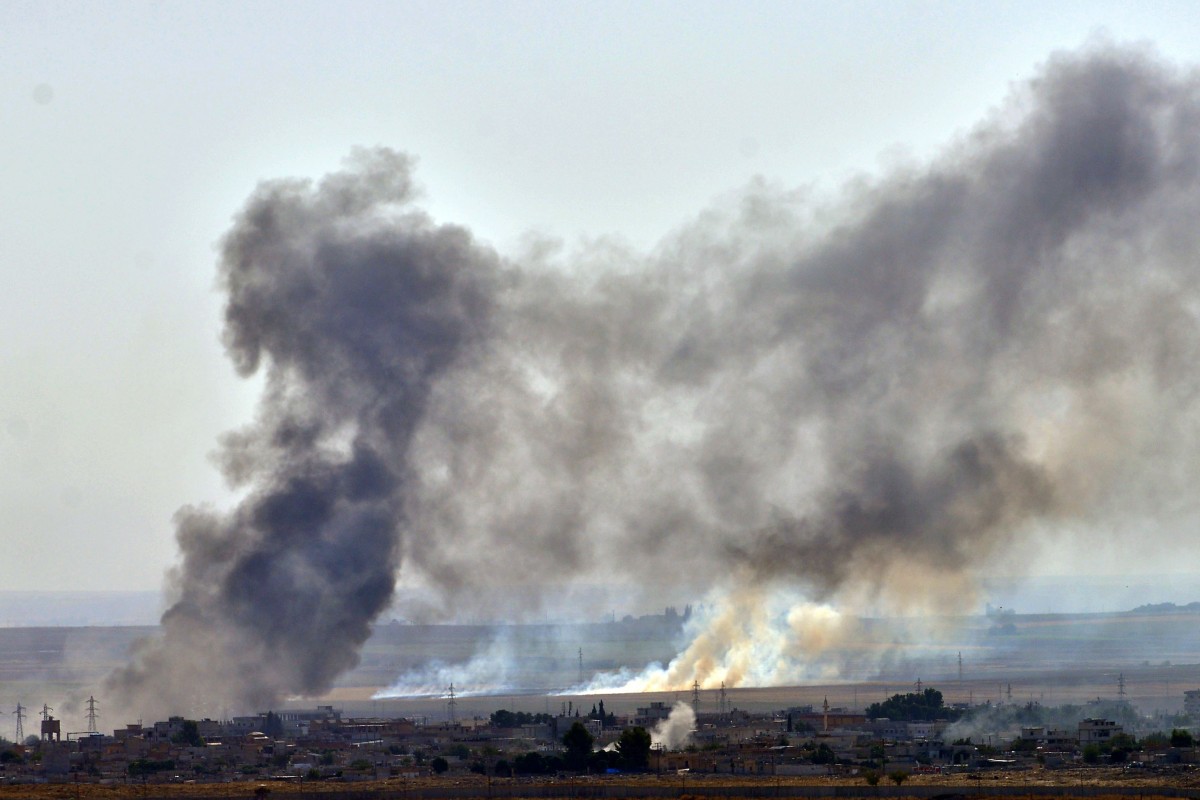
Turkey launched the attack on Kurdish fighters in northeastern Syria last week. Photo: Xinhua
China has urged Turkey to stop the military offensive it began in northeastern Syria last week and “return to the right track”.
Beijing is the latest to join global condemnation of the cross-border attack launched by Ankara on Kurdish fighters last Wednesday following US President Donald Trump’s decision to withdraw US troops from the region.
Foreign ministry spokesman Geng Shuang on Tuesday called for a ceasefire.
“The Chinese side has always opposed the use of force in international relations and has advocated for adherence to the Charter of the United Nations, and to resolve problems through political and diplomatic channels,” Geng said during a regular press briefing, when asked about Beijing’s position on the situation.
“Sovereignty, independence, unification and territorial integrity should be respected and protected,” he said. “We urge Turkey to halt military action and to return to the right track, resolving the issue with political solutions.”
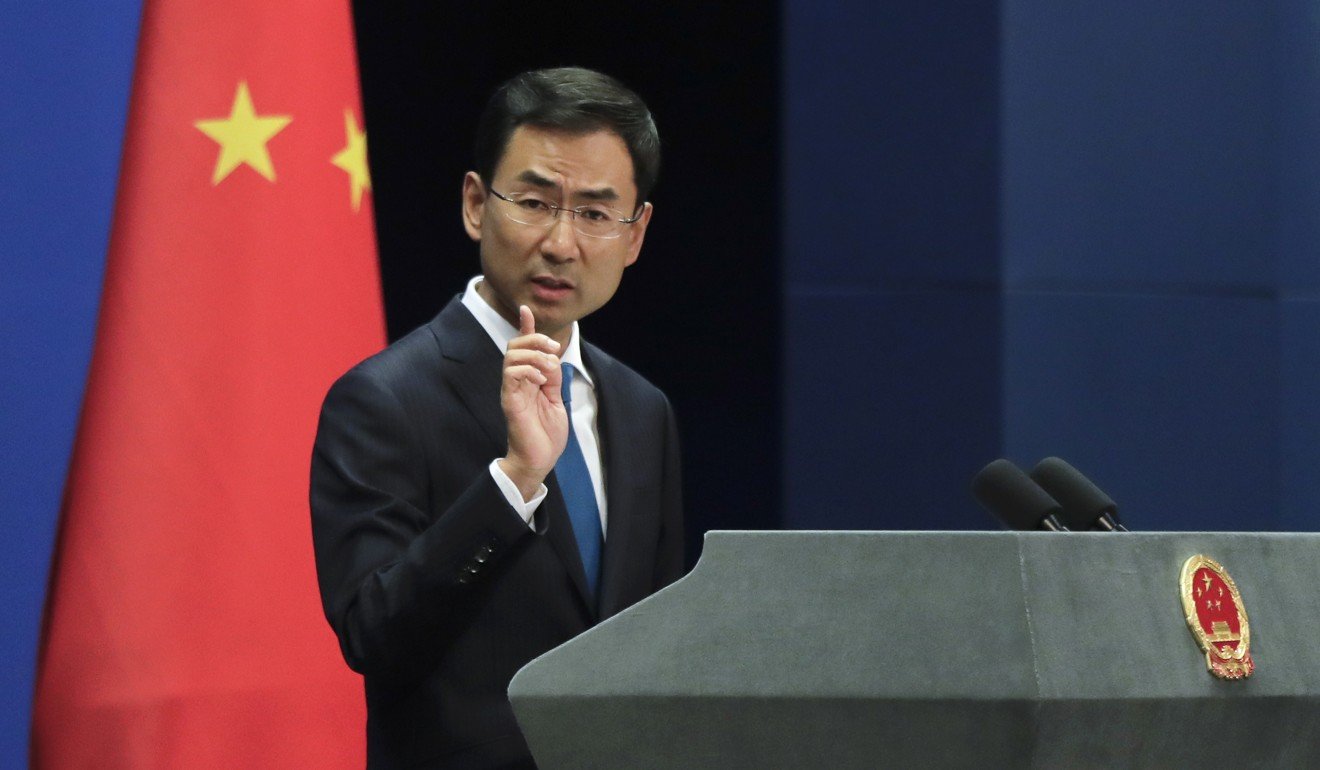
Chinese foreign ministry spokesman Geng Shuang called on Turkey to “work with the international community in fighting against terrorism”. Photo: AP
Geng also said the “anti-terrorism situation in Syria is still severe”, and the military operation could result in a comeback by Islamic State.
“We urge Turkey to take responsibility and work with the international community in fighting against terrorism,” he said.
Explained: why are Syria’s Kurds accusing the US of betrayal?
Trump’s move has drawn sharp criticism from around the world. Critics say he has abandoned the allies that helped fight against Isis, and that withdrawing troops could pave the way for a resurgence of the jihadist group whose violent takeover of Syrian and Iraqi land five years ago was the reason US forces went in.
The US president said about 1,000 US troops who had been partnering with local Kurdish fighters to battle Islamic State in northern Syria were leaving the country. He said they would remain in the Middle East to “monitor the situation” and to prevent a revival of Isis – a goal that even Trump’s allies say has become much more difficult as a result of the US pull-out.
Turkey says the offensive aims to remove the Kurdish-led Syrian Democratic Forces from the border area and create what it calls a “safe zone” to relocate 1 million Syrian refugees.
on Turkey, halted bilateral trade negotiations and called for an immediate ceasefire.
Vice-President Mike Pence also said Trump was sending him to the Middle East because the president was concerned about instability in the region.
Beijing has long worried that conflict in the region could spill over to Chinese soil after thousands of Uygurs – the Turkic-speaking Muslim minority from far western China – travelled to Syria to train and fight as jihadists.
HANOI (Reuters) – Vietnamese President and Communist Party chief Nguyen Phu Trong has called for restraint in the disputed South China Sea amid a tense months-long standoff between Chinese and Vietnamese ships, state media reported on Tuesday.
China claims almost all the energy-rich waters but neighbours Brunei, Malaysia, the Philippines, Taiwan and Vietnam also have claims.
Tension escalated when Beijing dispatched a research ship to conduct an energy survey in waters controlled by Vietnam in July.
“On the subject of foreign policy, including the East Sea issue, the General Secretary stressed the importance of maintaining a peaceful and stable environment, and resolutely fighting to protect Vietnam’s independence, sovereignty and territorial integrity,” the state-run Voice of Vietnam (VOV) said on its website.
The South China Sea is known as the East Sea in Vietnam.
Vietnam has good relations with China but should “never compromise” on its sovereignty and territorial integrity, VOV quoted Trong as saying.
The Chinese vessel, the Haiyang Dizhi 8, was continuing its survey in Vietnam’s exclusive economic zone late on Tuesday, under escort from at least three Chinese ships, according to data from Marine Traffic, a website that tracks vessel movements.
Vietnam’s foreign ministry has repeatedly accused the vessel and its escorts of violating its sovereignty and has demanded that China remove its ships from the area.
On Sunday, Vietnam pulled DreamWorks’ animated film “Abominable” from cinemas over a scene featuring a map which shows China’s unilaterally declared “nine-dash line” in the South China Sea.
The U-shaped line is used on Chinese maps to illustrate its claims, including large swathes of Vietnam’s continental shelf, where it has awarded oil concessions.
In August, police broke up a brief protest outside the Chinese embassy in Hanoi over the survey vessel.
Trong has made more public appearances in recent weeks after suffering from an unspecified illness..
The 75-year-old has presided over a widespread crackdown on corruption in the Southeast Asian country that has seen several high-ranking ministers and politicians, including one Politburo member, sent to prison on charges ranging from embezzlement to economic mismanagement.
70th anniversary of the founding of the People’s Republic of China marked by its biggest ever military parade and huge civilian parade
Xi says no force can stop China ‘marching forward’ and vows to protect the long-term stability of Hong Kong
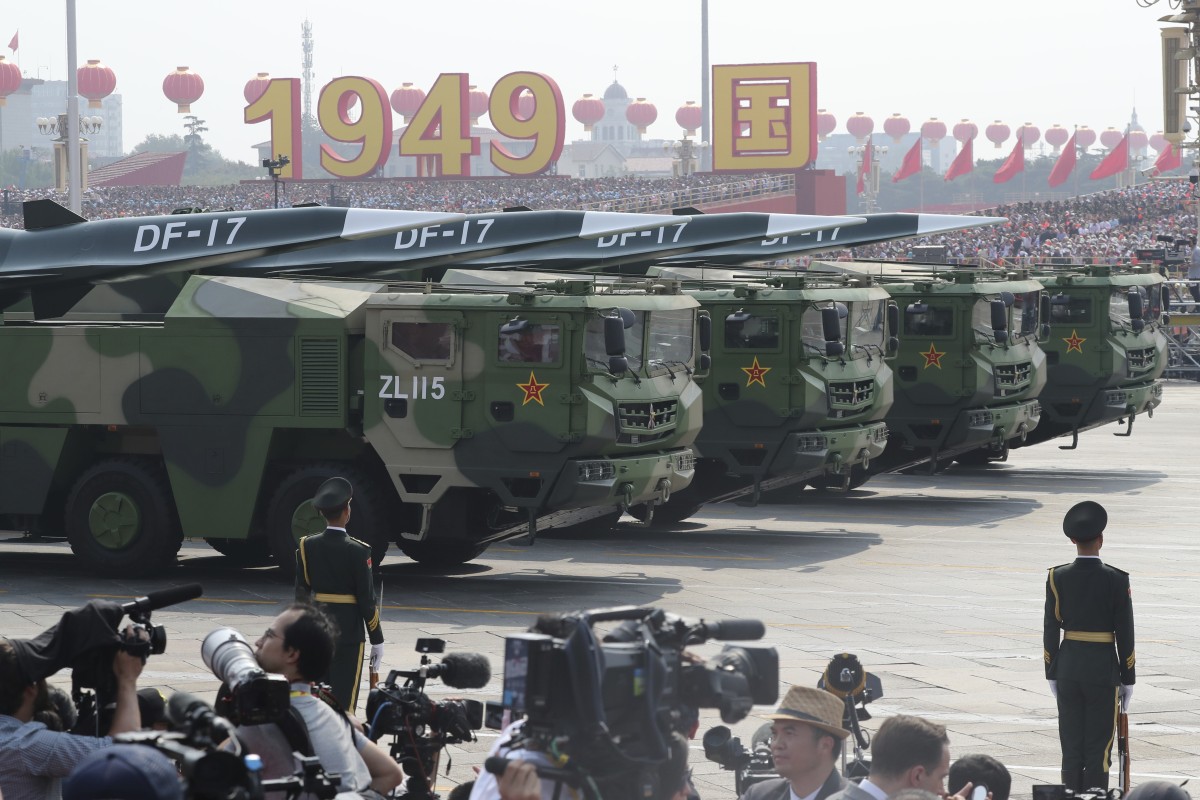
Military vehicles carry DF-17 missiles capable of reaching the US mainland during the parade to mark 70 years of the People’s Republic. Photo: AP
China staged a massive military parade in Beijing on Tuesday to mark the 70th anniversary of the founding of the People’s Republic, with much of the smog-shrouded capital city under a security lockdown.
President Xi Jinping inspected over 15,000 troops, more than 160 aircraft and 580 weapon systems in a show of the country’s growing military might and his drive to modernise the People’s Liberation Army.
He also delivered a bullish eight-minute speech hailing the accomplishments of seven decades of Communist rule and pledging to achieve his vision of a “Chinese dream” of national rejuvenation and global prominence.
Here are some of the key takeaways from a day of celebration in Beijing:
A show of unity
Xi presided over the ceremony in Tiananmen Square flanked by his predecessors Jiang Zemin and Hu Jintao, along with other retired and present party elders.
The rare appearance of Jiang and Hu – on the rostrum of the Gate of Heavenly Peace, where the country’s founding father Mao Zedong declared Communist rule on October 1, 1949 – was clearly aimed at projecting unity and solidarity in the face of daunting domestic and international challenges.
China’s National Day parade, as it happened
Hu had been absent from the funeral of former premier Li Peng in late July, although the ailing Jiang attended.
Former vice-president Zeng Qinghong and Song Ping, the oldest party elder in attendance, also appeared on the rostrum.
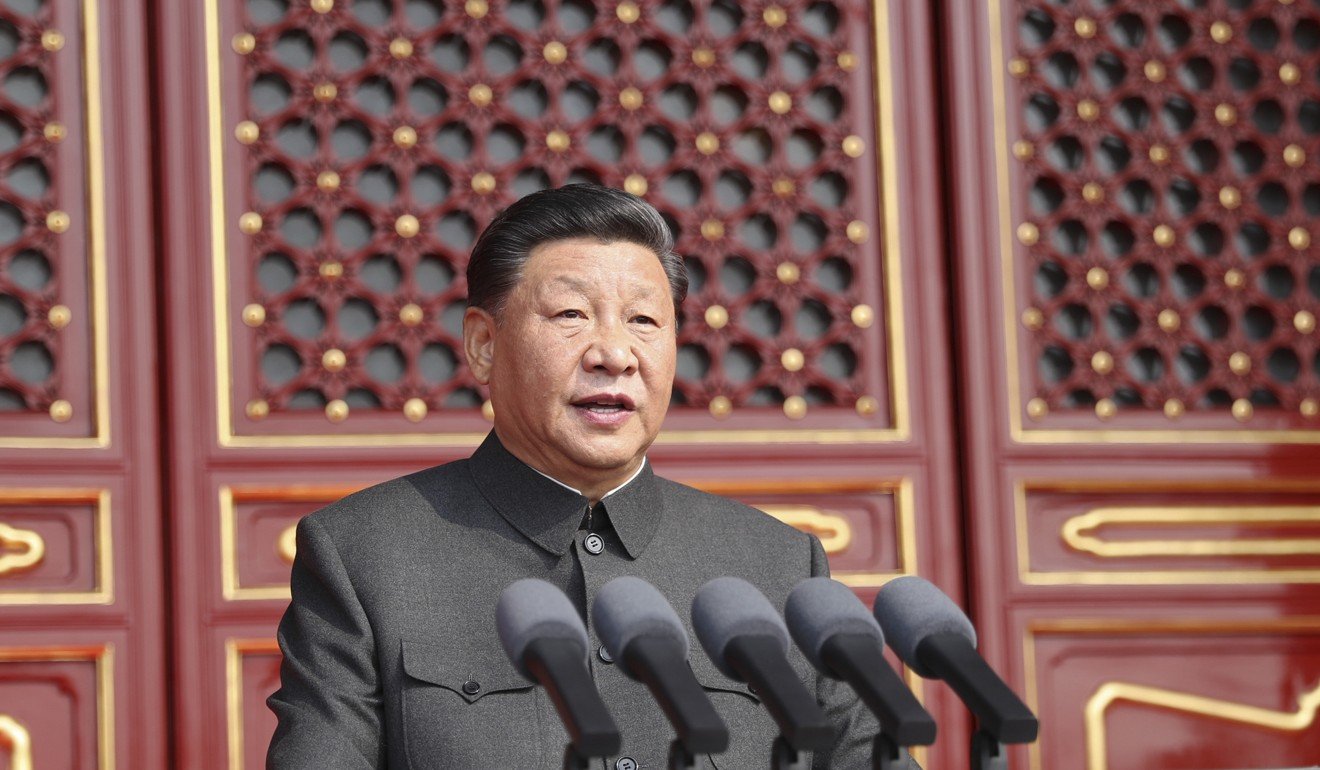
President Xi Jinping speaks in Tiananmen Square during Tuesday’s celebrations. Photo: Xinhua
But notably, while former premier Wen Jiabao was present, his predecessor Zhu Rongji was not.
‘No force can shake China’
Dressed in a Mao suit, Xi’s nationally televised speech invoked China’s “century of humiliation” and praised the achievements of its people, saying there was no force that could stop it forging ahead.
“No force can shake the status of our great motherland, and no force can stop the Chinese people and the Chinese nation from marching forward,” he said.
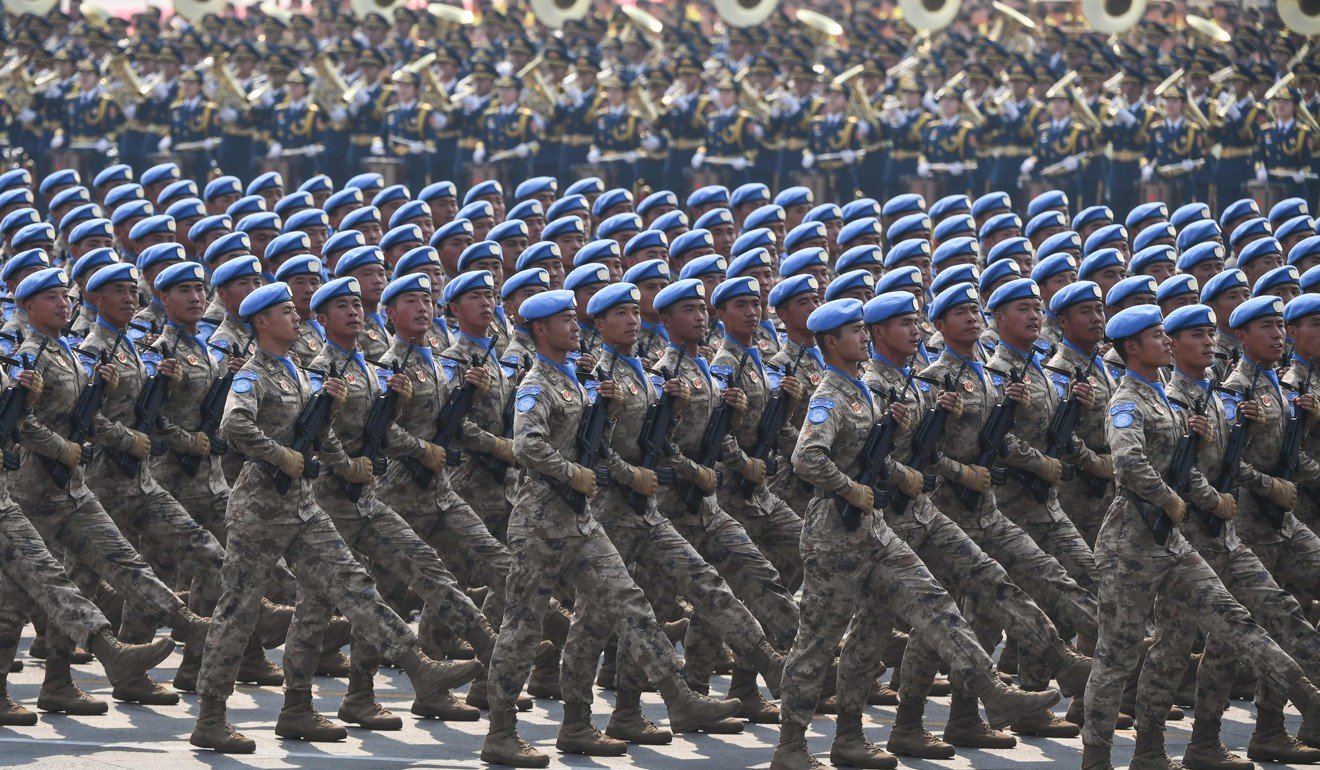
Chinese troops take part in the Republic’s largest ever military parade. Photo: AFP
“The People’s Liberation Army [PLA] will serve its purpose in safeguarding the sovereignty, security and development interests of the country, and world peace,” he said, at a time when Beijing has expanded its military footprint globally, including with its first overseas military base in Djibouti.
Xi called on the Communist Party and the country to unite and continue to fight for the realisation of what he called the “Chinese dream” – the nation’s rejuvenation.
One country, two systems
Amid escalating unrest in Hong Kong, which has plunged the city into a deepening crisis and threatened to overshadow the National Day celebrations, Xi vowed that the central government would uphold “one country, two systems”.
He said the central government would protect the long-term stability of Hong Kong and Macau, and stressed the goal of “peaceful reunification” with the self-ruling Taiwan, repeating a message frequently used by his predecessors, including Deng Xiaoping, Jiang and Hu.
The theme of one country, two systems later appeared in a National Day parade for the first time, with placards forming the words: “Hong Kong’s tomorrow will be better.”
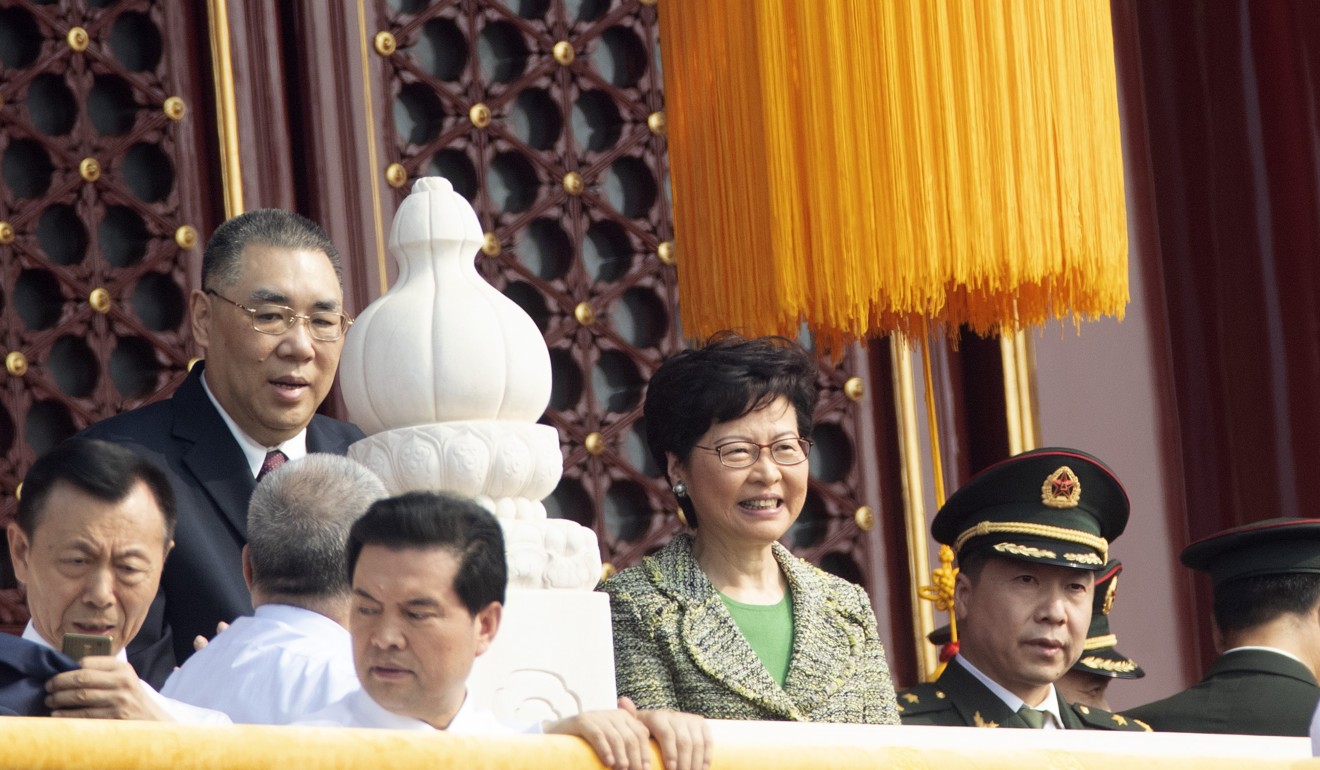
Hong Kong Chief Executive Cheng Yuet-ngor attended the ceremony, as did 10 Hong Kong police officers involved in suppressing anti-government protests in the city.
Showing off new weapons
China’s advancement in military weaponry was on full display, with almost half of the items featured being shown to the public for the first time.
Hong Kong leader Carrie Lam was among the guests in Beijing on Tuesday. Photo: AP
The morning’s celebrations included an 80-minute military parade – the biggest since the founding of the People’s Republic – in an apparent effort to showcase the prowess of the PLA, the world’s biggest military with 2 million personnel.
Among the weapons shown were DF series missiles, including the DF-17, a nuclear-capable glider that has the capacity to strike the US mainland, and the DF-41, which has a range of up to 15,000km, making it the world’s longest-range military missile.
Signalling Xi’s status
A 100,000-strong civilian parade featuring huge portraits of Xi and predecessors including Mao, Deng, Jiang and Hu wrapped up the morning celebration.
The procession was divided into three parts, representing three eras of the People’s Republic: the Mao era, Deng’s reform and opening up, and Xi’s era, which seeks global prominence on a par with that of the United States.
Xi appeared keen to project his supreme status in the party, reinforced since he abolished the constitutional term limit a year ago, allowing him potentially to remain leader for life.
He waved at his own portrait, unveiled alongside a sign reading “Carry out Xi Jinping Thought on Socialism with Chinese Characteristics for a New Era”.
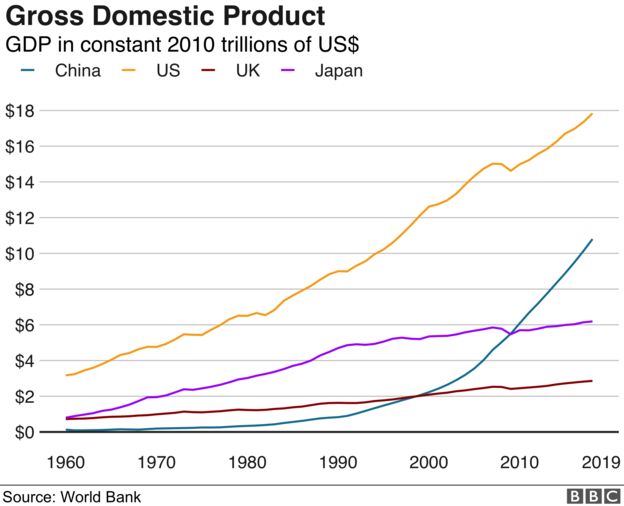
It took China less than 70 years to emerge from isolation and become one of the world’s greatest economic powers.
As the country celebrates the anniversary of the founding of the People’s Republic of China, we look back on how its transformation spread unprecedented wealth – and deepened inequality – across the Asian giant.
“When the Communist Party came into control of China it was very, very poor,” says DBS chief China economist Chris Leung.
“There were no trading partners, no diplomatic relationships, they were relying on self-sufficiency.”
Over the past 40 years, China has introduced a series of landmark market reforms to open up trade routes and investment flows, ultimately pulling hundreds of millions of people out of poverty.
The 1950s had seen one of the biggest human disasters of the 20th Century. The Great Leap Forward was Mao Zedong’s attempt to rapidly industrialise China’s peasant economy, but it failed and 10-40 million people died between 1959-1961 – the most costly famine in human history.
This was followed by the economic disruption of the Cultural Revolution in the 1960s, a campaign which Mao launched to rid the Communist party of his rivals, but which ended up destroying much of the country’s social fabric.
‘Workshop of the world’
Yet after Mao’s death in 1976, reforms spearheaded by Deng Xiaoping began to reshape the economy. Peasants were granted rights to farm their own plots, improving living standards and easing food shortages.
The door was opened to foreign investment as the US and China re-established diplomatic ties in 1979. Eager to take advantage of cheap labour and low rent costs, money poured in.
“From the end of the 1970s onwards we’ve seen what is easily the most impressive economic miracle of any economy in history,” says David Mann, global chief economist at Standard Chartered Bank.
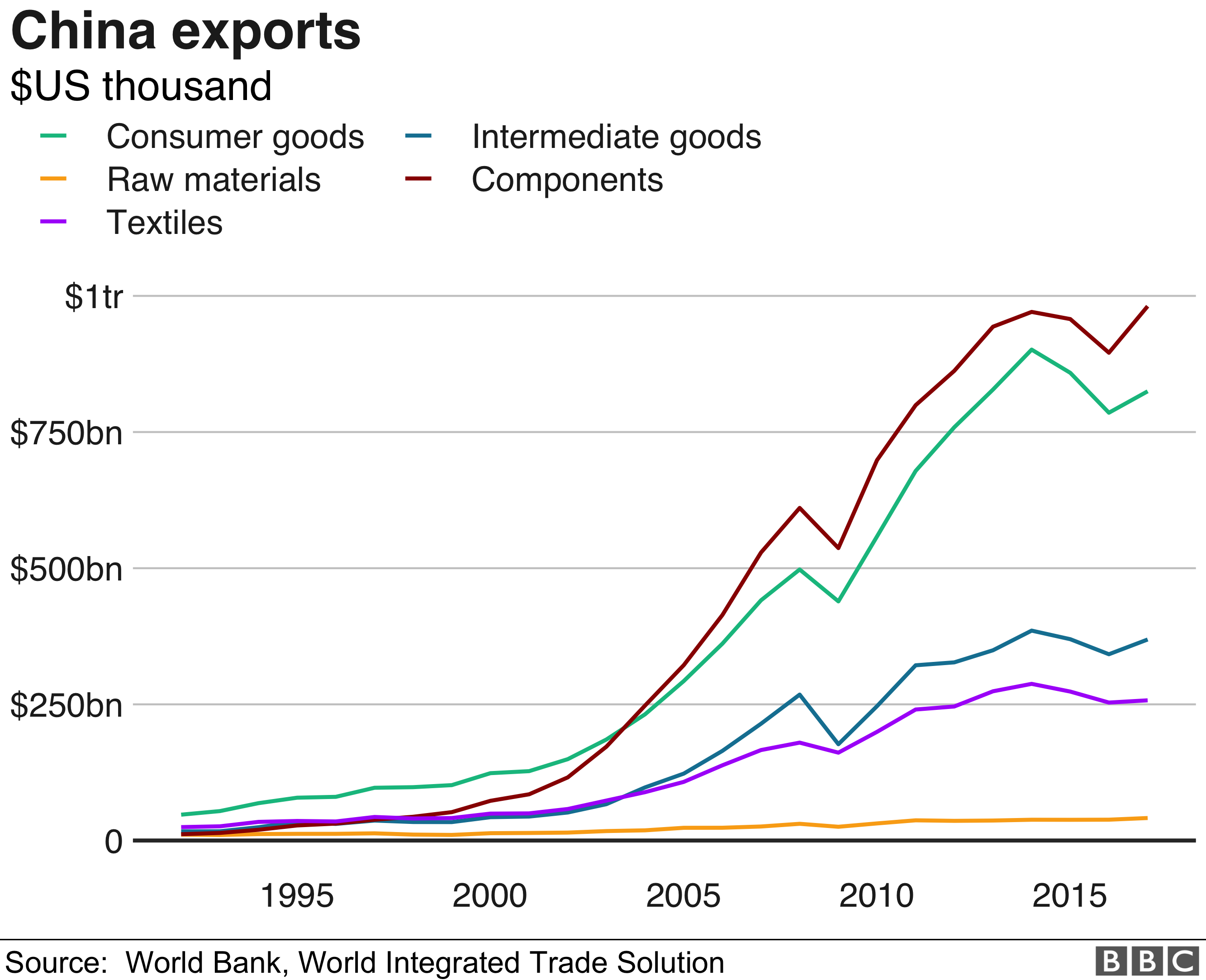
Through the 1990s, China began to clock rapid growth rates and joining the World Trade Organization in 2001 gave it another jolt. Trade barriers and tariffs with other countries were lowered and soon Chinese goods were everywhere.
“It became the workshop of the world,” Mr Mann says.
Take these figures from the London School of Economics: in 1978, exports were $10bn (£8.1bn), less than 1% of world trade.
By 1985, they hit $25bn and a little under two decades later exports valued $4.3trn, making China the world’s largest trading nation in goods.
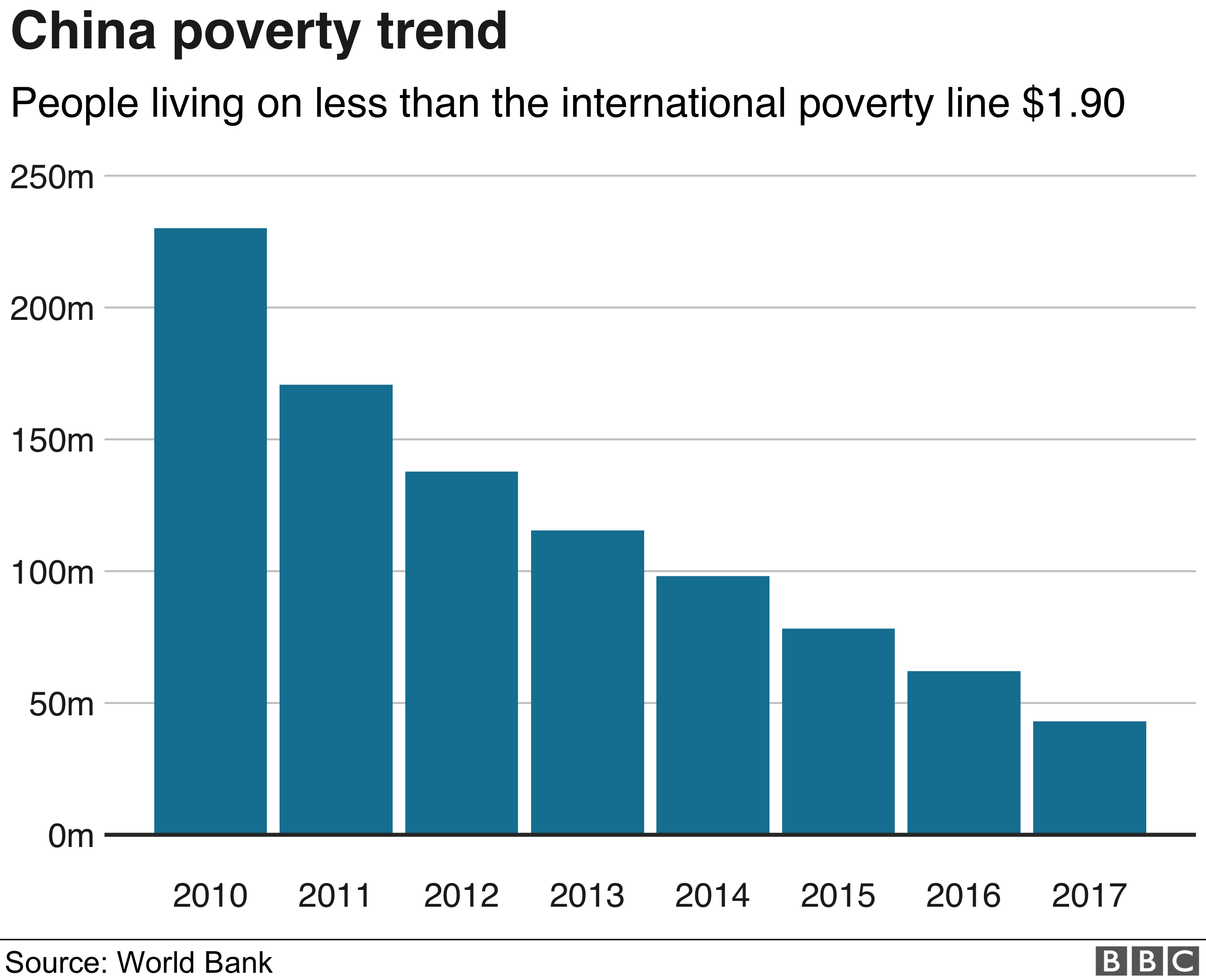
Poverty rates tumble
The economic reforms improved the fortunes of hundreds of millions of Chinese people.
The World Bank says more than 850 million people been lifted out of poverty, and the country is on track to eliminate absolute poverty by 2020.
At the same time, education rates have surged. Standard Chartered projects that by 2030, around 27% of China’s workforce will have a university education – that’s about the same as Germany today.
Rising inequality
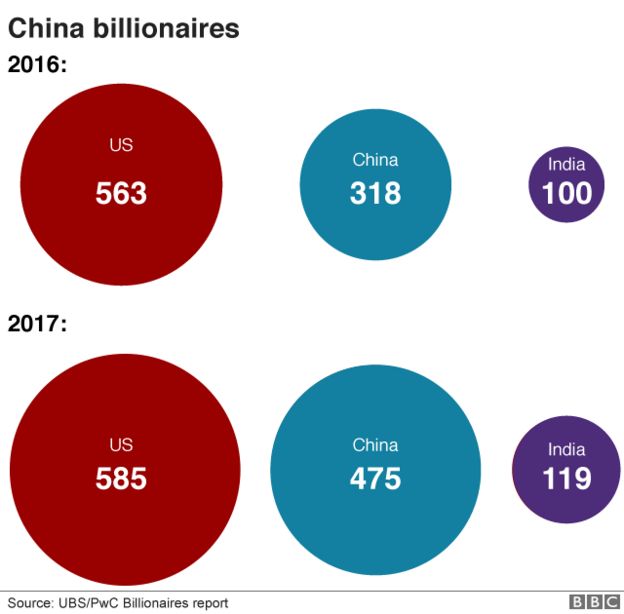
Still, the fruits of economic success haven’t spread evenly across China’s population of 1.3 billion people.
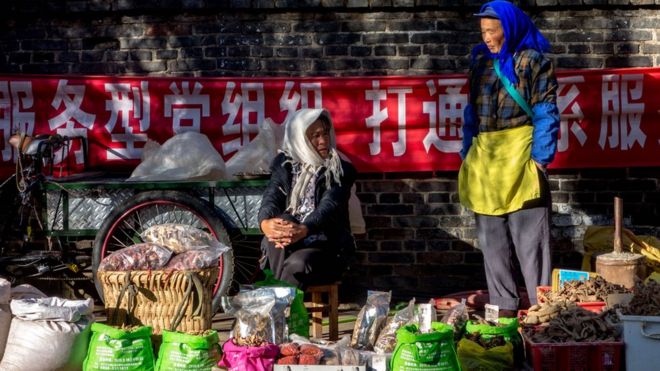
Examples of extreme wealth and a rising middle class exist alongside poor rural communities, and a low skilled, ageing workforce. Inequality has deepened, largely along rural and urban divides.
“The entire economy is not advanced, there’s huge divergences between the different parts,” Mr Mann says.
The World Bank says China’s income per person is still that of a developing country, and less than one quarter of the average of advanced economies.
China’s average annual income is nearly $10,000, according to DBS, compared to around $62,000 in the US.
Slower growth
Now, China is shifting to an era of slower growth.
For years it has pushed to wean its dependence off exports and toward consumption-led growth. New challenges have emerged including softer global demand for its goods and a long-running trade war with the US. The pressures of demographic shifts and an ageing population also cloud the country’s economic outlook.
Still, even if the rate of growth in China eases to between 5% and 6%, the country will still be the most powerful engine of world economic growth.
“At that pace China will still be 35% of global growth, which is the biggest single contributor of any country, three times more important to global growth than the US,” Mr Mann says.
The next economic frontier
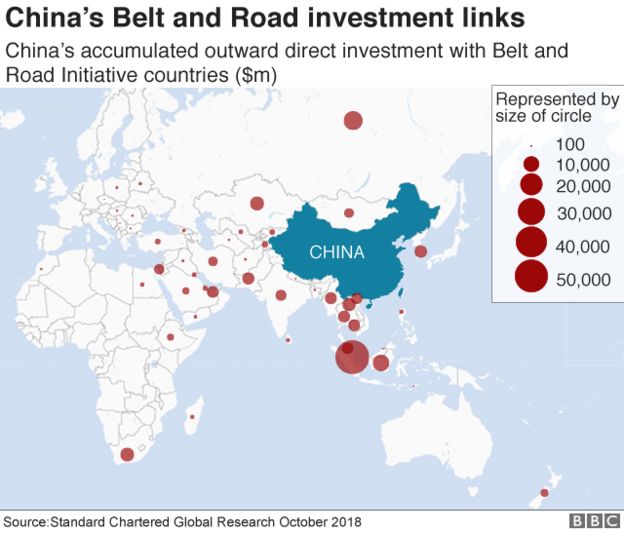
China is also carving out a new front in global economic development. The country’s next chapter in nation-building is unfolding through a wave of funding in the massive global infrastructure project, the Belt and Road Initiative.
The so-called new Silk Road aims to connect almost half the world’s populations and one-fifth of global GDP, setting up trade and investment links that stretch across the world.
You Quan, a member of the Secretariat of the Communist Party of China (CPC) Central Committee and head of the United Front Work Department of the CPC Central Committee, attends a symposium to commemorate the 74th anniversary of the victory in the Chinese People’s War of Resistance Against Japanese Aggression and the World Anti-Fascist War in Beijing, capital of China, Sept. 3, 2019. (Xinhua/Shen Hong)
BEIJING, Sept. 3 (Xinhua) — China on Tuesday held a symposium to commemorate the 74th anniversary of the victory in the Chinese People’s War of Resistance Against Japanese Aggression and the World Anti-Fascist War.
You Quan, a member of the Secretariat of the Communist Party of China (CPC) Central Committee and head of the United Front Work Department of the CPC Central Committee, joined about 200 representatives from various sectors at the event in Beijing.
Participants including Party officials, military officers, war veterans and student representatives spoke highly of the great achievements made by the Chinese people in safeguarding national independence and liberty and protecting the sovereignty and sanctity of the country at the symposium.
Families of war heroes, representatives of non-Communist parties and foreigners who contributed to China’s war against Japanese aggression also attended the symposium.
HONG KONG, June 15 (Xinhua) — An official in charge of the Office of the Commissioner of the Chinese Foreign Ministry in Hong Kong Special Administrative Region (HKSAR) on Saturday expressed understanding, respect and support for the decision by the HKSAR chief executive to suspend the exercise to amend the HKSAR’s Fugitive Offenders Ordinance and the Mutual Legal Assistance in Criminal Matters Ordinance.
The official also voiced continuous staunch support for HKSAR Chief Executive Carrie Lam and the SAR government in governing Hong Kong in accordance with law, safeguarding the country’s sovereignty, security and development interests, and upholding Hong Kong’s enduring prosperity and stability.
“We firmly support the SAR government’s efforts to amend the ordinances,” he said, adding that the amendments to the two ordinances aim to plug a legal loophole in the existing legal framework, demonstrate social justice and improve Hong kong’s rule of law, which is necessary, legitimate and reasonable.
The contents of the amendments conform to the international law and the common practices of the international community, and help fight crimes, he said.
The official strongly condemned the violent acts by some people, and voiced firm support for the Hong Kong police force to mete out punishment in accordance with law, uphold Hong Kong’s rule of law and protect Hong Kong’s social stability.
Since Hong Kong’s return to the motherland, Hong Kong people have been enjoying unprecedented and extensive rights and freedoms, including the freedoms of speech and assembly, he said.
However, freedom is by no means without boundaries, and rights must be exercised within the framework of the rule of law. Any civilized society ruled by law will not tolerate unlawful acts which impact peace and security, he said.
He stressed that Hong Kong is China’s Hong Kong and its affairs are purely China’s internal affairs. “We resolutely oppose any external forces interfering in its affairs with any excuse or in any form. Any attempts to create chaos in Hong Kong and jeopardize its prosperity and stability are doomed to fail,” he said.
“Again, we urge relevant countries to comply with the international law and the basic norms governing international relations, fully respect China’s sovereignty and the SAR government in exercising governance in accordance with law and immediately stop the wrong words and deeds that undermine Hong Kong’s prosperity and stability,” the official said.
Philippines’ foreign ministry weighs in on controversy over presence of Chinese fleet near contested Thitu Island
Manila has ‘consistently manifested its … objections or concerns over illegal, tension-raising or coercive activities’, statement says
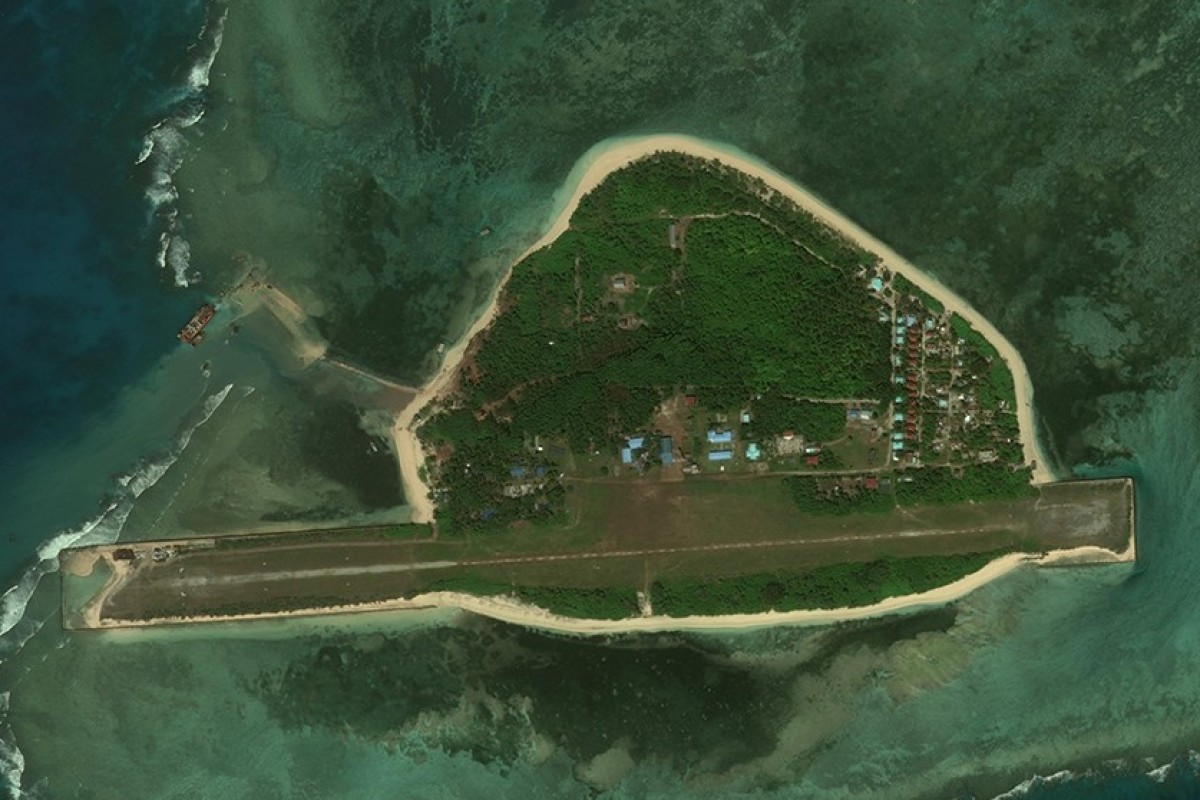
The Philippines is angry about the presence of a Chinese fleet close to Thitu Island in the South China Sea. Photo: AMTI
The Philippines’ foreign ministry on Thursday accused Beijing of violating its sovereignty and jurisdiction by allowing hundreds of vessels to sail close to an island claimed by Manila in the South China Sea.
described China’s growing presence in the disputed waters as “very concerning”, saying on a trip to Washington that it was encroaching on the Philippines’ exclusive economic zone.
, which Manila calls Pag-asa, in the disputed Spratly Islands.
The Department of Foreign Affairs in Manila said the Philippines “has consistently manifested its position on Pag-asa … and its objections or concerns over illegal, tension-raising or coercive activities, through diplomatic actions … and in meetings with the Chinese side”.
The statement said Thitu is part of the Kalayaan island group – the local name for the Spratlys – and an integral part of the Philippines, over which it has sovereignty and jurisdiction.
“The presence of Chinese vessels near and around Pag-asa and other maritime features in the KIG is illegal,” it said.
US, Philippines in talks on rocket system to deter Beijing
“Such actions when not repudiated by the Chinese government are deemed to have been adopted by it,” it said. “The presence of Chinese vessels within the KIG, whether military, fishing or other such will thus continue to be the subject of appropriate action by the Philippines”.
The foreign ministry said earlier it had filed a diplomatic protest about the presence of more than 200 Chinese vessels near Thitu between January and March.
Satellite images captured in February by the Asia Maritime Transparency Initiative under the Washington-based Centre for Strategic and International Studies show almost 100 Chinese ships apparently hampering Philippine construction work on Thitu.
The fleet, dispatched from the nearby Subi Reef, includes naval and coastguard vessels, as well as dozens of fishing boats.
Manila was planning to upgrade its military facilities on Thitu, including the construction of an airstrip, but the project was suspended because of the Chinese interference.
The defence chiefs of the US and the Philippines reaffirmed their security alliance on Monday in Washington. As well as agreeing to boost cooperation, the US promised to increase its support for Manila’s military modernisation – a move seen as a response to Beijing’s increasingly assertive posturing in the South China Sea.
Philippine President Rodrigo Duterte says he will not confront China over the South China Sea dispute as doing so would end in war. Photo: AP
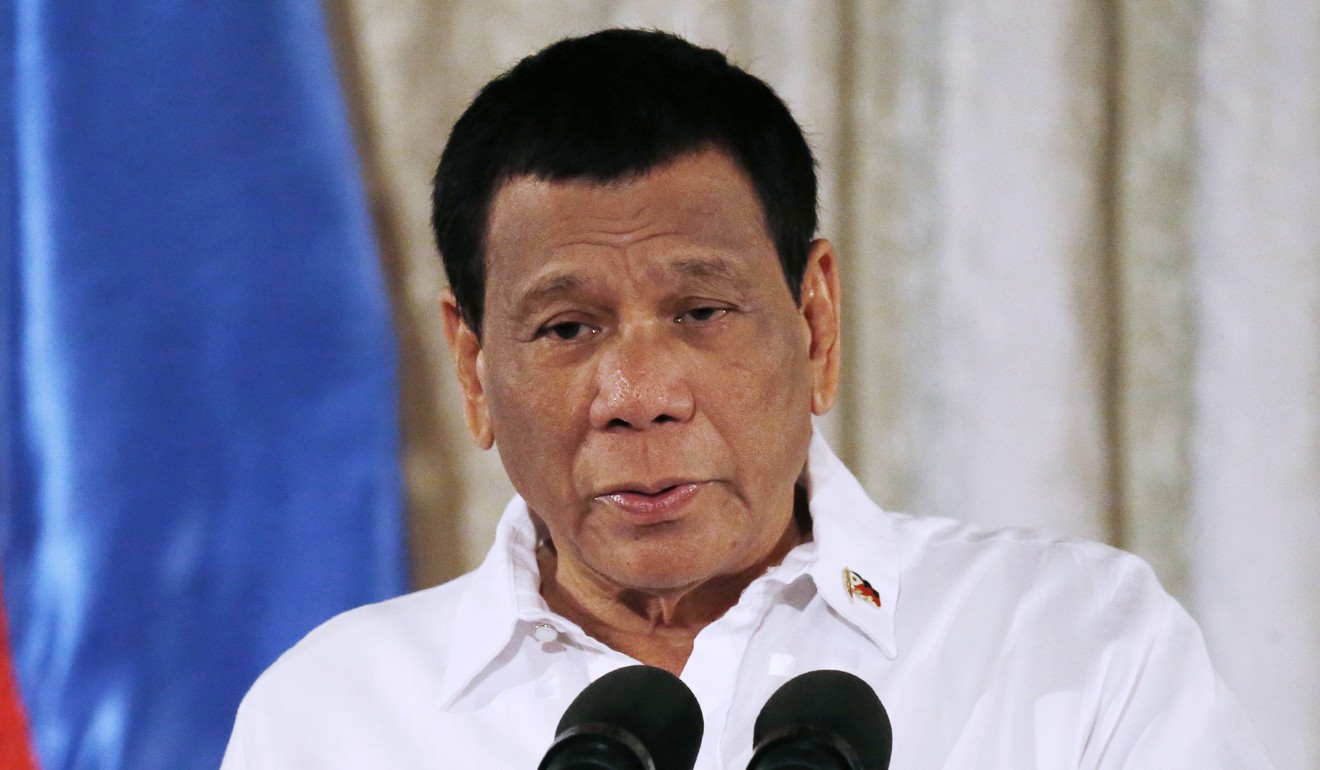
said on Wednesday that Beijing wanted to be friends with Manila and that he would not confront China over their competing claims in the South China Sea because it would end in war.
The foreign affairs department in Manila also sought to sound a positive note in its statement, saying the maritime dispute was not the “sum total” of Philippines-China relations, and should not exclude mutually beneficial cooperation in other fields.
US more likely than Philippines to end up in ‘shooting war’
A day after the two nations wrapped up their latest meeting on the South China Sea, Chinese foreign ministry spokesman Geng Shuang said on Thursday the two sides had reaffirmed their differences but would continue to seek a resolution.
“China looks forward to working with the Philippines to make active efforts to safeguard the overall interests of China-Philippines cooperation and peace and stability in the South China Sea,” he said.
Hong Kong-based military expert Song Zhongping said the presence of the Chinese vessels near Thitu was a clear statement of Beijing’s intent.
“Beijing believes Thitu Island is Chinese territory, so any work there should be done by China, not the Philippines,” he said.
It also wanted to stop Manila “opening the door to dangerous people” he said, referring to the Southeast Asian nation’s announcement about allowing the US access to five more of its military bases.




 CHINDIA ALERT: You'll be living in their world, very soon