Chindia Alert: You’ll be Living in their World Very Soon
aims to alert you to the threats and opportunities that China and India present. China and India require serious attention; case of ‘hidden dragon and crouching tiger’.
Without this attention, governments, businesses and, indeed, individuals may find themselves at a great disadvantage sooner rather than later.
The POSTs (front webpages) are mainly 'cuttings' from reliable sources, updated continuously.
The PAGEs (see Tabs, above) attempt to make the information more meaningful by putting some structure to the information we have researched and assembled since 2006.
Joint mission will send two unmanned probes into orbit around the closest planet to the sun
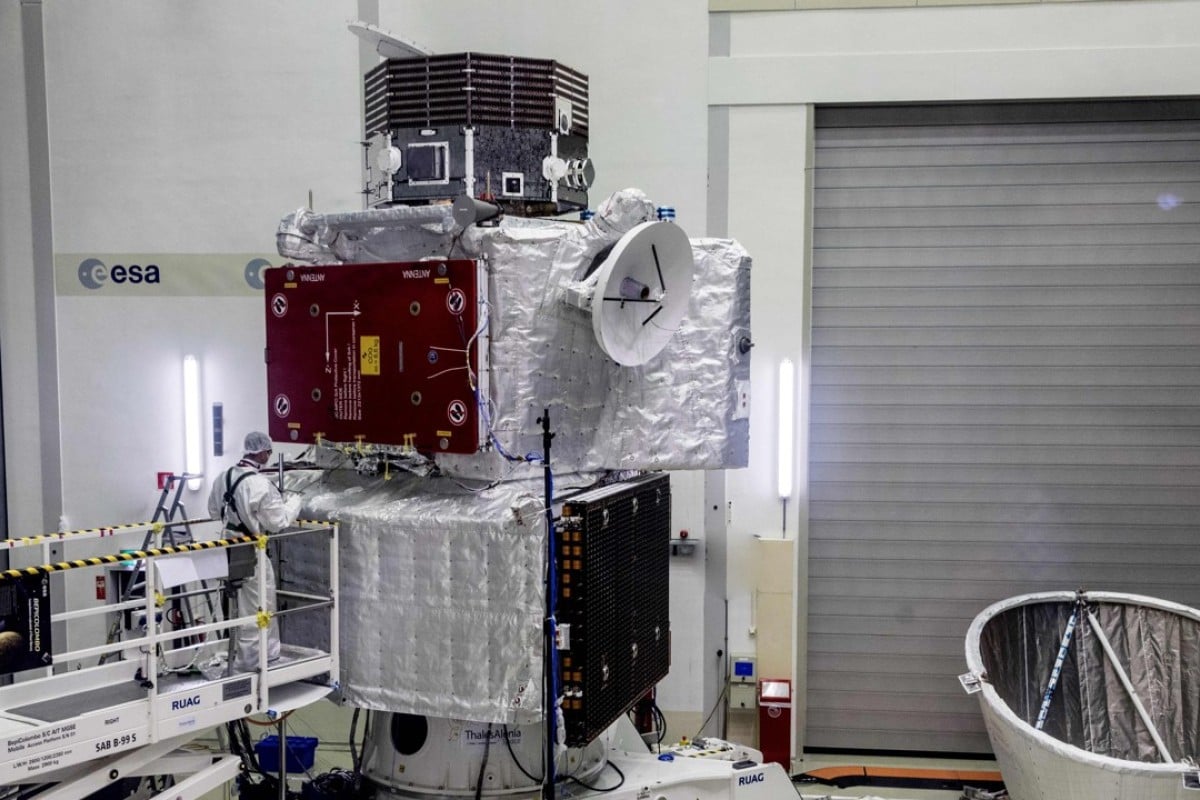
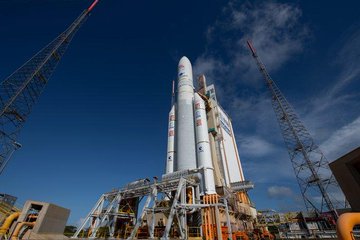
The BepiColombo standing in position at a test facility in Spijkenisse. Its mission to Mercury is scheduled for launch on an Ariane 5 from Europe’s Spaceport in Kourou, French Guiana on October 20. Photo: AFP Photo
Final preparations were underway on Friday for the launch of a joint mission by European and Japanese space agencies to send twin probes to Mercury, the closest planet to the sun.
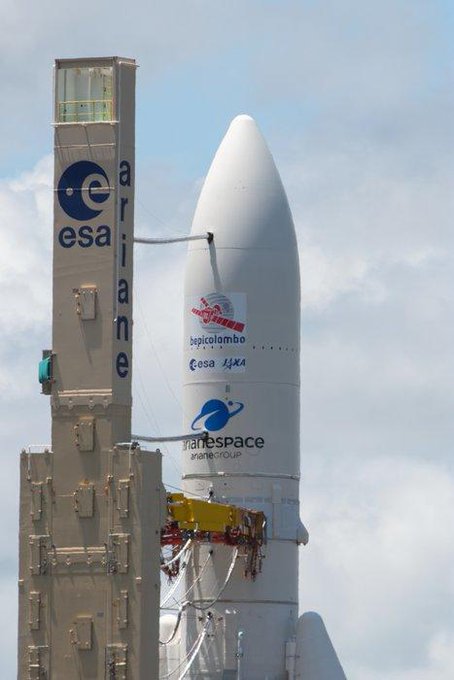
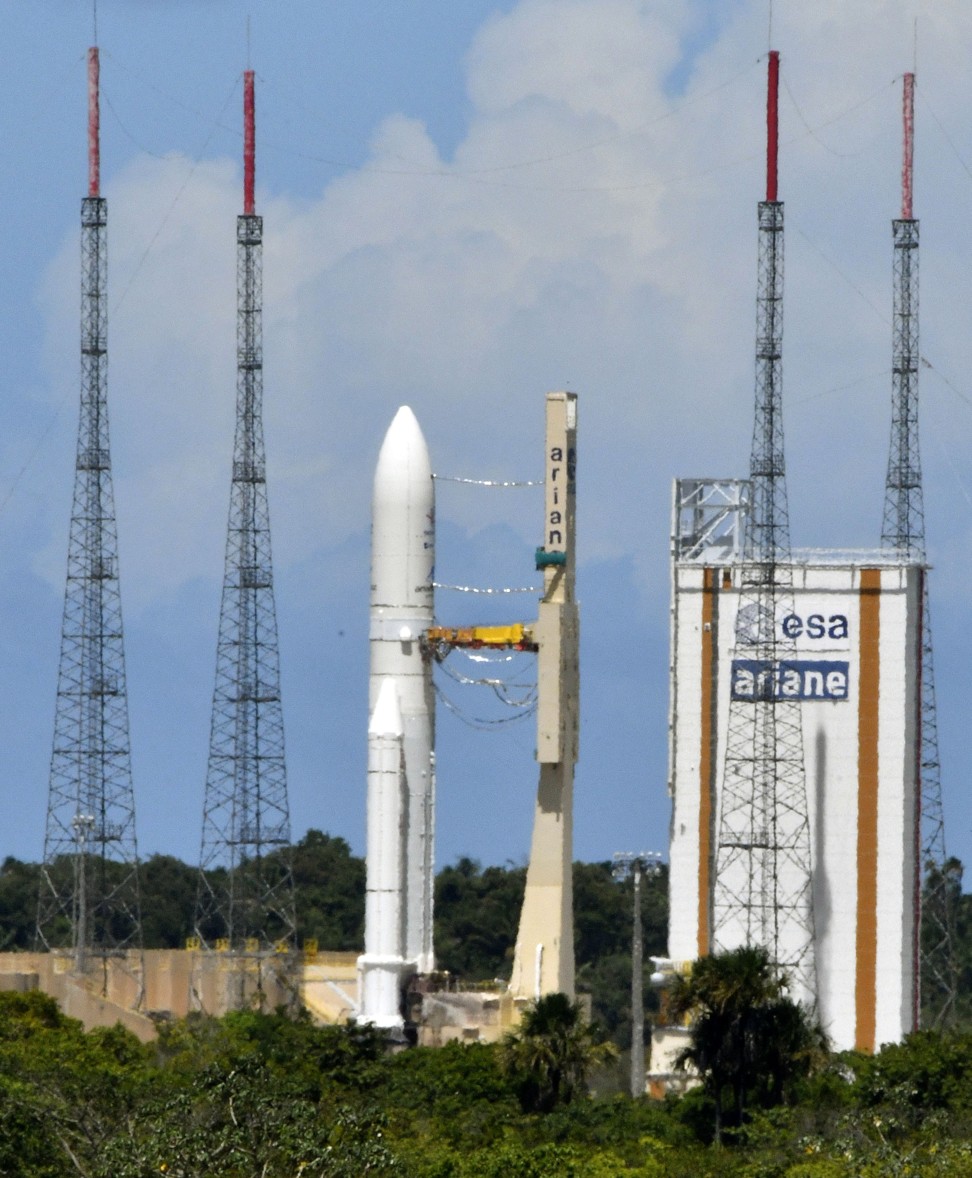
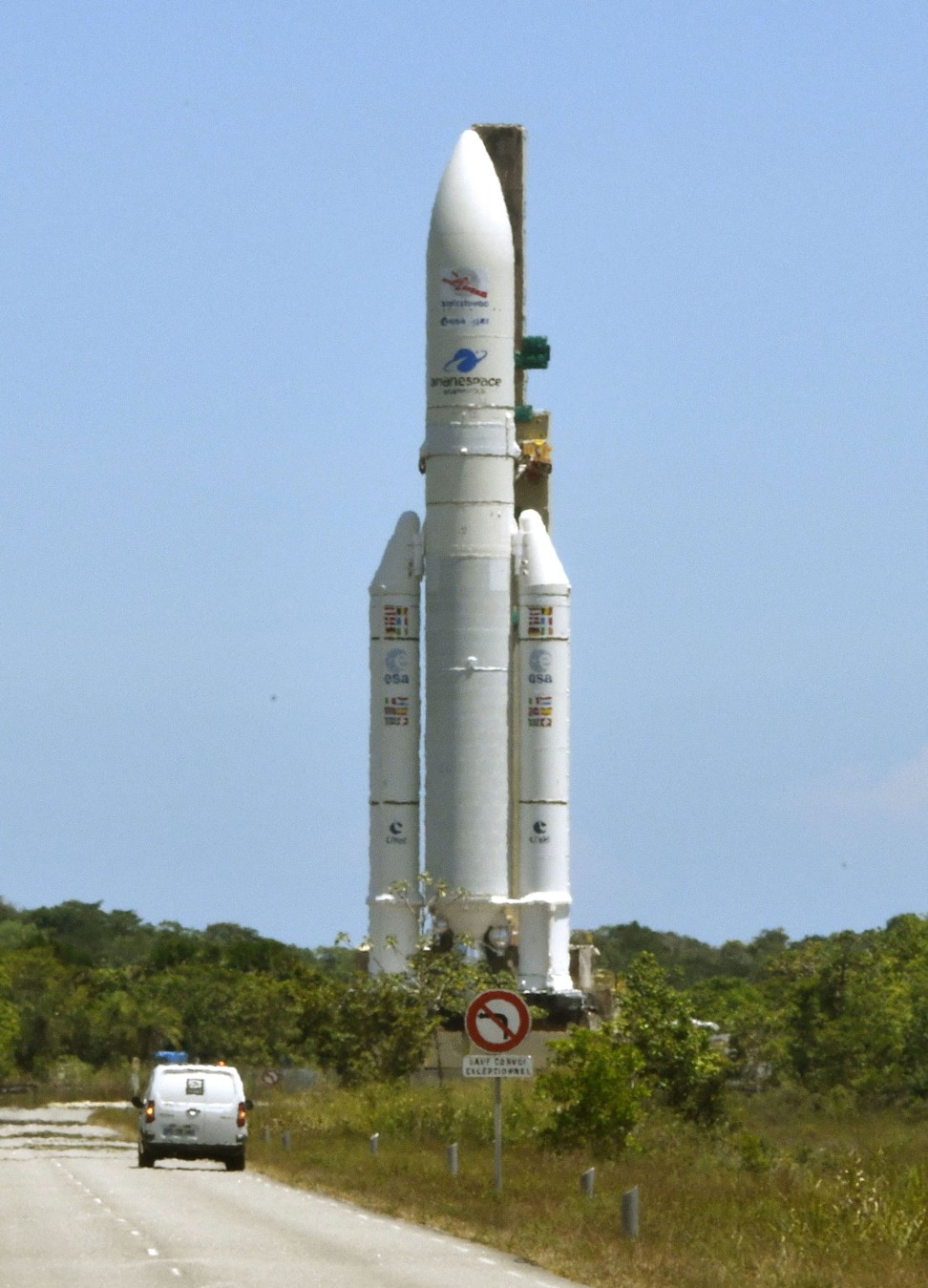
An Ariane 5 rocket is scheduled to lift the unmanned spacecraft into orbit from French Guiana shortly before midnight, the start of a seven-year journey to the solar system’s innermost planet.
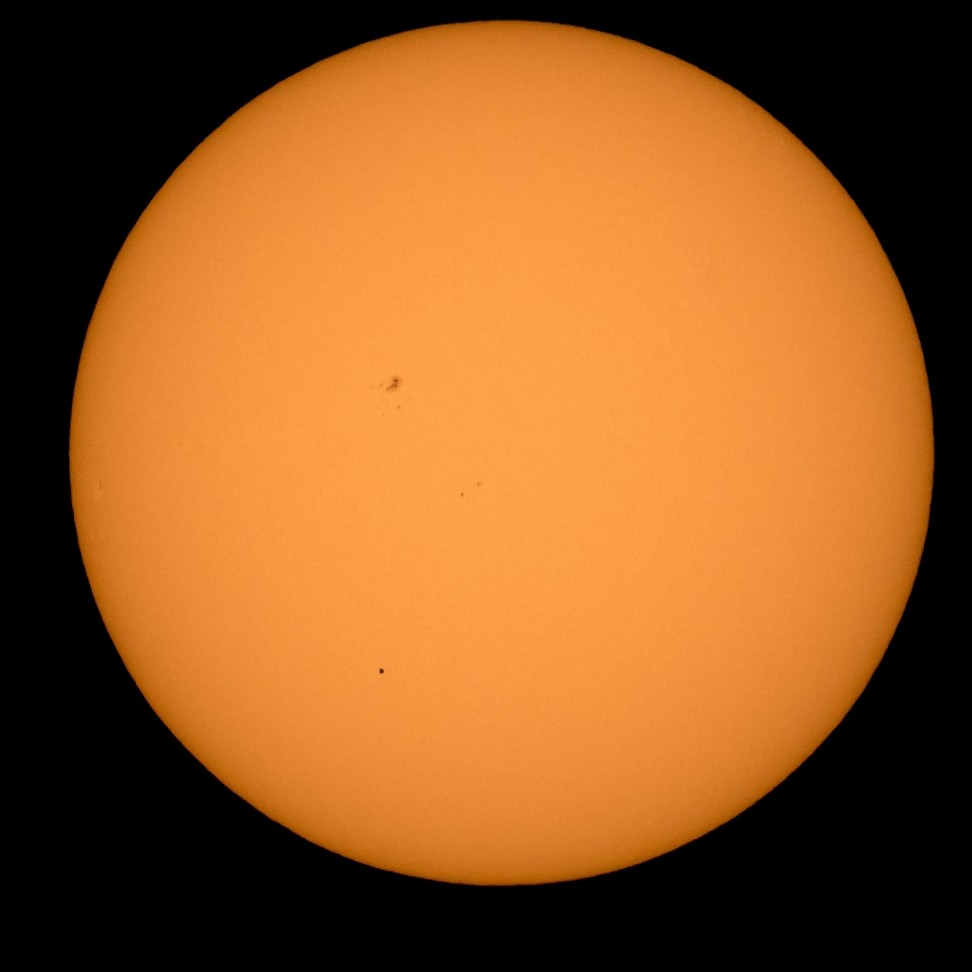
Mercury is seen in silhouette, lower third of image, as it transits across the face of the sun. Photo: AFP PHOTO / NASA / BILL INGALLS
The European Space Agency says the €1.3 billion (US$1.5 billion) mission is one of the most challenging in its history. Mercury’s extreme temperatures, the intense gravity pull of the sun and blistering solar radiation make for hellish conditions.
The BepiColombo spacecraft will have to follow an elliptical path that involves a fly-by of Earth, two of Venus and six of Mercury itself so it can slow down sufficiently before arriving at its destination in December 2025.
An Ariane-5 rocket is set for launch at the Guiana Space Centre in Kourou in French Guiana. Photo: Kyodo
Newly developed electrical ion thrusters will help nudge the spacecraft, which was named after Italian scientist Giuseppe “Bepi” Colombo, into the right orbit.
Aborted launch astronauts may head to International Space Station this year: Nasa head says
12 Oct 2018
When it arrives, BepiColombo will release two probes – Bepi and Mio – that will independently investigate the surface and magnetic field of Mercury. The probes are designed to cope with temperatures varying from 430 degrees Celsius (806F) on the side facing the sun, and -180 degrees Celsius (-292F) in Mercury’s shadow.
An Ariane-5 rocket is transported to its launch site at the Guiana Space Centre in Kourou. Photo: Kyodo
Scientists hope to build on the insights gained by Nasa’s Messenger probe, which ended its mission in 2015 after a four-year orbit of Mercury. The only other spacecraft to visit Mercury was Nasa’s Mariner 10 that flew past the planet in the mid-1970s.
Japanese space robots have landed on asteroid to carry out world-first survey
22 Sep 2018
Mercury, which is only slightly larger than Earth’s moon, has a massive iron core about which little is known. Researchers are also hoping to learn more about the formation of the solar system from the data gathered by the BepiColombo mission.
Modified version of country’s most powerful rocket carries next-generation capsule designed to take astronauts to its planned space station
It will be able to launch and land with three crew members and up to 500kg of cargo, according to state media
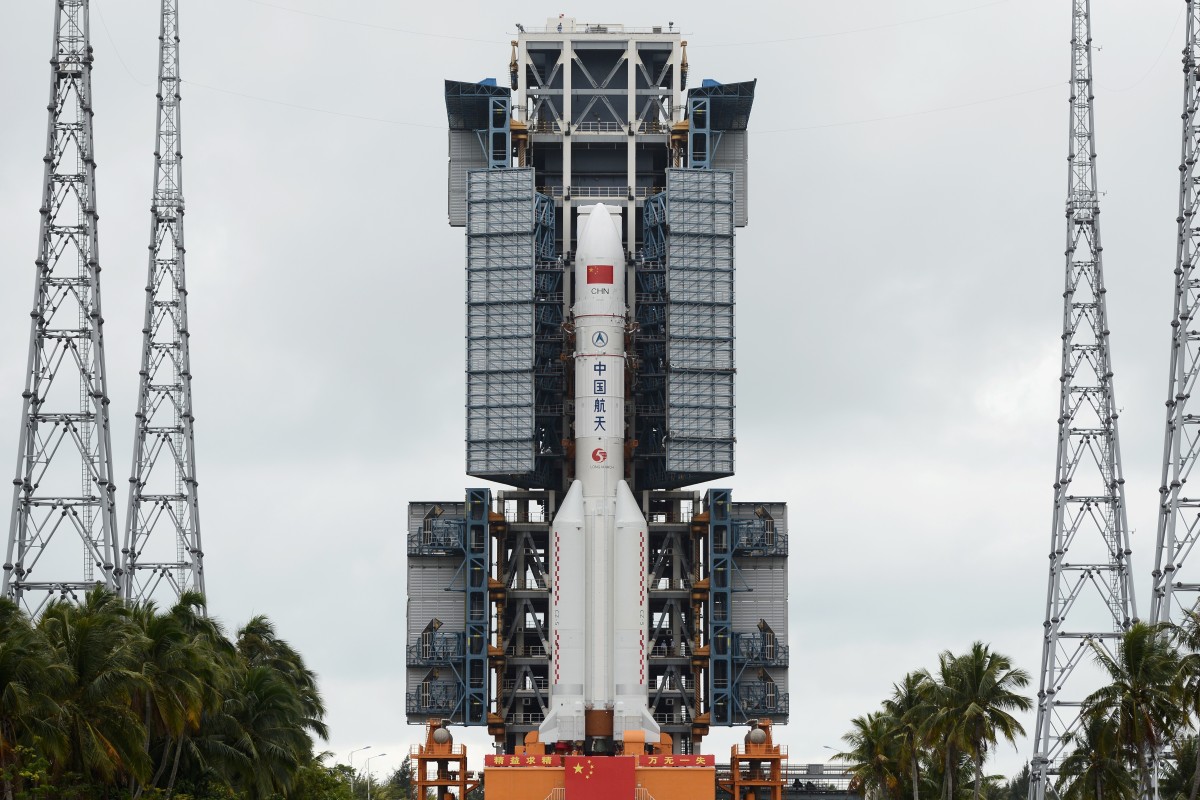
China launched a new version of its heavy-lift Long March 5 rocket on Tuesday. Photo: Reuters
China successfully launched a prototype of its next-generation manned spacecraft – without astronauts – along with a new version of its heavy-lift Long March 5 rocket on Tuesday, its space agency said.
The Long March 5B rocket was launched into low-Earth orbit from the Wenchang Satellite Launch Centre on Hainan Island in the country’s south.
The launch marks a significant step forward for China’s two big space exploration ambitions – building a space station and a mission to Mars.
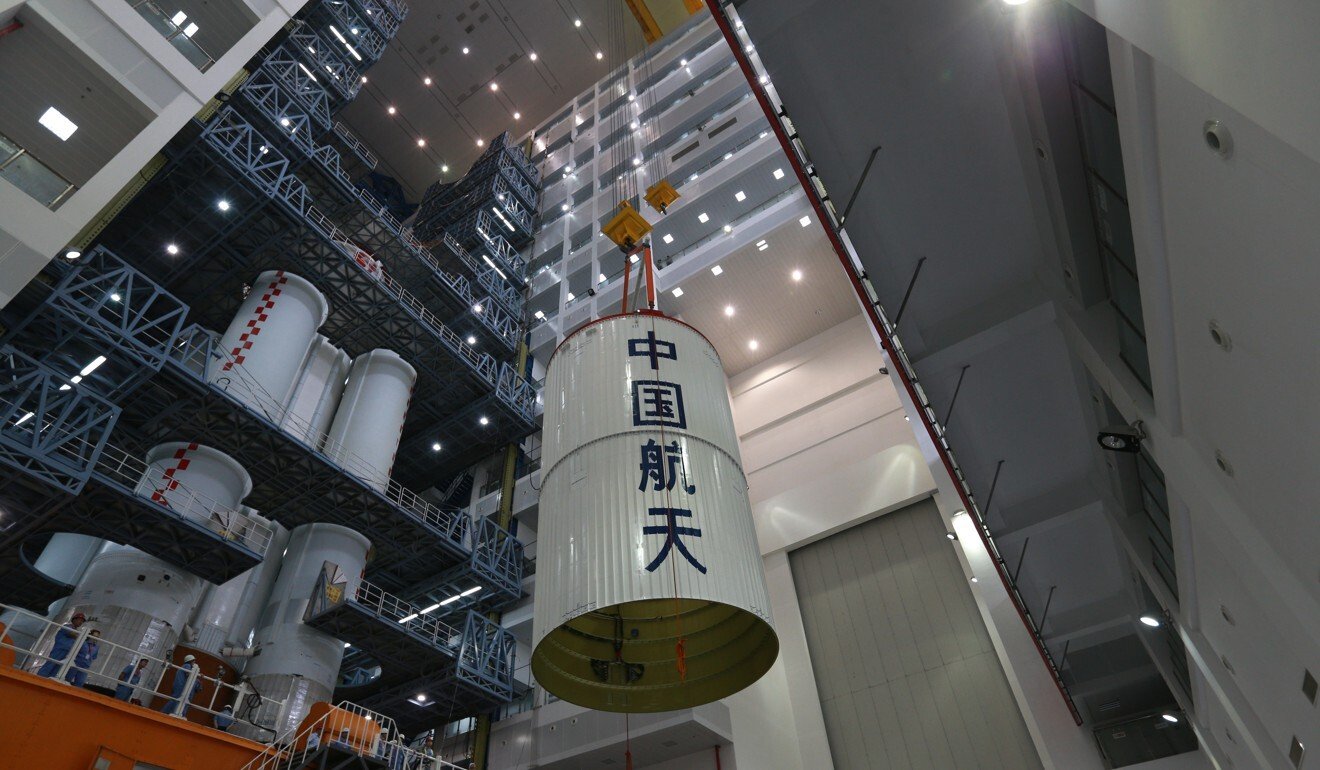
A modified version of China’s most powerful rocket, the Long March 5B is 53.7 metres (176 feet) tall. It will carry the next-generation crew capsule prototype designed to replace the Shenzhou spacecraft, to transport astronauts to its planned space station in low-Earth orbit.
China aims to launch the core module of that space station designed for three crew members, the Tianhe, in 2021. Beijing has been planning to build its own space station for decades as an alternative to the International Space Station, from which China has been excluded by the United States over security concerns.
China’s space station project has been delayed by problems with its heavy-lift rockets. Photo: Xinhua
The prototype capsule has a different configuration to Shenzhou’s and it will be able to launch and land with three astronauts on board as well as up to 500kg of cargo, according to state news agency Xinhua. That will mean it can be used to transport research specimens and hardware from the space station back to Earth.
While the Shenzhou can ferry three astronauts, the new capsule design will be able to accommodate up to six crew members and, unlike the Shenzhou, it will be capable of carrying them to the moon, according to Chinese media reports.
Its systems, performance in orbit and parachute deployment are among the areas that will be put to the test during the launch.
Why China’s next Long March 5 rocket mission will be about restoring national pride
14 Dec 2019
The long-anticipated space station project has been delayed by problems in the development of heavy-lift rockets to carry the modules. In 2017, an oxygen supply problem caused the failure of the second Long March 5 launch, and it plunged into the Pacific Ocean shortly after take-off. But in December it successfully carried a Shijian-20 satellite into orbit, while the liquid oxygen-liquid hydrogen engines used in both the Long March 5 and 5B rockets passed testing in January.
China’s other space ambitions include a Mars probe, and landing astronauts on the moon within the next decade. For the Mars mission, the unmanned orbiter and rover Tianwen-1 will be launched by the Long March 5 and it is expected to take up to seven months for the probe to reach the red planet. China would be the third country to do so – after the United States and the Soviet Union.
Zhang Kejian, head of the China National Space Administration, said China was on track to launch the mission this year, with July the likely launch date.
NANJING, Sept. 30 (Xinhua) — China’s spacecraft tracking ship Yuanwang-3 is sailing to the Pacific Ocean to carry out maritime monitoring missions for the BeiDou-3 and other satellites.
The ship departed Sunday from a port in east China’s Jiangsu Province. It is the third voyage of the ship this year.
Before the voyage, crew members completed preparation of supplies, carried out examinations and tests of the facilities and received tailored training to ensure the success of the missions.
This year, the ship has spent 83 days at sea and completed three missions, including maritime monitoring of a relay satellite Tianlian II and a BeiDou-3 satellite.
Yuanwang-3, China’s second-generation space tracking ship, mainly undertakes maritime tracking and monitoring tasks of high-, medium-, low-orbit satellites, spacecraft and space station.
Since it was launched more than 20 years ago, the ship has made 52 voyages and completed 83 missions on the sea, including maritime tracking of the Shenzhou spacecraft, the Chang’e lunar probe and BeiDou satellites, maintaining a 100 percent success rate.
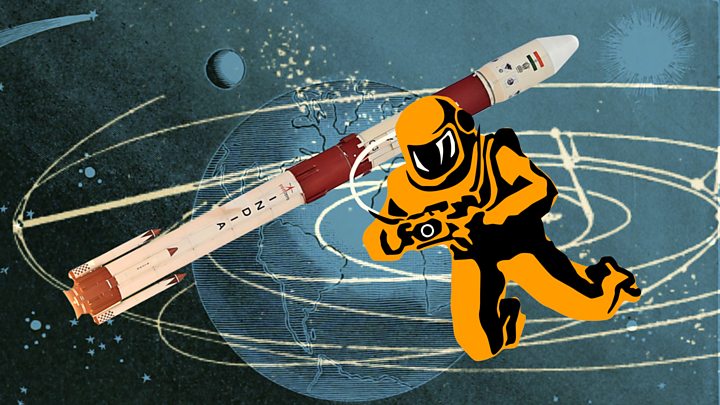
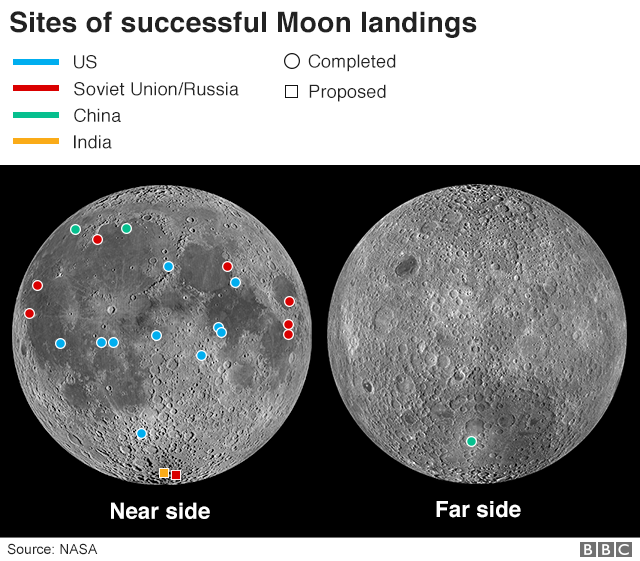
India hopes the $145m (£116m) mission will be the first to land on the Moon’s south pole.
Last month’s launch was the beginning of a 384,000km (239,000-mile) journey. Scientists hope the lander will touch down on the Moon on 6 or 7 September as planned.
India’s first lunar mission, Chandrayaan-1, was launched in 2008 but it did not land on the lunar surface. However it carried out the first and most detailed search for water on the Moon using radars.
Chandrayaan-2 (Moon vehicle 2) will try to land near the little-explored south pole of the Moon.
The mission will focus on the lunar surface, searching for water and minerals and measuring moonquakes, among other things.
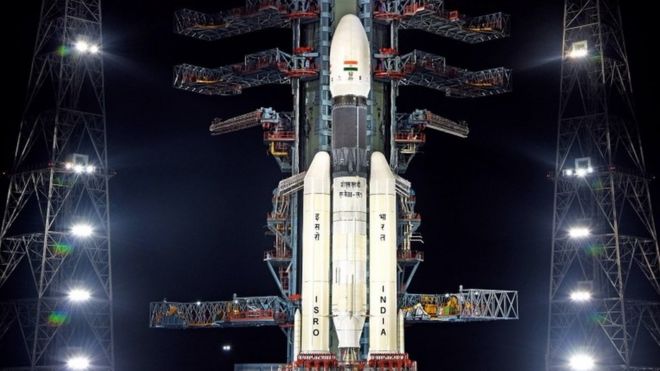
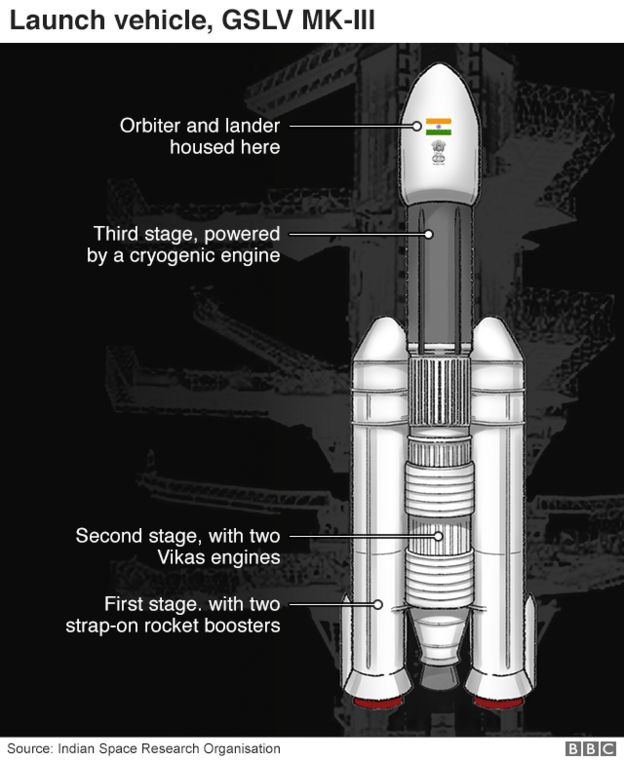
India used its most powerful rocket, the Geosynchronous Satellite Launch Vehicle Mark III (GSLV Mk-III), in this mission. It weighed 640 tonnes (almost 1.5 times the weight of a fully-loaded 747 jumbo jet) and, at 44 metres (144ft), was as high as a 14-storey building.
The spacecraft used in the mission has three distinct parts: an orbiter, a lander and a rover.
The orbiter, which weighs 2,379kg (5,244lb) and has a mission life of a year, will take images of the lunar surface.
The lander (named Vikram, after the founder of Isro) weighs about half as much, and carries within its belly a 27kg Moon rover with instruments to analyse the lunar soil. In its 14-day life, the rover (called Pragyan – wisdom in Sanskrit) can travel up to a half a kilometre from the lander and will send data and images back to Earth for analysis.
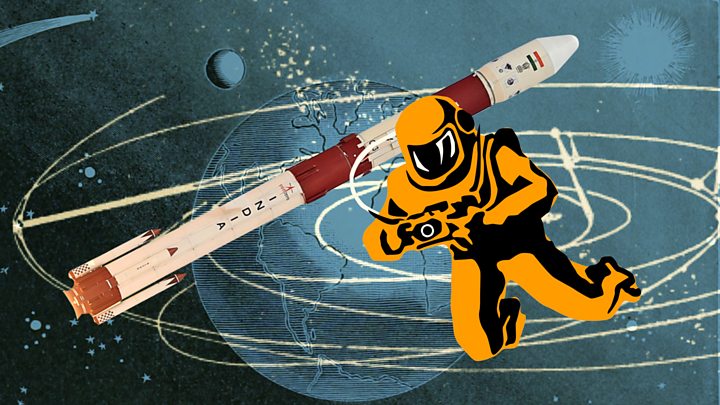
Media caption Is India a space superpower?
How long is the journey to the Moon?
The journey of more than six weeks is a lot longer than the four days the Apollo 11 mission 50 years ago took to land humans on the lunar surface for the first time.
In order to save fuel, India’s space agency has chose a circuitous route to take advantage of the Earth’s gravity, which will help slingshot the satellite towards the Moon. India does not have a rocket powerful enough to hurl Chandrayaan-2 on a direct path. In comparison, the Saturn V rocket used by the Apollo programme remains the largest and most powerful rocket ever built.
“There will be 15 terrifying minutes for scientists once the lander is released and is hurled towards the south pole of the Moon,” Isro chief K Sivan said prior to the first launch attempt.
He explained that those who had been controlling the spacecraft until then would have no role to play in those crucial moments. So, the actual landing would happen only if all the systems performed as they should. Otherwise, the lander could crash into the lunar surface.
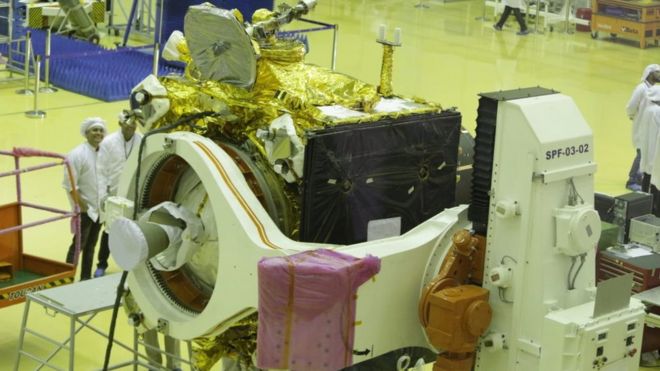
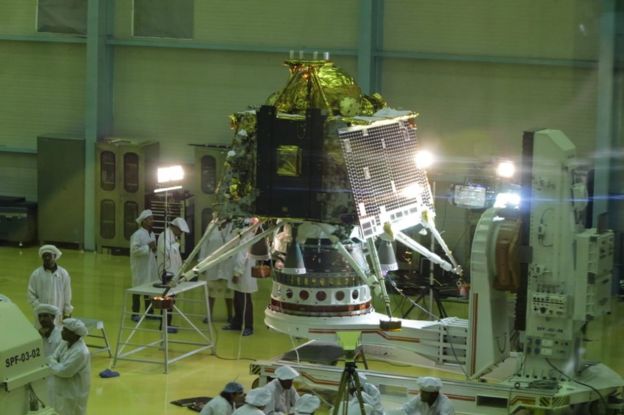
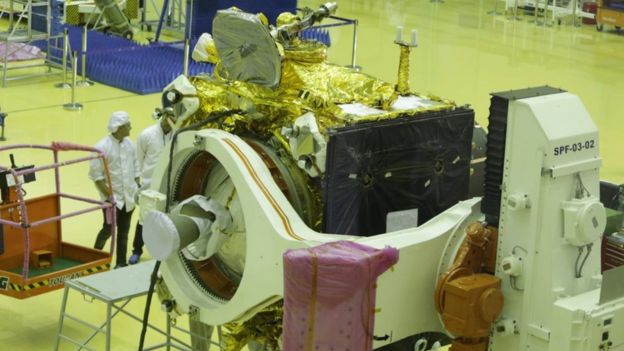
India’s space agency has unveiled its spacecraft that it hopes to land on the Moon by September.
If successful, India will be the fourth country to achieve a soft landing on the Moon, following the US, the former Soviet Union and China.
Chandrayaan-2 will be the country’s second lunar mission.
Its first mission, Chandrayaan-1 which launched in 2008, was an orbiter and did not actually land on the surface of the Moon.
Image copyright PRESS INFORMATION BUREAU, INDIA
This mission will focus on the lunar’s surface and gather data on water, minerals and rock formations.
The new spacecraft will have a lander, an orbiter and rover.
These are photos of the craft in the Indian Space and Research Organisation’s (ISRO) lab, where scientists have been busy getting the spacecraft ready:
Image copyright PRESS INFORMATION BUREAU, INDIA
Media caption Is India’s prime minister right when he calls his country a space superpower?
If all goes according to plan, the lander and rover will touch down near the lunar south pole in September. If successful, it would be the first ever spacecraft to land in that region.
The rover is expected to operate for 14 days on the Moon, ISRO chairperson K Sivan told the Times of India newspaper. “The rover will analyse the content of the lunar surface and send data and images back to the earth,” he said.
China says it has successfully landed a robotic spacecraft on the far side of the Moon, the first ever such attempt and landing.
At 10:26 Beijing time (02:26 GMT), the un-crewed Chang’e-4 probe touched down in the South Pole-Aitken Basin, state media said.
It is carrying instruments to analyse the unexplored region’s geology, as well to conduct biological experiments.
The landing is being seen as a major milestone in space exploration.
There have been numerous missions to the Moon in recent years, but the vast majority have been to orbit, fly by or impact. The last crewed landing was Apollo 17 in 1972.
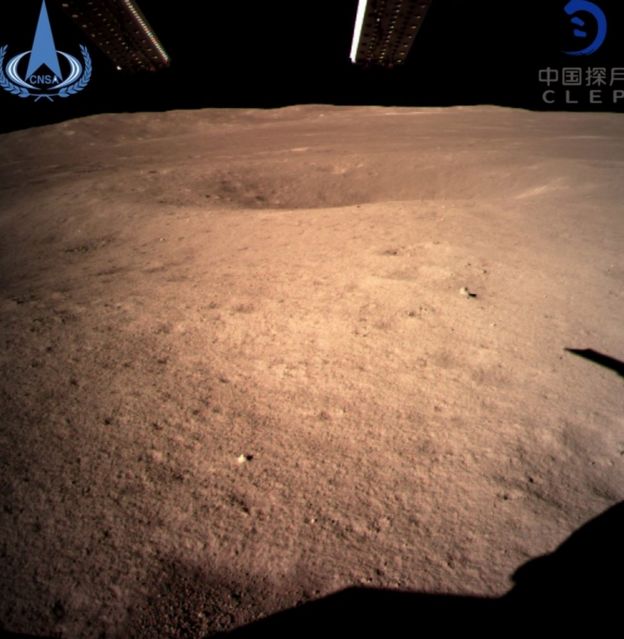
Image copyrightEPA/CNSAImage captionAll pictures and data have to be bounced off a separate satellite
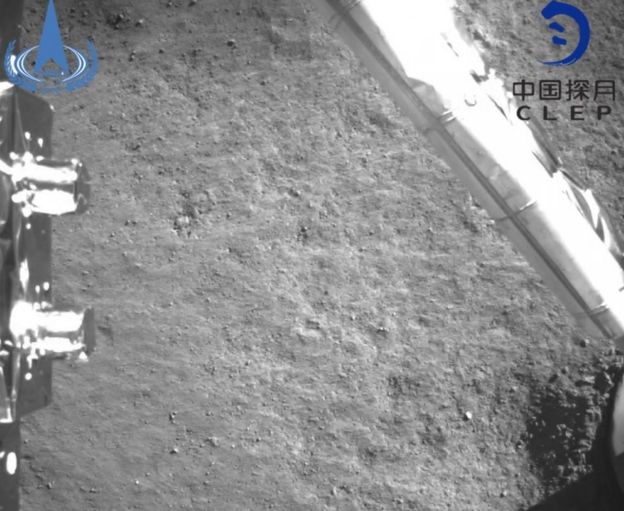
The Chang’e-4 probe has already sent back its first pictures from the surface, which were shared by state media.
With no direct communication link possible, all pictures and data have to be bounced off a separate satellite before being relayed to Earth.
Why is this Moon landing so significant?
Previous Moon missions have landed on the Earth-facing side, but this is the first time any craft has landed on the unexplored and rugged far side.
Ye Quanzhi, an astronomer at Caltech, told the BBC this was the first time China had “attempted something that other space powers have not attempted before”.
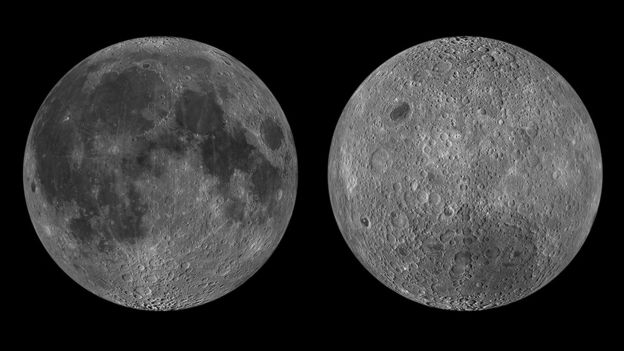
Image copyrightEPA/CNSAImage captionThe far side is not visible from the Earth due to “tidal locking”
The Chang’e-4 was launched from Xichang Satellite Launch Centre in China on 7 December; it arrived in lunar orbit on 12 December.
The Chang’e-4 probe is aiming to explore a place called the Von Kármán crater, located within the much larger South Pole-Aitken (SPA) Basin – thought to have been formed by a giant impact early in the Moon’s history.
“This huge structure is over 2,500km (1,550 miles) in diameter and 13km deep, one of the largest impact craters in the Solar System and the largest, deepest and oldest basin on the Moon,” Andrew Coates, professor of physics at UCL’s Mullard Space Science Laboratory in Surrey, told the BBC.
The event responsible for carving out the SPA basin is thought to have been so powerful, it punched through the Moon’s crust and down into the zone called the mantle. Researchers will want to train the instruments on any mantle rocks exposed by the calamity.
Image copyrightNASAImage captionThe near side (L) and far side (R) of the Moon have some key differences
A third objective is to study the far side regolith, the broken up rocks and dust that make up the surface, which will help us understand the formation of the Moon.
What else might we learn from this mission?
Chang’e-4’s static lander is carrying two cameras; a German-built radiation experiment called LND; and a spectrometer that will perform low-frequency radio astronomy observations.
Scientists believe the far side could be an excellent place to perform radio astronomy, because it is shielded from the radio noise of Earth. The spectrometer work will aim to test this idea.
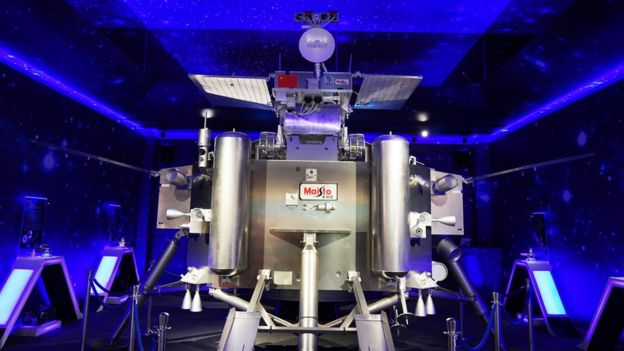
Image copyrightGETTY IMAGESImage captionA mock-up of the Chang’e-4 lander and rover, on display in Dongguan, China
The lander carries a 3kg (6.6lb) container with potato and arabidopsis plant seeds – as well as silkworm eggs – to perform biological studies. The “lunar mini biosphere” experiment was designed by 28 Chinese universities.
Other equipment/experiments include:
A panoramic camera
A radar to probe beneath the lunar surface
An imaging spectrometer to identify minerals
An experiment to examine the interaction of the solar wind (a stream of energised particles from the Sun) with the lunar surface
The mission is part of a larger Chinese programme of lunar exploration. The first and second Chang’e missions were designed to gather data from orbit, while the third and fourth were built for surface operations.
Chang’e-5 and 6 are sample return missions, delivering lunar rock and soil to laboratories on Earth.
Is there a ‘dark side of the Moon’?
The lunar far side is often referred to as the “dark side”, though “dark” in this case means “unseen” rather than “lacking light”. In fact, both the near and far sides of the Moon experience daytime and night-time.
But because of a phenomenon called “tidal locking”, we see only one face of the Moon from Earth. This is because the Moon takes just as long to rotate on its own axis as it takes to complete one orbit of Earth.
The far side has a thicker, older crust that is pocked with more craters. There are also very few of the “mare” – dark basaltic “seas” created by lava flows – that are evident on the near side.
How will scientists keep track of the rover?
In an article for the US-based Planetary Society in September, Dr Long Xiao from the China University of Geosciences (Wuhan), said: “The challenge faced by a far side mission is communications. With no view of Earth, there is no way to establish a direct radio link.”
Queqiao orbits 65,000km beyond the Moon, around a Lagrange point – a kind of gravitational parking spot in space where it will remain visible to ground stations in China and other countries such as Argentina.
What are China’s plans in space?
China wants to become a leading power in space exploration, alongside the United States and Russia.
In 2017 it announced it was planning to send astronauts to the Moon.
It will also begin building its own space station next year, with the hope it will be operating by 2022.
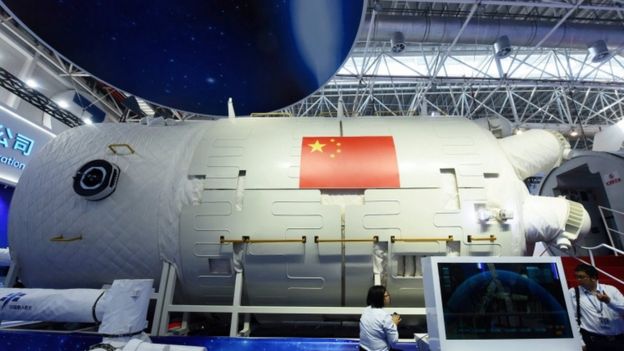
Image copyrightREUTERSImage captionA full-size model of the Tianhe core module of China’s space station
The BBC’s John Sudworth in Beijing says the propaganda value of China’s leaps forward in its space programme has been tempered by careful media management. There was very little news of the Chang’e 4 landing attempt before the official announcement it had been a success.
But Fred Watson, who promotes Australia’s astronomy endeavours as its astronomer-at-large, says the secrecy could simply be down to caution, similar to that shown by the Soviet Union in the early days of its competition with Nasa.
“The Chinese space agency is a young organisation, but perhaps in years to come, it will catch up,” he told the BBC.
Ye Quanzhi says China has made efforts to be more open.
“They live-streamed the launch of Chang’e 2 and 3, as well as the landing of Chang’e 3. PR skills take time to develop but I think China will get there,” he said.
China has been a late starter when it comes to space exploration. Only in 2003, it sent its first astronaut into orbit, making it the third country to do so, after the Soviet Union and the US.
The far side landing has already been heralded by experts at Nasa as “a first for humanity and an impressive accomplishment”.
The robotic space mission is the first landing on the side of the Moon that never
Media captionFar side of Moon captured by Chinese spacecraft
China says it has successfully landed a robotic spacecraft on the far side of the Moon, the first ever such attempt and landing.
At 10:26 Beijing time (02:26 GMT), the un-crewed Chang’e-4 probe touched down in the South Pole-Aitken Basin, state media said.
It is carrying instruments to analyse the unexplored region’s geology, as well to conduct biological experiments.
The landing is being seen as a major milestone in space exploration.
There have been numerous missions to the Moon in recent years, but the vast majority have been to orbit, fly by or impact. The last crewed landing was Apollo 17 in 1972.
Image copyrightEPA/CNSAImage captionAll pictures and data have to be bounced off a separate satellite
The Chang’e-4 probe has already sent back its first pictures from the surface, which were shared by state media.
With no direct communication link possible, all pictures and data have to be bounced off a separate satellite before being relayed to Earth.
Why is this Moon landing so significant?
Previous Moon missions have landed on the Earth-facing side, but this is the first time any craft has landed on the unexplored and rugged far side.
Ye Quanzhi, an astronomer at Caltech, told the BBC this was the first time China had “attempted something that other space powers have not attempted before”.
Image copyrightEPA/CNSAImage captionThe far side is not visible from the Earth due to “tidal locking”
The Chang’e-4 was launched from Xichang Satellite Launch Centre in China on 7 December; it arrived in lunar orbit on 12 December.
The Chang’e-4 probe is aiming to explore a place called the Von Kármán crater, located within the much larger South Pole-Aitken (SPA) Basin – thought to have been formed by a giant impact early in the Moon’s history.
“This huge structure is over 2,500km (1,550 miles) in diameter and 13km deep, one of the largest impact craters in the Solar System and the largest, deepest and oldest basin on the Moon,” Andrew Coates, professor of physics at UCL’s Mullard Space Science Laboratory in Surrey, told the BBC.
The event responsible for carving out the SPA basin is thought to have been so powerful, it punched through the Moon’s crust and down into the zone called the mantle. Researchers will want to train the instruments on any mantle rocks exposed by the calamity.
Image copyrightNASAImage captionThe near side (L) and far side (R) of the Moon have some key differences
A third objective is to study the far side regolith, the broken up rocks and dust that make up the surface, which will help us understand the formation of the Moon.
What else might we learn from this mission?
Chang’e-4’s static lander is carrying two cameras; a German-built radiation experiment called LND; and a spectrometer that will perform low-frequency radio astronomy observations.
Scientists believe the far side could be an excellent place to perform radio astronomy, because it is shielded from the radio noise of Earth. The spectrometer work will aim to test this idea.
Image copyrightGETTY IMAGESImage captionA mock-up of the Chang’e-4 lander and rover, on display in Dongguan, China
The lander carries a 3kg (6.6lb) container with potato and arabidopsis plant seeds – as well as silkworm eggs – to perform biological studies. The “lunar mini biosphere” experiment was designed by 28 Chinese universities.
Other equipment/experiments include:
A panoramic camera
A radar to probe beneath the lunar surface
An imaging spectrometer to identify minerals
An experiment to examine the interaction of the solar wind (a stream of energised particles from the Sun) with the lunar surface
The mission is part of a larger Chinese programme of lunar exploration. The first and second Chang’e missions were designed to gather data from orbit, while the third and fourth were built for surface operations.
Chang’e-5 and 6 are sample return missions, delivering lunar rock and soil to laboratories on Earth.
Is there a ‘dark side of the Moon’?
The lunar far side is often referred to as the “dark side”, though “dark” in this case means “unseen” rather than “lacking light”. In fact, both the near and far sides of the Moon experience daytime and night-time.
But because of a phenomenon called “tidal locking”, we see only one face of the Moon from Earth. This is because the Moon takes just as long to rotate on its own axis as it takes to complete one orbit of Earth.
The far side has a thicker, older crust that is pocked with more craters. There are also very few of the “mare” – dark basaltic “seas” created by lava flows – that are evident on the near side.
How will scientists keep track of the rover?
In an article for the US-based Planetary Society in September, Dr Long Xiao from the China University of Geosciences (Wuhan), said: “The challenge faced by a far side mission is communications. With no view of Earth, there is no way to establish a direct radio link.”
Queqiao orbits 65,000km beyond the Moon, around a Lagrange point – a kind of gravitational parking spot in space where it will remain visible to ground stations in China and other countries such as Argentina.
What are China’s plans in space?
China wants to become a leading power in space exploration, alongside the United States and Russia.
In 2017 it announced it was planning to send astronauts to the Moon.
It will also begin building its own space station next year, with the hope it will be operating by 2022.
Image copyrightREUTERSImage captionA full-size model of the Tianhe core module of China’s space station
The BBC’s John Sudworth in Beijing says the propaganda value of China’s leaps forward in its space programme has been tempered by careful media management. There was very little news of the Chang’e 4 landing attempt before the official announcement it had been a success.
But Fred Watson, who promotes Australia’s astronomy endeavours as its astronomer-at-large, says the secrecy could simply be down to caution, similar to that shown by the Soviet Union in the early days of its competition with Nasa.
“The Chinese space agency is a young organisation, but perhaps in years to come, it will catch up,” he told the BBC.
Ye Quanzhi says China has made efforts to be more open.
“They live-streamed the launch of Chang’e 2 and 3, as well as the landing of Chang’e 3. PR skills take time to develop but I think China will get there,” he said.
China has been a late starter when it comes to space exploration. Only in 2003, it sent its first astronaut into orbit, making it the third country to do so, after the Soviet Union and the US.
The far side landing has already been heralded by experts at Nasa as “a first for humanity and an impressive accomplishment”.


 BepiColombo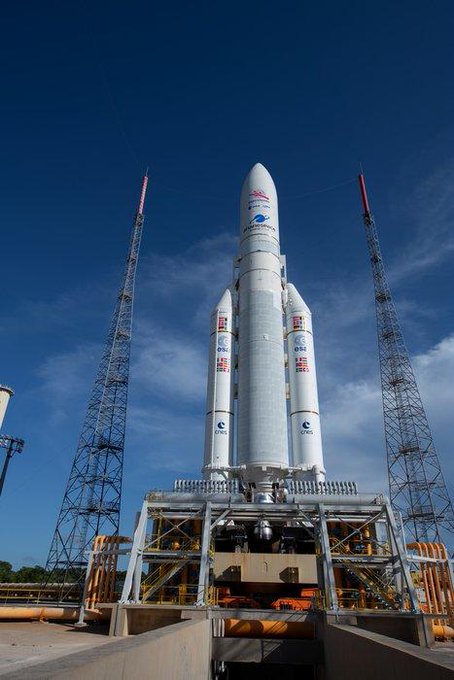






 CHINDIA ALERT: You'll be living in their world, very soon