Archive for ‘state-owned enterprises (SOEs)’

02/10/2019

Commentary: New China turns 70, witnessing a golden age

BEIJING, Oct. 2 (Xinhua) — While turning 70 often signals the beginning of a person’s twilight years, for the People’s Republic of China (PRC) it marks a golden age full of hope and vigor.

The PRC celebrated its 70th birthday on Oct. 1. China’s transformation from an agricultural society isolated from the West into the world’s second-largest economy open wide is nothing short of a miracle.

More importantly, it has charted a new path for developing countries to modernize.

Seven decades ago, the war-ravaged country started from scratch. Observers are astonished at China’s large-scale modernization, its reduction of the number of people living in poverty and the sheer volume of its consumer market. Their heads have been turned not only because of the speed of the transition but also by the unique path taken to realize this great transformation.

Reflecting on its past and present, and through experimentation, China has identified and will continue down the right path — socialism with Chinese characteristics.

Reform is the engine of China’s miracle. There is no ready-made solution for the development issues facing China. From creating special economic zones to building free trade pilot zones, from carrying out family-based production contracts to revitalizing state-owned enterprises, China has been one of the most successful countries in piloting reforms over the past decades. Now the reform is more in-depth and more comprehensive in economic, political, cultural, social and ecological sectors.

The Chinese government stresses being effective and responsive to the public interest. Development outlines are far-sighted. For example, the five-year plans are made to deal with comprehensive aspects that concern human development: food, transportation, communication, environment, health and education. These plans are a priority for the government.

Of course these achievements could never have been realized without the leadership of the CPC.

From the people and for the people, the CPC has always upheld its principle of striving for the happiness of the people and the rejuvenation of the nation.

At a life-or-death moment, the CPC shouldered the mission of saving the nation from existential peril. After 28 years of bloody struggle, it led the Chinese people to overthrow the “three mountains” placed on their heads and put an end to the semi-colonial and semi-feudal society of old China. Gone are the days where any attempt to bully China with “fists” or “intimidation” would succeed.

Despite overseas doubts, misunderstandings and predictions that its survival would be short-lived, the CPC has stunned the world with its leadership, innovative theories and ability to unite and organize the people.

It abolished the agricultural tax that had been in place for more than 2,600 years; it established a political system in which people are masters of their own affairs; it did its utmost to help people shake off poverty and keep nearly 1.4 billion people well-off.

No ruling party in the world can match the CPC’s record of adhering to the truth, versing itself in self-reform and self-purification, and turning impossibility into certainty in the face of difficulties and challenges, again and again.

The 70-year journey was never smooth. Trials and hardships abounded. The Chinese people dealt with floods and massive earthquakes and guarded against SARS and financial tsunamis. Yet these twists and turns never blocked China’s way forward but made it more sober, determined and mature.

Today, more than at any other time in history, China is closer to, more confident and more capable of achieving the great rejuvenation of the Chinese nation. However, lofty goals are never easily reached.

The world has been undergoing tremendous changes unseen in a century. Resistant external forces and headwinds still remain. “Zero-sum game” and “superior civilization” mentalities, among others, are prevailing.

The CPC will continue to lead the Chinese people to fight trade bullying, blackmailing and hegemonism. Only the CPC can lead China to emerge as a stronger country.

It all started long ago, and the journey is far from over.

Source: Xinhua
27/09/2019

EU and Japan play ‘guardians of universal values’ in effort to challenge China’s Belt and Road Initiative

  • Japan’s Prime Minister Shinzo Abe and EC President Jean-Claude Juncker mark first anniversary of EU-Asia Connectivity scheme with swipes at China
  • Partners reach out to countries in Balkans and Africa and agree US$65.5 billion development plan
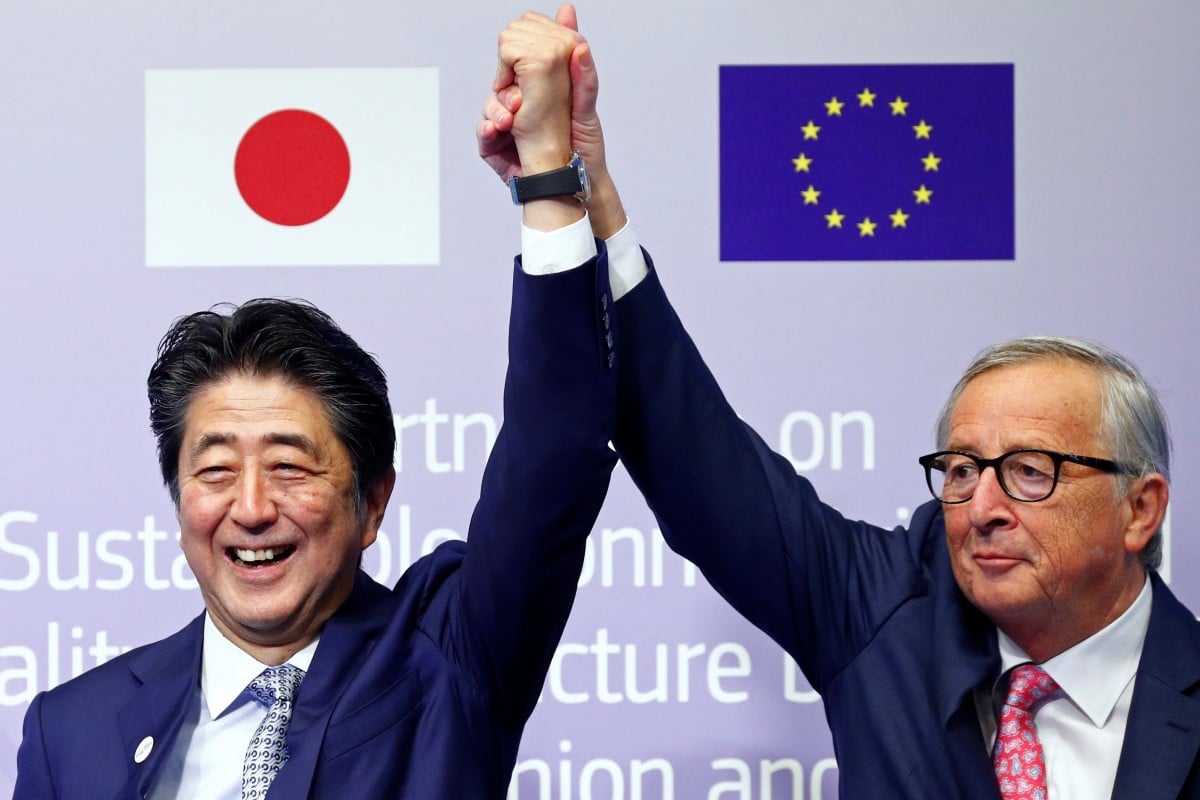
Japan’s Prime Minister Shinzo Abe (left) and European Commission President Jean-Claude Juncker mark the anniversary of the EU-Asia Connectivity scheme in Brussels, Belgium. Photo: Reuters
The European Union and Japan are stepping up their efforts to counter China’s

Belt and Road Initiative

, with their leaders vowing to be “guardians of universal values” such as democracy, sustainability and good governance.

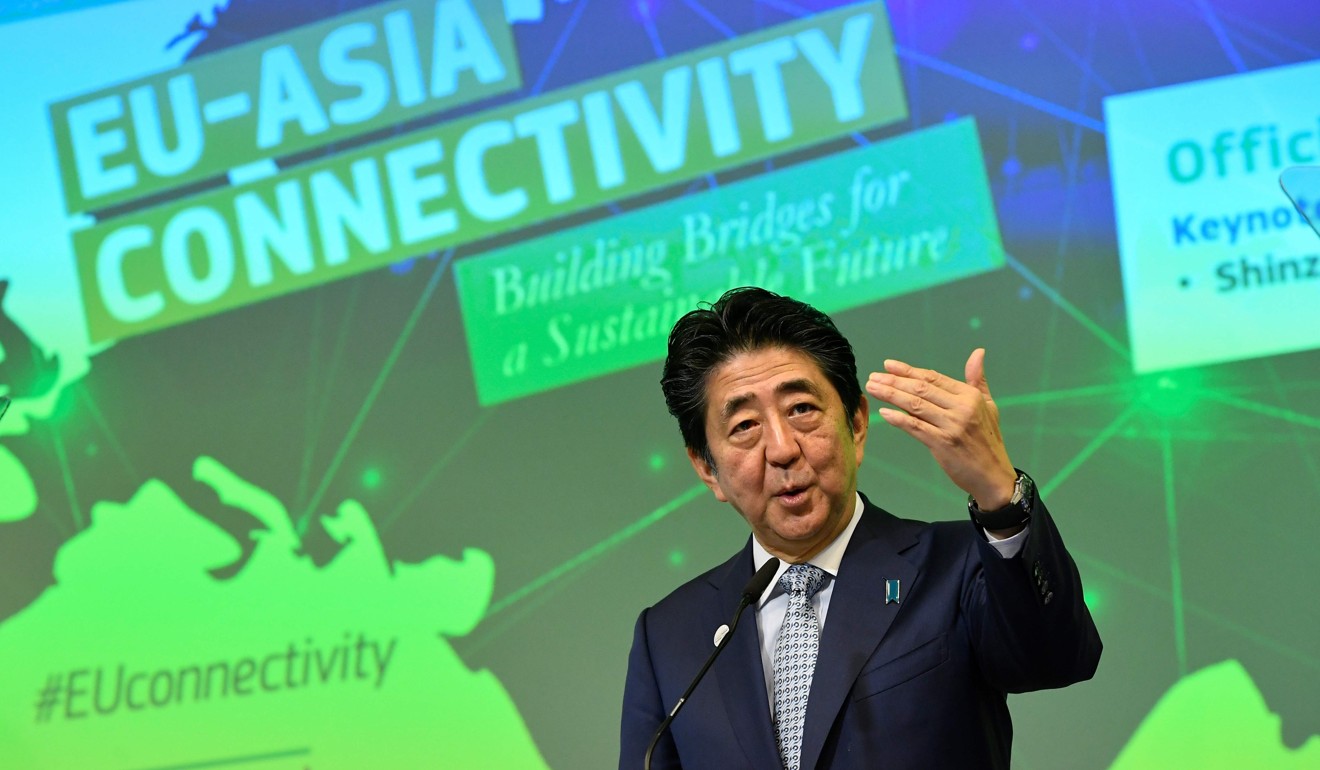
Speaking in Brussels on Friday, Japanese Prime Minister Shinzo Abe said the world’s third-biggest economy would work with the EU to strengthen their transport, energy and digital ties to Africa and the Balkans – key regions for China’s flagship trade and development project.
At a forum to mark the first anniversary of the EU-Asia Connectivity scheme, Abe and European Commission President Jean-Claude Juncker signed an agreement formalising Japan’s involvement in the Europe-Asia plan that will be backed by a 60 billion (US$65.54 billion) EU guarantee fund, development banks and private investors.

Abe said Japan would ensure that officials from 30 African countries would be trained in sovereign debt management over the next three years, a veiled attack on what Western diplomats claim is China’s debt trap for its belt and road partners.

“The EU and Japan are linked through and through,” Abe said. “The infrastructure we build from now on must be [high] quality infrastructure.

“Whether it be a single road or a single port, when the EU and Japan undertake something, we are able to build sustainable, comprehensive and rules-based connectivity, from the Indo-Pacific to the west Balkans and Africa.”

Japan wants to extend its business reach through its alliance with the EU as its economy slows and geopolitical competition from China takes its toll.

Japan indicates China is bigger threat than North Korea in latest defence review

China’s low-key delegation to the forum was led by Guo Xuejun, deputy director general of international affairs at the foreign ministry.

The US was represented by its deputy assistant secretary of state for cyber policy, Robert Strayer, who was in Europe to lobby against Chinese telecoms giant Huawei Technologies and its involvement in fifth-generation telecoms networks.

Abe and Juncker made cybersecurity the highlight of their addresses. Juncker, who will step down from the presidency by the end of October, repeated his attack on China’s trade policies without naming the country.

“Openness is reciprocal, based on high standards of transparency and good governance, especially for public procurement, and equal access to businesses while respecting intellectual property rights,” he said.

Prime Minister Shinzo Abe says Japan will train officials from 30 African countries in sovereign debt management in three years. Photo: AFP

European policymakers and businesses have for years complained about China’s refusal to allow foreign companies in without a Chinese joint venture partner, a practice that critics claimed involved forced transfer of intellectual property to the Chinese side.

“One of the keys to successful connectivity is to respect basic rules and common sense,” Juncker said, stressing that EU-Japanese cooperation focused on the “same commitment to democracy, rule of law, freedom and human dignity”.

European businesses urge EU to take ‘defensive’ measures against China’s state-owned enterprises

When the commission proposed improved transport, energy and digital infrastructure links with Asia last year, it denied it was seeking to stymie Chinese ambitions.

The EU plan, which would be backed by additional funds from the EU’s common budget from 2021, private sector loans and development banks, amounted to a response to China’s largesse in much of central Asia and south-eastern Europe, where Beijing has invested billions of dollars.

Source: SCMP

19/09/2019

Economic Watch: Chinese SOEs rise from scratch to spotlight

BEIJING, Sept. 18 (Xinhua) — China’s state-owned enterprises (SOEs) have navigated torrential waters over the past 70 years, from breaking the ground for the country’s industrial system to becoming the model of enterprises worldwide, and are now pledging more contributions to the world economy.

LAYING THE FOUNDATION

At a time when China’s manufacturing industry was still in its infancy, it was the SOEs that supplied the bedrock of the country’s industrial development.

The seamless steel pipe that debuted in China 66 years ago, the green-clad truck bearing the brand name “Jiefang” as well as the silver-white fighter jet that first rolled off production lines in 1956 attested to the SOEs’ early triumphs.

Seven decades have proved long enough for China’s SOEs to emulate their foreign counterparts and lead global innovation.

As a long-time pillar of the Chinese economy, the steel industry delivered a total output of 928 million tonnes in 2018, almost 5,900 times that of 1949, accounting for more than half of the world’s annual steel production.

Today, SOEs remain active in the advent and growth of China’s most acclaimed industrial fronts, including high-speed railway, supercomputers and navigation satellite systems, to name a few.

UNLEASHING VITALITY

Alongside their dazzling achievements, the SOEs’ quest to maintain vitality is equally memorable.

China’s SOEs have undergone a series of reforms in terms of shareholding, payroll and human resource management since 1978, in an effort to better fit into the big picture of China’s economy, which at the time was morphing into a socialist market economy marked by diverse corporate ownerships.

These reforms focused on granting the SOEs more leeway in making corporate decisions.

In 2003, the founding of the State-owned Assets Supervision and Administration Commission (SASAC) of the State Council further improved the management system for China’s SOEs and better prepared them for market competition.

Ongoing tasks of SOE reform include mixed-ownership reforms, employee shareholding and differentiated salary systems, with the underlying logic of delegating power unchanged.

GOING TOP-TIER

Years of continuous reforms have honed Chinese SOEs’ competitive edge, equipping them with the technologies and managerial skills needed to become global top-tier enterprises.

From 1978 to 2018, the business revenue and profit of China’s SOEs expanded at an annual rate of 11.9 percent and 10.3 percent, respectively.

The combined total assets of China’s SOEs in 2018 reached 247.1 times those in 1978, while shareholders’ equity amounted to 130 times.

The number of Chinese enterprises in the Fortune 500 list has risen for the 14th consecutive year, surpassing the U.S. in 2019 with 129 companies, among which 48 are centrally administered SOEs.

Seventy years on, the path of glory continues for China’s SOEs.

Source: Xinhua

09/03/2019

China to expand mixed ownership reform to more than 100 SOEs

BEIJING, March 9 (Xinhua) — China will expand the mixed ownership reform to more than 100 state-owned enterprises (SOEs), an official with the country’s state-asset regulator said Saturday.

“There will be more than 100 SOEs in the fourth batch of mixed ownership reform, which will be pushed ahead in key areas,” Xiao Yaqing, head of the State-owned Assets Supervision and Administration Commission of the State Council, said at a press conference on the sidelines of the annual legislative session.

Since 2016, China has selected 50 SOEs in three batches to conduct the pilot reform in fields including power, energy, civil aviation, telecommunications, and defence.

The first three batches have done a good job in exploring and experimenting with the means, equity ratio and governance structure of mixed ownership, Xiao said.

Next, China will create a sound environment for the reform so that enterprises of all kinds of ownership can realize integrated and common development, he added.

Source: Xinhua

Law of Unintended Consequences

continuously updated blog about China & India

ChiaHou's Book Reviews

continuously updated blog about China & India

What's wrong with the world; and its economy

continuously updated blog about China & India