Archive for ‘State visit’

06/03/2020

China, Japan in close communication over Xi’s state visit: FM spokesperson

BEIJING, March 5 (Xinhua) — China and Japan are in close communication regarding the timing of President Xi Jinping’s state visit to Japan, a Foreign Ministry spokesperson said Thursday.

While China and Japan are making all-out efforts to fight against the COVID-19 epidemic, both sides agreed that it must be ensured President Xi’s visit shall come at the most opportune time with the right conditions and atmosphere to achieve a complete success, spokesperson Zhao Lijian told a daily news briefing in response to reports that the visit may not materialize this spring.

“Upon agreement, the two sides will maintain close communication regarding the timing of the visit,” Zhao said.

Source: Xinhua

26/11/2019

China, Japan agree to further improve ties, strengthen people-to-people exchanges

JAPAN-TOKYO-CHINA-WANG YI-SHINZO ABE-MEETING

Japanese Prime Minister Shinzo Abe meets with Chinese State Councilor and Foreign Minister Wang Yi in Tokyo, Japan, Nov. 25, 2019. (Xinhua/Du Xiaoyi)

TOKYO, Nov. 25 (Xinhua) — Japanese Prime Minister Shinzo Abe and Chinese State Councilor and Foreign Minister Wang Yi on Monday agreed that both sides should work together to further improve bilateral ties and strengthen people-to-people exchanges.

Japan and China have witnessed frequent high-level exchanges and positive progress in the improvement of bilateral relations recently, said Abe, adding that the Japanese side is eagerly looking forward to Chinese President Xi Jinping’s state visit next spring and believes that it will be a major opportunity for promoting bilateral relations in the new era.

A stable Japan-China relationship is the cornerstone of peace and prosperity in Asia, and is also crucial to addressing current global challenges. Japan is ready to work with China to usher in a new future of bilateral relations, he said.

Japan welcomes the launch of the high-level consultation mechanism on people-to-people exchanges between the two countries and stands ready to work with China to continuously boost the affinity between the two peoples and properly handle sensitive differences so as to create a favorable atmosphere and conditions for the improvement and development of bilateral relations, he added.

Abe also said he is looking forward to further in-depth communication with Chinese leaders on bilateral ties during his visit to China next month to attend the China-Japan-ROK (Republic of Korea) leaders’ meeting.

Wang, for his part, said that with the political guidance of the two leaders and joint efforts of both sides, China-Japan relations have returned to the right track and have seen a sound momentum of improvement and development. The top leaders of the two countries had a successful meeting in Osaka in June and reached important consensus on building bilateral relations that meet the requirements of the new era.

The China-Japan relations have gone through twists and turns and the present situation has not come easily and should be doubly cherished, Wang said.

The two sides should push for continuous improvement and development of China-Japan relations from a longer-term and broader perspective, he said.

He called on the Japanese side to meet China halfway, take more positive actions, properly manage and handle differences so as to create a favorable atmosphere and conditions for the proposed major political and diplomatic agenda of the two countries.

The improvement and development of China-Japan relations not only conform to the interests of the two countries and peoples but also has great positive significance to regional peace and stability, injecting stability into the current world situation which is full of uncertainty, said Wang.

The Chinese side welcomes Abe to attend the China-Japan-ROK leaders’ meeting in China next month. China is willing to work with Japan to give full play to the role of the high-level consultation mechanism on people-to-people exchanges, usher in a new era of exchanges between our peoples, localities and youth, and create a brighter future for bilateral relations, he said.

Source: Xinhua

12/11/2019

Xi, Greek PM visit Piraeus Port, hail BRI cooperation

GREECE-CHINESE PRESIDENT-PIRAEUS PORT-VISIT

Chinese President Xi Jinping talks with representatives of local staff members as he visits the Piraeus Port in Greece, Nov. 11, 2019. Xi and his wife Peng Liyuan, accompanied by Greek Prime Minister Kyriakos Mitsotakis and his wife, visited the Piraeus Port on Monday. (Xinhua/Xie Huanchi)

ATHENS, Nov. 11 (Xinhua) — Chinese President Xi Jinping and Greek Prime Minister Kyriakos Mitsotakis on Monday visited the Piraeus Port, a flagship project in bilateral collaboration, and hailed it as a success under the Belt and Road cooperation.

In 2009, a subsidiary of China Ocean Shipping Company, also known as COSCO, started managing the Piraeus Port’s container terminals. In 2016, COSCO acquired a majority stake in the port and formally took over its management and operation.

So far, the project has created jobs for over 10,000 local people directly and indirectly, and has built the Piraeus Port into the largest port in the Mediterranean region and one of the fastest growing container terminals in the world.

Upon their arrival, Xi and his wife Peng Liyuan, accompanied by the Greek prime minister and his wife, were warmly welcomed by Chinese and foreign employees waving national flags of the two countries.

Talking with Xi about their work and life, representatives of local staff extended heartfelt gratitude to COSCO for providing them with job opportunities in the most difficult times during the Greek debt crisis.

Thanks to the Chinese company, they now enjoy stable jobs and happy lives, the Greek employees told Xi.

With the Piraeus Port becoming an important fruit in jointly building the Belt and Road, the local staff said they feel very proud and have full confidence in the port’s future.

Delighted to visit the port, Xi said that seeing is believing, and that he has seen here today that the China-proposed Belt and Road Initiative (BRI) was not a slogan or tale, but a successful practice and brilliant reality.

Noting that the BRI upholds the principle of extensive consultation, joint development and shared benefits, Xi said no one makes decisions for others, and instead all participants share responsibilities and benefits in BRI cooperation.

China, in its external exchanges, upholds the right approach to justice and interests, said the Chinese president, adding that he is delighted to know that COSCO’s Piraeus Port project was able to help local people through hard times.

Xi called local workers important participants in and contributors to jointly building the Belt and Road as they have helped the Piraeus Port develop well, and wished them success at work and a happy life.

The Piraeus Port project is a successful example of China-Greece cooperation featuring complementing each other’s advantages, combining forces, and achieving mutual benefits, Xi said.

He urged the two sides to make continued efforts to further construct and develop the port, achieve the goal of making the port a regional logistics distribution center, and advance the building of the China-Europe Land-Sea Express Line.

Expressing his confidence in the unlimited prospects of the Piraeus Port, Xi said the cooperation fruits will continue to benefit the people of both countries and the region. He also conveyed his wish that the two countries will continuously make new achievements in their cooperation.

For his part, Mitsotakis underlined that China helped the Greek people when his country was embroiled in the debt crisis.

Facts have proved that the Piraeus Port project is mutually beneficial, and has strongly boosted the recovery of the Greek economy and social development, served the interests of Greece and its people, and received the support from the Greek people, he said.

From that the Greek side has come to a deep understanding of the true meaning of “friends,” added the prime minister.

Greece is willing to join efforts with China to further expand and strengthen the Piraeus Port project and make it a paragon in the joint construction of the Belt and Road, Mitsotakis said.

Xi arrived in the Greek capital of Athens on Sunday for a three-day state visit to the European country.

Source: Xinhua

28/10/2019

Putin accepts Duterte invite, just before Manila-Beijing South China Sea oil talks. Coincidence?

  • The president is set to become the first Russian leader to make a state visit to the Philippines for more than 40 years, according to a former envoy
  • Moscow is aware of China’s entry into the Philippines, and could have its eye on some projects there, while the US is also watching developments
Russian President Vladimir Putin and Philippine President Rodrigo Duterte shake hands during a 2016 meeting in Peru. Photo: EPA
The timing of Moscow’s announcement over the weekend that President Vladimir Putin
has accepted an invitation to visit Manila has raised eyebrows, as it comes on the eve of crucial bilateral talks between the Philippines and China on joint oil exploration in the

South China Sea

.

In a statement immediately welcomed by the Philippine presidential palace, Igor Khovaev, Russia’s ambassador to the Philippines, on Saturday told reporters Putin had accepted Duterte’s invitation “with gratitude”.

No date has been set for the visit, with Khovaev only saying Moscow would “do our best to arrange this meeting as soon as possible”.

A steering committee with representatives from both Manila and Beijing is set to meet this week to discuss the joint oil exploration deal. China has proposed a 60 per cent-40 per cent split in favour of the Philippines, according to Hermogenes Esperon, 

Courting Russia with South China Sea oil is a ‘dangerous gamble’ for Duterte

Neither side has clarified if the split refers to ownership or revenue, and no other details were disclosed.

After an August meeting with Duterte, Chinese President Xi Jinping said the countries could take a “bigger step” in jointly developing oil and gas resources if they could properly handle their sovereignty dispute in the South China Sea.

But defence and security analysts say the Philippine president took a “dangerous gamble” on a visit to Russia last month, when he invited the Russian state oil company Rosneft to explore for oil in Philippine waters – which include parts of the South China Sea claimed by China.

The timing of Moscow’s announcement has not gone unnoticed.

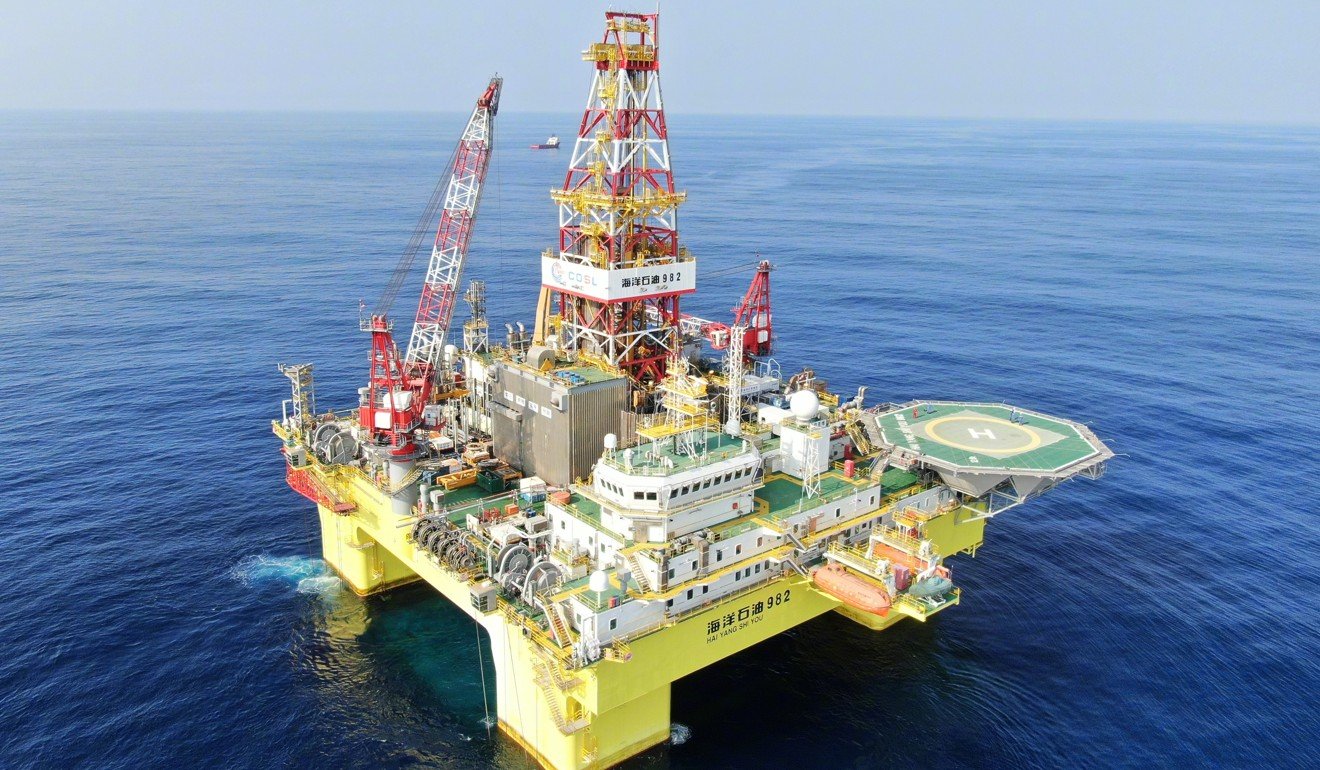
A Chinese deepwater oil rig in the South China Sea. Photo: Weibo

“It’s a welcome and historic development. Some wise guy in the Duterte government thought about timing [the invitation to Putin around the oil talks with Beijing],” said retired Philippine ambassador Lauro Baja, who once served as president of the United Nations Security Council.

Baja told the Post that no Russian president had visited the Philippines during his more than 40 years with the Department of Foreign Affairs.

“The Philippines then was almost a nonentity as far as Russia was concerned, [but] maybe now Russia recognises the strategic importance of the Philippines [in terms of] regional politics,” he said.

Baja said Moscow was aware of China’s entry into the Philippines, and could have its eye on some projects there.

“For all their so-called alliance, China and Russia are fierce competitors for influence and other benefits. And I think Russia has some objectives in mind like selling armaments and [forging] technological agreements,” he said, while cautioning that the situation remained “nebulous”.

New Philippines military chief sees no ‘shooting war’ in South China Sea despite disputes

“It’s a fascinating development but things are still early … For now, this is [just] an invitation extended by Duterte and accepted in principle by Putin.”

The United States will also be monitoring developments in the Philippines, according to Greg Poling, director of the Washington-based Centre for Strategic and International Studies’ Asia Maritime Transparency Initiative.

“Russia is eager to boost its influence in the region, and doubtless doing so with a long-standing US ally is seen as a bonus by Moscow,” he said. “There is nothing that prevents the Philippines from engaging in security cooperation with Russia, but the devil will be in the details.”

Poling added that the US would be concerned if Russia-Philippine cooperation involved acquiring military platforms that were incompatible with the shared platforms and doctrines used by Washington and Manila, as well as the latter’s other major security partners, namely Australia, Japan and South Korea.

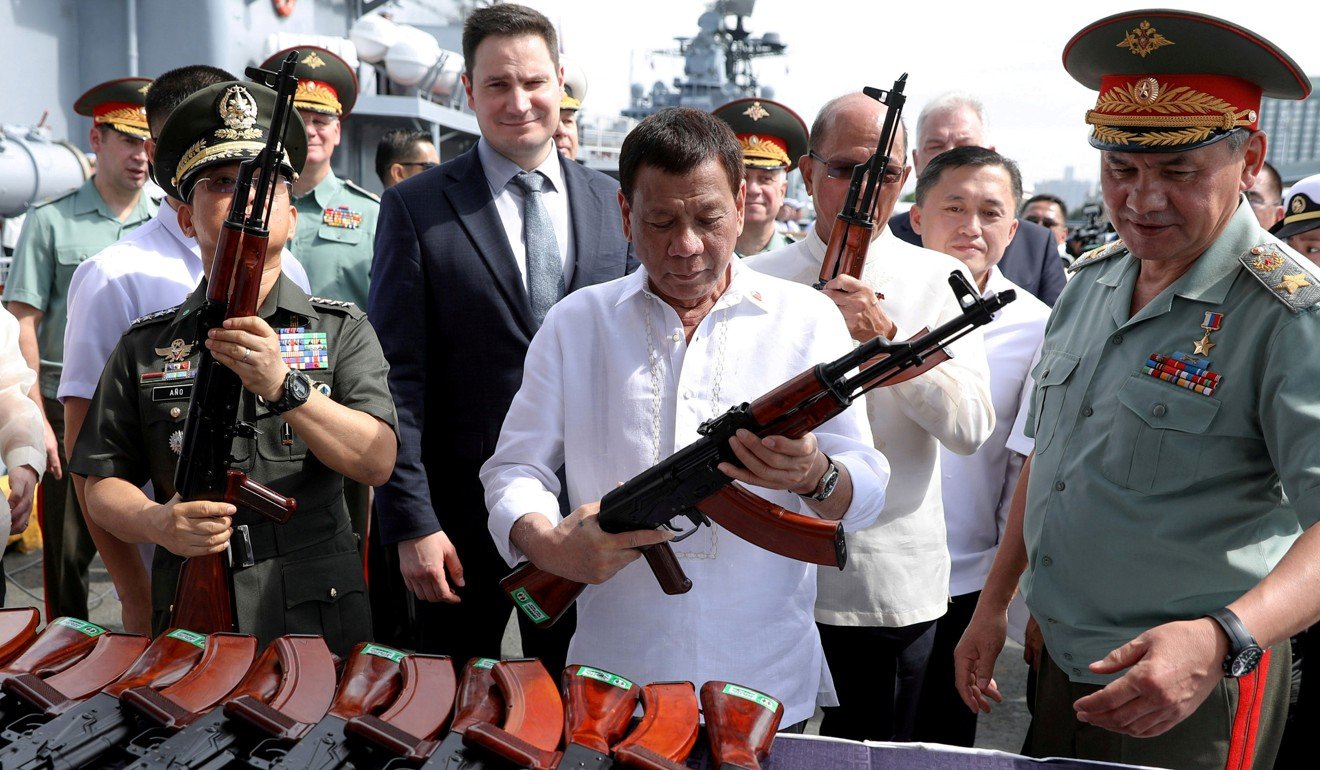
Philippine President Rodrigo Duterte inspects firearms donated by Russia in 2017. Photo: Reuters

“The US will also be concerned if any acquisitions or cooperation with Russia might threaten information security or intelligence cooperation between the US and the Philippines,” he said.

“And finally, any major platforms acquired from Russia would likely require the US to impose sanctions on the Philippines unless a waiver is granted, and the US government has been very stingy about awarding those waivers because they undermine the effectiveness of the sanctions regime.”

Moscow last week offered to help the Philippines produce its own arms for both domestic use and export with the help of Russian technology. Max Montero, an Australia-based Filipino security consultant, viewed that offer as “a swipe at the US”.

“Imagine a US stronghold and long-time ally and former colony becoming a manufacturing hub for Russian arms. And it makes it worse if [the Philippine armed forces] buys them too,” he said.

“Weakening the US alliances in Asia will benefit Russia [as it is] one of the US’ competitors in arms sales and geopolitics.”

Russia offers arms technology to the Philippines with ‘no conditions’ as US ties falter

The Philippines, Montero said, would benefit from such an arrangement since it is “a laggard in defence technology”. However, he pointed out that the country’s armed forces continue to buy weapons from the US and receive American arms as grants, potentially limiting the domestic market for Russian arms.

Navy cooperation has also been on the agenda, as Moscow and Manila discussed signing a new naval pact in March, while warships from each country have visited the other this year. Philippine naval vessels made their first-ever visit to Russia in October, while three Russian ships docked in the Philippines for a goodwill visit in January.

Russia is the top supplier of arms to Southeast Asia, and the No 2 global arms supplier, behind the US. Southeast Asia bought US$6.6 billion of Russian arms between 2010 and 2017, or more than 12 per cent of Russia’s sales, according to the Stockholm International Peace Research Institute, a Swedish think tank that publishes global arms tracking data.

Source: SCMP

15/10/2019

Xi returns to Beijing after informal meeting with Indian PM, visit to Nepal

NEPAL-KATHMANDU-CHINA-XI JINPING-FAREWELL CEREMONY

Nepali President Bidya Devi Bhandari hosts a grand farewell ceremony for Chinese President Xi Jinping at the airport in Kathmandu, Nepal, Oct. 13, 2019. Nepali Vice President Nanda Bahadur Pun, Prime Minister K.P. Sharma Oli, Chairman of the National Assembly Ganesh Prasad Timilsina, cabinet members and senior army generals also attended the ceremony. Chinese President Xi Jinping returned to Beijing from Kathmandu on Sunday. (Xinhua/Gao Jie)

BEIJING, Oct. 13 (Xinhua) — Chinese President Xi Jinping returned to Beijing Sunday evening after his second informal meeting with Indian Prime Minister Narendra Modi in India and a state visit to Nepal.

Xi’s entourage, including Ding Xuexiang, member of the Political Bureau of the Communist Party of China (CPC) Central Committee, member of the Secretariat of the CPC Central Committee, and director of the General Office of the CPC Central Committee; Yang Jiechi, member of the Political Bureau of the CPC Central Committee and director of the Office of the Foreign Affairs Commission of the CPC Central Committee; State Councilor and Foreign Minister Wang Yi; and He Lifeng, vice chairman of the National Committee of the Chinese People’s Political Consultative Conference and head of the National Development and Reform Commission, also returned to Beijing on the same plane.

As Xi and his entourage were leaving Kathmandu on Sunday noon local time, people of Nepal flocked to both sides of a road leading to the airport, waving flags and playing music to see the Chinese guests off.

Nepali President Bidya Devi Bhandari hosted a grand farewell ceremony for Xi at the airport. Nepali Vice President Nanda Bahadur Pun, Prime Minister K.P. Sharma Oli, Chairman of the National Assembly Ganesh Prasad Timilsina, cabinet members and senior army generals also attended the ceremony, which featured a 21-gun salute and the playing of national anthems of China and Nepal.

Calling his visit to Nepal a “very successful” one, Xi told Bhandari that upon his arrival, he had been warmly welcomed by the Nepali government and people.

Xi said he was convinced that the China-Nepal friendship enjoyed lasting popularity among the two peoples and will be unbreakable.

Expressing his appreciation for the arrangements made by the Nepali president, government and people, Xi said he was very satisfied with the visit that had resulted in the upgrading of bilateral relations.

He called for joint efforts to further develop the friendly relations between the two countries.

Bhandari said Xi’s successful and fruitful visit has become a milestone in the history of bilateral ties.

The Nepal-China relationship has entered a new era and stepped on a new height, Bhandari said, adding that Nepal will resolutely work with China to promote friendly and good neighborly relations and strategic cooperative partnership.

Source: Xinhua

14/10/2019

Xi returns to Beijing after informal meeting with Indian PM, visit to Nepal

NEPAL-KATHMANDU-CHINA-XI JINPING-FAREWELL CEREMONY

Nepali President Bidya Devi Bhandari hosts a grand farewell ceremony for Chinese President Xi Jinping at the airport in Kathmandu, Nepal, Oct. 13, 2019. Nepali Vice President Nanda Bahadur Pun, Prime Minister K.P. Sharma Oli, Chairman of the National Assembly Ganesh Prasad Timilsina, cabinet members and senior army generals also attended the ceremony. Chinese President Xi Jinping returned to Beijing from Kathmandu on Sunday. (Xinhua/Gao Jie)

BEIJING, Oct. 13 (Xinhua) — Chinese President Xi Jinping returned to Beijing Sunday evening after his second informal meeting with Indian Prime Minister Narendra Modi in India and a state visit to Nepal.

Xi’s entourage, including Ding Xuexiang, member of the Political Bureau of the Communist Party of China (CPC) Central Committee, member of the Secretariat of the CPC Central Committee, and director of the General Office of the CPC Central Committee; Yang Jiechi, member of the Political Bureau of the CPC Central Committee and director of the Office of the Foreign Affairs Commission of the CPC Central Committee; State Councilor and Foreign Minister Wang Yi; and He Lifeng, vice chairman of the National Committee of the Chinese People’s Political Consultative Conference and head of the National Development and Reform Commission, also returned to Beijing on the same plane.

As Xi and his entourage were leaving Kathmandu on Sunday noon local time, people of Nepal flocked to both sides of a road leading to the airport, waving flags and playing music to see the Chinese guests off.

Nepali President Bidya Devi Bhandari hosted a grand farewell ceremony for Xi at the airport. Nepali Vice President Nanda Bahadur Pun, Prime Minister K.P. Sharma Oli, Chairman of the National Assembly Ganesh Prasad Timilsina, cabinet members and senior army generals also attended the ceremony, which featured a 21-gun salute and the playing of national anthems of China and Nepal.

Calling his visit to Nepal a “very successful” one, Xi told Bhandari that upon his arrival, he had been warmly welcomed by the Nepali government and people.

Xi said he was convinced that the China-Nepal friendship enjoyed lasting popularity among the two peoples and will be unbreakable.

Expressing his appreciation for the arrangements made by the Nepali president, government and people, Xi said he was very satisfied with the visit that had resulted in the upgrading of bilateral relations.

He called for joint efforts to further develop the friendly relations between the two countries.

Bhandari said Xi’s successful and fruitful visit has become a milestone in the history of bilateral ties.

The Nepal-China relationship has entered a new era and stepped on a new height, Bhandari said, adding that Nepal will resolutely work with China to promote friendly and good neighborly relations and strategic cooperative partnership.

Source: Xinhua

23/06/2019

Xi Jinping’s state visit to North Korea aims for ‘new impetus’ in ties

  • Stalled denuclearisation talks also expected to be on the agenda when Chinese president meets Kim Jong-un this week
  • Analysts say Korean peninsula has become intense diplomatic battleground between Beijing and Washington
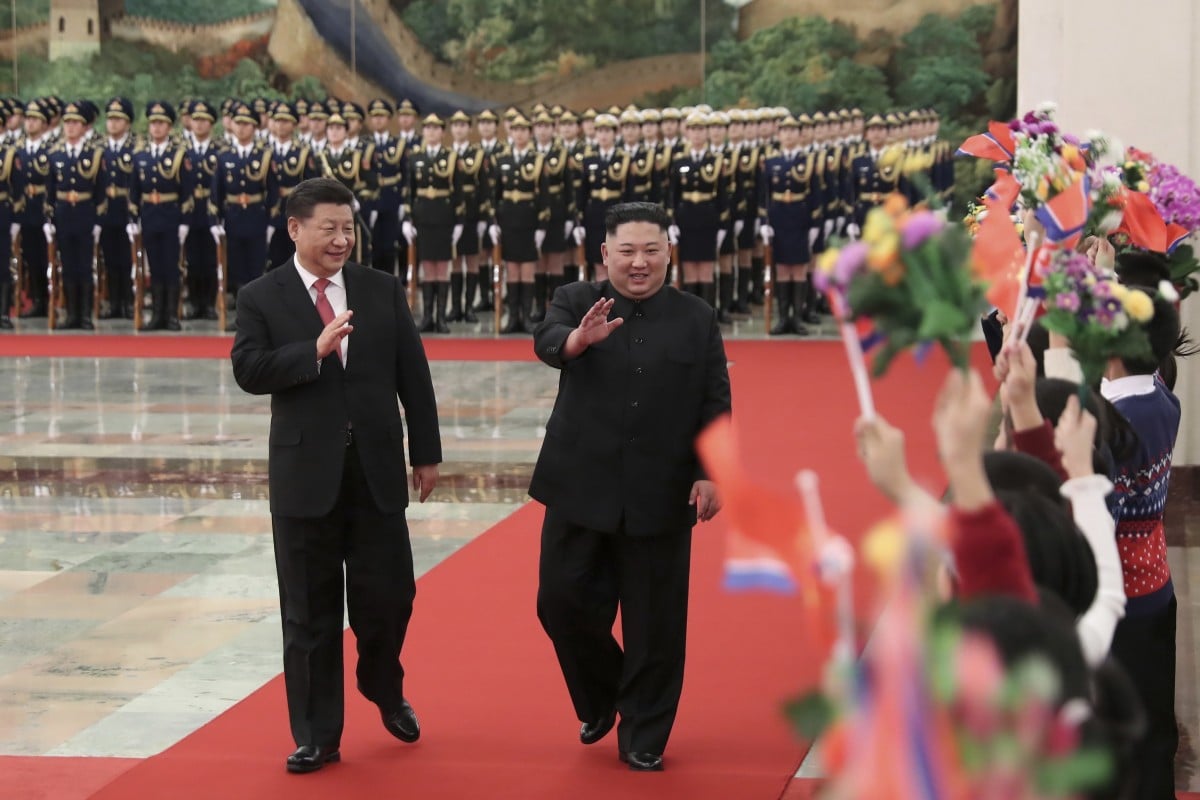
North Korean leader Kim Jong-un (right) attends a welcome ceremony in Beijing with Chinese President Xi Jinping in January. Xi will begin a visit to Pyongyang on Thursday. Photo: AP
Xi Jinping’s upcoming trip to 
North Korea

will be a state visit – a higher status than the last trip to the hermit kingdom by a Chinese president, highlighting the close bilateral ties between Beijing and Pyongyang.

Xi’s two-day trip, which 
begins on Thursday

, is the first by a Chinese president to North Korea in 14 years and comes just a week before he is due to meet US President Donald Trump for talks on the sidelines of the Group of 20 summit in Japan.

“Leaders of the two countries will review the development of the bilateral relationship and carry out an in-depth exchange of opinions on the development of Sino-North Korean relations in the new era, and chart the future course of development,” state news agency Xinhua reported on Tuesday.
Xi’s predecessor, Hu Jintao, went to North Korea in October 2005 on a three-day trip described as an “official goodwill” visit.
Speaking at a regular press briefing in Beijing on Tuesday, foreign ministry spokesman Lu Kang said Xi’s visit aimed to “inject new impetus” into relations in the year the two countries marked the 70th anniversary of establishing diplomatic ties, and to give stalled denuclearisation talks a much needed push.
“Regarding the progress on denuclearisation, as I said, the result of the Hanoi leaders’ meeting in February was indeed a little unexpected. But after that, everyone actually looks forward to the resumption of dialogue in a good direction,” Lu said, referring to the failed talks between Trump and North Korean leader Kim Jong-un in the Vietnamese capital four months ago.

Trump hinted at the possibility of another meeting with Kim after receiving what he called “a beautiful letter” from the North Korean leader last week. On Tuesday, South Korea’s chief nuclear negotiator, Lee Do-hoon, said the US had been in contact with the North.

Life in North Korea the ‘admiration and envy’ of others, state media says

Washington will also send US Special Representative for North Korea Stephen Biegun to South Korea next week, days after Xi’s visit to Pyongyang, to fully align its position on North Korea with its ally.

Meanwhile, Trump confirmed he would meet Xi for talks in Osaka next week, saying in a tweet on Tuesday they had “a very good telephone conversation” and would hold “an extended meeting” at the G20 summit, where they are

expected to try to cool tensions

over an almost year-long trade war.

Donald J. Trump

@realDonaldTrump

Had a very good telephone conversation with President Xi of China. We will be having an extended meeting next week at the G-20 in Japan. Our respective teams will begin talks prior to our meeting.

Analysts said the Korean peninsula had become an intense diplomatic battleground between Beijing and Washington.
Cha Du-hyeogn, a visiting research fellow at the Asan Institute for Policy Studies in Seoul, said China and the US were competing for influence over the peninsula.
“The US and China are seeking a greater sphere of influence in the region. After the Singapore summit between Trump and Kim last year, the US and North Korea are the only key players on peninsula matters. China may want to restore its influence and become a major player,” Cha said.
“But China is less likely to have a so-called strategic competition with the US – that is to say, it won’t challenge the US-led sanctions regime and its goal in achieving North Korea’s denuclearisation. In fact, it is likely to persuade Kim to come to the negotiating table for complete denuclearisation.”
Chinese tourists flood North Korea as Beijing remains Pyongyang’s key ally

Pyongyang has demanded the lifting of sanctions imposed on the regime following its nuclear and missile tests, while Beijing has said the livelihoods of North Koreans should not be affected. But Washington insists full sanctions should remain in place.

The US has also voiced scepticism about Chinese compliance with the sanctions. At a security summit in Singapore earlier this month, US acting Pentagon chief Patrick Shanahan – who on Wednesday stepped down from his role 

amid domestic abuse claims

– presented his Chinese counterpart Wei Fenghe with photographs and satellite images of North Korean ships transferring oil near China’s coast.

Analysts said Xi would seek to use the visit to boost China’s diplomatic leverage on the North Korean nuclear front, strengthening its hand in dealing with the US.
Exports from North Korea to China, which account for the bulk of its trade, plunged 87 per cent last year from 2017, and the country has faced other economic problems at a time when Kim has vowed to deliver on the economy.
A diplomatic source said China was expected to offer a large amount of humanitarian assistance, such as food and fertiliser, to North Korea, which could weaken the impact of sanctions.

China’s goal of denuclearisation on the Korean peninsula is unwavering and will not changeLu Chao, North Korean affairs expert at Liaoning Academy of Social Sciences

Communist Party mouthpiece People’s Daily on Tuesday said via its social media account that Xi would discuss economic and trade cooperation with Kim during the visit.

Quoting Zheng Jiyong, director of the Centre for Korean Studies at Fudan University in Shanghai, the newspaper said Pyongyang had taken steps to reform its economy and introduced China’s industrial manufacturing blueprint.

In September, Beijing proposed building a rail link from the city of Dandong, in China’s northeastern Liaoning province, to Pyongyang and then on to Seoul and Busan in the South, as well as a new road between Dandong and Pyongyang through Sinuiju.

Lu Chao, a North Korean affairs expert at the Liaoning Academy of Social Sciences, said large-scale economic cooperation between China and North Korea was unlikely because of the sanctions, but smaller moves were possible.

Chinese tourists flood North Korea as Beijing remains Pyongyang’s key ally

“For example, China may export daily necessities to North Korea. And if it’s needed, China is very likely to provide [food] assistance to North Korea,” Lu said. “I believe the UN sanctions on North Korea should change, because it has shown a more substantive approach to [achieving] denuclearisation.”

But analysts said Beijing remained firm on the need for Pyongyang to honour its pledges so that denuclearisation could be achieved.

“China’s goal of denuclearisation on the Korean peninsula is unwavering and will not change … China supports [North Korea] and the US continuing to hold talks,” Lu said.

Beijing also had an important part to play in the peace process, according to Boo Seung-chan, an adjunct professor at the Yonsei Institute for North Korean Studies in Seoul.

“China can have a positive role as a mediator to facilitate the peace process on the Korean peninsula,” Boo said.

Source: SCMP

05/06/2019

Chinese president arrives in Moscow for state visit to Russia

RUSSIA-MOSCOW-XI JINPING-ARRIVAL

Chinese President Xi Jinping inspects the guard of honor during a welcoming ceremony upon his arrival at the airport in Moscow, Russia, June 5, 2019. Xi arrived here on Wednesday for a state visit to Russia. (Xinhua/Li Xueren)

MOSCOW, June 5 (Xinhua) — Chinese President Xi Jinping arrived here on Wednesday for a state visit to Russia as the two countries are expected to bring their comprehensive strategic partnership of coordination to a new era.

Upon arrival, Xi said he would exchange views with Russian President Vladimir Putin on how to deepen bilateral ties and promote practical cooperation, and over major international and regional issues of common concerns.

The two heads of state would plan for the future development of bilateral relationship so as to push forward the China-Russia comprehensive strategic partnership of coordination to a new era of greater development at a higher level, Xi said.

Xi’s visit to Russia, the eighth since 2013 when he was elected Chinese president, comes as the two countries are embracing the historic moment of the 70th anniversary of the establishment of diplomatic ties.

Thanks to the joint efforts from both sides, China-Russia comprehensive strategic partnership of coordination is now at its best in history, serving as a model of living in harmony and win-win cooperation between major countries and neighboring countries, Xi said.

China and Russia enjoy strong political trust, maintain sound mechanisms of high-level exchanges and cooperation in various fields, and keep close coordination in global affairs, playing a positive and constructive role in safeguarding peace and stability of the region and the world as well as international fairness and justice, Xi said.

After standing the test of changing circumstances over the past 70 years, the bilateral relations are increasingly mature, stable and resilient, Xi said, noting the ties is at a new historical starting point with a new historic opportunity.

During the visit, Xi and Putin are expected to sign or witness the signing of important cooperation documents, and attend a gathering celebrating the 70 anniversary of bilateral diplomatic ties.

Xi will also attend the 23rd St. Petersburg International Economic Forum. He will address a plenary session to expound China’s ideas on sustainable development and call for concerted efforts to safeguard multilateralism and improve global governance for the common development and prosperity of the world.

Xi and Putin, maintaining close friendship, have met nearly 30 times on bilateral and multilateral occasions since 2013. In a meeting with Putin in April, Xi said the bilateral relationship has become a major-country relationship featuring the highest degree of mutual trust, the highest level of coordination and the highest strategic value.

Source: Xinhua

22/03/2019

Chinese president arrives in Italy for state visit

ITALY-ROME-XI JINPING-ARRIVAL

Chinese President Xi Jinping (L) and his wife Peng Liyuan disembark from the airplane upon their arrival in Rome, Italy, on March 21, 2019. Xi arrived in Rome Thursday for a state visit to Italy to map out the future of the bilateral relationship and move it into a new era. (Xinhua/Wang Ye)

ROME, March 21 (Xinhua) — Chinese President Xi Jinping arrived in Rome Thursday for a state visit to Italy to map out the future of the bilateral relationship and move it into a new era.

It is the first visit by a Chinese head of state to the European nation in 10 years.

Two Italian fighter jets escorted Xi’s plane as it entered the country’s airspace.

Xi and his wife, Peng Liyuan, were greeted by senior Italian government officials at the airport.

While delivering a written speech upon arrival, Xi said that the China-Italy relations have withstood the test of time and international vicissitudes since the two countries forged diplomatic ties 49 years ago.

Upholding the principle of mutual respect, trust and benefit, China and Italy have constantly promoted their friendship and cooperation, setting an example of developing bilateral ties between two countries of different social systems, cultural backgrounds and development stages, Xi said.

The practical cooperation between the two countries has yielded fruitful results, bringing tangible benefits to the two peoples, said Xi, adding that the bilateral cultural and people-to-people exchanges are rich and colorful, and have enhanced mutual understanding and friendship.

The Chinese president noted that he is looking forward to meeting the Italian leaders to jointly draw the blueprint for the future development of bilateral relations.

“I believe with the concerted efforts of both sides, the China-Italy comprehensive strategic partnership will enjoy a better tomorrow,” Xi said.

Italy is the first stop of Xi’s three-nation Europe tour, which will also take him to Monaco and France.

Source: Xinhua

05/12/2018

Chinese president arrives in Portugal for state visit

PORTUGAL-LISBON-CHINA-XI JINPING-ARRIVAL

Chinese President Xi Jinping (L) and his wife Peng Liyuan disembark from the airplane after arriving in Lisbon, Portugal, on Dec. 4, 2018. Xi arrived in Portugal on Tuesday for a two-day state visit. (Xinhua/Li Xueren)

LISBON, Dec. 4 (Xinhua) — Chinese President Xi Jinping arrived in Portugal on Tuesday for a two-day state visit aimed at carrying forward friendship and expanding cooperation between the two countries.

It is the first visit by a Chinese head of state to the European country in eight years.

Two Portuguese fighter jets escorted Xi’s plane as it entered the country’s airspace.

Xi and his wife, Peng Liyuan, were greeted by senior Portuguese government officials at the airport.

While delivering a written speech upon arrival, Xi praised the traditional friendship between China and Portugal, saying that the bilateral relations have withstood the test of time and international vicissitudes and become even stronger.

In 1999, the two countries properly resolved the question of Macao through friendly consultations, setting an example for other nations to tackle issues left over from history, Xi said.

In 2005, China and Portugal established a comprehensive strategic partnership, which enabled their mutually beneficial cooperation to embark on a fast lane of development and deliver substantial benefits to the people of the two countries, Xi said.

He said that next year marks the 40th anniversary of the establishment of diplomatic ties between the two countries, which is a new starting point in history for the bilateral relations.

Xi said that he is looking forward to meeting President Marcelo Rebelo de Sousa, Prime Minister Antonio Costa and other Portuguese leaders to draw up the blueprint for future bilateral cooperation.

He added that he believes with the concerted efforts of both sides, the China-Portugal comprehensive strategic partnership will enjoy an even brighter future.

Portugal is the final stop of Xi’s Europe and Latin America tour, which has already taken him to Spain, Argentina and Panama.

In Buenos Aires, Argentina, Xi also attended the 13th Group of 20 summit, and met U.S. President Donald Trump as well as leaders of other countries.

When Xi left Panama for Portugal, Panamanian President Juan Carlos Varela went to the airport to see him off.

Law of Unintended Consequences

continuously updated blog about China & India

ChiaHou's Book Reviews

continuously updated blog about China & India

What's wrong with the world; and its economy

continuously updated blog about China & India