Archive for ‘stockpiles’

04/03/2020

Sanitisers get priority over South Korea’s soju drink in virus crisis

SEOUL (Reuters) – Makers of soju, South Korea’s national drink and one of the world’s best selling spirits, are jumping into the fight on the largest outbreak of coronavirus outside China by sharing their stockpiles of alcohol with makers of sanitisers.

Disinfectants, such as hand sanitisers, are flying off the shelves, along with medical-grade masks, as infections in South Korea have surged past 5,000 in just over a month since its first patient was diagnosed.

South Korean soju makers have responded to soaring ethanol demand for sanitisers by donating the alcohol that goes into the drink, a distilled spirit with 17% to 20% alcohol by volume traditionally based on rice, but now often wheat or potatoes.

“Ethanol demand for disinfection has grown while supply is limited…we have decided to provide it,” an official of Daesun Distilling, based in the southeastern city of Busan, told Reuters.

To banish the virus, the company has pledged to donate 32 tonnes of ethanol for use in disinfecting buildings and public places in Busan and southeastern Daegu, the city at the centre of South Korea’s outbreak.

“We plan to keep donating until the coronavirus outbreak is stabilised and to donate 50 tonnes more,” added the official, who sought anonymity as he was not authorised to speak to media.

South Koreans drink an average of about 12 shots of soju each week, media say, citing industry figures. Ethanol for alcoholic drinks can be produced by fermentation or distillation, typically from grains and plants.

The chemical can also be made from petrochemical feedstock.

Whether used for liquor or disinfection, both have the same chemical structure and can break apart the virus particle, said Lee Duckhwan, a chemistry professor at Sogang University in Seoul, the capital.

“If there’s any difference, that is the liquor tax imposed on ethanol produced by liquor makers,” Lee said.

The virus fears boosted February sales of soaps and hand sanitisers, including those with an alcohol base, to four times the level a year ago, data from a major retailer Lotte Mart shows. Shares of ethanol producers also jumped.

Following Daesun Distilling, Hallasan Soju, based on the resort island of Jeju, also provided 5 tonnes of ethanol to authorities on Tuesday, a company official said.

Source: Reuters
05/09/2019

China earmarks site to store nuclear waste deep underground

  • Researchers will conduct tests at site in Gansu to see whether it will make a viable facility to store highly radioactive waste safely
  • Scientists say China has the chance to become a world leader in this field but has to find a way to ensure it does not leak
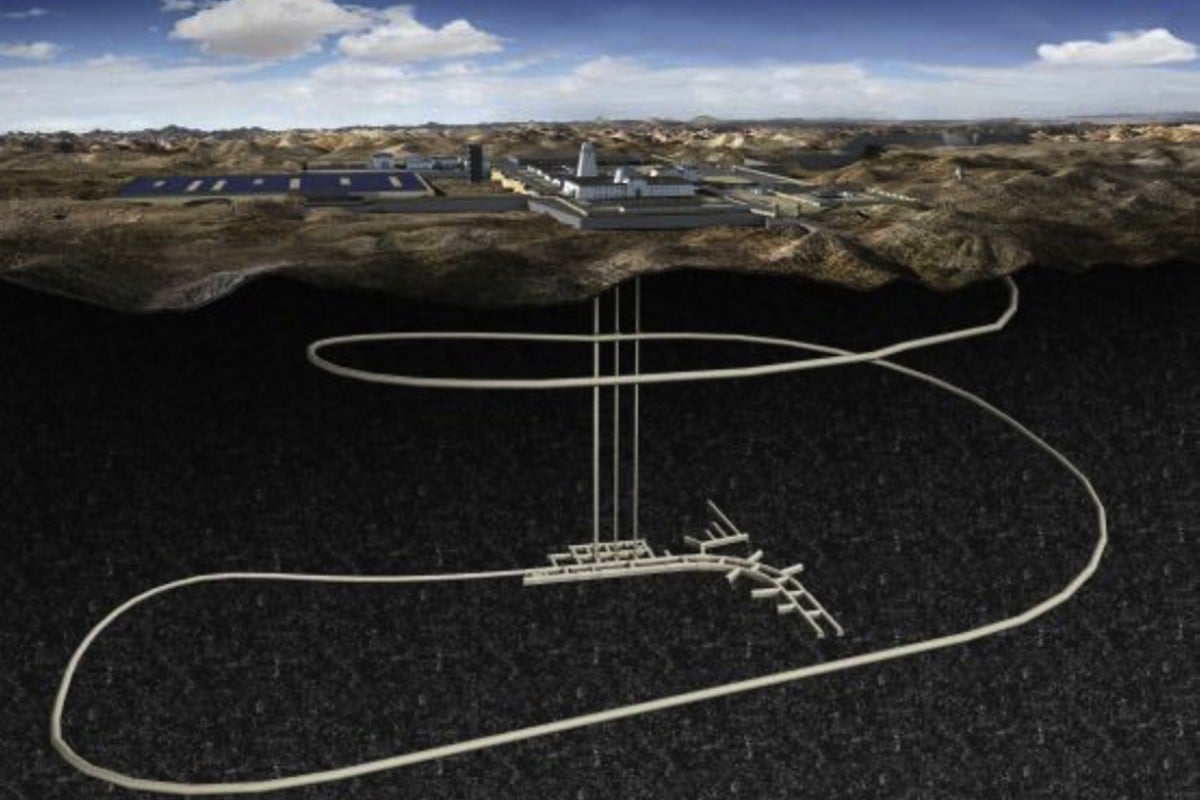
A preliminary design for the Beishan Underground Research Laboratory. Photo: Handout

China has chosen a site for an underground laboratory to research the disposal of highly radioactive waste, the country’s nuclear safety watchdog said on Wednesday.

Officials said work will soon begin on building the Beishan Underground Research Laboratory 400 metres underground in the northwestern province of Gansu.

Liu Hua, the head of the Chinese National Nuclear Safety Administration, said work would be carried out to determine whether it would be possible to build a repository for high-level nuclear waste deep underground.

“China sees radioactive waste disposal as a very important part [of the development nuclear energy],” said Liu. “To develop nuclear energy, we must have safe storage and disposal of nuclear waste.”

China condemns US blacklisting of nuclear firms and says American companies could be hurt as a result
The Chinese authorities see nuclear power an important source of energy that will help to curb carbon emissions and pollution as well as reducing its dependence on fuel imports.

But while the country has made great strides in the development of nuclear power, it needs to find a safe and reliable way of dealing with its growing stockpiles of nuclear waste.

Liu said the Gansu site had been identified as a possible location for a deep nuclear waste store after years of searching.

Once the laboratory is built, scientists and engineers will start experiments to confirm whether it will make a viable underground storage facility.

“Based on the data of the experiments, we can then decide if we are going to pick this as the final site,” he added.

China ‘actively promoting’ nuclear fuel processing plant with French Areva
Chinese officials usually stay tight-lipped about how nuclear waste is disposed of mainly because of fears that any discussion of the topic would trigger safety fears, although in recent years more efforts have been made to inform the public to win support.
Scientists say that nuclear waste can be divided into three categories depending on the level of radioactivity.
Low-level waste consists of minimally radioactive materials such as mop heads, rags, or protective clothing used in nuclear plants, while intermediate-level waste covers things such as filters and used reactor components.
High-level waste, however, is generated by the reprocessing of spent nuclear fuel and scientists generally agree that the safest way to dispose of it is to bury it deep underground in areas where the geology means it will have a minimal impact on the environment while it decays over thousands of years.
The facility will be built in a remote part of Gansu province. Photo: Handout

Some Chinese scientists said the country had the chance to lead the world in this area of research but others have expressed concerns about safety.

Jiang Kejun, a senior researcher at the Energy Research Institute of China’s National Development and Reform Commission, said that very few countries in the world are studying this form of nuclear waste disposal.

“It gives China an opportunity to be a leader in research in this area, plus China has the technology and financial means,” he said.

About a dozen countries including France, Switzerland, Japan, and the United States have carried out research in this area, but in recent years most have abandoned or scaled back their programmes.

At present there are storage sites operating in Finland and the US, but other countries such as Germany have abandoned plans to build similar facilities.

Washington blacklists Chinese nuclear firms for ‘helping military acquire US technology’

But despite broad scientific support for underground disposal, some analysts and many members of the public remain sceptical about whether it is really safe.

Lei Yian, an associate professor at the School of Physics at Peking University, said there was no absolute guarantee that the repositories would be safe when they are come into operation.

“Leakage has happened in [repositories] in the US and the former Soviet Union … it’s a difficult problem worldwide,” he said. “If China can solve it, then it will have solved a global problem.”

China is also building more facilities to dispose of low and intermediate level waste. Officials said new plants were being built in Zhenjiang, Fujian and Shandong, three coastal provinces that currently lack disposal facilities.

At present, two disposal sites for low and intermediate-level waste are in operation in Gansu and Guangdong provinces.

Source: SCMP

27/06/2019

Chinese port halts scrap metal imports as stockpiles mount

  • Customs authority at southern port of Sanshan brings forward deadline for scrap cargoes to arrive
  • Capacity has been ‘seriously exceeded’ and there are temporary controls on how many boats can dock
China is restricting imports of scrap metal as part of its efforts to reduce pollution. Photo: Reuters
The port of Sanshan in southern China’s Guangdong province stopped accepting scrap metal shipments on Thursday after an excessive build-up of stockpiles caused by importers racing to bring in cargoes ahead of new rules starting next week.
China, the world’s biggest metals consumer, is restricting imports of eight types of scrap metal, including high-grade copper scrap, from July 1 in a 
crackdown on foreign solid waste

to reduce pollution in the country.

Because scrap stockpiles at the port have grown too large, customs decided to bring forward the deadline for scrap cargoes to arrive at Sanshan from June 29 to June 26, according to a notice from the Sanshan port authority sent to customers and reviewed by Reuters.
Shipments arriving from June 27 could not be accepted, said the notice, whose authenticity was confirmed by a port official who asked to remain unidentified.
Sanshan’s import capacity had “already been seriously exceeded” and there were temporary controls on the number of boats allowed to dock, the official added.
It was not immediately clear when shipments would be able to resume. Firms that have received quotas from China’s Ministry of Ecology and Environment will still be allowed to import the soon-to-be-restricted metal after July 1, but no quotas have been issued so far for Guangdong and its key scrap hub of Foshan.

The Sanshan port official said cargoes declared to customs before July 1 would be able to pass.

The environment ministry last week released the first batch of quotas, which for copper scrap totalled around 240,000 tonnes, mostly for companies in Zhejiang, another of China’s metal recycling centres.

China to issue scrap metal import licences as restrictions tighten

The port of Sanshan, which is near Foshan and under the jurisdiction of Guangzhou customs, is one of only 18 seaports in China authorised to handle solid waste imports.

Guangzhou customs did not immediately respond to a faxed request for comment.

Source: SCMP

Law of Unintended Consequences

continuously updated blog about China & India

ChiaHou's Book Reviews

continuously updated blog about China & India

What's wrong with the world; and its economy

continuously updated blog about China & India