Archive for ‘Summer Palace’

22/03/2020

China scrambles to curb rise in imported coronavirus cases

BEIJING (Reuters) – China on Sunday reported 46 new cases of coronavirus, the fourth straight day with an increase, with all but one of those imported from overseas, and further stepped up measures to intercept cases from abroad as the outbreak worsens globally.

While China says it has drastically reduced the number of domestically transmitted cases – the one reported on Sunday was the first in four days – it is seeing a steady rise in imported cases, mostly from Chinese people returning from overseas.

In a sign of how seriously China is taking the threat of imported cases, all international flights due to arrive in Beijing starting Monday will first land at another airport, where passengers will undergo virus screening, government agencies said on Sunday, in an expansion of existing measures.

International flights that were scheduled to arrive in the capital will land instead at one of 12 airports. Passengers who clear screening will then be permitted to reboard the plane, which will then fly to Beijing, the regulator said.

Separately, Shanghai and Guangzhou both announced that all arriving international passengers will undergo an RNA test to screen for coronavirus, expanding a program that previously only applied to those coming from heavily-hit countries.

Among the new cases from abroad reported on Sunday, a record 14 were in the financial hub of Shanghai and 13 were in Beijing, a decline from 21 the previous day.

The new locally transmitted case was in the southern metropolis of Guangzhou and was also the first known case where the infection of a local person was linked to the arrival of someone from overseas, according to Guangdong province.

Hu Xijin, the editor-in-chief of the Global Times newspaper, called for all cities in China to implement 14-day quarantines for people arriving from abroad.

He also called for quarantine policies to apply to people from Hong Kong and Macau as well, he said on his Weibo account on Sunday.

“I am worried that there are similar cases to the Guangzhou one existing in other parts of the country. There were reports previously that people coming back from abroad returned to their homes in Shanghai without any obstacles,” Hu said.

“It matters to the overall situation of China’s next prevention and control efforts if we can plug the leaks.”

The Global Times is a tabloid published by the Ruling Communist Party’s People’s Daily.

The latest figures from China’s National Health Commission bring total reported coronavirus cases in the country to 81,054, with 3,261 deaths, including six on Saturday. On Saturday, China reported 41 new coronavirus cases for the previous day, all of them imported.

Of all 97 imported cases as of end-Saturday, 92 of them are Chinese nationals and 51 are Chinese students returning from studying abroad, said Gao Xiaojun, spokesman for the Beijing Municipal Health Commission during a press conference on Sunday.

The Beijing health commission announced separately on its website it had two more imported cases on Sunday, bringing the city’s total number of imported cases to 99 as of Sunday noon.

BACK TO A KIND OF NORMAL

China is trying to revive an economy that is widely expected to contract deeply in the current quarter, with life slowly returning to normal in cities such as Beijing and Shanghai, albeit with everyone wearing masks in public.

Still, numerous shops and restaurants remain shut – many have gone out of business – and factories and other workplaces are still not operating at full capacity.

On Sunday, a central bank official called for stepped-up global policy coordination to manage the economic impact of the pandemic. He said China’s recent policy measures were gaining traction, and it has capacity for further action.

Chen Yulu, a deputy governor at the People’s Bank of China (PBOC), also said he expects significant improvement in the Chinese economy in the second quarter.

And while the virus will continue putting upward pressure on near-term consumer prices, there is no basis for long-term inflation or deflation, he told a news briefing.

Globally, roughly 275,000 people have been infected with the virus, and more than 11,000 have died, according to a Reuters tally, with the number of deaths in Italy recently surpassing those in China.

“Now I think the epidemic has been controlled. But this definitely doesn’t mean that it’s over,” said a 25-year-old woman surnamed He who works in the internet sector and was visiting the vast Summer Palace complex in Beijing on Saturday.

“I’m willing to come out today but of course I am still afraid,” she told Reuters.

The central province of Hubei, where the outbreak first emerged late last year in its capital Wuhan, reported its fourth straight day of no new cases.

China has used draconian measures to contain the spread of the virus, including locking down Hubei province.

Source: Reuters
25/11/2019

A rundown Beijing home with standing-room only space sells for record, in a sign of desperation for hukou in the Chinese capital

  • Unit 121 on Lanman Hutong, about 10 minutes’ drive from Tiananmen Square and the Forbidden City, changed hands last month for 1.28 million yuan
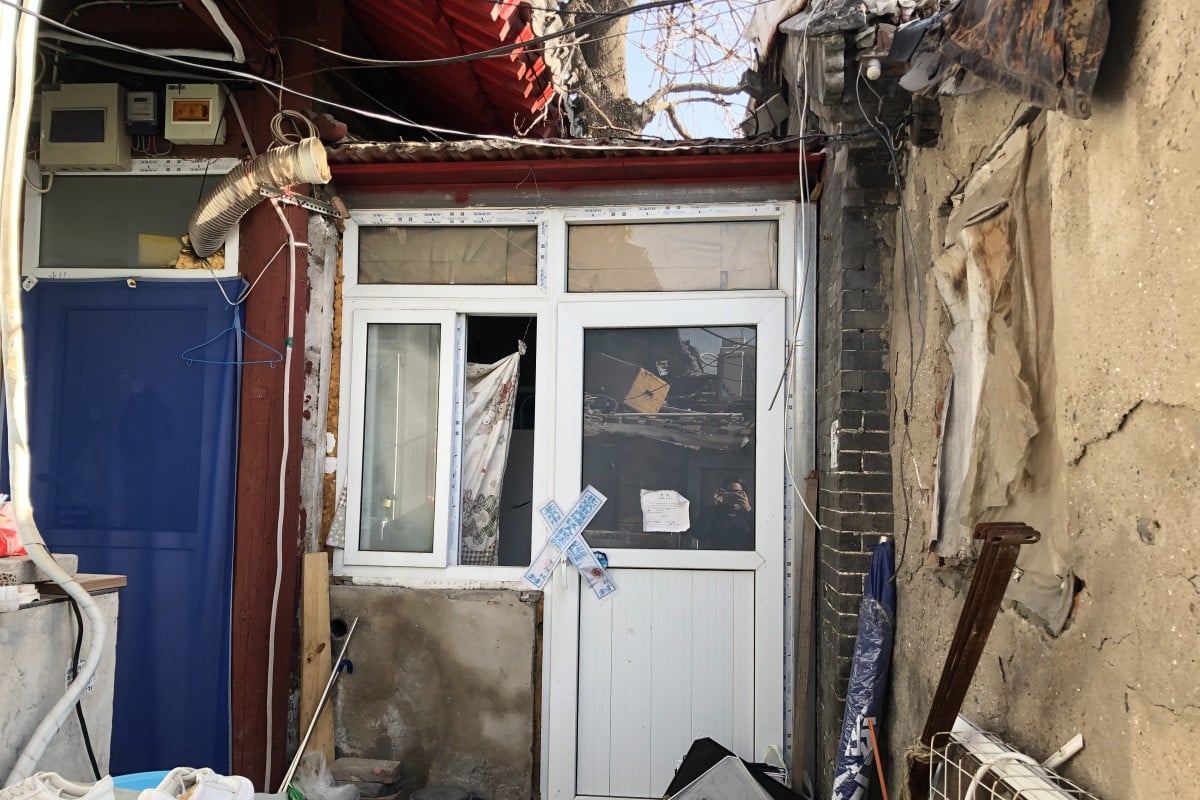
  • The new owner bought a 5.6-square metre (72 square feet) cubicle covered in bathroom tiles large enough to fit a bunk bed, with standing room only
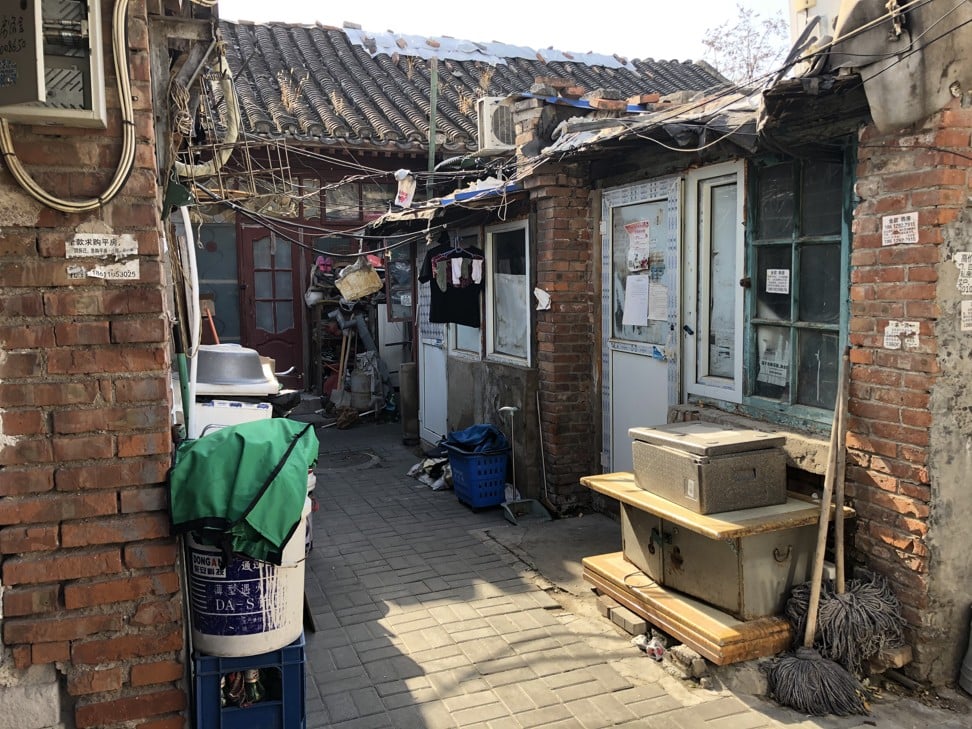
A view of the 5.6 square metre cubicle-size home in Beijing on 15 November 2019. The home sold for 1.28 million yuan at auction. Photo: Louise Moon

A subdivided home in a run-down alley in Beijing recently sold for a record price at auction, as eager buyers piled in to get hold of its much sought-after address to gain access to some of the Chinese capital’s best schools.

A subdivided unit at No. 121 Lanman Hutong, about 10 minutes’ drive from Tiananmen Square and the Forbidden City, changed hands on November 11 for 1.28 million yuan (US$182,400) after 136 rounds of furious bidding during an auction in Beijing.

For 230,000 yuan per square metre (HK$23,850 per square foot), the new owner bought a 5.6-square metre (72 square feet) cubicle covered in bathroom tiles large enough to fit a bunk bed, with standing room only. That’s smaller than even Hong Kong’s notorious micro-apartments – also known derisively as shoebox flats or nano flats – which average about 200 square feet. A standard car parking space measures 126 square feet.

What the dilapidated space does have is an address that entitles its owner to a hukou, the household registration that is the prerequisite for access to schools, homes, civil service jobs, public health care and almost every aspect of daily life in the Chinese capital.
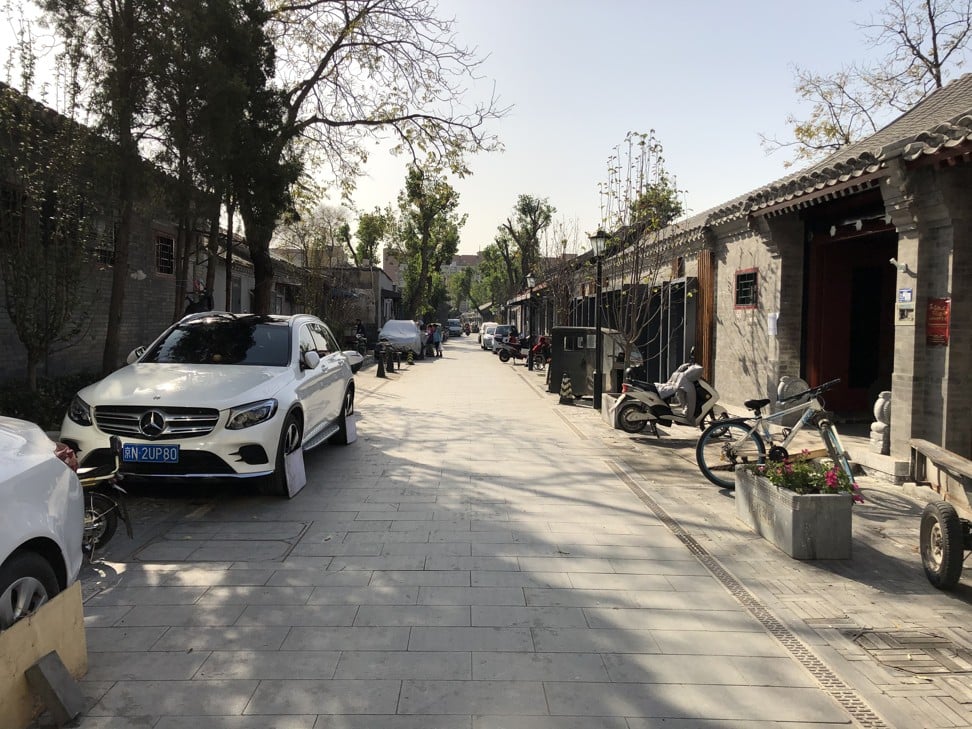
The alley on which No. 121 Lanman Hutong sits in Beijing on 15 November 2019. Photo: Louise Moon
Lanman Hutong, or the Alley of the Brilliant Drapes, sits in Xicheng district, a chequerboard neighbourhood criss-crossed with hundreds of alleyways that boasts three of the five highest-ranked schools in the city.
According to Beijing’s real estate regulations, one square metre entitles the owner a hukou. That fuelled the rush by parents to buy property in the area to qualify for sending their children to such eminent schools as the Beijing No. 4 High School, whose alumni include former Chongqing Commissar Bo Xilai, former China Development Bank president Chen Yuan and Citic’s chairman Kong Dan. Most of these bolt holes are now unoccupied after they have served their purposes, local residents said.
Lanman Hutong, or the Alley of the Brilliant Drapes, in the Xicheng district of Beijing, about 10 minutes drive from the Tiananmen Square and the Forbidden City, on 15 November 2019. Photo: Louise Moon

The auction result offers a peek into the growing speculative bubble in Beijing’s property market, a development that has defied more than two years of policymakers’ attempts to control. The average price of newly built homes rose 4.3 per cent in October to 60,894 yuan per square metre in Beijing, according to China’s statistics bureau data and Lianjia, a major real estate broker.

“Beijing’s homes have always been expensive, [particularly so] in Xicheng, where only the ultra-wealthy can afford to stay,” said Midland Beijing’s analyst Zhao Jia. “A million yuan is not expensive at all, to find space that close to the Forbidden City.”

Beijing’s average home price is equivalent to 24.9 years of the city’s median net income, excluding expenditures, according to data by E-House China Research and Development Institution. Hong Kong, the world’s most expensive urban centre to live and work in, requires 21 years of average income to affordable the average abode, according to the Demographia International Housing Affordability Study, as the city also boasts of a higher income and lower tax rate.

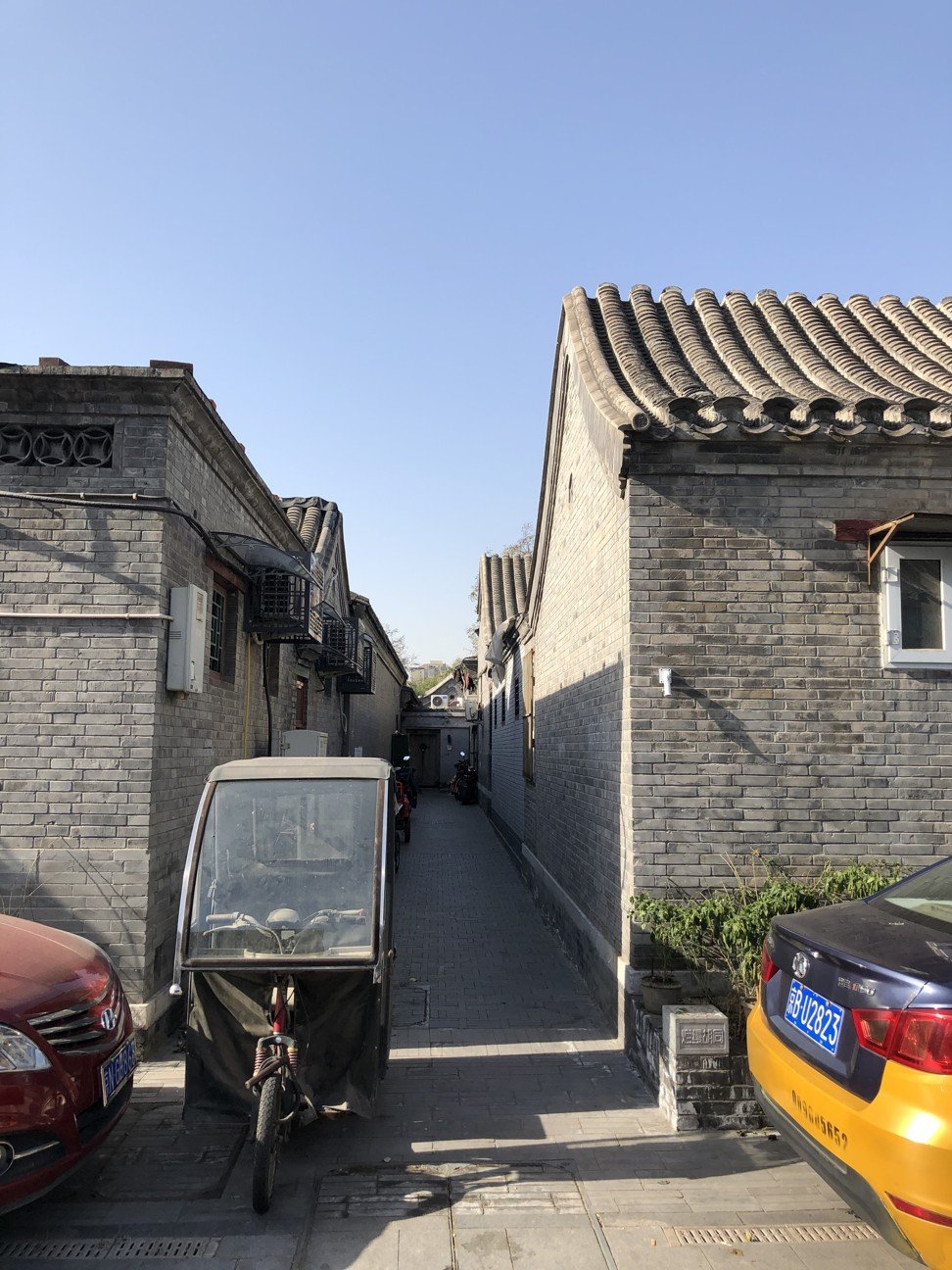
A tiny alleyway leading to No. 121 Lanman Hutong, which sold earlier this week for 1.28 million yuan in Beijing. Photo: Louise Moon
“It is not that easy for the average person to own property in Beijing,” said Midland’s Zhao. “For most homes in the city, 1 million yuan is only enough for a down payment.”

Unit 121 on Lanman Hutong is located among a cluster of siheyuan, as Beijing’s traditional courtyard homes are called. Bicycles, old washing machines and other household junk are piled along the maze of alleyways leading to the ground-floor unit.

Its auction drew 29 bidders starting from 470,000 yuan. The final winning bid prices the Lanman cubicle 35 per cent higher than a 100-million yuan villa with view of the Summer Palace in Beijing’s outskirts, on a per square foot basis.

To be sure, the unidentified buyer of the unit may be speculating for a quick flip, when the property is torn down, said Zhang Dawei, an analyst at Centaline Property Agency.

“This is more like a gamble, betting on the unit being demolished,” Zhang said. “If the odds are good, the buyer can pocket the [compensation], which could be several times what he bought it for. Even if it is not demolished in the short term, it is not bad to have some asset in the heart of Beijing.”

Source: SCMP

12/12/2018

Ancient bronze vessel looted from Old Summer Palace in 1860 returned to China

  • The 3,000-year-old relic was sold at auction in Britain for US$515,000 in April but the buyer decided to donate it to the Chinese government
  • It was taken by a British Royal Marines captain and had been in the possession of his descendants. Now it’s on display at a museum in Beijing
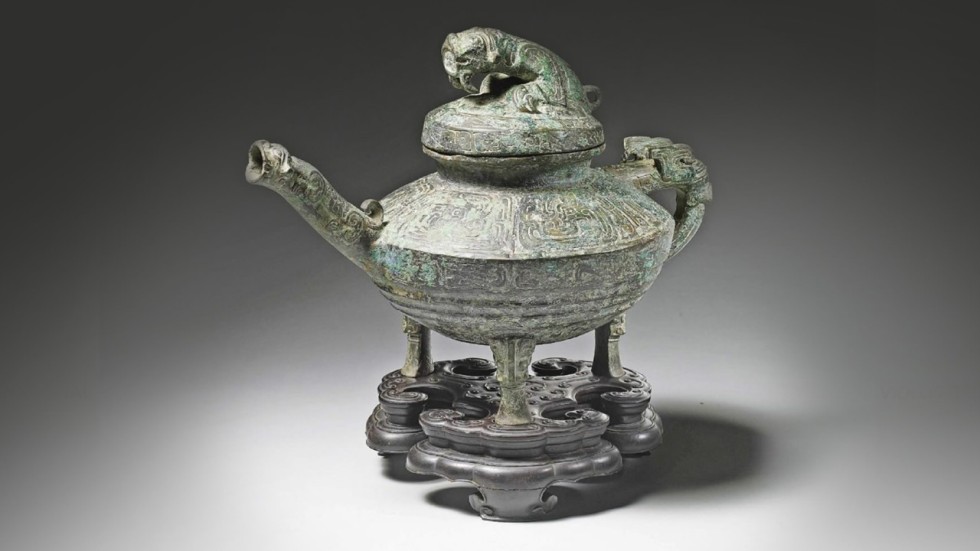
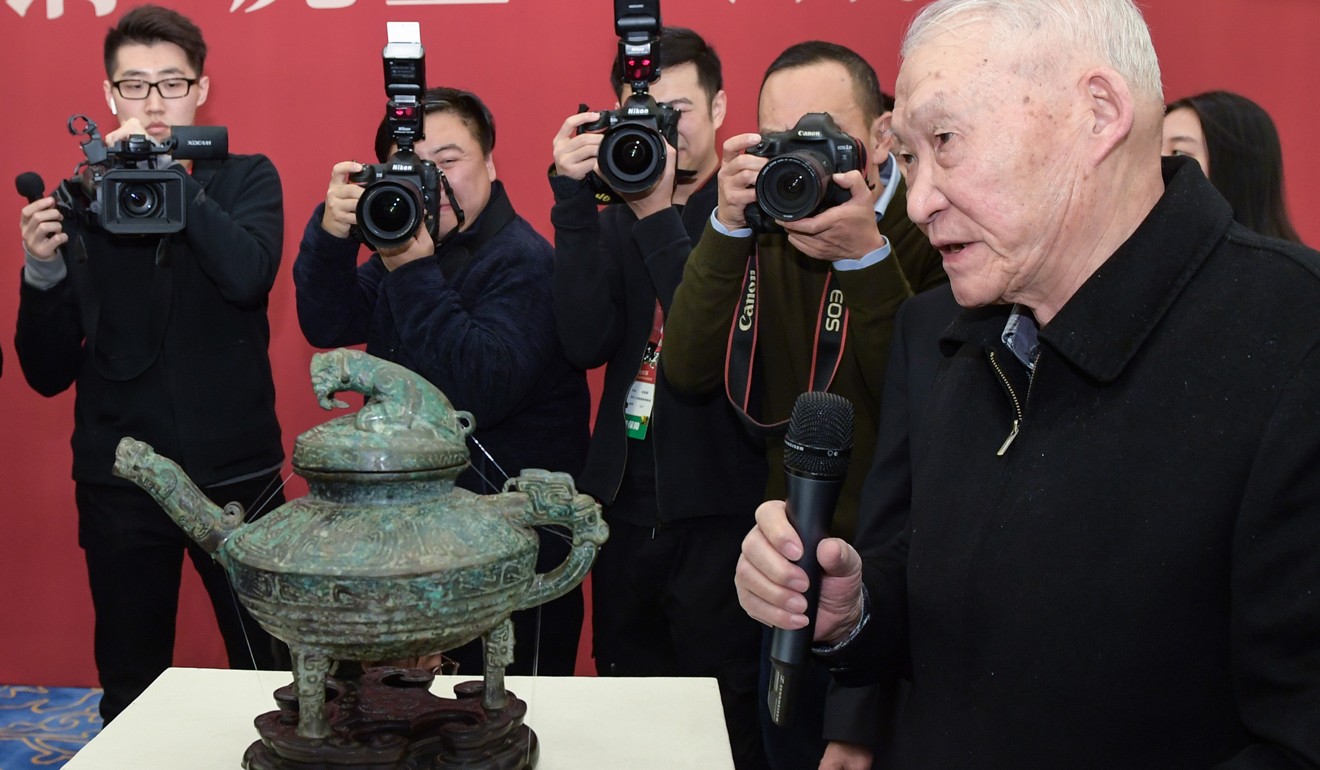
A 3,000-year-old bronze vessel that was taken from the Old Summer Palace in Beijing has been returned to China after more than a century overseas, according to the State Administration of Cultural Heritage.

On Tuesday, it was formally placed on display at the National Museum of China in the capital, where it is now part of the permanent collection.

The ancient relic was sold at auction in Britain for £410,000 (US$515,000) on April 11, but was donated to the Chinese government with no strings attached on April 28 after the unknown buyer had a change of heart.

A representative from Canterbury Auction Galleries, which sold and helped to return the item, told news site Thepaper.cn the buyer had recognised the deep significance of lost artefacts for Chinese.

After it was donated, the vessel was kept at the Chinese embassy in London before it was formally handed back to the cultural heritage administration on September 21.

The ceremonial vessel dates back to the Western Zhou Dynasty (1046-771BC) and is decorated with miniature tigers on its spout, handle and lid. It is believed to be one of only seven such vessels, five of which are held in museums.

It was taken by British Royal Marines captain Harry Evans during the ransacking of the Old Summer Palace by Anglo-French troops in 1860, and had been in the possession of his descendants before it was auctioned.

The auction of the rare artefact was strongly opposed by the Chinese government, which had been working to get it returned to China, but Canterbury Auction Galleries went ahead with the sale.

Unveiling the new museum exhibit, Liu Yuzhu, head of the administration, said Chinese historical artefacts lost overseas were an important part of China’s cultural heritage.

China views the loss of these relics as a potent source of national humiliation and as a reminder of the destruction inflicted by foreign armies. The government estimates that more than 10 million historical items were taken from China during its so-called century of humiliation between 1849 and 1949, when the country was repeatedly invaded by foreign powers.

In recent years, Beijing has led numerous high-profile campaigns aiming to get its stolen artefacts returned from overseas, as a symbol of the country’s growing economic and political clout.

Many objects remain in the world’s most prestigious museums, including the British Museum and the Palace of Fontainebleau in France, as well as in private collections.

But billionaire Chinese collectors have snapped up many items in recent years, including a porcelain “chicken cup” that was bought for US$36.3 million at an auction in Hong Kong in 2014.

Law of Unintended Consequences

continuously updated blog about China & India

ChiaHou's Book Reviews

continuously updated blog about China & India

What's wrong with the world; and its economy

continuously updated blog about China & India